

惯性聚合 高效追踪和阅读你感兴趣的博客、新闻、科技资讯
阅读原文 在惯性聚合中打开

推荐订阅源

Engineering at Meta
Engineering at Meta
人人都是产品经理
人人都是产品经理
大猫的无限游戏
大猫的无限游戏
博客园 - 三生石上(FineUI控件)
量子位
腾讯CDC
The Cloudflare Blog
酷 壳 – CoolShell
酷 壳 – CoolShell
云风的 BLOG
云风的 BLOG
Vercel News
Vercel News
钛媒体:引领未来商业与生活新知
钛媒体:引领未来商业与生活新知
L
LangChain Blog
aimingoo的专栏
aimingoo的专栏
The Hacker News
The Hacker News
T
The Exploit Database - CXSecurity.com
B
Blog
S
SegmentFault 最新的问题
P
Privacy & Cybersecurity Law Blog
T
Threatpost
博客园 - 聂微东
T
Tailwind CSS Blog
The Last Watchdog
The Last Watchdog
C
Check Point Blog
N
Netflix TechBlog - Medium
D
DataBreaches.Net
爱范儿
爱范儿
IT之家
IT之家
S
Secure Thoughts
M
MIT News - Artificial intelligence
NISL@THU
NISL@THU
C
Cisco Blogs
TaoSecurity Blog
TaoSecurity Blog
有赞技术团队
有赞技术团队
A
Arctic Wolf
OSCHINA 社区最新新闻
OSCHINA 社区最新新闻
P
Proofpoint News Feed
Spread Privacy
Spread Privacy
Schneier on Security
Simon Willison's Weblog
G
GRAHAM CLULEY
雷峰网
雷峰网
Project Zero
Project Zero
博客园 - Franky
H
Heimdal Security Blog
A
About on SuperTechFans
Security Latest
Security Latest
Webroot Blog
Webroot Blog
Exploit-DB.com RSS Feed
Hugging Face - Blog
Hugging Face - Blog
H
Hackread – Cybersecurity News, Data Breaches, AI and More

Hugging Face - Blog

Waypoint-1.5: Higher-Fidelity Interactive Worlds for Everyday GPUs ALTK‑Evolve: On‑the‑Job Learning for AI Agents Safetensors is Joining the PyTorch Foundation Holo3: Breaking the Computer Use Frontier Any Custom Frontend with Gradio's Backend A New Framework for Evaluating Voice Agents (EVA) Bringing Robotics AI to Embedded Platforms: Dataset Recording, VLA Fine‑Tuning, and On‑Device Optimizations One-Shot Any Web App with Gradio's gr.HTML CUGA on Hugging Face: Democratizing Configurable AI Agents New in llama.cpp: Model Management Building Deep Research: How we Achieved State of the Art OVHcloud on Hugging Face Inference Providers 🔥 20x Faster TRL Fine-tuning with RapidFire AI Building for an Open Future - our new partnership with Google Cloud Aligning to What? Rethinking Agent Generalization in MiniMax M2 Building a Healthcare Robot from Simulation to Deployment with NVIDIA Isaac Sentence Transformers is joining Hugging Face! Unlock the power of images with AI Sheets Supercharge your OCR Pipelines with Open Models Google Cloud C4 Brings a 70% TCO improvement on GPT OSS with Intel and Hugging Face Get your VLM running in 3 simple steps on Intel CPUs Nemotron-Personas-India: Synthesized Data for Sovereign AI Introducing RTEB: A New Standard for Retrieval Evaluation Accelerating Qwen3-8B Agent on Intel® Core™ Ultra with Depth-Pruned Draft Models VibeGame: Exploring Vibe Coding Games Nemotron-Personas-Japan: ソブリン AI のための合成データセット Swift Transformers Reaches 1.0 – and Looks to the Future Smol2Operator: Post-Training GUI Agents for Computer Use SyGra: The One-Stop Framework for Building Data for LLMs and SLMs Gaia2 and ARE: Empowering the community to study agents Scaleway on Hugging Face Inference Providers 🔥 Democratizing AI Safety with RiskRubric.ai Public AI on Hugging Face Inference Providers 🔥 `LeRobotDataset:v3.0`: Bringing large-scale datasets to `lerobot` Visible Watermarking with Gradio Introducing the Palmyra-mini family: Powerful, lightweight, and ready to reason! Tricks from OpenAI gpt-oss YOU 🫵 can use with transformers Fine-tune Any LLM from the Hugging Face Hub with Together AI Jupyter Agents: training LLMs to reason with notebooks mmBERT: ModernBERT goes Multilingual Welcome EmbeddingGemma, Google's new efficient embedding model SAIR: Accelerating Pharma R&D with AI-Powered Structural Intelligence Make your ZeroGPU Spaces go brrr with ahead-of-time compilation NVIDIA Releases 6 Million Multi-Lingual Reasoning Dataset Generate Images with Claude and Hugging Face From Zero to GPU: A Guide to Building and Scaling Production-Ready CUDA Kernels MCP for Research: How to Connect AI to Research Tools Kimina-Prover-RL Arm & ExecuTorch 0.7: Bringing Generative AI to the masses Neural Super Sampling is here! TextQuests: How Good are LLMs at Text-Based Video Games? 🇵🇭 FilBench - Can LLMs Understand and Generate Filipino? Introducing AI Sheets: a tool to work with datasets using open AI models! Accelerate ND-Parallel: A guide to Efficient Multi-GPU Training Vision Language Model Alignment in TRL ⚡️ Welcome GPT OSS, the new open-source model family from OpenAI! Measuring Open-Source Llama Nemotron Models on DeepResearch Bench 📚 3LM: A Benchmark for Arabic LLMs in STEM and Code Implementing MCP Servers in Python: An AI Shopping Assistant with Gradio Introducing Trackio: A Lightweight Experiment Tracking Library from Hugging Face Say hello to `hf`: a faster, friendlier Hugging Face CLI ✨ Parquet Content-Defined Chunking TimeScope: How Long Can Your Video Large Multimodal Model Go? Fast LoRA inference for Flux with Diffusers and PEFT Accelerate a World of LLMs on Hugging Face with NVIDIA NIM Arc Virtual Cell Challenge: A Primer Consilium: When Multiple LLMs Collaborate Back to The Future: Evaluating AI Agents on Predicting Future Events Five Big Improvements to Gradio MCP Servers Ettin Suite: SoTA Paired Encoders and Decoders Migrating the Hub from Git LFS to Xet Kimina-Prover: Applying Test-time RL Search on Large Formal Reasoning Models Asynchronous Robot Inference: Decoupling Action Prediction and Execution ScreenEnv: Deploy your full stack Desktop Agent Building the Hugging Face MCP Server Reachy Mini - The Open-Source Robot for Today's and Tomorrow's AI Builders Creating custom kernels for the AMD MI300 Upskill your LLMs With Gradio MCP Servers SmolLM3: smol, multilingual, long-context reasoner Three Mighty Alerts Supporting Hugging Face’s Production Infrastructure Efficient MultiModal Data Pipeline Announcing NeurIPS 2025 E2LM Competition: Early Training Evaluation of Language Models Training and Finetuning Sparse Embedding Models with Sentence Transformers Welcome the NVIDIA Llama Nemotron Nano VLM to Hugging Face Hub Gemma 3n fully available in the open-source ecosystem! Transformers backend integration in SGLang (LoRA) Fine-Tuning FLUX.1-dev on Consumer Hardware Groq on Hugging Face Inference Providers 🔥 How Long Prompts Block Other Requests - Optimizing LLM Performance Learn the Hugging Face Kernel Hub in 5 Minutes Convert Transformers to ONNX with Hugging Face Optimum Intel and Hugging Face Partner to Democratize Machine Learning Hardware Acceleration Director of Machine Learning Insights [Part 3: Finance Edition] The Annotated Diffusion Model Deep Q-Learning with Space Invaders Graphcore and Hugging Face Launch New Lineup of IPU-Ready Transformers Introducing Pull Requests and Discussions 🥳 Efficient Table Pre-training without Real Data: An Introduction to TAPEX An Introduction to Q-Learning Part 2/2 How Sempre Health is leveraging the Expert Acceleration Program to accelerate their ML roadmap
What's new in Diffusers? 🎨
Omar Sanseviero · 2022-09-12 · via Hugging Face - Blog

Back to Articles

Omar Sanseviero's avatar

A month and a half ago we released diffusers, a library that provides a modular toolbox for diffusion models across modalities. A couple of weeks later, we released support for Stable Diffusion, a high quality text-to-image model, with a free demo for anyone to try out. Apart from burning lots of GPUs, in the last three weeks the team has decided to add one or two new features to the library that we hope the community enjoys! This blog post gives a high-level overview of the new features in diffusers version 0.3! Remember to give a ⭐ to the GitHub repository.

Image to Image pipeline

One of the most requested features was to have image to image generation. This pipeline allows you to input an image and a prompt, and it will generate an image based on that!

Let's see some code based on the official Colab notebook.

from diffusers import StableDiffusionImg2ImgPipeline

pipe = StableDiffusionImg2ImgPipeline.from_pretrained(
    "CompVis/stable-diffusion-v1-4",
    revision="fp16", 
    torch_dtype=torch.float16,
    use_auth_token=True
)

# Download an initial image
# ...

init_image = preprocess(init_img)

prompt = "A fantasy landscape, trending on artstation"
images = pipe(prompt=prompt, init_image=init_image, strength=0.75, guidance_scale=7.5, generator=generator)["sample"]

Don't have time for code? No worries, we also created a Space demo where you can try it out directly
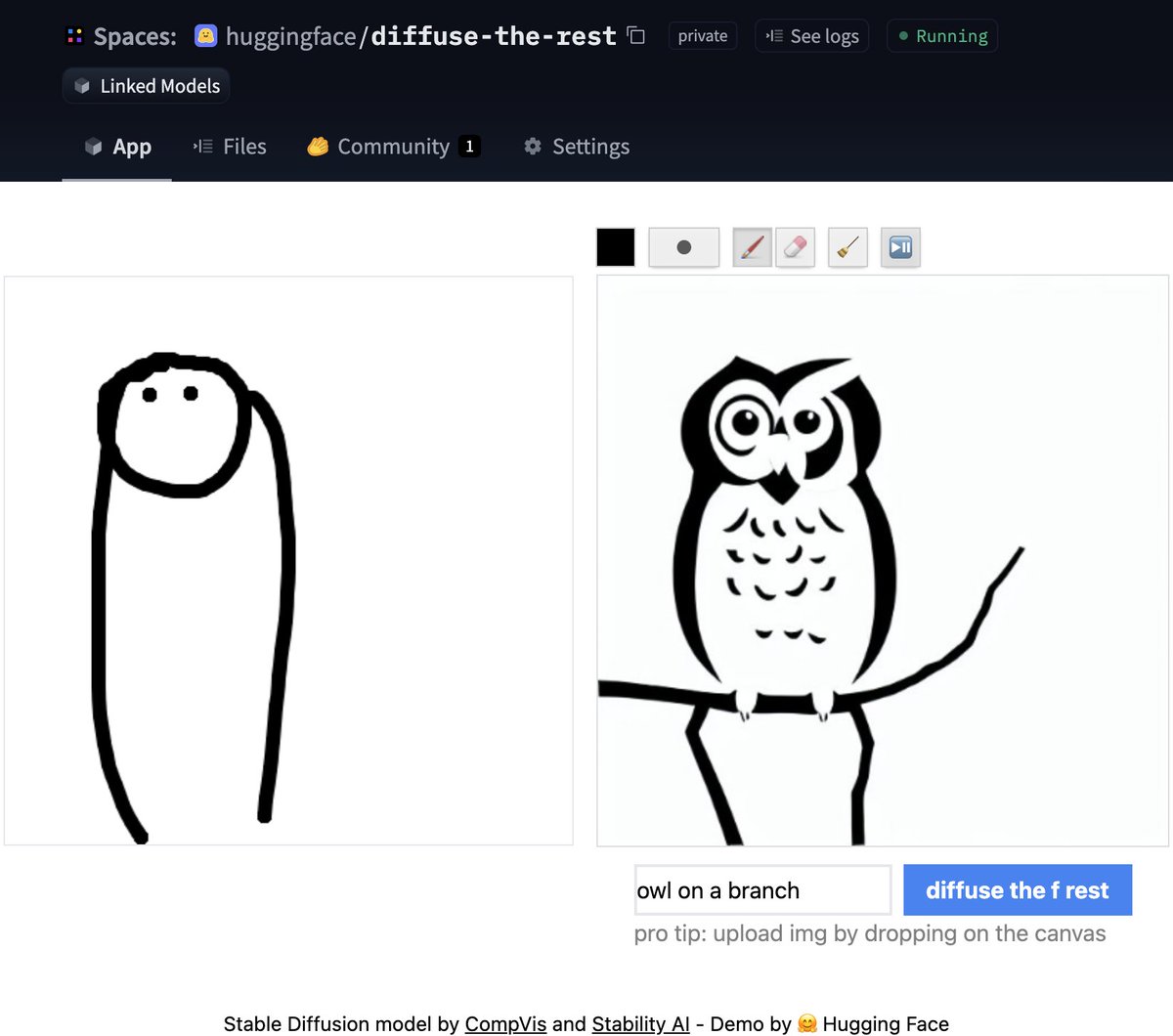
image info

Textual Inversion

Textual Inversion lets you personalize a Stable Diffusion model on your own images with just 3-5 samples. With this tool, you can train a model on a concept, and then share the concept with the rest of the community!
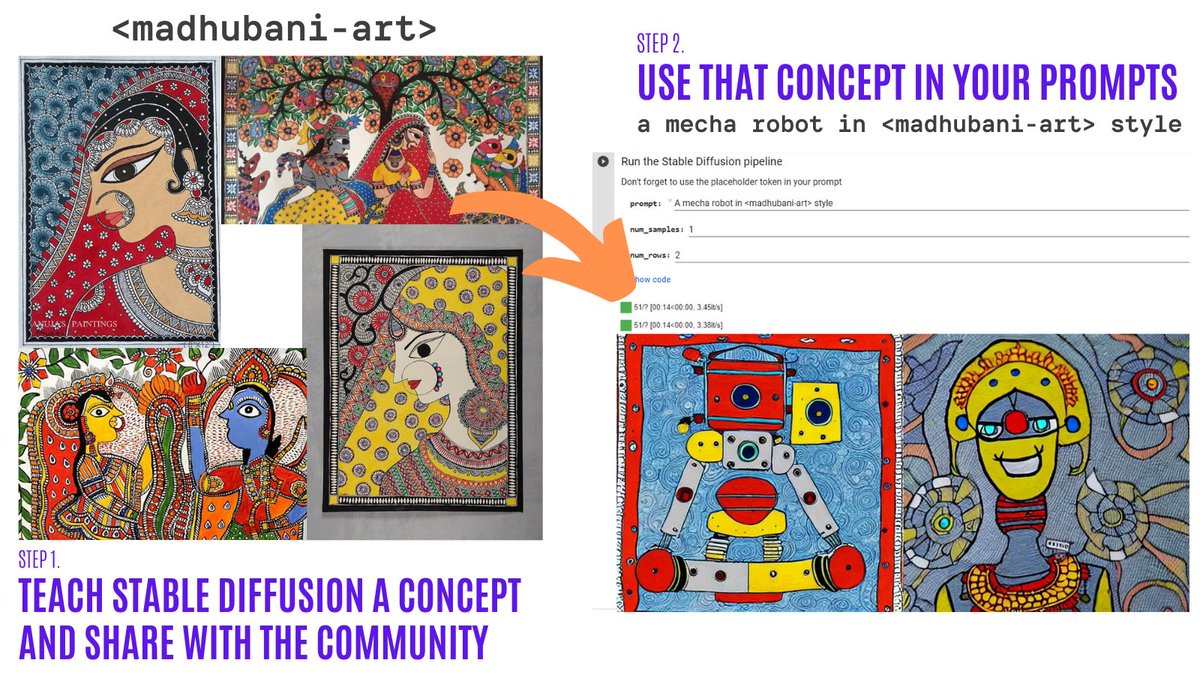
image info

In just a couple of days, the community shared over 200 concepts! Check them out!

  • Organization with the concepts.
  • Navigator Colab: Browse visually and use over 150 concepts created by the community.
  • Training Colab: Teach Stable Diffusion a new concept and share it with the rest of the community.
  • Inference Colab: Run Stable Diffusion with the learned concepts.

Experimental inpainting pipeline

Inpainting allows to provide an image, then select an area in the image (or provide a mask), and use Stable Diffusion to replace the mask. Here is an example:

Example inpaint of owl being generated from an initial image and a prompt

You can try out a minimal Colab notebook or check out the code below. A demo is coming soon!

from diffusers import StableDiffusionInpaintPipeline

pipe = StableDiffusionInpaintPipeline.from_pretrained(
    "CompVis/stable-diffusion-v1-4",
    revision="fp16", 
    torch_dtype=torch.float16,
    use_auth_token=True
).to(device)

images = pipe(
    prompt=["a cat sitting on a bench"] * 3,
    init_image=init_image,
    mask_image=mask_image,
    strength=0.75,
    guidance_scale=7.5,
    generator=None
).images

Please note this is experimental, so there is room for improvement.

Optimizations for smaller GPUs

After some improvements, the diffusion models can take much less VRAM. 🔥 For example, Stable Diffusion only takes 3.2GB! This yields the exact same results at the expense of 10% of speed. Here is how to use these optimizations

from diffusers import StableDiffusionPipeline

pipe = StableDiffusionPipeline.from_pretrained(
    "CompVis/stable-diffusion-v1-4", 
    revision="fp16", 
    torch_dtype=torch.float16,
    use_auth_token=True
)
pipe = pipe.to("cuda")
pipe.enable_attention_slicing()

This is super exciting as this will reduce even more the barrier to use these models!

Diffusers in Mac OS

🍎 That's right! Another widely requested feature was just released! Read the full instructions in the official docs (including performance comparisons, specs, and more).

Using the PyTorch mps device, people with M1/M2 hardware can run inference with Stable Diffusion. 🤯 This requires minimal setup for users, try it out!

from diffusers import StableDiffusionPipeline

pipe = StableDiffusionPipeline.from_pretrained("CompVis/stable-diffusion-v1-4", use_auth_token=True)
pipe = pipe.to("mps")

prompt = "a photo of an astronaut riding a horse on mars"
image = pipe(prompt).images[0]

Experimental ONNX exporter and pipeline

The new experimental pipeline allows users to run Stable Diffusion on any hardware that supports ONNX. Here is an example of how to use it (note that the onnx revision is being used)

from diffusers import StableDiffusionOnnxPipeline

pipe = StableDiffusionOnnxPipeline.from_pretrained(
    "CompVis/stable-diffusion-v1-4",
    revision="onnx",
    provider="CPUExecutionProvider",
    use_auth_token=True,
)

prompt = "a photo of an astronaut riding a horse on mars"
image = pipe(prompt).images[0]

Alternatively, you can also convert your SD checkpoints to ONNX directly with the exporter script.

python scripts/convert_stable_diffusion_checkpoint_to_onnx.py --model_path="CompVis/stable-diffusion-v1-4" --output_path="./stable_diffusion_onnx"

New docs

All of the previous features are very cool. As maintainers of open-source libraries, we know about the importance of high quality documentation to make it as easy as possible for anyone to try out the library.

💅 Because of this, we did a Docs sprint and we're very excited to do a first release of our documentation. This is a first version, so there are many things we plan to add (and contributions are always welcome!).

Some highlights of the docs:

Community

And while we were doing all of the above, the community did not stay idle! Here are some highlights (although not exhaustive) of what has been done out there

Stable Diffusion Videos

Create 🔥 videos with Stable Diffusion by exploring the latent space and morphing between text prompts. You can:

  • Dream different versions of the same prompt
  • Morph between different prompts

The Stable Diffusion Videos tool is pip-installable, comes with a Colab notebook and a Gradio notebook, and is super easy to use!

Here is an example

from stable_diffusion_videos import walk

video_path = walk(['a cat', 'a dog'], [42, 1337], num_steps=3, make_video=True)

Diffusers Interpret

Diffusers interpret is an explainability tool built on top of diffusers. It has cool features such as:
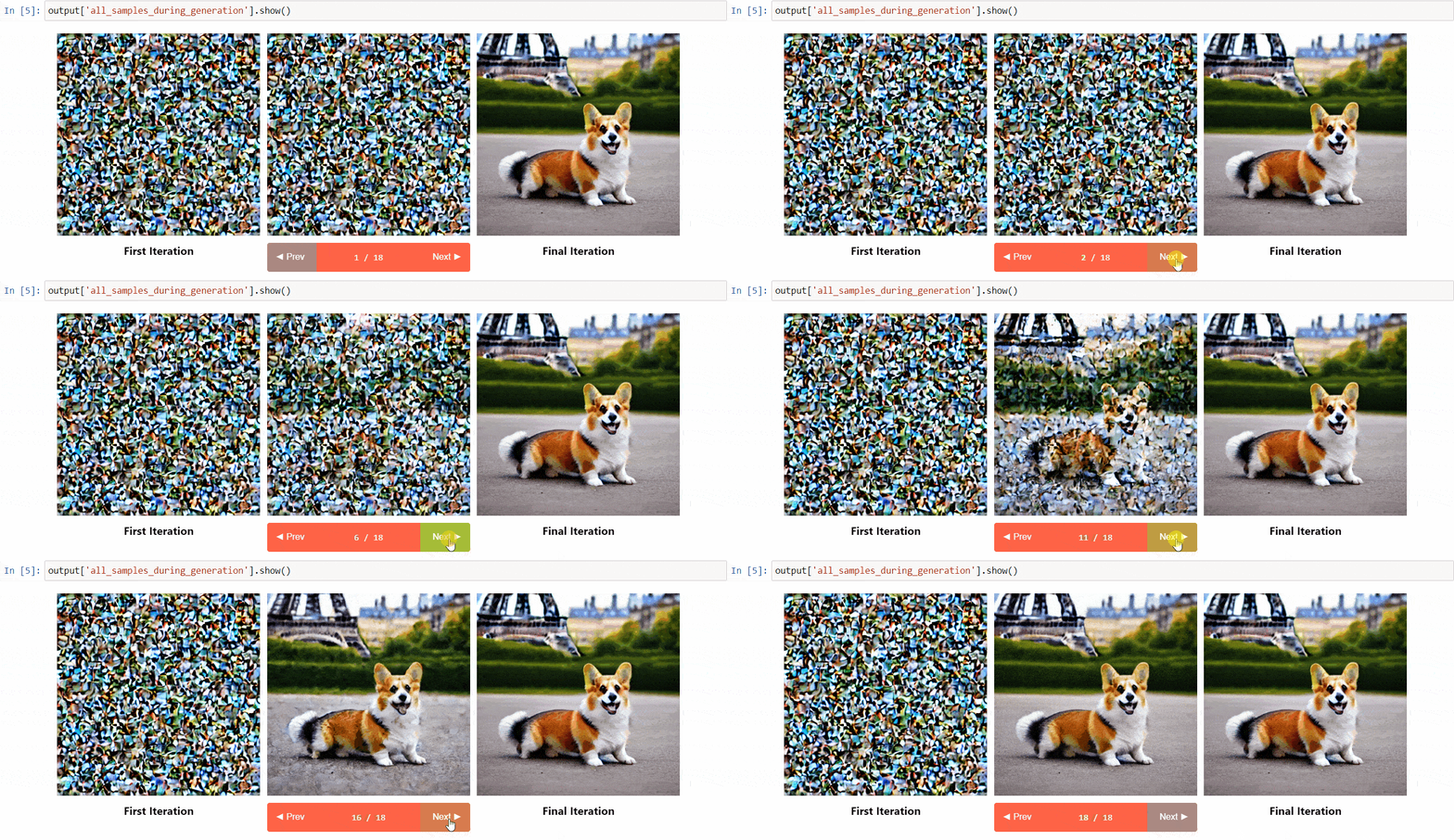
  • See all the images in the diffusion process
  • Analyze how each token in the prompt influences the generation
  • Analyze within specified bounding boxes if you want to understand a part of the image

image info (Image from the tool repository)

# pass pipeline to the explainer class
explainer = StableDiffusionPipelineExplainer(pipe)

# generate an image with `explainer`
prompt = "Corgi with the Eiffel Tower"
output = explainer(
    prompt, 
    num_inference_steps=15
)

output.normalized_token_attributions # (token, attribution_percentage)
#[('corgi', 40),
# ('with', 5),
# ('the', 5),
# ('eiffel', 25),
# ('tower', 25)]

Japanese Stable Diffusion

The name says it all! The goal of JSD was to train a model that also captures information about the culture, identity and unique expressions. It was trained with 100 million images with Japanese captions. You can read more about how the model was trained in the model card

Waifu Diffusion

Waifu Diffusion is a fine-tuned SD model for high-quality anime images generation.
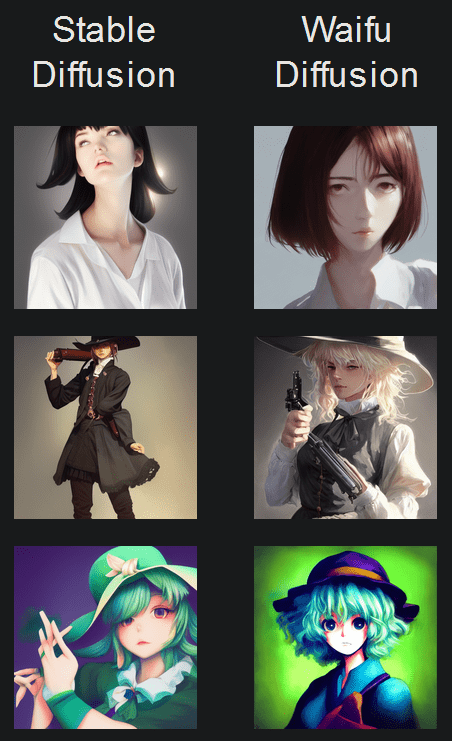
Images of high quality anime

(Image from the tool repository)

Cross Attention Control

Cross Attention Control allows fine control of the prompts by modifying the attention maps of the diffusion models. Some cool things you can do:

  • Replace a target in the prompt (e.g. replace cat by dog)
  • Reduce or increase the importance of words in the prompt (e.g. if you want less attention to be given to "rocks")
  • Easily inject styles

And much more! Check out the repo.

Reusable Seeds

One of the most impressive early demos of Stable Diffusion was the reuse of seeds to tweak images. The idea is to use the seed of an image of interest to generate a new image, with a different prompt. This yields some cool results! Check out the Colab

Thanks for reading!

I hope you enjoy reading this! Remember to give a Star in our GitHub Repository and join the Hugging Face Discord Server, where we have a category of channels just for Diffusion models. Over there the latest news in the library are shared!

Feel free to open issues with feature requests and bug reports! Everything that has been achieved couldn't have been done without such an amazing community.