


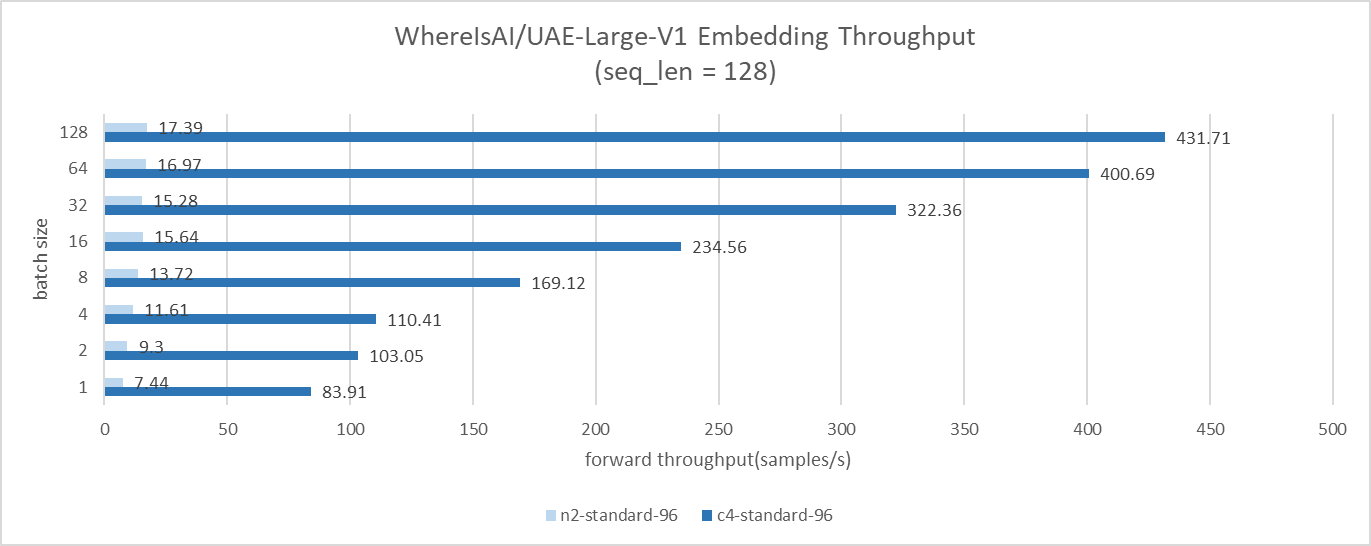
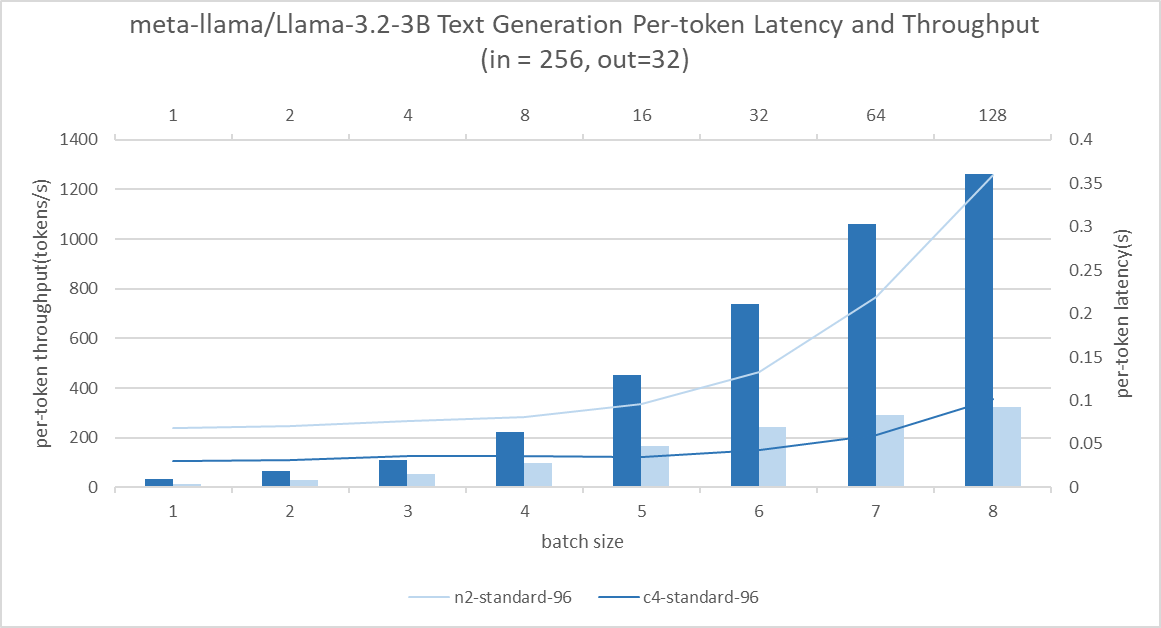
TL;DR: We benchmark 2 representative agentic AI workload components, text embedding and text generation, on two Google Cloud Compute Engine Xeon-based CPU instances, namely N2 and C4. The results consistently shows that C4 has 10x to 24x higher throughput over N2 in text embedding and 2.3x to 3.6x higher throughput over N2 in text generation. Taking price into consideration, C4's hourly price is about 1.3x of N2, in this sense, C4 keeps 7x ~ 19x TCO(Total Cost of Ownership) advantage over N2 in text embedding and 1.7x ~ 2.9x TCO advantage in text generation. The results indicate that it is possible to deploy light-weight Agentic AI solutions wholly on CPUs.
People believe the next frontier of artificial intelligence lies in agentic AI. The new paradigm uses the perceive - reason - action pipeline to combine LLM's sophisticated reasoning and iterative planning capabilities with a strong context understanding enhancement. The context understanding capability is provided by tools like vector databases and sensor input, to ceate more context-aware AI systems which can autonomously solve complex, multi-step problems. Moreover, the function calling capability of LLMs make it possible for the AI agent to directly take the action, going far beyond the chatting a chatbot offers. Agentic AI offers exciting prospects to enhance productivity and operations across industries.
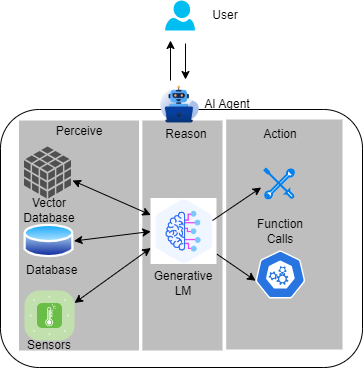
People are bringing more and more tools into agentic AI systems, and most of these tools are now work on CPU, this brings a concern that there will be non-negligible host-accelerator traffic overheads in this paradigm. At the same time, model builders and vendors are building Small Language Models (SLMs) that are smaller yet powerful, the latest examples being Meta's 1B and 3B llama3.2 models, advanced multilingual text generation and tool calling capabilities. Further, CPUs are evolving and beginning to offer increased AI support, Intel Advanced Matrix Extensions (AMX), a new AI tensor accelerator, was introduced in its 4th generation of Xeon CPUs. Putting these 3 threads together, it would be interesting to see the potential of CPU to host the whole agentic AI systems, especially when it uses SLMs.
In this post, we will benchmark 2 representative components of agentic AI: text embedding and text generation and compare the gen-on-gen performance boost of CPU on these 2 components. We picked Google Cloud Compute Engine C4 instance and N2 instance for comparison. The logic behind is: C4 is powered by 5th generation Intel Xeon processors (code-named Emerald Rapids) , the latest generatiton of Xeon CPU available on Google Cloud which integrates Intel AMX to boost AI performance; and N2 is powered by 3rd generation Intel Xeon processors (code-named Ice Lake), the previous generation of Xeon CPU on Google Cloud which only has AVX-512 and no AMX. We'll demonstrate the benefits of AMX.
We will use optimum-benchmark, Hugging Face's unified benchmark library for multi-backends and multi-devices, to measure the performance. The benchmark runs on optimum-intel backend. optimum-intel is an Hugging Face acceleration library to accelerate end-to-end pipelines on Intel architectures (CPU, GPU). Our benchmark cases are as below:
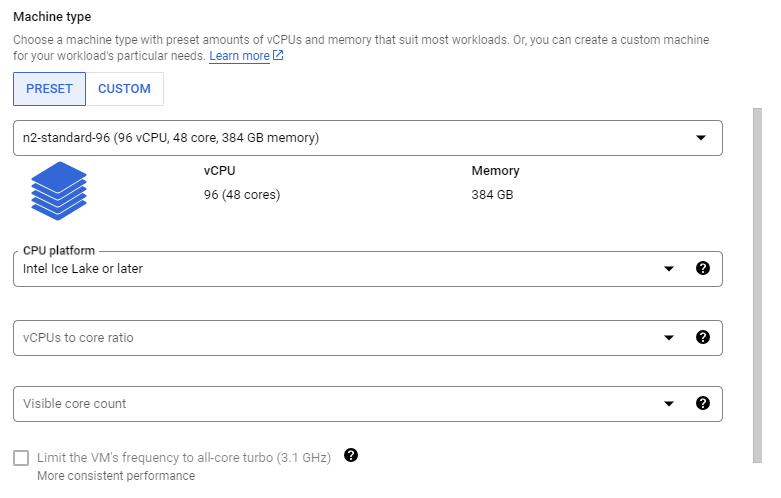
WhereIsAI/UAE-Large-V1 model with input sequence length 128, and we sweep batch size from 1 to 128meta-llama/Llama-3.2-3 model with input sequence length 256 and output sequence length 32, and we sweep batch size from 1 to 64Visit google cloud console and click on create a VM under your project. Then, follow the below steps to create a single 96-vcpu instance which corresponds to one Intel Ice Lake CPU socket.
Machine configuration tab and specify Machine type as n2-standard-96. Then you need set CPU platform as below image:
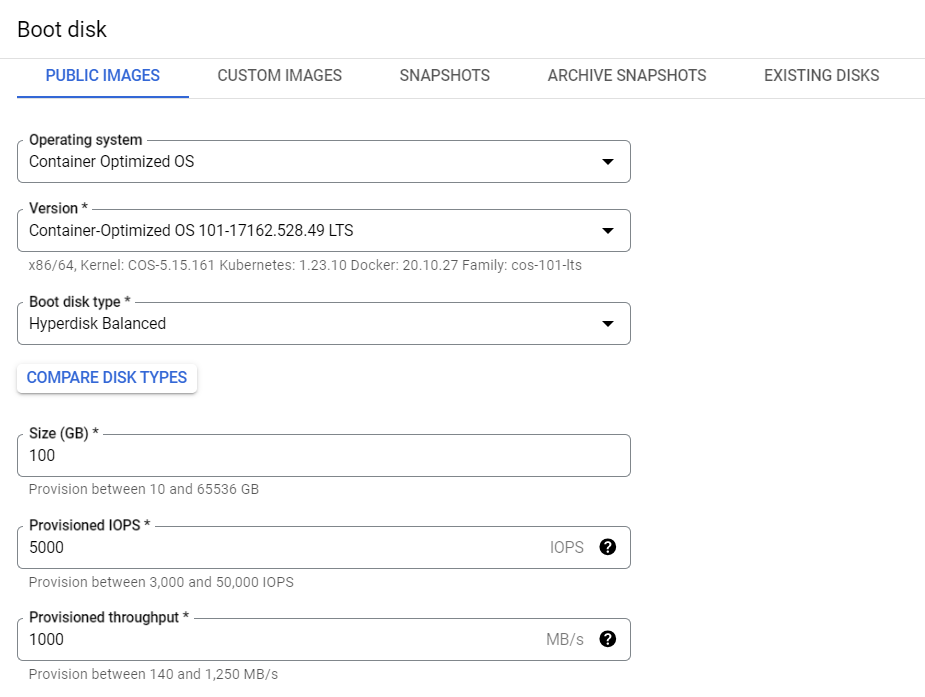
OS and storage tab as below:
CREATE buttonNow, you have one N2 instance.
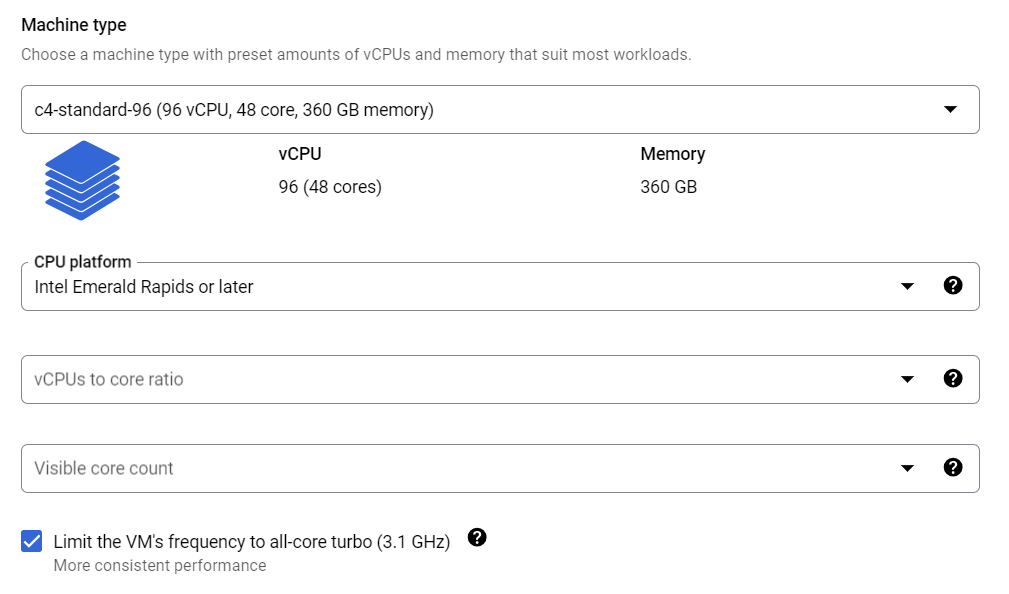
Follow the below steps to create a 96-vcpu instance which corresponds to one Intel Emerald Rapids socket. Please note that we use the same CPU core count between C4 and N2 in this post to ensure an iso-core-count benchmark.
Machine configuration tab and specify Machine type as c4-standard-96. You can also set CPU platform and turn on all-core turbo to make performance more stable:
OS and storage as N2CREATE buttonNow, you have one C4 instance.
Follow below steps to set up the environment easily. For reproducibility, we list the version and commit we are using in the commands.
$ git clone https://github.com/huggingface/optimum-benchmark.git$ cd ./optimum-benchmark$ git checkout d58bb2582b872c25ab476fece19d4fa78e190673$ cd ./docker/cpu$ sudo docker build . -t <your_docker_image_tag>$ sudo docker run -it --rm --privileged -v /home/<your_home_folder>:/workspace <your_docker_image_tag> /bin/bashWe are in container now, do following steps:
$ pip install "optimum-intel[ipex]"@git+https://github.com/huggingface/optimum-intel.git@6a3b1ba5924b0b017b0b0f5de5b10adb77095b$ pip install torch==2.3.1 torchvision torchaudio --index-url https://download.pytorch.org/whl/cpu$ python -m pip install intel-extension-for-pytorch==2.3.10$ cd /workspace/optimum-benchmark$ pip install .[ipex]$ export OMP_NUM_THREADS=48$ export KMP_AFFINITY=granularity=fine,compact,1,0$ export KMP_BLOCKTIME=1$ pip install huggingface-hub$ huggingface-cli login, then input your Hugging Face token to access llama modelYou need update examples/ipex_bert.yaml in optimum-benchmark directory as below to benchmark WhereIsAI/UAE-Large-V1. We change numa binding to 0,1 because both N2 and C4 have 2 NUMA domains per socket, you can double check with lscpu.
--- a/examples/ipex_bert.yaml
+++ b/examples/ipex_bert.yaml
@@ -11,8 +11,8 @@ name: ipex_bert
 launcher:
   numactl: true
   numactl_kwargs:
-    cpunodebind: 0
-    membind: 0
+    cpunodebind: 0,1
+    membind: 0,1

 scenario:
   latency: true
@@ -26,4 +26,4 @@ backend:
   no_weights: false
   export: true
   torch_dtype: bfloat16
-  model: bert-base-uncased
+  model: WhereIsAI/UAE-Large-V1
Then, run benchmark:
$ optimum-benchmark --config-dir examples/ --config-name ipex_bert
You can update examples/ipex_llama.yaml as below to benchmark meta-llama/Llama-3.2-3.
--- a/examples/ipex_llama.yaml
+++ b/examples/ipex_llama.yaml
@@ -11,8 +11,8 @@ name: ipex_llama
 launcher:
   numactl: true
   numactl_kwargs:
-    cpunodebind: 0
-    membind: 0
+    cpunodebind: 0,1
+    membind: 0,1

 scenario:
   latency: true
@@ -34,4 +34,4 @@ backend:
   export: true
   no_weights: false
   torch_dtype: bfloat16
-  model: TinyLlama/TinyLlama-1.1B-Chat-v1.0
+  model: meta-llama/Llama-3.2-3B
Then, run benchmark:
$ optimum-benchmark --config-dir examples/ --config-name ipex_llama
The GCP C4 instance delivers approximately 10x to 24x higher throughput over N2 in the text embedding benchmark cases.
Consistently, the C4 instance shows approximately 2.3x to 3.6x higher throughput over N2 in the text generation benchmark. Across batch sizes of 1 to 16, throughput is 13x better without significantly compromising latency. It enables concurrent query serving without needing to sacrifice user experience.
In this post, we benchmarked 2 representative workloads of agentic AI on Google Cloud Compute Engine CPU instances: C4 and N2. The results show prominent performance boost thanks to AMX and memory capability improvements on Intel Xeon CPUs. Intel released Xeon 6 processors with P-cores (code-named Granite Rapids) one month ago, and it offers ~2x performance boost in Llama 3. We believe, with the new Granite Rapids CPU, we can explore to deploy light-weight Agentic AI solutions wholly on CPU, to avoid intensive host-accelerator traffic overheads. We will benchmark it once Google Cloud Compute Engine has Granite Rapids instance and report results.
Thanks for reading!
此内容由惯性聚合(RSS阅读器)自动聚合整理,仅供阅读参考。 原文来自 — 版权归原作者所有。