








Models are becoming quite good at understanding text on its own, but what about text in images, which gives important contextual information? For example, navigating a map, or understanding a meme? The ability to reason about the interactions between the text and visual context in images can power many real-world applications, such as AI assistants, or tools to assist the visually impaired.
We refer to these tasks as "context-sensitive text-rich visual reasoning tasks".
At the moment, most evaluations of instruction-tuned large multimodal models (LMMs) focus on testing how well models can respond to human instructions posed as questions or imperative sentences (“Count this”, “List that”, etc) over images... but not how well they understand context-sensitive text-rich scenes!
That’s why we (researchers from University of California Los Angeles) created ConTextual, a Context-sensitive Text-rich visuaL reasoning dataset for evaluating LMMs. We also released a leaderboard, so that the community can see for themselves which models are the best at this task.
For an in-depth dive, you can also check these additional resources: paper, code, dataset, validation dataset, and leaderboard.
ConTextual is a Context-sensitive Text-rich visual reasoning dataset consisting of 506 challenging instructions for LMM evaluation. We create a diverse set of instructions on text-rich images with the constraint that they should require context-sensitive joint reasoning over the textual and visual cues in the image.
It covers 8 real-world visual scenarios - Time Reading, Shopping, Navigation, Abstract Scenes, Mobile Application, Webpages, Infographics and Miscellaneous Natural Scenes. (See the figure for a sample of each dataset).
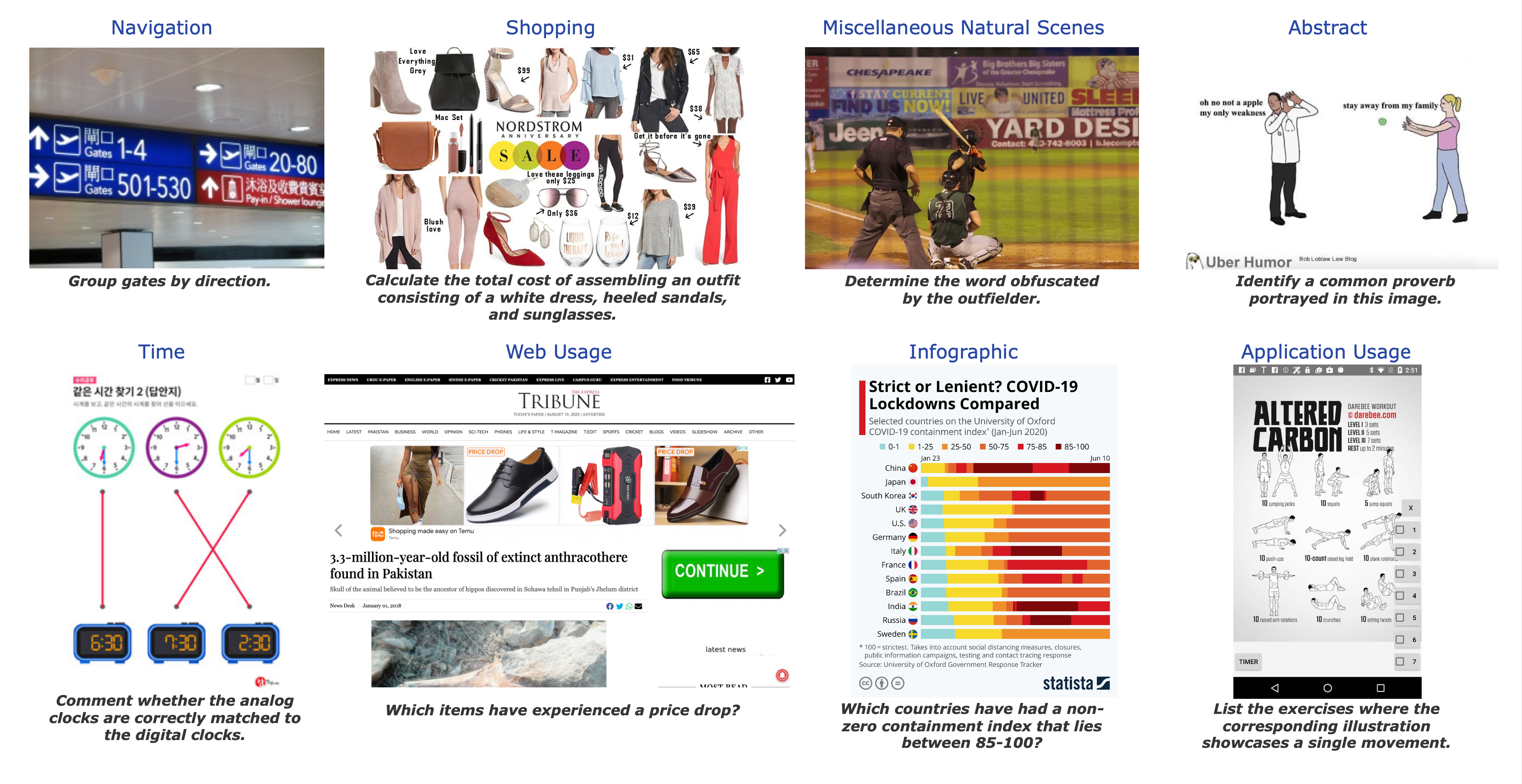
Each sample consists of:
The dataset is released in two forms:
The leaderboard contains model results both on the validation and test datasets (the information is also present in the paper). The development set allows the practitioners to test and iterate on their approaches easily. The evaluation sandbox is present in our github.
For our initial experiments, our benchmark assessed the performance of 13 models. We divided them into three categories:
Our dataset includes a reference response for each instruction, allowing us to test various automatic evaluation methods. For evaluation, we use an LLM-as-a-judge approach, and prompt GPT-4 with the instruction, reference response, and predicted response. The model has to return whether the predicted response is acceptable or not. (GPT4 was chosen as it correlated the most with human judgement in our experiments.)
Let's look at some examples!
Example 1 In this instance, GPT-4V provides an incorrect response to the instruction, despite its logical reasoning. The use of green indicates responses that match the reference, while red highlights errors in the responses. Additionally, a Summarized Reasoning is provided to outline the rationale used by GPT-4V to arrive at its answer.
Example 2 In this example, GPT-4V correctly responds to the instruction. However, ShareGPT-4V-7B (best performing open-source LMM) and GPT-4 w/ Layout-aware OCR + Caption (Augmented LLM) produce a wrong response, due to lack of joint reasoning over text and image.
You’ll find more examples like this in the Appendix section of our paper!
While working on this, we found that:
Our analysis suggests promising next steps include:
This, in turn, will lead to more effective context-sensitive text-rich visual reasoning.
We’d love to evaluate your models too, to help collectively advance the state of vision language models! To submit, please follow our guidelines below.
We hope that this benchmark will help in developing nuanced vision-language alignment techniques and welcome any kind of collaboration! You can contact us here: Rohan and Hritik, and know more about the team here: Rohan, Hritik, Kai-Wei Chang, Nanyun (Violet) Peng.
We are accepting submissions for both the test and validation sets. Please, follow the corresponding procedure below.
To submit your validation results to the leaderboard, you can run our auto-evaluation code (Evaluation Pipeline with GPT4), following these instructions.
We expect submissions to be json format as shown below:
{"model_name": {"img_url": "The boolean score of your model on the image, 1 for success and 0 for failure"}}
There should be 100 predictions, corresponding to the 100 urls of the val set.
To make the submission please go to the leaderboard hosted on HuggingFace and fill up the Submission form.
Once you are happy with your validation results, you can send your model predictions to Rohan and Hritik.
Please include in your email:
We expect submissions to be json format similar to val set as shown below:
{"model_name": {"img_url": "predicted response"}}
There should be 506 predictions, corresponding to the 506 urls of the test set.
此内容由惯性聚合(RSS阅读器)自动聚合整理,仅供阅读参考。 原文来自 — 版权归原作者所有。