







BT and Huawei today announced a new five-year initiative which aims to see the two companies establish a joint research and collaboration group at the University of Cambridge.
This new team, intended to combine the brightest minds from two of the biggest global information, communication and telecommunications (“ICT”) companies with one of the foremost academic institutions in the world, will further strengthen the UK’s status as one of the world’s leading hubs for innovation. Backed by up to £25 million in funding and contributions over the next five years, the research group is expected to focus on projects relating to photonics, digital and access network infrastructure and media technologies, alongside work aimed at enhancing the societal impact of communications technologies.
The research project aims to bring together experts from the BT Labs, the Huawei R&D Team and academics from the University of Cambridge to explore new technologies which have the potential to unlock economic benefits for UK businesses and organisations, such as reducing the cost of network infrastructure and boosting operational performance. The projects are also expected to focus on the critical role that new technologies can play in delivering positive impacts for society, such as those aimed at reducing inequality, particularly for those groups excluded from digital transformation and using ICT technologies to improve resilience of communities to climate change.
Finally, the funding is also intended to be used to support longer-term, ‘blue skies’ research projects being progressed by postgraduate students at the University which are focused on generating benefits for industry and society at large. All these projects will be assessed by an Academic Advisory Board intended to be made up of senior representatives from each of the parties. The University maintains strong links with the hi-tech business cluster of more than 4,700 companies which has sprung up around the Cambridge area. The new research and collaboration team – expected to be based at the University’s Maxwell Centre – will further harness the combined strengths of industry and the very best in academia to strengthen the area’s position as one of the leading technology hubs in Europe.
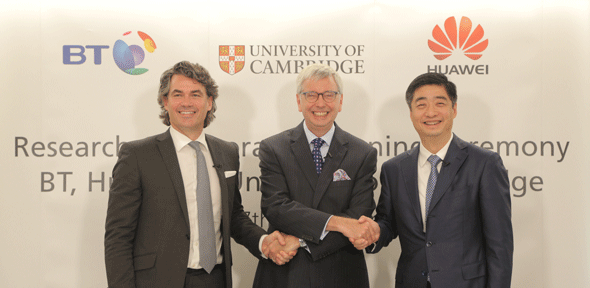
From left to right: BT CEO, Gavin Patterson, University of Cambridge Vice-Chancellor, Prof Stephen Toope and Huawei CEO, Ken Hu
Following the signing of a Memorandum of Understanding today, the new group is expected to kick off research activity in the first half of 2018 with five to ten researchers from BT and Huawei working alongside their University collaborators.
Prof Stephen Toope, Vice-Chancellor at the University of Cambridge, said: “The University of Cambridge is delighted to be, once again, demonstrating the importance of its research to business and industry. The world of telecommunications has advanced rapidly over the last two decades. However, there is still work to be done to improve the technologies we use on a daily basis and to ensure that they are long-lived. By working with BT and Huawei we will be able to demonstrate that the insights delivered through our research have a broad impact.”
Gavin Patterson, BT Group Chief Executive said: “BT’s fixed and mobile infrastructure is the engine of the UK economy, so it is essential that we continue to innovate in this space to enhance the UK’s competitiveness on the world stage towards and through Brexit.
“BT currently invests around £500m every year in R&D, and over the last ten years we’ve been the third biggest contributor to the UK’s R&D efforts.
“We believe the best way of ensuring this country remains at the forefront of innovation is by combining the expertise and commercial focus of industry with the fantastic intellectual capital found at our world-leading universities. Working together with Huawei and the University of Cambridge, we will discover the next generation of technologies which promise to deliver huge economic, social and cultural benefits for UK citizens.”
Ken Hu Deputy Chairman and Rotating CEO, Huawei, said: “Technology is changing the world faster than we have ever seen. It will bring many benefits to mankind, and affect nearly every aspect of our lives. Huawei will continue to invest and form partnerships to build out future infrastructure. We have over 80,000 people in research and development globally, working with customers, universities and industry bodies.
“No single organization has all the answers. Partnership is the only way forward in a complex digital age. We look forward to working with BT and the University of Cambridge. Together, we will explore future technologies and help ensure a positive social impact.”
Both BT and Huawei have a long history of working with Cambridge on research projects. Researchers at the BT Labs in Adastral Park recently collaborated with the University’s Cavendish Lab on a project to assess the potential theoretical speeds that can be delivered over the UK’s access network infrastructure. Huawei and the University of Cambridge have been working together for seven years on range of successful research projects including media, communications and other technologies.
此内容由惯性聚合(RSS阅读器)自动聚合整理,仅供阅读参考。 原文来自 — 版权归原作者所有。