
惯性聚合 高效追踪和阅读你感兴趣的博客、新闻、科技资讯
阅读原文 在惯性聚合中打开

推荐订阅源

C
Cisco Blogs
Schneier on Security
T
Tor Project blog
Threat Intelligence Blog | Flashpoint
T
Tenable Blog
C
Cyber Attacks, Cyber Crime and Cyber Security
T
Threat Research - Cisco Blogs
C
CERT Recently Published Vulnerability Notes
Security Latest
Security Latest
Exploit-DB.com RSS Feed
NISL@THU
NISL@THU
L
Lohrmann on Cybersecurity
Scott Helme
Scott Helme
Webroot Blog
Webroot Blog
Project Zero
Project Zero
Google Online Security Blog
The Last Watchdog
The Last Watchdog
Spread Privacy
Spread Privacy
Hacker News: Ask HN
Hacker News: Ask HN
PCI Perspectives
PCI Perspectives
cs.CL updates on arXiv.org
W
WeLiveSecurity
Attack and Defense Labs
D
Darknet – Hacking Tools, Hacker News & Cyber Security
N
News | PayPal Newsroom
Help Net Security
Help Net Security
The Hacker News
The Hacker News
H
Heimdal Security Blog
O
OpenAI News
S
Security @ Cisco Blogs
N
News and Events Feed by Topic
Cyberwarzone
Cyberwarzone
Simon Willison's Weblog
G
GRAHAM CLULEY
www.infosecurity-magazine.com
博客园 - 叶小钗
K
KPMG report finds enterprise disconnect between AI and its ROI | CIO
Hacker News - Newest:
Hacker News - Newest: "LLM"
T
Tailwind CSS Blog
大猫的无限游戏
大猫的无限游戏
A
Arctic Wolf
I
Intezer
钛媒体:引领未来商业与生活新知
钛媒体:引领未来商业与生活新知
S
Security Affairs
P
Proofpoint News Feed
S
Secure Thoughts
腾讯CDC
Google DeepMind News
量子位
罗磊的独立博客

Snorkel AI

Building AI-Native Systems for Federal Infrastructure: A Conversation with Rezaur Rahman Code World Models and AutoHarness for LLM Agents Benchtalks #1: Alex Shaw (Terminal-Bench, Harbor) – Building the Benchmark Factory Building FinQA: An Open RL Environment for Financial Reasoning Agents How Tool Discipline Let a 4B Model Outsmart a 235B Giant on Financial Tasks Coding agents don’t need to be perfect, they need to recover Closing the Evaluation Gap in Agentic AI SlopCodeBench: Measuring Code Erosion as Agents Iterate Introducing the Snorkel Agentic Coding Benchmark 2026: The year of environments Part V: Future Direction and Emerging Trends in Rubric-Based AI Evaluation The self-critique paradox: Why AI verification fails where it’s needed most Chat With the Terminal-Bench Team | Snorkel AI Intelligence per watt: A new metric for AI’s future Terminal-Bench 2.0: Raising the bar for AI agent evaluation Snorkeling in RL environments Introducing SnorkelSpatial: A Benchmark for LLM Spatial Reasoning Scaling Trust: Rubrics in Snorkel's Quality Process Evaluating Multi-Agent Systems in Enterprise Tool Use Evaluating Coding Agents with Terminal-Bench 2.0 Parsing isn’t neutral: why evaluation choices matter The science of rubric design The right tool for the job: An A-Z of rubrics Data quality and rubrics: how to build trust in your models Building the benchmark: inside our agentic insurance underwriting dataset Evaluating AI agents for insurance underwriting LLM observability: key practices, tools, and challenges Anthropic Claude + AWS: revolutionizing pharma data analytics with Snorkel AI Data-centric development of an enterprise AI agent with Snorkel Building the data development platform for specialized AI LLM-as-a-judge for enterprises: evaluate model alignment at scale Why GenAI evaluation requires SME-in-the-loop for validation and trust Research spotlight: is long chain-of-thought structure all that matters when it comes to LLM reasoning distillation? Why enterprise GenAI evaluation requires fine-grained metrics to be insightful What is specialized GenAI evaluation, and why is it so critical to enterprise AI? LLM alignment techniques: 4 post-training approaches Research spotlight: Is intent analysis the key to unlocking more accurate LLM question answering? Why enterprises should embrace LLM distillation Retrieval-augmented generation (RAG) failure modes and how to fix them What is large language model (LLM) alignment? Databricks + Snorkel Flow: integrated, streamlined AI development How LLM evaluation drives better models in Snorkel Flow Unlock proprietary data with Snorkel Flow and Amazon SageMaker LLM evaluation in enterprise applications: a new era in ML Snorkel AI joins the AWS ISV Accelerate Program and launches Snorkel Flow Availability in AWS Marketplace AI data development: a guide for data science projects SnorkelCon 2024: Inaugural Snorkel AI user conference gathers leaders from 30+ Fortune 500 companies Snorkel Flow 2024.R3: Supercharge your AI development with enhanced data-centric workflows Explore the new GenAI Evaluation Suite: Snorkel 2024.R3 New NLP features in Snorkel Flow 2024.R3 Enterprise data compliance and security review: Snorkel Flow 2024.R3 How a global financial services company built a specialized AI copilot accurate enough for production Task Me Anything: innovating multimodal model benchmarks Alfred: Data labeling with foundation models and weak supervision RAG: LLM performance boost with retrieval-augmented generation Call center AI for customer experience management: a case study New GenAI features, data annotation: Snorkel Flow 2024.R2 How data slices transform enterprise LLM evaluation Meta’s Llama 3.1 405B is the new Mr. Miyagi, now what? Meta’s new Llama 3.1 models are here! Are you ready for it? Data-centric AI with Snorkel and MinIO Weak supervision for non-categorical applications + superalignment Snorkel AI signs strategic collaboration agreement with AWS to help enterprises cross the demo-to-production chasm AI alignment made simple: innovative solutions for businesses How does the Snorkel Flow label model work? Vision language models: how LLMs boost image classification Long context models in the enterprise: benchmarks and beyond How to build production-grade RAG retrieval with Snorkel Flow How Bonito helps fine-tune specialized LLMs faster than ever Walking safely before building flying saucer seatbelts: introducing Enterprise Alignment Role-based access controls in Snorkel Flow secure enterprise data Accelerating AI development in manufacturing with Snorkel Flow and AWS SageMaker How ROBOSHOT boosts zero-shot foundation model performance Discover what’s new in Snorkel Flow: Flexible data and LLM connectivity, secure data controls, and more! Faster than ever document intelligence with new Snorkel Flow FM-first workflow The art of data development for Enterprise LLMs Crossing the demo-to-production chasm with Snorkel Custom How Snorkel topped the AlpacaEval leaderboard (and why we're not there anymore) CRFM's HELM and enterprise LLM evaluation beyond accuracy How we achieved 89% accuracy on contract question answering Five sessions not to miss at Google Cloud Next 24 Content filtering breakthrough: Snorkel client reaches 96% recall in 3 days Here's how Snorkel Flow + Google AI built an enterprise-ready model in a day Snorkel teams with Microsoft to showcase new AI research at NVIDIA GTC How Skill-it! enables faster, better LLM training Fine-tuned representation models boost LLM systems. Here's how Enterprise GenAI to surge in 2024: survey results Large language model training: how three training phases shape LLMs LoRA: Low-Rank Adaptation for LLMs LLM distillation demystified: a complete guide Enterprises must shift their focus from models to data in AI development Insurance’s GenAI revolution: a business perspective Scaling human preferences in AI: Snorkel's programmatic approach Building better enterprise AI: incorporating expert feedback in system development “Fall in love with your data”—Snorkel AI’s Enterprise LLM Summit Why QBE Ventures invested in Snorkel AI New benchmark results demonstrate value of Snorkel AI approach to LLM alignment Retrieval augmented generation (RAG): a conversation with its creator Snorkel Flow 2023.R4: enhanced UI + PDF and Databricks tools Stanford professor discusses exciting advances in foundation model evaluation
How Snorkel Flow users can register custom models to Databricks
2024-01-10 · via Snorkel AI

Snorkel AI is thrilled to announce our partnership with Databricks and seamless end-to-end integration across the Databricks Data Intelligence Platform. 

This integration grants Snorkel Flow users access to data within Databricks with just a few clicks (as detailed here) while also facilitating the streamlined registration of custom, use-case-specific models to the Databricks Workspace Model Registry. 

The synergy between Snorkel and Databricks enables data scientists to navigate their entire machine learning pipeline—from data access to model deployment—all within Snorkel Flow. 

Closing the loop with end-to-end integration across the Databricks platform

Snorkel Flow integrates seamlessly into existing enterprise workflows. Snorkel offers a full suite of third-party data connectors, making data stored in popular cloud repositories like Databricks quickly and easily accessible for data-centric AI development with Snorkel Flow. 

The new Databricks Model Registry integration equips Snorkel Flow users to automatically register custom, use case-specific models trained in Snorkel Flow to the Databricks platform, which provides a unified service for deploying, governing, querying, and monitoring models.
Data-centric AI development with Snorkel Flow

One of the most painstaking and time-consuming issues with developing AI applications is the process of curating and labeling unstructured data. Snorkel AI eases this bottleneck with the Snorkel Flow AI data development platform.

Data science and machine learning teams use Snorkel Flow to intelligently capture knowledge from various sources—such as previously labeled data (even when imperfect), heuristics from subject matter experts, business logic, and even the latest foundation models and large language models—and then scale this knowledge to label large quantities of data.

As users integrate more sources of knowledge, the platform enables them to rapidly improve training data quality and model performance using integrated error analysis tools. Once they have completed the data labeling process, Snorkel Flow users can apply their labeled data to train predictive models or filter data for generative AI applications.

Snorkel Flow + Databricks Model Registry

Snorkel further streamlines the machine learning development process for organizations that rely on Databricks through a native integration with Databricks Model Registry built directly into the platform. After training, adapting, or distilling a model using the Snorkel Flow data development platform, users can easily register their custom, use case-specific models to the Databricks Workspace Model Registry with just a few clicks.

Here’s how it works:
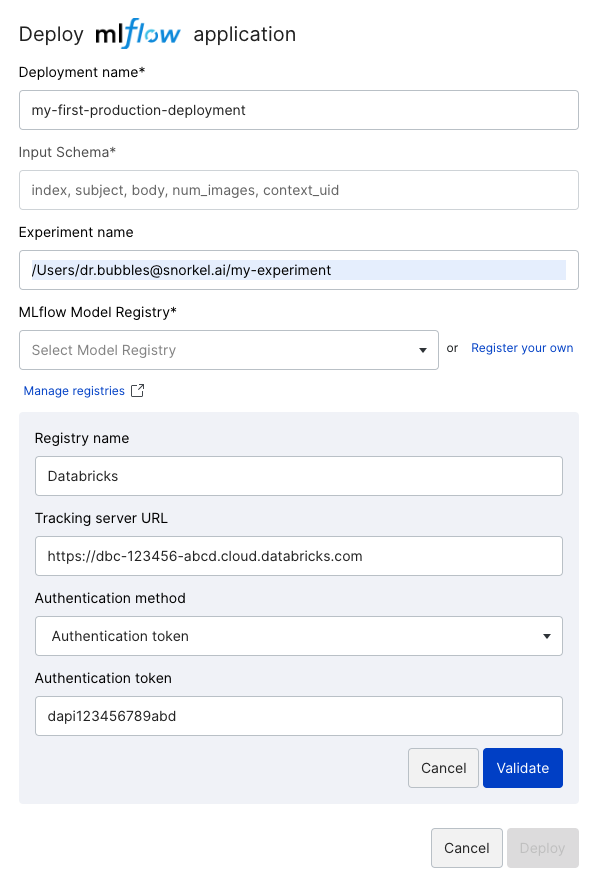
  1. Register a new model registry for your Databricks workspace and access token.
  2. Fill out the experiment name in the format /Users/<your-username>/<experiment_name>, where <your-username> should be your Databricks username.
  3. Upon clicking the “Deploy” button, Snorkel Flow registers a model to your Databricks Workspace Model Registry.

Once users register a model to the Databricks Workspace Model Registry, they can deploy the model to the Databricks Model Serving or use it on a Spark cluster.

In an upcoming release, Snorkel will expand this integration to allow registering a model to the Databricks Unity Catalog.

Learn More

Follow Snorkel AI on LinkedInTwitter, and YouTube to be the first to see new posts and videos!

Hiromu Hota

Hiromu Hota is a Staff Engineer at Snorkel AI, where he brings extensive expertise in applied machine learning as the Tech Lead Manager and Lead Machine Learning Engineer. Prior to Snorkel AI, he held roles as a Senior Researcher and Researcher at Hitachi, focusing on advanced research and development. Hiromu also serves as a Visiting Scholar at Stanford University's School of Engineering, where he contributes to academic advancements in computational science and engineering.

With a background that includes software engineering at Hitachi Data Systems and internships, Hiromu holds a Ph.D. in Computational Science and Engineering and a Master of Engineering from Nagoya University, underscoring his deep technical knowledge and academic achievements.

Connect with Hiromu to discuss machine learning, computational science, or collaborative opportunities in applied research and engineering.