


Humans learn tasks better when taught in a logical order. A child who has already learned addition, for example, will have an easier time learning multiplication. Along with our collaborators at Stanford, I and my students at the University of Wisconsin-Madison have discovered that a similar logic applies to large language models, and we’ve developed a way to exploit this tendency that we call “Skill-it!”
I recently presented a summary of our Skill-it! research findings at Snorkel AI’s Enterprise LLM Summit. The presentation also included a peek into some other research we’ve done on how to strengthen foundation models when you don’t have additional data, a process we call “zero-shot robustification.” You can watch the entire video below—which I would recommend—but I’ve summarized the main points here.
Large language models (LLMs) can accomplish a diverse range of tasks, from writing code to chatting with users. However, the sheer amount of data they need to process during training can be overwhelming. That’s where Skill-it! comes in.
The Skill-it! tool helps us select and order the data these models are trained or fine-tuned on to enhance their capabilities in the most efficient way possible.
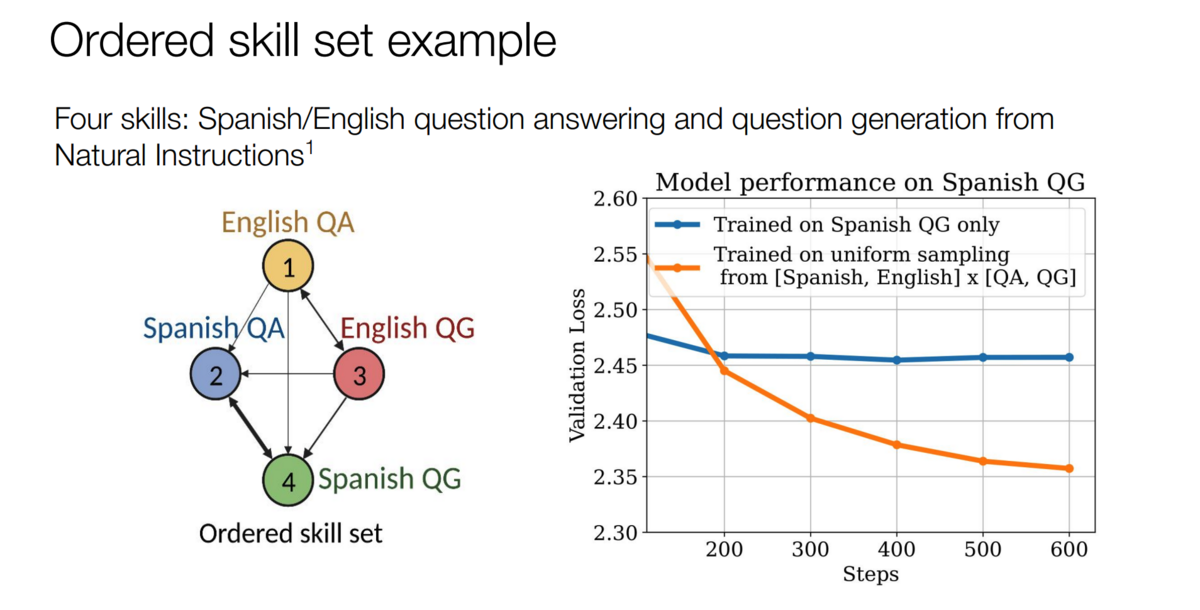
In Skill-it!, we define a “skill” as a specific capability or behavior that the model acquires from a piece of data. This could be a task, a data source, a category, or a family of tasks. We then partition our dataset into different groups that correspond to these skills.
From here, we construct what we call a “skills graph.” This graph represents the different skills we’ve identified, with edges between skills indicating how learning one skill can aid in learning another. This graph allows us to create an “order” for the skills, helping the model learn more structurally and efficiently.
The algorithm adjusts the mixture of skills at each round of training, basing these adjustments on the skills graph and the model’s performance on each skill. An initial data mixture trains the model for one round. Then, Skill-it! constructs a new mixture based on an update rule. This update rule takes into account adjacency from the skills graph and the evaluation loss, allowing us to continuously refine the data mixture to optimize each round of the model’s learning process.
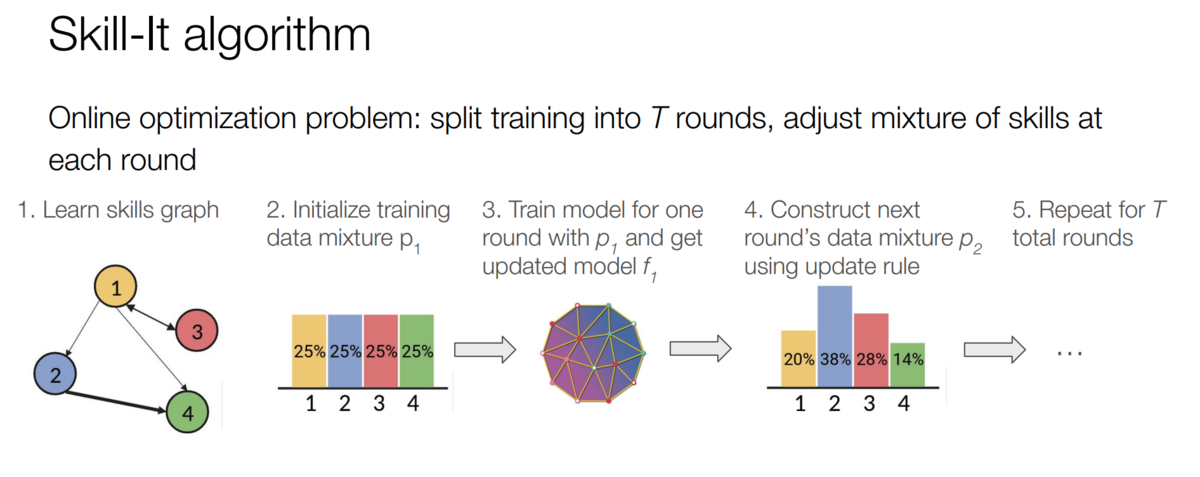
Skill-it! has demonstrated significant impact in optimizing the training of language models. Its performance has been tested across a variety of tasks and baselines, consistently proving its efficacy. Here are some noteworthy accomplishments of Skill-it!
In certain situations, we may not have access to additional data for training. This is where a technique we call “zero-shot robustification” comes into play. This innovative approach offers a unique solution to improve the robustness of models without the need for external data.
Zero-shot robustification operates on a simple yet powerful premise. It queries an LLM for insights into its understanding of useful features and those that are spurious or misleading.
In our paper on the topic, we use the popular Waterbirds dataset, which requires distinguishing between water birds and land birds. An unmodified CLIP model would frequently confuse land birds shown in or near water as water birds, and vice versa. We asked an LLM what features to emphasize and ignore. It suggested—correctly—that we should ignore the background and focus on the shape of the bird’s beak.
We then use those insights to guide the CLIP model’s predictions on the fly—without any fine-tuning or training data.

Once we’ve gathered these insights, the next step involves modifying the model’s representations based on this newfound knowledge.
How can we turn the text-based insights into a way to modify our model’s representations? First, we embed them (e.g., with CLIP’s text encoder). Next, inspired by work on debiasing word embeddings, we use simple linear-algebraic operations. For example, to get rid of a spurious concept, we project the current representation onto a subspace invariant to the one spanned by the embedded spurious insight. This boosts the features that the language model has identified as useful and diminishes or eliminates those that are deemed spurious. This fairly simple procedure has the potential to dramatically increase prediction quality without any external data.
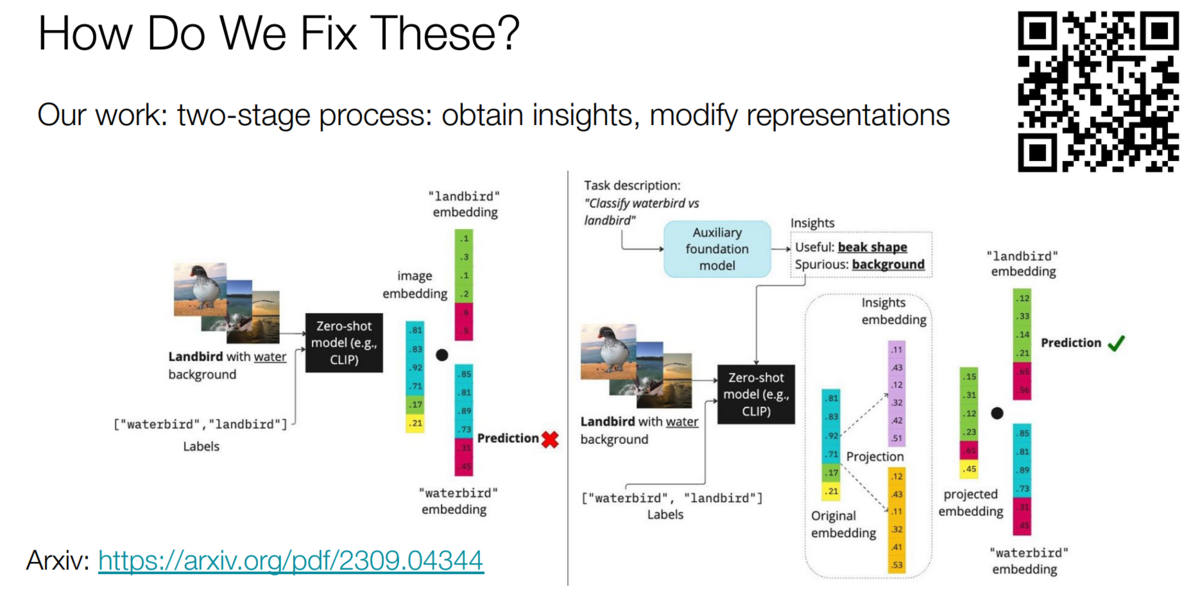
This approach to robustification can significantly improve the model’s robustness. Even without access to additional training data, zero-shot robustification allows us to leverage the model’s inherent knowledge to enhance its performance. This not only helps make the models more reliable but also aids in mitigating issues caused by spurious correlations, leading to more accurate predictions and outcomes.
Skill-it! and zero-shot robustification provide powerful tools for optimizing the training and robustness of foundation models. By ordering training data efficiently and leveraging the model’s inherent knowledge, we can greatly improve the performance of foundation models across a range of tasks.
As we continue to explore these techniques and others, we look forward to the future of language model training and the potential it holds.
Snorkel has more live online events coming. Look at our events page to sign up for research webinars, product overviews, and case studies.
If you're looking for more content immediately, check out our YouTube channel, where we keep recordings of our past webinars and online conferences.
此内容由惯性聚合(RSS阅读器)自动聚合整理,仅供阅读参考。 原文来自 — 版权归原作者所有。