



惯性聚合 高效追踪和阅读你感兴趣的博客、新闻、科技资讯
阅读原文 在惯性聚合中打开

推荐订阅源

F
Fox-IT International blog
Recent Announcements
D
Docker
IT之家
IT之家
B
Blog
Jina AI
Jina AI
奇客Solidot–传递最新科技情报
奇客Solidot–传递最新科技情报
博客园 - 【当耐特】
Google DeepMind News
F
Fortinet All Blogs
量子位
C
Check Point Blog
Microsoft Azure Blog
罗磊的独立博客
博客园 - 司徒正美
李成银的技术随笔
美团技术团队
Blog — PlanetScale
Blog — PlanetScale
雷峰网
雷峰网
The GitHub Blog
The GitHub Blog
让小产品的独立变现更简单 - ezindie.com
J
Java Code Geeks
T
The Blog of Author Tim Ferriss
酷 壳 – CoolShell
酷 壳 – CoolShell
MongoDB | Blog
MongoDB | Blog
P
Proofpoint News Feed
L
LangChain Blog
Cyber Security Advisories - MS-ISAC
OSCHINA 社区最新新闻
OSCHINA 社区最新新闻
Y
Y Combinator Blog
大猫的无限游戏
大猫的无限游戏
有赞技术团队
有赞技术团队
钛媒体:引领未来商业与生活新知
钛媒体:引领未来商业与生活新知
V
Visual Studio Blog
T
Tailwind CSS Blog
H
Help Net Security
Engineering at Meta
Engineering at Meta
小众软件
小众软件
B
Blog RSS Feed
Stack Overflow Blog
Stack Overflow Blog
月光博客
月光博客
M
Microsoft Research Blog - Microsoft Research
宝玉的分享
宝玉的分享
人人都是产品经理
人人都是产品经理
freeCodeCamp Programming Tutorials: Python, JavaScript, Git & More
GbyAI
GbyAI
H
Hackread – Cybersecurity News, Data Breaches, AI and More
Last Week in AI
Last Week in AI
Martin Fowler
Martin Fowler
Stack Overflow Blog
Stack Overflow Blog

Snorkel AI

Building AI-Native Systems for Federal Infrastructure: A Conversation with Rezaur Rahman Code World Models and AutoHarness for LLM Agents Why coding agents need better data, evals, and environments Why coding agents need better data, evals, and environments Understanding Olmix: A Framework for Data Mixing Throughout Language Model Development Understanding Olmix: A Framework for Data Mixing Throughout Language Model Development Benchmarks should shape the frontier, not just measure it Benchmarks should shape the frontier, not just measure it Benchtalks #1: Alex Shaw (Terminal-Bench, Harbor) – Building the Benchmark Factory Building FinQA: An Open RL Environment for Financial Reasoning Agents How Tool Discipline Let a 4B Model Outsmart a 235B Giant on Financial Tasks Coding agents don’t need to be perfect, they need to recover Closing the Evaluation Gap in Agentic AI SlopCodeBench: Measuring Code Erosion as Agents Iterate Introducing the Snorkel Agentic Coding Benchmark 2026: The year of environments Part V: Future direction and emerging trends The self-critique paradox: Why AI verification fails where it’s needed most A chat with the Terminal-Bench team Intelligence per watt: A new metric for AI’s future Terminal-Bench 2.0: Raising the bar for AI agent evaluation Snorkeling in RL environments Introducing SnorkelSpatial Scaling trust: rubrics in Snorkel’s quality process Evaluating multi-agent systems in enterprise tool use Evaluating coding agent capabilities with Terminal-Bench: Snorkel’s role in building the next generation benchmark Parsing isn’t neutral: why evaluation choices matter The science of rubric design The right tool for the job: An A-Z of rubrics Data quality and rubrics: how to build trust in your models Building the benchmark: inside our agentic insurance underwriting dataset Evaluating AI agents for insurance underwriting LLM observability: key practices, tools, and challenges Anthropic Claude + AWS: revolutionizing pharma data analytics with Snorkel AI Data-centric development of an enterprise AI agent with Snorkel Building the data development platform for specialized AI LLM-as-a-judge for enterprises: evaluate model alignment at scale Why GenAI evaluation requires SME-in-the-loop for validation and trust Research spotlight: is long chain-of-thought structure all that matters when it comes to LLM reasoning distillation? Why enterprise GenAI evaluation requires fine-grained metrics to be insightful What is specialized GenAI evaluation, and why is it so critical to enterprise AI? LLM alignment techniques: 4 post-training approaches Research spotlight: Is intent analysis the key to unlocking more accurate LLM question answering? Why enterprises should embrace LLM distillation Retrieval-augmented generation (RAG) failure modes and how to fix them What is large language model (LLM) alignment? Databricks + Snorkel Flow: integrated, streamlined AI development How LLM evaluation drives better models in Snorkel Flow Unlock proprietary data with Snorkel Flow and Amazon SageMaker LLM evaluation in enterprise applications: a new era in ML Snorkel AI joins the AWS ISV Accelerate Program and launches Snorkel Flow Availability in AWS Marketplace AI data development: a guide for data science projects SnorkelCon 2024: Inaugural Snorkel AI user conference gathers leaders from 30+ Fortune 500 companies Snorkel Flow 2024.R3: Supercharge your AI development with enhanced data-centric workflows Explore the new GenAI Evaluation Suite: Snorkel 2024.R3 New NLP features in Snorkel Flow 2024.R3 How a global financial services company built a specialized AI copilot accurate enough for production Task Me Anything: innovating multimodal model benchmarks Alfred: Data labeling with foundation models and weak supervision RAG: LLM performance boost with retrieval-augmented generation Call center AI for customer experience management: a case study New GenAI features, data annotation: Snorkel Flow 2024.R2 How data slices transform enterprise LLM evaluation Meta’s Llama 3.1 405B is the new Mr. Miyagi, now what? Meta’s new Llama 3.1 models are here! Are you ready for it? Data-centric AI with Snorkel and MinIO Weak supervision for non-categorical applications + superalignment Snorkel AI signs strategic collaboration agreement with AWS to help enterprises cross the demo-to-production chasm AI alignment made simple: innovative solutions for businesses How does the Snorkel Flow label model work? Vision language models: how LLMs boost image classification Long context models in the enterprise: benchmarks and beyond How to build production-grade RAG retrieval with Snorkel Flow How Bonito helps fine-tune specialized LLMs faster than ever Walking safely before building flying saucer seatbelts: introducing Enterprise Alignment Role-based access controls in Snorkel Flow secure enterprise data Accelerating AI development in manufacturing with Snorkel Flow and AWS SageMaker How ROBOSHOT boosts zero-shot foundation model performance Discover what’s new in Snorkel Flow: Flexible data and LLM connectivity, secure data controls, and more! Faster than ever document intelligence with new Snorkel Flow FM-first workflow The art of data development for Enterprise LLMs Crossing the demo-to-production chasm with Snorkel Custom How Snorkel topped the AlpacaEval leaderboard (and why we’re not there anymore) CRFM’s HELM and enterprise LLM evaluation beyond accuracy How we achieved 89% accuracy on contract question answering Five sessions not to miss at Google Cloud Next 24 Content filtering breakthrough: Snorkel client reaches 96% recall in 3 days Here’s how Snorkel Flow + Google AI built an enterprise-ready model in a day Snorkel teams with Microsoft to showcase new AI research at NVIDIA GTC How Skill-it! enables faster, better LLM training Fine-tuned representation models boost LLM systems. Here’s how Enterprise GenAI to surge in 2024: survey results Large language model training: how three training phases shape LLMs LoRA: Low-Rank Adaptation for LLMs LLM distillation demystified: a complete guide Enterprises must shift their focus from models to data in AI development Insurance’s GenAI revolution: a business perspective Scaling human preferences in AI: Snorkel’s programmatic approach Building better enterprise AI: incorporating expert feedback in system development “Fall in love with your data”—Snorkel AI’s Enterprise LLM Summit
Enterprise data compliance and security review: Snorkel Flow 2024.R3
2024-10-09 · via Snorkel AI

We are proud to announce the latest generation of enterprise readiness features for Snorkel Flow introduced in our 2024.R3 release. These capabilities enable enterprise IT admins, compliance officers, and security analysts to configure and tailor Snorkel Flow data safeguards to your company’s control policies.

As a result, many top US financial institutions and Fortune 500 enterprises continue to entrust Snorkel for programmatic data development, model fine-tuning, and SME annotation on their corporate and customer data.

Learn more about:

RBAC: authentication, authorization, and entitlements

Snorkel Flow’s role-based access controls now enable you to limit who has access to specific features and data on the platform. Enterprise IT admins can configure access to features and data at an instance, workspace, or role level by leveraging access control rules.

In addition to empowering admins to manually provision users and configure access on the platform, Snorkel Flow can sync with external identity providers like Azure Active Directory to directly consume entitlement information within SAML or OIDC SSO integrations. Snorkel automatically provisions those users with locked-down feature & data access to a set of permissioned workspaces.

In compliance with NIST AAL3 re-authentication standards, Snorkel Flow requires users to reauthenticate if they idle for more than 15 minutes. Users must also re-authenticate every 12 hours for any given active session. IT admins can configure the login rate depending on your security posture.
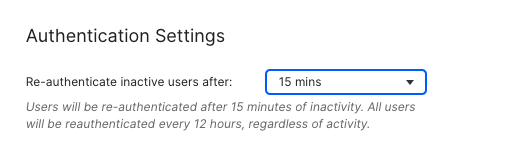
Image3

Data ingress and egress

Snorkel enables multiple paths to bring data into and out of Snorkel Flow, including but not limited to:

  • Upload from and download to your local computer
  • Data connectors with common third-party data lakes such as Databricks, Snowflake, Google BigQuery as well as S3, GCS, and Azure buckets.
  • Custom notebook integrations to handle local data connectors hosted either within your company’s VPC or from a remote source.

Snorkel Flow admins can configure who has access to which data connectors and customize them at the role and workspace level.
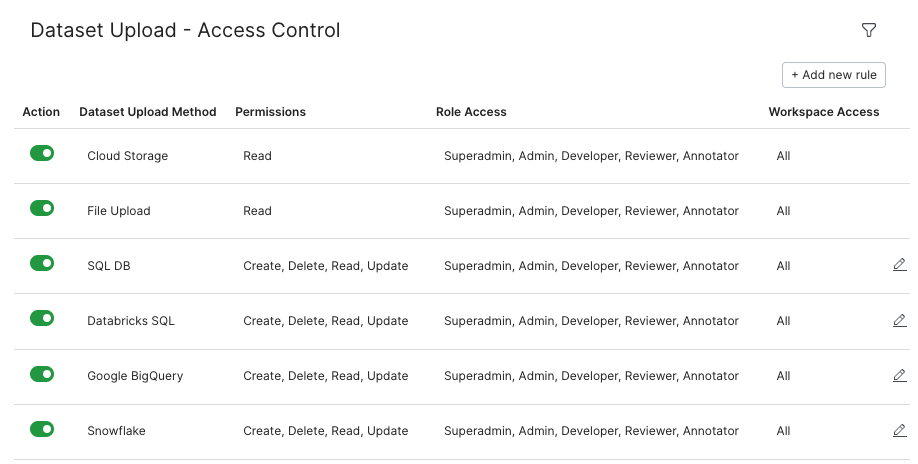
Shoring up data compliance and security in Snorkel Flow through access controls with easy toggles.

For authenticated access, Snorkel provides the ability to securely persist, manage, and control access to data connector credentials on the platform. Within a given workspace, you can enable trusted users to create, modify, and delete credentials—or limit them to only use existing credentials without the ability to view the underlying secrets.
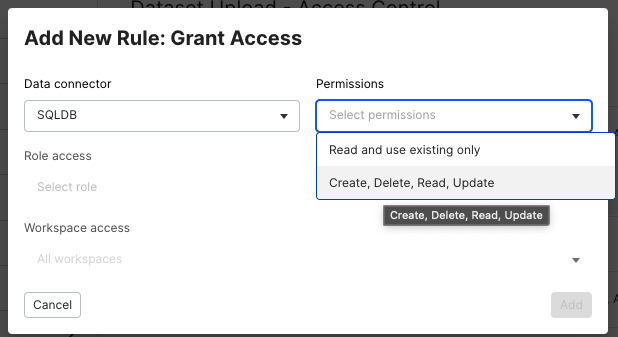
Shoring up data compliance and security in Snorkel Flow through access controls.

We understand that customers may wish to manage their credentials and keys off-platform. In future releases, Snorkel will provide integrations with cloud-native services like AWS Secrets Manager or equivalents on GCP and Azure.

Storage-API launch, MinIO Client & Boto3 deprecation

Prior to adding data to an application in Snorkel Flow, users can perform data surgery, error correction, and dataset triage. Users will find data stored within workspace scoped buckets persisted on the Snorkel NFS.

To that end, we have changed our data access policies to enforce data isolation at the workspace level by default. In this release, we are announcing the deprecation of MinIO Client and boto3 upload and download functions from Snorkel Flow’s SDK to make our users’ data more secure than ever.

Snorkel’s SDK now provides suitable replacement functions in our new 1st party storage-api. This new service uploads files in an RBAC-safe manner directly into workspace-scoped buckets. To give customers adequate time to migrate onto storage-api and maintain backward compatibility with legacy notebooks, we will continue to permit MinIO Client and boto3 usage until EOQ1 2025—after which access to these functions will be blocked.
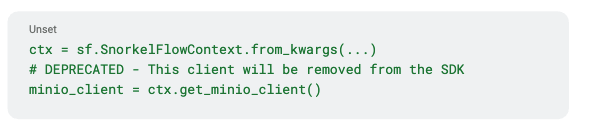
Image6

Security, support, and audit trail

Snorkel encrypts on-platform data both at-rest and in-transit. The platform secures all services, credentials, and keys by first salting and then using AES-256 encryption with a random-initialization vector.

If you choose to use our Snorkel Hosted deployment option, we ensure that all customer data is stored exclusively on our SOC-2 Type II certified infrastructure and is isolated, stored, and processed separately from all other customer data.

Additionally, we enforce audit trail event coverage and capture relevant network telemetry over all critical on-platform UI and notebook SDK actions. Upon request, audit events can be exported off-platform for long-term, secured cold-storage retention on all major clouds to enable Basel II and SOX compliance for financial institutions, or HIPAA compliance for health industry covered entities.

Installation & provisioning updates

Snorkel Flow Installations – State of the Union

In the spirit of transparency, Snorkel is excited to publish some high-level statistics, trends, and observations about our customers’ preferred production installation methods. We hope to continue publishing similar metrics for future releases to track changes in enterprise preferences over time.

  1. Most Snorkel customers continue to prefer multi-node, private cloud (customer-hosted) and on-prem installations for production use cases. This is no surprise to us; our customers have been very clear from the earliest phases of our conversations that security is vitally important to them.
    1. Customers like financial institutions will never allow production data classified as highly confidential (HCD) OR material non-public information (MNPI) to leave their VPC. 
    2. Due to extensive tech-risk controls, some IT teams will not approve any telemetry data (like a heartbeat signal) that has the potential to expose data from the in-customer-VPC Snorkel Flow tenant. 
    3. Snorkel is in active discussions with several customer IT teams to explore whether we can get approval to extract support bundles, which contain event log data to facilitate remote debugging.
  2. As a counterpoint, we also observed quick adoption of our customer-hosted,Snorkel-managed VPC instances by several customers on AWS and Azure within the span of a single release.
    1. This clearly shows that there exists a set of motivated enterprises who still want to retain full control of critical data and user IAM within the customer’s VPC, but are open to adopting slightly more open cloud-vendor practices in exchange for faster support and instance management
    2. To Snorkel, this is clear evidence of an evolving gradient of data security preferences and control requirements for production use cases, even for the most tech-risk-sensitive customers. 
    3. We are incredibly excited by this development, more on this later in the blog post.
  3. Average version age segmented by customer build will vary significantly across deployment methods.
    1. Older versions are predominantly concentrated in our on-prem (single-node) federal customer-hosted setups, with Snorkel-hosted and Managed VPCs comprising the majority of Snorkel’s modern installations. 
    2. We observe the greatest build age variance in multi-node, customer-hosted VPC deployments. This variance stems from Snorkel’s catalog of legacy customers and our recently onboarded financial institutions, which upgrade frequently.
  4. We have observed that increasing build age (particularly for end-of-life versions of Snorkel Flow) is directly correlated with a greater prevalence of unpatched bugs and SecurityCVEs.
    1. We recognize that upgrades for on-prem customers (particularly Federal) can be painful from a security approvals process POV
    2. However, we strongly recommend upgrading Snorkel Flow to a new LTS version every build for an improved security posture.

Managed VPC support

Snorkel is excited to announce our new Snorkel-managed, in-customer VPC deployment method for AWS and Azure. This installation path is best suited for customers who still want data to be hosted within their private cluster, but do not have the bandwidth to install, manage, and upgrade the Snorkel Flow platform.

Most of our customers prefer managed VPC when they transition from on-prem to private cloud environments. Frameworks like cloud-native Kubernetes & terraform, initially setting up network configurations, and IAM management can present a significant learning curve to onboarding enterprises. This can challenge newcomers. Standard installations may require over 20+ configuration inputs— with many more optional configurations available for your particular infrastructure stack.

With Managed VPC, Snorkel infrastructure engineers and customer support provide considerably faster time to resolution with direct instance access to the infrastructure environment, but with limited permissions that can be configured at your discretion.

As a result, we have seen average install and upgrade times drop from days for pure on-prem installations to under 2 hours for a managed VPC setup.

Although unavailable in 2024.R3, managed VPC support for GCP will be provided in subsequent releases. Please reach out to your Snorkel representative for more details.

Single-node VM deprecation

We are announcing deprecation and end-of-life support for Snorkel Flow on-prem and private cloud instances that are installed on single node VMs. Customers currently installed on a single node VM setup should reach out to their Snorkel representative for next steps on how to migrate onto a different provisioning & installation method.

This was a difficult decision. We know that some customers may want to provision a small instance locally to test a Snorkel Flow deployment during POVs. Unfortunately, doing so creates a myriad of unforced errors and support issues, including but not limited to:

  • Installing and upgrading using legacy path which uses docker-compose rather than utilizing helm-chart based Kubernetes installation, commonly results in potential misconfiguration bugs and security issues.
  • Under-provisioned instances lag when customers begin to scale to production workloads and expect better application performance.
  • Instance is unable to utilize horizontal autoscaling for compute-intensive jobs.
  • Due to legacy infrastructure setup, IT Admins are unable to effectively inspect instance health or export support bundles and job error logs from Snorkel Flow.

As a company, we fundamentally believe Snorkel Flow’s mission is to enable customers to perform programmatic data development at production scale. Therefore, we now require that all new customers host Snorkel Flow in a multi-node available, horizontally scalable environment.

A10G GPUs available for Snorkel Hosted

Customers want to develop with larger, more modern models and LLMs while prototyping, which means they will require more GPU cores and vRAM. We are excited to provide A10G GPUs to all Snorkel Hosted customers by default. This marks a significant upgrade over NVIDIA T4 GPUs, which are better suited to small-scale model training and basic image processing tasks rather than LLM inference on 7B parameter models.
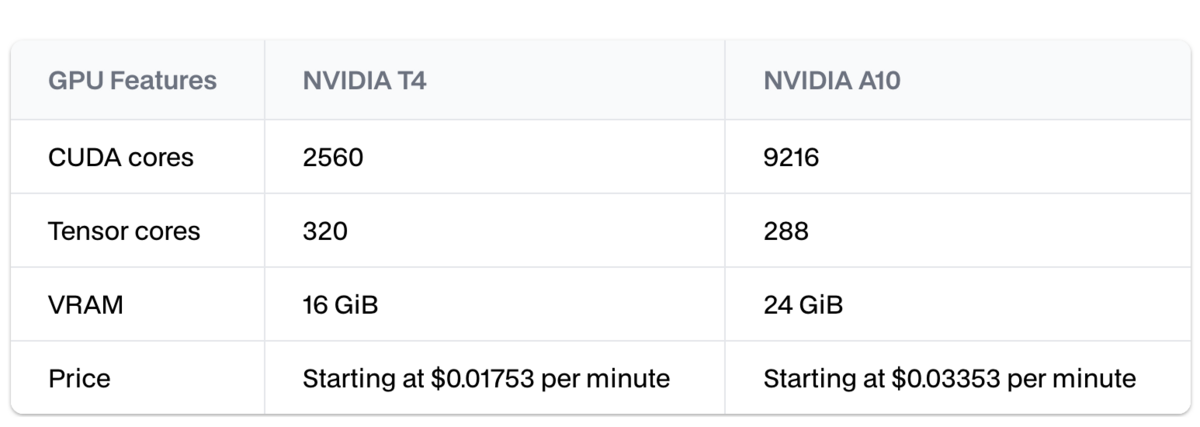
Image4

Comparison courtesy of Baseten, note the table shows NVIDIA A10s but they are identical in terms of vRAM and core count (differs in following specs)

Platform performance: remote LLM inference speedup

We are excited to announce that all Snorkel Flow features (including but not limited to Prompt LFs, Warm Start LFs, and FM Suite) which rely on third party LLM inference services like OpenAI and AzureOpenAI endpoints have become significantly faster.

We have observed a 10-20x reduction in aggregate network bound job latency between our R2 v0.93 LTS and R3 v0.95 LTS versions, and we anticipate that network bound jobs will become 50x faster by R4 v0.96 STS.

Snorkel achieved this by implementing a new robust concurrency framework which fully saturates resource quotas while preventing any given job from triggering LLM rate limits. It also implements fair scheduling for concurrent jobs, as well as caching and checkpointing for long-running jobs.

We designed this new framework to generalize and support multiple types of remote inference services (with varying rate limit and exponential back-off policies), and have made it easy to flexibly customize LLM provider constraints in SDK.
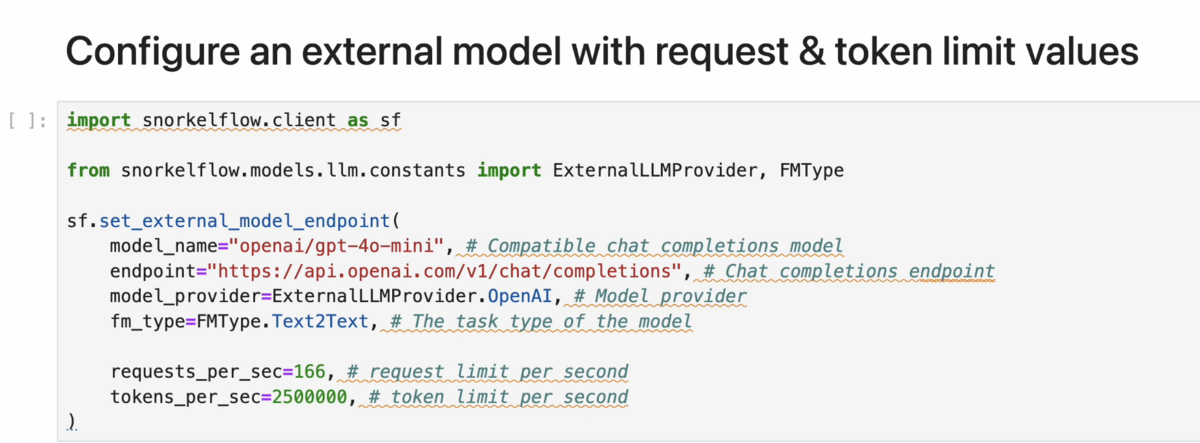
Image1

We wanted to recognize our partners from Prefect for their support in helping us construct a best in class in-process job orchestration framework. Thank you for your support, and we hope to continue contributing back to the Prefect Open Source over the next couple of releases!