


惯性聚合 高效追踪和阅读你感兴趣的博客、新闻、科技资讯
阅读原文 在惯性聚合中打开

推荐订阅源

月光博客
月光博客
钛媒体:引领未来商业与生活新知
钛媒体:引领未来商业与生活新知
人人都是产品经理
人人都是产品经理
IT之家
IT之家
Cyberwarzone
Cyberwarzone
T
Troy Hunt's Blog
有赞技术团队
有赞技术团队
阮一峰的网络日志
阮一峰的网络日志
T
Threat Research - Cisco Blogs
S
SegmentFault 最新的问题
Apple Machine Learning Research
G
GRAHAM CLULEY
cs.CL updates on arXiv.org
博客园 - 叶小钗
Last Week in AI
Last Week in AI
C
CERT Recently Published Vulnerability Notes
The Hacker News
The Hacker News
Jina AI
Jina AI
T
Tor Project blog
V
Vulnerabilities – Threatpost
酷 壳 – CoolShell
酷 壳 – CoolShell
Spread Privacy
Spread Privacy
博客园_首页
C
Cybersecurity and Infrastructure Security Agency CISA
Threat Intelligence Blog | Flashpoint
freeCodeCamp Programming Tutorials: Python, JavaScript, Git & More
Simon Willison's Weblog
Security Latest
Security Latest
cs.CV updates on arXiv.org
cs.AI updates on arXiv.org
博客园 - 司徒正美
V2EX - 技术
V2EX - 技术
I
Intezer
The Cloudflare Blog
Cisco Talos Blog
Cisco Talos Blog
SecWiki News
SecWiki News
博客园 - 【当耐特】
奇客Solidot–传递最新科技情报
奇客Solidot–传递最新科技情报
L
Lohrmann on Cybersecurity
Scott Helme
Scott Helme
Google Online Security Blog
量子位
The Last Watchdog
The Last Watchdog
AI
AI
Application and Cybersecurity Blog
S
Security Affairs
P
Palo Alto Networks Blog
S
Secure Thoughts
OSCHINA 社区最新新闻
OSCHINA 社区最新新闻
Attack and Defense Labs

Snorkel AI

Building AI-Native Systems for Federal Infrastructure: A Conversation with Rezaur Rahman Code World Models and AutoHarness for LLM Agents Benchtalks #1: Alex Shaw (Terminal-Bench, Harbor) – Building the Benchmark Factory Building FinQA: An Open RL Environment for Financial Reasoning Agents How Tool Discipline Let a 4B Model Outsmart a 235B Giant on Financial Tasks Coding agents don’t need to be perfect, they need to recover Closing the Evaluation Gap in Agentic AI SlopCodeBench: Measuring Code Erosion as Agents Iterate Introducing the Snorkel Agentic Coding Benchmark 2026: The year of environments Part V: Future Direction and Emerging Trends in Rubric-Based AI Evaluation The self-critique paradox: Why AI verification fails where it’s needed most Chat With the Terminal-Bench Team | Snorkel AI Intelligence per watt: A new metric for AI’s future Terminal-Bench 2.0: Raising the bar for AI agent evaluation Snorkeling in RL environments Introducing SnorkelSpatial: A Benchmark for LLM Spatial Reasoning Scaling Trust: Rubrics in Snorkel's Quality Process Evaluating Multi-Agent Systems in Enterprise Tool Use Evaluating Coding Agents with Terminal-Bench 2.0 Parsing isn’t neutral: why evaluation choices matter The science of rubric design The right tool for the job: An A-Z of rubrics Data quality and rubrics: how to build trust in your models Building the benchmark: inside our agentic insurance underwriting dataset Evaluating AI agents for insurance underwriting LLM observability: key practices, tools, and challenges Anthropic Claude + AWS: revolutionizing pharma data analytics with Snorkel AI Data-centric development of an enterprise AI agent with Snorkel Building the data development platform for specialized AI LLM-as-a-judge for enterprises: evaluate model alignment at scale Why GenAI evaluation requires SME-in-the-loop for validation and trust Research spotlight: is long chain-of-thought structure all that matters when it comes to LLM reasoning distillation? Why enterprise GenAI evaluation requires fine-grained metrics to be insightful What is specialized GenAI evaluation, and why is it so critical to enterprise AI? LLM alignment techniques: 4 post-training approaches Research spotlight: Is intent analysis the key to unlocking more accurate LLM question answering? Why enterprises should embrace LLM distillation Retrieval-augmented generation (RAG) failure modes and how to fix them What is large language model (LLM) alignment? Databricks + Snorkel Flow: integrated, streamlined AI development How LLM evaluation drives better models in Snorkel Flow Unlock proprietary data with Snorkel Flow and Amazon SageMaker LLM evaluation in enterprise applications: a new era in ML Snorkel AI joins the AWS ISV Accelerate Program and launches Snorkel Flow Availability in AWS Marketplace AI data development: a guide for data science projects SnorkelCon 2024: Inaugural Snorkel AI user conference gathers leaders from 30+ Fortune 500 companies Snorkel Flow 2024.R3: Supercharge your AI development with enhanced data-centric workflows Explore the new GenAI Evaluation Suite: Snorkel 2024.R3 New NLP features in Snorkel Flow 2024.R3 Enterprise data compliance and security review: Snorkel Flow 2024.R3 How a global financial services company built a specialized AI copilot accurate enough for production Task Me Anything: innovating multimodal model benchmarks Alfred: Data labeling with foundation models and weak supervision RAG: LLM performance boost with retrieval-augmented generation Call center AI for customer experience management: a case study New GenAI features, data annotation: Snorkel Flow 2024.R2 How data slices transform enterprise LLM evaluation Meta’s Llama 3.1 405B is the new Mr. Miyagi, now what? Meta’s new Llama 3.1 models are here! Are you ready for it? Data-centric AI with Snorkel and MinIO Weak supervision for non-categorical applications + superalignment Snorkel AI signs strategic collaboration agreement with AWS to help enterprises cross the demo-to-production chasm AI alignment made simple: innovative solutions for businesses How does the Snorkel Flow label model work? Vision language models: how LLMs boost image classification Long context models in the enterprise: benchmarks and beyond How to build production-grade RAG retrieval with Snorkel Flow How Bonito helps fine-tune specialized LLMs faster than ever Walking safely before building flying saucer seatbelts: introducing Enterprise Alignment Role-based access controls in Snorkel Flow secure enterprise data Accelerating AI development in manufacturing with Snorkel Flow and AWS SageMaker How ROBOSHOT boosts zero-shot foundation model performance Discover what’s new in Snorkel Flow: Flexible data and LLM connectivity, secure data controls, and more! Faster than ever document intelligence with new Snorkel Flow FM-first workflow The art of data development for Enterprise LLMs Crossing the demo-to-production chasm with Snorkel Custom How Snorkel topped the AlpacaEval leaderboard (and why we're not there anymore) CRFM's HELM and enterprise LLM evaluation beyond accuracy How we achieved 89% accuracy on contract question answering Five sessions not to miss at Google Cloud Next 24 Content filtering breakthrough: Snorkel client reaches 96% recall in 3 days Here's how Snorkel Flow + Google AI built an enterprise-ready model in a day Snorkel teams with Microsoft to showcase new AI research at NVIDIA GTC How Skill-it! enables faster, better LLM training Fine-tuned representation models boost LLM systems. Here's how Enterprise GenAI to surge in 2024: survey results Large language model training: how three training phases shape LLMs LLM distillation demystified: a complete guide Enterprises must shift their focus from models to data in AI development Insurance’s GenAI revolution: a business perspective Scaling human preferences in AI: Snorkel's programmatic approach Building better enterprise AI: incorporating expert feedback in system development “Fall in love with your data”—Snorkel AI’s Enterprise LLM Summit Why QBE Ventures invested in Snorkel AI New benchmark results demonstrate value of Snorkel AI approach to LLM alignment Retrieval augmented generation (RAG): a conversation with its creator Snorkel Flow 2023.R4: enhanced UI + PDF and Databricks tools How Snorkel Flow users can register custom models to Databricks Stanford professor discusses exciting advances in foundation model evaluation
LoRA: Low-Rank Adaptation for LLMs
Matt Casey · 2024-02-22 · via Snorkel AI

Large language models promise enormous functionality. Trained on internet-scale datasets, off-the-shelf LLMs handle many general reasoning tasks remarkably well without any additional training. Reaching high performance on specific tasks, however, requires additional customization. At tens of billions of parameters, customizing an entire LLM costs significant time and money. But data scientists have developed a shortcut: Low-Rank Adaptation, also known as LoRA.

LoRA shrinks the difficulty of training and fine-tuning large language models (LLMs) by reducing the number of trainable parameters and producing lightweight and efficient models. Data scientists can also apply LoRA to large-scale multi-modal or non-language generative models, such as Stable Diffusion

Table of contents

    LoRA: through the low-rank looking glass

    LoRA is one form of parameter-efficient fine-tuning, abbreviated PEFT. The central idea underlying LoRA, and PEFT more generally, is to approximate the update to a large parameter model using a low-dimension update. This low-dimension update contains most of the information (gradient signal) contained in the full update but requires much less computation time and memory.

    Intuition

    LoRA doesn’t change the underlying model, but it changes how the model emphasizes different connections. Think of each low-rank matrix as a filter. Most photo applications offer pre-made filters that users can apply to their images to evoke different moods. A sepia filter makes photos look older. Adding a vignette filter makes the photos feel more cinematic.

    LoRA matrices work similarly, though more subtly. Through their chosen training data, data scientists and machine learning engineers can modulate the model’s response to perform better on a particular topic or task or to render responses in a particular tone. Because this doesn’t alter the underlying model, they can train different LoRA “filters” for different applications and apply them to the same model.

    Algorithmic details

    The genesis of LoRA was a paper by Microsoft researchers Edward Hu, et. al. In this work, they apply their technique to the use case of fully fine-tuning the GPT-3 175B model and show that LoRA “reduces the number of trainable parameters by 10,000 times and the GPU memory requirement by 3 times.” These are immense savings that make full LLM fine-tuning feasible and cost-effective for those who are compute constrained.

    The idea behind the technique is simple: Given a layer’s weight matrix W0, the weights are updated during each iteration of fine-tuning as W0 = W0 + ∇W, where ∇W is the gradient of the weight matrix. Computing this update matrix is what takes the bulk of time and GPU resources in finetuning. The researchers cleverly note that one can approximate and greatly simplify the update computation by breaking ∇W into a product of low-rank matrices.

    Mathematically, you can think of this as projecting the weight matrix into two low-dimensional subspaces (where the learning now occurs) and then reconsolidating it in the original space. LoRA can be applied to any and all weights in the model, including the attention weights. Data scientists can use a number of approaches to select which weight matrices to update.

    Efficiency and runtime analysis

    Studies have shown that LoRA training pipelines can use incredibly small rank-decomposition subspaces (relative to the size of the original space). Doing so allows data scientists to fine-tune an LLM such as GPT-3 by updating as few as 0.01% of the original parameters.

    PEFT and LoRA implementations

    Popular deep learning libraries offer PEFT implementations, such as PyTorch Lightning’s Lit-GPT and HuggingFace’s PEFT, that accelerate the process of getting to a fine-tuned model. Configuring PEFT is particularly simple in HuggingFace. Doing so requires only a quick import statement followed by wrapping a base HuggingFace Transformers model. From their blog post, all you need is to add the following lines to your code to integrate PEFT into your finetuning workflow.

    Starting with imports…

    from transformers import AutoModelForSeq2SeqLM
    
    + from peft import get_peft_model, LoraConfig, TaskType
    
      model_name_or_path = "bigscience/mt0-large"
    
      tokenizer_name_or_path = "bigscience/mt0-large"

    And subsequently define an appropriate config…

    peft_config = LoraConfig(
    
        task_type=TaskType.SEQ_2_SEQ_LM, inference_mode=False, r=8, lora_alpha=32, lora_dropout=0.1
    
    )

    And finally wrapping the base Transformers model…

    model = AutoModelForSeq2SeqLM.from_pretrained(model_name_or_path)
    
    + model = get_peft_model(model, peft_config)
    
    + model.print_trainable_parameters()
    
    # output: trainable params: 2359296 || all params: 1231940608 || trainable%: 0.19151053100118282

    LoRA/PEFT + scalable data curation

    Appropriate data selection forms the foundation for all machine learning customization efforts—whether that’s a simple logistic regression model or a LoRA-customizated generative AI (GenAI) model.

    For LoRA and other GenAI fine-tuning approaches, data scientists and machine learning engineers must ensure that they have a sufficient number of high-quality, domain-appropriate prompt and response pairs for each of the tasks that they care about. Depending on the number and complexity of the target tasks, this could require tens of thousands of examples. Few organizations possess this data in a usable form. The vast majority would require labeling and curation. Manual approaches to preparing this data often prove unworkable due to time, cost, or privacy concerns.

    The Snorkel Flow AI data development platform allows users to clear this challenge through scalable data labeling solutions. For example, two of our researchers used programmatic labeling functions in Snorkel Flow to curate 20,000 examples from the OpenAssistant and Dolly 2.0 data sets down to the best 10,000 examples in about a day.

    The original version fo the RedPajama open source LLM used the entire 20,000 examples. Our researchers fine-tuned a separate version using their curated 10,000 examples. In double-blind study, human testers preferred our researchers’ version of the model in every category. Snorkel researchers and engineers have since used similar approaches to improve generative applications for some of the largest companies in the world.

    <EMBED VIDEO OF CHRIS GLAZE TALK>

    Getting LoRA right

    Practitioners such as Sebastian Raschka have established a number of tips and tricks that are crucial to getting full performance out of LoRA. Here are some essential heuristics.

    • Adjust the scaling factor alpha in the LoRA update. As a general rule of thumb, set alpha to be twice the rank of the decomposition, i.e. alpha = 2 * r.
    • Even with LoRA, you’ll still need a decently specced GPU. Expect to need about 14GB of GPU RAM to finetune a 7 billion parameter LLM.
    • If you’re resource-constrained, try using QLoRA. You should get about a 33% reduction in GPU memory usage (14GB → 9.37GB) at the cost of about a 40% increase in runtime.
    • Ideally, use Adam or AdamW as your optimizer. If you have to use SGD, be sure to do so with a cosine annealing learning rate scheduler.
    • Using LoRA, you can fine tune in as little as a single epoch (and often fewer is better, due to overfitting).
    • Use LoRA everywhere: there’s no reason not to. LoRA can be applied to dense layers, attention weights, adaptation heads, and projection layers. Using it everywhere seems to help performance and yield additional savings on GPU memory and runtime.

    LoRA variants

    LoRA’s simplicity and effectiveness have catalyzed a whole thread of research centered on developing LoRA variants. Some of the most popular variants include:

    • QLoRA: a quantized version of LoRA
    • QALoRA: a combination of PEFT and quantization applied to LoRA
    • LongLoRA: adapts LoRA to longer context lengths
    • S-LoRA: a scalable version of LoRA that optimizes memory usage
    • Tied-LoRA: LoRA with weight-tying for increased parameter efficiency

    Many other variants have been proposed, and even more are in the works.
    Other PEFT Methods

    Image4

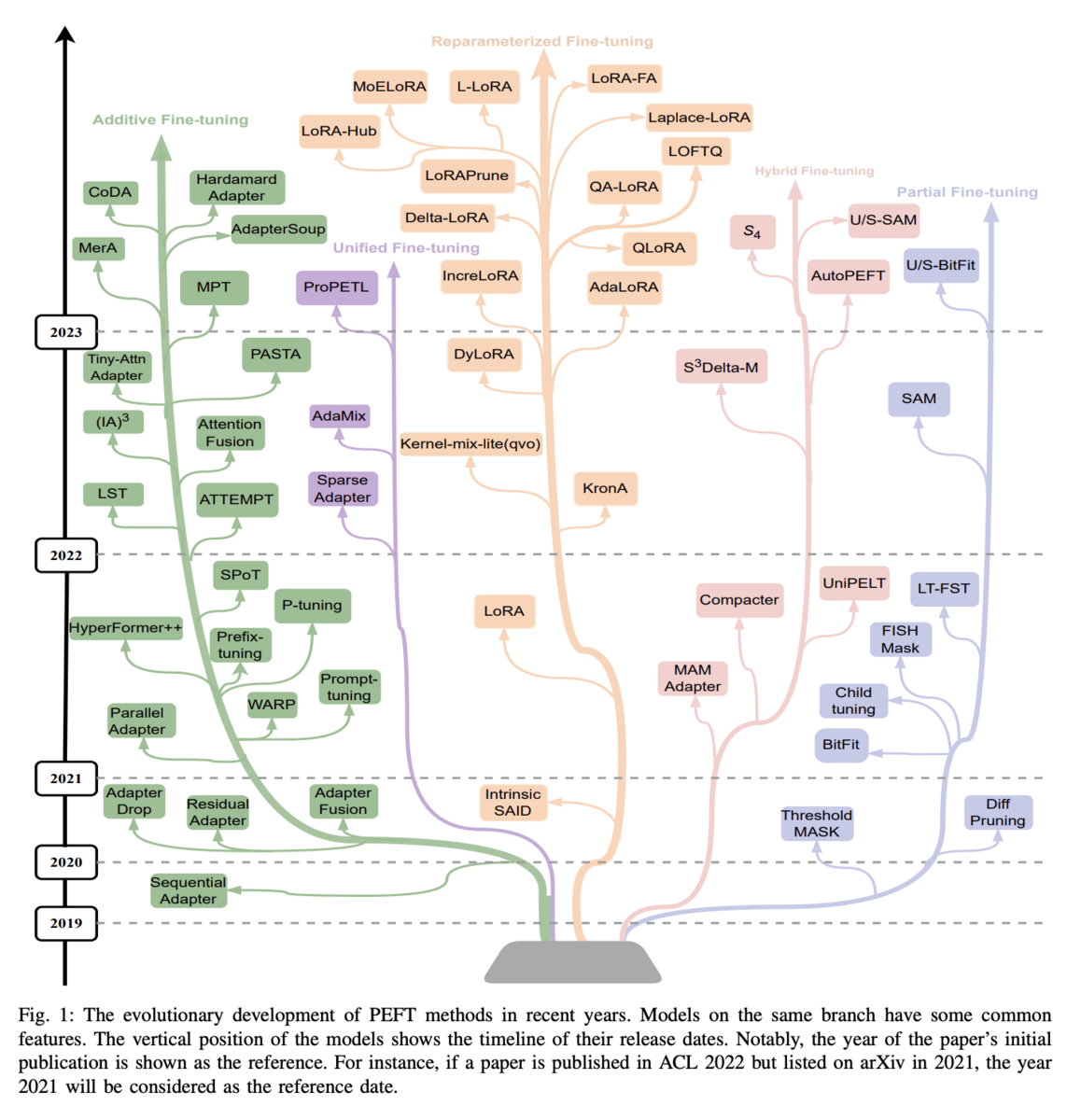
    This survey paper provides an excellent overview of the ecosystem of parameter-efficient finetuning methods. While LoRA falls under the umbrella of reparameterized fine-tuning methods, there are four additional categories of methods: additive fine-tuning, hybrid fine-tuning, partial fine-tuning, and unified fine-tuning.

    • Additive fine-tuning approaches introduce additional parameters to the model in order to perform task-specific fine-tuning. Examples of additive fine-tuning methods include CoDA and LST.
    • Partial fine-tuning approaches operate within a model’s original parameter space. They perform adaptation by selecting a subset of the existing weights most useful for a downstream task. Examples of this approach include SAM and LT-SFT.
    • Reparameterized fine-tuning methods take the classical LoRA approach by learning a low-rank approximation to a high-rank matrix update.
    • Hybrid fine-tuning methods combine the unique benefits of different PEFT approaches – adapter, prefix, and LoRA – in an effort to achieve the best of all worlds. Examples of the hybrid approach include UniPELT and AutoPEFT.
    • Unified fine-tuning methods resemble hybrid fine tuning approaches, but they provide theoretically-motivated architectures for combining methods into a single framework. Examples include AdaMix and SparseAdapter.

    Comparing LoRA & PEFT Methods

    The following table from the Xu et. al. paper summarizes performance (in terms of GPU memory consumption) across a variety of PEFT methods.
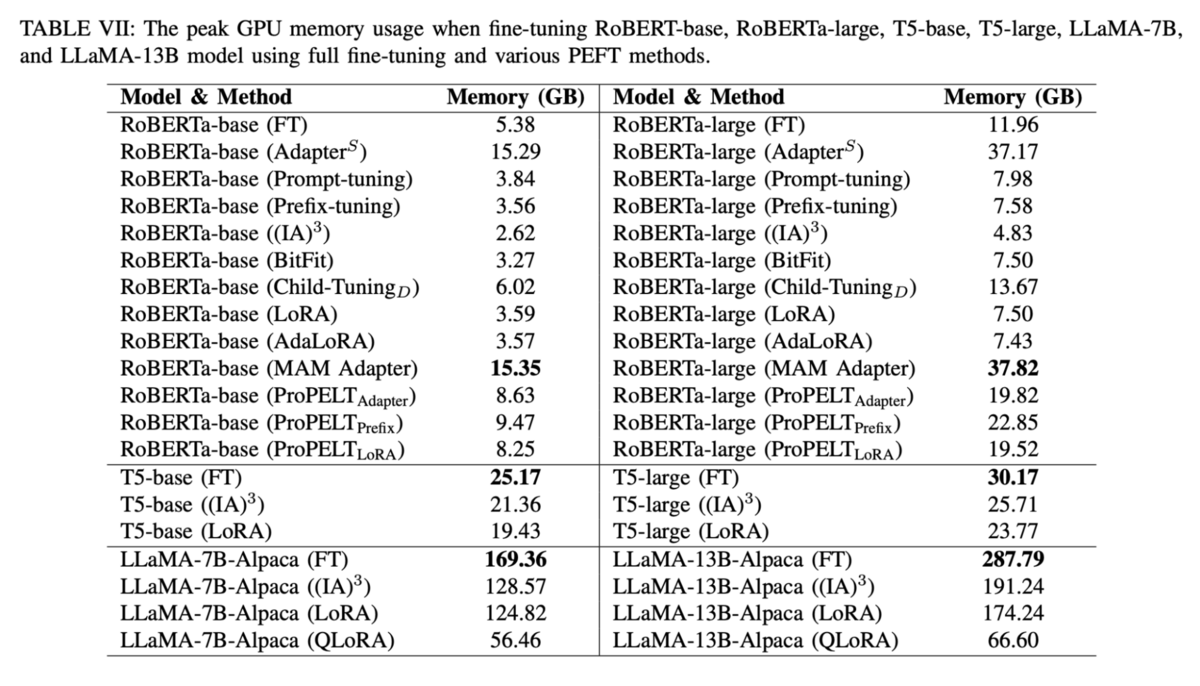
    Image1

    One takeaway is that the reduction in GPU memory usage provided by the use of LoRA and PEFT is huge, ranging anywhere from 25-100% depending on the type and size of the model. Furthermore, if you are willing to sacrifice some accuracy, quantized versions of LoRA can further cut memory usage by half or more. However, some hybrid and additive fine-tuning methods such as MAM can increase memory usage.

    Another table from the paper further emphasizes these points
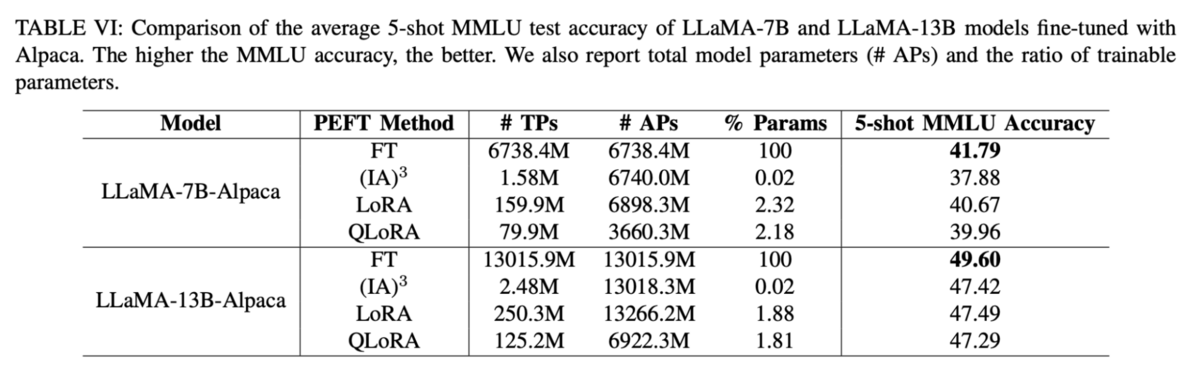
    Image6

    For only a slight reduction in downstream task performance, LoRA and QLoRA can perform comparably to the original LLaMA-7/13B-Alpaca models but with parameter counts at only about 2% of the originals.

    LoRA: customize generative models faster

    LoRA provides one of the best and easiest ways to reduce LLM parameter counts and memory usage and increase the speed of fine-tuning and inference. The availability and ease-of-use of open source implementations, such as those provided by HuggingFace, allow for plug-and-play adaptations of LoRA and PEFT methods to any LLM.

    While many variants of LoRA have been proposed, along with hybrid approaches that combine the benefits of different algorithms, simple approaches such as the original LoRA and QLoRA are enough to provide extreme reductions in memory usage and runtime. Additionally, to get the most out of LoRA, practitioners such as Sebastian Raschka have provided thorough guides that detail optimal hyperparameter settings and strategies for utilizing these methods.

    Learn More

    Follow Snorkel AI on LinkedInTwitter, and YouTube to be the first to see new posts and videos!