


惯性聚合 高效追踪和阅读你感兴趣的博客、新闻、科技资讯
阅读原文 在惯性聚合中打开

推荐订阅源

N
News and Events Feed by Topic
S
Security @ Cisco Blogs
S
Secure Thoughts
Attack and Defense Labs
cs.AI updates on arXiv.org
Hacker News - Newest:
Hacker News - Newest: "LLM"
Recent Commits to openclaw:main
H
Hacker News: Front Page
博客园 - 叶小钗
H
Heimdal Security Blog
Microsoft Security Blog
Forbes - Security
Forbes - Security
AI
AI
cs.CV updates on arXiv.org
T
Troy Hunt's Blog
罗磊的独立博客
Application and Cybersecurity Blog
爱范儿
爱范儿
GbyAI
GbyAI
The Last Watchdog
The Last Watchdog
TaoSecurity Blog
TaoSecurity Blog
C
CXSECURITY Database RSS Feed - CXSecurity.com
D
DataBreaches.Net
Recent Announcements
Schneier on Security
C
Cisco Blogs
美团技术团队
D
Docker
让小产品的独立变现更简单 - ezindie.com
WordPress大学
WordPress大学
月光博客
月光博客
雷峰网
雷峰网
Threat Intelligence Blog | Flashpoint
H
Hackread – Cybersecurity News, Data Breaches, AI and More
A
Arctic Wolf
B
Blog RSS Feed
Cisco Talos Blog
Cisco Talos Blog
C
Cybersecurity and Infrastructure Security Agency CISA
V
Vulnerabilities – Threatpost
V2EX - 技术
V2EX - 技术
Y
Y Combinator Blog
N
News and Events Feed by Topic
www.infosecurity-magazine.com
W
WeLiveSecurity
Security Archives - TechRepublic
G
GRAHAM CLULEY
Jina AI
Jina AI
Hugging Face - Blog
Hugging Face - Blog
酷 壳 – CoolShell
酷 壳 – CoolShell
The Hacker News
The Hacker News

Snorkel AI

Building AI-Native Systems for Federal Infrastructure: A Conversation with Rezaur Rahman Code World Models and AutoHarness for LLM Agents Benchtalks #1: Alex Shaw (Terminal-Bench, Harbor) – Building the Benchmark Factory Building FinQA: An Open RL Environment for Financial Reasoning Agents How Tool Discipline Let a 4B Model Outsmart a 235B Giant on Financial Tasks Coding agents don’t need to be perfect, they need to recover Closing the Evaluation Gap in Agentic AI SlopCodeBench: Measuring Code Erosion as Agents Iterate Introducing the Snorkel Agentic Coding Benchmark 2026: The year of environments Part V: Future Direction and Emerging Trends in Rubric-Based AI Evaluation The self-critique paradox: Why AI verification fails where it’s needed most Chat With the Terminal-Bench Team | Snorkel AI Intelligence per watt: A new metric for AI’s future Terminal-Bench 2.0: Raising the bar for AI agent evaluation Snorkeling in RL environments Introducing SnorkelSpatial: A Benchmark for LLM Spatial Reasoning Scaling Trust: Rubrics in Snorkel's Quality Process Evaluating Multi-Agent Systems in Enterprise Tool Use Evaluating Coding Agents with Terminal-Bench 2.0 Parsing isn’t neutral: why evaluation choices matter The science of rubric design The right tool for the job: An A-Z of rubrics Data quality and rubrics: how to build trust in your models Building the benchmark: inside our agentic insurance underwriting dataset Evaluating AI agents for insurance underwriting LLM observability: key practices, tools, and challenges Anthropic Claude + AWS: revolutionizing pharma data analytics with Snorkel AI Data-centric development of an enterprise AI agent with Snorkel Building the data development platform for specialized AI LLM-as-a-judge for enterprises: evaluate model alignment at scale Why GenAI evaluation requires SME-in-the-loop for validation and trust Research spotlight: is long chain-of-thought structure all that matters when it comes to LLM reasoning distillation? Why enterprise GenAI evaluation requires fine-grained metrics to be insightful What is specialized GenAI evaluation, and why is it so critical to enterprise AI? LLM alignment techniques: 4 post-training approaches Research spotlight: Is intent analysis the key to unlocking more accurate LLM question answering? Why enterprises should embrace LLM distillation Retrieval-augmented generation (RAG) failure modes and how to fix them What is large language model (LLM) alignment? Databricks + Snorkel Flow: integrated, streamlined AI development How LLM evaluation drives better models in Snorkel Flow Unlock proprietary data with Snorkel Flow and Amazon SageMaker LLM evaluation in enterprise applications: a new era in ML Snorkel AI joins the AWS ISV Accelerate Program and launches Snorkel Flow Availability in AWS Marketplace AI data development: a guide for data science projects SnorkelCon 2024: Inaugural Snorkel AI user conference gathers leaders from 30+ Fortune 500 companies Snorkel Flow 2024.R3: Supercharge your AI development with enhanced data-centric workflows Explore the new GenAI Evaluation Suite: Snorkel 2024.R3 New NLP features in Snorkel Flow 2024.R3 Enterprise data compliance and security review: Snorkel Flow 2024.R3 How a global financial services company built a specialized AI copilot accurate enough for production Task Me Anything: innovating multimodal model benchmarks RAG: LLM performance boost with retrieval-augmented generation Call center AI for customer experience management: a case study New GenAI features, data annotation: Snorkel Flow 2024.R2 How data slices transform enterprise LLM evaluation Meta’s Llama 3.1 405B is the new Mr. Miyagi, now what? Meta’s new Llama 3.1 models are here! Are you ready for it? Data-centric AI with Snorkel and MinIO Weak supervision for non-categorical applications + superalignment Snorkel AI signs strategic collaboration agreement with AWS to help enterprises cross the demo-to-production chasm AI alignment made simple: innovative solutions for businesses How does the Snorkel Flow label model work? Vision language models: how LLMs boost image classification Long context models in the enterprise: benchmarks and beyond How to build production-grade RAG retrieval with Snorkel Flow How Bonito helps fine-tune specialized LLMs faster than ever Walking safely before building flying saucer seatbelts: introducing Enterprise Alignment Role-based access controls in Snorkel Flow secure enterprise data Accelerating AI development in manufacturing with Snorkel Flow and AWS SageMaker How ROBOSHOT boosts zero-shot foundation model performance Discover what’s new in Snorkel Flow: Flexible data and LLM connectivity, secure data controls, and more! Faster than ever document intelligence with new Snorkel Flow FM-first workflow The art of data development for Enterprise LLMs Crossing the demo-to-production chasm with Snorkel Custom How Snorkel topped the AlpacaEval leaderboard (and why we're not there anymore) CRFM's HELM and enterprise LLM evaluation beyond accuracy How we achieved 89% accuracy on contract question answering Five sessions not to miss at Google Cloud Next 24 Content filtering breakthrough: Snorkel client reaches 96% recall in 3 days Here's how Snorkel Flow + Google AI built an enterprise-ready model in a day Snorkel teams with Microsoft to showcase new AI research at NVIDIA GTC How Skill-it! enables faster, better LLM training Fine-tuned representation models boost LLM systems. Here's how Enterprise GenAI to surge in 2024: survey results Large language model training: how three training phases shape LLMs LoRA: Low-Rank Adaptation for LLMs LLM distillation demystified: a complete guide Enterprises must shift their focus from models to data in AI development Insurance’s GenAI revolution: a business perspective Scaling human preferences in AI: Snorkel's programmatic approach Building better enterprise AI: incorporating expert feedback in system development “Fall in love with your data”—Snorkel AI’s Enterprise LLM Summit Why QBE Ventures invested in Snorkel AI New benchmark results demonstrate value of Snorkel AI approach to LLM alignment Retrieval augmented generation (RAG): a conversation with its creator Snorkel Flow 2023.R4: enhanced UI + PDF and Databricks tools How Snorkel Flow users can register custom models to Databricks Stanford professor discusses exciting advances in foundation model evaluation
Alfred: Data labeling with foundation models and weak supervision
kedia · 2024-08-27 · via Snorkel AI

As enterprises and individuals better understand the power of machine learning tools, they often find themselves blocked by the same thing: a lack of high-quality training data. Anyone familiar with Snorkel AI knows that manual labeling presents scalability and data privacy challenges. As a researcher focused on data labeling solutions, I’m excited to introduce Alfred, an open-source tool for combining foundation models with weak supervision.

I recently presented my project to Snorkel AI researchers. You can watch the entire talk (embedded below), but I have summarized the main points here.

What is Alfred?

Alfred is a python library designed to streamline the use of foundation models (FMs) to make it easier for data scientists and researchers to use them to label data at scale.

Traditional data annotation methods often involve time-consuming and costly manual processes. Using FMs to label data directly can create inaccurate results. Alfred aims to address these limitations.

To do this, Alfred allows users to define labeling rules in plain language as prompts to FMs, such as Llama 3.1, GPT-4, or CLIP. Then it denoises and synergizes the models’ responses through weak supervision.

Alfred was initially designed with academic researchers in mind, offering a tool to streamline data science projects in academic settings. While its current iteration may not fully address the complex needs of enterprise data teams, Alfred incorporates fundamental principles similar to those found in the Snorkel Flow AI data development platform, which is enterprise-ready.
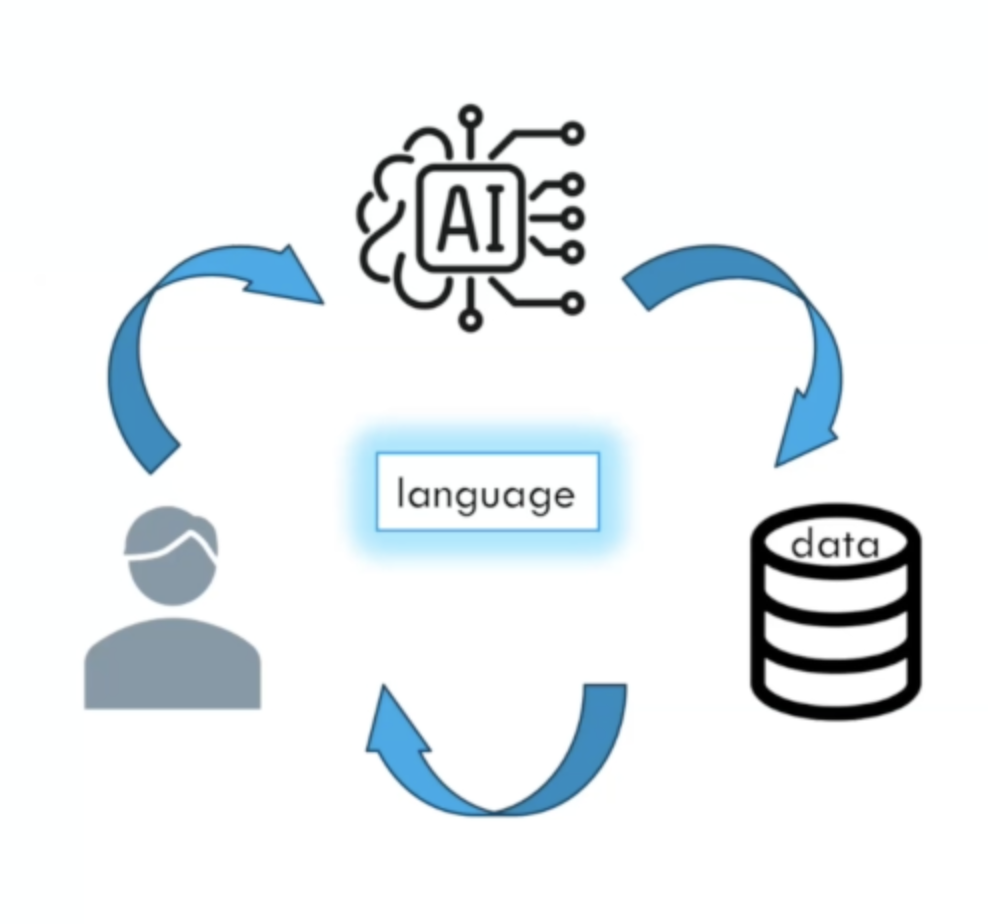
How Alfred works

Alfred enables users—even relatively non-technical ones—to multiply their labeling impact. By transforming rigid code-based labeling functions into flexible natural language prompts, Alfred allows non-experts to leverage the expertise of pre-trained foundation models, making the annotation process more accessible.

Here’s what that process looks like:

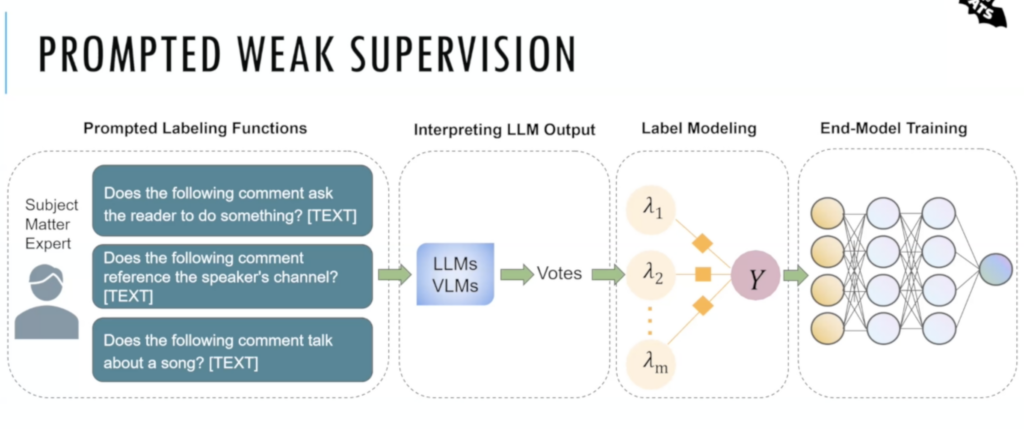
  1. Heuristics development: Users create informative heuristics as prompt templates, which are then processed to generate typed query objects. This step allows for the translation of domain expertise into a format that foundation models can understand and act upon.
  2. Query and response processing: Alfred sends the prepared prompts to the user’s chosen FM, whether it’s hosted locally, on a server, in the cloud, or accessed through APIs like GPT-4 or Claude. The system then interprets the model’s responses, converting them into numerical values suitable for subsequent voting mechanisms.
  3. Probabilistic labeling: In this final stage, Alfred applies the user-selected label models (such as FlyingSquid, Noisy Partial Label Model, or other algorithms) to transform the aggregated, potentially noisy votes into high-quality, probabilistic labels.

With Alfred, users layer heuristics on top of each other. They can write labeling prompts that address different aspects of their target records. They can even use different models. From our empirical studies, we’ve found that using multiple models for the same heuristics improves accuracy by offsetting individual model biases.
Key features of Alfred

In addition to providing an easy-to-use wrapper, my colleagues at Brown and I have built several useful features into Alfred, such as:

  • Optimized Inference Throughput: Alfred packages inference requests together, achieving 2-3x faster processing compared to standard methods. This minimizes the number of queries sent to the foundation model, significantly speeding up data labeling.
  • Flexible Model Support: Alfred works with a wide range of language and multi-modal foundation models. It supports cloud-based API services from companies like Anthropic, OpenAI, and Google, and self-hosted open-source models. This flexibility lets users choose the best option for their needs.
  • User-Friendly Development: Alfred offers a consistent experience whether users are working with local models, Alfred-hosted servers, or third-party APIs. This unified interface allows for rapid iteration and refinement, regardless of where the AI models are running. Users enjoy the same smooth workflow whether the model is on their laptop or a remote cluster.
  • Easy-to-Use Templates: The system includes tools for quickly creating, testing, and improving labeling rules. These templates work consistently across all supported model types, allowing users to efficiently develop and refine their approach.
  • Smart Label Aggregation: Alfred includes several methods for combining labels from different sources, helping to produce more accurate final labels for training data.


Alfred aims to integrate more automation in future updates, utilizing language models to further streamline template creation and other stages of the workflow.

Alfred in action: sentiment analysis and image classification

In my presentation, I gave two examples of how Alfred can help in the real world.

In the first, we looked at an application to classify the sentiment of financial newss headlines. Very quickly, we noticed headlines that mentioned price targets going up or down. This could serve as a good heuristic. Traditionally, a user might use a regular expression to capture this signal, but regex would miss headlines that used synonyms or even where the writer ordered their words differently.

With Alfred, we can skip the regex and prompt a large language model (LLM). We can create a template that presents the headline to the LLM and asks it which sentiment category the headline falls into—neutral, positive, or negative.
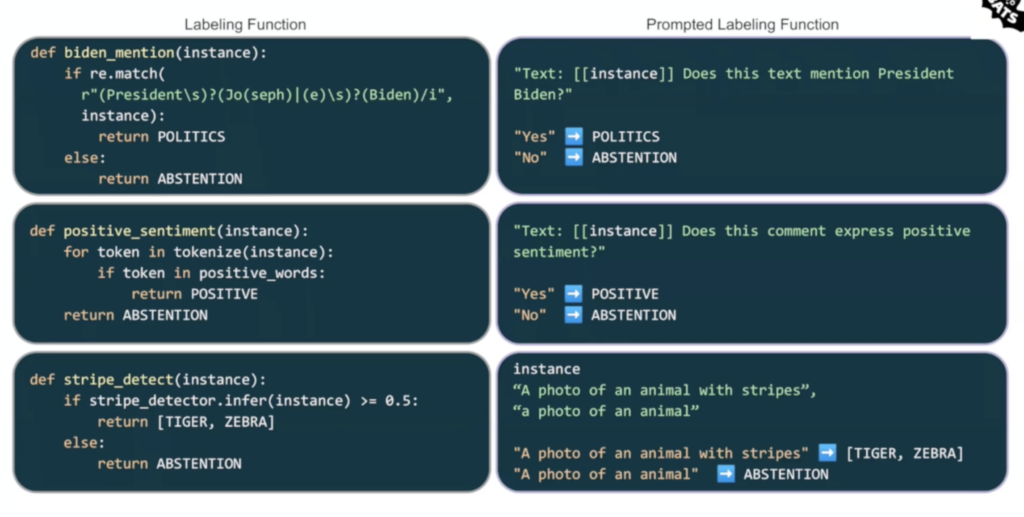
In the second, we demonstrated image Data Annotation. For tasks involving image data, Alfred supports contrastive models like CLIP and autoregressive models like BLIP to simplify attribute-based classification. Here, again, our templates help us efficiently present the information to the model and process a response.

Common challenges addressed by Alfred

One of the significant challenges in data annotation is managing the complexity and computational demands of foundation models. Alfred addresses these through:

  • Dynamic batching: By automatically grouping queries of similar lengths, Alfred reduces the impact of useless padding, increasing throughput by up to 2.9x.
  • Caching mechanisms: The system caches query and response data to reduce redundant model queries, enhancing efficiency.

Alfred: foundation models + weak supervision

Our Alfred package represents a significant leap forward in open-source programmatic weak supervision. It offers a flexible, efficient, and user-friendly system that enhances data annotation and model training. We believe that Alfred will serve as a cornerstone for future machine learning applications—especially for academic projects— driving innovation and simplifying complex data workflows.

Learn More

Follow Snorkel AI on LinkedInTwitter, and YouTube to be the first to see new posts and videos!