




惯性聚合 高效追踪和阅读你感兴趣的博客、新闻、科技资讯
阅读原文 在惯性聚合中打开

推荐订阅源

Microsoft Security Blog
Apple Machine Learning Research
美团技术团队
WordPress大学
WordPress大学
酷 壳 – CoolShell
酷 壳 – CoolShell
G
Google Developers Blog
阮一峰的网络日志
阮一峰的网络日志
The Cloudflare Blog
J
Java Code Geeks
Martin Fowler
Martin Fowler
M
MIT News - Artificial intelligence
IT之家
IT之家
博客园 - 三生石上(FineUI控件)
月光博客
月光博客
Google DeepMind News
小众软件
小众软件
V
V2EX
Hugging Face - Blog
Hugging Face - Blog
爱范儿
爱范儿
OSCHINA 社区最新新闻
OSCHINA 社区最新新闻
Jina AI
Jina AI
freeCodeCamp Programming Tutorials: Python, JavaScript, Git & More
腾讯CDC
B
Blog

Samsung Global Newsroom

[Video] Where Robotics Meets Precision: Samsung Displays Shape KUKA’s Immersive Showroom [Interview] Where Sound Meets Design — Redefining the Audio Experience With Music Studio Samsung and MUNCH Museum Bring Rarely Seen Masterpieces to Samsung Art Store Samsung Electronics Vietnam Becomes First Company in Vietnam To Purchase Renewable Electricity Through DPPA – Samsung Global Newsroom Samsung Highlights Vision for AI-Powered Connected Care at VivaTech 2026 [Infographic] Exploring the 2026 Samsung Odyssey G8 & G7 Models at a Glance: From the Industry-First 6K to OLED Samsung Electronics and LG Uplus Collaborate on ISAC Technology for 6G Samsung Electronics Begins Shipment of Industry-First HBM4E Samples Samsung and Massachusetts General Hospital Launch Joint Study To Investigate GLP-1 Treatment Monitoring With Galaxy Watch [Interview] The Future of Screen Experiences, Part ①: Inside Samsung’s Micro RGB TV, Setting a New Standard for Next-Generation Displays Samsung TV Plus Brings Monthly SM K-Pop Concert Series to Fans at Home [Infographic] Samsung AI Appliances Deliver Inclusive Experiences Through Enhanced Accessibility Features Traveling With Peace of Mind: Why Samsung Care+ Is Your Essential Summer Holiday Companion Samsung and Google Give First Look at New Intelligent Eyewear Samsung Launches Next-Gen Odyssey Gaming and ViewFinity Monitors, Including Industry’s First 6K Gaming Monitor Samsung Art Store Welcomes the Wonderful World of the Moomins in New Global Collaboration Samsung Presents AI-Powered Screen Innovations at Australian Tech Summit 2026 Samsung Launches Samsung AI Week 2026 for AI-Powered Living Samsung Adopts New EU Code of Conduct for Energy Smart Appliances Samsung To Launch 2026 Bespoke AI Laundry Combo, Advancing All-in-One Comfort Lifestyle Samsung Solve for Tomorrow Wins Merit Award at 2026 Global Views ESG Corporate Sustainability Awards – Samsung Global Newsroom Samsung Launches One UI 9 Beta for Galaxy S26 Series Users Samsung Expands AI Capabilities of Bespoke AI Refrigerator Family Hub With Major Updates [Interview] When a Washer Becomes Furniture: Meet the Designers Behind the Red Dot Design Award 2026 [Video] How Samsung’s Spatial Signage Transforms the Attraction Queue Into an Immersive Safari Experience at Everland [Interview] From TV to a Work of Art: Samsung’s Design Innovation at the Red Dot Design Award 2026 [Interview] Make Every Moment Cinematic: How Cinematic LUT Transforms Video on the Galaxy S26 Series Samsung Announces World-First Breakthrough in Fainting Prediction With Galaxy Watch Samsung and Qualcomm Achieve Industry-First Power Class 1 Validation for 5G Fixed Wireless Access on Virtualized RAN Samsung’s One UI 8.5 Official Rollout Starts May 6
Samsung and POSTECH Publish 2D/3D Switchable Display Rese...
Samsung Newsroom · 2026-04-23 · via Samsung Global Newsroom

Samsung Electronics and POSTECH have published a research paper titled “Switchable 2D-3D display through a metasurface lenticular lens” in the prestigious journal Nature, marking notable progress in next-generation display technology through industry-academia collaboration.

Rethinking 3D Displays With Metasurfaces

A metasurface lenticular lens-based switchable 2D/3D display uses an ultra-thin metalens1 composed of nanoscale structures to transition seamlessly between flat (2D) and stereoscopic (3D) images.

A metasurface is significantly thinner while enabling complex optical functions — making it key to next-generation displays and camera systems.
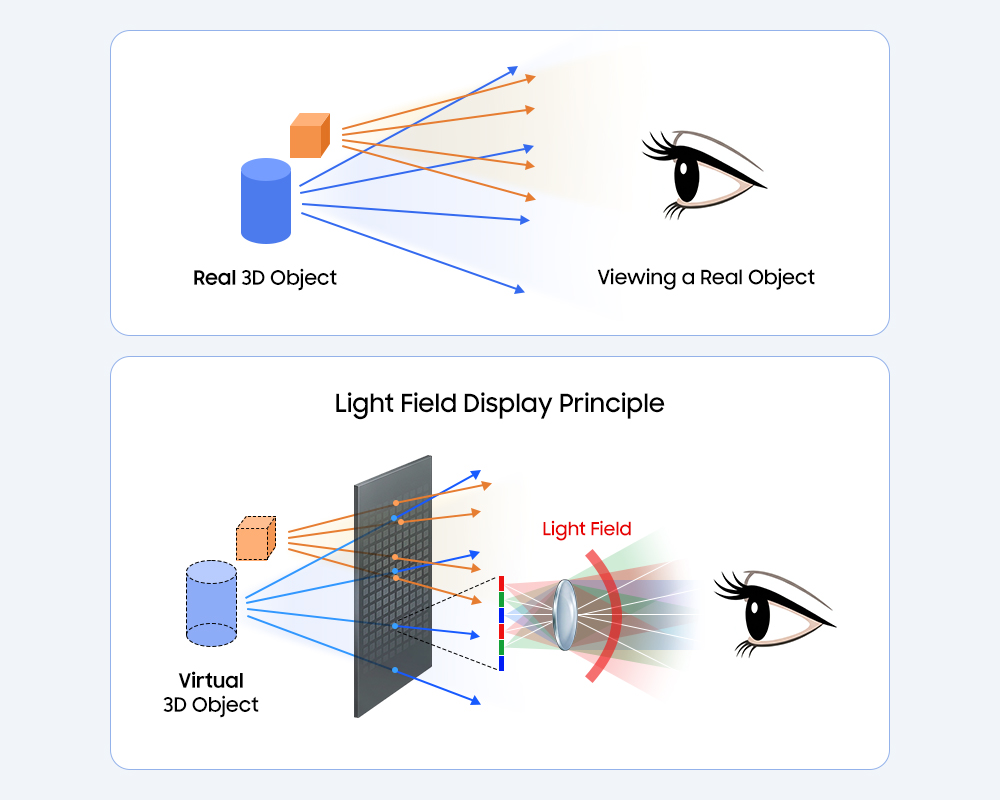
A Light Field Display presents different images depending on the viewing angle.
▲ A Light Field Display presents different images depending on the viewing angle.

This approach advances Light Field Display by directing light from multiple angles to create a glasses-free 3D experience that mimics real-world perception.

Though long considered promising for entertainment, augmented reality (AR) and medical imaging, conventional Light Field Displays face commercialization challenges, including bulky optics, narrow viewing angles (around 15 degrees), reduced resolution and reliance on real-time eye tracking.

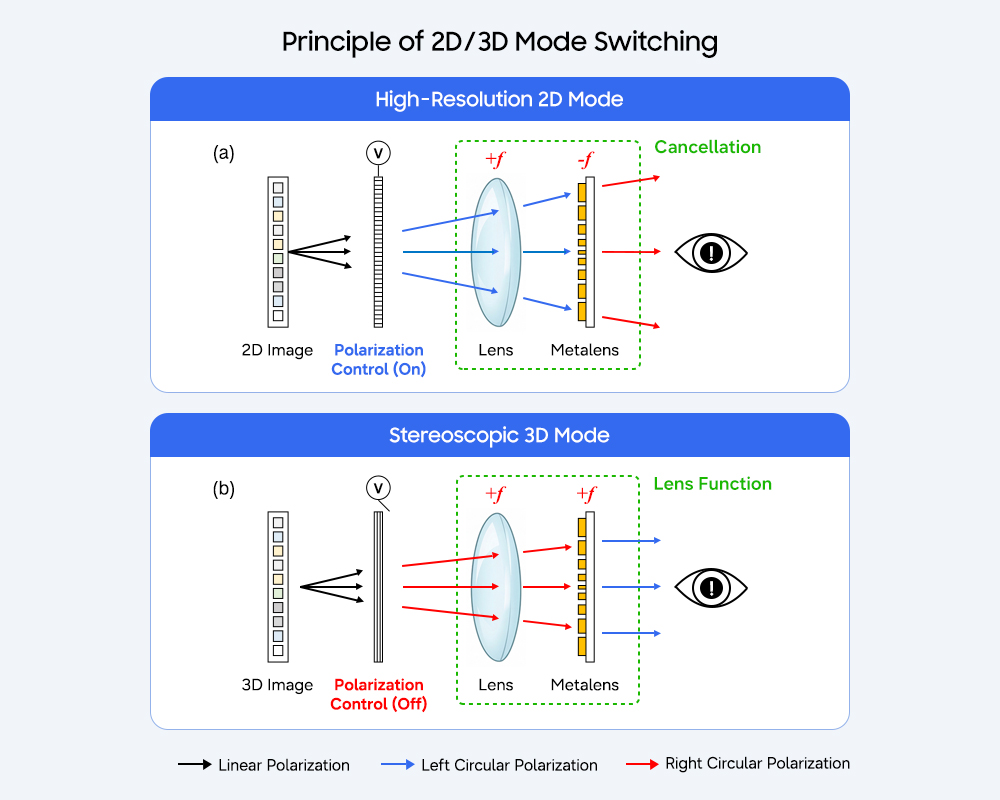
The research team addressed these limitations using polarization — the direction in which light oscillates — to design a metasurface lenticular lens (MLL) that dynamically adjusts focal properties.
Switching Between 2D and 3D

Diagram showing how the metalens switches between high-resolution 2D and stereoscopic 3D modes based on the polarization controller state
▲ Diagram showing how the metalens switches between high-resolution 2D and stereoscopic 3D modes based on the polarization controller state
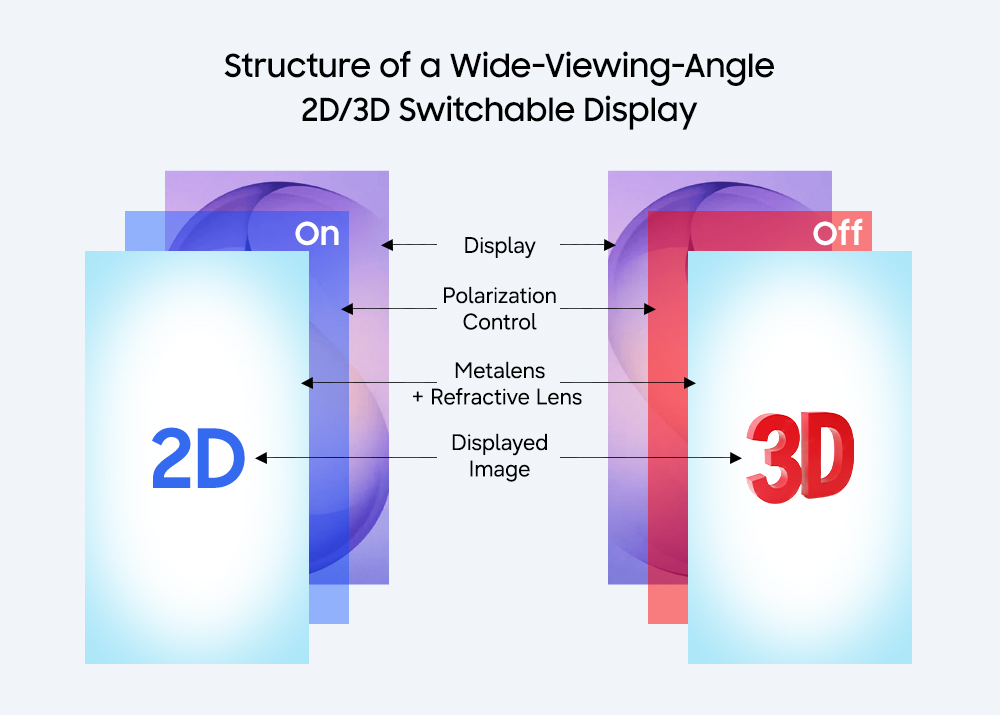
Illustration of a switchable 2D/3D display
▲ Illustration of a switchable 2D/3D display

The study is the first to demonstrate a meta-optical system capable of switching between 2D and 3D modes in a single device using voltage control. For end users, it’s a breakthrough that could eventually enable them to choose between high-resolution 2D for everyday tasks and immersive, multi-view 3D for video.

The system switches the metalens between concave and convex modes depending on the polarization controller in front of the display. For 2D viewing — such as reading or browsing — the metalens acts as a concave lens (controller on), offsetting the convex lens and allowing light to pass straight through like a flat pane of glass to produce a clear image.

For 3D content, the metalens becomes convex when the controller is off and works with the existing lens to enhance depth and widen the viewing angle. Through this, it can provide both the clarity of 2D and the depth of 3D simultaneously.
Thinner Design, Wider Viewing Angles

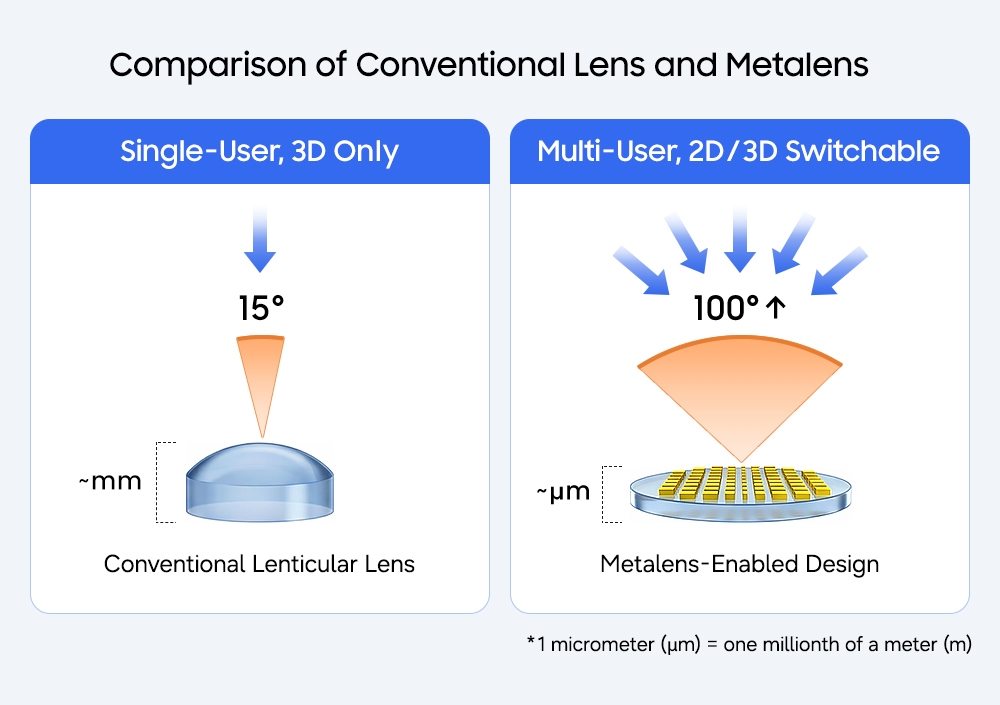
▲ Comparison of a conventional lenticular lens and improved metalens

A major achievement of this research is the dramatic improvement in both thickness and viewing angle. Traditionally, high image quality and a wide viewing angle required large, thick lenses. The team’s MLL, however, features a high numerical aperture (NA)2 — enabling an ultra-thin profile of 1.2 mm and an ultra-wide viewing angle of up to 100 degrees. This represents more than a sixfold increase from the conventional 15-degree viewing angle, allowing multiple viewers to experience 3D content from different positions. It also demonstrates how nanoscale design can overcome the limitations of bulky optical systems.
A Step Closer to Commercialization

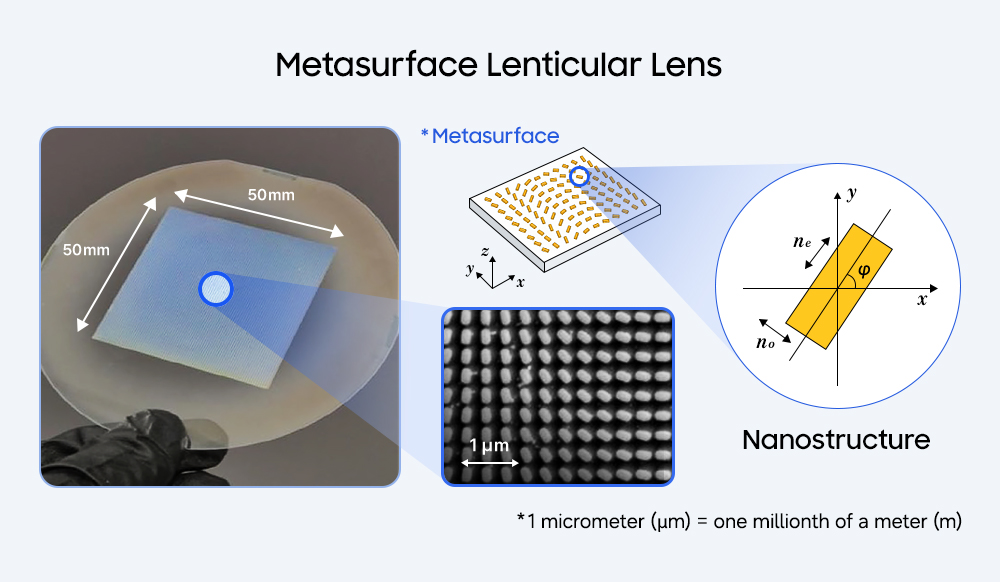
(From left) A fabricated MLL (50 × 50 mm, 25 cm²) and nanoscale structures enabling lenticular lens functionality
▲ (From left) A fabricated MLL (50 × 50 mm, 25 cm²) and nanoscale structures enabling lenticular lens functionality

Beyond a simple proof of concept, the research demonstrates the practical viability of integrating metalens technology into real-world devices. The team fabricated a large-area metalens measuring 50 × 50 mm (25 cm²) and validated its use on OLED panels widely used in mobile devices.

This research was conducted in collaboration with the Visual Technology Team at Samsung Research, Samsung Electronics, and the POSTECH Nanoscale Photonics & Integrated Manufacturing Laboratory.

Looking ahead, this technology has the potential to reshape next-generation displays across smartphones, tablets and commercial systems.

From optical design and fabrication to real-time switching validation, Samsung and POSTECH have broken through a technological barrier. With the publication in Nature, Samsung further strengthens its leadership in meta-optics and next-generation display technologies.


  1. A next-generation optical technology that controls light beyond conventional refractive lenses. ↩︎
  2. A measure of an optical system’s ability to gather light, indicating the maximum angle at which light enters the lens. ↩︎