





José Francisco Ochoa is a member of Generation17, a Samsung and United Nations Development Programme (UNDP) partnership empowering young people who are contributing to the Global Goals.
Since 2020, Generation17 has supported Young Leaders worldwide with Samsung Galaxy technology, mentorship and networking opportunities to amplify their stories and solutions.
On the coast of San Jacinto in northwest Ecuador, a group of university students are up before dawn, combing the shoreline by red light so as not to disturb the sea turtles nesting nearby. For some of the students, it’s the first time they have ever seen the ocean. As the sun rises, they head out to tour mangroves by boat. They later return to clean plastic waste from the beach before heading back to the classroom to learn how it all connects to ocean conservation and climate action.
This is what Academia del Océano looks like in practice: hands-on science education that has long been out of reach for Spanish-speaking communities. The organization was co-founded by José Francisco Ochoa, a biologist from southern Ecuador whose love of nature led him to ocean science and to a belief that protecting our environment starts with making science education accessible.
Together with three colleagues, Juan Fernando Pesántez, Nicole Auz and Francisca Hernández, José Francisco set out to bridge that language gap. “Ocean and climate science is often only in English,” José Francisco Ochoa says. “That means entire communities have been left out of the conversation — and the solutions.”
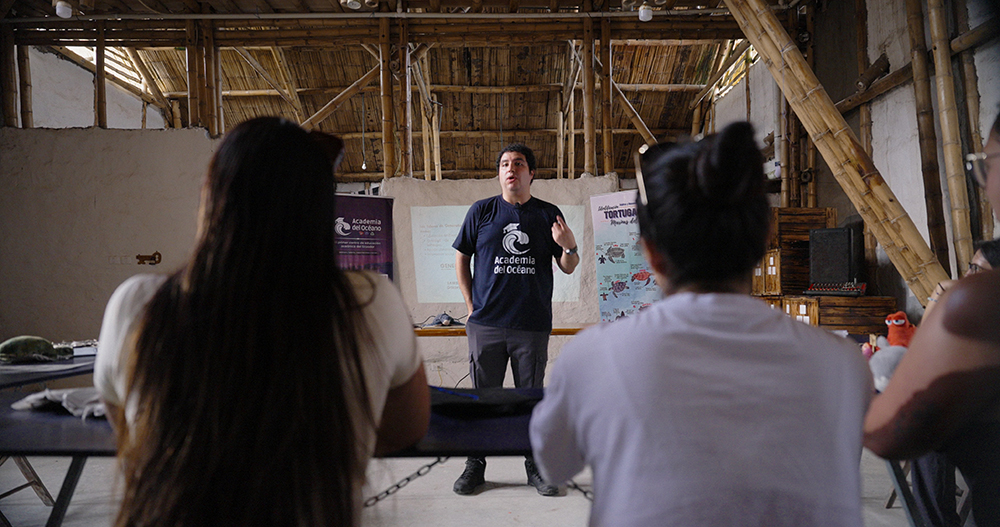
José Francisco grew up surrounded by nature, always curious about the world around him. “I wanted to explore,” he says. “I always wanted to work in the field, with the community.” He channeled that curiosity into a biology degree and a career in ocean conservation.
The deeper he dove, the more clearly he saw the language barrier at work. It was more than an inconvenience. It limited who could enter the profession and help protect the ocean.
So, in 2023, José Francisco and his colleagues founded Academia del Océano — one of the first ocean education centers in Ecuador to teach entirely in Spanish. Their mission: to democratize access to ocean and climate science, advancing the UN’s Global Goal for quality education (Goal 4).
At their coastal center in San Jacinto, courses cover marine biology, ocean conservation and citizen science. Their curriculum supports the Global Goals for life below water (Goal 14) and climate action (Goal 13). In addition, a certified partnership with one of Ecuador’s top universities gives students credentials in marine conservation and marine biology to jumpstart their careers. “We are empowering young people to be leaders in their communities through education and technology,” says José Francisco.
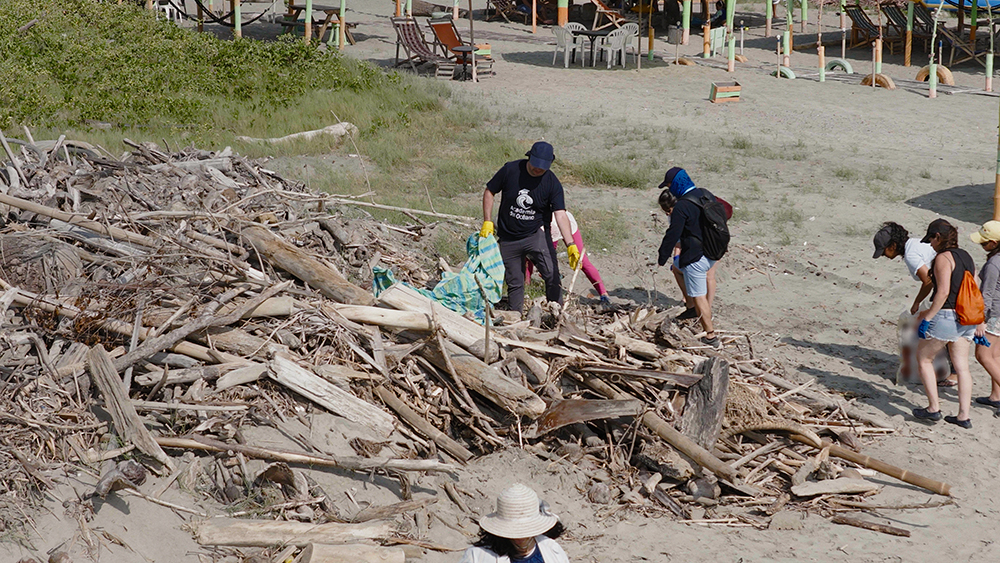
Beyond San Jacinto, Academia del Océano reaches students across more than 10 countries through virtual programming and an active online community — bringing ocean and climate education in Spanish to wherever students are. To power that content, José Francisco and his team use AI to develop curriculum and create multimedia resources that break down complex scientific language into accessible lessons.
Their impact is growing. Since 2023, Academia del Océano has trained more than 10,000 students, awarded over 500 certifications in ocean science, planted more than 2,200 mangrove seeds and released roughly 5,000 sea turtle hatchlings. “Many of our students go on to work in ocean conservation and environmental science,” says José Francisco, “taking what they’ve learned back to their communities.”
Kerly Martinez, a 2025 graduate, says the program inspired her to start an ecotourism company. “We talk about responsible tourism, conservation, waste and plastic issues,” she says. “And I learned all of this right here in Academia del Océano.”
The organization has also been recognized as an official activity of the Ocean Decade, a global initiative coordinated by UNESCO’s Intergovernmental Oceanographic Commission to advance ocean science through 2030.

José Francisco’s vision for the future extends well beyond Ecuador’s coast. He hopes to expand what he and his colleagues have built to reach more Spanish-speaking communities, equipping a new generation to protect their local ecosystems and contribute to ocean research in their own regions. “My dream is that Academia del Océano becomes the greatest platform in the world in terms of ocean education and environmental action,” he says.
For the students arriving at San Jacinto’s shoreline for the first time and for the millions across Latin America who have never had ocean science in their own language, that dream is already taking shape.
此内容由惯性聚合(RSS阅读器)自动聚合整理,仅供阅读参考。 原文来自 — 版权归原作者所有。