











HPE Morpheus Enterprise Software v8.1.0 powers True N-Tier Multi-Tenancy, scaling cloud operations and governance for CSPs, MSPs, and Enterprises without compromising security or autonomy.
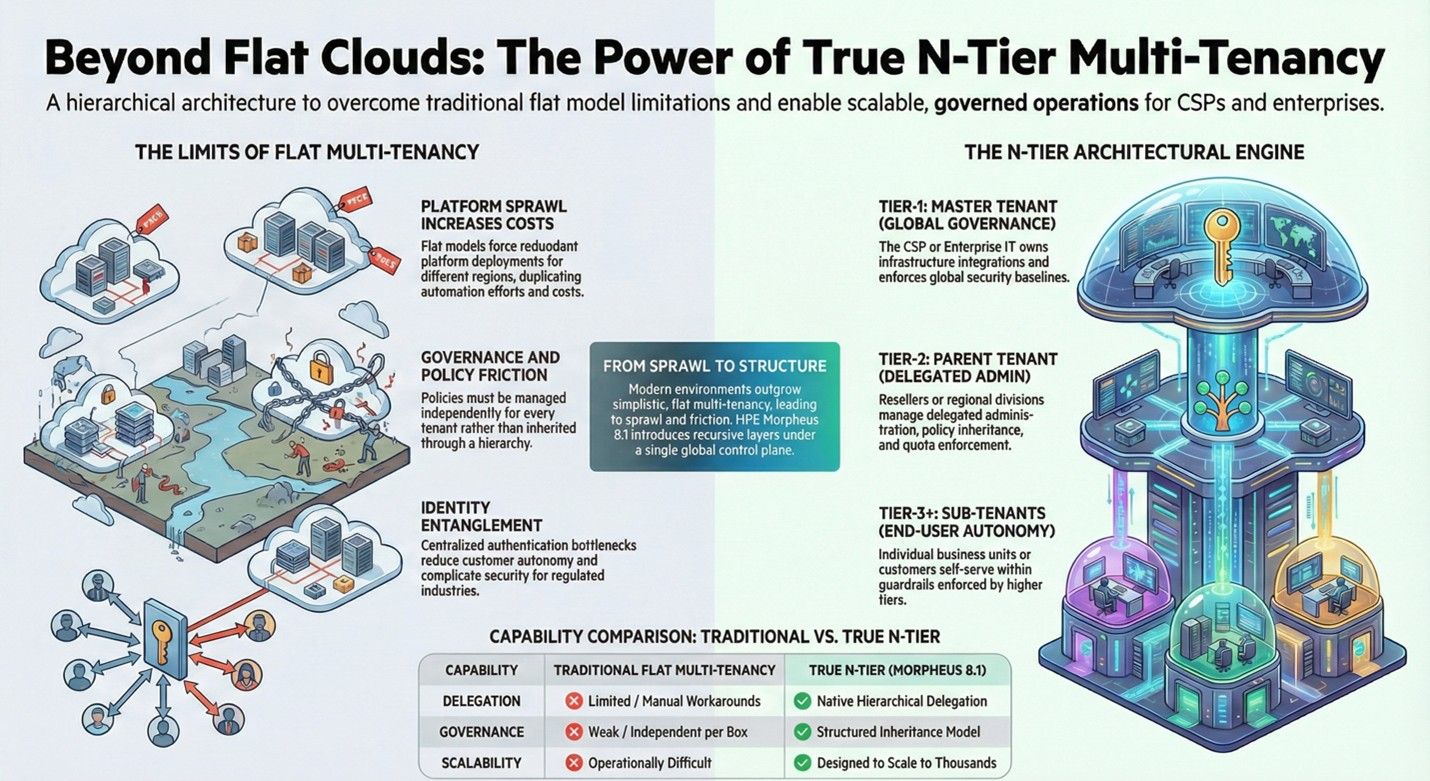
Figure 1. Beyond flat clouds: The power of True N-Tier Multi-Tenancy
For cloud service providers (CSPs), managed service providers (MSPs), and global enterprises, achieving cloud-scale efficiency has become increasingly difficult as environments expand across multiple segmentations and business ecosystems. Platform sprawl, fragmented control planes, and duplicated automation are common challenges. The root cause is the continued reliance on legacy flat cloud taxonomy models, which were designed for simpler, one-to-one relationships.
Modern cloud taxonomies are inherently layered. They include geo-based organizations, shared service teams, resellers, sales agents, autonomous applications groups, and business units—all of which require more than horizontal tenant separation. Addressing this complexity requires a cloud architecture and taxonomy that supports native hierarchy, delegated governance, and strong isolation by design.
HPE Morpheus Enterprise Software v8.1.0 introduces True N‑Tier Multi‑Tenancy, a persona-driven model that evolves cloud taxonomy from basic logical separation into a structured, hierarchical operational architecture.
Five architectural takeaways of True N‑Tier Multi‑Tenancy
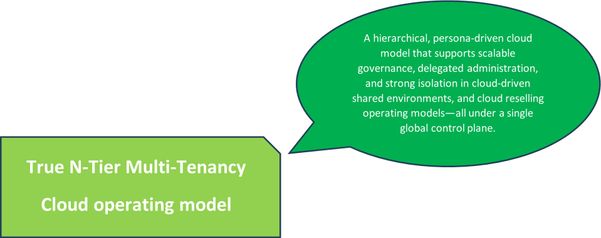
Traditional flat cloud operating models enforce a rigid provider-to-tenant relationship. While sufficient for limited deployments, this approach introduces significant governance and identity challenges at scale. The core limitation is architectural: policies and identities operate in isolation, with no native mechanism for hierarchical inheritance.
As a result, policies must be defined and maintained independently for each tenant, leading to RBAC sprawl, increased operational risk, and inconsistent compliance enforcement. Limited support for multilevel identity federation further constrains tenant autonomy and increases security complexity. These issues are not configuration gaps—they reflect fundamental constraints of flat multitenancy models.
HPE Morpheus Enterprise Software v8.1.0 addresses these limitations by introducing a recursive N‑Tier tenancy architecture. Rather than enforcing a fixed number of layers, any tenant can function as both a consumer of upstream governance and a provider of downstream control. This enables hierarchical delegation to extend to arbitrary depth without sacrificing consistency or control.
This recursive model enables regional organizations, shared services teams, and resellers to function as localized control planes, preserving operational agility while maintaining centralized governance.
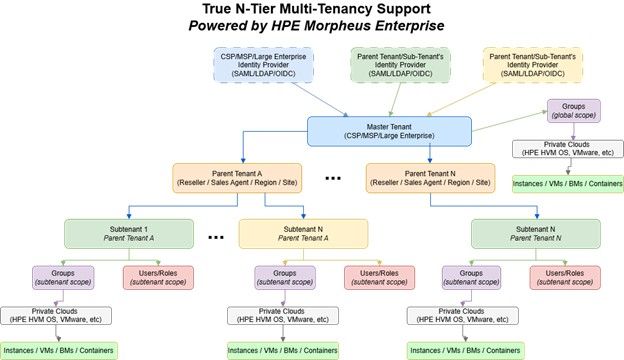
Figure 2. Multitenancy taxonomy
Historically, organizations achieved tenant isolation by deploying separate platform instances per region or customer. While effective for isolation, this approach resulted in fragmented governance, duplicated automation, and higher operational costs.
True N‑Tier Multi‑Tenancy consolidates tenants under a single global control plane while preserving strict isolation boundaries. Identity, policy, and resource controls are enforced through software‑defined mechanisms rather than platform duplication.
This model helps ensure:
The result is strong isolation at scale without the overhead and governance fragmentation of multi‑instance architectures.
Flat operating models scale poorly because each new tenant requires manual segmentation across identity, policy, and infrastructure domains. As environments grow, this increases operational overhead and the risk of configuration drift.
In a true N‑Tier model, scalability is achieved through automated tenant provisioning combined with hierarchical RBAC and policy inheritance. Roles, access controls, and automation are applied consistently across the tenancy structure, eliminating per‑tenant customization.
This approach enables predictable growth across on‑premises and public cloud environments while allowing delegated administration to operate safely within defined guardrails.
Flat billing models lack the financial granularity required by complex organizations. HPE Morpheus Enterprise Software v8.1.0 enables hierarchical cost attribution across the full N‑Tier structure, supporting chargeback, showback, and multilevel revenue models.
Organizations can align cloud financial management with their operating structures, including:
By associating consumption, budgets, and accountability at each tier, enterprises can maintain centralized governance while enabling downstream teams to manage spend with greater autonomy.
As organizations scale across regions, partners, and business units, cloud operating models must evolve beyond flat tenancy constructs. Native hierarchy, delegated governance, and consistent control are no longer optional—they are foundational requirements.
HPE Morpheus Enterprise Software v8.1.0 delivers this foundation through True N‑Tier Multi‑Tenancy, enabling cloud operations to scale without compromising security, governance, or autonomy. The future of cloud taxonomies is not flat—it is layered, intentional, and architected for scale.
CTA:
For more information, visit: hpe.com/us/en/software/cloud-ops-suite.html
By Author:
Fernando Escobar
Sr. Technical Product Manager
HPE Morpheus Enterprise
此内容由惯性聚合(RSS阅读器)自动聚合整理,仅供阅读参考。 原文来自 — 版权归原作者所有。