


Design resilient enterprise applications for hybrid cloud. Learn how telemetry-aware adaptation, modernization, and services-led transformation enable stable SLAs and operational continuity.
Resilience is commonly defined as the capacity to withstand or recover quickly from difficulties; the ability to return to an original state after disruption.
Over the past decade, modern enterprises have invested heavily in engineering resilience into infrastructure layers. High-availability clusters, self-healing storage systems, redundant networking fabrics, elastic cloud platforms, automated failover orchestration, and policy-driven security controls have become standard architectural practices. Even cybersecurity models now assume breach and are designed for containment rather than prevention alone.
Infrastructure has evolved to detect anomalies, redistribute load, and restore stability with minimal human intervention.
Yet the application layer, comprising the software that directly implements business logic, has remained comparatively fragile. While infrastructure has evolved toward self-correction, many enterprise applications still rely on static timeout values, rigid retry loops, fixed concurrency limits, and manual toggles during incidents. This asymmetry introduces risk. When downstream latency increases or a dependency degrades, a non-adaptive application may continue issuing high concurrency requests. Instead of absorbing volatility, it amplifies it. What begins as a localized delay can cascade into thread exhaustion, database contention, and service-level agreement breaches.
Hence, the next evolution lies in engineering resilience into the application itself.
 Volatility in hybrid architecture
In hybrid cloud, dependency variability is normal, not exceptional. Multi-region databases introduce replication lag. Edge aggregation systems exhibit fluctuating network latency. AI inference services may respond unpredictably under burst workloads. Third-party APIs operate outside direct control. Microservices orchestrated on Kubernetes platforms introduce scheduling delays, pod restarts, and dynamic scaling behavior.
Applications increasingly interact with multiregion databases, edge data aggregation systems, AI inference services, third-party application programming interface (APIs), and distributed microservices running on Kubernetes platforms. Infrastructure elasticity provides the foundation for scale in hybrid and cloud environments, enabling resources to be dynamically allocated and workloads to be distributed efficiently as demand fluctuates. This flexibility allows organizations to respond quickly to changing business needs and unexpected spikes in usage. However, while elastic infrastructure is essential for maintaining high availability and operational continuity, it alone cannot compensate for brittle application behavior.
Applications that are not designed to adapt to changing conditions, such as fluctuating latency, degraded dependencies, or unexpected failures, can undermine even the most resilient infrastructure. To truly harness the benefits of infrastructure elasticity, application resilience, and runtime adaptability must be engineered as core components of the overall architecture.
Similarly, rigid database interaction models may amplify contention even when underlying compute resources remain healthy. Without implementing adaptive logic at the application level, including telemetry-driven adjustments and behavioral modifications, enterprises risk cascading failures, increased contention, and breaches of service-level agreements.
This shifts resilience from infrastructure containment to application-level anticipation.
True resilience in hybrid cloud requires:
All three must operate in coordination.
Modern enterprise environments already generate rich telemetry at the hardware and platform layers. Systems such as HPE InfoSight leverage this data to optimize performance and anticipate infrastructure anomalies before they impact production systems.
The next logical evolution is extending this telemetry-driven intelligence upward into the application runtime.
Instead of reacting only to threshold-based alerts, applications can consume signals about dependency health, latency distributions, and resource saturation. This enables runtime logic to adjust concurrency levels, alter retry strategies, introduce backoff controls, or prioritize workloads dynamically.
Telemetry-aware applications shift from static logic to adaptive behavior.
This approach complements broader modernization initiatives that aim to transform static legacy systems into adaptive, cloud-ready architectures. Observability, when embedded directly into runtime logic, becomes an active control mechanism rather than a passive monitoring tool.
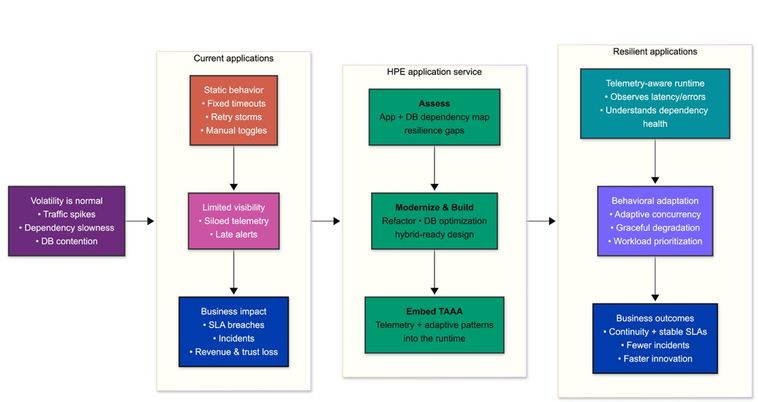
Figure 1. Evolution from static to adaptive, telemetry-driven, resilient-by-design runtime architecture
Most enterprise applications in production today were not architected for adaptive behavior. Monolithic architectures, tightly coupled database schemas, and synchronous call chains limit the ability to introduce adaptive control mechanisms.
Transitioning toward resilient-by-design principles often requires:
These are not purely infrastructure initiatives; they are application engineering transformations.
Services-led modernization efforts play a critical role in enabling this shift. By aligning application design, database optimization, and runtime behavior with hybrid infrastructure capabilities, enterprises can progressively embed resilience without disrupting business continuity.
This transformation is especially relevant as organizations migrate workloads to hybrid consumption models such as GreenLake, where elasticity and distributed deployment introduce new behavioral considerations at the application layer.
Infrastructure resilience alone is no longer sufficient in distributed hybrid environments. Self-healing storage, automated failover clusters, and elastic compute provide foundational durability. However, true operational continuity demands applications that are telemetry-aware, behaviorally adaptive, and engineered to anticipate instability rather than merely survive it.
Resilient-by-design software completes the stack by aligning infrastructure intelligence, platform elasticity, and adaptive runtime logic into a cohesive,
self-healing system.
When applications understand the health of their dependencies and respond dynamically, they prevent cascading failures. They reduce unnecessary retries. They protect databases from overload. They maintain stable service levels even under volatile conditions.
In hybrid enterprise environments, resilience must move up the stack.
And the application layer is where it now matters the most.
Learn more at hpe.com/in/en/application-modernization-services.html
By Author:
Nachammai Nagappan
Technology Consultant,
Professional Services Global Competency Center,
HPE Services
此内容由惯性聚合(RSS阅读器)自动聚合整理,仅供阅读参考。 原文来自 — 版权归原作者所有。