
惯性聚合 高效追踪和阅读你感兴趣的博客、新闻、科技资讯
阅读原文 在惯性聚合中打开

推荐订阅源

Microsoft Security Blog
J
Java Code Geeks
GbyAI
GbyAI
aimingoo的专栏
aimingoo的专栏
L
LangChain Blog
I
InfoQ
D
Docker
F
Fortinet All Blogs
Y
Y Combinator Blog
Martin Fowler
Martin Fowler
月光博客
月光博客
B
Blog
Engineering at Meta
Engineering at Meta
T
Tailwind CSS Blog
罗磊的独立博客
博客园_首页
G
Google Developers Blog
Stack Overflow Blog
Stack Overflow Blog
Recent Announcements
D
DataBreaches.Net
freeCodeCamp Programming Tutorials: Python, JavaScript, Git & More
B
Blog RSS Feed
IT之家
IT之家
V
V2EX

Latest from Tom's Hardware in Tech-industry

Samsung engineer sentenced to 7 years in prison for selling chipmaking trade secrets to Chinese chipmaker — ex-employee supplied 10nm DRAM data to CXMT for $2 million Microsoft facing $2.8 billion UK lawsuit for overcharging 60,000 businesses using Microsoft Server on other clouds — Azure users allegedly received lower wholesale pricing Ransomware negotiator pleads guilty after leaking victims' insurance details to 'BlackCat' hackers — perp gave attackers a precise picture of exactly how much each target could afford to pay Congress moves to strip the DoC of chip-export discretion with the MATCH Act — DUV lithography machines among those targeted in chipmaking tool crackdown Anthropic's Model Context Protocol includes a critical remote code execution vulnerability — newly discovered exploit puts 200,000 AI servers at risk Iran claims US exploited networking equipment backdoors during strikes — says devices from Cisco and others failed despite blackout in attack that 'indicates deep sabotage' Cerebras files for IPO — company remains unprofitable despite 20x revenue growth Scientists solve decades-old 2D physics puzzle — Chaotic growth in a 2D quantum system obeys statistical laws Anthropic nuked a company's access to Claude, stopping 60 employees dead in their tracks — support via Google Form is the only recourse for vague usage policy violation Biohacker claims to have sequenced their own genome at the kitchen table with M3 Ultra Mac Studio, Claude, and a $3,200 sequencer — DIY project requires 100GB of data storage per run, oodles of RAM New Jersey datacenter expansion got $77m in tax breaks to create exactly one permanent job — JPMorgan's site already scored $35m and currently employs just 25 workers Chinese chipmakers made record profit in 2025, despite slipping margins — U.S shipments fall 34% as Beijing shores up local chipmaking efforts AI cloud company Vercel breached after employee grants AI tool unrestricted access to Google Workspace — hacker… Every SK hynix employee could receive $477,000 bonuses this year, almost $900,000 next year — 35,000 workers reportedly set to benefit from share of $169 billion projected operating profit US gov't blocks China's largest LED chipmaker's $239 million bid to acquire Dutch lighting firm Lumileds… Tokyo court rules movie and anime 'spoiler articles' are copyright infringement in landmark criminal case — detailed, monetized plot summaries land man in Japanese prison Voyager 1 gets emergency instrument shutdown to solve escalating power crisis and give it ‘about a year of breathing room’ — interstellar spacecraft's nuclear power source is dying, leading to intensifying countermeasures Russian-made Shahed drones are ‘disintegrating in the air before reaching their targets’ due to shoddy manufacturing, video shows — commentators call Russian clones of Iran's drones 'flying garbage' Inventor showcases 3D printer filament dryer that mines Bitcoins and dries filament with waste heat, capable of 6 TH/s at 140W — joins Bitcoin-mining 3D printer in hobbyist-focused miner lineup Bluetooth tracker hidden in a postcard and mailed to a warship exposed its location — $5 gadget put a $585 million… Techie buys fake Ledger Nano S+ hardware crypto wallet and almost falls for phishing — a convincing clone would… Nvidia CEO Jensen Huang ‘nearly lost his composure’ when pressed on selling chips to China — ‘You’re not talking to someone who woke up a loser’ US lawmakers amend new restrictions on Chinese chipmakers — MATCH Act Analytics group signals possible delays at 40% of AI data center construction sites — companies deny schedule holdups, but satellite imagery indicates otherwise Local political revolts threaten to derail US data center projects — mounting delays are already costing AI hyperscalers billions Intel hires tenured Samsung exec to lead Foundry Services — signals company focus on winning business from potential Foundry suitors Elon Musk pushing forward with Terafab at TSMC ups revenue guidance and CapEx, buoyed by Google and Pentagon in talks to run custom AI chips inside classified environments — Google pushes for tight controls for TPUs surrounding use for mass surveillance and autonomous weapons TSMC warns of Intel Foundry
Intel’s performance-enhanced 18A-P process enters risk pr...
https://www.tomshardware.com/author/jake-roach · 2026-06-17 · via Latest from Tom's Hardware in Tech-industry
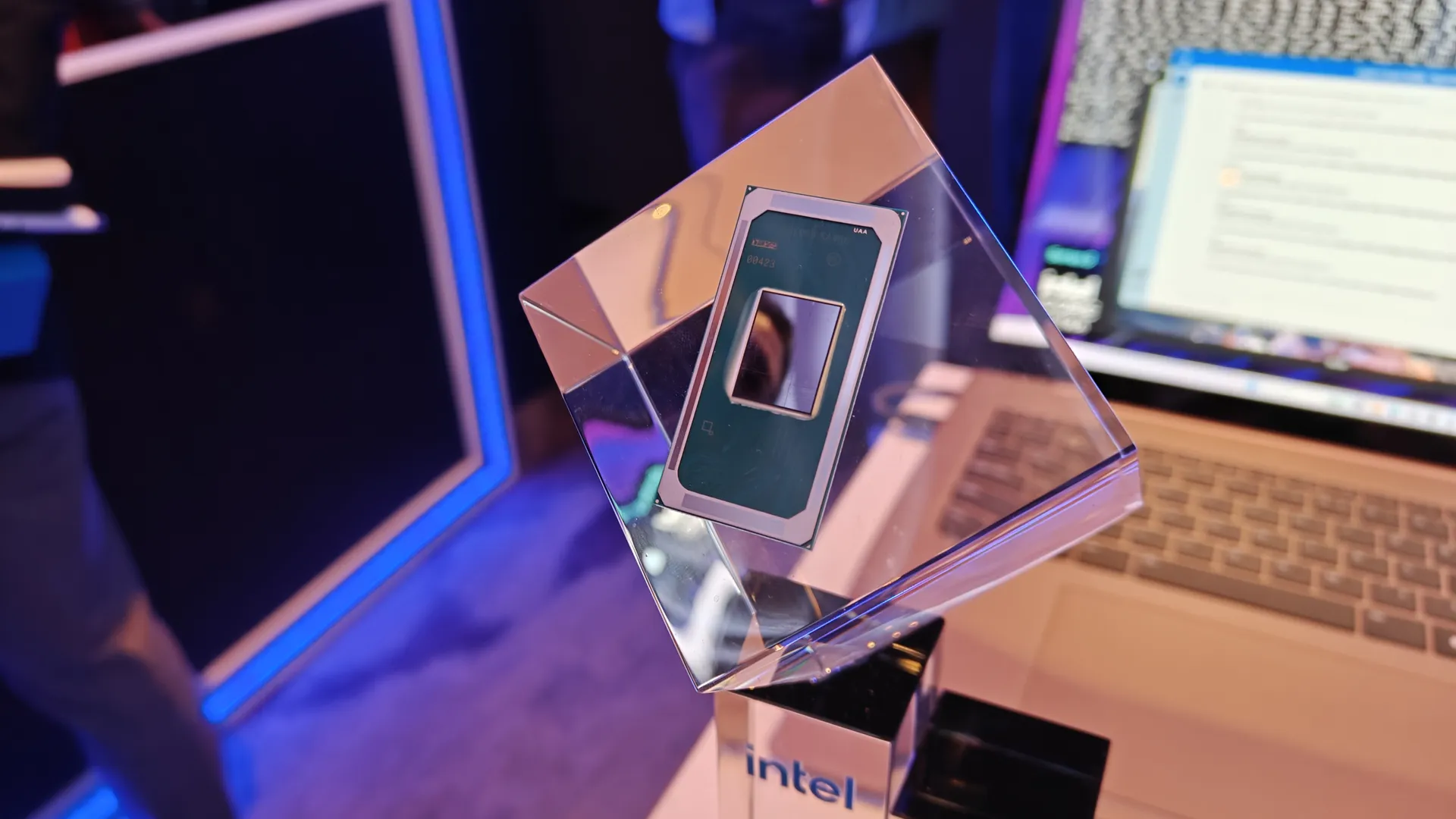
An Intel Panther Lake SoC.
(Image credit: Tom's Hardware)

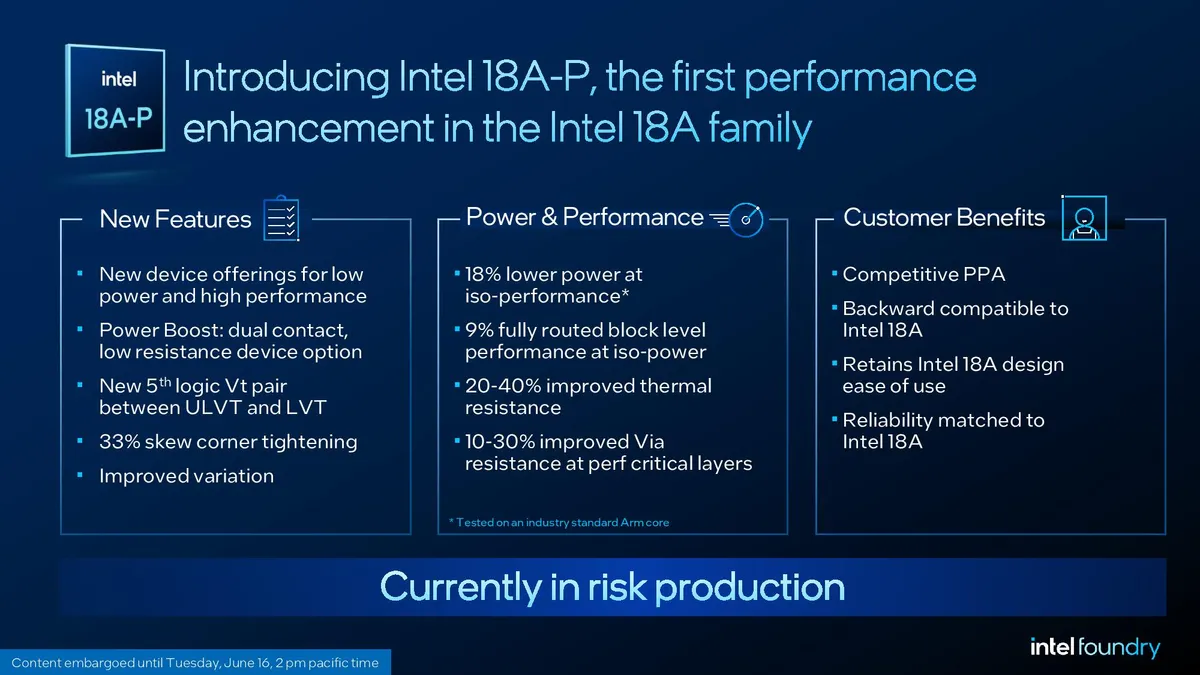
Following a paper published earlier this year, Intel has provided more details on its optimized 18A-P process at VLSI 2026. The performance-optimized node is an enhancement of 18A that Intel is using in products like Panther Lake and Xeon 6+, promising a 9% improvement in performance at the same power, or an 18% reduction in power consumption at the same performance level. In addition to greater technical detail, Intel has revealed that 18A-P has entered risk production.

Go deeper with TH Premium: Chipmaking

If you’re unfamiliar with that term, it’s the stage of semiconductor manufacturing just before high-volume mass production. It’s a low-volume manufacturing stage where Intel will produce full wafers of 18A-P on a standard production line, just with a limited scope to gather data on defect rate, performance, and variability before full production begins. Risk production usually leads mass production on advanced logic by 12 to 24 months, though we’re not dealing with an entirely new node here, so expect a tighter timeline.

18A-P is a revision of 18A, and although it carries new transistor designs (more on those soon), they live in the same libraries at cell heights of 180mm (High Performance) and 160mm (High Density). The new process is backward compatible with 18A designs, meaning designers can port to 18A-P without making any changes. Some of the new transistor options could spur a design change, but it’s not required; anything built on 18A can be built on 18A-P with more minor performance benefits, but no design changes.

For performance, Intel arrived at its numbers by testing on a standard Arm core subblock, noting the 9% frequency increase or 18% reduction in power specifically at 0.75 volts. The chart you can see in the gallery below is a beautified version of a chart published in Intel’s original research; in other words, it’s not just random lines without any correlation. You can see that even as voltage moves outside that 0.75V mark, 18A-P retains a frequency/power improvement.

With 18A-P, Intel is adding three transistor designs to its library. The W1 design is available in the 180mm cell height library (it was previously available in the 160mm library), while W1.5 is available in the 160mm library. The enhanced W3P design is available in both libraries. W1 and W1.5 are both narrow designs optimized for low-power usage, helping fill gaps in power-optimized designs in Intel’s library, while W3P is a new dual-contact transistor with “Power Boost,” as Intel calls it. As you can see in the gallery below, the original W2 and W3 designs still see a boost in ring oscillator frequency (moving an electrical signal through a ring of inverters) with 18A-P.

Image 1 of 6
Intel 18A-P details.
(Image credit: Intel)

W3P is the most interesting design due to Power Boost. 18A already uses backside power delivery with PowerVia, which uses the back of the wafer to route power, freeing up space for front side signal wiring and reducing thermal resistance. The W3P design has contacts on the front side and backside, reducing parasitic resistance and enabling higher drive current to speed up switching.

Although the standard W2 and W3 transistors will see a benefit moving from 18A to 18A-P, it’s minor. The biggest frequency improvement comes from W3P, while W1 pushes 18A-P down to lower capacitance levels for energy-optimized designs.

Get Tom's Hardware's best news and in-depth reviews, straight to your inbox.

Intel is also adding a new VT (threshold voltage) pair to its lineup. Typically, we see four flavors of VT pairs: HVT, SVT, LVT, and ULVT, noting high, standard, low, and ultra-low threshold voltage, respectively. The lower the threshold voltage, the less power a transistor needs to activate, and therefore the more power it leaks. So, ULVT transistors are the most performant, but they leak the most power, while HVT transistors are the least performant but leak the least amount of power. Chip designers need to balance these different flavors of threshold voltage for their application.

The new VT pair adds another option: ULVTLL, or Ultra-Low Voltage Threshold Low Leakage. It lives between ULVT and LVT, offering better performance than LVT but lower leakage than ULVT. Like the new transistor design, it gives designers more flexibility when designing a chip for 18A-P.

In addition to the expanding 18A-P’s capabilities, Intel says the revision comes with a 20% to 40% improvement in thermal resistance, as well as a 10% to 30% improvement in via resistance at “perf critical layers.” The reduction in thermal resistance comes from grinding the wafer down with advanced EDA tools for better thermal conductivity.

Intel 18A is currently ramping in two U.S. fabs, and although the company has taken some heat for poor 18A yields, Intel says that defect rates continue to drop along with its expectations. 18A is being used already in Panther Lake and Xeon 6+, and Intel is reportedly in talks with Apple and Nvidia to build on 18A, as well.

Full presentation

Image 1 of 14
Intel 18A-P details.
(Image credit: Intel)

Google Preferred Source

Follow Tom's Hardware on Google News, or add us as a preferred source, to get our latest news, analysis, & reviews in your feeds.

Jake Roach is the Senior CPU Analyst at Tom’s Hardware, writing reviews, news, and features about the latest consumer and workstation processors.
