



惯性聚合 高效追踪和阅读你感兴趣的博客、新闻、科技资讯
阅读原文 在惯性聚合中打开

推荐订阅源

钛媒体:引领未来商业与生活新知
钛媒体:引领未来商业与生活新知
云风的 BLOG
云风的 BLOG
IT之家
IT之家
C
Check Point Blog
T
The Blog of Author Tim Ferriss
S
SegmentFault 最新的问题
人人都是产品经理
人人都是产品经理
H
Hackread – Cybersecurity News, Data Breaches, AI and More
美团技术团队
M
MIT News - Artificial intelligence
Jina AI
Jina AI
Blog — PlanetScale
Blog — PlanetScale
freeCodeCamp Programming Tutorials: Python, JavaScript, Git & More
Microsoft Security Blog
G
Google Developers Blog
F
Fortinet All Blogs
V
Visual Studio Blog
奇客Solidot–传递最新科技情报
奇客Solidot–传递最新科技情报
T
Tailwind CSS Blog
Hugging Face - Blog
Hugging Face - Blog
MyScale Blog
MyScale Blog
爱范儿
爱范儿
The Cloudflare Blog
博客园 - 三生石上(FineUI控件)

Latest from Tom's Hardware in Tech-industry

Samsung engineer sentenced to 7 years in prison for selling chipmaking trade secrets to Chinese chipmaker — ex-employee supplied 10nm DRAM data to CXMT for $2 million Microsoft facing $2.8 billion UK lawsuit for overcharging 60,000 businesses using Microsoft Server on other clouds — Azure users allegedly received lower wholesale pricing Ransomware negotiator pleads guilty after leaking victims' insurance details to 'BlackCat' hackers — perp gave attackers a precise picture of exactly how much each target could afford to pay Congress moves to strip the DoC of chip-export discretion with the MATCH Act — DUV lithography machines among those targeted in chipmaking tool crackdown Anthropic's Model Context Protocol includes a critical remote code execution vulnerability — newly discovered exploit puts 200,000 AI servers at risk Iran claims US exploited networking equipment backdoors during strikes — says devices from Cisco and others failed despite blackout in attack that 'indicates deep sabotage' Cerebras files for IPO — company remains unprofitable despite 20x revenue growth Scientists solve decades-old 2D physics puzzle — Chaotic growth in a 2D quantum system obeys statistical laws Anthropic nuked a company's access to Claude, stopping 60 employees dead in their tracks — support via Google Form is the only recourse for vague usage policy violation Biohacker claims to have sequenced their own genome at the kitchen table with M3 Ultra Mac Studio, Claude, and a $3,200 sequencer — DIY project requires 100GB of data storage per run, oodles of RAM New Jersey datacenter expansion got $77m in tax breaks to create exactly one permanent job — JPMorgan's site already scored $35m and currently employs just 25 workers Chinese chipmakers made record profit in 2025, despite slipping margins — U.S shipments fall 34% as Beijing shores up local chipmaking efforts AI cloud company Vercel breached after employee grants AI tool unrestricted access to Google Workspace — hacker… Every SK hynix employee could receive $477,000 bonuses this year, almost $900,000 next year — 35,000 workers reportedly set to benefit from share of $169 billion projected operating profit US gov't blocks China's largest LED chipmaker's $239 million bid to acquire Dutch lighting firm Lumileds… Tokyo court rules movie and anime 'spoiler articles' are copyright infringement in landmark criminal case — detailed, monetized plot summaries land man in Japanese prison Voyager 1 gets emergency instrument shutdown to solve escalating power crisis and give it ‘about a year of breathing room’ — interstellar spacecraft's nuclear power source is dying, leading to intensifying countermeasures Russian-made Shahed drones are ‘disintegrating in the air before reaching their targets’ due to shoddy manufacturing, video shows — commentators call Russian clones of Iran's drones 'flying garbage' Inventor showcases 3D printer filament dryer that mines Bitcoins and dries filament with waste heat, capable of 6 TH/s at 140W — joins Bitcoin-mining 3D printer in hobbyist-focused miner lineup Bluetooth tracker hidden in a postcard and mailed to a warship exposed its location — $5 gadget put a $585 million… Techie buys fake Ledger Nano S+ hardware crypto wallet and almost falls for phishing — a convincing clone would… Nvidia CEO Jensen Huang ‘nearly lost his composure’ when pressed on selling chips to China — ‘You’re not talking to someone who woke up a loser’ US lawmakers amend new restrictions on Chinese chipmakers — MATCH Act Analytics group signals possible delays at 40% of AI data center construction sites — companies deny schedule holdups, but satellite imagery indicates otherwise Local political revolts threaten to derail US data center projects — mounting delays are already costing AI hyperscalers billions Intel hires tenured Samsung exec to lead Foundry Services — signals company focus on winning business from potential Foundry suitors Elon Musk pushing forward with Terafab at TSMC ups revenue guidance and CapEx, buoyed by Google and Pentagon in talks to run custom AI chips inside classified environments — Google pushes for tight controls for TPUs surrounding use for mass surveillance and autonomous weapons TSMC warns of Intel Foundry
NASA pushes Mars helicopter rotors past the speed of soun...
Etiido Uko · 2026-05-10 · via Latest from Tom's Hardware in Tech-industry
NASA next gen rotor
(Image credit: NASA/JPL-Caltech)

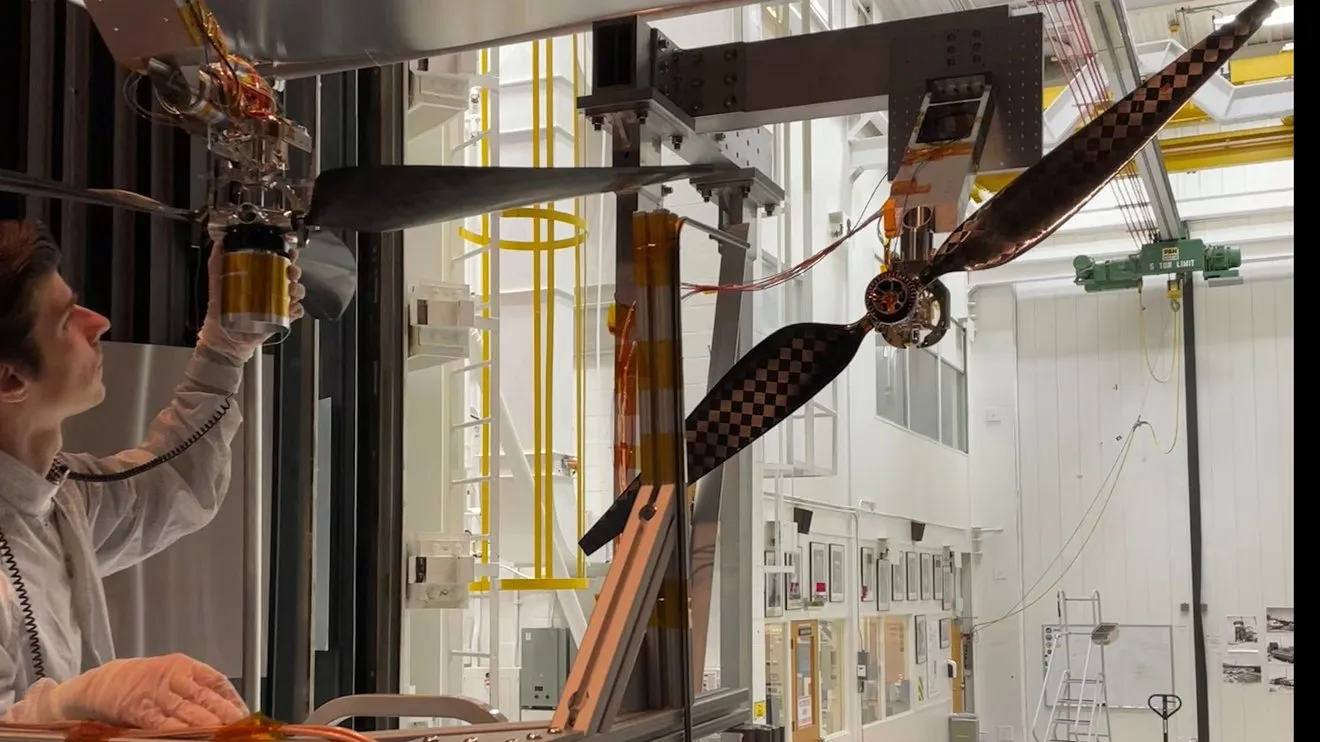
NASA confirmed in a blog post that it had successfully tested two Mars-bound rotor systems, achieving never-before-seen rotational speeds. In the tests, which took place at the historic 25-Foot Space Simulator at NASA’s Jet Propulsion Laboratory (JPL), the rotor systems — one two-bladed and one three-bladed — reached rotor tip speeds of Mach 1.08 and Mach 0.98, respectively, before additional headwinds pushed them past the sound barrier for the first time ever. The rotors reached up to 3,750 rpm. For comparison, that is roughly 10 times faster than the rotor speeds of many modern helicopters.

These extreme speeds are necessary to generate enough lift in Mars’ ultra-thin atmosphere, which is only about 1% as dense as Earth’s. The rotors were jointly developed by NASA and AeroVironment as part of Project SkyFall, a proposed mission to deploy multiple airborne exploratory rotorcraft across Mars. The mission, currently targeted for December 2028, would transport three next-generation Mars helicopters aboard a spacecraft to the Red Planet. Once the spacecraft lands on Mars, the helicopters would deploy to different regions of the planet for independent exploration missions, using the landed spacecraft as a communications and operational base.

Testing the Next Generation of Mars Helicopter Rotor Blades - YouTube Testing the Next Generation of Mars Helicopter Rotor Blades - YouTube
Watch On

SkyFall would mark only the second time NASA has conducted Mars exploration using an airborne craft. The pioneering 2021 Ingenuity Mars Helicopter mission deployed the small rotorcraft — equipped with carbon-fiber blades — to access parts of Mars that ground-based rovers such as the famous Perseverance Rover could not easily reach. NASA reports that while Ingenuity was initially planned for just five flights, it ultimately completed 72 flights, with its longest covering approximately 2,300 feet (704 meters). These achievements confirmed the viability of powered-rotor flight on Mars and laid the foundation for developing new ultra-fast rotor systems.

“NASA had a great run with the Ingenuity Mars Helicopter, but we are asking these next-generation aircraft to do even more at the Red Planet,” said Al Chen, Mars Exploration Program manager at JPL. “That’s not an easy ask. While everything about Mars is hard, flying there is just about the hardest thing you can do. That’s because its atmosphere is so incredibly thin that it is hard to generate lift, and yet Mars has significant gravity.”

The biggest obstacle to airborne exploration on Mars has always been the planet’s ultra-thin atmosphere, which requires extremely high rotor speeds to generate sufficient lift. Ingenuity achieved this with rotor tip speeds of around Mach 0.7 as a safety precaution. However, despite its success, the entire craft was only about the size of a tissue box, weighed 1.8 kg (4 lbs), and did not carry a payload, so it did not carry any scientific or communication equipment. The obvious solution was larger aircraft, but bigger craft create more drag and require significantly more thrust to remain airborne. That thrust could theoretically be achieved at near-supersonic rotor speeds, but rotor blades would normally be at risk of structural failure under such extreme conditions, until now.

“The successful testing of these rotors was a major step toward proving the feasibility of flight in more demanding environments, which is key for next-gen vehicles,” said Shannah Withrow-Maser, a NASA aerodynamicist and member of the test team. “We thought we’d be lucky to hit Mach 1.05, and we reached Mach 1.08 on our last runs. We’re still digging into the data, and there may be even more thrust on the table. These next-gen helicopters are going to be amazing.”

NASA’s new supersonic rotor technology could enable significantly larger exploratory aircraft capable of carrying bigger batteries for longer missions, more advanced scientific instruments, and improved communication systems. NASA says Project SkyFall’s helicopters will perform low-altitude aerial exploration and scouting missions, gathering scientific data while helping pave the way for future robotic and potentially human missions to Mars.

Get Tom's Hardware's best news and in-depth reviews, straight to your inbox.

Google Preferred Source

Follow Tom's Hardware on Google News, or add us as a preferred source, to get our latest news, analysis, & reviews in your feeds.

Etiido Uko is an engineer and technical writer with over nine years of experience in documentation and reporting. He is deeply passionate about all things gadgets, technology, and engineering.