







What Susanne Bayly-Yukawa remembers, maybe the most, is how much her partner did not want to get on that plane. It was the morning of August 12, 1985, a Monday, and Akihisa Yukawa was scheduled to be in Osaka for one night. The pair had met in London eight years before, when Yukawa’s work took him to England to act as branch manager of the Sumitomo Bank. Now he was back in Japan, newly in charge of building up the bank’s aircraft leasing finance arm. Nearly every other week, he flew on Japan Airlines from Tokyo to Osaka for business. That Monday morning, however, was different.
“He spent the whole morning saying he was in a really unusual mood, and it was unusual for him because he was flying all the time,” Bayly-Yukawa recalls.
Yukawa even went so far as to ask his assistant to book a seat on the bullet train for him. But the train was full, as millions of Japanese citizens were on the move that week preparing to celebrate Obon. (The annual holiday, which takes place in August, is a time for people to return to their ancestral lands to honor their forefathers.) When Yukawa came home for lunch, he was furious that the head office still insisted that he travel to Osaka.
“He desperately wanted to cancel going,” says Bayly-Yukawa, who at the time was nine months pregnant with their second child. “He had a very bad feeling.”
It would be the last time she ever saw her partner. That evening, he boarded Japan Airlines 123, a Boeing 747. At the time, it was the world’s largest and most impressive passenger aircraft and had a virtually spotless safety record. It took off at 6:12 p.m. without a hitch from Tokyo’s Haneda Airport—but never made it to Osaka.
What should have been a routine 54-minute flight turned catastrophic in only 12 minutes. After reaching cruising altitude at 24,000 feet, the bulkhead at the rear of the 747 ruptured with a loud boom. The aft bulkhead, an amalgamation of aluminum sheeting, rivets, stiffening rods, and fortifying strips of metal called tear straps, separates the pressurized passenger cabin from the unpressurized tail of the aircraft. Once it opened up, air rushed into the rear of the 747 with so much force that it ripped off the aircraft’s tail cone at the back of the fuselage, where an airplane’s sensitive avionics are housed. The burst tore away the jet’s auxiliary power unit and a major portion of its vertical stabilizer fin, including the rudder. Most critically: When the explosion sheared off the rear of the plane, it severed all four hydraulic systems, which power the plane’s rudder, ailerons, and other control surfaces. Without them, the massive jet was like a paper airplane on a gusty day—completely unresponsive to the pilots’ steering commands.
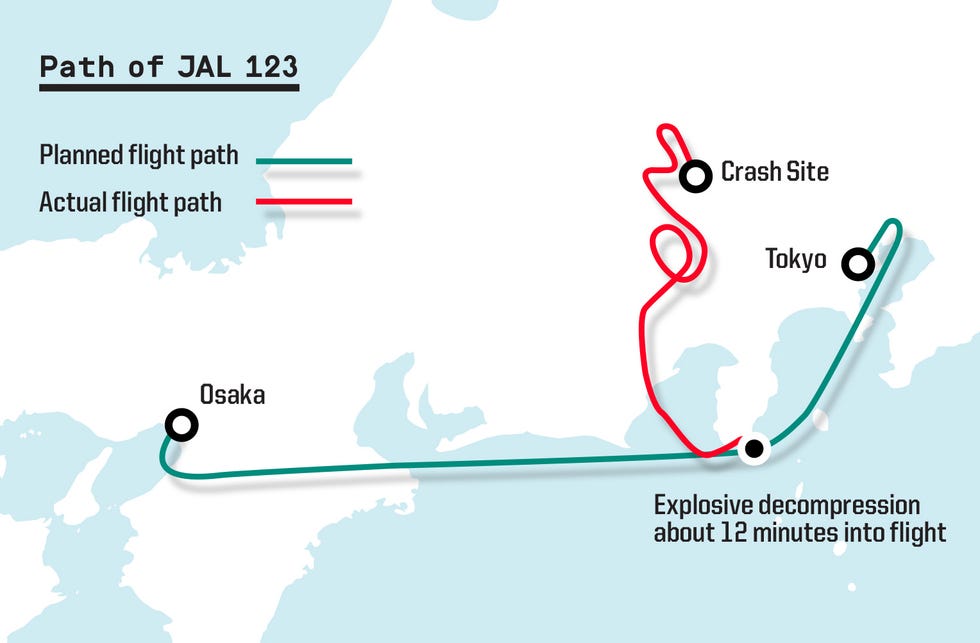
The planned flight from of JAL 123 from Tokyo to Osaka turns off course roughly 12 minutes into the flight.
For 32 minutes the crew battled to keep the 747 airborne. With the aircraft’s normal flight controls inoperable, they had only one option—using engine thrust to ascend and descend in their attempt to keep the plane level. But the damage was just too severe. “It’s the end!” shouted Captain Masami Takahama. Moments later, Japan Airlines Flight 123 crashed into a ridge on Mount Osutaka, about 62 miles northwest of Tokyo. Only four people survived. The other 520 on board—three pilots, 12 attendants, and 505 passengers—all died, including Akihisa Yukawa, at age 56. To this day, it remains the world’s deadliest single-aircraft disaster.
A rescue and investigative operation recovered bodies and airplane parts in the days and weeks following. As authorities picked up the pieces, they began assembling clues that would reveal what went wrong, and why. A commission from Japan’s Ministry of Transport concluded in 1987 that a faulty repair to the bulkhead made by Boeing several years earlier precipitated the plane’s demise. In the months that followed, Boeing made substantial changes to several critical elements of its flagship 747 aircraft. Nearly 40 years after the crash, though, relatives of the victims still question whether anything more could have been done to save people in the wake of the disaster.
One thing, however, is certain: “The crew did all they could do,” says Ron Schleede, a member of the team from the U.S. National Transportation Safety Board that flew to Japan to assist in the accident investigation. “But the crash was inevitable.”
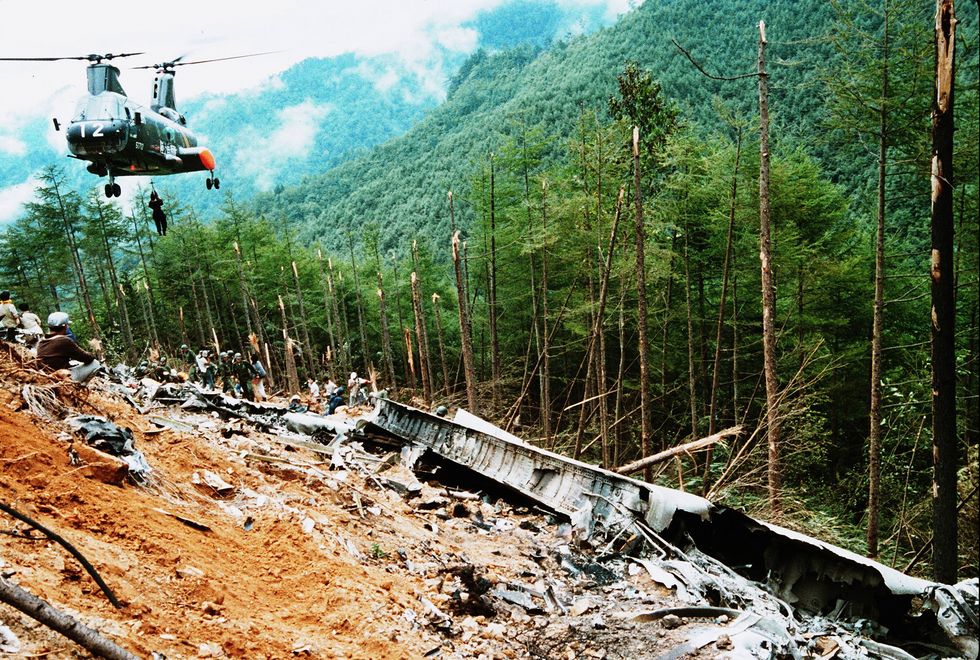
After the crash, authorities mobilized more that 8,000 people to assist with the search, rescue, and investigation efforts.
The scale of the tragedy of JAL 123 attracted international attention. That it happened to a Boeing 747 drew even further scrutiny. The aircraft, though it had debuted just 15 years before, was famous around the world.
This year, in fact, marks the end of an era. In January, Boeing delivered the final 747, a freighter for Atlas Air. Fewer than 50 passenger 747s are in regular service today. Over the years, the 747’s supremacy was gradually supplanted by more fuel-efficient twin-engine wide-body planes. But the plane dubbed “Queen of the Skies” kicked off an aviation revolution by making air travel more accommodating and more affordable than ever before. It’s the plane that Austin Powers fashioned into his technicolored airborne shaggin’ wagon. It’s the plane on which Leonardo DiCaprio and his dream team flew in the movie Inception. It’s also the plane that the U.S. government trusts to fly the president, Air Force One. From its first test flight on February 9, 1969, and for decades after, the 747 was the most impressive passenger aircraft of its time.
Development started a few years earlier when, according to industry lore, Juan Trippe, the president of Pan American World Airways, proposed that William Allen, Boeing president, build an aircraft that could carry 400-plus passengers—more people and cargo than ever before. “If you buy it,” Allen is said to have replied, “I’ll build it.” In 1966, Trippe agreed to purchase 25 of the planes at $20 million apiece.
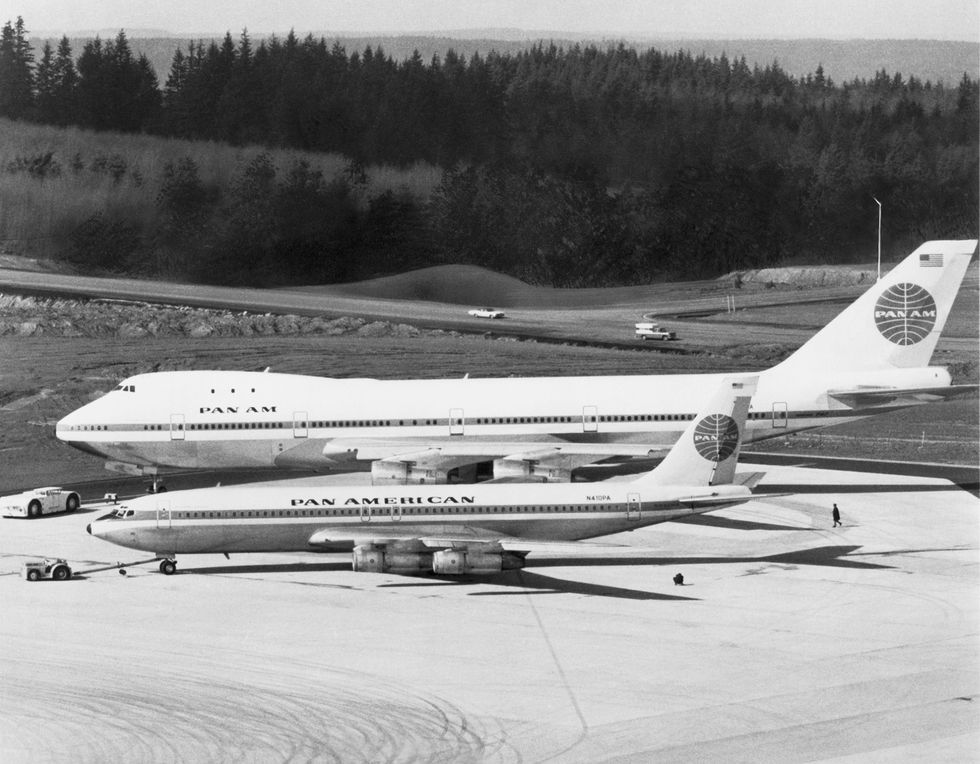
The first Boeing 747 that rolled off the production line in 1969 was significantly larger than any other commercial airliner. Here, a Boeing 707-321B, which carried about half as many passengers, is dwarfed by its imposing neighbor.
Things quickly kicked into high gear. Boeing opened a new facility in Everett, Washington, to house the gargantuan plane, while an internal team of 50,000 Boeing employees, known as the Incredibles, worked on the jet’s design and construction, a feat accomplished in just 29 months. The group was led by chief engineer Joe Sutter, who had early reservations about Trippe’s demand that the plane fit at least 400 passengers. Conventional wisdom was that the only way to achieve that was to stack two single-aisle cabins. Sutter flagged the design as both an evacuation risk in case of emergency and too small for carrying cargo.
Unsung hero Rowland Brown, a lower-level engineer who led the configuration unit, stepped in with the necessary fixes. First he suggested placing two standard cargo pallets side by side, which created a huge luggage hold and a fuselage of about 20 feet in width. Then he thought up a design that created two main aisles down the center of the plane. The two problems, solved independently, were perfectly complementary.
Now moving in the right direction, the Incredibles placed the flight deck above the main cabin. This innovation allowed the nose of the plane to open upward, which made loading cargo much easier. It also created a second floor of passenger space that was accessible by a spiral staircase. In the earliest days of commercial operation, airlines used the second floor as a lounge or piano bar, adding to the plane’s mystique. Even as the size of the 747 brought down the price of international travel, its swanky upstairs parlor furthered the romance of air travel.
On January 22, 1970, the first 747—the world’s first twin-aisle jetliner—entered service with Pan Am. Japan Airlines flew its first 747 in July of the following year.
A jumbo jet: That’s what Boeing gave to the world. When the first passenger-service flight lifted off in New York City in 1970, it carried 335 out of a possible 400 passengers. The aircraft with the next largest passenger capacity at the time, the DC-8, had only 259 seats. Thanks to all the additional seating, airlines could sell international tickets for lower prices. “This was the airplane that introduced flying for the middle class in the U.S.,” Air France-KLM CEO Ben Smith said earlier this year. “Prior to the 747, your average family couldn’t fly from the U.S. to Europe affordably.”
What initially surprised pilots about the 747 was its sheer size. “It was like walking inside a gymnasium,” says Paul Misencik, who flew the 747 for both Eastern Air Lines and Evergreen International before retiring in 1996. Misencik adds that despite the plane’s size, it was effortless to control.
“You could fly it with one hand,” he says.
Misencik even recalls descending into Anchorage, Alaska, from the east, through fierce turbulence over the Chugach Mountains. He said the 747 was responsive and docile, and that he “never felt like it was a chore” to guide the plane through rough skies.
By 1985, there were 608 747s in the world, including 29 short-range versions that could carry more than 500 passengers. These were flown exclusively by Japan’s All Nippon Airways and Japan Airlines. Short-range 747s had tougher fuselages and landing gears, necessary to endure a higher number of takeoffs and landings. The plane that flew JAL 123 was a short-range 747 built by Boeing in 1974.
When 509 passengers boarded Flight 123 out of Tokyo that evening in 1985, they were all likely expecting an uneventful journey—and almost certainly none were aware that an incident from 1978 involving this exact plane would play a fateful role. During a landing in Osaka seven years before, the pilot had pitched the plane’s nose too high and slammed the tail into the runway. More than 100,000 flights take off and land around the world every day. Tail strikes can be a serious but uncommon incident. “They sure don’t happen every day,” says John Purvis, a former manager in Boeing’s Air Safety Investigation facility. Twenty-five people were injured in the 1978 strike, and the structural damage to the rear of the 747 was severe.
Trickiest to repair was the aft pressure bulkhead, which had been so damaged that Japan Airlines called in Boeing’s Airplane-on-Ground Team, known as AOG, to perform the rehab. The bulkhead of the 747 was nearly 15 feet in diameter and about as thin as nine pages of printer paper stacked together. It was a standard design, just much bigger because of the size of the airplane. Arranged in a circle were 18 slices of aluminum skin attached to one another by two rows of rivets. Several tear straps were affixed to each slice, which were further held in place by 36 stiffening rods that ran radially from the center of the bulkhead to the edges.
Bulkheads can be flat or dome-shaped. The 747’s was a dome: Cut an orange down the middle, take one half of it, spoon out the insides, and you have the idea. Both designs perform the same function: separating the pressurized cabin from the unpressurized tail of the plane. Japan Airlines, at the time, typically pressurized the inside cabin to about 8.9 pounds of force per square inch. Each time, the bulkhead had to withstand a force roughly similar to a simultaneous punch by a couple hundred super heavyweight boxers. After more than 12,000 direct hits, Flight JAL 123 would take a fatal blow.
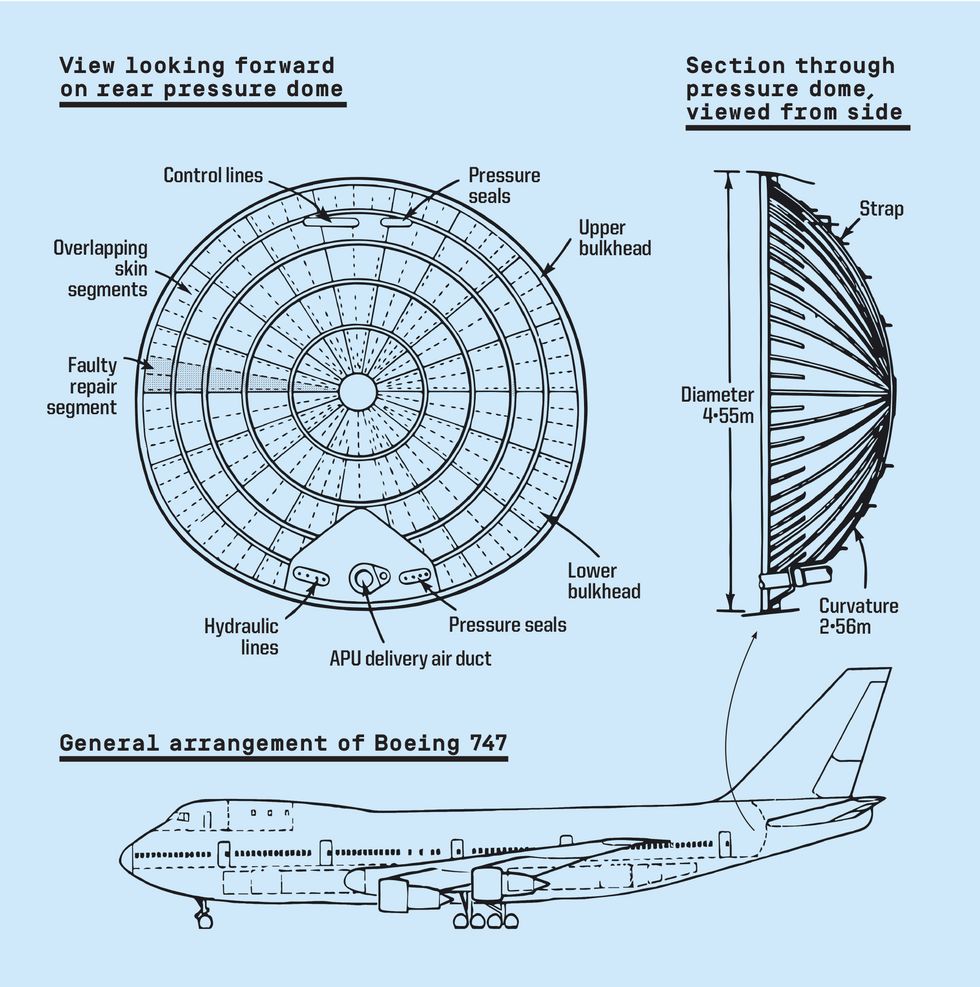
The tail strike accident mangled the bottom half of the bulkhead. Instead of mending it, the AOG team had to remove the damaged section and remake it. The fix should have been straightforward. But when it came time to attach the new bottom half onto the remaining top half, one section of the aluminum from the upper half barely overlapped with the skin of the new bottom—not enough space, in other words, for the required two rows of rivets. To solve the problem, an overlapping splice plate was fashioned to connect this one section on the bulkhead. During the installation, however, the maintenance team had to cut the plate to make it fit, which weakened the structural integrity of the repair in this location—now a single row of rivets, instead of two, was taking most of the load. The faulty repair was missed on inspection because all the joints of the bulkhead had been filled in by a sealant.
According to a report on the crash published by the Federal Aviation Administration, cutting the splice plate and using one row of rivets instead of two weakened the bulkhead in that one section by 30 percent. Over time, repeated pressurizations put stress on the incorrectly repaired section. Small, imperceptible cracks began to form as the bulkhead reached its breaking point. On the evening of August 12, 1985, the 747 en route to Osaka had flown more than 16,000 hours over the course of 12,318 flights since the bulkhead repair. Flight 12,319 would be its last.
Shortly after takeoff, JAL 123 pressurized its cabin as it climbed to about 24,000 feet. That’s when 26-year-old flight attendant Yumi Ochiai, who would survive the crash, recalled hearing a loud bang. One of the flight attendants could see daylight out of the back of the jet, and the cabin turned white as atmospheric air condensed. Up in the cockpit, Captain Takahama called for emergency squawk code 7700 on the transponder. Just then, an amber light came on to indicate that the plane was losing hydraulic pressure.
Just 12 minutes into the trip, the pilots had lost command of the aircraft, and the plane entered what’s called a phugoid cycle, which pitches it up and down. Without rear stabilizers, it also began oscillating laterally, which is known as a Dutch roll. Ochiai would eventually compare the sensation to a falling leaf. Think of a roller-coaster track that’s going up and down repeatedly while also rocking violently from side to side.
“It’s a sickening feeling,” says Purvis.
Captain Takahama and his copilot, meanwhile, tried to course-correct by increasing and decreasing power in the engines and even using the wing flaps. By accelerating, they made the plane climb; decelerating had the opposite effect. For 32 agonizing minutes, they tried turning the plane right to get back to Haneda Airport by raising power in the left engines, but without success. “Can you control now?” the air traffic controller in Tokyo asked them around 6:47 p.m. “Uncontrollable,” came the captain’s voice over the radio.
Meanwhile, frantic, frightened passengers fixed oxygen masks to their faces and composed final messages on scraps of paper. “I’m scared. I’m scared. I’m scared,” wrote 26-year-old Mariko Shirai, who perished. “Help. I feel sick. I don’t want to die.”
Descending more and more, the pilots still battled the unresponsive 747. “Rev up, rev up!” Captain Takahama commanded, but the plane slipped steadily toward the mountains. At 6:56 and 29 seconds, the captain could see the end, as larch trees on the ridges of Mount Osutaka came into focus. “Power, power, raise the nose, raise the nose, raise it!” he yelled. Less than a minute later, the plane collided with the trees on the mountainside, and then the right wing clipped a ridge.
In the accident report published two years after the crash, the authors wrote that the “right wing … was shattered to such an extent that it retained no resemblance to the original form.” Boeing 747’s safety record was excellent, according to Christopher Hood, a professor at Cardiff University in Wales who wrote a book about the crash. “This was the first accident,” he says, “where there were no obvious signs of pilot error or terrorism.”
The crash site was visible for miles. Once the right wing hit the ridge, digging a deep trench into the mountain, the plane’s fuselage tumbled across a ravine until it landed on its back and exploded in a fireball. Trees were scorched in seconds; the stench of jet fuel hung in the air. The mountain terrain, difficult to navigate and inaccessible by road, made the prospect of a quick rescue dubious. But only about 25 minutes after JAL 123 made impact, a passing U.S.C-130 planelogged the coordinates of the wreckage and sent them to Japanese authorities.
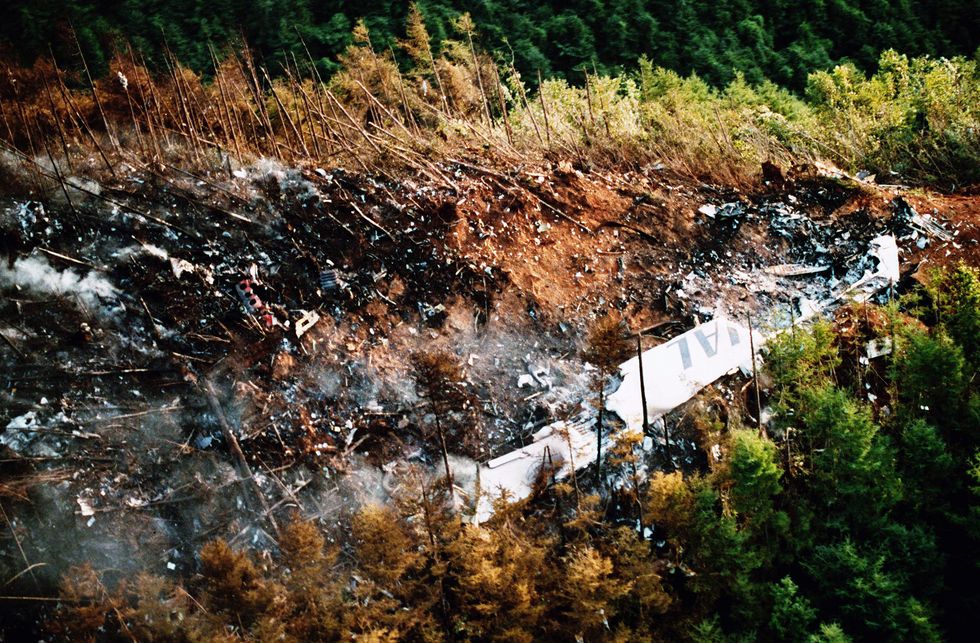
A wing from JAL 123 at the crash site on Mount Osutaka, northwest of Tokyo.
During the night, a helicopter dispatched by the Japan Self-Defense Forces, or JSDF, located the crash site, but the pilot reported no signs of survivors. Meanwhile, authorities amassed a huge search team: roughly 8,000 people, including firefighters, local police, and 3,200 JSDF personnel, plus almost 900 vehicles and 37 helicopters and other aircraft. But none of that assistance reached the outskirts of the debris field until 10 a.m. the next day; it seemed unlikely that anyone lived through the crash.
Then the seemingly miraculous happened. Ochiai was spotted when rescuers saw her hand raised in the air, the wrecked remains of the 747’s tail section strewn about her. Another survivor, 12-year-old Keiko Kawakami, was found alive hanging from the branches of a tree. (She became an orphan that day; her family had also been on the flight.) Two other people, a mother and her daughter, also survived.
Had the search team reached the site earlier, the survivor count might have been higher. Kyra Dempsey, a chronicler of air accidents, notes that Ochiai’s testimony of her 16-hour overnight ordeal indicates that other passengers had survived the initial impact: “After the crash, I heard harsh panting and gasping noises from many people … from everywhere, all around me. There was a boy crying ‘mother.’ I clearly heard a young woman saying, ‘Come quickly!’”
The accident investigation report published two years later seemed certain in its assessment that, with the exception of the four survivors, the rest of the people on the plane “suffered from total bruise, brain damage, or bursting of internal organs, resulting in instantaneous or near-instantaneous death.” But some of those who lost loved ones in the crash believe that more should have been done.
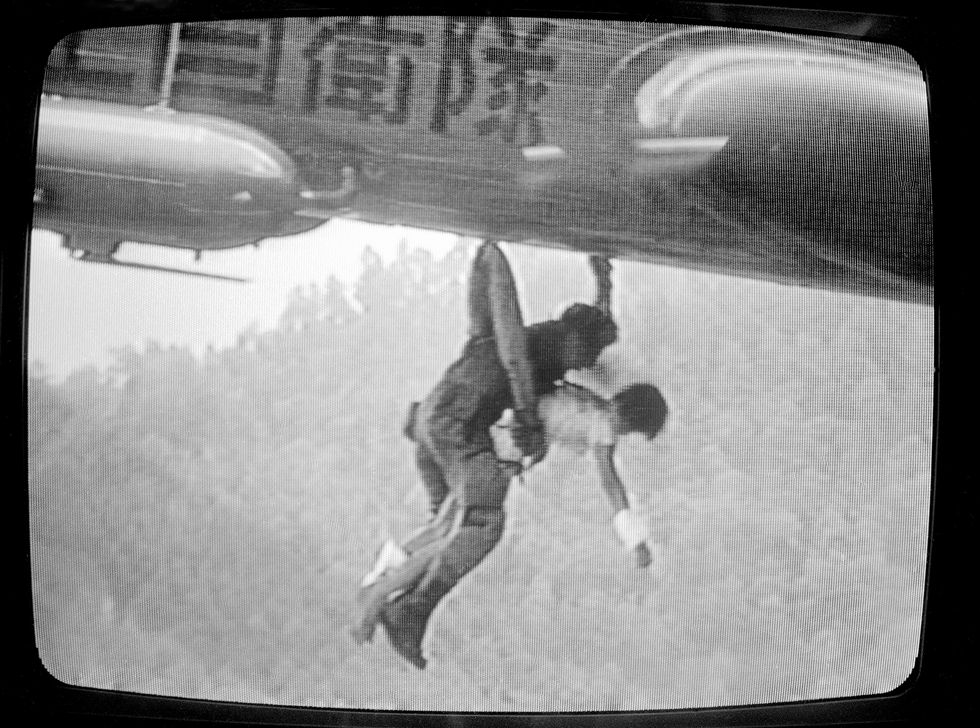
A passenger from JAL 123 is hoisted into a helicopter from the crash scene. Of the 524 people on board, only four survived.
“It’s endless agony for those whose loved ones could have been saved,” says Bayly-Yukawa.
When the U.S. National Transportation Safety Board team arrived, consisting of Schleede, Purvis, and others from Boeing and the Federal Aviation Administration, the scene resembled a war zone. In fact, they had to ride in U.S. Army Huey helicopters and land on makeshift pads made of timber and bamboo poles. Purvis remembers the burn scars on the hillside from the fires caused by spilled fuel. Schleede recalls something different.
“Family members had been given access to the site, and they had placed small religious memorials among the wreckage,” he says. “There were hundreds of military and other Japanese sorting through the wreckage, removing body parts.” Some of Captain Takahama’s teeth were found and not much else.
The team initially suspected a bomb. “I spent the first few days there finding the left and right lavatories, and swabbed them for any bomb residue using distilled water and pure-grain alcohol,” Purvis remembers. “I sent the samples back home, and none of them showed anything.”
People back in the States began pulling maintenance records. They found information about the 1978 tail strike and the ensuing repair to the bulkhead. Meanwhile, on site, an expert from Boeing on airplane stress and structure was analyzing photographs of the broken bulkhead found at the crash site and noticed a piece of metal that had cracked through the first row of rivets on one section.
Cracks could typically form in the second row of rivets, which was the row responsible for shouldering much of the load. This time, the evidence pointed to the section on the bulkhead that had been repaired. “Better heads than mine started putting two and two together,” Purvis says.
It looked as if that section had split open and the tear straps couldn’t stop the crack from growing. Once the bulkhead burst, the rapid change in pressure blew apart the plane’s tail section, destroying the pilot’s flight controls.
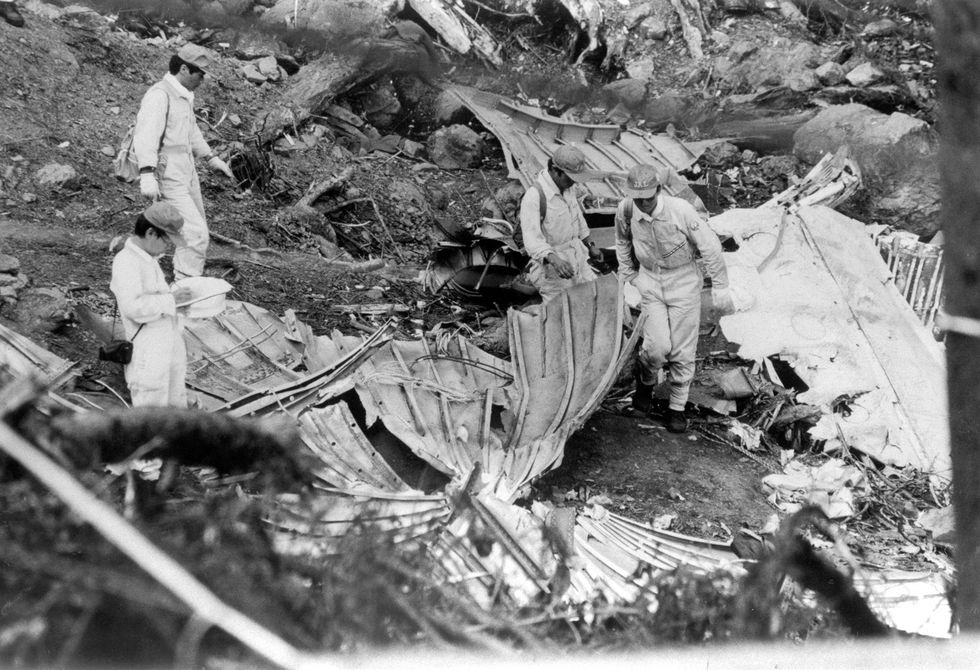
The wreckage was strewn so widely around the crash site that investigators initially suspected a bomb had downed the plane.
By comparing what was found on the ground with the repair records, the team in Japan identified the problem: A splice plate had been cut in two when it was being installed, and only one row of rivets was taking most the stress over the length of the repair. “Someone calculated how long that would hold. Lo and behold, they came up with the number that was close to the number of flights when the plane crashed. It’s clear what happened,” says Purvis.
Some people, including Bayly-Yukawa and Hood, have doubts about the official crash narrative. Bayly-Yukawa points to a section omitted from the published accident report that was unearthed by Tōko Aoyama, who published a book about the crash in 2020. It shows there was external damage to the tail sustained in the flight, which Bayly-Yukawa says indicates that the faulty repair perhaps wasn’t the major cause of the crash—a point she believes could be cleared up if bits of the largely obliterated tail fin had been recovered from their final resting place in Sagami Bay, to the south of the crash. Several people, including Aoyama and the prominent Japanese economist Takuro Morinaga, are leading a campaign to reopen the investigation on these grounds.
In quiet moments, when Bayly-Yukawa turns over in her mind what went wrong and why, there is, at least, one question which she has never struggled to answer. Even after all the mornings without her beloved partner, Bayly-Yukawa knows how he felt just before the plane went down—ending his life and preventing the marriage they had planned. In his final moments, he undoubtedly was thinking of her.
“You never know how much I do love you. You are my treasure forever. Wherever I am, I’ll always be with you,” he wrote in a note he left her the weekend before the crash. At the bottom he signed it, simply: “Yours, Aki.”
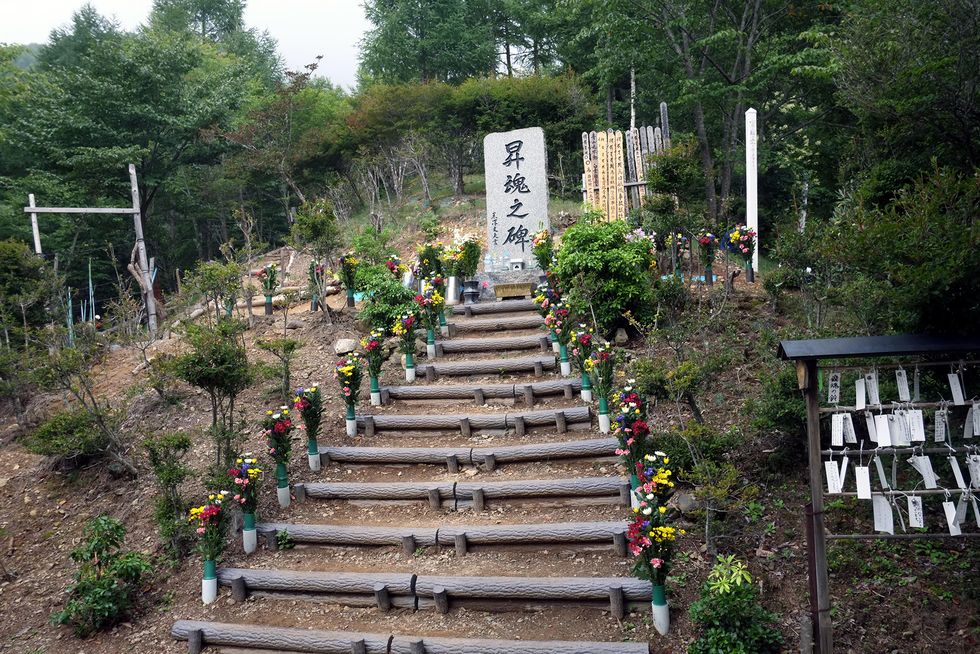
The memorial to Japan Airlines Flight 123 on Mount Osutaka.
For Boeing, the crash of Japan Airlines Flight 123 forced the company to make changes. “We looked upon it as a real chance to learn a lot of lessons,” says Purvis.
Many of those lessons were applied to the 747. First Boeing studied the structure of the aft pressure bulkhead. Using a retired short-range 747, it pressure-tested the bulkhead by repeatedly pressurizing and depressurizing it. The company’s findings led them to request that all passenger 747s undergo a visual inspection of the aft side of the bulkhead every 2,000 flight cycles. Then the company doubled down, recommending that mechanics use X-rays or ultrasonic waves to inspect the rear side of the bulkhead every 4,000 flight cycles once a plane completed 20,000 flights. Boeing also reinforced the aft pressure bulkhead on future planes by adding a cover plate to the bulkhead’s center and what Purvis calls “super” tear straps.
Boeing also supplied aluminum covers to all 747 operators to fit over the access hole at the base of the vertical stabilizer. Had a cover been in place, the extreme pressure change on JAL 123 may not have blown the rudder to bits. Not long after, Boeing began using Inconel, a stronger steel alloy, to fashion the bolts that connected the tail section to the plane’s fuselage. Finally, Boeing added a fuse to prevent the total loss of hydraulic fluid in the event that the hydraulic system is compromised.
Whether these changes have prevented another accident is hard to tell. “I’m sure they have,” says Purvis, “but to come up with concrete evidence is pretty tricky.”
That a triumph of innovation and modern technology could be felled by a botched repair is perhaps the twisted hand that fate decided to play. Had a more stringent inspection caught the issue, Japan Airlines Flight 123 would have never taken off that Monday evening. Had a properly repaired bulkhead been in place, the flight would have made it to Osaka. Relics of the crash are still turning up. Last August, one week before the anniversary of the crash, a construction worker discovered an old oxygen mask near the site.
Other 747s kept flying even as investigators searched for more clues and families wondered about what more could have been done in the wake of the crash—a disaster, and the lessons learned from it, that makes up a tragic chapter in the plane’s storied history.
Boeing ultimately produced 1,547 of its 747, revising it half a dozen times over its 54-year run. The plane that changed commercial aviation finally couldn’t compete with smaller, more fuel-efficient aircraft capable of carrying passengers across the oceans.
But even after the final 747 rolled off the line, more than 300 freighter models of the aircraft remain airborne, flying more than 40,000 flights per month. Indeed, the 747 is a key cog in the global trade of everything from iPhones to high-definition televisions to sacks of coffee. The Incredibles’ innovative design that created a double-wide transport plane with a nose that opened for easier loading has yet to be outdone. One aviation expert even claimed that he expected 747s to be hauling cargo well into 2050, nearly a century after Juan Trippe pitched his idea for an outlandishly large long-haul jet. Decades after it first flew, it seems, the Queen of the Skies still rules the air.
This story originally appeared in the June/July 2023 digital issue of Popular Mechanics. It appears here as originally published; some details, terminology, or understandings may have changed over time. Download the issue here.
Andrew Zaleski, a writer based near Washington, D.C., covers science, technology, and business.
此内容由惯性聚合(RSS阅读器)自动聚合整理,仅供阅读参考。 原文来自 — 版权归原作者所有。