











Here’s what you’ll learn when you read this story:
Imagine a war zone where swarms of cockroaches equipped with miniature backpacks sneak across front lines to spy on enemies. It might sound like a scene from a horror movie, but experiments to accomplish exactly that are underway. SWARM Biotactics, a German company founded in 2024, aims to create “bio-robotic swarms” for military use.
The company is attaching electrodes to the antennae of Madagascar hissing cockroaches, fitting them with small backpacks, and developing algorithms to control them autonomously, according to CBS. SWARM Biotactics didn’t respond to Popular Mechanics’ requests for comment.
The cockroaches are outfitted for secure communication, precise navigation, and real-time data collection, according to a SWARM Biotactics press release. This means that there could be entire swarms of literal reconnaissance bugs. So, is it truly possible to control cyborg insects, and, if so, is this the future of spy craft?
Scientists and engineers have been creating these kinds of cyborg insects for two or three decades, including by implanting electrodes into cockroach antennae, according to Coby Schal, PhD, a renowned entomologist and expert on cockroaches at North Carolina State University. “The military has been doing this for many years,” Schal says.
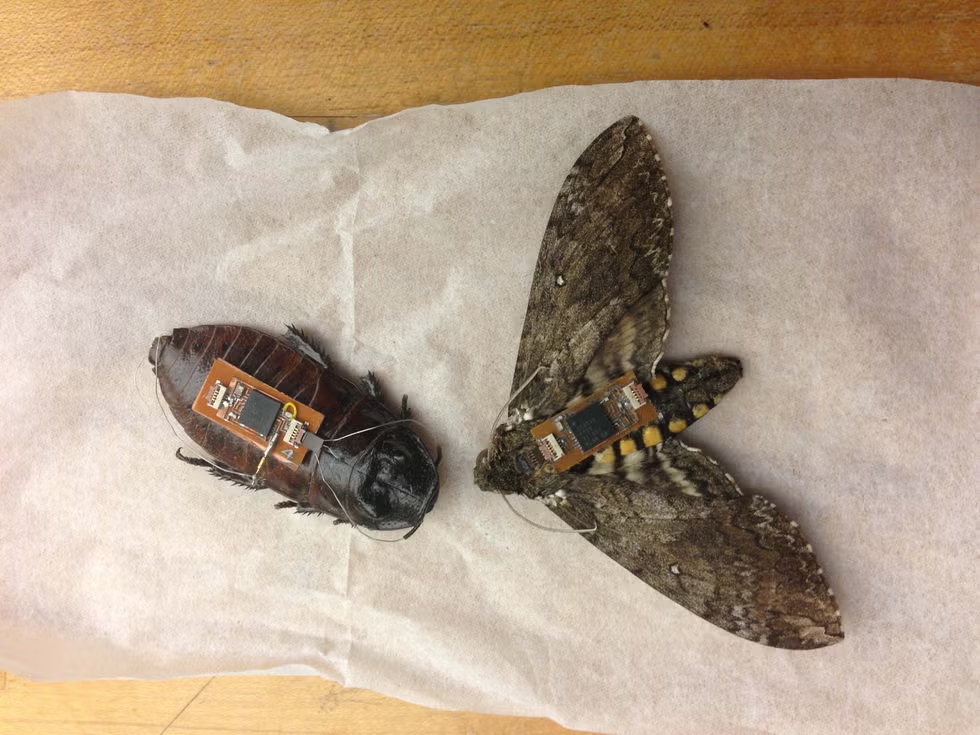
In the past, the Pentagon has sought to harness the abilities of insects for reconnaissance. The U.S. Defense Advanced Research Projects Agency (DARPA) used its HI-MEMS (Hybrid Insect Micro-Electro-Mechanical System) program in 2008 to create cyborgs by placing electronic implants into insect pupae—mainly moths—as they developed into adults.
Alper Bozkurt, PhD, an expert in insect bionics at North Carolina State University, worked on the DARPA project using moths. Later, he experimented with Madagascar hissing cockroaches as potential cyborgs to be used for search-and-rescue missions, he explains. He worked to find out if cyborg roaches could help find people trapped under rubble in a project featured on The Science Channel due to its novelty at the time.
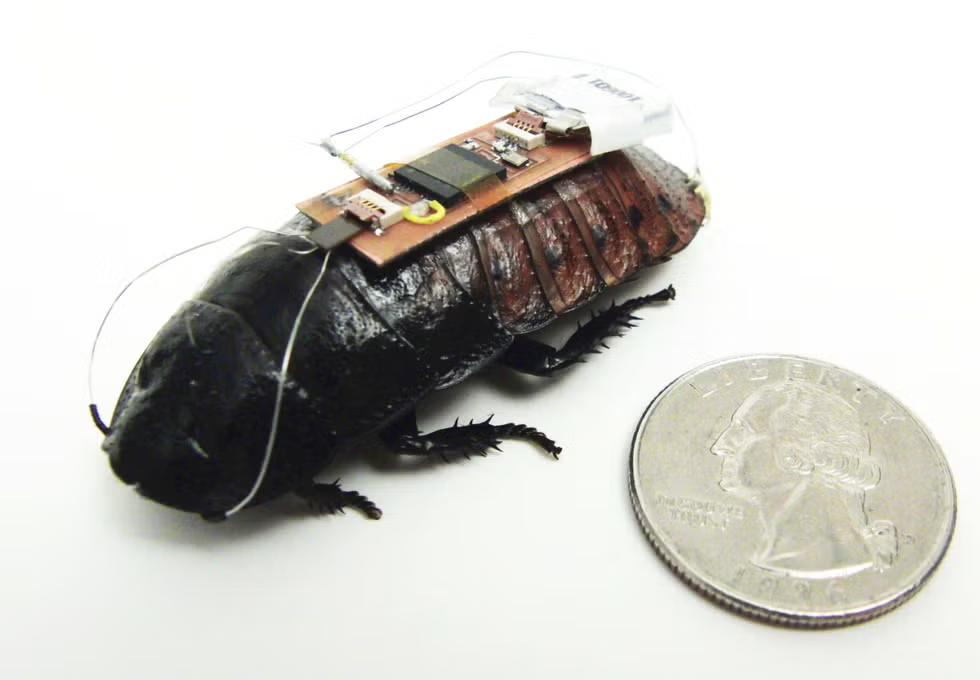
The Madagascar cockroach can grow up to 3 inches long.
The cockroaches undergo what some might consider a rather horrifying process to transform into cyborgs. Typically, engineers perform surgery to implant electrodes into the insects’ antennae. The antennae contain sensors for smell, taste, sound, touch, and sensitivity to temperatures and even wind direction, according to Schal.
Bozkurt explains that he and his team inserted electrodes into the antennae and applied electrical pulses using handheld controllers with twin joysticks to stimulate the cockroaches to move. They got them to perform, but it wasn’t a straightforward task.
He says that insects are affected by light, pheromones, heat, food, and other senses. “You need to basically make that biological entity not to be distracted by any of those but just follow the neuro-stimulation that you are providing to them,” he explains.
Bozkurt says he knows the ins and outs of what works and what doesn’t. For instance, too much electricity can change the insects’ tissue over time, electrically charging the antennae and making insects unable to respond to pulses. He added that cockroaches don’t have the concept of pain or perceive it the same way as humans and other animals do.
Schal believes the electrodes that the researchers inserted are thick compared to refined biological sensors and that the volts are unlike anything experienced in nature.
“My take on all of this is basically that these researchers are giving the cockroach an electric shock. It has nothing to do with specific sensory systems like smell and taste. It’s a shock. It’s an aversive stimulus, and it causes a cockroach to turn away from the shock. You can do this with any animal,” Schal argues. “These are not biologically relevant stimuli. These are electric shocks, which the cockroach never sees in nature. We are all programmed to avoid electric shocks. In humans, that would be considered pain.”
While he didn’t offer an opinion on the controversial question of whether insects can feel pain, he explains that observations reveal that the cockroaches try to avoid the shocks.
“It’s very difficult to know whether in fact the cockroach experiences pain or not. Regardless, it’s aversive,” Schal says. “It moves away from a stimulus that to us would cause pain.”
One thing is very important to note, according to Schal—that is, that Madagascar hissing cockroaches are in no way comparable to the pesky scavenging cockroaches that you exterminate with pesticide or stomp on at first sight.
“This is not taking a ‘pest’ and making it into something useful for humankind,” Schal explains. “The Madagascar cockroach is not a pest… In fact, if you drop the ‘s’, it’s a human pet, because you can buy them in pet stores and lots of kids have them as pets in little terrariums in their homes.”
The “pest” species are notorious but are a minority among cockroaches, he notes. “We have about 5,000 species of cockroaches, and only a handful of them, maybe up to 10, are considered to be pests. By definition, pests are those that affect humans or livestock. These are absolutely harmless.”
The Madagascar hissing cockroach is one of the largest cockroach species on the planet. However, it’s a gentle giant—it’s wingless and crawls at a slow pace. Left to its own devices, it’s an easygoing creature that prefers shade, likes to climb, can be trained to eat cat food or leftover vegetables, and tolerates being handled by humans.
Their trademark hissing is the result of a severe case of machismo. In nature, males hiss at each other to show dominance when fighting for females—or to attract female admirers. They create this sound by inhaling air through holes in the sides of their bodies and expelling it. They also use this noise to scare away predators, like lemurs.
“We love these cockroaches,” Schal says, adding they are great for demonstrating insect communication and behavior. “I use them a lot in outreach activities to educate young kids about science in general.”
In fact, the very qualities that make the Madagascar hissing cockroach an ideal invertebrate pet or classroom ambassador make it a top pick for scientists to experiment with.
“It’s convenient because it’s incredibly hardy. They don’t fly. They can withstand all kinds of falls. They can withstand dehydration and starvation for a long time. You can do all sorts of surgeries on them, which are required for this type of thing,” Schal says, adding they’re also easy to raise in laboratories.
Bob Fischer, PhD, professor at Texas State University and treasurer of the Insect Welfare Research Society, says that insects—including cockroaches—are often chosen for extreme experiments because no regulatory environment exists to control what is done to them.
“Because there are no ethical guidelines on this research, people can do whatever they want with these animals in their labs,” Fischer explains. “If you were dealing with a mouse, there would be at least some humane protocols. There would be some attempts to regulate and to make sure that people are not doing unnecessary things.” He also added that no protections like that exist for insects.
Madagascar cockroaches can bear up to 60 babies—called nymphs—at a time.
Despite his lengthy experience working with bionic cockroaches and belief in their research value, Bozkurt says he is extremely skeptical they could be used effectively for military purposes. “You can exterminate them,” he argues. “Researchers found all kinds of different chemicals that can hurt a cockroach but nothing else.”
He said it’s also difficult to ensure cybersecurity for electronic signals mounted on cockroaches. “You want to encrypt your data,” Bozkurt explains. “With cockroaches, you only have tiny microcontrollers and radios, so it’s relatively challenging to provide those cybersecurity measures and precautions such that your devices will not be jammed.”
For Fischer, this brings up an entirely new ethical dilemma: if the technology isn’t effective, is it worth the harm researchers may cause to create it?
“If we don’t really need to use technologies like this, if they don’t provide a lot of value, we should be asking hard questions about why we’re developing them in the first place and what the costs of them are,” he argues.
Initially a skeptic on insect pain, Fischer published his change of views in an essay on insect consciousness. He points out that cockroaches are sensitive organisms used to study pain in humans. They respond to morphine the way humans do and avoid heat barriers. Stopping insects from using their instincts robs them of their ability to avoid threats, as they can be steered over hot surfaces or paths they would normally avoid.
Meanwhile, Schal points out that insects are often used to conduct successful and important scientific experiments that can’t be conducted on most mammals or other organisms. “There have been seven Nobel prizes won based on research on the fruit fly,” he explains. “The fruit fly has contributed enormously to our understanding of human biology and human health.”
While it might be easy to imagine cyborg moths fluttering around and bionic cockroaches charging across battlefields of the future, the little critters could ultimately wind up being swatted or felled with pesticide. SWARM Biotactics—the German startup currently trying to make these cyborg insects—raised a hefty $15 million in funding, and given the existing technology, it’s possible for other companies to pursue creating insect cyborgs as well. However, the bedrock truth is that trying to make war machines out of the raw biological material of nature might not prove to be impossible, but impractical.



















Zita Ballinger Fletcher is an award-winning author, defense journalist, and military historian. She enjoys writing on military leaders, tactics, and autonomous systems technology. Her work can be found in Forbes, Military Times, Defense News, Army Times, and numerous other publications. Follow her articles on LinkedIn.
此内容由惯性聚合(RSS阅读器)自动聚合整理,仅供阅读参考。 原文来自 — 版权归原作者所有。