







This story is a collaboration with Biography.com.
Do you think the U.S. government is hiding, and possibly reverse-engineering, extraterrestrial technology? Think again. Or better yet, don’t think about it at all. Nothing to see here.
That’s the underlying message of a report released in 2024 by the Department of Defense. The 63-page “Report on the Historical Record of U.S. Government Involvement with Unidentified Anomalous Phenomena (UAP)” concludes that the DoD’s All-Domain Anomaly Resolution Office (AARO) “found no evidence that any [U.S. Government] investigation, academic-sponsored research, or official review panel has confirmed that any sighting of a UAP represented extraterrestrial technology.”
The AARO, as The Guardian summarizes, is “a government office established in 2022 to detect and, as necessary, mitigate threats including ‘anomalous, unidentified space, airborne, submerged and transmedium objects’.”
This report came on the heels of, and in contradiction to, what was arguably the most high-profile hearing on UAPs—formerly known as unidentified flying objects, or UFOs—in decades: the August 2023 testimony of “whistleblower” Dave Grusch.
In the bombshell hearing, Grusch, a former member of the Pentagon’s UAP Task Force, claimed that he had been made aware of a “multi-decade UAP crash retrieval and reverse engineering program.” But his claims were never substantiated, and while the 2024 report doesn’t mention Grusch by name, it does offer plausible explanations for the phenomena he described in his testimony.
This is hardly the first government report to debunk stories about little green men and their strange flying saucers. So, why do Americans keep clinging to conspiracy theories about extraterrestrial visitors? Blame science fiction, the AARO report says:
“A consistent theme in popular culture involves a particularly persistent narrative that the USG—or a secretive organization within it—recovered several off-world spacecraft and extraterrestrial biological remains, that it operates a program or programs to reverse engineer the recovered technology, and that it has conspired since the 1940s to keep this effort hidden from the United States Congress and the American public.
AARO recognizes that many people sincerely hold versions of these beliefs which are based on their perception of past experiences, the experiences of others whom they trust, or media and online outlets they believe to be sources of credible and verifiable information. The proliferation of television programs, books, movies, and the vast amount of internet and social media content centered on UAP-related topics most likely has influenced the public conversation on this topic, and reinforced these beliefs within some sections of the population.”
The X-Files and the internet helped guide curious people toward the fringes of ufology. But to fully understand the ongoing public skepticism regarding the government-provided explanations about aliens, we must consider the man who was once responsible for upholding these “official” stories—and examine his stunning evolution from a fellow skeptic to the world’s leading UFO advocate.
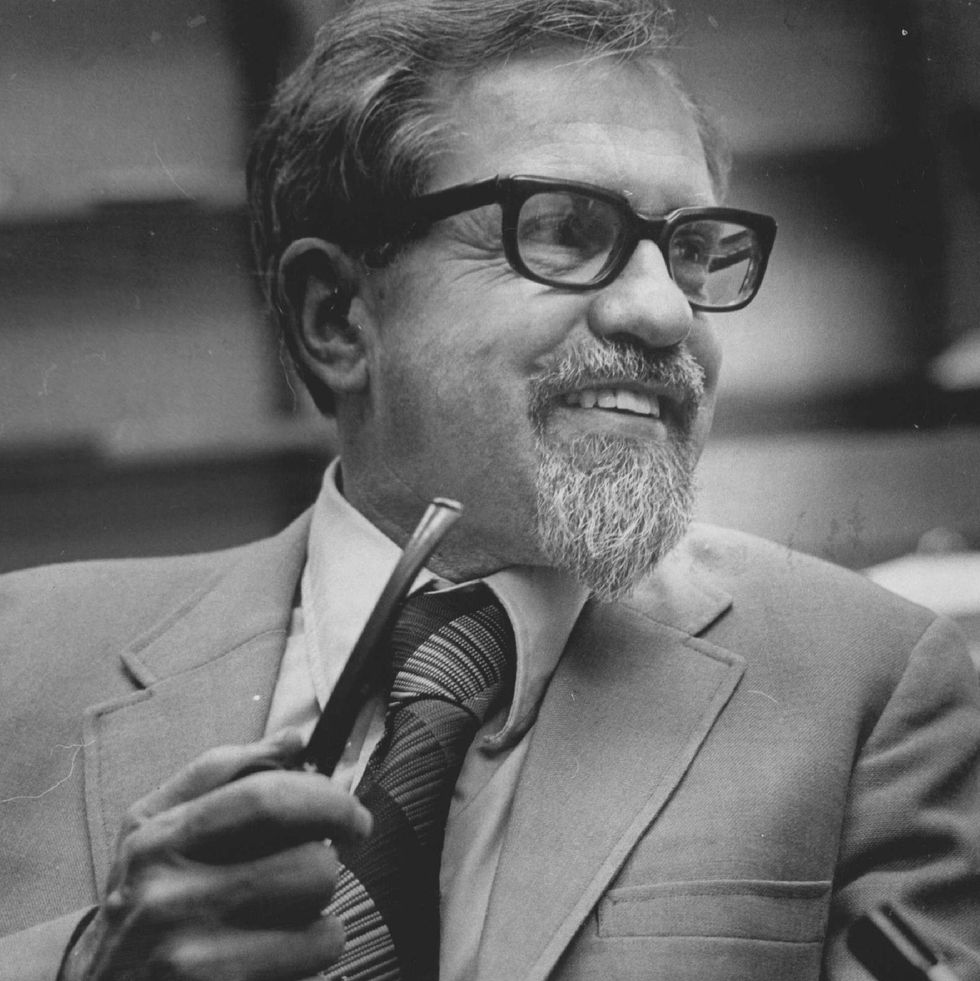
J. Allen Hynek, photographed in 1972.
Josef Allen Hynek, who was born on May 1, 1910, developed an interest in the cosmos following an episode of illness during his childhood. The sickness steered his curiosity away from following in the footsteps of his mother and father—a schoolteacher and cigar manufacturer, respectively—and toward the universe. Biography.com writes:
“An introduction to the stars came after Hynek was bedridden with scarlet fever at age seven: Having run through their supply of children's books to read, his mom turned to textbooks, with a high school edition on astronomy capturing the boy’s attention.”
From an early age, Hynek’s passion for science was mixed with a penchant for mystery and a pursuit of philosophical thought. He had “an interest in more esoteric subjects, particularly the works of the Rosicrucian secret societies and hermetic philosopher Rudolf Steiner,” according to Biography.com.
In 1934, as a doctoral student, Hynek contributed to observations of the Nova Herculis supernova at Perkins Observatory in Ohio. By 1936, he joined Ohio State University’s Physics and Astronomy Department. His research over the next 12 years culminated in his appointment as director of the university’s McMillin Observatory.
And that’s when the U.S. government came calling—with an unusual request.
In the waning days of World War II, American fighter pilots reported seeing aircraft that were unlike any previously encountered in combat. Some described “orange, flowing lights,” while another pilot “saw a red-ish, wingless, cigar-shape object.”
These accounts reached the media, and a population exhausted by war both wondered and worried about the tales of the strange aircraft. But the occurrences were ultimately attributed to “electrostatic or electromagnetic phenomena.”
The incident involving pilot Kenneth Arnold on June 24, 1947, however, wasn’t as readily explained—and, more crucially, it wasn’t as easily dismissed. As Pop Mech previously summarized:
“While searching for a Marine Corps C-46 transport plane, experienced pilot Kenneth Arnold diverted from his original flight path to help search the southwest slope of Mount Rainier. During the search, Arnold observed nine “peculiar-looking” and possibly “completely round” objects flying in a formation that reminded him of geese. It was later estimated they were flying in excess of 1,000 miles per hour. When he reported it (and assuming they were a new type of jet or experimental military aircraft), the Army Air Corps dismissed it as a mirage or hallucination.”
When Arnold believed the Army dismissed his claims too lightly, he reached out to the press. His discussion with Bill Bequette from the East Oregonian newspaper resulted in Bequette creating the term “flying saucers” to describe the unusual objects Arnold reported seeing.
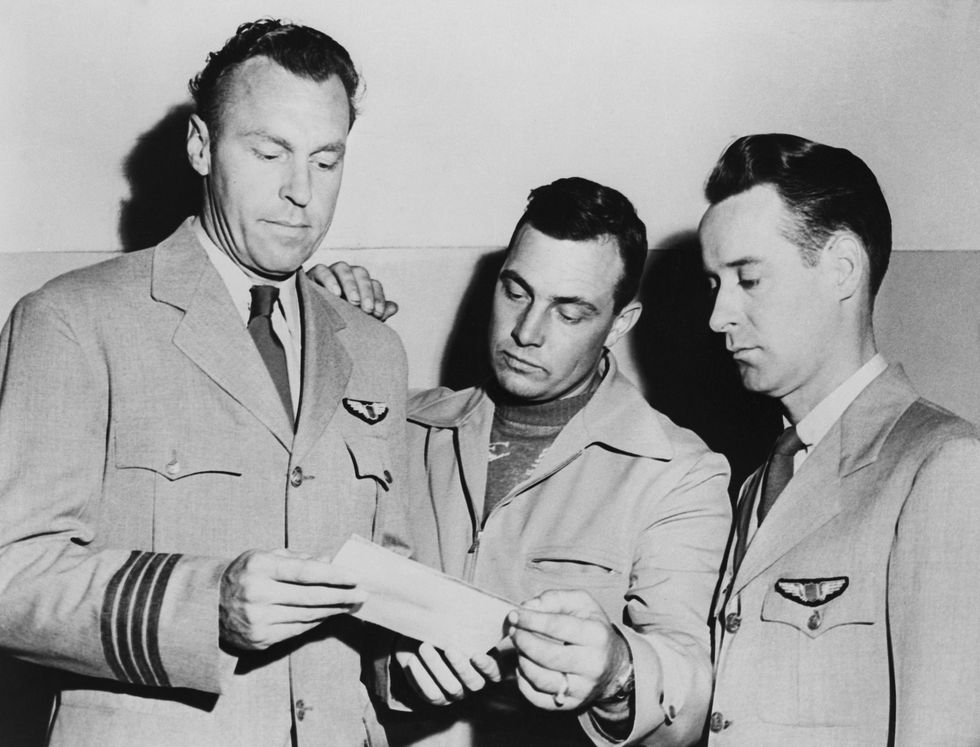
(L-R) Pilots E.J. Smith, Kenneth Arnold, and Ralph E. Stevens look at a photo of an unidentified flying object which they sighted while en route to Seattle, Washington in 1947.
America’s intelligence apparatus was still nascent at the time; the Office of Strategic Services (OSS) dissolved in 1945, and its successor, the Central Intelligence Agency (CIA), wouldn’t form until three months after Arnold reported his sighting. If there were mysterious objects flying in America’s airspace, the U.S. didn’t know where they could be coming from: The USSR? Enemies abroad? Aliens from another world?
It was crucial, then, to investigate whether these claims had any truth to them, and just as important to reassure a nervous American public that there was no cause for alarm (even if that might not have been true).
The U.S. Air Force enlisted Hynek to serve as an “astronomical consultant” for “Project Sign,” its initiative dedicated to examining the multitude of reports. Throughout Project Sign, Hynek meticulously analyzed each account of unusual aerial occurrences and categorized them accordingly. Per Biography.com:
“There were those which were simply astronomical observations, like the appearance of a meteor, those explained by meteorology, like an unusually shaped cloud, and those which captured accounts of man-made objects, like balloons. That left about 20 percent with no clear explanation...”
Hynek’s later writings suggest that he had hoped for additional investigations to address the questions posed by the remaining 20 percent of unexplained cases. However, the U.S. government, apprehensive about public fears during the Cold War and the potential for those fears to be manipulated, preferred to make such questions go away. And so, Project Sign evolved into “Project Grudge.”
“The staff,” the Report on the Historical Record of U.S. Government Involvement with Unidentified Anomalous Phenomena summarizes, “especially those who seemed to lean towards belief in the ‘interplanetary’ origin of UFOs, were reportedly purged from the organization.”
Project Grudge released only one report, in August 1949. “There is no evidence that objects reported upon are the result of an advanced scientific foreign development; and, therefore they constitute no direct threat to the national security,” the report determined. It concluded by recommending that “the investigation and study of reports of unidentified flying objects be reduced in scope.”
Hynek, disillusioned with the direction the investigations took, characterized Project Grudge as a “public relations campaign.”
Project Grudge’s conclusions failed to quell concerns about what people now referred to as “unidentified flying objects,” or UFOs. So the Air Force resumed its investigations once more, this time in its most famous form: “Project Blue Book.”
The Air Force again brought in Hynek for Project Blue Book, permitting him to actually conduct field investigations into these phenomena himself. Hynek’s perspective on the extraterrestrial theories regarding the unexplained sightings evolved from his days with Project Sign. As Biography.com observes:
“While he had harbored plenty of skepticism the first time around, he found his assumptions challenged by the rational recollections of witnesses, and began thinking about the legitimate scientific study of these 'Unidentified Flying Objects' or 'UFOs.'”
However, Hynek quickly realized that he was seen more as an instrument to dismiss alien speculation than as a scientist tasked with exploring such possibilities. As Biography notes, “By the 1960s, Hynek found himself in conflict with the restrictive supervision of the Air Force.”
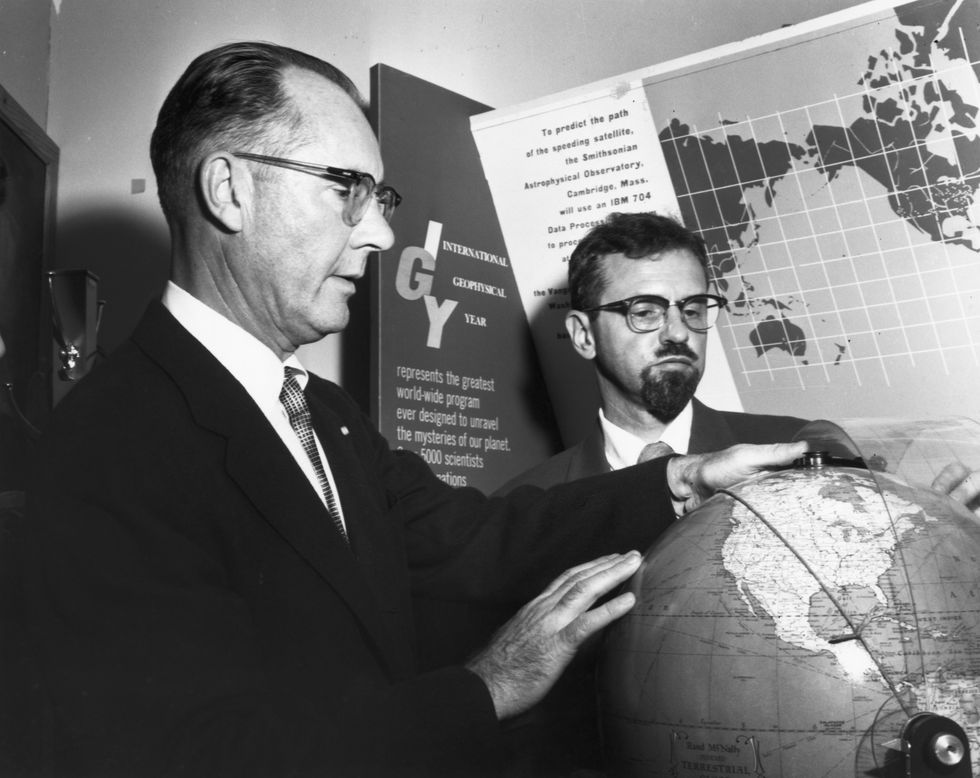
Hynek (right) at the Smithsonian Observatory during his post as the chief of Operation Moonwatch in 1957.
One particularly embarrassing incident for Hynek came in 1966, when he was sent to investigate “reports of unusual lights in separate areas of Michigan over successive nights.” Hurried to provide an explanation and pressed to steer clear of extraterrestrial theories, Hynek was compelled to suggest publicly that the sightings might be attributed to “swamp gas.”
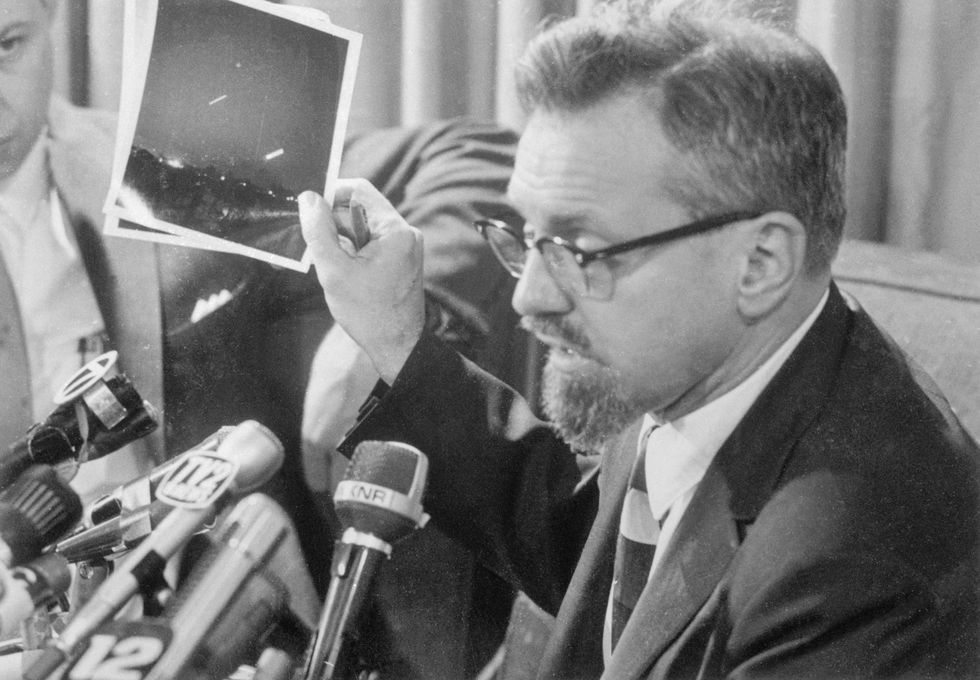
Hynek dismisses a Michigan sighting of a UFO as luminous swamp gas at a press conference in 1966.
The term “swamp gas” became a proto-meme of the mid-60s, and House Minority Leader (and future president) Gerald Ford demanded answers for the seemingly shoddy investigation. “Called to testify,” Biography.com notes, “Hynek used the occasion to argue for an extensive, transparent study of UFOs.”
Hynek broke from the directives of the Air Force, and just three years later, Project Blue Book was completely terminated. But that didn’t stop the astronomer.
Freed from the constraints of the Air Force, Hynek initiated a public campaign to promote the rigorous scientific investigation of what he called “ufology.” This effort first materialized as his 1972 book, The UFO Experience: A Scientific Inquiry.
Hynek wrote about his philosophy on the study of UFOs, his observations from decades working on Project Sign and Project Blue Book, and his scale for classifying UFO sightings, which involved both distant and close encounters. He classified distant observations as either “nocturnal lights,” “daylight discs,” or for those not seen directly by human eyes, “radar/visuals.”
The other observations—“close encounters”—also broke down into three categories. HISTORY summarizes:
“Close Encounters of the First Kind meant UFOs seen at a close enough range to make out some details. In a Close Encounter of the Second Kind, the UFO had a physical effect, such as scorching trees, frightening animals or causing car motors to suddenly conk out. In Close Encounters of the Third Kind, witnesses reported seeing occupants in or near a UFO.”
That final category inspired the title of the classic 1977 Steven Spielberg film, Close Encounters of the Third Kind. Hynek was reportedly paid for the use of the title and for his role as a consultant on the movie, and he also made a brief appearance in the Best Picture nominee. Hynek also appeared on shows like “The Dick Cavett Show” and “In Search Of...,” spoke on the university lecture circuit, and even presented on UFOs to the United Nations. His life’s work inspired a two-season TV series that aired in the 2010s, aptly named Project Blue Book.
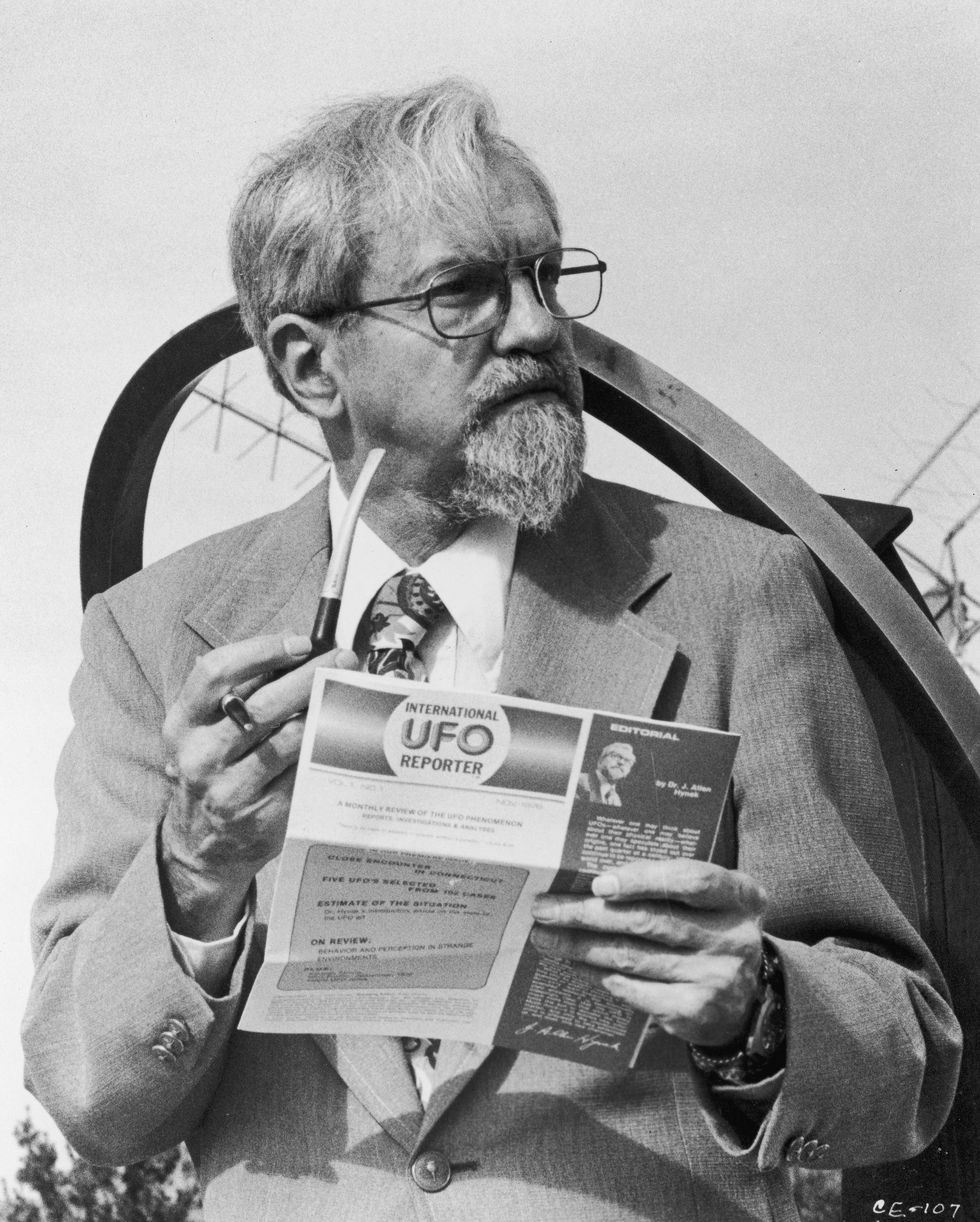
Dr. J. Allen Hynek holds a pipe and one of his magazine editorials while serving as technical advisor for the film, ’Close Encounters of The Third Kind,’ directed by Steven Spielberg, 1977.
Crucially, while Hynek openly discussed the limitations he faced during his tenure with the Air Force and was forthright about its apparent lack of genuine interest in investigating the possibility of alien encounters, his written work never fully embraced conspiracy theories. That wouldn’t be true for those who came after him.
In 1986, the year Hynek died, conspiracy theorist George C. Andrews published Extra-Terrestrials Among Us, a book that incorporated ideas of ufology into existing ideas of government conspiracies and secret organizations. In Andrews’ grand vision of a global conspiracy, he claimed extraterrestrials were behind the killing of President John F. Kennedy.
In 1991, conspiracy theorist Bill Cooper incorporated Andrews’ theories into his manifesto, Behold a Pale Horse, one of the more widely read books of fringe political conspiracies. Where Hynek kept his speculations scientific, The New Republic noted that Cooper’s co-opting of ufology was “...the tip of a spear asserting that the number one thing we had to fear was not little green men, but the government that colluded with them, appropriating their technology against us.”
Hynek’s legacy risks being overshadowed by the extreme and politically charged theories of self-proclaimed ufologists that emerged in his wake. His ambition was for ufology to gain recognition as a legitimate scientific field; however, the proliferation of conspiracy theories that came after him provided the government with further justification to dismiss the subject entirely.
The 2024 AARO report stated that during the time Hynek was working with Project Blue Book, “about 75 percent of Americans trusted the [US government] ‘to do the right thing almost always or most of the time.’” But, the report noted, since 2007, that number has never risen above 30 percent. “This lack of trust probably has contributed to the belief held by some subset of the U.S. population that the USG has not been truthful regarding knowledge of extraterrestrial craft.”
Ultimately, the Air Force’s efforts to stifle Hynek—pressuring him to offer the public standard responses to questions he wasn’t even allowed to ask—appears to have backfired.
Ironically, the Air Force’s attempts to quiet suspicions only fueled them, leading to more conspiracy theories and distrust. People came to believe that the government was hiding the truth, contrary to Hynek’s actual revelation: that, in reality, the people at the top may not care much about finding the answers after all.
Best Portable Charger Deal

Now 30% Off
Best Vacuum Deal

Best TV Deal

Now 40% Off
Best Headphones Deal

Now 30% Off
Best Jump Starter Deal

Now 22% Off
Michale Natale is a News Editor for the Hearst Enthusiast Group. As a writer and researcher, he has produced written and audio-visual content for more than fifteen years, spanning historical periods from the dawn of early man to the Golden Age of Hollywood. His stories for the Enthusiast Group have involved coordinating with organizations like the National Parks Service and the Secret Service, and travelling to notable historical sites and archaeological digs, from excavations of America’ earliest colonies to the former homes of Edgar Allan Poe.
此内容由惯性聚合(RSS阅读器)自动聚合整理,仅供阅读参考。 原文来自 — 版权归原作者所有。