惯性聚合 高效追踪和阅读你感兴趣的博客、新闻、科技资讯
阅读原文 在惯性聚合中打开

推荐订阅源

有赞技术团队
有赞技术团队
Martin Fowler
Martin Fowler
N
Netflix TechBlog - Medium
WordPress大学
WordPress大学
罗磊的独立博客
H
Help Net Security
MongoDB | Blog
MongoDB | Blog
A
About on SuperTechFans
让小产品的独立变现更简单 - ezindie.com
D
Docker
云风的 BLOG
云风的 BLOG
Microsoft Security Blog
Blog — PlanetScale
Blog — PlanetScale
P
Proofpoint News Feed
钛媒体:引领未来商业与生活新知
钛媒体:引领未来商业与生活新知
I
InfoQ
J
Java Code Geeks
博客园 - 聂微东
大猫的无限游戏
大猫的无限游戏
Engineering at Meta
Engineering at Meta
美团技术团队
小众软件
小众软件
Stack Overflow Blog
Stack Overflow Blog
C
Check Point Blog

Latest Content - Popular Mechanics

I Swapped My Skateboard for an Electric Scooter, and I'm Never Looking Back Tight Schedule? These Battery Packs Keep Your Phone, Tablet, and Laptop Charged All Day You Don't Need to Overspend to Get an Effective Trail Camera. These Smart, Stealthy Picks Will Get The Job Done. I Found Toys at the Beach and Change at the Park, Testing These Expert-Approved Metal Detectors Early Prime Day Apple Deals Are Now Live on Amazon—Here’s What Shoppers Should Add to Cart ASAP Here's How Yeti's Newest Camp Chair Stacks Up Against the Best We've Tested Skip the Ice With One of These Editor-Recommended Portable Refrigerators Yes, Dyson Did Well In My Vacuum Testing. But It’s Not the One I Recommend for Most People. Roborock Reigns Supreme for Robot Vacuums—But These Other Editor-Tested Models Are Worth a Look The 8 Best Ductless Air Conditioners for Efficient Home Cooling Our Results for Best Dishwashers Are In. Here’s Why This Bosch Model is the One to Buy. The Coolest Tech Gifts of the Year Are Here. These Gadgets Will Blow Gearheads Away. Have a Handyman in Your Life? Any Gifts On This List Will Bring Them a Smile. The Best Electronic Deadbolts for Securing Your Home, Even When You Forget the Keys Tired of Pool Cleaning Eating Up Your Weekend? These Robots Can Do It For You There’s a New Best Bang-for-Your-Buck Flashlight—and It’s a Collab With Jeep Our Favorite Ceramic and Radiant Space Heaters Warm You Fast. But Which Style Is Actually Best? The Best Gaming Desktops For Every Spec and Budget The TCL QM8L SQD Mini-LED TV Brings More Color and Brightness to Last Year’s Top TV The 8 Best Pocket Knives for Everyday Carry and More This $30 Tarp Solves More Camping Problems Than You Think The World Is Running Out of People—and the Next 40 Years Could Determine the Fate of Humanity Thieves Stole a Legendary Egyptian Artifact. But They Missed the Terrifying 4,000-Year-Old Fine Print Inside. The 9 Best Carpet Cleaners to Lift Set-In Stains and Eliminate Odors The Air Force Faked a Cargo Flight Over Europe. Austria Investigated—and Found Two Smuggled Stealth Jets. They Froze a Brain to −196°C. Then Brought It ‘Back to Life’ in a Groundbreaking New Study. Russia Is Perfecting This Formidable Weapon Fast—Making Iran’s Drones ‘Significantly Deadlier’ One Piece x Lego Is Official—New Sets Are Available for Preorder Now Tick Season Is Getting Worse. These Prevention Tips And Products Can Help Counterfeit SSDs Are Getting Harder to Spot: Here’s How to Make Sure You Aren’t Getting a Fake
This Scientist Found the Secret to Nuclear Fusion in 1938...
2026-04-15 · via Latest Content - Popular Mechanics

Here’s what you’ll learn when you read this story:

  • Today, many fusion reactors rely on deuterium and tritium—heavy isotopes of hydrogen—to power fusion reactions. But where did this idea come from?
  • Although the Manhattan Project makes mention of the advantages of deuterium-tritium reactions, they only vaguely source pre-war research.
  • After some sleuthing, scientists at Los Alamos National Laboratory discovered the work of little-known physicist Arthur Ruhlig, and recreated his 1938 experiment to better understand his unknown-yet-groundbreaking contribution to fusion physics.

This story is a collaboration with Biography.com.

Around the world, scientists are working diligently to perfect ways to fuse deuterium and tritium—two heavy isotopes of hydrogen—through nuclear fusion. This DT fuel will be at the heart of the International Thermonuclear Experimental Reactor (ITER) in southern France, which will be the world’s most advanced nuclear reactor once it’s up and running in the 2030s.

The energy-producing magic of these two isotopes has been known for more than 80 years. One of the earliest mentions of the advantages of DT interactions came from Emil Konopinski—an American scientist who worked on the Manhattan project during World War II—who famously mentioned at a July, 1942 Berkeley physics conference that deuterium and tritium would be good components for a future thermonuclear bomb. There was just one question: Where did this idea to use deuterium and tritium even come from?

That’s the question that Los Alamos Laboratory’s Mark Chadwick and Mark Paris wondered as they searched for the original mind behind using DT fuel for fusion reactions in an attempt to to compile a compendium on the early history of fusion research. After a little bit of sleuthing, Chadwick and Paris found a 1986 audio recording of Konopinski, who mentions being inspired by “pre-war” research.

Scouring physics literature between 1934 (the year tritium was discovered) and the start of the war, Paris stumbled across a 1938 paper written by little-known physicist Arthur Ruhlig titled “Search for Gamma-Rays from the Deuteron-Deuteron Reaction.”

Ruhlig was studying the interactions between deuterium and deuterons—the nuclei of deuterium atoms—and mentioned observing protons with very high energies that were likely produced by secondary deuterium-tritium fusion neutrons. According to Chadwick and Paris, Ruhlig noted that a DT reaction “must be an exceedingly probable one,” but the paper received few citations. The plot thickened when the researchers realized that Ruhlig and Konopinski overlapped at the University of Michigan, and even shared the mentor George Uhlenbeck, who helped discover the electron’s spin.

With serious evidence pointing to Ruhlig being the initial mind behind deuterium-tritium fusion, Chadwick, Paris, and a team of physicists from Duke University decided to recreate Ruhlig’s experiment to understand the physicists’ insights and role in fusion history.

“Replicating his experiment helped us interpret his work and better understand his role, and what proved to be his essentially correct conclusions,” Chadwick said in a press statement. “The course of nuclear fuel physics has borne out the profound consequences of Arthur Ruhlig’s clever insight.”

The team used the Tandem accelerator at Duke University to essentially recreate Ruhlig’s original experiment step-by-step, publishing the results in the journal Physical Review C. The team found the expected secondary DT reactions, and though the ratio of these interactions was smaller than Ruhlig’s original estimate, the experiment nonetheless provided extremely strong evidence that Ruhlig’s initial tests likely mark the beginning of humanity’s investigation into deuterium-tritium fusion.

“Regardless of the inconsistency of Ruhlig’s rate of fusion against our modern understanding, our replication leaves no doubt that he was at least qualitatively correct when he said that DT fusion was ‘exceedingly probable,’” Chadwick said in a press statement. “I think we’re all proud to lift Arthur Ruhlig up again out of history as an important contributor to ongoing, vital research.”

Best Portable Charger Deal

3-Port USB-C Nano Charger

Anker 3-Port USB-C Nano Charger

Now 20% Off

Best Vacuum Deal

V8 Plus Cordless Vacuum

Best TV Deal

55-inch 4K UHD Smart Fire TV

INSIGNIA 55-inch 4K UHD Smart Fire TV

Now 40% Off

Best Headphones Deal

WH-1000XM5 Noise Canceling Headphones

Sony WH-1000XM5 Noise Canceling Headphones

Now 38% Off

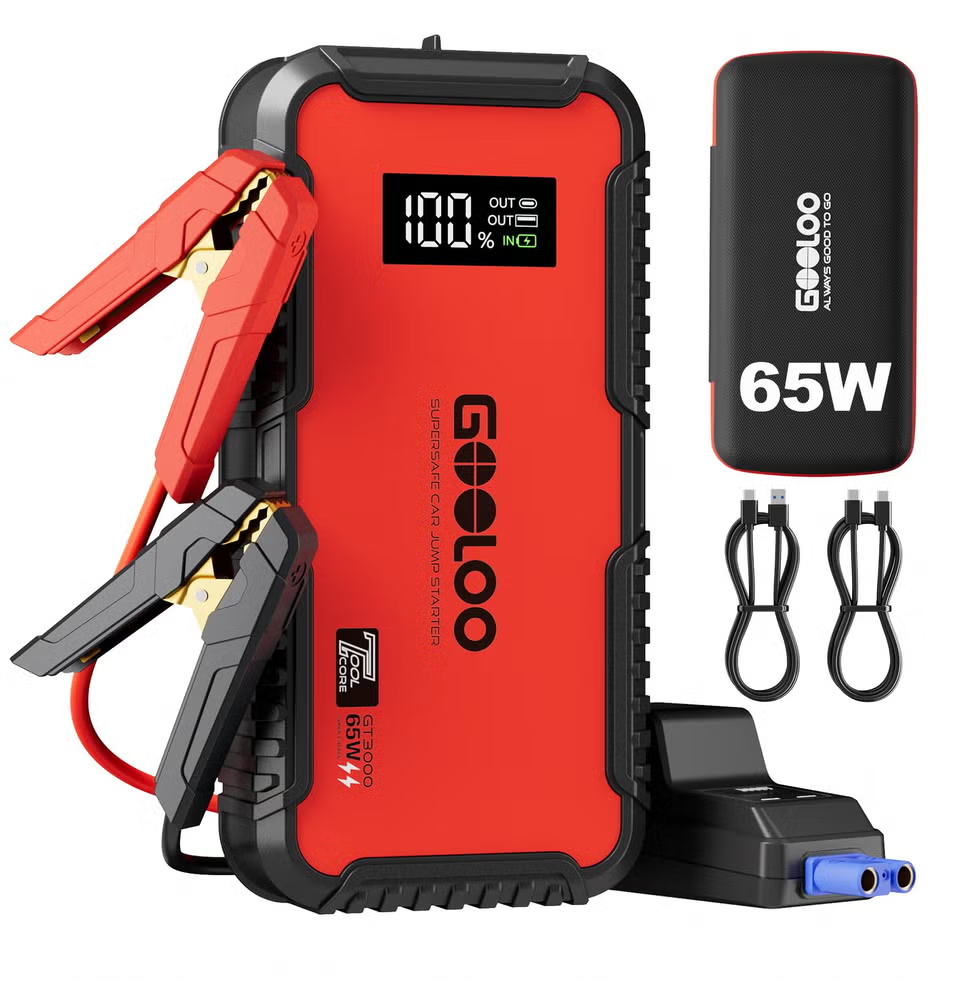
Best Jump Starter Deal

GT3000 Jump Starter

GOOLOO GT3000 Jump Starter

Now 22% Off

Headshot of Darren Orf

Darren lives in Portland, has a cat, and writes/edits about sci-fi and how our world works. You can find his previous stuff at Gizmodo and Paste if you look hard enough.