



Here’s what you’ll learn when you read this story:
This story is a collaboration with Biography.com.
“At the place where Jesus was crucified, there was a garden, and in the garden a new tomb, in which no one had ever been laid.”- John 19:41
As a literary device, this description of the burial place of Jesus Christ is effective; it offers a contrast between the site of Jesus’s death at the crucifixion site of Calvary (also called Golgotha, both derived from the Latin for “place of the skull”) and a fertile garden, brimming with life. It also provides a cyclical shape to the final chapter of the Christ narrative, which begins with his arrest in the garden of Gethsemane.
So, as storytelling, this single sentence from the Gospel of John (the most recently written of the four canonical gospels, most scholars agree) has a substantial power to its brevity. But, as a historical record of where, exactly, one of the most famous men who ever lived was laid to rest, you’d be forgiven for finding it sorely lacking in detail.
Yet, thanks to a discovery reported in the Times of Israel in 2025, that sentence might be key to confirming where the real man at the center of the Christian faith was placed after his famous crucifixion.
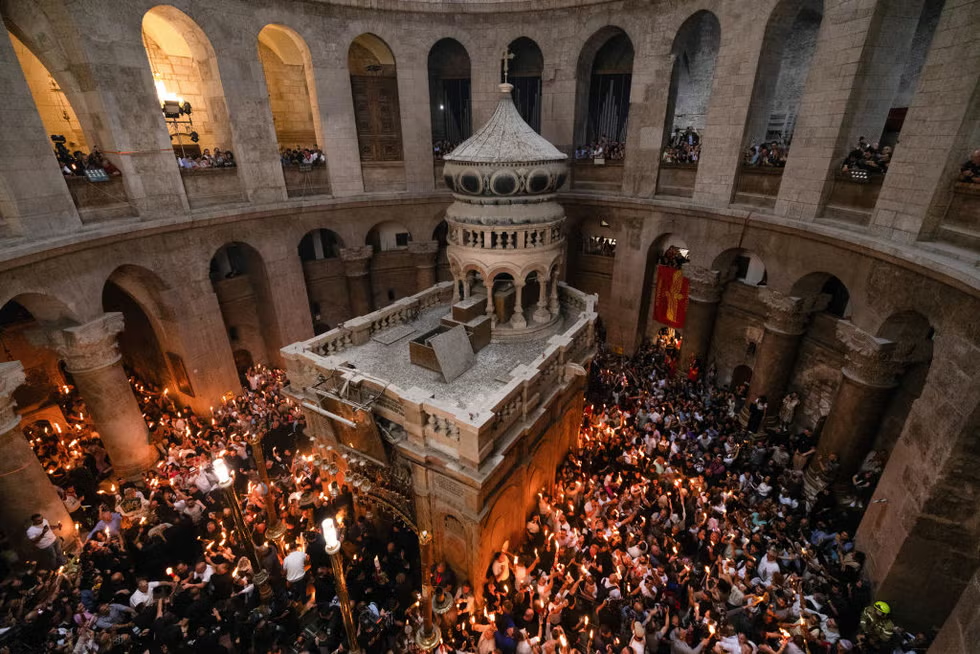
Christian pilgrims hold candles during the Holy Fire ceremony, a day before Easter, at the Church of the Holy Sepulcher, where many Christians believe Jesus was crucified, buried, and resurrected, in Jerusalem’s Old City, Saturday, May 4, 2024.
As the Times notes, the site that now hosts the Church of the Holy Sepulchre is held in the Christian tradition to encompass both the crucifixion site and the tomb in which Christ was buried. As such, it is beset upon at all times by Christ-following pilgrims from across the planet, determined to worship at the site where they believe the Messiah lay dead for three days before his resurrection on Easter Sunday.
But this popularity is only part of the problem for archaeologists hoping to examine the purportedly holy site.
There was also, as the Times describes, “decades of in-fighting” between the three religious communities charged with managing the church: the Orthodox Patriarchate, the Custody of the Holy Land, and the Armenian Patriarchate. When these groups finally came to a consensus in 2019 that the Church of the Holy Sepulchre required renovations to replace the site’s 19th-century floor, a team of Italian architects with La Sapienza University saw their opportunity.
“With the renovation works, the religious communities decided to also allow archaeological excavations under the floor,” Francesca Romana Stasolla from the Sapienza University of Rome noted to the Times of Israel. The excavations have been under Stasolla’s direction since they commenced in 2022.
“We take turns, but our team in Jerusalem always includes 10 or 12 people,” said Stasolla, while noting that the bulk of their team remains in Rome, receiving their data for the post-production process. But this core team would occasionally be joined by specialists, including “geologists, archaeobotanists, or archaeozoologists.” Their contributions would prove important, as beneath the 19th-century floor, there lies a quarry which dates back to the Iron Age (1200-586 B.C.).
During the time of Jesus, this quarry was a burial site “with several tombs hewn in the rock.” It wasn’t the only such site in Jerusalem, but when Constantine—the first emperor of Rome to convert to Christianity—was in power, this quarry was the one exalted by early Christians as the site of the burial, so the emperor ordered the construction of the first iteration of the Church of the Holy Sepulchre there (the church would suffer numerous attacks over the centuries, before its current form was constructed by Crusaders in the 12th century).
What Stasolla’s team found was that, in the time between when the quarry was originally mined during the Iron Age and the construction of the church atop it, the area to which the burial site is attributed had (at one time) been used for agriculture, based on the discovery of 2,000 year-old olive trees and grapevines.
“Low stone walls were erected, and the space between them was filled with dirt,” noted Stasolla, who added:
“The archaeobotanical findings have been especially interesting for us, in light of what is mentioned in the Gospel of John, whose information is considered written or collected by someone familiar with Jerusalem at the time. The Gospel mentions a green area between the Calvary and the tomb, and we identified these cultivated fields.”
Stasolla acknowledged that a full analysis of all the artifacts uncovered during the excavation—which also included coins and pottery dating roughly to the 4th century—would take years to complete.
As for whether this discovery definitively proved the burial site of Christ, Stasolla chose to look at it from a different angle. “The real treasure we are revealing is the history of the people who made this site what it is by expressing their faith here,” she told the Times. “Whether someone believes or not in the historicity of the Holy Sepulchre, the fact that generations of people did is objective. The history of this place is the history of Jerusalem, and at least from a certain moment, it is the history of the worship of Jesus Christ.”
Best Portable Charger Deal

Now 20% Off
Best Vacuum Deal

Best TV Deal

Now 40% Off
Best Headphones Deal

Now 38% Off
Best Jump Starter Deal

Now 22% Off

Michale Natale is a News Editor for the Hearst Enthusiast Group. As a writer and researcher, he has produced written and audio-visual content for more than fifteen years, spanning historical periods from the dawn of early man to the Golden Age of Hollywood. His stories for the Enthusiast Group have involved coordinating with organizations like the National Parks Service and the Secret Service, and travelling to notable historical sites and archaeological digs, from excavations of America’ earliest colonies to the former homes of Edgar Allan Poe.
此内容由惯性聚合(RSS阅读器)自动聚合整理,仅供阅读参考。 原文来自 — 版权归原作者所有。