









Here’s what you’ll learn when you read this story:
Scientists from the University of Oslo say one side of Earth’s interior is losing heat much faster than the other side—and the culprit is practically as old as time.
A study published in Geophysical Research Lettersuses computer models of the last 400 million years to calculate how “insulated” each hemisphere was by continental mass, which is a key quality that holds heat inside instead of releasing it. The pattern goes all the way back to Pangaea.
Earth has a red hot liquid interior that warms the entire planet from inside. It spins, too, generating both gravity and Earth’s magnetic field. This holds our protective atmosphere close to Earth’s surface.
Over the extremely long term, this interior will continue to cool until Earth is more like Mars. The surprise in the study is how unevenly the heat is dissipating, but the reason makes intuitive sense: Parts of Earth have been insulated by more landmass, creating something of a Thermos layer that traps heat.
This contrasts with how Earth loses most of its heat: “Earth’s thermal evolution is largely controlled by the rate of heat loss through the oceanic lithosphere,” the study authors write. Why is this the site of the greatest loss? For that, we need a quick-and-dirty run-through of continental drift.
Earth’s mantle is like a convection oven that powers a treadmill. Every day, seafloor surface moves a tiny bit; new seafloor is born from the magma that erupts at the continental divide, while old seafloor is smashed and melted beneath existing continental landmass.
To study how Earth’s interior heat behaves, the scientists built a model that divides Earth into African and Pacific hemispheres, then divides Earth’s entire surface into a grid by half degrees latitude and longitude.
The scientists combined several previous models for things like seafloor age and continental positions during the last 400 million years. Then, the team crunched the numbers for how much heat each grid cell contains over its long life. This paved the way to calculate the rate of cooling overall, where the researchers found the Pacific side has cooled much faster.
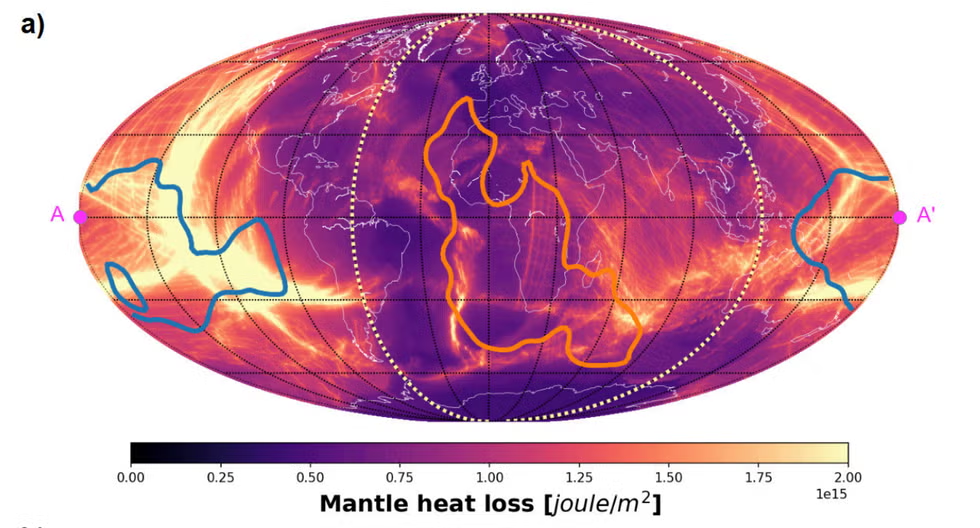
Accumulated mantle heat loss (oceanic + continental) over the past 400 Myrs. Regions above the Pacific and African large low shear velocity provinces are shown using blue and orange lines. Dashed, light-colored meridians indicate the separation of the Pacificand African hemispheres.
The seafloor is far thinner than the bulky landmass, and temperature from within Earth is “quenched” by the enormous volume of cold water that’s above it. Think of the gigantic Pacific Ocean compared with the opposite-side landmasses of Africa, Europe, and Asia—it makes sense that heat dissipates more quickly from the biggest seafloor in the world.
Previous research on this seafloor effect only went back 230 million years, meaning the new model, which goes back 400 million years, almost doubles the timeframe being studied.
There’s a surprising contradiction in the findings. The Pacific hemisphere has cooled about 50 Kelvin more than the African hemisphere, but the “consistently higher plate velocities of the Pacific hemisphere during the past 400 [million years]” suggest the Pacific was much hotter at a certain moment in time.
Was it covered by landmass at some point in the far distant past, keeping more heat inside? There are other possible explanations, but either way, the Pacific’s high tectonic activity today points to a heat disparity. The meltier the mantle, the more the plates can slide and slam together.
Best Garden Hose

Weed Puller

Now 11% Off
Best Spreader

Now 13% Off
Best Value Thatch Rake

Now 30% Off
Best Garden Cart


Caroline Delbert is a writer, avid reader, and contributing editor at Pop Mech. She's also an enthusiast of just about everything. Her favorite topics include nuclear energy, cosmology, math of everyday things, and the philosophy of it all.
此内容由惯性聚合(RSS阅读器)自动聚合整理,仅供阅读参考。 原文来自 — 版权归原作者所有。