


This story is a collaboration with Biography.com
In 1995, a mysterious skull emerged from the Atlantic Ocean and landed on a beach in Longport, New Jersey. Then his bones started showing up.
In 1999, fragments linked to the same person turned up less than two miles away in Margate. In 2013, additional skeletal remains likely connected to the case washed ashore in Ocean City. By then, authorities had a nickname for the unidentified remains: “Scattered Man John Doe.”
Finally, in 2025, 30 years after his skull was first discovered, the Scattered Man was identified. New Jersey State Police turned to the Ramapo College of New Jersey’s Investigative Genetic Genealogy Center, which concluded the remains belonged toHenry Goodsell, the 29-year-old captain of the schooner Oriental, who died with his crew.
Goodsell was only 29 years old when he died, meaning that he spent more years as “the skull that washed up on the beach” than he ever did as a living, breathing man. But all the more remarkable is how long Goodsell’s body had been lost, awaiting discovery: the storm that claimed Goodsell’s life occurred in the winter of 1844.
The case really began moving in fall 2023, when NJSP partnered with Ramapo’s IGG Center. A sample from the remains went to Intermountain Forensics in November 2023. By February 2024, a SNP profile had been uploaded to GEDmatch and FamilyTreeDNA, giving student researchers a trail to follow through public genetic-genealogy databases and archival records. The students found evidence of ancestry “dating back to the 1600s, with genetic relatives hailing from Litchfield and Fairfield counties in Connecticut.”
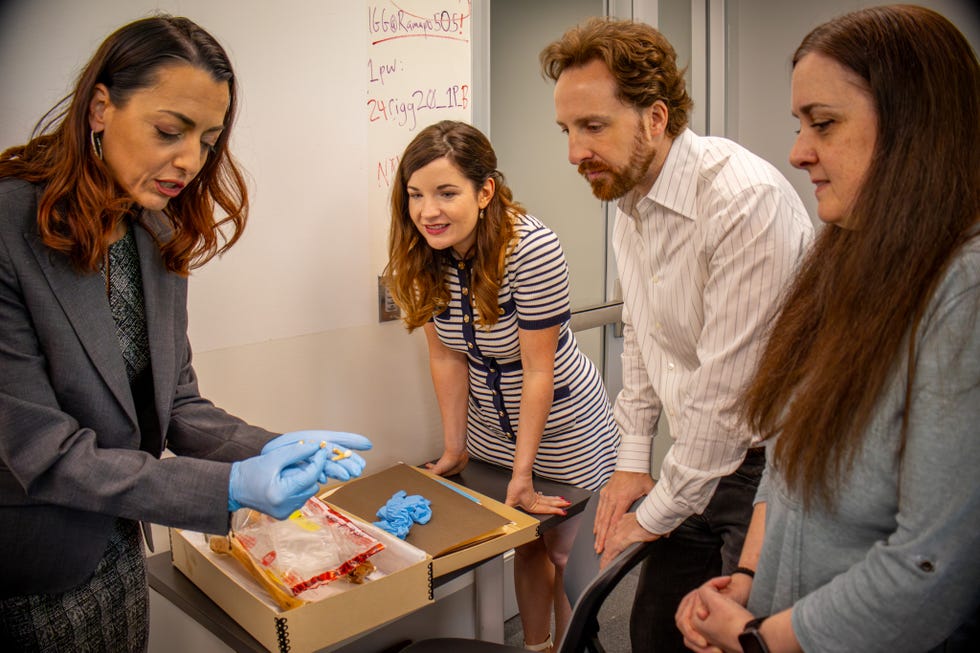
New Jersey State Police and students from Ramapo College IGG Center worked together to solve the mystery of the "Scattered Man John Doe". From L-to-R: Anna Delaney, forensic anthropologist for the New Jersey State Police; Cairenn Binder, asst. dir. of the Ramapo College IGG Center; David Gurney, dir. of the Ramapo College IGG Center; Tracie Boyle, Ramapo College IGG Center case manager & administrative asst.
For a full year, students at Ramapo hit the books, volunteering their time to try and triangulate deceased or missing figures with ties to Connecticut who may have been involved in shipwrecks off of the coast of New Jersey. That’s when they discovered two news articles from December of 1844, which spoke of the sad fate of the vessel Oriental:
“The students learned that five crew members were aboard the Oriental, which departed from Connecticut en route to Philadelphia, PA, to deliver 60 tons of marble for use by Girard College, a college preparatory boarding school that opened in 1848. The ship was wrecked off the coast of Brigantine Shoal in 1844. It was reported the ship likely sprung a leak and went down less than one mile from the shoreline, and all crew members died. The captain of the ship was 29-year-old Henry Goodsell.”
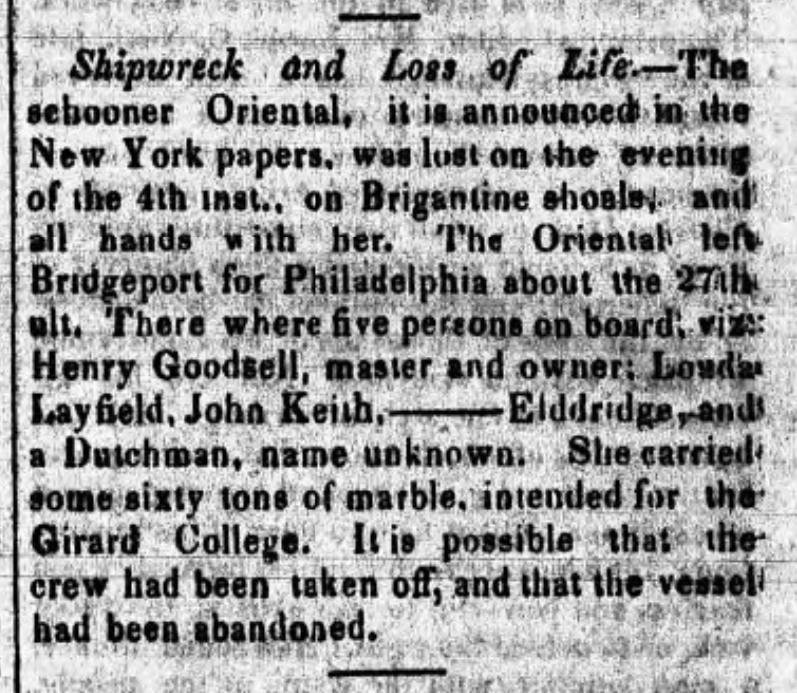
Article in the York Democratic Press, Friday, 12/20/1844 pertaining to the loss of the Oriental, from the press release published by Ramapo College
Goodsell fit both the genetics and the history. After students proposed him as the candidate, NJSP collected a reference sample from a great-great-grandchild. The match was confirmed on April 8, 2025, resolving the case that had followed three separate New Jersey beach discoveries across 18 years.
Ramapo now lists the case among its resolved identifications and says a death certificate was issued for Goodsell more than 180 years after he died.
“Identifying human remains is one of the most solemn and challenging responsibilities law enforcement is charged with,” Chief of County Detectives Patrick Snyder at the Atlantic County Prosecutor’s Office stated in the press release. “Law enforcement works hard knowing that behind every case is a promise: that no one will be forgotten, and that we will pursue the truth until families have the answers they deserve.”
The identification of Goodsell also demonstrates the potential of modern genetic analysis to solve cases that have gone even colder than we ever thought solvable. “Using modern genealogy testing to identify bone fragments from the 19th century is a powerful reminder of our unwavering commitment to resolving cases no matter how old,” noted Colonel Patrick J. Callahan, NJSP superintendent. “The ability to bring answers to families—even generations later—shows how far science and dedication can take us.”
Follow-up reporting said Goodsell’s family did not want the remains and that they would remain in a state repository indefinitely.
Laptop Cleaner

Portable Jump Starter

Now 25% Off
Pocket Cleaver

Now 39% Off
RFID-Blocking Wallet

Best Value Water Bottle

Michale Natale is a News Editor for the Hearst Enthusiast Group. As a writer and researcher, he has produced written and audio-visual content for more than fifteen years, spanning historical periods from the dawn of early man to the Golden Age of Hollywood. His stories for the Enthusiast Group have involved coordinating with organizations like the National Parks Service and the Secret Service, and travelling to notable historical sites and archaeological digs, from excavations of America’ earliest colonies to the former homes of Edgar Allan Poe.
此内容由惯性聚合(RSS阅读器)自动聚合整理,仅供阅读参考。 原文来自 — 版权归原作者所有。