








In a surprising paper from 2021, scientists Alexey Bobrick and Gianni Martire suggested that they’d nailed down a physical model for a warp drive, which flew in the face of what we’ve long thought about the crazy concept of warp speed travel: that it requires exotic, negative forces.
The paper proposed a broader way to classify warp-drive spacetimes. In some subluminal cases, the authors argued, a warp bubble could be described using positive energy rather than the exotic negative energy that has haunted the idea since Miguel Alcubierre’s famous 1994 proposal.
To best understand what the breakthrough means, you’ll need a quick crash course on the far-out idea of traveling through folded space—because warp drive has always sounded cleaner in science fiction than it does in general relativity.
The colloquial term “warp drive” comes from science fiction, most famously Star Trek. The faster-than-light warp drive of the Federation works by colliding matter and antimatter and converting the explosive energy to propulsion. Star Trek suggests that this extraordinary power alone pushes the ship at faster-than-light speeds.
Scientists have been studying and theorizing about faster-than-light space travel for decades. One major reason for our interest is pure pragmatism: without warp drive, we’re probably never making it to a neighboring star system. The closest such trip is still four years long at light speed.
The modern physics version dates to 1994, when Alcubierre, a theoretical physicist, proposed what became known as the Alcubierre drive. His idea worked inside Einstein’s general relativity by changing the geometry around the craft. Spacetime expands behind the ship and contracts in front of it. To an outside observer, that bubble could appear to move faster than light even though the ship locally stays inside the rules.
Essentially, an Alcubierre drive would expend a tremendous amount of energy—likely more than what’s available within the universe and, more awkwardly, negative energy—to contract and twist space-time in front of it and create a bubble. Inside that bubble would be an inertial reference frame where explorers would feel no proper acceleration. The rules of physics would still apply within the bubble, but the ship would be localized outside of space.
For years, the negative-energy requirement was the bugaboo. Alcubierre’s original concept was mathematically allowed, but it demanded the kind of matter and energy budget no one knows how to supply. Earlier this year, Alcubierre told Pop Mech that a roughly 100-meter bubble moving at light speed would require on the order of 100 Jupiter masses converted into negative energy, and he called a practical warp drive “very unlikely.”
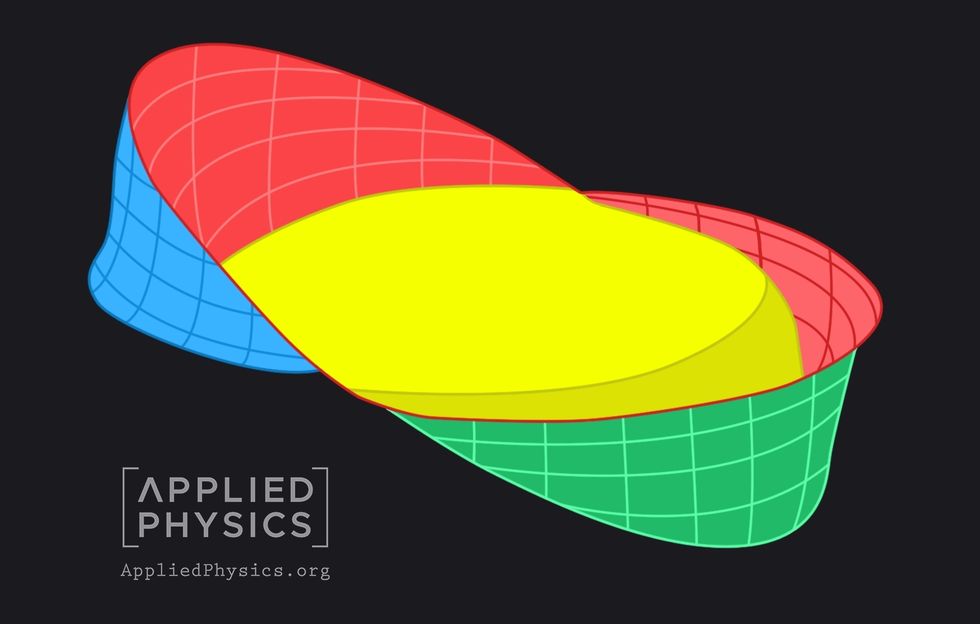
That’s why Bobrick and Martire’s 2021 paper drew so much attention. The authors, working with Applied Physics, described what they called “physical warp drives”: spacetime-bubble geometries that could be discussed using known general relativity, without automatically invoking the classic Alcubierre setup. Physical, of course, doesn’t mean buildable.
The study is understandably pretty thick (read the whole thing here), but here’s the gist of the model: Instead of treating a warp drive as a ship somehow moving through spacetime, treat the bubble itself as the object under study. In that framework, the authors argued that some subluminal warp-drive classes could use positive energy, at least in principle.
While newer research hasn’t killed the idea of a physical warp drive, it’s certainly thrown some cold water on it. In a 2025 peer-reviewed paper, José Rodal described a warp-drive spacetime with predominantly positive invariant energy density and reduced energy-condition deficits. But Rodal still quantified a smaller, non-zero negative-energy burden.
In a 2026 arXiv preprint, Hamed Barzegar, Thomas Buchert, and Quentin Vigneron argued that most claims about physical warp drives need to be reassessed. Another 2026 preprint, by An T. Le, introduced an observer-robust verification toolkit called warpax and found small but real weak-energy-condition violations in a regularized WarpShell implementation.
And José Natário, whose own research helped refine the warp-drive problem, told Pop Mech this year that superluminal travel is impossible and pointed to a stubborn practical issue: even if a warp bubble could exist, steering it and stopping it remain unsolved.
Finally, there’s still the problem of stability: Just this month, Thomas Buchert and Antony Frackowiak posted a paper that re-examined Alcubierre-style kinematics and reported an “expected generic instability of the warp field” in one example they studied.
So, none of this gives engineers a warp drive. The concept is still in the “far future” zone of possibility, made of ideas that scientists still don’t know how to construct in any sense.
“While the mass requirements needed for such modifications are still enormous at present,” the APL scientists wrote in 2021, “our work suggests a method of constructing such objects based on fully understood laws of physics.”
Of course, there’s one gigantic caveat here: The concept in this paper is still in the “far future” zone of possibility, made of ideas that scientists still don’t know how to construct in any sense.
“While the mass requirements needed for such modifications are still enormous at present,” the APL scientists write, “our work suggests a method of constructing such objects based on fully understood laws of physics.”
So, is a warp drive possible? In the loose, mathematical sense, the idea is certainly stronger than it used to be. But in the practical sense—the one that would actually send us across interstellar distances—no one has brought it much closer. Yet.
Wired Headphones

Now 16% Off
Best Value Pocket Knife

Now 11% Off
Classic Lego

Now 25% Off
Classic Camp Cooler

Now 50% Off
Garage Essential

Now 61% Off

Caroline Delbert is a writer, avid reader, and contributing editor at Pop Mech. She's also an enthusiast of just about everything. Her favorite topics include nuclear energy, cosmology, math of everyday things, and the philosophy of it all.
此内容由惯性聚合(RSS阅读器)自动聚合整理,仅供阅读参考。 原文来自 — 版权归原作者所有。