










Here’s what you’ll learn when you read this story:
U.S. Air Force airmen studying for service tests once reportedly leaked highly classified details about American nuclear weapons for the entire world to see.
According to a 2021 report, the airmen exposed the information—including which storage bunkers at European military bases likely held nuclear weapons, as well as secret signals to indicate duress—through sets of online flash cards.
The good news? Although the information could have theoretically helped someone stealing a nuke, built-in safety features would have prevented them from actually using the weapon. But still.
According to a researcher at the open source intelligence group Bellingcat, Europe-based airmen who were charged with protecting six U.S. bases’ nuclear weapons uploaded secrets to flashcard learning apps online. The flashcards included classified information to help the airmen pass qualification tests.
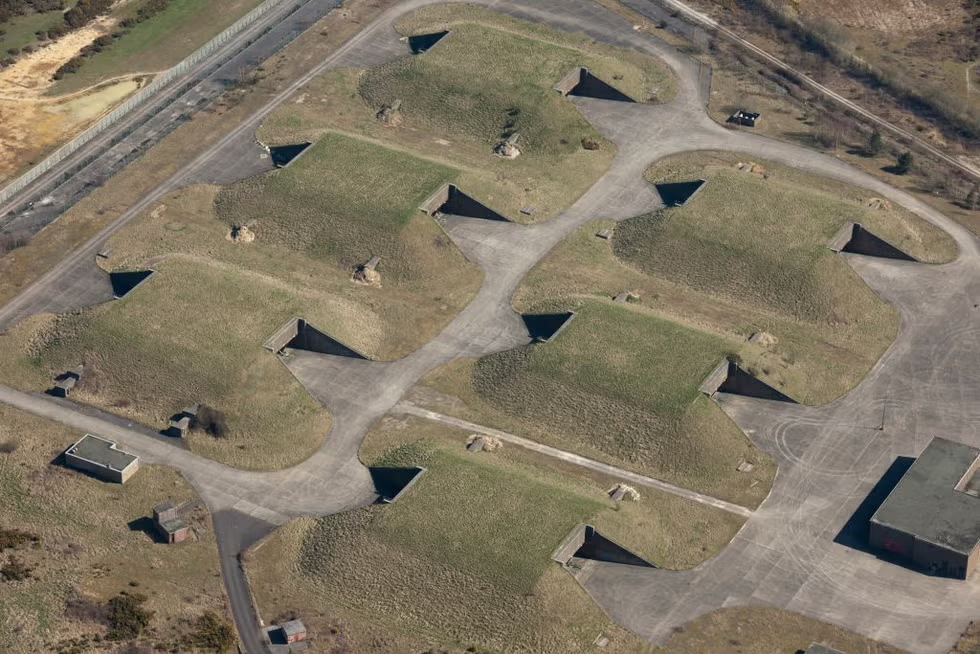
Decommissioned Cold War-era bunkers that formerly held nuclear-tipped Gryphon cruise missiles at Greenham Common, U.K. Vaults for nuclear gravity bombs will have a similar appearance.
The bases included Aviano and Ghedi Air Bases in Italy, Incirlik Air Base (Turkey) Volkel Air Base (the Netherlands), Kleine Brogel (Belgium), and Büchel (Germany). According to the Bulletin of the Atomic Scientists, the six bases house a total of 100 B61-3 and B61-4 tactical nuclear bombs.
The B61-3 is an aircraft-delivered gravity bomb with an adjustable explosive yield, starting at just 300 tons of TNT. Other yields include 1.5 kilotons (1,500 tons of TNT), and go all the way up to 170 kilotons. For reference, the atomic bomb that exploded over Hiroshima, Japan in August 1945 had a yield of 16 kilotons.
The leaked information reportedly included how many “vaults,” or nuclear storage bunkers, were located on bases. Additionally, the details revealed which vaults at one base were “hot” (likely storing a live nuclear weapon), and which were “cold” (empty). The flashcards also included locations of security cameras, unique identifiers on special security badges carried by base personnel, and even secret duress words.
Other sensitive information on Europe-based tactical nuclear weapons also appeared on social media. In one case, a group Facebook photo from the Volkel-based 703rd Munitions Support Squadron allowed researchers to determine the exact location and name of the vault where the photo was taken.
Researchers were also able to identify the “bomb” in the photo as a dummy version of a B61 bomb. This strongly suggests the vault normally stored a dummy bomb—information that adversaries could use to deduce which vaults at the base held real bombs.
The B61s are the last nuclear gravity bombs that U.S. and NATO tactical aircraft carry. In the event of war, the bombs located at Volkel, for example, would be loaded onto Royal Netherlands Air Force F-16 fighter jets stationed at the base. Here’s a 2018 test of the B61-12, the latest version of the long-serving bomb, involving a U.S. Air Force F-16:
While the leaked information could have conceivably aided terrorists or enemy soldiers in stealing a thermonuclear bomb, it’s extremely hard to actually set one off. The B61-3 and B61-4 bombs require the input of a 12-digit Permissive Action Link (PAL) code to arm themselves. If someone enters the incorrect code too many times, the electrical system will automatically short out the bomb’s electronics, disabling it completely.
And that’s just the beginning of the arming process. The PAL must be entered into the bomb while the weapon is loaded on the delivery plane. Once it’s in the air, the bomb will only arm when it detects the plane is flying the programmed flight and release profile, and finally detonate when it senses it’s sailing through the air and toward the target in the expected manner.
The learning apps that Bellingcat uncovered may well have been the world’s most dangerous flash cards.
Best Portable Charger Deal
Now 20% Off
Best Vacuum Deal
Now 20% Off
Best TV Deal

Now 43% Off
Best Headphones Deal
Now 38% Off
Best Jump Starter Deal
Now 30% Off

Kyle Mizokami is a writer on defense and security issues and has been at Popular Mechanics since 2015. If it involves explosions or projectiles, he's generally in favor of it. Kyle’s articles have appeared at The Daily Beast, U.S. Naval Institute News, The Diplomat, Foreign Policy, Combat Aircraft Monthly, VICE News, and others. He lives in San Francisco.
此内容由惯性聚合(RSS阅读器)自动聚合整理,仅供阅读参考。 原文来自 — 版权归原作者所有。