





Here’s what you’ll learn when reading this story:
Over the millennia, the Bay of Algeciras off the southern tip of Spain—flanked by the eponymous Spanish city on the west and by the British-controlled Rock of Gibraltar on the east—has seen a lot of maritime action. Carthaginians ran the show during the Punic era, but soon, the nearby Roman republic (“Carthago delenda est” and all of that) took over and held on to the region as it transformed into an empire. Eventually, the Visigoths seized control (once Rome lost its cool), followed by the Moors, and a lineage of Catholic kings and queens that (eventually) gave rise to today’s parliamentary Spanish monarchy.
And while the Bay of Algeciras has a riveting history, it’s also one of the most fascinating underwater archaeology locations in the world. Now, after completing the three-year-long Herakles Project, experts from the University of Cádiz and the University of Granada have successfully cataloged the vast extent of this archaeological wonderland. According to The Guardian, the project discovered 134 shipwrecks in the bay, and fully documented 34 of them. The oldest belongs to the Punic era and dates to around the fifth century B.C.E., and most of the others come from the Roman era or early modern era. However, fascinating finds—like three medieval vessels—provide a rare glimpse into seafaring during late Islamic rule in southern Spain.
“There are really few places in the Mediterranean that have this kind of concentration and such a significant variety of archaeological remains, especially in terms of different cultures or different nations,” Felipe Cerezo Andreo, an underwater archaeologist from the University of Cádiz and lead investigator of Project Herakles, told The Guardian. “We have Dutch, Venetian, Spanish, and of course English ships—ships of practically every nationality—because they all passed through the strait, whether heading out to the Atlantic for trade, or entering the Mediterranean from northern Europe or other regions.”
One of the rarest vessels was an 18th-century gunboat designed to harass British ships near the Rock of Gibraltar—a strategic spot of land that Spain ceded to Britain “in perpetuity” in 1713 in the Treaty of Utrecht, which officially ended the War of the Spanish Succession. According to The Guardian, these boats often disguised themselves as humble fishing vessels before quickly discarding netting that hid powerful cannons. While historians had read about such boats, they had remained essentially unstudied until now.
According to the researchers, time is of the essence when it comes to preserving these treasures. The highly trafficked area is already subject to degradation by shipyards, oil refineries, and other industries, and the effects of climate change are impacting local ocean dynamics and sediment transport in the area. Because the bay is frequented by ships from around the world, it’s also plagued with a variety of invasive species, including Rugulopteryx okamurae—brown algae native to the Northwest Pacific Ocean that’s now proliferating throughout the Mediterranean and the Northeast Atlantic. In just five years, the unwanted algae has covered the seabed of the bay, and those thick mats both damage the local ecosystem and prevent more shipwrecks from being discovered.
In modern history, the Mediterranean has coughed up immense treasures, including some that still baffle us to this day. Who knows what other underwater wonders are lying below, waiting to reveal their secrets?
Best Portable Charger Deal

Now 20% Off
Best Vacuum Deal

Now 20% Off
Best TV Deal

Now 43% Off
Best Headphones Deal
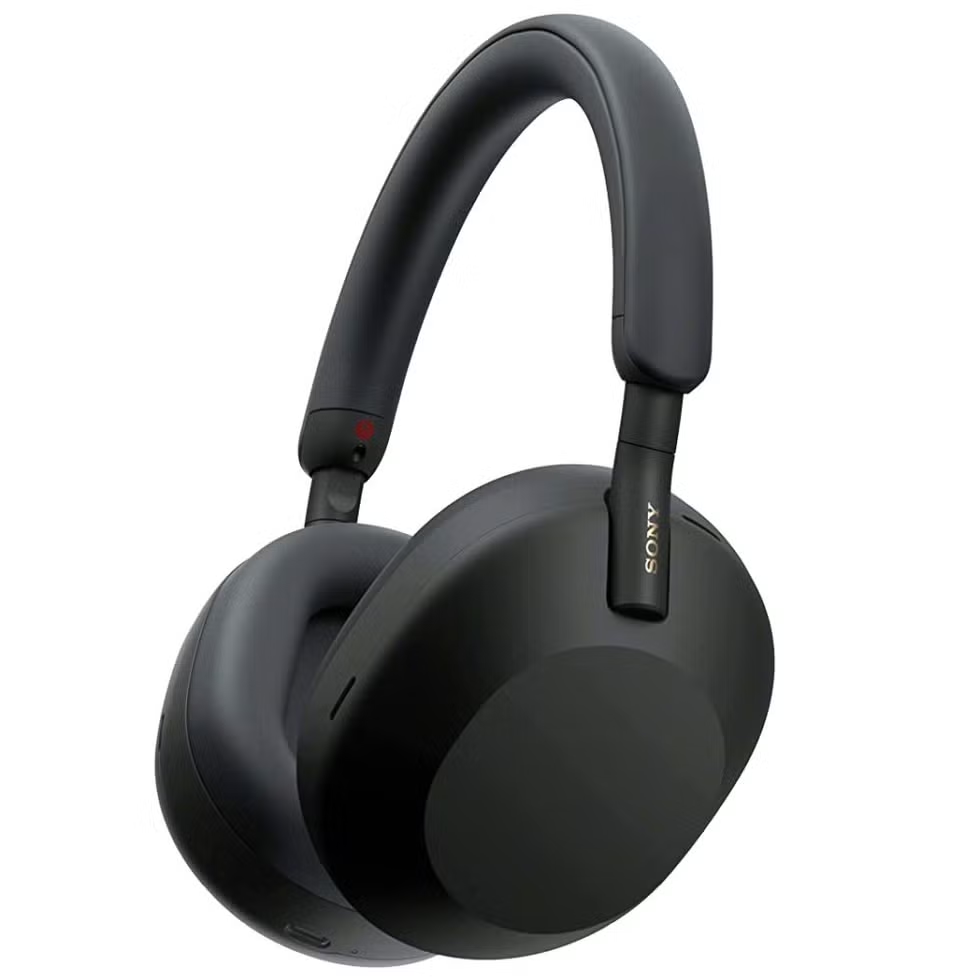
Now 38% Off
Best Jump Starter Deal

Now 30% Off

Darren lives in Portland, has a cat, and writes/edits about sci-fi and how our world works. You can find his previous stuff at Gizmodo and Paste if you look hard enough.
此内容由惯性聚合(RSS阅读器)自动聚合整理,仅供阅读参考。 原文来自 — 版权归原作者所有。