


Whether you’ve got a drawer full of dull knives, scissors that just don’t cut it anymore, or some overused drill bits, you can bring your tools back to life by sharpening them at home.
In this straightforward PDF guide, you’ll learn how to select the best sharpening method for your project, techniques for creating smooth, razor-sharp edges, and step-by-step instructions to transform even your most beat-up blades. Mastering this skill can help you extend the life of your tools and make the projects you tackle with them go all the more smoothly.
Preview everything you’ll get below and keep scrolling to download the entire PDF.

Tools lose their edge and become dull. That’s a fact of their existence. But it’s also a fact that they need not stay that way. Sharpening nearly anything, from a shovel to a putty knife to a plane to a chisel, is a relatively simple procedure. You abrade away some metal and, in the process, produce a cleanly shaped bevel that leads to an acute edge. When seen under magnification, however, the first sharpening pass on the bevel may leave deep scratches in it. The second phase of sharpening is to polish out these scratches.
Let’s not complicate matters. That’s sharpening. Remove metal, smooth out scratches.
Here’s another fact of sharpening. There are multiple ways to get the same job done. You might enjoy the endless discussion that this topic generates among sharpening enthusiasts—I call them sharpen-istas. My take on it: I sharpen my way, and you sharpen your way (please, don’t send me hate mail on this topic). To me, sharpening is just the means to an end—which is sharp tools. Here, we’ll show you some simple methods to sharpen most of what you own.

We won’t show any exotic methods or expensive equipment. Most of what you’ll see here is accomplished using oil stones and water stones manufactured by Norton, the same ones that you find at any home center, hardware store, or lumberyard. The other equipment we show, such as files, a drill-bit grinder, and a bench grinder, is stuff you can buy at any home center or online.
Sharpening your tools will make them safer to use in your chosen applications, but the process of restoring them does involve a few risks if proper measures aren’t taken. To protect your eyes from dust and metal shards, wear a pair of secure safety glasses. Work gloves with good grip are also essential to shield you against abrasions. As you sharpen your tools, always file away from your body and, if the method calls for it, ensure the tool you’re working on is secure in a clamping jig or vise.
If ever there was one tool that gets the sharpenistas going, it’s the hand plane. There’s something to producing a whispery-thin shaving from a plane that is deeply satisfying. The part of a hand plane that cuts is not called a blade, it’s called a plane iron. Sharpening plane irons draws sharpenistas like cats to catnip. Let’s skip all that.
Here are two methods for sharpening a damaged (or at least very dull) plane iron using a DeWalt bench grinder, oil stones, and water stones.
On a bench grinder, grind the plane iron’s bevel to an angle of approximately 25 degrees. If you don’t have a protractor to help you estimate this angle, draw a 45-degree line on a piece of paper and divide that in half. That gives you a line sloping at 22.5 degrees. Increase that slope by a few degrees and that’s accurate enough.
To grind a plane iron accurately, clamp it in a sharpening jig that you build yourself [1]. The jig is nothing more than two 6-inch blocks of wood that are about 2 inches wide. Each block can be anywhere from ½ to ¾ inch thick. Use two small ¼-20 bolts, four washers, and two wing nuts to provide clamping pressure. Use this jig to hold the plane iron in place as you move the iron along the tool rest of a bench grinder. DeWalt’s bench grinder has one coarse wheel (36-grit) and one finer wheel (60-grit). Grind on the 36-grit wheel, and note that any grit finer than 60 will be more likely to overheat the blade. But even on the coarser of the two wheels, keep in mind that after a few passes the tip of the plane iron will get hot. And, since the tip of the ground edge is such an acute angle and there’s very little steel at that point, the steel that’s there will easily get overheated. Let the iron cool off. Some people dip the hot plane iron in water, but I don’t recommend that. Research has shown this contributes to microscopic cracks forming along the edge of the iron.
Once you have a uniformly ground edge, proceed to honing. One side of the oil stone is coarse grit, and the other side is medium grit. Hone on the medium-grit side first. Spread some sharpening oil on the surface of the stone and place the freshly ground bevel facedown [2]. Gently rock the plane iron’s bevel back and forth until you can feel that the bevel’s face is making full contact on the stone, then push and pull the plane iron back and forth with equal pressure on the forward and back strokes.


After a few cycles, check the bevel. You should see a flat surface form at the iron’s front edge and another at the back edge. Once these two flat surfaces appear, stop. Next, switch to a hard Arkansas oil stone and repeat honing the bevel. After a few passes on this stone, you should notice a tiny but distinct curl of metal at the front of the plane iron. This is called a wire edge. Once the wire edge appears, stop honing the bevel.
Wipe the hard Arkansas stone clean and apply some fresh oil on it, then lay the back of the plane iron on the stone. Push and pull it back and forth to remove the wire edge. With the wire edge removed, flip the iron back onto its bevel and take a light pass or two over the stone. Repeat on the back of the iron. At this point, you should have a plane iron that’s shaving sharp or nearly so.
Note: Some woodworkers hone the plane iron’s bevel and the back surface on the medium-grit stone before proceeding to the hard Arkansas.
More about this in the section on Sharpening Wisdom.
We show two dual-grit stones. One stone consists of 220-grit on one face and 1000-grit on the other. The other stone has 4000-grit on one face and 8000-grit on the other. Soak both stones in a bucket of water for 30 minutes before using them. Also, fill a spray bottle with clean water.


After grinding the plane iron to a uniform angle, begin honing on the 1000-grit stone [3]. Hone the bevel on three grit levels: 1000, 4000, and 8000. Flip the plane iron over and polish off the wire edge on the 8000-grit stone [4]. Flip back to the bevel and take a few more passes. Flip to the back and take a few more passes. You should have a shaving-sharp plane iron at this point. Again, see the section Sharpening Wisdom for our thoughts about the sharpening sequence as well as some fine points on methodology.
Chisels are an ideal tool on which to begin your sharpening education, especially if you have some that are really beat up, such as those purchased at a flea market. Their narrow width compared to a plane iron allows them to fit on a narrow sharpening stone, and their thick steel gives you plenty of material to work with in case you mess up.
Wood chisels are honed in exactly the same manner as plane irons. Grind to a 25-degree angle, then hone the bevel through progressive grits [1]. Remove the wire edge by honing the back of the chisel, and check it under bright light [2]. Flip back to the bevel, take a few passes, and take a couple more passes on the back before calling it quits.


On the previous page, we discuss the secondary bevel, which is particularly useful on wood chisels. Since their work is harder, you need to refresh their edge more often, and a secondary bevel can keep the tool sharp as you work.
Cold chisels can be sharpened with a file or on a bench grinder [3]. Unlike wood chisels, which are sharpened with one bevel, most cold chisels are sharpened with a bevel on both faces of the tool (however, cold chisels used on sheet metal or steel plate have a single steep bevel). The included angle on most cold chisels varies from a very steep 90 degrees to about 60 degrees.

Given that cold chisels see such rugged use, it’s not unusual to have to repair a chipped edge. File a flat across the chisel’s tip. Then restore a sharp edge by filing or grinding equally from both sides to the center of that flat. If you have a steady hand, you can skip the flattened edge and simply regrind a cold chisel’s edge.
Note: We make this sound somewhat simpler than it is. Cold chisels vary in hardness, and manufacturers use different steels in forming them. You may find that a file or a grinding wheel that cuts well on one chisel may cut poorly on another. Also, you may have to smooth out the file marks or grind marks by honing the chisel on a medium-grit oil stone or on a water stone. The goal is a sharpened tool with smooth bevels.
Knives are also a good place to start your sharpening education. Simple tools like files and sharpening stones make the work easy.
The classic method to sharpen a kitchen knife is to hone each bevel in a slicing motion.
Here we’ll use the same Norton sharpening stones we used earlier. They work just as well on kitchen knives as they do on woodworking tools. Hold the knife’s bevel facedown on the stone and push forward [1], moving in a slicing motion as you go, covering the full length of the bevel (and the stone) from the start of the stroke to where the tip of the knife exits the stone [2]. The amount of pressure you use is light; it’s as if you’re trying to slice into the stone itself. Move to the next-finer grit and repeat.


The Horl is a unique system consisting of a rolling sharpener and a magnetic knife-holding block with two beveled faces, one at 15 degrees and the other at 20 degrees. Hold the knife on the appropriate face of the block that suits your knife bevel and roll the Horl sharpener along the knife’s edge [3]. The sharpener is a cylinder with a medium-grit diamond abrasive disc that grinds the bevel to shape on one end and, on the other end, has a finer ceramic abrasive disc that hones the edge.

This small 120-volt belt grinder has two adjustable edge guides, one each for the knife’s left and right bevels. Both guides are adjustable from 15 to 30 degrees. Five abrasive belts come with the machine, from 120-grit to 6000-grit. Depending on the knife and what you use it for, it allows you to control the knife’s edge angle and the degree to which you sharpen it. It’s as simple as this: Set the angle of the guides, and with the belt spinning, lower the knife into the guide so that its edge makes contact with the abrasive belt. Pull the knife toward you [4]. Repeat on the opposite bevel.

For serrated knives, a chainsaw file or a round Swiss pattern file (a small, specialized file used by toolmakers and machinists) works beautifully to put a new bevel on the serrations. If the blade is serrated on one side, file the serrations [5] then hone the back of the knife on a medium-grit oil stone or water stone [6]. If the serrations are on both surfaces, file both. Then very lightly hone both surfaces on a fine oil stone or water stone.


To file the serrations, hold the full length of the blade off the bench, file the serration nearest to the bench, then move the blade back one serration and file the next serration. Keep going in that fashion right to the tip.
This is a common sight: a box, drawer, or sleeve full of dull drill bits. That’s too bad. They’re surprisingly easy to sharpen, and you only need a few helpful drill-bit-sharpening tools.
To sharpen an auger bit, you need a specialized auger-bit file. Hold the auger bit upright in a vise, then file the bit’s lip with the file’s edge [1]. Turn the auger bit in the vise and sharpen the spur [2]. One or two strokes with the file on each cutting edge will do it. Repeat on the opposite side.


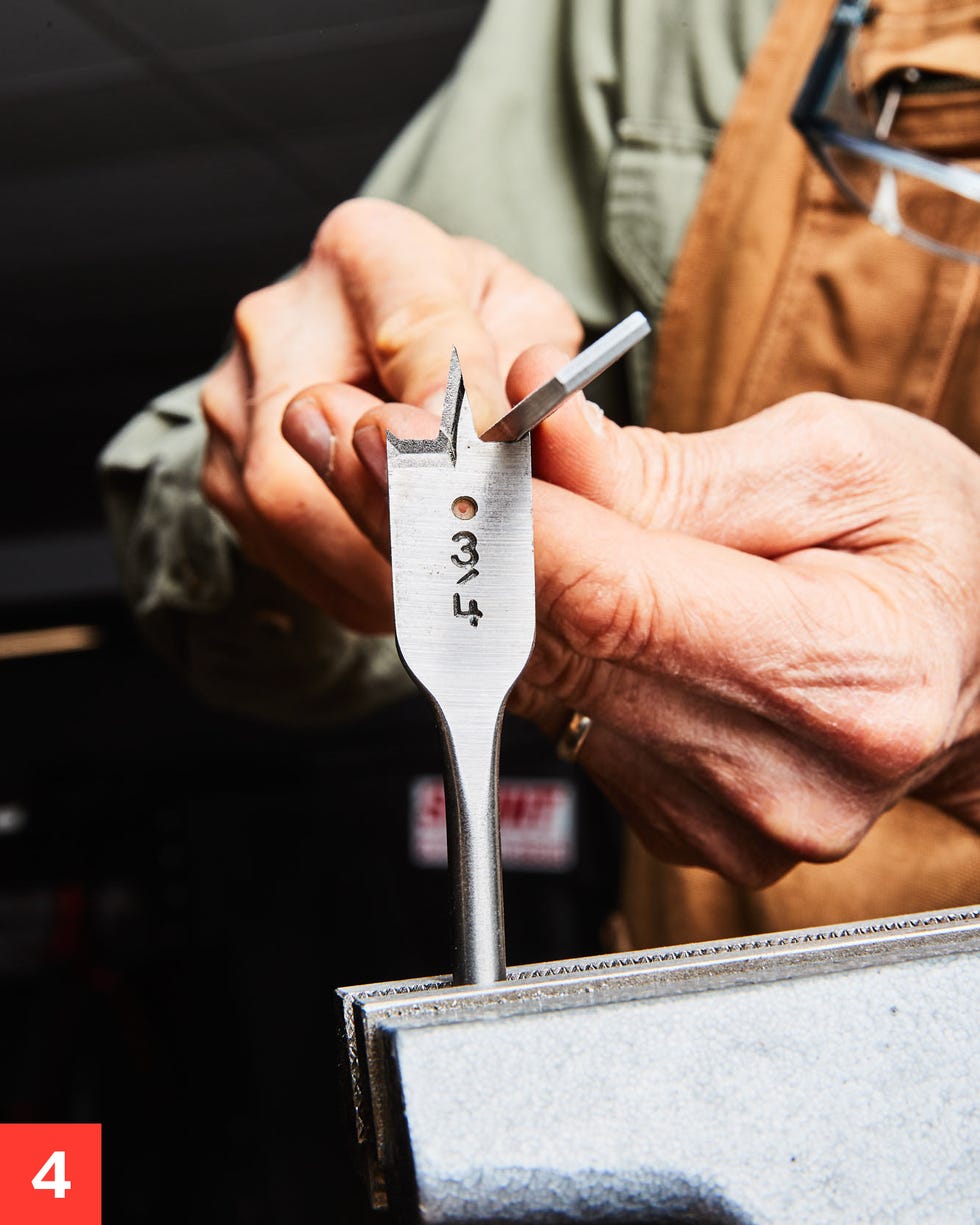
Holding the spade bit upright in a vise, sharpen the point with a tapered triangular file or fine file with a safe edge [3]. Next, use either file to sharpen the spur [4]. File the lip that runs uphill from you by pushing the file away from you and up the cutting lip. Turn the bit around and sharpen the opposite surfaces. Take an equal number of passes with the file on each surface (spur, lip, and point) to ensure that all surfaces are equally sharp and the bit spins without wobble.

Sharpening twist drill bits by hand on a bench grinder is somewhat of a knack. It comes with experience—trial and error. Unless this is a skill you are committed to learning, you may be better off buying a Drill Doctor.
Using a Drill Doctor is simple. Set the drill bit in the spring-loaded chuck. Once the chuck jaws close down around the drill bit, insert the bit and the chuck into the port designed for them. Once inserted into the port, rotate the chuck (and, thus, the bit) against the grinding wheel [5]—and there you have it, a properly sharpened twist drill bit.

It doesn’t take much to sharpen household items, from shovels to lawnmower blades to scissors. In many cases, a file or even some sandpaper is all you need.
Use a garden hose or wire brush to remove caked-on dirt from a shovel, then use an angle grinder and an 80-grit flap disc (or a 60-grit or 80-grit grinding wheel) to repoint a dull tip. If the shovel’s tip is reasonably well-shaped, all it might need is a tune-up with a double-cut file (see our discussion of files in the drill-bit section). For a light touch-up, you can use a Norton Utility File, which is a two-sided sharpening stone mounted to a wood handle [1].

Use household spray cleaner and a shop cloth to wipe off any dirt, then rub the blade back and forth on a series of abrasive papers, such as 80- or 100-grit [2]. If all the blade needs is a little light cleaning, 120- or even 220-grit will do. Once the blade is clean and shiny, tip it up and rub it back and forth to put a bevel on it.

Use an angle grinder and an 80-grit flap disc (or a 60- or 80-grit
grinding wheel) to remove chips and rust from a mower blade. You can also regrind the bevel on a bench grinder [3]. If the blade is in good shape, wipe it clean with a shop rag and any household spray cleaner. Once you’ve removed grass and dirt, use a Norton Utility File or a fast-cutting double-cut file to put a sharp edge on the blade [4]. Equally sharpen both sides of the blade. The blade should hang level when supported in its bolt hole by a nail driven into the wall or workbench. If one side rotates downward, remove metal from that side.


To remove a chip in the edge, use a bench grinder or right-angle grinder and an 80-grit wheel or flap disc. I recommend using a lighter grit on any abrasive (80-grit, for example) rather than a coarse grit (such as a 60-grit) to restore a damaged edge. While it’s true that coarse-grit grinding is faster and doesn’t create as much heat, it risks removing too much metal, and the scratches it leaves behind are deep. If the damage is minor, file out the damage with a double-cut file followed by a fine single-cut file.
Although I’ve seen a lot of people recommend filing an axe (maul or hatchet) toward the head, I recommend filing away from it. While filing toward the head has the advantage of preventing the formation of a wire edge, you run the risk of getting a nasty cut (even when wearing gloves). I file away from the head and remove the wire edge with a Norton Utility Stone [5].

My wife sews, and she’s very particular about the sharpness of her scissors, a trait she inherited from her mom, Beatrice, who always quipped, “I want to be buried with my scissors.” I developed this technique to deliver a nearly shaving-sharp edge, which is difficult to do with scissors not only because their blades are small but also because their unusual shape limits access to their cutting edges.
First, to get access to the cutting edges, disassemble the scissors by removing the axle screw (also called the pivot screw). Next, secure one half of the scissors, as shown, in a little clamping jig [6] (the same one we used to grind the bevel on a plane iron). Note that one edge of this jig is beveled, which permits full access with a file to the scissors’ cutting edge. Once secured, clamp the jig upright in a machinist’s vise and adjust the whole thing up or down so the scissors’ half is at a working height that suits you.

Removing as little metal as possible, use a fine single-cut file and stroke forward to the tip of the scissors’ cutting bevel. Remove just enough metal so the bevel’s tip has a fine burr of metal facing toward the back edge. It doesn’t take much filing. Note: The average scissors’ blades are extremely hard—even the best files will barely cut. If your file is not sharp enough, use a diamond-grit file.
Next, lay a fine sharpening stone (either oil- or water-) on its side and very lightly hone the back surface of the scissors’ half (a sharpening stone has six surfaces; use them all to distribute the wear and tear on the stone—don’t just work on the two widest faces). Professional-grade scissors have a slightly hollow-ground back surface. As you hone, you’ll see a tiny bright line appear where the hollow grind is honed flat at its perimeter. When that line appears, stop honing. Your goal is to leave as much of this hollow grind intact as possible because it permits the crisp and pleasing cutting action that is the mark of a professional-grade tool. For homeowner-grade scissors with a flat back, hone and then very carefully check with your thumb that the wire edge has disappeared. Then stop honing.
Next, reassemble the scissors and adjust the tightness of the axle screw so the tool cuts but there is a little friction as it closes. Most important, the scissors should cut well right to their tip.
Sharpening a handsaw with a file is as much a separate hobby as woodworking itself. But, the first thing you have to ask yourself is whether sharpening a handsaw is worth the investment of your time or whether it’s better to take the tool to a local sharpening shop. Saw-sharpening services are few and far between these days, so we recommend a mail-in service below. As much as I love using a sharp handsaw (and I have a collection of seven), I really have begun to wonder whether filing them is worth my time.
While it doesn’t take much in the way of equipment to file a saw, it does take a tremendous investment of hours and patience to get really good at it. And it will demand all the patience you can muster to become proficient—assuming you’re doing this without the instruction of an experienced saw filer. I’ve put in many dozens of hours saw filing, and all I had to go on were old handbooks, such as the Disston Saw, Tool and File Manual (long out of print). A beginner might pick this up more quickly today, thanks to YouTube videos. Many decades after filing my first saw, I still consider myself a beginner. What does that tell you?
Furthermore, the intervals between filing my saws have grown longer as the years have gone by. Given how hard-pressed I am for free time these days, I often forego the pleasure of using a sharp handsaw and make almost all of my cuts with a circular saw, a table saw, or a miter saw. And when I do file a saw, I feel like I have to learn the craft of saw filing all over again.
But I don’t want to discourage you. Let’s say you’re really interested in this, even perhaps pursuing antique saw restoration as a separate hobby, or you want a thorough understanding of using traditional woodworking tools (that was my first motivation). Where do you begin?
Don’t pick up a file and have at a dull saw. You might improve it or it might end up even worse for your efforts. You begin saw filing by understanding saw-tooth geometry and how to use a correctly sized triangular file to produce uniformly shaped saw teeth. And there are other tools and methods you have to get comfortable with: A saw set [1] is a tool, like a pair of pliers, that bends the tooth to the left and right of the saw body. That is, it sets the saw’s teeth so they are wider than the saw body. The oddly named bastard file [2] flattens the tops of badly shaped saw teeth. You can also use a double-cut file for this. A long and slim triangular file is used to shape and bevel saw teeth [3]. As to method, after sharpening is complete, you carefully run a sharpening stone down the side of the saw [4].


Once you can make small changes in tooth geometry to improve the saw’s cut, you’ve arrived.
There are many different ways to arrive at the same level of sharpness—and this issue is hotly debated. Here’s our take on a variety of sharpening topics.
To hone freehand, lock your hands and wrists, and produce the honing motion by rocking on the balls of your feet and bending your knees to ensure you keep the plane iron steady. Some people lock their hands and wrists and pivot from the waist. Some woodworkers put equal pressure on both the forward and back strokes, while others put more pressure on the back stroke because it’s easier to apply steady pulling pressure than pushing pressure. See what works best for you.
If the tool is wider than the stone, you have two options:
You can buy factory-prepared sharpening oil (about $10 for 4.5 oz), or you can thin ordinary 10W-40 motor oil with mineral spirits (paint thinner) to a 50/50 ratio. If all you have around the house are other oils, no problem. Shoot a little WD-40 on a stone followed by a few drops of clean motor oil right on top of it. Mix the two together with your finger to produce a cutting lubricant of the right viscosity. I use this all the time and find that it works beautifully.
Use a spray bottle to mist the stones as you work. You should always be working in a slurry of abrasive particles and water.

Many woodworkers put what is known as a secondary bevel at the tip of plane irons and chisels. Rather than hone the entire width of the bevel (as we instruct on the previous page), they tip the plane iron or chisel up a few degrees and hone just a tiny fraction of an inch right at the bevel’s tip. Since the tip is where the tool’s cutting action takes place, it makes sense to hone only there. The tool’s back is honed after the secondary bevel is established.
But the secondary bevel is not universally well liked. Some woodworkers prefer it, others don’t. Once you get the knack of honing it, you may find that it increases the number of times you can hone the tool before the bevel is lost and the plane iron or chisel needs to be reground. Also, you may notice that a secondary bevel produces a tool with a slightly different cutting action, compared to one on which you hone the entire bevel. For me, a secondary bevel is razor-sharp and cuts well, but its cutting action feels slightly different than a full-bevel hone, almost like a sharp woodworking scraper that produces a
whispery-thin shaving—for lack of a better description.
Another sharpening variation some people prefer is to hone the bevel and the back of the plane iron (or chisel) with every grit level, rather than waiting to hone the back of the plane iron or chisel only on the last and finest grit. I’ve honed both ways and have looked at the edge under a magnifying glass. I haven’t found a difference in the tool’s sharpness or how it cuts. Give both methods a try and see how they work for you.

Roy Berendsohn has worked for more than 25 years at Popular Mechanics, where he has written on carpentry, masonry, painting, plumbing, electrical, woodworking, blacksmithing, welding, lawn care, chainsaw use, and outdoor power equipment. When he’s not working on his own house, he volunteers with Sovereign Grace Church doing home repair for families in rural, suburban and urban locations throughout central and southern New Jersey.
此内容由惯性聚合(RSS阅读器)自动聚合整理,仅供阅读参考。 原文来自 — 版权归原作者所有。