






One of the last major mysteries of the U.S. Navy is the loss of the coal ship USS Cyclops. The ship, her name torn from Greek legend, went missing in 1918 during what should have been a routine return voyage from the Caribbean. Instead, the 540-foot-long collier vanished with about 306 to 309 people aboard, including passengers. There wasn’t a confirmed wreck, distress call, or official cause. As of May 2026, the Navy’s own historical material still treats Cyclops as an unsolved disappearance, despite online claims that the case has finally been cracked.
In the early 20th century, most of the U.S. Navy’s big warships used coal, not fuel oil, to heat their boilers and provide power. Ships like the Nevada and New York-class battleships and Montgomery-class cruisers were dependent on ships known as colliers to keep the fleet steaming. Colliers carried thousands of tons of coal at a time and could transfer up to two tons to the decks of other ships via enormous clamshell buckets.
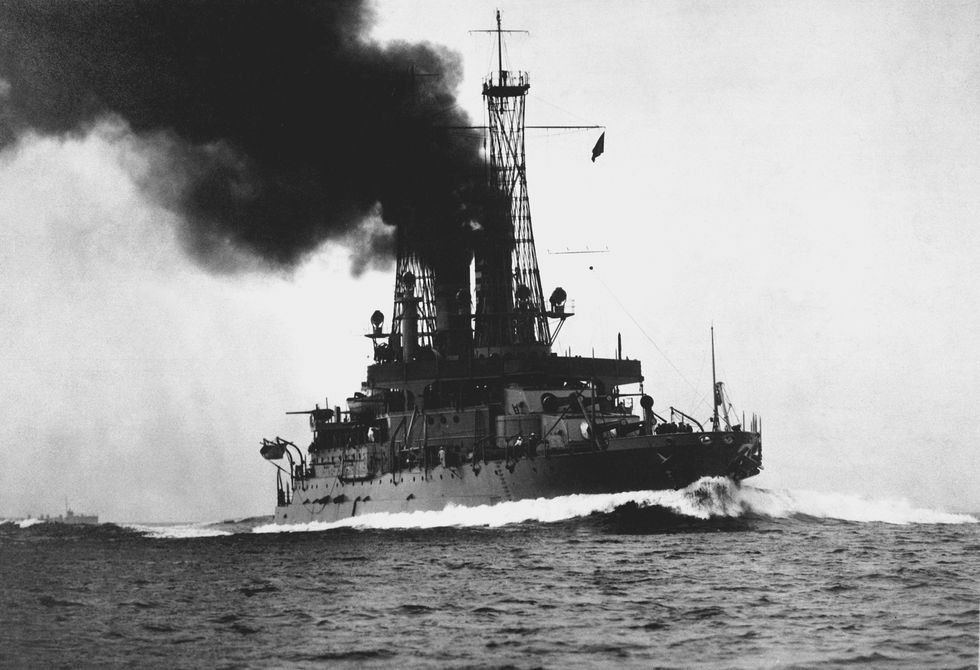
The coal-fired battleship USS Michigan, circa 1918. Ships like Cyclops could top off the coal bunkers of battleships like her, or deposit the fuel at coaling stations worldwide.
USS Cyclops was one such collier. Cyclops displaced 19,360 tons fully loaded with coal. Although she had a relatively simple job, the lack of mechanization meant she was manpower-intensive, requiring a crew of more than 300. The modern Navy’s Henry J. Kaiser class fleet oilers, by contrast, are 50 percent bigger, displace twice as much fully loaded, but have a crew of just 89.
Cyclops served the U.S. Navy’s Naval Overseas Transport Service, supplying coal to major seaports used by Navy warships. On her final voyage on January 28, 1918, the ship had supplied 9,960 tons of coal to the South American Patrol Squadron in Rio de Janeiro, Brazil. The ship picked up 11,000 tons of manganese—a metal invaluable in the production of iron and steel—for her return voyage to Baltimore, Maryland. Although Cyclops was a collier by profession, the United States’ entry into World War I spurred a hunger for raw materials for war production.
On the way home, the collier stopped in Barbados for coal. After that, the trail goes bad. Cyclops didn’t steam into Baltimore. No wreckage was recovered. The ship and the people aboard were never seen again.
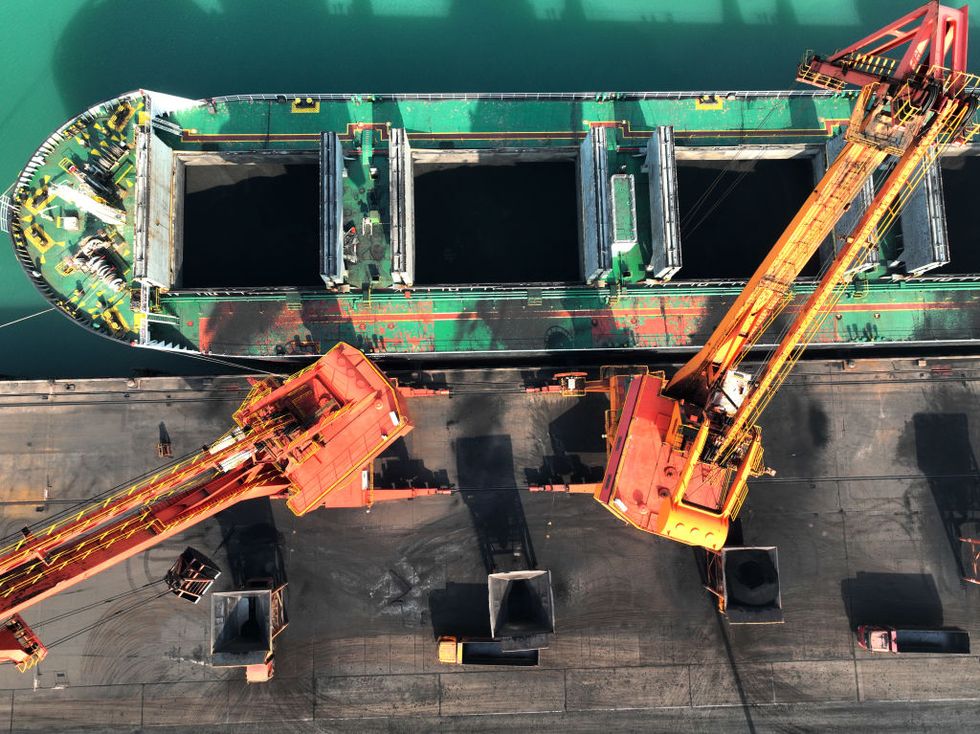
Aerial view of coal being unloaded from a cargo ship in Lianyungang, Jiangsu, China. Coal is still moved by ship but no longer provides propulsion via coal-fired boilers.
A number of theories have surfaced to explain the sudden loss of the Navy ship—so sudden that Cyclops apparently never sent out a distress signal, despite having a radio manned around the clock. One theory is that rough water, a freak storm, or a rogue wave broke the ship apart, with the dense manganese cargo helping drag the wreck down fast.
That theory shouldn’t be dismissed for the old reason that there was no underwater seismic activity. Rogue waves are not tsunamis. NOAA describes them as large surface waves that can form when storm-driven seas interact with opposing currents such as the Gulf Stream. Recent research has even treated rogue waves as measurable enough to forecast minutes ahead using buoy data. None of that proves a rogue wave hit Cyclops. It just means the wave theory has to be handled as ocean science, not folklore.
Another theory is that the ship was sunk by enemy action. German Navy u-boats prowled the Atlantic and by the end of the war had destroyed almost 5,000 merchant ships, equal to 30 percent of the world’s shipping. The submarines attacked enemy ships with both torpedoes and mines. However, no u-boats are known to have been operating in the area Cyclops was lost, and no u-boat reported having sunk her. A ship hit by a torpedo or striking an uncharted minefield would also leave behind debris from the explosion, and there was no sign of either in the ensuing search.
For years, the disappearance of the Cyclops was blamed by some on the Bermuda Triangle, a mysterious zone in the Atlantic and Caribbean that allegedly had many mysterious disappearances, UFO sightings, and other paranormal events. The loss of the Cyclops, as well as the infamous disappearance of Flight 19, was blamed on mysterious forces whose origin included extraterrestrials, interdimensional vortices, and even the lost civilization of Atlantis.
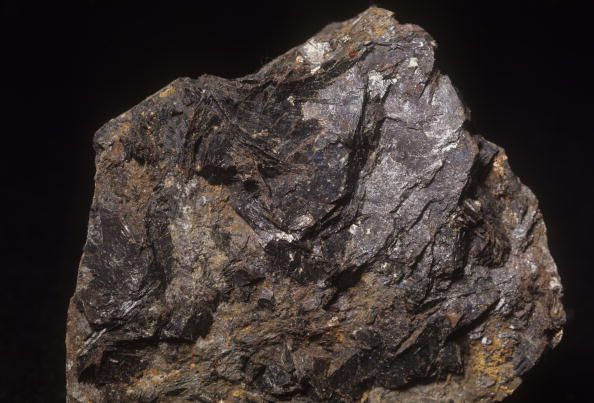
The best explanation for the loss of Cyclops is that the ship’s heavier than usual cargo was stored fore and aft, stressing the ship’s hull in the center, and that rough waters could have split her in two. This uneven loading could have taken place because the captain had placed the ship’s executive officer—the only officer on board with experience loading manganese—under arrest after a minor argument; the captain was known for irrational and bullying behavior. Anyone else could then have overseen the ship’s loading, including the captain, who had little knowledge of how to store the heavy and magnetic ore.
In 2024, Florida International University added another layer to the manganese question. Tomás R. Guilarte, a dean and neurotoxicologist at FIU, argued that Cyclops’ manganese cargo may have carried risks beyond weight: combustible dust and possible toxic exposure that could have affected crew performance. The chemistry checks out as a hazard category—the Agency for Toxic Substances and Disease Registry treats manganese as a toxicological concern, NOAA’s CAMEO database warns that finely divided manganese dust can be pyrophoric or explosive, and the ILO chemical safety card says finely dispersed particles can form explosive mixtures in air.
That still doesn’t prove anything happened aboard Cyclops—just that the cargo remains the sharpest object in the case.
So, why did no crew survive the incident? The ship is believed to have sunk at nighttime, when only about 10 percent of crew would be awake and on duty. It’s generally assumed that under the circumstances, the weight of the cargo would have snapped in half in any sinking scenario. If the ship sank rapidly, pulled under by her heavy cargo, the majority of the crew would have been asleep and below decks. The crew may not have had time to prepare and man lifeboats before the ship went under.
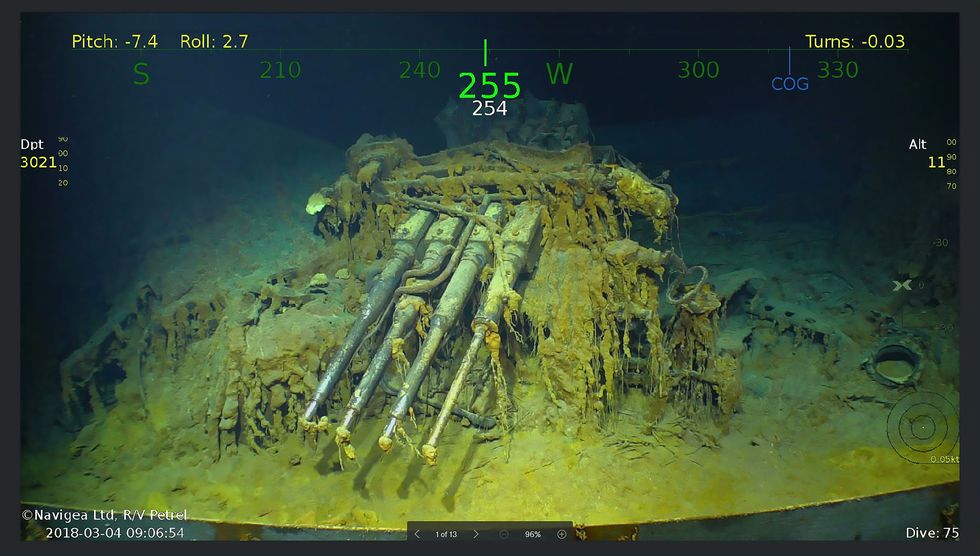
A quadruple 20mm anti-aircraft mount found aboard the aircraft carrier USS Lexington. Explorers working for Microsoft founder Paul Allen rediscovered the wreck of the Lexington in 2018.
In February 2024, HISTORY Channel aired “Eye of the Cyclops,” a season-two episode of The Bermuda Triangle: Into Cursed Waters. Marvin Barrash, a longtime Cyclops researcher who participated in the production, later wrote that Lone Wolf Media and HISTORY mounted a serious search and showed him imagery from wreck investigations. The outcome was not a discovery. Cyclops, he wrote, would “remain in the shadows” for now.
Cyclops is still generally treated as one of the last major U.S. Navy ships missing in the ocean. While the case has drawn another public search effort and a new wave of “mystery solved” claims online, no official or peer-reviewed source has verified the wreck. If Cyclops is ever identified, the find may finally put hard evidence under the old theories. Until then, the ship is still missing—and the cause of loss is still unknown.

Kyle Mizokami is a writer on defense and security issues and has been at Popular Mechanics since 2015. If it involves explosions or projectiles, he's generally in favor of it. Kyle’s articles have appeared at The Daily Beast, U.S. Naval Institute News, The Diplomat, Foreign Policy, Combat Aircraft Monthly, VICE News, and others. He lives in San Francisco.
此内容由惯性聚合(RSS阅读器)自动聚合整理,仅供阅读参考。 原文来自 — 版权归原作者所有。