









After trying out the Breeo X Series 24 for several months, test editor Brad Ford loved it. According to Ford, “One of the coolest details of the X Series 24 is its corten finish. (It is also available in a stainless-steel finish.) Corten is a structural steel alloy you often see used for bridges or power line towers. It’s designed to oxidize, or rust, creating a natural finish that protects the steel rather than continuing to degrade it. This eliminates the frustration I’ve had with some stainless-steel fire pits that discolor after a couple uses.”
Beyond this, Ford also liked, “that Breeo intended for their smokeless fire pits to be used for cooking from the get-go, which means they’ve got accessories for the X 24 that work very well. And most of their cooking accessories are compatible with all their fire pits. Top this all off with the fact that the X 24 is made right in Lancaster PA, USA, unlike most other popular brands.”
The Breeo X 24 weighs more than twice as much as the other models we’ve tested, which means it’s not exactly portable—but it's long-lasting.
As the largest pick of the lot, the X Series was easy to load with wood and start a fire. We fit 18- to 20-inch logs into it, laying them across the raised X in the bottom of the pit. This patented design keeps the logs high, allowing air to flow in and feed the fire from the bottom.
Clean-up required scooping ash out, as the unit is too heavy to dump out easily—Breeo sells a shovel designed to ease this process. The brand also offers several accessories for cooking over the fire, which make the X Series as much a grill as it is a fire pit.
| Dimensions | 27.5 x 27.5 x 14.75 in. |
| Weight | 62 lb |
| Fuel | Wood |
| Carrying case/cover | No |
| Ash pan | No |
Solo Stove’s Bonfire 2.0 is an update to the Bonfire we previously tested, now including a removable ash pan. While its smokeless performance remains unchanged, the ash pan does add about five pounds to the overall weight.
It includes a carrying case with a drawstring closure at the top—which we love—and is essentially a big bag with handles that makes it easier to transport. It also keeps ashes from falling out in the car, house, or anywhere we store it.
We’ve come to appreciate Solo Stove’s smokeless fire pit technology because it really does work. The fire pit is a double-walled, stainless-steel cylinder with holes rimming the entire base on the outside and around the top on the inside.
As heat from the fire rises, it pulls air through the inside holes, while also drawing in air from the bottom via the outside holes. This process creates secondary combustion that cuts down on smoke and speeds up the burn.
It’s fair to note that we went through logs relatively quicker than we would with an open fire. With the constant air supply flowing through the pit, it burned hot and fast, leaving very little ash to clean up afterward.
The Bonfire projects heat—a lot of it—in an even circle, but mostly from the rim and up. If we had the fire roaring, the heat radiated more evenly but didn’t really reach our feet on a cool day.
If you want a smokeless fire pit that lives up to the hype, looks great, and fits in at home or on an occasional weekend of car camping, then the Bonfire 2.0 is a solid option.
| Dimensions | 22 x 22 x 17 in. |
| Weight | 19.8 lb |
| Fuel | Wood |
| Carrying case/cover | Yes |
| Ash pan | Yes |
Advertisement - Continue Reading Below
The Breeo Y-Series is smaller and lighter than previous iterations, now with an added handle on the body—it's centered position brings balance when the fire pit is carried in one hand at your side.
We found it to be the simplest full-sized, non-collapsible fire pit that is still portable. The addition of the handle also makes the Y-Series easy to flip over to dump out the ashes. This design is a bit heavier than other portable fire pits we’ve tried because it's made with thicker-gauge metal, though that enhances its durability. It’s perfect for RV camping, tailgating, barbecuing, or firing up in the backyard—but it’s not a model you’re going to bring on a hike.
During testing, the Y-series lit up fairly quickly using dry firewood and kindling, reaching smokeless operation between five and ten minutes. It fits logs of up to 16 inches but also burns wood pellets and charcoal.
The use of charcoal, along with the optional Outpost Grill attachment, makes the Y-series a competent barbecue. Cooking over wood is also an option, and the height of the grill surface is adjustable for keeping clear of the flames.
The legs are also adjustable, and they raised the top of the fire pit up to 20 inches so the grill surface was easier to reach. Heat radiates well from the Y-Series when loaded up with logs. The 15-inch burning height allowed for more heat to be felt on our lower extremities.
| Dimensions | 21 x 21 x 20 in. |
| Weight | 31 lb |
| Fuel | Wood, wood pellets, charcoal |
| Carrying Case/Cover | No |
| Ash pan | No |

Cuisinart’s Cleanburn is unique in its bowl-shaped design. It comes in three pieces: the main body, a top ring that acts as a wind guard, and a base that doubles as an ash tray.
We can’t understate how much easier it is to clean out than our picks that don’t have a detachable base. With a quick twist of the body, we were able to lift it off, set it aside, and dump the ashes.
In testing, the body drew air in at the base to feed the fire both at the bottom and along the top lip, functioning as intended to reduce smoke. Aside from when we were initially lighting the fire, we noted nearly no smoke at all.
It seemed to radiate a lot of heat out at an angle because of the unique bowl, and it created a warm zone in the shape of an inverted, squat cone, even when the flames weren’t reaching out of the fire pit. When they were, we could feel even more heat radiating straight out from them.
A slight disadvantage of the concave shape is that although we fit 14-inch logs in it, they wouldn’t completely drop to the bottom. This made it more difficult to fill the fire pit and keep a bigger fire going.
We ended up selecting smaller chunks of wood to fit, then adding longer pieces as we stacked wood in. If you’re getting firewood in uniform lengths, you might want to chop a few pieces to fit in the bottom of the pit.
| Dimensions | 24 x 24 x 16 in. |
| Weight | 29.7 lb |
| Fuel | Wood |
| Carrying Case/Cover | No |
| Ash Pan | Yes |
Advertisement - Continue Reading Below

Many fire pits, in order to create a larger space for firewood, have tall bodies. While this is beneficial for longer burns, it means the heat and flame is higher up and away from your extremities on a chilly night. The Summit smokeless fire pit from Solo Stove has a shorter body that provides warmth at a level more in line with your legs.
Furthermore, the shallower build in comparison to the Bonfire also means more flames out the top. The more visible flame is better for roasting marshmallows, keeping your hands toasty, and generally feeling a bit more of the heat radiating outward.
The smokeless fire pit also comes built with an integrated stand. This is a major difference in comparison to previous Solo Stove models which have separate stands. The design of the integrated stand improves airflow and makes it easier to use on grass.
During his own time using the fire pit, test editor Brad Ford said, “With the lower height and flames up above the rim, I could definitely feel more heat radiating onto my lower extremities—a welcome feeling on cooler days.”
| Dimensions | 14 x 19.5 x 19.5 in. |
| Weight | 23.3 lb |
| Fuel | Wood |
| Carrying case/cover | No |
| Ash pan | Yes |

If you want to bring the campfire with you wherever you go, the Packfire portable fire pit is an ideal choice. The fire pit packs down into a backpack, so you can carry it on your shoulders and set it up wherever your adventures take you.
The fire pit is comprised of three sections: the base, which serves as a stand and ash pan; the body which, when fully set up, surrounds the base; and the ring, which holds the body in place. Cleanup is easy: Simply lift the ring and body off the base, pour the ashes out, and break everything back down for travel.
It’s worth noting that even when built for travel, the fire pit is still a bit cumbersome to carry around. According to Director of Product Content, Will Egensteiner, “The fire pit at 27.5 pounds, but as I heaved everything onto my back to put it away, I almost tipped over. And I’m not a small guy.”
| Dimensions | 17 x 17 x 22.4 in. |
| Weight | 27.5 lb |
| Fuel | Wood |
| Carrying case/cover | Yes |
| Ash pan | Yes |
Advertisement - Continue Reading Below
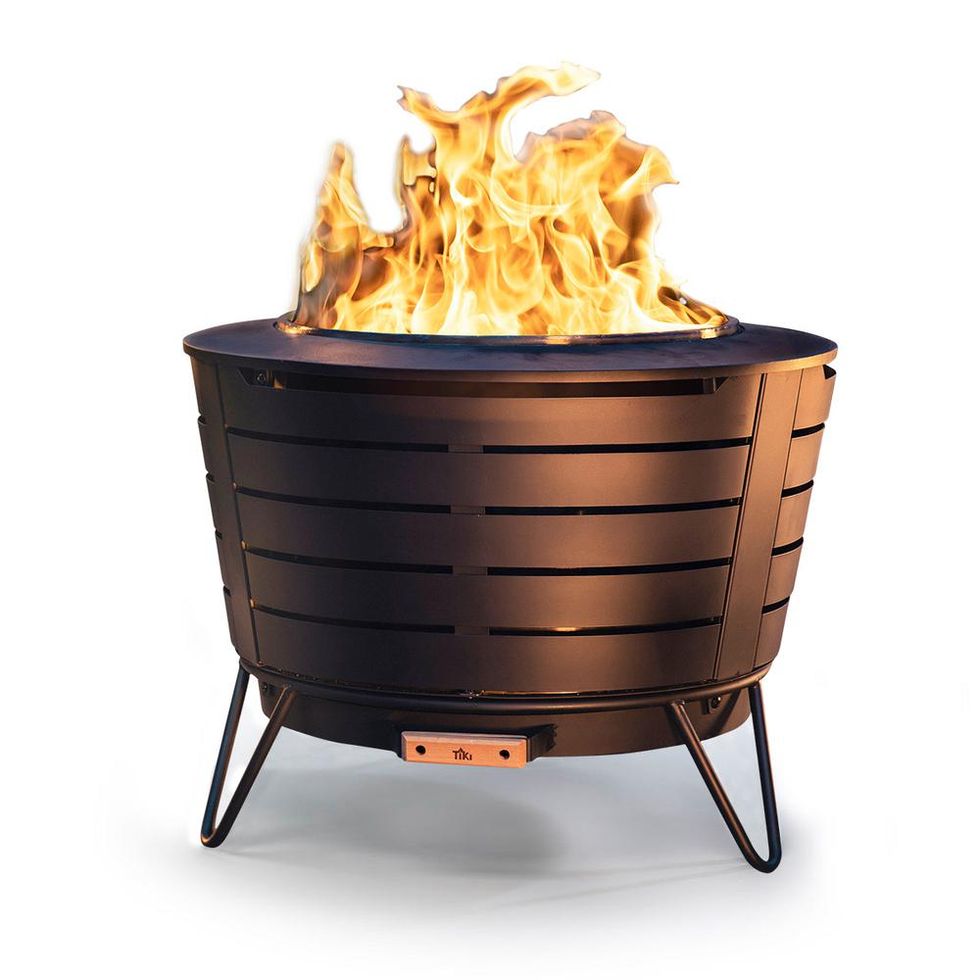
Tiki’s patio fire pit features a slightly tapered, cylindrical design that sets it apart from others while still allowing it to blend in with almost any décor. One of the first things we noticed when unpacking were the openings around the rim that act as hand-holds for lifting and moving the fire pit—something few models account for.
The black powder coat finish might be subdued, but we like the fact that it doesn’t discolor after repeated use. Unlike many other smokeless fire pits that pull air in from the bottom edge of the body, the patio fire pit pulls it in through the horizontal slats instead.
Initially, we were concerned with how effective this would be in fostering a smokeless fire but it was as smokeless as any other we tested. To build the fire, we used logs 12 to 13 inches long. As with any round fire pit, filling it with wood requires logs of different lengths—longer in the center and shorter at the edges.
We found the firebox to be a little shallow at eight inches, but we were able to get two layers of logs loaded in. This meant re-loading a little more frequently, but that had no bearing on its smoke-free performance.
Cleanup was easy thanks to the removable ash pan. All we had to do was sweep the ash around in the bottom of the fire pit, allowing it to fall through holes and into the pan. In addition to firewood, the patio fire pit is compatible with Tiki’s wood pellets that are pre-packaged and ready to burn.
| Dimensions | 24.8 x 24.8 x 18.8 in. |
| Weight | 45 lb |
| Fuel | Wood, wood pellets |
| Carrying case/cover | Yes |
| Ash pan | Yes |

If the main goal is staying warm while spending time outdoors, then you can't get much better than the Fireside360 from Ninja. It's a combination smokeless fire pit and space heater, and both modes are able to be used at the same time.
While our tester missed the familiar smell of burning wood, the heat-resistant rocks made for an easy setup process. "The entire setup took me less than 15 minutes."
A standard propane tank powers the device, and it sits in a hatch door inside the base of the fire pit. "The propane makes for what was, in my experience, a virtually smokeless endeavor. Unlike its wood-burning rivals, you can start and fully extinguish the flame at the touch of a dial," says our tester. "Much like a standard propane grill, the flame is also fully adjustable, allowing you to tinker with different settings. Of course, this also eliminates everyone’s least favorite part of using a fire pit—waiting for the flame to fully dissipate."
The Fireside360 puts out a combined 80,000 BTUs of heat when the pit and space heater modes are used together. Everything is controlled with two dials on the control panel, so you don't have to wait for wood to ignite or burn out.
It's weather-resistant but doesn't come with a cover or a lid. Both can be purchased separately, but expect to add another $60 to your tab.
| Dimensions | 21.8 x 21.8 x 28.8 in. |
| Weight | 40 lb |
| Fuel | Propane |
| Carrying case/cover | No |
| Ash pan | No |
Advertisement - Continue Reading Below

The Solo Stove Mesa XL steps things up from its original tabletop pit—the Mesa—with a slightly larger design and a more formidable flame, and it all fits cozily on a deck table or patio. Our tester appreciated its lightweight build and ultra portability. "The first thing I noticed about the Mesa was its size. It didn’t feel much bigger than an extra-large travel mug in hand."
Similar to other Solo Stove designs, the Mesa XL has holes that line the base and pull in air to fuel the fire. On the interior, there's another line of holes close to the top. These holes pull smoke away from the center opening. Though this fire pit isn't meant to produce the same level of heat as a larger design, it's large enough to roast a few marshmallows or hot dogs.
That said, the flames don't last as long as larger models (even larger tabletop models). Our tester found that they only lasted from 30 to 35 minutes when the fire pit is fully packed, and even then you can't get a ton of wood inside the main chamber. If not watched consistently, you might notice the fire has extinguished. Overall, it's a great little unit that offers a fireside experience without less hassle.
It comes with a stand and nylon carry bag for taking on the go, too. If you need a little extra, the Mesa XL bundle is available for about another $100. That kit includes an accessory pack, heat deflector, stand, and one pound bag of wood pellets.
| Dimensions | 7 x 7 x 8.6 in. |
| Weight | 2.3 lb |
| Fuel | Pellets or wood |
| Carrying case/cover | Yes |
| Ash pan | No |
What to Consider

How do smokeless fire pits work?
Smokeless fire pits are designed to burn more efficiently so they produce fewer fumes. They achieve this through two points of combustion. The first happens at the bottom where airflow feeds burning wood. The next layer occurs at the top, basically burning off the smoke and gases the fire emits. If you want to learn more, check out our deep dive into how smokeless fire pits work.
Are smokeless fire pits really smokeless?
In short, yes, but manage your expectations. Good smokeless fire pits are almost completely smokeless, but they still produce exhaust gases and still have that familiar campfire smell, especially if there's a breeze. In the same vein, you might get a face full of invisible smoke from time to time if you're in the wind.
What’s the best fuel to use in a smokeless fire pit?
A majority of smokeless fire pits burn wood—and you need the right kind to ensure a fume-free operation. It's best to use seasoned wood that has been dried out for at least six months.
You'll get an uneven burn and more smoke when using wood that is still green or wet, no matter if it's being used in a smokeless fire pit. Some models use wood pellets or charcoal which are already prepared for burning out of the bag.
The Tiki model we tested burns both pellets and wood. Whatever fuel you use, you’ll burn through it quicker in a smokeless fire pit because of the constant stream of air feeding the fire. The upside of this is that, when the wood burns this hot and completely, there's less ash to clean up.
Do you need to clean smokeless fire pits?
Absolutely. Smokeless fire pits are prone to corrosion if they are left with ash inside or kept uncovered in the rain. Most models have a removable ash pan that makes cleaning easier, but smaller models usually require you to tip them over and dump out excess embers.
After you're done using your smokeless fire pit, wait until the embers cool down before handling so you don't burn yourself or risk a fire hazard. If you want to hose down your fire pit, make sure it's completely dry before storing it.
What precautions should I take when using a smokeless fire pit?
While they might be safer and cleaner than traditional fire pits, smokeless fire pits still produce real flames and high heat, so following basic fire pit safety measures is essential.
Always place your fire pit on a level, nonflammable surface like stone, concrete, or gravel, and keep it away from structures and overhangs—basically, anything that could potentially catch fire. You also shouldn't use them indoors or in an enclosed space because even low-smoke fire pits produce carbon monoxide.
Stick to the recommended fuel type to minimize sparks and fumes, and it might be wise to keep a fire extinguisher or a hose nearby just in case. Make sure all the embers have cooled and the ash is properly disposed of before packing up for the night.
Advertisement - Continue Reading Below
FAQs

Do you need to clean smokeless fire pits?
Absolutely. Smokeless fire pits are prone to corrosion if they are left with ash inside or kept uncovered in the rain. Most models have a removable ash pan that makes cleaning easier, but smaller models usually require you to tip them over and dump out excess embers.
After you're done using your smokeless fire pit, wait until the embers cool down before handling so you don't burn yourself or risk a fire hazard. If you want to hose down your fire pit, make sure it's completely dry before storing it.
What precautions should I take when using a smokeless fire pit?
While they might be safer and cleaner than traditional fire pits, smokeless fire pits still produce real flames and high heat, so following basic fire pit safety measures is essential.
Always place your fire pit on a level, nonflammable surface like stone, concrete, or gravel, and keep it away from structures and overhangs—basically, anything that could potentially catch fire. You also shouldn't use them indoors or in an enclosed space because even low-smoke fire pits produce carbon monoxide.
Stick to the recommended fuel type to minimize sparks and fumes, and it might be wise to keep a fire extinguisher or a hose nearby just in case. Make sure all the embers have cooled and the ash is properly disposed of before packing up for the night.
Amber is a Reviews Editor with bylines on Popular Mechanics, Runner’s World, Bicycling, and Best Products sites. Specializing in kitchen gadgets, small appliances, lifestyle, and consumer tech, she brings hands-on testing and a detail-oriented approach to every review. In her free time you can likely find her trading trinkets at an EDM festival, searching for hidden gems at thrift stores, or cuddling with her two cats.
Tom Price is a reviews editor for Popular Mechanics while also contributing to Runner's World, Best Products, and Bicycling. Here at Popular Mechanics, Tom loves testing out home appliances, smart tech, gear for city life and outdoor adventures, small gadgets like watches and multitools, and anything else you can find piled up at his hoarder's nest of a desk.
Prior to working here, Tom attended NYU, graduating with a degree in English and a minor in creative writing. He also wrote for Best Reviews, The Daily Beast, and other publications covering tech, fitness gear, gadgets, and lifestyle products. Furthermore, he covered startup news, pop culture, and even professional wrestling. To follow more of his work, check back here for new stories.

Brad Ford has spent most of his life using tools to fix, build, or make things. Growing up he worked on a farm, where he learned to weld, repair, and paint equipment. From the farm he went to work at a classic car dealer, repairing and servicing Rolls Royces, Bentleys, and Jaguars. Today, when he's not testing tools or writing for Popular Mechanics, he's busy keeping up with the projects at his old farmhouse in eastern Pennsylvania.
此内容由惯性聚合(RSS阅读器)自动聚合整理,仅供阅读参考。 原文来自 — 版权归原作者所有。