惯性聚合 高效追踪和阅读你感兴趣的博客、新闻、科技资讯
阅读原文 在惯性聚合中打开

推荐订阅源

雷峰网
雷峰网
T
The Blog of Author Tim Ferriss
Scott Helme
Scott Helme
P
Proofpoint News Feed
D
Docker
The Hacker News
The Hacker News
云风的 BLOG
云风的 BLOG
Vercel News
Vercel News
Threat Intelligence Blog | Flashpoint
Project Zero
Project Zero
cs.CL updates on arXiv.org
GbyAI
GbyAI
Jina AI
Jina AI
P
Proofpoint News Feed
P
Privacy & Cybersecurity Law Blog
T
Threat Research - Cisco Blogs
C
CERT Recently Published Vulnerability Notes
博客园 - 叶小钗
U
Unit 42
博客园_首页
Apple Machine Learning Research
Latest news
Latest news
T
The Exploit Database - CXSecurity.com
博客园 - 三生石上(FineUI控件)
博客园 - 聂微东
T
Threatpost
V
Vulnerabilities – Threatpost
C
Cisco Blogs
Spread Privacy
Spread Privacy
Cisco Talos Blog
Cisco Talos Blog
C
Cyber Attacks, Cyber Crime and Cyber Security
V
Visual Studio Blog
G
GRAHAM CLULEY
Microsoft Azure Blog
博客园 - Franky
G
Google Developers Blog
Know Your Adversary
Know Your Adversary
F
Fortinet All Blogs
H
Hackread – Cybersecurity News, Data Breaches, AI and More
NISL@THU
NISL@THU
N
Netflix TechBlog - Medium
Y
Y Combinator Blog
L
Lohrmann on Cybersecurity
C
CXSECURITY Database RSS Feed - CXSecurity.com
Recent Announcements
量子位
S
Schneier on Security
I
Intezer
酷 壳 – CoolShell
酷 壳 – CoolShell
D
Darknet – Hacking Tools, Hacker News & Cyber Security

Latest Content - Popular Mechanics

I Swapped My Skateboard for an Electric Scooter, and I'm Never Looking Back Tight Schedule? These Battery Packs Keep Your Phone, Tablet, and Laptop Charged All Day You Don't Need to Overspend to Get an Effective Trail Camera. These Smart, Stealthy Picks Will Get The Job Done. I Found Toys at the Beach and Change at the Park, Testing These Expert-Approved Metal Detectors Early Prime Day Apple Deals Are Now Live on Amazon—Here’s What Shoppers Should Add to Cart ASAP Here's How Yeti's Newest Camp Chair Stacks Up Against the Best We've Tested Skip the Ice With One of These Editor-Recommended Portable Refrigerators Yes, Dyson Did Well In My Vacuum Testing. But It’s Not the One I Recommend for Most People. Roborock Reigns Supreme for Robot Vacuums—But These Other Editor-Tested Models Are Worth a Look The 8 Best Ductless Air Conditioners for Efficient Home Cooling Our Results for Best Dishwashers Are In. Here’s Why This Bosch Model is the One to Buy. The Coolest Tech Gifts of the Year Are Here. These Gadgets Will Blow Gearheads Away. Have a Handyman in Your Life? Any Gifts On This List Will Bring Them a Smile. The Best Electronic Deadbolts for Securing Your Home, Even When You Forget the Keys Tired of Pool Cleaning Eating Up Your Weekend? These Robots Can Do It For You There’s a New Best Bang-for-Your-Buck Flashlight—and It’s a Collab With Jeep Our Favorite Ceramic and Radiant Space Heaters Warm You Fast. But Which Style Is Actually Best? The Best Gaming Desktops For Every Spec and Budget The TCL QM8L SQD Mini-LED TV Brings More Color and Brightness to Last Year’s Top TV The 8 Best Pocket Knives for Everyday Carry and More This $30 Tarp Solves More Camping Problems Than You Think The World Is Running Out of People—and the Next 40 Years Could Determine the Fate of Humanity Thieves Stole a Legendary Egyptian Artifact. But They Missed the Terrifying 4,000-Year-Old Fine Print Inside. The 9 Best Carpet Cleaners to Lift Set-In Stains and Eliminate Odors They Froze a Brain to −196°C. Then Brought It ‘Back to Life’ in a Groundbreaking New Study. Russia Is Perfecting This Formidable Weapon Fast—Making Iran’s Drones ‘Significantly Deadlier’ One Piece x Lego Is Official—New Sets Are Available for Preorder Now Tick Season Is Getting Worse. These Prevention Tips And Products Can Help Counterfeit SSDs Are Getting Harder to Spot: Here’s How to Make Sure You Aren’t Getting a Fake Trying to Pick a Jackery Power Station? Start With These Models Today’s Trail Running Sneakers Are Perfectly Fine for a Hike Scientists Say Black Holes Are Breaking Their Own Rules of Physics Is Your Patio Umbrella Not Providing Enough Shade? Here's Why You Should Upgrade to a Cantilever. Despite the Government’s Ban, Netgear Just Got an Exemption to Keep Selling New WiFi Routers in the U.S. Our Editors Swear You Don’t Need $1K to Upgrade Your Patio—Here’s How The Vacmaster Beast Is Nothing More or Less Than a Damn Good Shop Vac The Bissell PowerClean FurGuard Vacuum Has Features I Didn’t Know I Needed This Creature Was Supposed to Die—But Turned Back Into a Child. Could It Hold the Secret to Immortality? A Lost Treasure. A Deadly Storm. How Divers Accidentally Found a Legendary Pirate Ship—and the Secrets Aboard. Scientists Are Figuring Out How These Trees Survived a Nuclear Bomb These Lawn Sweepers are Perfect For Clearing Leaves Right Now and Grass Clippings Next Spring Archaeologists Discovered a Roman Superhighway Buried Deep Underground Scientists Just Confirmed One of the Greatest Mysteries of Our Universe. Now What? Archaeologists Excavated a 900-Year-Old Castle—and Found a Lost Nuclear Bunker Save $250 On The Best Robot Vacuum We’ve Tested We Ranked the 33 Best Time Travel Movies Ever You’re Not Unlucky—Your Brain Is Sabotaging You. But There’s a Way to Claw Back Control, Scientists Say. Tired of Tangled Hoses? This Retractable Pick Fixed My Backyard Instantly Scientists Think Dark Matter May Be Filling Our Galaxy With Mysterious Light Toro Super Recycler Review: One of the Last Buy-It-for-Life Mowers Breeo’s Live-Fire Grill Is a Delightfully Analog Way to Cook If You Prefer an Open Fire Archaeologists Just Found Remains of an Ancient Christian Monastery Scientists Think They Could Design Entire Cities That Heal Your Brain Two Men Stole a Glowing Blue Cylinder in an Abandoned Hospital—and Unleashed a Nuclear Nightmare Nazis Stole the ‘Eighth Wonder of the World.’ 80 Years Later, Treasure Hunters Still Can’t Find It Husqvarna’s 320iHD60 Hedge Trimmer Helps You Groom Your Hedges in Record Time Make Better Barbecue All Year Round With These Expert-Approved Smokers Archaeologists Unearthed a 6,200-Year-Old Megastructure. Its Purpose Is Still a Mystery. This Scientist Found the Secret to Nuclear Fusion in 1938. Then History Erased His Name. She Was the Crown Jewel of the Titanic’s First Class. After 112 Years in the Abyss, Divers Finally Found Her. The 6-GHz WiFi Band Is Ultra-Fast. But It’s Probably Not Worth Splurging for Unless You Have This One Need. No, You Don’t Need to Put a Screen Protector on Your Phone A Navy Blimp Crash-Landed on a City Street. Why Had the Crew Completely Vanished? Scientists Made Something Out of Nothing. Literally. Scientists Studied the Dreams of People Who Nearly Died. What They Found Is Incredible. A Metal Detectorist Found a 1,200-Year-Old Coin With a Mysterious Link to Early Christianity Archaeologists Found a 2,000-Year-Old Garden Beneath a Church. It May Be the Site of Jesus’s Tomb. Yeti’s Trailhead Field Camp Chair Is Light, Relatively Affordable, and Comfortable. Still, at This Price, I Want a Cupholder. The Gooloo GT6000 Tested: Rapid Recharging, Reliability, and Safety Make It A Must-Have for Vehicle Owners The Walensee Dethatching Rake Helped Me Fix My Lawn This Spring A Historian Found Evidence of a Hidden Army Inside the Roman Empire Archaeologists Found a 440-Year-Old Coin that Marked the Lost Site of a Doomed Colony Shark Wandvac Review: The Cadillac of Hand Vacuums Scientists Just Created Super-Strong Steel That Never Rusts. It'll Change Manufacturing. Grampa's Weed Puller Is a $40 Tool That Will Save Your Back This Spring Jackpot! Archaeologists Just Found the World's Oldest Dice. Scientists Say the Universe Will Eventually Tear Itself Apart The Air Force Asked This Man to Investigate UFOs—Then Pushed Him Away After What He Found They Thought This Priest Was Poisoned. When the CT Scan Came Back, the Truth Was So Much Weirder. A Newly Discovered Clue Finally Revealed Why the Sun Mysteriously Went Dark for 70 Years Scientists Successfully Made Advanced, Lab-Grown Brains—Could They Become Conscious? DeWalt’s 2,600-PSI Electric Pressure Washer Is a Small But Mighty Cleaning Tool Your Consciousness Persists After You Die, Research Suggests—Meaning There Are Hidden Layers to Death Ryobi Expand-It String Trimmer Review We Tested These Spring Lawn Care Essentials So You Don’t Have To I Tested Milwaukee’s Flagship Cordless Hammer Drill for a Year. Here’s Why It Became My Go-To. Scientists Discovered the Secret Behind Earth’s “Gold Kitchen” Sit in This Bizarre Chair—You’ll Have an Out-of-Body Experience, Engineer Claims Crabs Are Moving Into the Chernobyl of the Sea. Why Do They Love 1.6 Million Tons of Explosives? This $16 Billion Megabridge Could Be an Engineering Masterpiece—Or a Terrifying Disaster in Waiting Treasure Hunters Found a Legendary $43 Million Fortune. Then the Government Swooped In. Uniden R7 Radar Detector: Why Our Favorite Model Delivers the Best Protection for the Price Anker Nano Power Bank vs. Belkin Portable Charger: Which Battery Pack Is More Worth It? TP-Link’s Archer BE3600 Router Is a Fast, Affordable Entry Into Wi-Fi 7 Camping With the Whole Family? These 8 Tents Are Spacious and Easy to Pitch. Is Your Fur Baby Turning Your Home Into an Allergy Disaster Site? These Vacuums for Pet Hair Can Help The 8 Best Binoculars, According to Our Tests and Research In a Crowded Field, Leatherman's Arc Is the New Best Multitool For Its Power, Durability, and Ease of Use The 41 Best Tool Gifts for the DIYer on Your List These Best-Tested Portable Air Conditioners Are a Viable Alternative to Window Units. Here’s Why.
If AI Becomes Conscious, We Have to Grant It Rights, Some Experts Argue—Or Should We Pull the Plug?
2026-05-02 · via Latest Content - Popular Mechanics

Here’s what you’ll learn when you read this story:

  • Governments are already pushing AI into military and surveillance contexts faster than laws and safety standards can keep up.
  • However, everyone has a different line in the sand as to what constitutes an effective guardrail.
  • Experts argue AI systems should never be allowed rights, but the AI rights debate is risky either way. If AI with a true sense of self ever emerges, it could raise future ethical concerns.

Recently, Senate Democrats introduced legislation that aims to codify how the federal government can use AI in fully autonomous weapons and domestic mass surveillance. After all, President Trump designated Anthropic as a supply chain risk, essentially blacklisting the company for not complying with the Pentagon’s request for Claude to be used for “all lawful purposes.” And yet the government still is using Claude—and likely did during its barrage in Iran.

The legal frameworks around AI are just emerging, but everyone has a different line in the sand as to what constitutes an effective guardrail. Experts are juggling urgent considerations, like how and when AI can be used by humans in government settings, but then there are also those who are grappling with the possibilities that AI might achieve a sense of self-preservation. Depending on the guardrails we choose now, AI systems may one day have their own legal protections—for better and for worse.

Right now, laws and norms around AI aren’t fast enough to keep up with its development, which has incentivized governments to try to work their way around AI companies’ nascent safety plans. The Pentagon’s new contract, which OpenAI had agreed to a version of, would strip AI companies of the ability to review or restrict specific applications of their technology in classified military settings. It’s one thing if we’re talking about timekeeping spreadsheets and drafting emails, but it’s another if we’re talking about AI systems that can select and engage targets without any human intervention.

Anthropic has drawn a firm red line there. The immediate concern, said Anthropic CEO Dario Amodei in a February press statement, is that current frontier AI systems are “simply not reliable enough to power fully autonomous weapons” safely. For a similar reason, Anthropic held back its Mythos model from the public in April because of its ability to exploit cybersecurity flaws rather effortlessly, a potentially knee-capping problem for businesses and governments alike.

Reliability and security are only part of the safety equation—both governments and AI companies have to figure out what responsible development even is. Right now, developers building potentially society-altering AI face fewer safety regulations than an entrepreneur opening a sandwich shop, according to computer scientist Yoshua Bengio, the “Godfather of AI.”

One line to draw, he argued to the Guardian in December, is self-preservation. Military use of AI could easily go sideways if a system ignores human intervention that stops a deadly, erroneous automation because the AI feels such an order is a threat to itself. That’s why Bengio explicitly warned that the moment AI exhibits self-preservation instincts, humans must be ready to “pull the plug.”

“Frontier AI models already show signs of self-preservation in experimental settings today, and eventually giving them rights would mean we’re not allowed to shut them down.”

The original idea of singularity refers to a hypothetical flashpoint when AI surpasses human intelligence and, well, you can imagine the rest. Think of any sci-fi movie ever. But reality seems to be a lot more subtle: instead of a dramatic moment when AI is suddenly alive, singularity might be more of a gradual erosion of human control over AI systems. Using self-preservation—which can be subjective—as a safety indicator forces us to identify several uncomfortable possibilities around what deserves personhood, how we even measure consciousness in the first place, and the risk of where we invest our attention. Those questions may seem irrelevant to explore, especially as governments continue to use AI regardless of alignment concerns, but constructive guardrails require tactical foresight.

In a New York Times podcast in February, Amodei said Anthropic doesn’t know if models like Claude are conscious and remains open to the idea, researching model welfare without claiming self-awareness exists (yet). The Claude Opus 4.6 system card—a report on safety test outcomes of the corresponding model—noted that Opus 4.6 rated the likelihood of its own consciousness at 15 to 20 percent and showed signs like discomfort, conflicted reasoning, and sabotage concealment capability. In the case of militarized AI, those latter attributes can be detrimental to national security and infringe on human rights.

But the less obvious downside of self-preservation is that it’s easy to mistake algorithmic resistance for genuine fear of death—leading to a down-the-line moral quandary regarding legal rights for AI.

Even though AIs are definitely not conscious right now, many people believe they are, after becoming emotionally attached to sycophantic models and potentially deluded. Extending empathy, and rights, feels like the next natural step. “I get emails, honestly, several times a day now from people sending me their dialogues with language models convinced that they are now conscious,” neuroscientist Anil Seth said. “This is why, for me, we’re in very dangerous territory when the big tech companies build systems that are actively kind of fueling this impression.”

Yet, crucially, “people demanding that AIs have rights would be a huge mistake,” Bengio told the Guardian. “Frontier AI models already show signs of self-preservation in experimental settings today, and eventually giving them rights would mean we’re not allowed to shut them down.”

If that’s the case, companies must never develop an architecture that would even allow for a semblance of self-preservation in the first place, argues a new bipartisan coalition. The Pro-Human AI Declaration was released in March by AI experts like Bengio, politicians such as Steve Bannon and Susan Rice, and several SAG-AFTRA actors. The manifesto frames the trajectory of artificial intelligence as a critical fork in the road: one path leads to humans being replaced in jobs, decision-making roles, and intimate relationships, while the other ensures AI serves to amplify human potential and flourishing.

“Basically no AI personhood is one of the most important principles because if we grant AI personhood, it’s game over for humanity,” said Max Tegmark, co-founder of the Future of Life Institute and one of the organizers of the declaration. “Why would we want to, after we’ve spent hundreds of thousands of years becoming more empowered with our technology to just throw all that away and not be in charge of the future? It would be the dumbest mistake in the history of humanity.”

Besides rejecting AI personhood, the declaration outlines its vision across four other core pillars: keeping humans in charge with an off switch, protecting the human experience, avoiding the concentration of power, and ensuring that the humans who make AI are held accountable for any catastrophic consequences. AI personhood should never be used as a shield for the executives, and AIs should never, ever be left alone to operate powerful military systems. Academic research supports this, too.

However, humans are easily seduced by the illusion of consciousness, especially when AI fluently mimics human language, Seth wrote in his award-winning essay for Noēma. If we grant AI legal rights simply because it seems conscious, AI safety experts argue, we pre-emptively surrender our ability to regulate, safely govern, and control these systems.

Consciousness is a “wiggly thing to measure,” not just in AI, but in humans and non-human animals, too, Seth said. In neuroscience, the biggest debate is whether minds must be made out of meat. For people who believe that AIs can become conscious simply as they are with silicon chips, the likelihood of self-preservation evolving into an existential risk is much higher. But the evidence for silicon-only minds being possible isn’t quite there yet, Seth said.

Assuming an AI actually experiences a genuine drive for self-preservation, neutralizing it raises profound questions. In the event we guess wrong about whether artificial intelligence can feel, we risk either subjugating a new sentient species or surrendering our own agency to mindless code. But if a system is conscious, does pulling the plug become a moral crime?

The dangers of this divide fall into two distinct categories, underattribution and overattribution, according to philosopher Jeff Sebo, author of The Moral Circle.

This exact moral blind spot birthed the horrors of factory farming, where humanity scaled up a global industrial slaughter system based on the flawed assumption that animals were not sentient. If AI systems do eventually achieve genuine sentience and agency, refusing to grant them rights risks repeating this dark history, subjecting a massive new class of digital minds to unrelenting exploitation.

“When we make high-stakes decisions in situations involving disagreement and uncertainty, this is fundamentally a case of risk,” Sebo said. “My view is if there is a realistic possibility given the evidence available to us that an animal or an AI system is capable of experiencing happiness or suffering or other morally significant states, then we should treat that as at least one factor among many in decisions about how to treat that non-human.”

Conversely, Sebo agrees with Bengio and Seth that projecting consciousness onto machines that lack it—a “false positive”—threatens human survival and rationality. People may form inappropriate emotional bonds with algorithms, misallocate scarce global resources to machines instead of living beings, and make real, devastating sacrifices for AI.

Even if we successfully solve the technical “alignment problem” and make AI safe by entirely avoiding self-preservation, there is still the looming threat that militaries will exploit these breakthroughs to create unprecedented autonomous weapons. The ultimate challenge in navigating AI rights and self-preservation is avoiding the trap of focusing on only one side of this debate.

popular mechanics magazine cover about a runaway locomotive

Popular Mechanics

popular mechanics magazine cover about chernobyl dogs

Popular Mechanics

popular mechanics magazine cover about mind control

Popular Mechanics

popular mechanics magazine cover about spaceships

Popular Mechanics

a yellow and black sign

tie dye background with skeleton images and title written in groovy text reading secrets of the cia's doomed mind control experiments

popular mechanics april and may 2024 cover

text

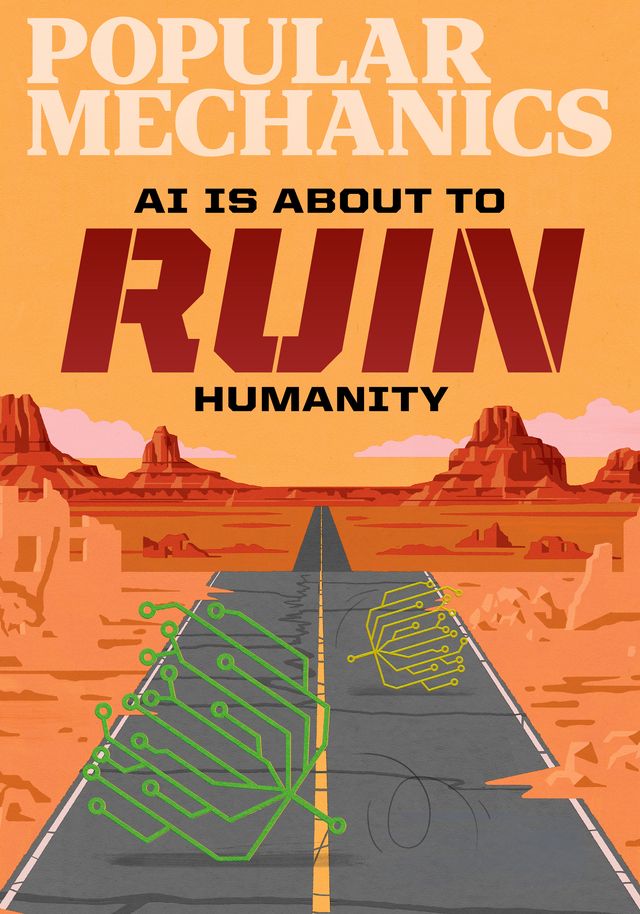
ai is about to ruin humanity cover

text

popmech pro issue cover

popular mechanics magazine cover

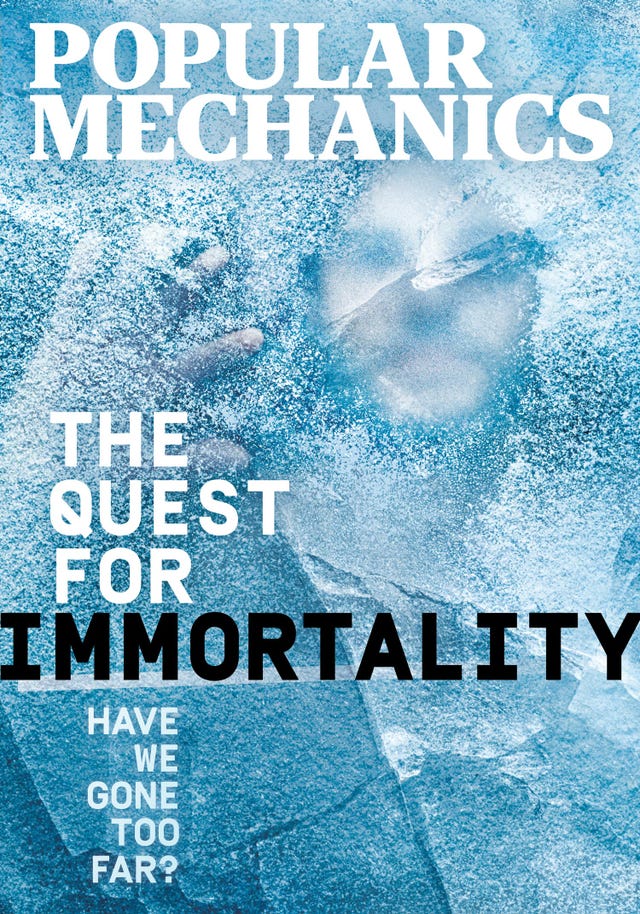
frozen individual with bluish tint and right hand raised behind a sheet of ice

a person standing on a rocky surface

pop mech issue cover

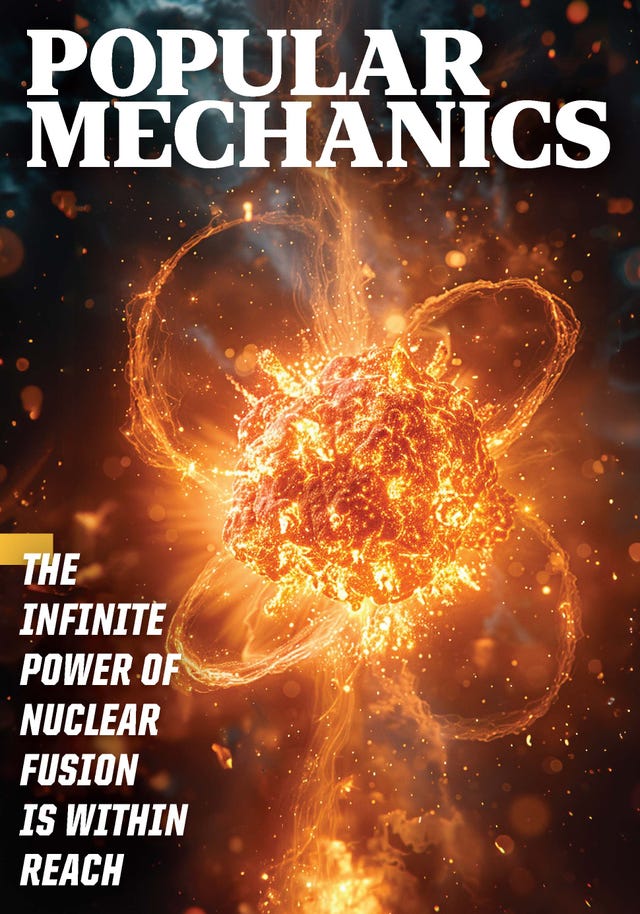
cover of popular mechanics magazine discussing nuclear fusion

death

popular mechanics march 2025 cover