





From the archives: This story originally appeared in the October 1930 issue of Popular Mechanics. We’re republishing it now as part of our ongoing look back at Pop Mech’s best feature stories from the last 125 years. It appears here as originally published; some details, terminology, or understandings may have changed over time.
Strange stories of vanished ships and vain searches by airplanes, liners and warships scouring the seas from Capetown to Cape Horn and Frisco, in the attempt to solve marine mysteries, continue to puzzle the sleuths of Lloyd’s, the famous shipping corporation of the Royal Exchange, London.
Not a month goes by without the name of some missing boat being added to the files in Lloyd’s ships’ “graveyard.” At the present moment, there are half a dozen first-class mysteries of missing ships of European ownership alone which have vanished on the high seas in 1929 to 1930.
Despite directional wireless, radio lighthouses and compasses, and beam-radio navigation, the sea retains all its elements of mystery and danger. The red-robed caller still mounts the rostrum at Lloyd’s and rings the bell of the lost “Lutine,” tolling the unknown fate of some good ship of which no news has reached any of the world’s ports for many months since she left her home port.
Yet, of all the skeletons in Davy Jones’ locker, nothing is stranger than the mystery of the fate of the crew of the “Mary Celeste.”
Fifty-eight years ago, this stanch ship was found derelict in the North Atlantic, and today, in ports of the eastern seaboard of the United States, there are yet living descendants of the captain who are hoping that the mystery will be cleared up. They complain of sea writers weaving legends about the captain and crew of a ship which has become as weird in reputation as the mythical Flying Dutchman. Whereas, in fact, the truth about the “Mary Celeste” is stranger than any fiction.
What are the facts about this famous derelict? The “Mary Celeste,” a brigantine of 282 tons, left New York for Genoa, Italy, on Nov. 7, 1872, freighted with alcohol. The captain, Benjamin S. Briggs, an American citizen, was part owner of the ship with James H. Winchester, a New York shipowner, and aboard on the last fateful voyage were the captain’s wife and child. Besides the mate, Albert C. Richardson, the second mate, Andrew Gilling, and the steward, Edward W. Head, there were a crew of four seamen—Germans or Scandinavians—Walkert Lorenzen, Arian Hardene, Boy Lorenzen, and Gallhib Gondschatt.
For about seventeen days, the ship held on her course across the Atlantic till, at 8:00 a.m. on November 25, somebody wrote on the deck slate log that she sighted the island of Santa Maria, in the Azores. Twelve days after this last entry ever made on the ship’s records, the British Nova Scotian brig “Dei Gratia,” Captain Morehouse, bound from New York to Gibraltar for orders, sighted a strange ship, with jib and foremast staysail set, running on the starboard tack, but in so erratic a way that Morehouse decided to investigate.
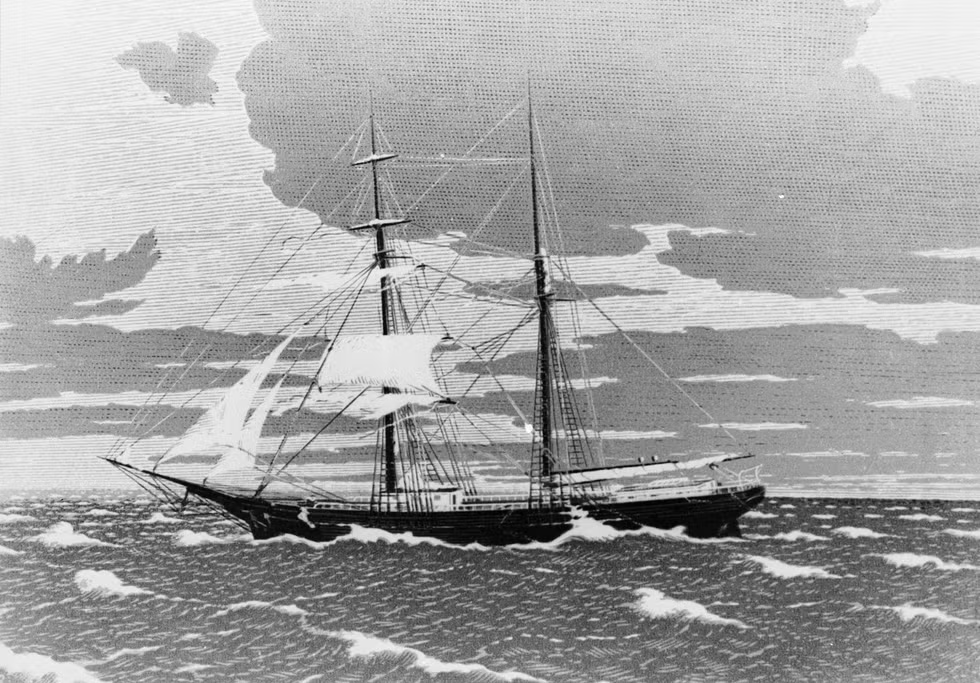
The Mary Celeste, 1870.
The ship was searched thoroughly, but not a soul was found. In the cabin a table was set for breakfast, but the meal had been only half eaten. In the fo’c’sle, the seamen’s chests of clothes were quite dry, and the razors left behind showed no trace of rust. There wasn’t a crack in the paint or planks of the deck, and if the “Mary Celeste” had met bad weather, why was it that a small phial of sewing-machine oil stood upright by a reel of cotton and thimble? Surely, rough seas would have upset that phial.
The captain of the “Dei Gratia” ordered the mate and two of the crew to take the “Mary Celeste” into Gibraltar, which they reached on December 13. “There were no boats aboard the ‘Mary Celeste,’” said U.S. Consul Horatio J. Sprague, in reporting to Washington. “The vessel is said to leak some, but her new crew had no difficulty in bringing her into this port.”
The cargo of alcohol was all in good order, except for one cask that had started; the exterior of the hull below the waterline showed not the least sign of damage; the ship herself was in excellent order. However, the sleuths noted one apparently sinister feature: marks, seemingly of blood, stained the “Mary Celeste’s” top-gallant rail, and both bows had been “intentionally slashed.” The ship’s bill of lading and manifest were missing. They examined and compared the logs of the “Mary Celeste” and the “Dei Gratia,” and noted a strange circumstance.
Between November 25 and December 5, when the “Mary Celeste” was apparently abandoned, and actually sighted by the “Dei Gratia,” the derelict ship seemed to have held on her course with the wheel loose and no one at the helm. Now, the distance of the longitude of the place where the derelict was found by the “Dei Gratia” from that of the island of Santa Maria is about 527 miles, and, says the admiralty experts, “It appears almost impossible that the derelict should have compassed within that time such a distance at all events on the starboard tack, upon which she was met by the ‘Dei Gratia,’ when the log of the latter shows that the wind was blowing from the north all that time, and that she was on the port tack all the time.”
This, in non-technical language, means that during the ten days the position of the sails of the “Mary Celeste” must have been altered by someone, “and the obvious inference is that the ‘Mary Celeste’ was not abandoned till some days after the last entry in her log.”
When the marshal of the vice-admiralty court entered the cabin of the “Mary Celeste,” he found on the floor a curious sword. “I have examined it,” reports Consul Sprague to Washington, “and it is evidently of Italian make, and bears a cross of Savoy on the hilt; it remains in the custody of the court. The chronometer and ship’s papers cannot be found.”
Capt. R. W. Shufeldt, of the U.S. warship “Plymouth,” chanced at this time to call at Gibraltar, and went aboard the “Mary Celeste,” at the request of the U.S. consul. “I reject the idea of a mutiny,” said he; “there is no evidence of violence about the deck or in the cabins.” And so this mystery remains unsolved.
West Australian airplanes, a liner from Capetown, a motorship, a steamer, and a fleet of Danish vessels have recently been unable to solve another mystery of the sea.
A nearly new and well-found five-master sailing ship, the “Kobenhavn,” left Montevideo, on Dec. 14, 1928, on a voyage to Melbourne, Australia, where she was to load wheat. Eight days out of port, in the South Atlantic, she signaled “all’s well” to a passing Norwegian steamer, and then she vanished into the regions of the “Roaring Forties.”
Aboard were seventy Danish naval cadets and an experienced crew, and she was fitted with radio and auxiliary engines.
Laptop Cleaner

Portable Power Station

Now 17% Off
Pocket Cleaver

Now 30% Off
RFID-Blocking Wallet
Best Value Water Bottle

此内容由惯性聚合(RSS阅读器)自动聚合整理,仅供阅读参考。 原文来自 — 版权归原作者所有。