






Some time ago, a mechanic in Vienna was working on top of a fuselage, at the tail.Suddenly the craft bounded forward. The startled mechanic was just able to grasp the framework as the pilot, unaware of his unwilling stowaway, took the air.
Clinging with a death grip, he tried to attract the pilot’s attention, as did spectators who expected momentarily to see him dashed to earth. Finally the airdrome manager signaled the pilot to land. Not until he had stopped his plane did he know why his tail seemed heavy. The mechanic climbed off his perch and went on with his job.
There have been several such cases. But lately mechanics have taken to the air as a necessary part of the day’s work. Some fly on test flights of new ships. Distance flyers usually carry one or more mechanics able to make any emergency repairs.
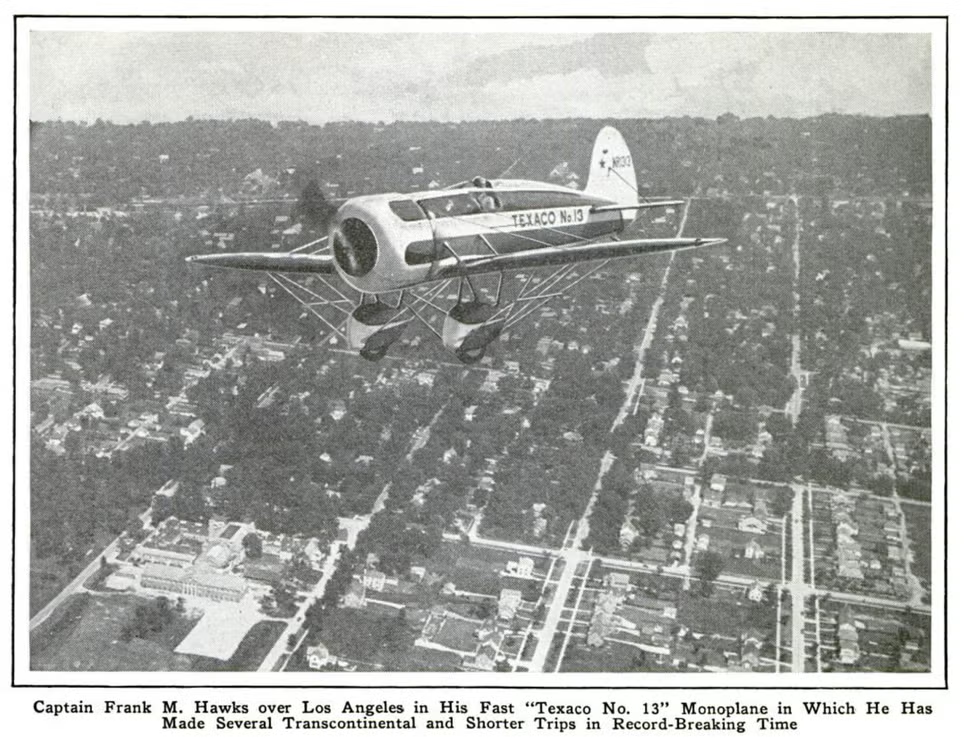
When Capt. Frank Hawks set a non-stop record between Los Angeles and New York, in 1929, he had 375 gallons of extra fuel stowed in five-gallon cans in the cabin forward. The cabin was crammed full of the cans when the mechanic, Oscar Grubb, was squeezed in and the door closed.
Clear across the continent, Grubb opened cans and pumped fuel for the voracious engine. Pumping his way across the continent, his only recollection was of fumes that nearly asphyxiated him. In his spare time he cut up empty cans to make more room. He had no time to eat during those hectic eighteen hours of storms, fog, high winds and terrific speed.
From the archives: This story originally appeared in the December 1930 issue of Popular Mechanics. We’re republishing it now as part of our ongoing look back at Pop Mech’s best feature stories from the last 125 years. It appears here as originally published; some details, terminology, or understandings may have changed over time.
It was the American refueling endurance flight that evolved the flying mechanic into a daring mid-air repairman. The “Question Mark,” which began the contest, had a narrow catwalk on each side of the motor, on which Staff Sergeant Roy W. Hooe stood while he cleaned and changed sparkplugs. He tried to find the cause of trouble when the motor began missing badly, but the ship was too unstable and he had to desist from his search.
For later refueling flights, therefore, plans were made to make repairs in flight. On the “Fort Worth,” which next broke the record, James Kelly, former cowboy, wore a parachute as he tended the motor 2,000 feet above the airport. He not only changed sparkplugs and greased rocker arms at sixty miles an hour, while balanced on his narrow plank, but he also installed a new tachometer shaft.
On the St. Louis “Robin,” “Red” Dale Jackson did the catwalking, and he added a safety feature. “To check the motor,” he related, “I would open the door of the cabin on either side and climb out on the six-inch wide running-board catwalk, which extended forward to within three inches of the propeller blades.”
“The wind, far more than the height above the ground, made this difficult. For protection there were two rods rigged as railings outside me, and I had a safety belt with a ring which slid along the lower of these rods. Once I was in position, it was not so hard to do the work, because old man O’Brine certainly did hold the ship steady. He knew that one slip by me, standing there without a parachute, would mean certain death.”
Even more spectacular, to the thousands watching below, was his trip to the tail. Forest O’Brine, at the controls, said it was even worse to watch than when “Red” went out on the catwalk. Jackson climbed out on top of the fuselage, and then slid back, the pilot “feeling” his progress by his elevator control. The repairs completed, Jackson swung over on his stomach astride the fuselage, put his feet against the stabilizers, and worked his way forward into the cabin.
But the worst was yet to come.
At 3:00 a.m. on the eighth day, when only half through the long grind, the motor started cutting out and vibrating heavily. “Red” was asleep. He awoke instantly, and in a few moments was out on the catwalk, flashlight in hand. He changed sparkplugs in two lower cylinders. He had hardly got back when the motor again went bad. He checked over the magnetos and oil-soaked wiring, and burnt his hands severely. He kept on in spite of this, for the flight was in imminent danger. The breaker points of the left-hand magneto he found to be grounded in the base. While it rotated at high speed, he fished out a small piece of wire, and the motor settled down to its steady roar.
After a while a pushrod began spraying oil, and this was mended. Once O’Brine got a gasoline shower bath when the refueling planes suddenly were separated by the backwash from another plane. Their light 170-horsepower motor was apparently as good as ever when they landed, after 420 hours seventeen minutes aloft.
The “City of Chicago” monoplane, piloted by John and Kenneth Hunter, had a catwalk on which Kenneth, a former wing walker and parachute jumper, “doctored up” ailing cylinders and kept all parts lubricated. One of his exploits was clearing the tail of masses of paper, string and other debris which had blown back and caught in wires, rudder and stabilizers, with imminent danger of clogging the controls. Kenneth crawled out, head first, from the hatch, slid backward on the fuselage, and hung to a rope while he cleared away the debris. A lurch of the plane would have pitched him off, and he wore no parachute.
During the night of July 1, the motor coughed and sputtered. At 2:00 a.m. John went out on the catwalk and put a new breaker into the magneto, restoring the steady drone. On July 3, an engine holding-down bolt dropped out. Kenneth obtained a new one and from the catwalk put it into place.
The next attempt to break the Hunters’ record of 553 hours, at Roosevelt Field, almost came to grief before it was half completed. The motor began to miss badly. Changing sparkplugs failed to remedy it. Finally a battery was sent up for possible use, and the plane climbed to a high level while the mechanic crawled out of the window onto the catwalk. Hanging to a short rope with one arm, he put one foot on the propeller, to prevent its turning with the wind as the engine was cut off and the plane glided. He then installed a new breaker-point assembly, restoring power at once. By a higher climb, a repair job of five or ten minutes could thus be made.
A couple of years ago, the “Graf Zeppelin,” on its way across the Atlantic, ran into a storm and lost some 717 square yards of fabric from the underside of the port stabilizing fin. This occurred about 1,000 miles from Bermuda. The speed was cut in two, and two helmsmen, one of them Knut Eckener, son of the commander, volunteered for the dangerous and unique job of recovering the fin. They crawled out on top of the great air cruiser, then made their way to the damaged fin. Buffeted by wind and rain, they clung to the framework and made an emergency repair job, running imminent risk of being pitched headlong into the sea.
Earlier in this voyage, while over the Madeira Islands, a mechanic climbed out on top of a motor gondola to repair a damaged oil tank.
“It may be possible in the future, on larger planes, to transfer complete engines, and even crews.”
Oddly enough, the British dirigible “R-100,” on its way to Canada in July of this year, had almost exactly the same accident while over the St. Lawrence River.
A sudden strain ripped the fabric from the underside of the port fin. A rigger, named Flatters, crawled out through the torn hole and made the fabric fast to the undamaged part.
The great Dornier “Do-X,” which flew on one test flight with 169 persons aboard, is the first aircraft to provide mechanics and facilities for regular repairs in flight. A tunnel in the huge wing leads to the six nacelles which carry the twelve tandem motors. An engine man at each nacelle starts his two engines with compressed air. The four men in the outer nacelles stay there during flight.
The great airliners, airplanes and airships of the near future will carry spare parts, repair mechanics and equipment to provide for all ordinary repairs in flight. Possibly even a spare motor can be carried. A round trip across the continent will take twenty-four hours or less, with huge airliners refueled in air to save time. Anthony H. G. Fokker said recently:
“It is now certain that, as the size of the plane increases, the engines will be made more accessible to provide facilities for making minor repairs in the air. It may be possible in the future, on larger planes, to transfer complete engines, and even crews.”
Best Garden Hose

Weed Puller

Now 11% Off
Best Spreader

Now 13% Off
Best Value Thatch Rake

Now 30% Off
Best Garden Cart

此内容由惯性聚合(RSS阅读器)自动聚合整理,仅供阅读参考。 原文来自 — 版权归原作者所有。