










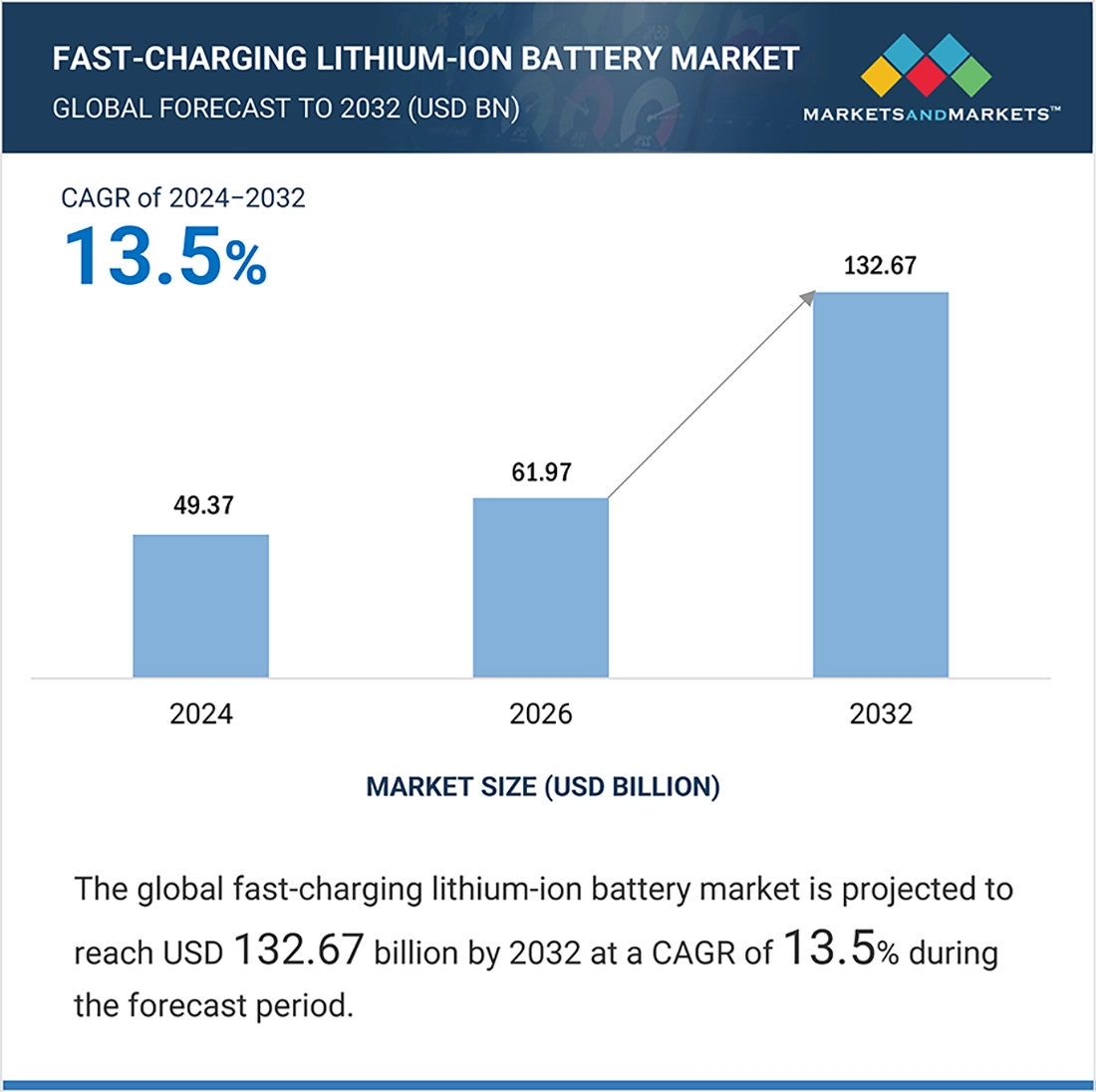
The global fast-charging lithium-ion battery market is valued at USD 61.97 billion in 2026 and is projected to reach USD 132.67 billion by 2032, registering a CAGR of 13.5% during the forecast period. Fast-charging lithium-ion batteries play a critical role across industries by enabling rapid energy replenishment and improved operational efficiency for applications such as electric mobility, consumer electronics, and energy storage systems. These batteries, designed with advanced cell chemistries and optimized thermal management, support high power input while maintaining safety, cycle life, and performance stability. They also enable seamless integration with battery management systems and high-voltage architectures, enhancing reliability and efficiency. Increasing focus on reducing charging time, improving user convenience, and supporting large-scale electrification is driving adoption, along with continuous advancements in battery materials and charging technologies. The importance of fast-charging lithium-ion batteries continues to grow across sectors such as automotive, electronics, and energy, where they support high-performance applications and evolving energy demands.
Attractive Opportunities in Fast-Charging Lithium-ion Battery Market

Rising focus on improving energy efficiency, reducing downtime, and enhancing user convenience is accelerating the adoption of advanced fast-charging battery technologies, particularly high-power battery systems and optimized charging architectures.

The Asia Pacific fast-charging lithium-ion battery market is expected to witness strong growth during the forecast period, driven by large-scale battery production, expanding EV adoption, and increasing investments in high-power charging networks.

Utilization of advanced battery management systems, digital monitoring, and integration with smart energy and grid systems is expected to create new opportunities by improving performance, safety, and predictive maintenance capabilities.

Challenges related to high initial costs, supply chain constraints for critical materials, and thermal management complexities are expected to pose constraints to the growth of this market.
The rapid expansion of EV adoption is driving strong demand for fast-charging lithium-ion batteries as reduced charging time becomes a key requirement for users. As EV penetration increases across passenger and commercial segments, the need for quicker energy replenishment is critical to improve vehicle utilization and user convenience. Automakers are increasingly integrating fast-charging capabilities as a standard feature to enhance product competitiveness and address range anxiety concerns. High-power battery systems, combined with advancements in charging infrastructure, are enabling shorter charging cycles and improved driving efficiency. In addition, supportive government policies, investments in EV ecosystems, and expansion of high-speed charging networks are accelerating market growth. Continuous innovation in battery chemistry and thermal management is further supporting the transition toward fast-charging becoming a baseline expectation in electric mobility.
Supply chain constraints for advanced battery materials are limiting the growth of the fast-charging lithium-ion battery market, as critical inputs such as lithium, nickel, and cobalt face availability and pricing pressures. Increasing demand from EVs and energy storage systems is intensifying competition for these raw materials, leading to cost volatility and procurement challenges. Limited geographic concentration of key resources and dependence on a few supplier regions further increase supply risks. In addition, processing and refining capacities are still developing, creating bottlenecks in scaling production. These constraints impact manufacturing timelines, cost structures, and overall market expansion. Companies are focusing on material diversification, recycling initiatives, and supply chain localization to mitigate risks, but near-term supply limitations continue to act as a restraint on market growth.
Advancements in next-generation battery materials are creating strong opportunities in the fast-charging lithium-ion battery market by enabling higher charging speeds without compromising battery life. Innovations in electrode materials, solid-state designs, and advanced electrolytes are reducing degradation typically associated with high-rate charging. These developments support improved cycle stability, enhanced thermal performance, and greater safety under high-power conditions. As industries demand faster charging alongside durability, material innovation is becoming a key differentiator for battery manufacturers. Increased R&D investments and collaboration across the battery value chain are accelerating the commercialization of these technologies. The ability to achieve rapid charging while maintaining long-term performance is expected to unlock new applications and drive broader adoption across electric mobility and high-performance energy storage systems.
Accelerated battery degradation remains a key challenge in the fast-charging lithium-ion battery market, as higher charging rates can increase thermal stress and impact long-term performance. Rapid charging often leads to issues such as lithium plating, reduced cycle life, and capacity fade, which can affect battery reliability over time. Balancing charging speed with durability and safety is a critical concern for manufacturers and end users. Advanced thermal management systems and battery management technologies are being developed to mitigate these effects, but maintaining optimal performance under high-power conditions remains complex. Ensuring consistent performance across varying operating environments adds to the challenge. Addressing these lifecycle trade-offs is essential to support widespread adoption and long-term viability of fast-charging battery solutions.
Prismatic cell formats are gaining strong traction in the fast-charging lithium-ion battery market due to their high energy density, efficient space utilization, and structural advantages in battery pack design. These cells are widely adopted in EVs where compact configuration and optimized packaging are critical for performance and range. Their ability to support stable thermal behavior and high power output makes them suitable for fast-charging applications. Increasing integration by automotive OEMs, along with advancements in cell architecture and manufacturing scalability, is driving rapid adoption. In addition, prismatic cells offer improved mechanical stability and simplified pack assembly, supporting cost efficiency and performance consistency. As the demand for high-capacity and fast-charging battery systems continues to rise, prismatic formats are expected to witness strong growth across key applications.
Electric vehicles are projected to account for the largest share of the fast-charging lithium-ion battery market, driven by large-scale electrification of transportation and increasing demand for reduced charging time. Fast-charging capability is becoming a core requirement in EV platforms to improve vehicle usability and support long-distance travel. Automakers are integrating high-power battery systems and optimizing charging architectures to enhance performance and reduce downtime. The expansion of public fast-charging infrastructure and supportive government policies is further accelerating EV adoption globally. In addition, growing consumer preference for high-range vehicles and improved charging convenience is strengthening demand for advanced battery solutions. Continuous investments in EV production capacity and battery innovation continue to reinforce the leadership of this segment in the overall market.
The Asia Pacific is projected to lead the fast-charging lithium-ion battery market, supported by strong battery manufacturing capacity and large-scale adoption of electric mobility across China, South Korea, and Japan. The region serves as a global hub for lithium-ion battery production, backed by well-established supply chains and continuous investments in advanced battery technologies. High demand for EVs, along with expanding fast-charging infrastructure, is driving significant battery deployment. In addition, favorable government policies, incentives for EV adoption, and increasing focus on clean energy are accelerating market growth. The presence of leading battery manufacturers and close collaboration with automotive OEMs further strengthen regional leadership. Ongoing expansion of production facilities and advancements in high-performance battery systems continue to reinforce Asia Pacific’s leading position in the overall market.
| Report Attribute | Details | |
|---|---|---|
| Market size available for years | 2024–2032 | |
| Base year considered | 2025 | |
| Forecast period | 2026–2032 | |
| Forecast units | Value (USD Billion) | |
| Segments Covered | By Cell Format, Application, Charging Capacity, and Region | |
| Regions covered | North America, Europe, Asia Pacific, and Rest of the World | |
The global fast-charging lithium-ion battery market is projected to record a CAGR of 13.5% from 2026 to 2032.
Rising demand for reduced charging time and increasing adoption of EVs, along with advancements in battery technologies and expansion of fast-charging infrastructure, are the key driving factors for the fast-charging lithium-ion battery market.
The electric vehicle industry is expected to grow at a fast pace during the forecast period.
BYD Company Ltd. (China), Contemporary Amperex Technology Co., Limited. (China), LG Energy Solution (South Korea), Panasonic Holdings Corporation (Japan), and Samsung SDI (South Korea) are among the top players in the fast-charging lithium-ion battery market.
The fast-charging lithium-ion battery market in the Asia Pacific region is expected to achieve the largest market share during the forecast period.
 Exclusive indicates content/data unique to MarketsandMarkets and not available with any competitors.
TITLE
PAGE NO
INTRODUCTION
10
EXECUTIVE SUMMARY
11
PREMIUM INSIGHTS
12
MARKET OVERVIEW
13
4.2 MARKET DYNAMICS
DRIVERS
RESTRAINTS
OPPORTUNITIES
CHALLENGES
INDUSTRY TRENDS
14
5.2 MACROECONOMICS INDICATORS
INTRODUCTION
GDP TRENDS AND FORECAST
TRENDS IN GLOBAL ELECTRIC VEHICLE (EV) INDUSTRY
TRENDS IN GLOBAL CONSUMER ELECTRONICS INDUSTRY
5.11 IMPACT OF 2025 US TARIFFS ON FAST-CHARGING LITHIUM-ION BATTERY MARKET
INTRODUCTION
KEY TARIFF RATES
PRICE IMPACT ANALYSIS
IMPACT ON COUNTRIES/REGIONS
IMPACT ON END-USE INDUSTRIES
TECHNOLOGICAL ADVANCEMENTS, AI-DRIVEN IMPACT, PATENTS, INNOVATIONS, AND FUTURE APPLICATIONS
15
REGULATORY LANDSCAPE
16
7.1 REGIONAL REGULATIONS AND COMPLIANCE
REGULATORY BODIES, GOVERNMENT AGENCIES, AND OTHER ORGANIZATIONS
INDUSTRY STANDARDS
CUSTOMER LANDSCAPE & BUYER BEHAVIOR
17
FAST-CHARGING LITHIUM-ION BATTERY MARKET, BY CELL FORMAT (MARKET SIZE & FORECAST TO 2032 – VALUE IN USD MILLION)
18
9.4 POUCH
FAST-CHARGING LITHIUM-ION BATTERY MARKET, BY APPLICATION (MARKET SIZE & FORECAST TO 2032 – VALUE IN USD MILLION)
FAST-CHARGING LITHIUM-ION BATTERY MARKET, BY APPLICATION (MARKET SIZE & FORECAST TO 2032 – VALUE IN USD MILLION)
19
FAST-CHARGING LITHIUM-ION BATTERY MARKET, BY CHARGING CAPACITY (MARKET SIZE & FORECAST TO 2032 – VALUE IN USD MILLION)
20
FAST-CHARGING LITHIUM-ION BATTERY MARKET, BY REGION (MARKET SIZE & FORECAST TO 2032 – VALUE IN USD MILLION)
21
12.2 NORTH AMERICA
US
CANADA
MEXICO
12.3 EUROPE
GERMANY
FRANCE
UK
REST OF EUROPE
12.4 ASIA PACIFIC
CHINA
JAPAN
INDIA
REST OF ASIA PACIFIC
12.5 ROW
MIDDLE EAST
AFRICA
SOUTH AMERICA
COMPETITIVE LANDSCAPE
22
13.6 COMPANY EVALUATION MATRIX: KEY PLAYERS, 2025
STARS
EMERGING LEADERS
PERVASIVE PLAYERS
PARTICIPANTS
COMPANY FOOTPRINT: KEY PLAYERS, 2025
- Company footprint
- Application footprint
- Cell format footprint
- Charging capacity footprint
- Region footprint
13.7 COMPANY EVALUATION MATRIX: STARTUPS/SMES, 2025
PROGRESSIVE COMPANIES
RESPONSIVE COMPANIES
DYNAMIC COMPANIES
STARTING BLOCKS
COMPETITIVE BENCHMARKING: STARTUPS/SMES, 2025
- Detailed list of key startups/SMEs
- Competitive benchmarking of key startups/SMEs
13.9 COMPETITIVE SCENARIO
PRODUCT LAUNCHES
DEALS
EXPANSIONS
COMPANY PROFILES
24
14.1 KEY PLAYERS
CONTEMPORARY AMPEREX TECHNOLOGY CO., LIMITED.
LG ENERGY SOLUTION
BYD COMPANY LTD.
PANASONIC HOLDINGS CORPORATION
SAMSUNG SDI
EVE ENERGY CO., LTD.
GOTION
SK INNOVATION CO., LTD.
CHINA AVIATION LITHIUM BATTERY CO., LTD.
TOSHIBA CORPORATION
RESEARCH METHODOLOGY
25
15.1 RESEARCH DATA
SECONDARY DATA
- Key data from secondary sources
PRIMARY DATA
- Key data from primary sources
- Key primary participants
- Breakdown of primary interviews
- Key industry insights
15.2 MARKET SIZE ESTIMATION
BOTTOM-UP APPROACH
TOP-DOWN APPROACH
BASE NUMBER CALCULATION
15.3 MARKET FORECAST APPROACH
SUPPLY SIDE
DEMAND SIDE
APPENDIX
26
The study involved four major activities in estimating the current size of the fast-charging lithium-ion battery market. Exhaustive secondary research was done to collect information on the market, peer market, and parent market. To validate these findings, assumptions, and sizing with industry experts across the value chain through primary research was the next step. Both top-down and bottom-up approaches were employed to estimate the complete market size. After that, market breakdown and data triangulation methods were used to estimate the market size of segments and subsegments. Two sources of information, secondary and primary, were used to identify and collect information for an extensive technical and commercial study of the fast-charging lithium-ion battery market.
Various secondary sources were referred to in the secondary research process to identify and collect information important for this study. The secondary sources included annual reports, press releases, and investor presentations of companies; white papers; journals and certified publications; and articles from recognized authors, websites, directories, and databases. Secondary research was conducted to obtain key information about the industry’s supply chain, the market’s value chain, the total pool of key players, market segmentation according to the industry trends (to the bottom-most level), regional markets, and key developments from market- and technology-oriented perspectives. The secondary data was collected and analyzed to determine the overall market size, further validated by primary research.
Extensive primary research was conducted after gaining knowledge about the current scenario of the fast-charging lithium-ion battery market through secondary research. Several primary interviews were conducted with experts from the demand and supply sides across four major regions: North America, Europe, the Asia Pacific, and the RoW. This primary data was collected through questionnaires, emails, and telephonic interviews.
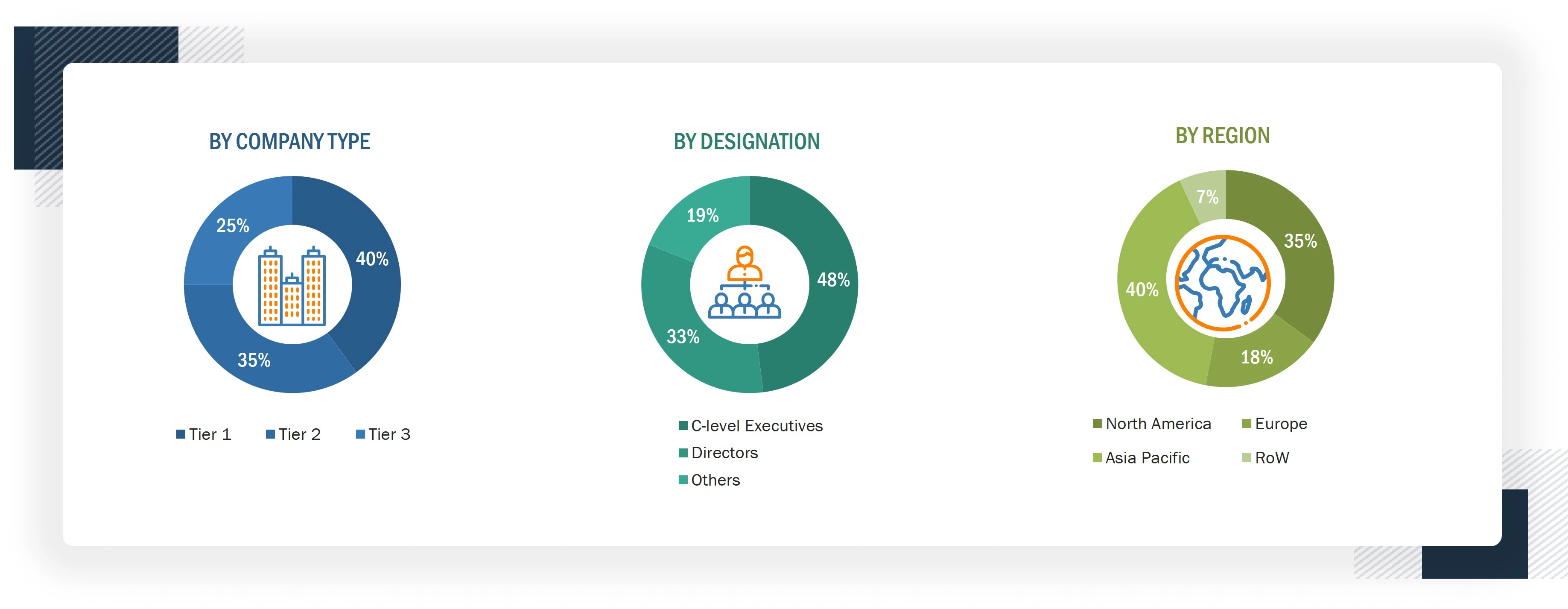
Notes: Other designations include product managers, sales managers, and marketing managers.
Three tiers of companies have been defined based on their total revenue as of 2024: tier 3: revenue less than USD 500 million; tier 2: revenue between USD 500 million and USD 1 billion; and tier 1: revenue more than USD 1 billion.
The Rest of the World (RoW) mainly includes South America, Africa, and the Middle East.
To know about the assumptions considered for the study, download the pdf brochure
Both top-down and bottom-up approaches were used to estimate and validate the total size of the fast-charging lithium-ion battery market. These methods have also been used extensively to estimate the size of various subsegments in the market. The following research methodology has been used to estimate the market size:
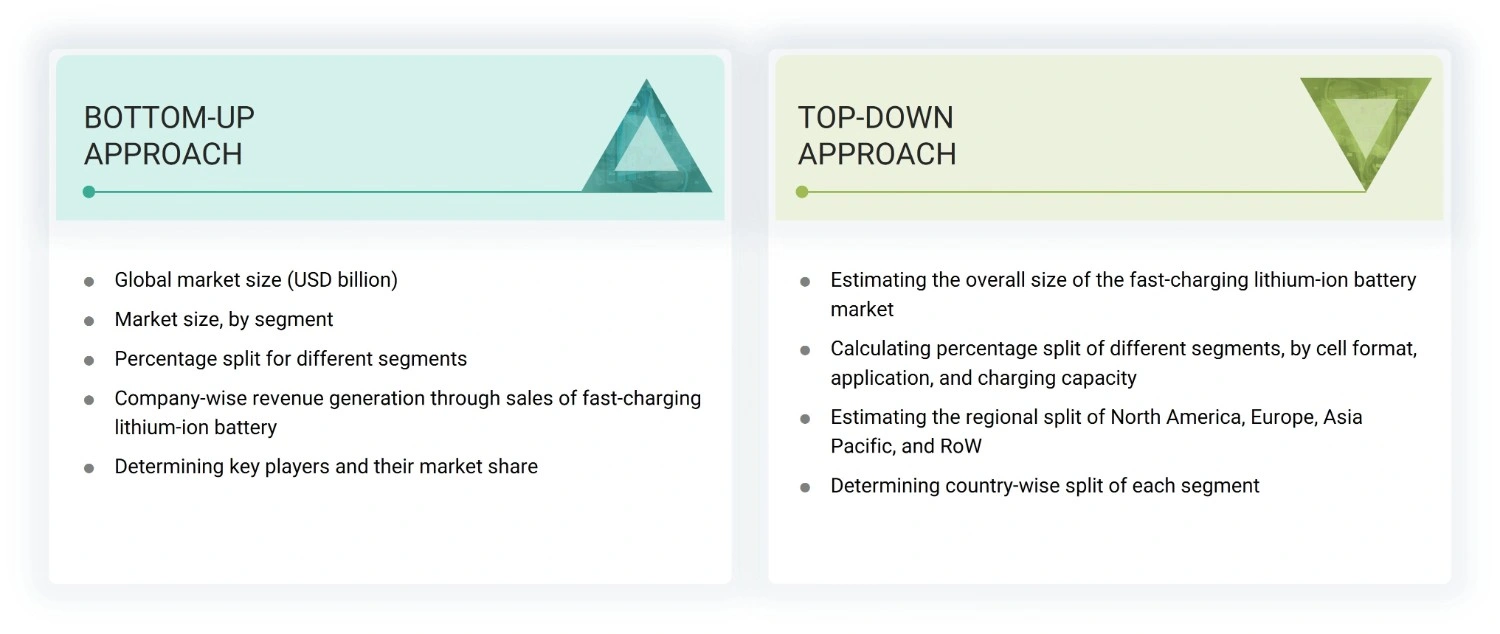
After arriving at the overall size of the fast-charging lithium-ion battery market from the market size estimation process explained above, the total market was split into several segments and subsegments. Data triangulation and market breakdown procedures were employed, wherever applicable, to complete the overall market engineering process and arrive at the exact statistics for all segments and subsegments of the market. The data has been triangulated by studying various factors and trends from both the demand and supply sides. Along with this, the market size was validated using both top-down and bottom-up approaches.
The fast-charging lithium-ion battery market refers to battery technologies designed to enable significantly reduced charging time while maintaining performance, safety, and lifecycle stability. These batteries support high power input through advanced cell chemistries, optimized electrode materials, and efficient thermal management systems, allowing rapid energy transfer without degradation. They are widely used in applications where quick turnaround and high energy availability are critical, particularly in electric mobility and portable electronics. Integration with advanced battery management systems ensures controlled charging, improved efficiency, and protection under high load conditions. The market is driven by increasing demand for reduced downtime, enhanced user convenience, and scalable energy solutions, positioning fast-charging batteries as a key enabler of next-generation electrification.
With the given market data, MarketsandMarkets offers customizations according to the company’s specific needs. The following customization options are available for the report:
此内容由惯性聚合(RSS阅读器)自动聚合整理,仅供阅读参考。 原文来自 — 版权归原作者所有。