









- DESCRIPTION
- TABLE OF CONTENTS
- METHODOLOGY
- DOWNLOAD PDF
Cargo E-Bike Market by Mode (Pedal, Throttle Assist), Motor (Hub, Mid), Battery (Lead Acid, Li-ion, LIP), Wheel Size (20, 20�24, 25�28, >28�), Drive (Chain, Belt), Type (2- & 3-wheel), Motor Output, Application, and Region - Global Forecast to 2032

USD 8.97 BN
MARKET SIZE, 2032

CAGR 11.8%
(2025-2032)

298
REPORT PAGES

120
MARKET TABLES
OVERVIEW
Source: Secondary Research, Interviews with Experts, MarketsandMarkets Analysis
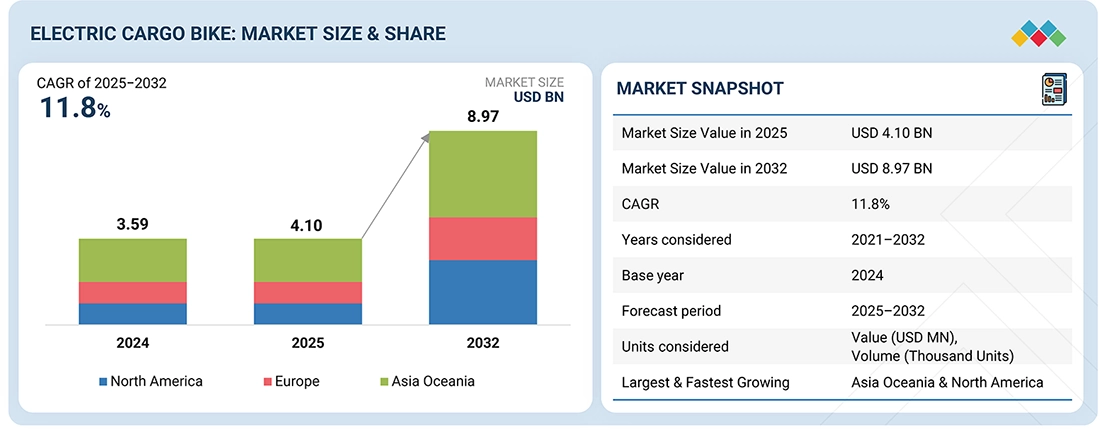
The cargo e-bike market is expected to grow from USD 4.10 billion in 2025 to USD 8.97 billion by 2032, with a CAGR of 11.8%. This growth is driven by shifts in urban logistics and zero-emission delivery mandates. Adoption is speeding up among parcel, grocery, and food delivery companies as cargo e-bikes lower last-mile costs, help avoid congestion charges, and meet low-emission zone (LEZ) regulations in Europe and North America. Modern models feature high-torque mid-drive motors (80–120 Nm), dual-battery systems (up to 2 kWh), and reinforced frames that support payloads of 150–300 kg, making them viable van replacements in busy urban routes. The increased use of LFP batteries for their safety and lifecycle advantages, along with telematics-based fleet management, further enhances their role as scalable commercial logistics solutions.
KEY TAKEAWAYS
-
By Drive Type
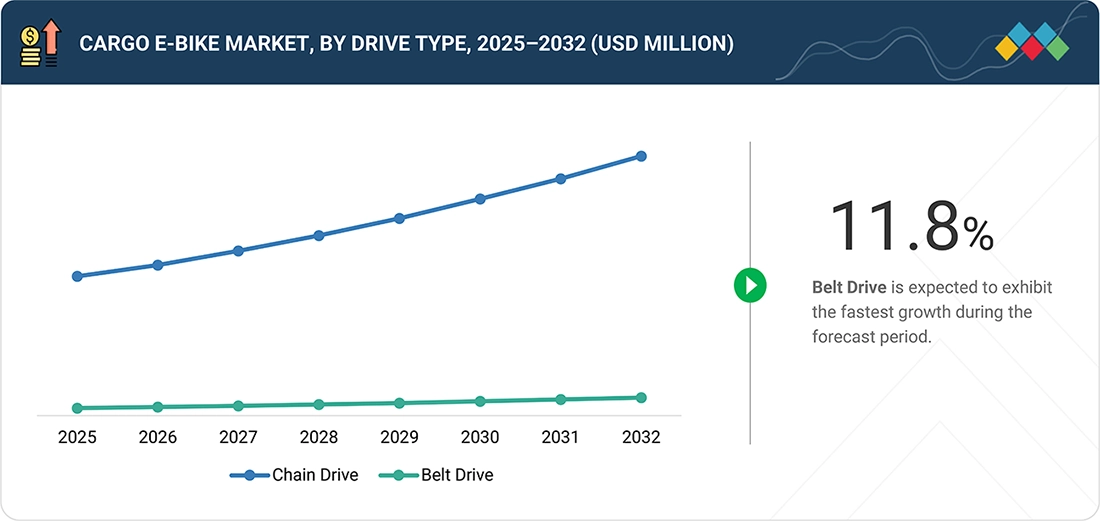
The belt drive segment is expected to register the fastest growth with a CAGR of 11.8% during the forecast period.
-
By Type
The two-wheeled segment is expected to dominate the market during the forecast period.
-
By Motor type
The mid-drive motor segment is expected to record a CAGR of 10.3% between 2025 and 2032.
-
BY REGION
The European cargo e-bike market accounted for over 50% share in 2025.
-
COMPETITIVE LANDSCAPE
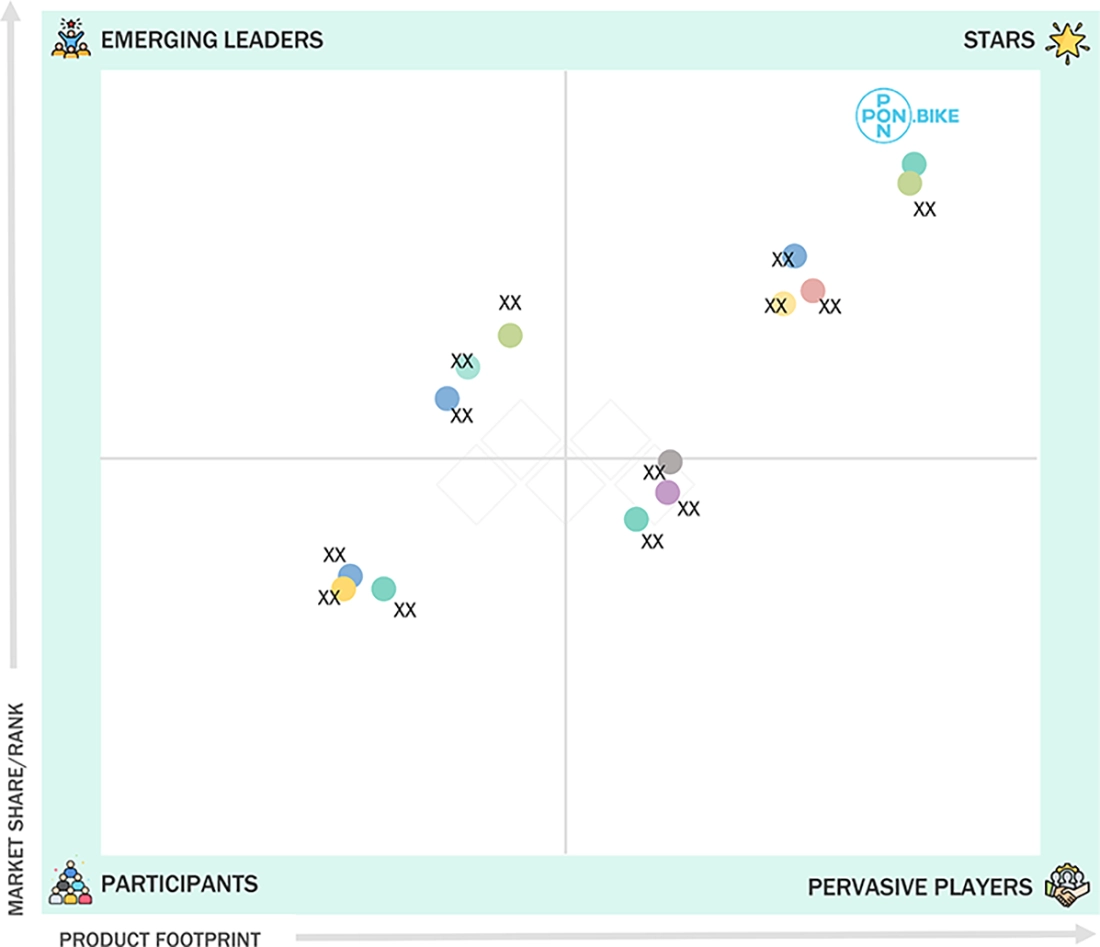
Pon. Bike and Accell Group were identified as stars in the market, primarily due to their strong business networks and strategic growth, which have enabled them to establish their market positions.
The market is primarily driven by product innovation and the growth of urban logistics and delivery infrastructure. Recent OEM launches include lightweight aluminum or steel frames, high-torque mid-drive motors in the 70–100 Nm range, and high-capacity 500–750 kWh battery packs, which enable longer riding distances, better thermal management, and improved load-carrying capabilities.
TRENDS & DISRUPTIONS IMPACTING CUSTOMERS' CUSTOMERS
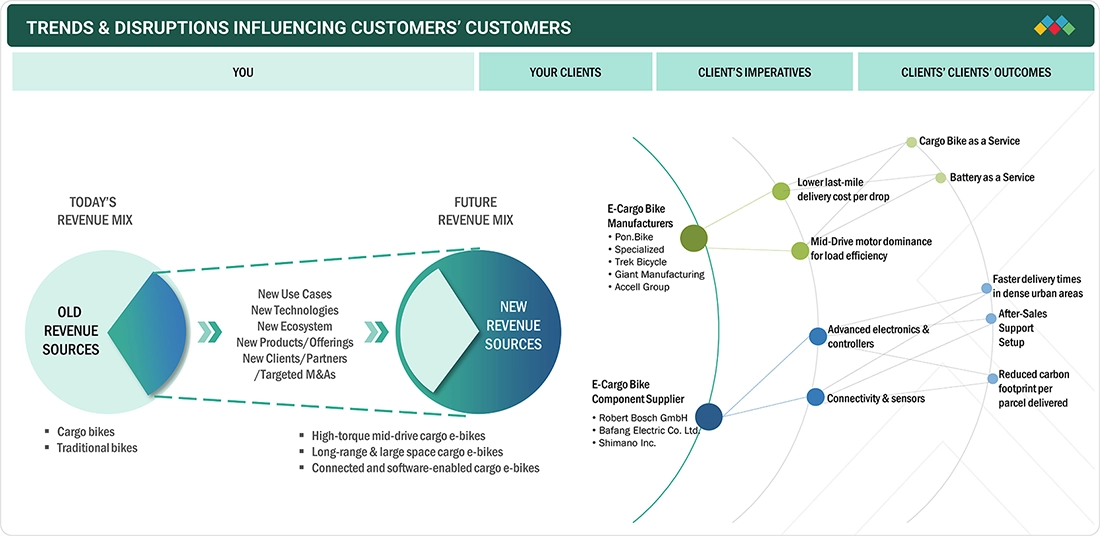
The cargo e-bike market is experiencing a major shift driven by the push toward electrifying urban logistics, changes in regulations, and the digitalization of fleets. The expansion of low-emission zones, congestion charges, and restrictions on van access in European cities are accelerating the switch from LCVs to cargo e-bikes for last-mile delivery. Meanwhile, improvements in high-torque mid-drive systems, dual-battery setups, modular cargo platforms, and telematics are transforming product features and boosting commercial growth. The market is also shifting toward service-based models, such as leasing, fleet-as-a-service, and battery subscription programs, which are challenging traditional bicycle manufacturer strategies and opening new opportunities in urban mobility.
Source: Secondary Research, Interviews with Experts, MarketsandMarkets Analysis
MARKET DYNAMICS

Drivers
Impact
Level
-
Urban logistics electrification and LEZ regulations


RESTRAINTS
Impact
Level
-
High fleet acquisition cost


OPPORTUNITIES
Impact
Level
-
Fleet telematics and subscription-based services


CHALLENGES
Impact
Level
-
Infrastructure and urban integration constraints

Source: Secondary Research, Interviews with Experts, MarketsandMarkets Analysis
The rapid growth of low-emission zones, congestion pricing, and diesel vehicle restrictions in major cities is speeding up the shift of fleets to cargo e-bikes. Logistics companies are using cargo e-bikes to reduce last-mile delivery costs (fuel, parking, tolls) and increase delivery speed in busy urban centers. Payload capacities of 150–300 kg and dual-battery systems now make it practical to replace vans on short urban routes.
Commercial-grade cargo e-bikes are costlier than traditional cargo bikes, which limits their use among small businesses and independent operators. The higher costs are caused by large-capacity battery packs (1–2 kWh), stronger frames, hydraulic brakes, and telematics systems. Return on investment depends largely on daily usage and available government incentives.
Integration of GPS tracking, route optimization, battery analytics, and remote diagnostics is transforming cargo e-bikes into connected fleet assets. OEMs and fleet solution providers are monetizing through leasing models, battery-as-a-service (BaaS), and maintenance subscriptions. As fleet operators prioritize uptime and asset tracking, software-enabled service ecosystems offer recurring revenue opportunities beyond hardware sales.
Despite increasing adoption, limited dedicated cargo-bike parking, secure charging stations, and standardized micro-hub infrastructure hinder operational growth. In many cities, cycling lanes are not designed for wider, longer cargo bikes, leading to maneuverability and safety issues. Without coordinated urban planning and infrastructure improvements, fleet expansion could encounter challenges in high-density delivery areas.
CARGO E-BIKE MARKET: COMMERCIAL USE CASES ACROSS INDUSTRIES
| COMPANY | USE CASE DESCRIPTION | BENEFITS |
|---|---|---|
|
|
Urban parcel and grocery delivery: Load 75/Packster models are commonly used by last-mile operators and supermarket chains for inner-city deliveries and micro-hub distribution. | Reduces last-mile delivery costs, avoids congestion and LEZ charges, and enables faster point-to-point urban routing compared to vans. |
|
|
SME and food delivery logistics: GSD and Quick Haul cargo bikes are used by small businesses, restaurants, and service providers for daily goods transportation in dense areas. | Provides van-like utility with lower CapEx and OpEx, improves parking flexibility, and boosts delivery efficiency in narrow urban streets. |
|
|
Municipal and family transportation: E-bikes are utilized by city services (such as maintenance and waste collection) and for family travel to carry children and cargo. | Replaces short-distance car trips, reduces urban emissions, and supports a high payload capacity of up to 250 kg within compact urban infrastructure. |



Logos and trademarks shown above are the property of their respective owners. Their use here is for informational and illustrative purposes only.
MARKET ECOSYSTEM
The ecosystem analysis identifies various players in the cargo e-bike market, mainly including raw material suppliers, component manufacturers, cargo e-bike producers, and service providers.
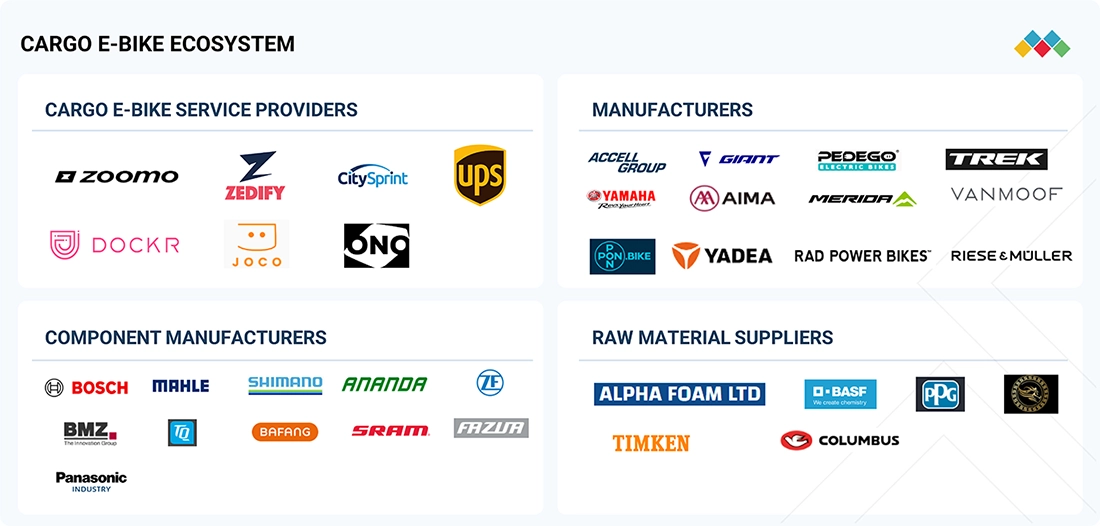
Logos and trademarks shown above are the property of their respective owners. Their use here is for informational and illustrative purposes only.
MARKET SEGMENTS
Source: Secondary Research, Interviews with Experts, MarketsandMarkets Analysis
Two-wheeled cargo e-bikes dominate the market due to their better maneuverability, lower price, and capability to operate within existing urban cycling infrastructure. Their slim design allows access to bike lanes and congestion-restricted zones, making them effective replacements for vans in last-mile delivery. Adoption is strongest in Europe, supported by mature cycling networks and low-emission regulations, while North America is seeing increasing fleet deployment for e-commerce and food delivery. These bikes use high-torque mid-drive motors (80–120 Nm) paired with 500 Wh–1.5 kWh battery systems, allowing 150–250 kg payload capacity for daily commercial use.
The commercial segment dominates the market, fueled by rapid growth in last-mile delivery, grocery distribution, food service logistics, and municipal operations. Logistics companies are increasingly using cargo e-bikes to cut urban delivery costs, meet LEZ rules, and improve route efficiency in busy city centers. Fleet adoption is strongest in Europe, where urban access restrictions and cycling infrastructure support commercial growth, while North America is expanding through e-commerce and micro-fulfillment models. Commercial cargo e-bikes usually have higher payload capacities (150–300 kg), dual-battery systems for longer daily range, and telematics for fleet tracking and uptime management.
Chain-drive systems dominate the market, especially in the commercial segment, because they are cost-effective, handle high torque well, and are easy to maintain. Commercial cargo e-bikes that carry heavy loads (150–300 kg) and operate under frequent stop-and-start urban cycles need durable drivetrains that can handle high mechanical stress. Chain drives are also highly compatible with mid-drive motors and multi-speed derailleur or hub gear systems, making them the preferred option for fleet-focused models. Adoption of chain-drive systems is most widespread in Europe and North America, where logistics operators focus on lower initial costs and easy field servicing.
Mid-drive motors dominate the market, especially for commercial and high-payload uses. Their ability to provide higher torque (80–120 Nm) through the drivetrain allows for better load handling, improved hill-climbing, and more efficient power use under heavy cargo loads (150–300 kg payloads). This makes them the top choice for last-mile delivery fleets working in dense urban areas. Additionally, mid-drive motors offer better weight distribution and a lower center of gravity, which enhances vehicle stability when carrying front- or rear-mounted cargo boxes. As a result, most high-end and fleet-focused models in Europe and North America feature mid-drive setups combined with high-capacity or dual-battery systems.
Lithium-ion batteries dominate the market. They are preferred for their higher energy density, lighter weight, and strong power delivery needed for heavy payload operations and extended daily use. These batteries usually support 500 Wh to 1.5 kWh configurations, including dual-battery setups for commercial fleets. Compared to lead-acid batteries, they have a longer lifespan and better efficiency, while being more cost-effective and scalable than lithium-ion polymer in high-capacity commercial applications.
REGION
Europe to be largest market for cargo e-bikes during forecast period
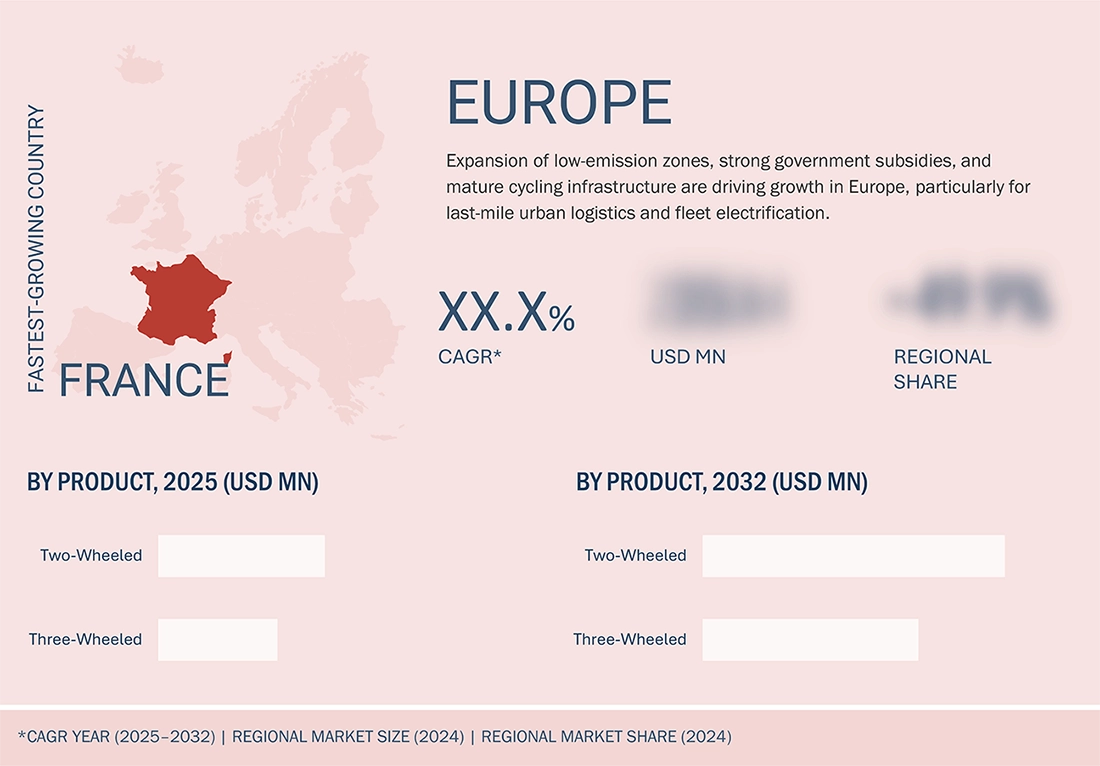
Europe dominates the cargo e-bike market, driven by strong urban mobility policies, mature cycling infrastructure, and strict LEZ regulations. Cities like Amsterdam, Copenhagen, Berlin, and Paris have actively promoted cargo bikes as viable alternatives to LCVs for last-mile delivery. The region also benefits from government purchase subsidies, diesel van congestion restrictions, and well-developed cycling lanes that support larger two-wheel cargo setups. Additionally, major OEMs such as Riese & Müller, Urban Arrow, and Tern have extensive distribution networks across Europe, speeding up both commercial fleet adoption and family mobility uses.
CARGO E-BIKE MARKET: COMPANY EVALUATION MATRIX
The micro quadrant offers information on major players providing cargo e-bikes and presents the findings and analysis of each vendor's performance within the set criteria. The company evaluation matrix positions companies based on market share, rank, and product footprint. Pon. Bike (Star) dominates the cargo e-bike market with a strong presence and a wide range of products.
Source: Secondary Research, Interviews with Experts, MarketsandMarkets Analysis
KEY MARKET PLAYERS
- • Pon.Bike
- • Accell Group N.V.
- • Merida Industry Co., Ltd.
- • Specialized Bicycle Components Inc.
- • Trek Bicycle Corporation
- • Cube
- • AIMA Technology Group Co., Ltd.
- • Riese & Müller
- • Smart Urban Mobility B.V.
MARKET SCOPE
| REPORT METRIC | DETAILS |
|---|---|
| Market Size in 2025 (Value) | USD 4.10 BN |
| Market Forecast in 2032 (Value) | USD 8.97 BN |
| Growth Rate | 11.8% |
| Actual Data | 2021–2032 |
| Base Year | 2024 |
| Forecast Period | 2025–2032 |
| Units Considered | Value (USD MN/BN), Volume (Thousand Units) |
| Report Coverage | Revenue Forecast, Regional Market Shares, Competitive Landscape, Driving Factors, Trends & Disruption, OEM Analysis, Bill of Materials, Total Cost of Ownership |
| Segments Covered |
|
| Regional Scope | Asia Oceania, Europe, North America |
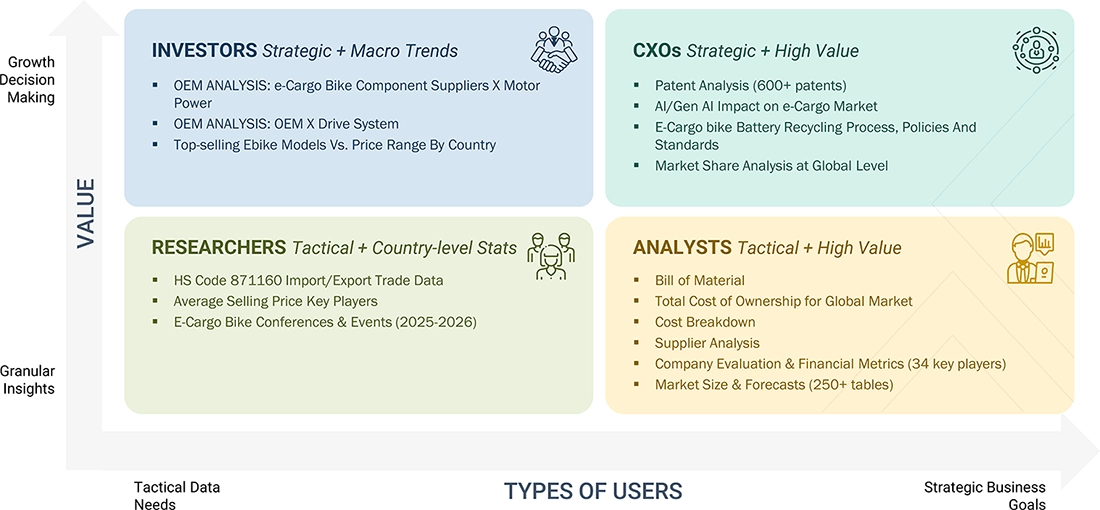
WHAT IS IN IT FOR YOU: CARGO E-BIKE MARKET REPORT CONTENT GUIDE
DELIVERED CUSTOMIZATIONS
We have successfully delivered the following deep-dive customizations:
| CLIENT REQUEST | CUSTOMIZATION DELIVERED | VALUE ADDS |
|---|---|---|
| Market size of Cargo Ebikes | • Market sizing and forecast models for Cargo Ebikes at the global and regional level (US & Collective Europe) provided | • Market sizing and forecast models for Cargo Ebikes at the global and regional level (US & Collective Europe) provided |
| E-Cargo Bike OEM-wise global market share | • OEM-wise global market share provided for Accell Group, Pon (Urban Arrow), Riese & Müller, Tern, Rad Power Bikes, Yuba (2023–2024) | • OEM-wise global market share provided for Accell Group, Pon (Urban Arrow), Riese & Müller, Tern, Rad Power Bikes, Yuba (2023–2024) |
| Drivetrain Type (Chain vs Belt) | • Global share analysis for Chain Drive vs Belt Drive systems provided | • Global share analysis for Chain Drive vs Belt Drive systems provided |
RECENT DEVELOPMENTS
- January 2026 : Accell announced the sale of its titanium bicycle brand Van Nicholas to Italian premium bike manufacturer Veloce. The divestment aligns with Accell’s portfolio optimization strategy, allowing the company to focus on core brands with stronger category depth and broader geographic presence.
- October 2025 : Accell has begun centralizing production by relocating manufacturing from its Helmond (Netherlands) facility to Hungary, with full transfer expected by Q1 2026. The Helmond site, previously accounting for ~20% of output, including Babboe and Koga models, will be transformed into a European R&D hub by Q2 2026.
- July 2025 : Riese & Müller has introduced key updates to its Carrie2 compact cargo bike for 2026, featuring the new Bosch Performance Line PX motor (up to 90 Nm torque) for stronger load-handling performance. The model now includes a Supernova Mini2 headlight as standard, a new zipper door for easier cargo access, and an optional Enviolo Automatiq automatic gearing system.
Table of Contents
 Exclusive indicates content/data unique to MarketsandMarkets and not available with any competitors.
TITLE
PAGE NO
1
INTRODUCTION
15
2
EXECUTIVE SUMMARY
3
PREMIUM INSIGHTS
4
MARKET OVERVIEW
4.1
INTRODUCTION
4.2
MARKET DYNAMICS
4.2.1
DRIVERS
4.2.2
RESTRAINTS
4.2.3
OPPORTUNITIES
4.2.4
CHALLENGES
4.3
UNMET NEEDS AND WHITE SPACES
4.4
INTERCONNECTED MARKETS AND CROSS-SECTOR OPPORTUNITIES
4.5
STRATEGIC MOVES BY TIER-1/2/3 PLAYERS
5
INDUSTRY TRENDS
5.1
MACROECONOMIC OUTLOOK
5.1.1
GDP TRENDS AND FORECAST
5.1.2
TRENDS IN GLOBAL CARGO E-BIKE MARKET
5.1.3
TRENDS IN GLOBAL E-BIKE MARKET
5.2
ECOSYSTEM ANALYSIS
5.3
SUPPLY CHAIN ANALYSIS
5.4
PRICING ANALYSIS
5.4.1
AVERAGE SELLING PRICE TREND OF CARGO E-BIKE OFFERED BY KEY PLAYERS, 2022–2025
5.4.2
AVERAGE SELLING PRICE TREND, BY REGION, 2022–2025
5.5
TRENDS/DISRUPTIONS IMPACTING CUSTOMER BUSINESS
5.6
INVESTMENT AND FUNDING SCENARIO
5.7
TRADE ANALYSIS
5.7.1
IMPORT SCENARIO (HS CODE 871160)
5.7.2
EXPORT SCENARIO (HS CODE 871160)
5.8
KEY CONFERENCES AND EVENTS,
5.9
CASE STUDY ANALYSIS
6
TECHNOLOGICAL ADVANCEMENTS, AI-DRIVEN IMPACT, PATENTS, INNOVATIONS, AND FUTURE APPLICATIONS
6.1
KEY TECHNOLOGIES
6.2
COMPLEMENTARY TECHNOLOGIES
6.3
IMPACT OF AI/GEN AI
6.3.1
TOP USE CASE AND MARKET POTENTIAL
6.3.2
BEST PRACTICE
6.3.3
CASE STUDIES RELATED TO AI IMPLEMENTATION
6.3.4
INTERCONNECTED ECOSYSTEM AND IMPACT ON MARKET PLAYERS
6.3.5
CLIENTS’ READINESS TO ADOPT AI
6.4
PATENT ANALYSIS
7
REGULATORY LANDSCAPE AND SUSTAINABILITY INITIATIVES
7.1
REGIONAL REGULATIONS AND COMPLIANCE
7.1.1
REGULATORY BODIES, GOVERNMENT AGENCIES, AND OTHER ORGANIZATIONS
7.1.2
INDUSTRY STANDARDS
7.2
SUSTAINABILITY INITIATIVES
7.2.1
CARGO E-BIKE BATTERY RECYCLING PROCESSES, POLICIES, AND STANDARDS
8
CUSTOMER LANDSCAPE AND BUYER BEHAVIOR
8.1
DECISION-MAKING PROCESS
8.2
KEY STAKEHOLDERS IN BUYING PROCESS AND THEIR EVALUATION CRITERIA
8.2.1
KEY STAKEHOLDERS IN BUYING PROCESS
8.2.2
BUYING CRITERIA
8.3
ADOPTION BARRIERS AND INTERNAL CHALLENGES
8.4
MARKET PROFITABILITY
9
CARGO E-BIKE MARKET, BY DRIVE TYPE
9.1
INTRODUCTION
9.2
CHAIN DRIVE
9.3
BELT DRIVE
9.4
PRIMARY INSIGHTS
10
CARGO E-BIKE MARKET, BY APPLICATION
10.1
INTRODUCTION
10.2
PERSONAL
10.3
COMMERCIAL
10.4
PRIMARY INSIGHTS
11
CARGO E-BIKE MARKET, BY TYPE
11.1
INTRODUCTION
11.2
TWO-WHEELED
11.3
THREE-WHEELED
11.4
PRIMARY INSIGHTS
12
CARGO E-BIKE MARKET, BY MOTOR OUTPUT
12.1
INTRODUCTION
12.2
<250 W
12.3
250–500 W
12.4
501–750 W
12.5
>750 W
12.6
PRIMARY INSIGHTS
13
CARGO E-BIKE MARKET, BY WHEEL SIZE
13.1
INTRODUCTION
13.2
<20.”
13.3
20–24.”
13.4
25–28.”
13.5
>28.”
13.6
PRIMARY INSIGHTS
14
CARGO E-BIKE MARKET, BY BATTERY TYPE
14.1
INTRODUCTION
14.2
LITHIUM-ION
14.3
LITHIUM-ION POLYMER
14.4
LEAD-ACID
14.5
PRIMARY INSIGHTS
15
CARGO E-BIKE MARKET, BY MODE
15.1
INTRODUCTION
15.2
PEDAL ASSIST
15.3
THROTTLE ASSIST
15.4
PRIMARY INSIGHTS
16
CARGO E-BIKE MARKET, BY MOTOR TYPE
16.1
INTRODUCTION
16.2
HUB MOTOR
16.3
MID-DRIVE MOTOR
16.4
PRIMARY INSIGHTS
17
CARGO E-BIKE MARKET, BY REGION
17.1
INTRODUCTION
17.2
ASIA OCEANIA
17.2.1
CHINA
17.2.2
JAPAN
17.2.3
INDIA
17.2.4
SOUTH KOREA
17.2.5
TAIWAN
17.2.6
AUSTRALIA
17.3
EUROPE
17.3.1
GERMANY
17.3.2
NETHERLANDS
17.3.3
FRANCE
17.3.4
UK
17.3.5
AUSTRIA
17.3.6
ITALY
17.3.7
BELGIUM
17.3.8
SPAIN
17.3.9
SWITZERLAND
17.4
NORTH AMERICA
17.4.1
US
17.4.2
CANADA
18
COMPETITIVE LANDSCAPE
18.1
OVERVIEW
18.2
KEY PLAYER STRATEGIES/RIGHT TO WIN, 2021–2026
18.3
MARKET SHARE ANALYSIS,
18.4
REVENUE ANALYSIS, 2020–2025
18.5
BRAND/PRODUCT COMPARISON
18.6
COMPANY VALUATION AND FINANCIAL METRICS
18.7
COMPANY EVALUATION MATRIX: KEY PLAYERS,
18.7.1
STARS
18.7.2
EMERGING LEADERS
18.7.3
PERVASIVE PLAYERS
18.7.4
PARTICIPANTS
18.7.5
COMPANY FOOTPRINT: KEY PLAYERS,
18.7.5.1
COMPANY FOOTPRINT
18.7.5.2
REGION FOOTPRINT
18.7.5.3
MOTOR TYPE FOOTPRINT
18.7.5.4
DRIVE SYSTEM FOOTPRINT
18.8
COMPANY EVALUATION MATRIX: START-UPS/SMES,
18.8.1
DYNAMIC COMPANIES
18.8.2
RESPONSIVE COMPANIES
18.8.3
PROGRESSIVE COMPANIES
18.8.4
STARTING BLOCKS
18.8.5
COMPETITIVE BENCHMARKING: START-UPS/SMES,
18.8.5.1
LIST OF START-UPS/SMES
18.8.5.2
COMPETITIVE BENCHMARKING OF START-UPS/SMES
18.9
COMPETITIVE SCENARIO
18.9.1
PRODUCT DEVELOPMENTS
18.9.2
DEALS
18.9.3
EXPANSIONS
18.9.4
OTHERS
18.10
STRATEGIC PARTNERSHIPS AND OEM TIE-UPS
19
COMPANY PROFILES
19.1
KEY PLAYERS
19.1.1
ACCELL GROUP N.V.
19.1.1.1
BUSINESS OVERVIEW
19.1.1.2
PRODUCTS/SOLUTIONS/SERVICES OFFERED
19.1.1.3
RECENT DEVELOPMENTS
19.1.1.4
MNM VIEW
19.1.2
PON.BIKE
19.1.3
MERIDA INDUSTRY CO., LTD.
19.1.4
SPECIALIZED BICYCLE COMPONENTS INC.
19.1.5
TREK BICYCLE CORPORATION
19.1.6
CUBE
19.1.7
AIMA TECHNOLOGY GROUP CO. LTD.
19.1.8
RIESE & MÜLLER
19.1.9
SMART URBAN MOBILITY B.V.
19.1.10
YUBA BICYCLES LLC
*DETAILS ON BUSINESS OVERVIEW, PRODUCTS OFFERED, RECENT DEVELOPMENTS, AND MNM VIEW MIGHT NOT BE CAPTURED IN CASE OF UNLISTED COMPANIES.
19.2
OTHER PLAYERS
20
RESEARCH METHODOLOGY
20.1
RESEARCH DATA
20.1.1
SECONDARY DATA
20.1.1.1
KEY DATA FROM SECONDARY SOURCES
20.1.2
PRIMARY DATA
20.1.2.1
KEY DATA FROM PRIMARY SOURCES
20.1.2.2
PRIMARY PARTICIPANTS
20.1.2.3
BREAKDOWN OF PRIMARY INTERVIEWS
20.1.2.4
INSIGHTS FROM INDUSTRY EXPERTS
20.2
MARKET SIZE ESTIMATION
20.2.1
BOTTOM-UP APPROACH
20.2.2
TOP-DOWN APPROACH
20.3
MARKET FORECAST APPROACH
20.3.1
SUPPLY SIDE
20.3.2
DEMAND SIDE
20.4
DATA TRIANGULATION
20.5
FACTOR ANALYSIS
20.6
RESEARCH ASSUMPTIONS
20.7
RESEARCH LIMITATIONS AND RISK ASSESSMENT
21
APPENDIX
21.1
DISCUSSION GUIDE
21.2
KNOWLEDGESTORE: MARKETSANDMARKETS’ SUBSCRIPTION PORTAL
21.3
CUSTOMIZATION OPTIONS
21.4
RELATED REPORTS
21.5
AUTHOR DETAILS
22
RECOMMENDATIONS BY MARKETSANDMARKETS
Methodology
The research study involved various secondary sources, such as company annual reports/presentations, industry association publications, cargo e-bike magazine articles, directories, technical handbooks, World Economic Outlook, trade websites, technical articles, and databases, which were used to identify and collect information for an extensive study of the cargo e-bike market. Primary sources—experts from related industries, automobile OEMs, and suppliers—were interviewed to obtain and verify critical information and assess prospects and market estimations.
Secondary Research
Secondary sources for this research study included the cargo e-bike industry association, internal databases, corporate filings (such as annual reports, investor presentations, and financial statements), and data from trade and business. Secondary data was collected and analyzed to determine the overall market size, further validated by primary research.
Primary Research
In the primary research process, several primary interviews were conducted with market experts from the demand and supply sides across three major regions: North America, Europe, and Asia Oceania. 20% and 80% of primary interviews were conducted with the OEMs and Tier-1 players, respectively.
Primary data was collected through questionnaires, e-mails, and telephonic interviews. In the canvassing of primaries, various departments within organizations, such as sales, operations, and administration, were covered to provide a holistic viewpoint in the report. After interacting with industry experts, brief sessions were conducted with highly experienced independent consultants to validate the findings from the primaries. This and insights by in-house subject-matter experts led to the conclusions described in the remainder of this report.
To know about the assumptions considered for the study, download the pdf brochure
Market Size Estimation
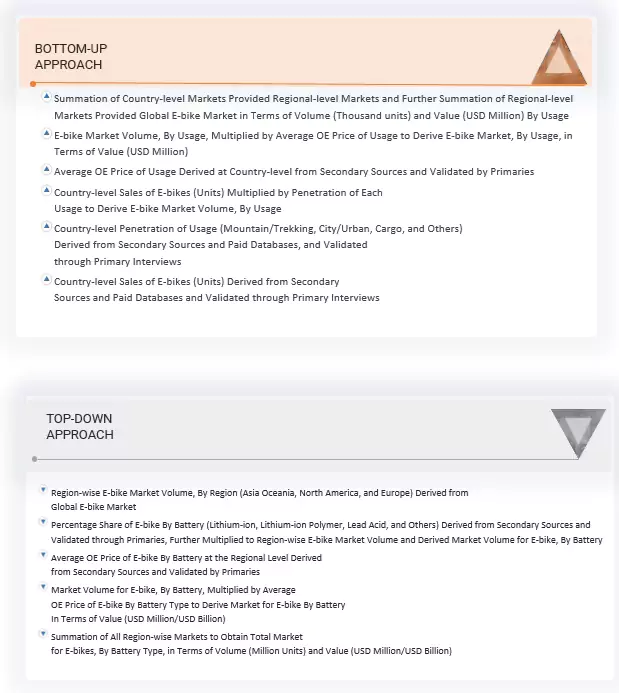
The bottom-up approach was used to derive the cargo e-bike market size based on volume and value. This was followed by primary interviews and feature mapping on a regional basis from the MarketsandMarkets repository.
The market size was validated through in-depth interviews with industry experts—excerpts available in the discussion guide in the appendix—and secondary research. The report-writing phase began after arriving at the final numbers for the market size.
By estimating the regional market size for cargo e-bikes by battery type, the global market was derived in terms of volume. The percentage share of cargo e-bikes by battery type (lithium-ion, lithium-ion polymer, lead-acid, and others) was derived from secondary sources and validated through primary sources. It was multiplied by the region-wise market volume. The market volume for cargo e-bikes, by battery type, was derived from this. The average OE price of an cargo e-bike by battery type at the regional level was derived from secondary sources, and primary sources validated the same. The market volume for cargo e-bikes, by battery type, was multiplied by the average OE price of cargo e-bikes. The market for cargo e-bikes by battery type was derived in terms of value (USD million). All region-wise markets were summed to obtain the total market for cargo e-bikes by battery type in terms of volume (thousand units) and value (USD million).
A similar approach was followed to obtain the market by motor type, mode, component, and speed.
Market Size Estimation Methodology-Bottom-up approach
The bottom-up approach was used to estimate and validate the size of the cargo e-bike market by usage. Country-level cargo e-bike sales (in terms of volume) were derived from secondary sources such as country-wise manufacturing associations. They paid for databases and validated them through primary interviews to determine the size of the market by class and usage in terms of volume. Country-level penetration by usage type (mountain/trekking bikes, city/urban, cargo, and others) was derived from secondary sources and paid databases and validated through primary interviews.
The market was then forecasted based on various parameters such as analysis of the historical data, market trends, and growth drivers such as increasing bike sales, an increase in infrastructural development activities, economic conditions, and government incentives and subsidies. Technological advancements in cargo e-bike motors, emerging market opportunities, and competitive landscape assessments were also considered to arrive at the country-wise forecast of the cargo e-bikes by usage.
The country-level cargo e-bike sales (by volume) were multiplied by the penetration of each usage type. The cargo e-bike market volume, by usage type, was derived through this. The average OE price by usage type was derived from secondary sources, and primary sources validated the same. The market volume, by usage, was multiplied by the average OE usage price. The market, by usage type, in terms of value (USD million), was derived through this. The summation of country-level markets provided the regional-level market. Further summation of the regional-level markets provided the global market in terms of volume (thousand units) and value (USD million) by usage.
Cargo E-bike Market : Top-Down and Bottom-Up Approach
Data Triangulation
All percentage shares, splits, and breakdowns were determined using secondary sources and verified through primary sources. All parameters expected to affect the markets covered in this research study were accounted for, viewed in extensive detail, verified through primary research, and analyzed to obtain the final quantitative and qualitative data. This data was consolidated, supplemented with detailed inputs and analysis from MarketsandMarkets, and presented in the report.
Market Definition
An cargo e-bike is a bicycle with a small electric motor and a rechargeable battery to assist the power provided by the rider. The batteries can be recharged by connecting them to a plug. A typical cargo e-bike needs 6 to 8 hours to charge the battery and has a range of 35 to 50 km at a speed of about 20 km/h.
Stakeholders
- Cargo E-bike manufacturers
- Cargo E-bike battery & motor manufacturers
- Component suppliers for cargo e-bikes
- Raw material suppliers for cargo e-bikes
- Country-level associations
- Traders, distributors, and suppliers of cargo e-bikes
Report Objectives
-
To define, describe, and forecast the size of the global cargo e-bike market in terms of value (USD million) and volume (thousand units)
- By Class (Class-I, Class-II, Class-III) at the regional level
- By Speed (up to 25 km/h, 25-45 km/h) at the regional level
- By Battery Type (Lithium-ion, Lithium-ion Polymer, Lead Acid, and Others) at the regional level
- By Motor Type (Hub and Mid) at the regional level
- By Mode (Pedal Assist and Throttle) at the regional level
- By Component (Batteries, Electric Motors, Frames With Forks, Wheels, Crank Gears, Brake Systems, and Motor Controller) at the regional level
- By Usage (Mountain/Trekking, City/Urban, Cargo, and Others) at the regional level
- By Ownership (Shared and Personal)
- By Battery Capacity (<250W, >250 & <450W, >450 & <650W, and >650W)
- By Motor Weight (<2 kg, >2 kg & <2.4 kg, >2.4 kg)
- By Motor Power (<40nm, >40nm-<70nm, >70nm)
- Country-level analysis of class-wise and usage-wise segments (Asia Oceania, Europe, and North America)
- To understand the dynamics (drivers, restraints, opportunities, and challenges) of the market
- To strategically analyze the market with trade analysis, pricing analysis, recession impact, case study analysis, patent analysis, technology analysis, regulatory analysis, key conferences and events, bill of material, the total cost of ownership, pricing analysis trends/disruptions impacting buyers, financial matrix, investment, and funding case scenario
- To analyze the competitive landscape of the global players in the market, along with their market share/ranking
- To analyze the competitive leadership mapping of the global and regional cargo e-bike manufacturers and cargo e-bike component suppliers in the market
- To analyze a detailed listing of OEMs and their brands, OEM-wise technical specifications, mergers & acquisitions, partnerships, collaborations, expansions, and new product launches/developments undertaken by critical participants in the market
Available Customizations
Along with the market data, MarketsandMarkets offers customizations per company-specific needs. The following customization options are available for the report:
BY DESIGN
- Foldable
- Unfoldable
BY FRAME MATERIAL
- Carbon Fiber
- Carbon Steel
- Aluminum
- Aluminum Alloy
⚡ Growth Signals
Personalize This Research
- Triangulate with your Own Data
- Get Data as per your Format and Definition
- Gain a Deeper Dive on a Specific Application, Geography, Customer or Competitor
- Any level of Personalization
Let Us Help You
- What are the Known and Unknown Adjacencies Impacting the Cargo E-Bike Market
- What will your New Revenue Sources be?
- Who will be your Top Customer; what will make them switch?
- Defend your Market Share or Win Competitors
- Get a Scorecard for Target Partners


JIM NAAS
PRODUCT DIRECTOR, WEASLER
Weasler Engineering, a CentroMotion organization
Global Provider of Industrial Actuation & Control Solutions
Our organization was interested in learning more about the attractiveness of a particular market space. We contacted MarketsandMarkets to help us based on previous positive experiences we had with them. The results did not disappoint! We discussed our objectives with them, and the team at MarketsandMarkets developed and executed a proposal that met our needs precisely. We were very impressed by their level of expertise, the quality of the analysis and their insightful recommendations. We would not hesitate in working with them again in the future.

Matt Kardel,
Vice President
Aptiv,
A global technology company that develops safer, greener and more connected solutions.
We contracted with MarketsandMarkets to evaluate the value chain and potential go-to-market partners related to our interest in the Fleet Management space. The team successfully completed the work on time and at the pricing agreed. MarketsandMarkets listened and understood our objectives and collaborated well with us to help us get the visibility we needed to make an investment.
We have subsequently used MarketsandMarkets again related to Smart Cities to good results.
What the Cargo E-Bike Report Didn't Show You?
Explore the strategic intelligence behind the Cargo E-Bike Market
- 🏆 Competitors
- 🎯 Opportunities
- 📈 Growth Signals
Generate 15+ consulting-grade insights instantly
Powered by 17 years of MarketsandMarkets intelligence
