








- DESCRIPTION
- TABLE OF CONTENTS
- METHODOLOGY
- Download FREE Sample
Knowledge Graph Market by Solution (Enterprise Knowledge Graph Platform, Graph Database Engine, Knowledge Management Toolset), Model Type (Resource Description Framework (RDF) Triple Stores, Labeled Property Graph) - Global Forecast to 2032

USD 9.88 BN
MARKET SIZE, 2032

CAGR 31.6%
(2026-2032)

309
REPORT PAGES

350
MARKET TABLES
OVERVIEW
Source: Secondary Research, Interviews with Experts, MarketsandMarkets Analysis
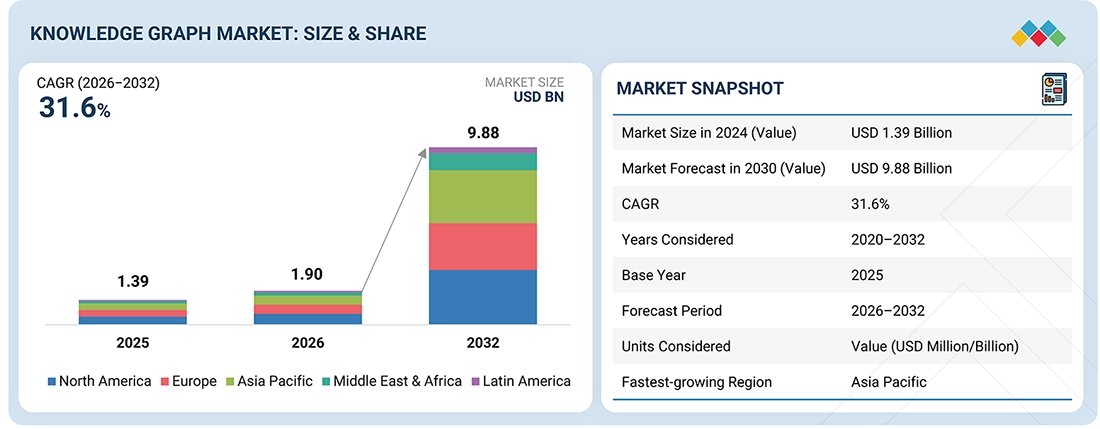
The global knowledge graph market is estimated to grow from USD 1.90 billion in 2026 to USD 9.88 billion by 2032, registering a CAGR of 31.6% during the forecast period. The market is driven by the growing need to manage highly interconnected data across enterprise environments. Organizations are increasingly dealing with large volumes of structured and unstructured data generated from multiple systems, making it difficult to derive meaningful insights using traditional approaches. This has led to the adoption of knowledge graph technologies that enable the representation of data as relationships, improving visibility and context across datasets.
KEY TAKEAWAYS
-
By Offering
The services segment is projected to register the highest CAGR of 32.5%.
-
By Application
The data analytics and business intelligence segment is estimated to account for a 25.3% share in 2026.
-
By Vertical
The BFSI segment is projected to dominate the market.
-
By Region
The Asia Pacific region is projected to grow the fastest from 2026 to 2032.
-
Competitive Landscape - Key Players
Companies such as Committee for Children, EVERFI, Panorama Education, and Nearpod were identified as some of the star players in the knowledge graph market, given their strong market share and product footprint.
-
Competitive Landscape - Startups/SMEs
Companies such as Wayfinder, Everyday Speech, and Taproot Learning were identified as some of the star players in the knowledge graph market, given their strong market share and product footprint.
Enterprises are deploying knowledge graph platforms to unify data, support semantic search, and enable advanced analytics across business functions. These platforms allow organizations to access and analyze data in real time, reducing dependency on manual data processing and improving decision accuracy. As digital transformation initiatives accelerate and the demand for AI-driven applications increases, knowledge graphs are becoming an essential component of modern data architectures, supporting scalability, interoperability, and continuous insight generation across industries.
TRENDS & DISRUPTIONS IMPACTING CUSTOMERS' CUSTOMERS
The knowledge graph market is evolving from standalone graph database deployments to integrated, AI-driven data platforms. Earlier use cases focused on static data integration, while current approaches emphasize real-time insights, unified data, and explainable AI. This shift is moving value from one-time implementations to continuous, outcome-driven analytics, such as faster discovery and improved decision-making. Knowledge graphs are now being embedded within broader enterprise architectures like data fabric and semantic layers. As a result, they are becoming a core component of digital transformation and connected data ecosystems.

Source: Secondary Research, Interviews with Experts, MarketsandMarkets Analysis
MARKET DYNAMICS

Drivers
Impact
Level
-
Increasing adoption of knowledge graphs as grounding layer for generative AI and LLMs

-
Growing demand for semantic search and contextual information retrieval


RESTRAINTS
Impact
Level
-
Data quality and integration complexity across heterogeneous data sources

-
High implementation complexity and challenges in scaling from pilot to enterprise deployment


OPPORTUNITIES
Impact
Level
-
Increasing demand for data unification and semantic interoperability

-
AI governance and compliance-driven adoption


CHALLENGES
Impact
Level
-
Standardization and interoperability

-
Difficulty in demonstrating ROI across multiple use cases

Source: Secondary Research, Interviews with Experts, MarketsandMarkets Analysis
The rapid advancement of generative AI and large language models (LLMs) is significantly accelerating the adoption of knowledge graphs as a foundational data layer. While LLMs enable advanced natural language understanding and content generation, they often lack contextual accuracy and may produce unreliable or hallucinated outputs when operating on unstructured data alone. Knowledge graphs address this limitation by embedding structured relationships, domain-specific context, and factual grounding into AI workflows. This enables more accurate, explainable, and context-aware responses across enterprise applications. Emerging architectures such as graph-based retrieval-augmented generation (GraphRAG) further enhance this capability by enabling multi-hop reasoning and deeper contextual retrieval. As organizations increasingly deploy AI across customer engagement, search, and decision intelligence use cases, the need for reliable and interpretable outputs is becoming critical. Consequently, knowledge graphs are evolving from niche data tools into essential components of enterprise AI infrastructure, supporting scalable, trustworthy, and production-grade AI deployments.
Data quality and integration challenges remain a significant restraint in the knowledge graph market. Constructing accurate and reliable knowledge graphs requires integrating data from multiple heterogeneous sources, including structured databases, unstructured documents, and real-time data streams. This process involves complex steps such as data extraction, entity resolution, relationship mapping, and quality validation. Inconsistent data formats, incomplete datasets, and semantic discrepancies can lead to inaccuracies in the graph structure, which may propagate across applications and impact decision-making outcomes. Additionally, maintaining data quality over time requires continuous updates, monitoring, and governance, increasing operational complexity. Organizations must invest in robust data management frameworks and validation processes to ensure the effectiveness of knowledge graphs. Without addressing these challenges, enterprises may struggle to fully leverage the benefits of knowledge graph technologies, limiting their adoption and scalability across large-scale deployments.
The growing need to unify fragmented data across organizations is driving demand for knowledge graph solutions. Enterprises today operate in complex data environments where information is distributed across multiple systems, formats, and domains. This fragmentation limits the ability to derive meaningful insights and hinders decision-making processes. Knowledge graphs address this challenge by creating a semantic layer that connects diverse datasets and enables interoperability across systems. By establishing relationships between data entities, they provide a unified and context-rich view of information. This capability is particularly valuable for advanced analytics, AI applications, and cross-functional collaboration. As organizations continue to prioritize data-driven strategies, the demand for solutions that can integrate and harmonize data across silos is expected to grow. Knowledge graphs are well-positioned to meet this need, driving their adoption across industries.
Standardization and interoperability continue to pose significant challenges in the knowledge graph market. The lack of common standards for data modeling, ontology development, and query languages leads to inconsistencies across platforms. This makes it difficult for organizations to integrate knowledge graphs with existing systems and share data across different environments. Additionally, varying data formats and semantic structures further complicate interoperability. Without standardized approaches, organizations may face challenges in scaling their knowledge graph initiatives and ensuring compatibility across applications. Addressing these challenges will require industry-wide collaboration to develop common frameworks and protocols. Improved standardization will enhance data sharing, reduce integration complexity, and support the broader adoption of knowledge graph technologies.
KNOWLEDGE GRAPH MARKET: COMMERCIAL USE CASES ACROSS INDUSTRIES
| COMPANY | USE CASE DESCRIPTION | BENEFITS |
|---|---|---|
|
|
Neo4j supported UBS in implementing a knowledge graph platform to enhance fraud detection and customer data analysis. The solution connected transaction data, customer profiles, and behavioral patterns, enabling real-time detection of suspicious activities and improved risk assessment across financial operations. | Reduced fraud risk | Real-time anomaly detection | Improved customer insights | Enhanced regulatory compliance |
|
|
TigerGraph collaborated with Intuit to develop a knowledge graph-based fraud detection system for its financial services platform. The implementation enabled the integration of large-scale transactional and user data, allowing faster identification of fraud patterns and improving decision-making accuracy. | Faster fraud detection | Scalable data processing | Improved decision accuracy | Reduced financial loss |
|
|
AWS supported Zalando by implementing a knowledge graph using Amazon Neptune to power product recommendations and personalization. The system connected product data, user behavior, and inventory information to deliver more accurate and context-aware recommendations. | Improved recommendation accuracy | Enhanced customer experience | Increased conversion rates | Scalable infrastructure |


Logos and trademarks shown above are the property of their respective owners. Their use here is for informational and illustrative purposes only.
MARKET ECOSYSTEM
The knowledge graph ecosystem consists of technology providers, data providers, solution and service providers, and regulatory bodies. Technology providers such as Neo4j, AWS, Oracle, and SAP offer core platforms for building and managing graph-based systems, while data providers like Google and DBpedia supply structured datasets for knowledge graph development. Solution and service providers, including IBM, Microsoft, Ontotext, and TigerGraph, support enterprise deployment and integration across industries. Regulatory bodies such as IEEE, NIST, and data protection authorities establish standards for governance, interoperability, and security, ensuring reliable adoption of knowledge graph technologies.

Logos and trademarks shown above are the property of their respective owners. Their use here is for informational and illustrative purposes only.
MARKET SEGMENTS

Source: Secondary Research, Interviews with Experts, MarketsandMarkets Analysis
Graph database engines form the core foundation of knowledge graph deployments, enabling efficient storage, management, and querying of highly connected data. Unlike traditional relational databases, graph databases are designed to represent relationships directly, allowing organizations to analyze complex data structures with greater speed and flexibility. This makes them particularly valuable for applications such as fraud detection, recommendation systems, network analysis, and customer intelligence. Enterprises are increasingly adopting graph database engines to support real-time analytics and handle large volumes of interconnected data across multiple sources. In addition, the ability of these engines to integrate with AI and machine learning frameworks further enhances their role in advanced analytics and decision-making. As organizations continue to prioritize data-driven strategies and scalable architectures, the demand for graph database engines is expected to remain strong, supporting their leading position within the knowledge graph solutions segment.
Knowledge graphs play a significant role in enhancing data analytics and business intelligence by enabling organizations to connect and analyze data from multiple sources in a unified manner. Unlike traditional systems, knowledge graphs provide contextual relationships between data points, allowing for more accurate and meaningful insights. This capability helps businesses perform advanced analytics, uncover hidden patterns, and improve reporting efficiency. Organizations across industries such as BFSI, retail, and healthcare are increasingly integrating knowledge graphs with BI tools to support real-time analytics and decision-making. Additionally, knowledge graphs enhance data enrichment by linking internal and external datasets, providing a more comprehensive view of business operations. As enterprises continue to focus on data-driven strategies, the demand for knowledge graph-enabled analytics and business intelligence solutions is expected to grow significantly.
The manufacturing and automotive sector is increasingly adopting knowledge graph technologies to improve operational efficiency and manage complex data environments. Knowledge graphs enable organizations to integrate data from production systems, supply chains, and IoT devices, providing a connected view of operations. This helps manufacturers enhance predictive maintenance by identifying relationships between equipment performance and failure patterns. In addition, knowledge graphs support supply chain optimization by improving visibility across suppliers, inventory, and logistics networks. Automotive companies are also leveraging these technologies for product lifecycle management, quality control, and intelligent design processes. The ability to connect engineering, production, and customer data enables faster decision-making and innovation. As the industry continues to adopt digital transformation and Industry 4.0 initiatives, the use of knowledge graphs is expected to increase rapidly, driving growth in this segment.
REGION
Asia Pacific to be fastest-growing region in global knowledge graph market during forecast period
Asia Pacific is estimated to see continued growth in knowledge graph adoption during the forecast period. The knowledge graph landscape in Asia Pacific is advancing through a range of cross-sector initiatives aimed at improving data integration and semantic capabilities across industries. Governments and public institutions are increasingly adopting linked data frameworks to unify large and diverse datasets. In early 2026, the National Library Board (NLB), Singapore, implemented the Infopedia Widget using a Linked Data–based semantic knowledge graph to integrate heritage and archival resources. This initiative enables improved data discovery, interoperability, and access to structured knowledge across platforms. In Australia, the HydroKG project has progressed by integrating with the National Water Grid, combining datasets such as GeoFabric and HydroATLAS. This development supports precision water management, environmental monitoring, and flood modeling applications. Research institutions and public agencies are actively contributing to such projects, highlighting the growing importance of knowledge graphs in managing critical data infrastructure. These initiatives demonstrate a strong regional focus on leveraging semantic technologies to improve data quality and accessibility.

KNOWLEDGE GRAPH MARKET: COMPANY EVALUATION MATRIX
In the knowledge graph market matrix, Neo4j (Star) holds a leading position, supported by its strong graph database platform, extensive enterprise adoption, and well-established ecosystem for managing and analyzing connected data. Altair (Emerging Leader) is expanding its presence through its data analytics and graph capabilities, including Altair Graph Studio and RapidMiner, showing potential to move upward as demand grows for integrated data intelligence and AI-driven analytics solutions.

Source: Secondary Research, Interviews with Experts, MarketsandMarkets Analysis
KEY MARKET PLAYERS
- Neo4j (US)
- TigerGraph (US)
- Stardog (US)
- Progress Software (US)
- Oracle (US)
- IBM Corporation (US)
- Microsoft Corporation (US)
- AWS (US)
- Franz Inc (US)
- OpenLink Software (US)
- Graphwise (US)
- Altair (US)
- ArangoDB (US)
- Fluree (US)
- Memgraph (UK)
- FactNexus (Australia)
- Metaphacts (Germany)
- RelationalAI (US)
- WiseCube (US)
- Smabbler (Poland)
- Onlim (Austria)
- GraphAware (UK)
- Diffbot (US)
- eccenca (Germany)
- ESRI (US)
- Datavid (UK)
- SAP (Germany)
MARKET SCOPE
| REPORT METRIC | DETAILS |
|---|---|
| Market Size in 2025 (Value) | USD 1.39 Billion |
| Market Forecast in 2030 (Value) | USD 9.88 Billion |
| Growth Rate | CAGR of 31.6% from 2026–2032 |
| Years Considered | 2020–2032 |
| Base Year | 2025 |
| Forecast Period | 2026–2032 |
| Units Considered | Value (USD Million/Billion) |
| Report Coverage | Revenue forecast, company ranking, competitive landscape, growth factors, and trends |
| Segments Covered |
|
| Regions Covered | North America, Europe, Asia Pacific, Middle East & Africa, Latin America |
WHAT IS IN IT FOR YOU: KNOWLEDGE GRAPH MARKET REPORT CONTENT GUIDE

DELIVERED CUSTOMIZATIONS
We have successfully delivered the following deep-dive customizations:
| CLIENT REQUEST | CUSTOMIZATION DELIVERED | VALUE ADDS |
|---|---|---|
| Leading Service Provider (US) | Regional Analysis: • Further breakdown of the North American knowledge graph market • Further breakdown of the European knowledge graph market • Further breakdown of the Asia Pacific knowledge graph market • Further breakdown of the Middle Eastern & African knowledge graph market • Further breakdown of the Latin American knowledge graph market | • Identifies high-growth regional opportunities, enabling tailored market entry strategies. • Optimizes resource allocation and investment based on region-specific demand and trends. |
| Company Information | Detailed analysis and profiling of additional market players (up to five) | • Broadens competitive insights, helping clients make informed strategic and investment decisions • Reveals market gaps and opportunities, supporting differentiation and targeted growth initiatives |
RECENT DEVELOPMENTS
- March 2026 : Tech Mahindra collaborated with Microsoft to launch an ontology-driven agentic AI platform leveraging knowledge graphs and semantic models for real-time, explainable decision-making in telecom and enterprise use cases.
- November 2025 : Memgraph announced a new AI Graph Toolkit to help developers convert SQL and unstructured data into knowledge graphs for GraphRAG-based AI applications. The toolkit was designed to automate data transformation and enable up to 10x faster development of graph-powered AI solutions, making GraphRAG more accessible to non-graph users.
- August 2025 : AWS introduced Bring Your Own Knowledge Graph (BYOKG) support in Amazon Neptune for GraphRAG, enabling enterprises to directly connect existing knowledge graphs with generative AI workflows. This capability reduced the need for custom pipelines and improved accuracy and reasoning by leveraging structured graph data alongside vector search.
- April 2024 : Altair acquired Cambridge Semantics to enhance its data analytics and AI capabilities. This acquisition integrated Cambridge's graph-powered data fabric technology into Altair's RapidMiner platform, enabling the creation of comprehensive knowledge graphs that improve data management and support generative AI applications.
Table of Contents
 Exclusive indicates content/data unique to MarketsandMarkets and not available with any competitors.
TITLE
PAGE NO
1
INTRODUCTION
15
2
EXECUTIVE SUMMARY
3
PREMIUM INSIGHTS
4
MARKET OVERVIEW
4.1
MARKET DYNAMICS
4.1.1
DRIVERS
4.1.2
RESTRAINTS
4.1.3
OPPORTUNITIES
4.1.4
CHALLENGES
4.2
INTERCONNECTED MARKETS AND CROSS-SECTOR OPPORTUNITIES
4.3
STRATEGIC MOVES BY TIER-1/2/3 PLAYERS
5
INDUSTRY TRENDS
5.1
PORTER’S FIVE FORCES ANALYSIS
5.1.1
THREAT OF NEW ENTRANTS
5.1.2
THREAT OF SUBSTITUTES
5.1.3
BARGAINING POWER OF SUPPLIERS
5.1.4
BARGAINING POWER OF BUYERS
5.1.5
INTENSITY OF COMPETITIVE RIVALRY
5.2
MACROECONOMICS INDICATORS
5.2.1
INTRODUCTION
5.2.2
GDP TRENDS AND FORECAST
5.2.3
TRENDS IN KNOWLEDGE GRAPH INDUSTRY
5.3
VALUE/SUPPLY CHAIN ANALYSIS
5.4
ECOSYSTEM ANALYSIS
5.5
PRICING ANALYSIS
5.5.1
AVERAGE SELLING PRICE TREND OF KEY PLAYERS, BY SOLUTION,
5.5.2
AVERAGE SELLING PRICE TREND, BY SUBSCRIPTION-BASED KNOWLEDGE GRAPH SOFTWARE,
5.6
KEY CONFERENCES AND EVENTS, 2026–2027
5.7
TRENDS/DISRUPTIONS IMPACTING CUSTOMERS’ BUSINESS
5.8
INVESTMENT AND FUNDING SCENARIO
5.9
CASE STUDY ANALYSIS
5.10
IMPACT OF 2025 US TARIFF ON KNOWLEDGE GRAPH MARKET
5.10.1
KEY TARIFF RATES
5.10.2
PRICE IMPACT ANALYSIS
5.10.3
IMPACT ON END-USE INDUSTRIES
6
STRATEGIC DISRUPTIONS THROUGH TECHNOLOGY, PATENTS, DIGITAL, AND AI ADOPTION
6.1
KEY EMERGING TECHNOLOGIES
6.2
COMPLEMENTARY TECHNOLOGIES
6.3
TECHNOLOGY/PRODUCT ROADMAP
6.4
PATENT ANALYSIS
6.5
IMPACT OF AI/GEN AI ON KNOWLEDGE GRAPH MARKET
6.5.1
TOP USE CASES AND MARKET POTENTIAL
6.5.2
CASE STUDIES OF AI IMPLEMENTATION IN KNOWLEDGE GRAPH MARKET
6.5.3
INTERCONNECTED ADJACENT ECOSYSTEM AND IMPACT ON MARKET PLAYERS
6.5.4
CLIENTS’ READINESS TO ADOPT GENERATIVE AI IN KNOWLEDGE GRAPH
7
REGULATORY LANDSCAPE AND SUSTAINABILITY INITIATIVES
7.1
REGIONAL REGULATIONS AND COMPLIANCE
7.1.1
REGULATORY BODIES, GOVERNMENT AGENCIES, AND OTHER ORGANIZATIONS
7.1.2
INDUSTRY STANDARDS
7.2
SUSTAINABILITY INITIATIVES
7.3
IMPACT OF REGULATORY POLICIES ON SUSTAINABILITY INITIATIVES
8
CUSTOMER LANDSCAPE AND BUYER BEHAVIOR
8.1
DECISION-MAKING PROCESS
8.2
BUYER STAKEHOLDERS AND BUYING EVALUATION CRITERIA
8.3
ADOPTION BARRIERS AND INTERNAL CHALLENGES
8.4
UNMET NEEDS IN VARIOUS END-USE INDUSTRIES
9
KNOWLEDGE GRAPH MARKET, BY OFFERING
9.1
INTRODUCTION
9.2
SOLUTIONS
9.2.1
ENTERPRISE KNOWLEDGE GRAPH PLATFORMS
9.2.2
GRAPH DATABASE ENGINES
9.2.3
KNOWLEDGE MANAGEMENT TOOLSETS
9.3
SERVICES
9.3.1
PROFESSIONAL SERVICES
9.3.2
MANAGED SERVICES
10
KNOWLEDGE GRAPH MARKET, BY MODEL TYPE
10.1
INTRODUCTION
10.2
RESOURCE DESCRIPTION FRAMEWORK (RDF) GRAPH
10.3
LABELED PROPERTY GRAPH (LPG)
10.4
OTHER MODEL TYPES (HYPERGRAPH, SEMANTIC PROPERTY GRAPH)
11
KNOWLEDGE GRAPH MARKET, BY APPLICATION
11.1
INTRODUCTION
11.2
DATA GOVERNANCE AND MASTER DATA MANAGEMENT
11.3
DATA ANALYTICS AND BUSINESS INTELLIGENCE
11.4
KNOWLEDGE AND CONTENT MANAGEMENT
11.5
VIRTUAL ASSISTANTS, SELF-SERVICE DATA, AND DIGITAL ASSET DISCOVERY
11.6
PRODUCT AND CONFIGURATION MANAGEMENT
11.7
INFRASTRUCTURE AND ASSET MANAGEMENT
11.8
PROCESS OPTIMIZATION AND RESOURCE MANAGEMENT
11.9
RISK MANAGEMENT, COMPLIANCE, REGULATORY REPORTING
11.10
MARKET AND CUSTOMER INTELLIGENCE, SALES OPTIMIZATION
11.11
OTHER APPLICATIONS
12
KNOWLEDGE GRAPH MARKET, BY VERTICAL
12.1
INTRODUCTION
12.2
BANKING, FINANCIAL SERVICES, AND INSURANCE (BFSI)
12.3
RETAIL AND ECOMMERCE
12.4
HEALTHCARE, LIFE SCIENCES, AND PHARMACEUTICALS
12.5
TELECOM AND TECHNOLOGY
12.6
GOVERNMENT
12.7
MANUFACTURING AND AUTOMOTIVE
12.8
MEDIA AND ENTERTAINMENT
12.9
ENERGY, UTILITIES, AND INFRASTRUCTURE
12.10
TRAVEL AND HOSPITALITY
12.11
TRANSPORTATION AND LOGISTICS
12.12
OTHER VERTICALS
13
KNOWLEDGE GRAPH MARKET, BY REGION
13.1
INTRODUCTION
13.2
NORTH AMERICA
13.2.1
US
13.2.2
CANADA
13.3
EUROPE
13.3.1
UK
13.3.2
GERMANY
13.3.3
FRANCE
13.3.4
ITALY
13.3.5
SPAIN
13.3.6
REST OF EUROPE
13.4
ASIA PACIFIC
13.4.1
CHINA
13.4.2
JAPAN
13.4.3
INDIA
13.4.4
AUSTRALIA & NEW ZEALAND
13.4.5
SOUTH KOREA
13.4.6
REST OF ASIA PACIFIC
13.5
MIDDLE EAST AND AFRICA
13.5.1
UAE
13.5.2
KSA
13.5.3
SOUTH AFRICA
13.5.4
REST OF MIDDLE EAST AND AFRICA
13.6
LATIN AMERICA
13.6.1
BRAZIL
13.6.2
MEXICO
13.6.3
ARGENTINA
13.6.4
REST OF LATIN AMERICA
14
COMPETITIVE LANDSCAPE
14.1
OVERVIEW
14.2
KEY PLAYER STRATEGIES/RIGHT TO WIN
14.3
REVENUE ANALYSIS OF TOP FIVE PLAYERS, 2021–2025
14.4
MARKET SHARE ANALYSIS,
14.5
COMPANY VALUATION AND FINANCIAL METRICS
14.6
BRAND COMPARISON
14.7
COMPANY EVALUATION MATRIX: KEY PLAYERS,
14.7.1
STARS
14.7.2
EMERGING LEADERS
14.7.3
PERVASIVE PLAYERS
14.7.4
PARTICIPANTS
14.7.5
COMPANY FOOTPRINT: KEY PLAYERS,
14.7.5.1
COMPANY FOOTPRINT
14.7.5.2
OFFERING FOOTPRINT
14.7.5.3
MODEL TYPE FOOTPRINT
14.7.5.4
APPLICATION FOOTPRINT
14.7.5.5
VERTICAL FOOTPRINT
14.8
COMPANY EVALUATION MATRIX: STARTUPS/SMES,
14.8.1
PROGRESSIVE COMPANIES
14.8.2
RESPONSIVE COMPANIES
14.8.3
DYNAMIC COMPANIES
14.8.4
STARTING BLOCKS
14.8.5
COMPETITIVE BENCHMARKING: STARTUPS/SMES,
14.8.5.1
DETAILED LIST OF KEY STARTUPS/SMES
14.8.5.2
COMPETITIVE BENCHMARKING OF KEY STARTUPS/SMES
14.9
COMPETITIVE SITUATION AND TRENDS
14.9.1
PRODUCT LAUNCHES
14.9.2
DEALS
14.9.3
EXPANSIONS
15
KNOWLEDGE GRAPH MARKET, COMPANY PROFILES
15.1
KEY PLAYERS
15.1.1
IBM
15.1.2
MICROSOFT
15.1.3
AWS
15.1.4
NEO4J
15.1.5
TIGERGRAPH
15.1.6
SAP
15.1.7
ORACLE
15.1.8
STARDOG
15.1.9
GRAPHWISE
15.1.10
OPENLINK SOFTWARE
15.1.11
PROGRESS SOFTWARE
15.1.12
FRANZ INC.
15.1.13
ALTAIR
15.1.14
ESRI
15.2
12.3 STARTUPS/SMES
15.2.1
DATAVID
15.2.2
GRAPHBASE
15.2.3
CONVERSIGHT
15.2.4
ECCENA
15.2.5
ARANGODB
15.2.6
FLUREE
15.2.7
DIFFBOT
15.2.8
BITNINE
15.2.9
MEMGRAPH
15.2.10
GRAPHAWARE
15.2.11
ONLIM
15.2.12
SMABBLER
15.2.13
WISECUBE
15.2.14
RELATIONALAI
15.2.15
METAPHACTS
16
RESEARCH METHODOLOGY
16.1
RESEARCH DATA
16.1.1
SECONDARY DATA
16.1.1.1
KEY DATA FROM SECONDARY SOURCES
16.1.2
PRIMARY DATA
16.1.2.1
KEY DATA FROM PRIMARY SOURCES
16.1.2.2
KEY PRIMARY PARTICIPANTS
16.1.2.3
BREAKDOWN OF PRIMARY INTERVIEWS
16.1.2.4
KEY INDUSTRY INSIGHTS
16.2
MARKET SIZE ESTIMATION
16.2.1
BOTTOM-UP APPROACH
16.2.2
TOP-DOWN APPROACH
16.3
MARKET FORECAST APPROACH
16.3.1
SUPPLY SIDE
16.3.2
DEMAND SIDE
16.4
DATA TRIANGULATION
16.5
RESEARCH ASSUMPTIONS
16.6
RESEARCH LIMITATIONS AND RISK ASSESSMENT
17
APPENDIX
17.1
DISCUSSION GUIDE
17.2
KNOWLEDGE STORE: MARKETSANDMARKETS' SUBSCRIPTION PORTAL
17.3
AVAILABLE CUSTOMIZATIONS
17.4
RELATED REPORTS
17.5
AUTHOR DETAILS
Methodology
This research study involved the extensive use of secondary sources, directories, and databases, such as Dun & Bradstreet (D&B), Hoovers, and Bloomberg BusinessWeek, to identify and collect information useful for a technical, market-oriented, and commercial study of the Knowledge graph market. The primary sources have been mainly industry experts from the core and related industries and preferred suppliers, manufacturers, distributors, service providers, technology developers, alliances, and organizations related to all segments of the value chain of this market. In-depth interviews have been conducted with various primary respondents, including key industry participants, subject matter experts, C-level executives of key market players, and industry consultants, to obtain and verify critical qualitative and quantitative information.
Secondary Research
The market for companies offering knowledge graph solutions and services to different end users has been estimated and projected based on the secondary data made available through paid and unpaid sources, and by analyzing their product portfolios in the ecosystem of the knowledge graph market. In the secondary research process, various sources such as JAX Magazine, International Journal of Electrical and Computer Engineering (IJECE), and Frontiers have been referred to for identifying and collecting information for this study on the Knowledge graph market. The secondary sources included annual reports, press releases, investor presentations of companies, white papers, journals, certified publications, and articles by recognized authors, directories, and databases. Secondary research has been mainly used to obtain essential information about the supply chain of the market, the total pool of key players, market classification, segmentation according to industry trends to the bottommost level, regional markets, and key developments from both market- and technology-oriented perspectives that primary sources have further validated.
Primary Research
In the primary research process, various primary sources from both the supply and demand sides were interviewed to obtain qualitative and quantitative information on the market. The primary sources from the supply side included various industry experts, including Chief Experience Officers (CXOs); Vice Presidents (VPs); directors from business development, marketing, and product development/innovation teams; related critical executives from Knowledge graph service vendors, system Integrators, professional service providers, and industry associations; and key opinion leaders. Primary interviews were conducted to gather insights, such as market statistics, revenue data collected from services, market breakups, market size estimations, market forecasts, and data triangulation. Primary research also helped in understanding various trends related to technologies, applications, deployments, and regions. Stakeholders from the demand side, such as Chief Information Officers (CIOs), Chief Technology Officers (CTOs), Chief Strategy Officers (CSOs), and end users using knowledge graph services, were interviewed to understand the buyer’s perspective on suppliers, products, service providers, and their current usage of Knowledge graph services, which would impact the overall knowledge graph market.
BREAKDOWN OF PRIMARIES

Note: Others include sales managers, marketing managers, and product managers.
To know about the assumptions considered for the study, download the pdf brochure
Market Size Estimation
Multiple approaches were adopted to estimate and forecast the size of the knowledge graph market. The first approach involves estimating market size by summing up the revenue generated by companies through the sale of the knowledge graph solution and services.
Both top-down and bottom-up approaches were used to estimate and validate the total size of the Knowledge graph market. These methods were extensively used to estimate the size of various segments in the market. The research methodology used to estimate the market size includes the following:
- Key players in the market have been identified through extensive secondary research.
- In terms of value, the industry’s supply chain and market size have been determined through primary and secondary research processes.
- All percentage shares, splits, and breakups have been determined using secondary sources and verified through primary sources.
- After arriving at the overall market size, the knowledge graph market was divided into several segments and subsegments.

Data Triangulation
After arriving at the overall market size, the knowledge graph market was divided into several segments and subsegments.
The data was triangulated by studying various factors and trends from the demand and supply sides. Along with data triangulation and market breakdown, the market size was validated by the top-down and bottom-up approaches.
Market Definition
A knowledge graph is a type of database designed to store, query, and manage data in the form of nodes, edges, and properties. Nodes represent entities, edges capture relationships between them, and properties provide additional details. This structure enables efficient analysis of complex, interconnected data. It is widely used in scenarios like social networks, recommendation systems, and fraud detection.
Key Stakeholders
- Solution providers
- Technology vendors
- Enterprise buyers
- System integrators
- Consulting firms and sis
- Open-source communities
- Regulatory bodies
- Industry alliances
Report Objectives
- To determine, segment, and forecast the knowledge graph market based on offerings, type, application, vertical, and region in terms of value
- To forecast the size of the market segments with respect to five main regions: North America, Europe, Asia Pacific, the Middle East & Africa, and Latin America
- To provide detailed information about the major factors (drivers, restraints, opportunities, and challenges) influencing the growth of the market
- To study the complete value chain and related industry segments, and perform a value chain analysis of the market landscape
- To strategically analyze the macro and micromarkets with respect to individual growth trends, prospects, and contributions to the total market
- To analyze the industry trends, pricing data, patents, and innovations related to the market
- To analyze the opportunities for stakeholders by identifying the high-growth segments of the market
- To profile the key players in the market and comprehensively analyze their market share/ranking and core competencies
- To track and analyze competitive developments, such as mergers & acquisitions, product launches & developments, partnerships, agreements, collaborations, business expansions, and R&D activities.
Available customizations:
With the given market data, MarketsandMarkets offers customizations as per the company’s specific needs. The following customization options are available for the report:
- Country-wise information
- Analysis for additional countries (up to five)
Company Information
- Detailed analysis and profiling of additional market players (up to five)
Key Questions Addressed by the Report
Tariff pressures have led enterprises to rethink their cross-border data operations, pushing for more localized data ecosystems. This shift has intensified the demand for flexible knowledge graph architectures that can operate efficiently across fragmented infrastructures, with enhanced interoperability to manage diverse regulatory environments.
There are various opportunities in the knowledge graph market, such as data unification, rapid proliferation of knowledge graphs, and increasing adoption in healthcare and life sciences.
A knowledge graph is a structured representation of interconnected data, where entities (such as people, places, concepts, or objects) are linked through relationships, forming a network of knowledge. It uses a graph structure with nodes (representing entities) and edges (representing relationships between them) to organize and represent complex information. Knowledge graphs enable advanced data querying, semantic search, and analytics by providing a way to model real-world knowledge and their interdependencies. The value of a knowledge graph lies in its ability to integrate principles, data, and relationships to uncover new knowledge and actionable insights for users or businesses. Its design is well-suited for various use cases, such as real-time applications, search and discovery, and grounding generative AI for effective question-answering. It comprises solutions such as enterprise knowledge graph platform, knowledge graph engine, and knowledge management toolset.
North America region will acquire the largest share of the knowledge graph market during the forecast period.
The knowledge graph market is estimated to be worth USD 1,068.4 million in 2024 and is projected to reach USD 6,938.4 million by 2030, at a CAGR of 36.6% during the same period.
The key market players profiled in the Knowledge Graph market are IBM Corporation (US), Oracle (US), Microsoft Corporation (US), AWS (US), Neo4j (US), Progress Software (US), TigerGraph (US), Stardog (US), Franz Inc (US), Openlink Software (US), Graphwise (US), Altair (US), Bitnine ( South Korea), ArangoDB (US), Fluree (US), Memgraph (UK), GraphBase (Australia), Metaphacts (Germany), RelationalAI (US), Wisecube (US), Smabbler (Poland), Onlim (Austria), Graphaware (UK), Diffbot (US), Eccenca (Germany), Conversight (US), ESRI (US).
The key technology trends in the knowledge graph market include semantic web technologies, gen AI and NLP, and graph databases.
⚡ Growth Signals
Personalize This Research
- Triangulate with your Own Data
- Get Data as per your Format and Definition
- Gain a Deeper Dive on a Specific Application, Geography, Customer or Competitor
- Any level of Personalization
Let Us Help You
- What are the Known and Unknown Adjacencies Impacting the Knowledge Graph Market
- What will your New Revenue Sources be?
- Who will be your Top Customer; what will make them switch?
- Defend your Market Share or Win Competitors
- Get a Scorecard for Target Partners

Leading IT Company in US
The research and discussions with the MarketsandMarkets team were insightful and influential towards driving our team's strategic direction. After engaging with the analyst team, we were able to have focused use cases, a targeted market segment, and strategic partners to consider as part of our GTM. The insights shared by MarketsandMarkets captured some useful information that we could leverage to develop our point of view for the next steps. The market reports were a great start for the project, but the analyst hours made a rough diamond turn into a polished gem of a project

Still Researching the
Knowledge Graph Ecosystem?
See the competitors, opportunity evaluation, and growth signals shaping it - Instantly!
Generate 15+ consulting-grade strategic intelligence outputs - from competitor analysis to board-ready strategy decks, tailored to your Knowledge Graph growth question.
