









- DESCRIPTION
- TABLE OF CONTENTS
- METHODOLOGY
- DOWNLOAD PDF
Digital Twins in Healthcare Market By Component (Software, Services), Application (Personalized Medicine, Drug Discovery, Medical Education, Workflow Optimization), End User (Providers, Research & Academia, Payers), and Region - Global Forecast to 2031

USD 101.19 BN
MARKET SIZE, 2031

CAGR 68.4%
(2026-2031)

400
REPORT PAGES

350
MARKET TABLES
DIGITAL TWINS IN HEALTHCARE MARKET SIZE, SHARE & GROWTH SNAPSHOT
Source: Secondary Research, Interviews with Experts, MarketsandMarkets Analysis
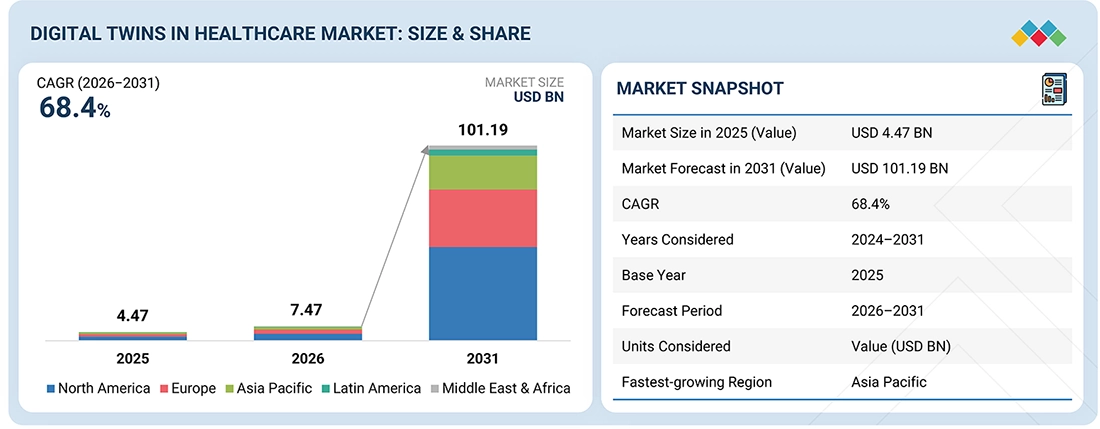
The global digital twins in healthcare market is projected to grow from USD 7.47 billion in 2026 to USD 101.19 billion by 2031, at a CAGR of 68.4% during the forecast period. The market was valued at USD 4.47 billion in 2025. The demand for digital twins in the pharma and healthcare sector is anticipated to increase owing to their application in clinical studies, hospitals, and personal medicine. Developments in simulations based on AI/ML algorithms, real-time data, cloud computing, and IoT technology have resulted in more accurate digital twins. The use of digital twins helps in the virtual replication of patients, organs, and entire healthcare facilities for better planning and prediction of disease progressions. Additionally, there is a rising emphasis on virtual clinical trials, predictions, and simulations, which are driving the usage of digital twins in healthcare.
KEY TAKEAWAYS
-
By Region
By region, North America accounted for the largest share of 48.2% of the global digital twins in healthcare market in 2025.
-
By Component
In 2025, by component, the software segment accounted for the largest share of 58.1% of the digital twins in healthcare market.
-
By Application
The Personalized medicine segment accounted for the largest share of the digital twins in healthcare market in 2025.
-
By Type
By type, the body part twins segment is projected to register the fastest growth of 69.0% in the global digital twins in healthcare market.
-
By End User
By end user, the providers segment accounted for the largest share of the digital twins in healthcare market in 2025.
-
Competitive Landscape - Key Players
Siemens Healthineers AG (Germany), Dassault Systemes (France), and Microsoft Corporation (US) were identified as some of the star players in the digital twins in healthcare market (global), given their strong market share and product footprint.
-
Competitive Landscape - Startups/SMEs
PrediSurge (France), Qbio (US), Virtonomy GmbH (Germany), and Sim and Cure (France) have distinguished themselves among startups and SMEs by securing strong footholds in specialized niche areas, underscoring their potential as emerging market leaders.
The factors influencing the digital twins in healthcare market include the growing adoption of real-time and real-world data integration, increasing use of AI-driven simulation models and the rising focus on predictive, patient-centric care. Additionally, the shift toward virtual clinical trials and data-driven decision-making is accelerating the adoption of digital twin technologies across the healthcare and pharmaceutical sectors. However, challenges such as the lack of standardized validation frameworks for digital twin models, evolving regulatory guidelines and concerns related to data privacy and interoperability and model accuracy continue to impact market growth.
TRENDS & DISRUPTIONS IMPACTING CUSTOMERS' CUSTOMERS
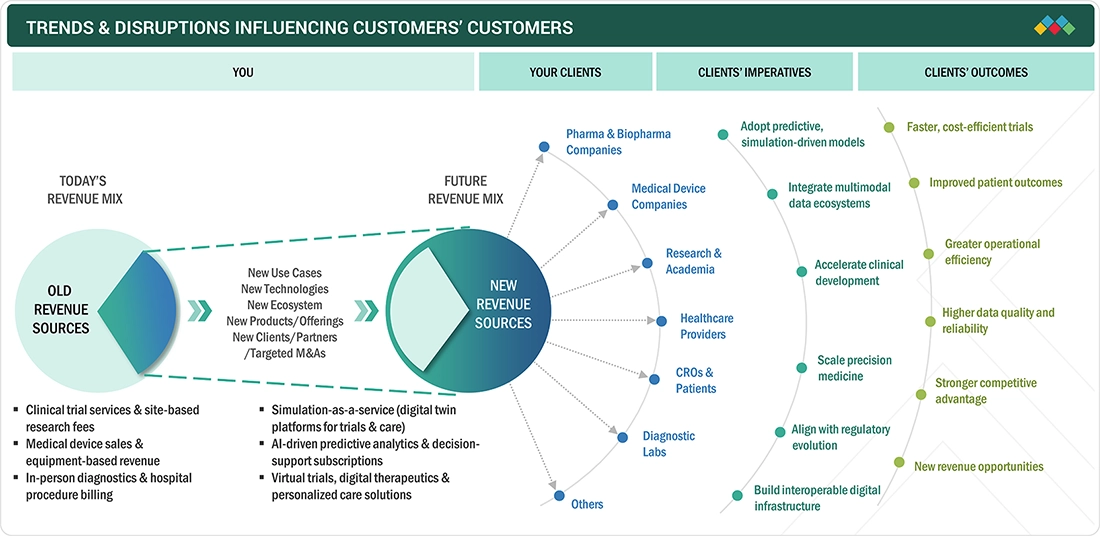
Real-time and simulation-based healthcare enabled by constant data input from electronic health records, medical imaging, and connected devices is emerging as a major trend in the digital twins in healthcare market. Increasing attention is being paid to patient-specific and organ-level digital twins for predicting disease progression, treatment effectiveness, and outcome in order to extend the scope of digital twins in healthcare from operational optimization to clinical decision-making and personalized medicine. Simultaneously, the rise of in-silico trials and other virtual patient cohorts is changing the landscape of therapy and drug development by integrating digital health approaches into research and creating an overlap between healthcare services and research. Finally, another trend associated with digital twins in healthcare is blurring of the boundaries between clinical practice, research, and various digital health platforms to create scalable solutions for healthcare systems. These trends create new challenges related to validation and acceptance of the models and the need for effective model management. Another important consideration associated with digital twins in healthcare concerns transparent algorithms, interoperability, and ownership of simulations.
Source: Secondary Research, Interviews with Experts, MarketsandMarkets Analysis
MARKET DYNAMICS

Drivers
Impact
Level
-
Increasing investments by public and private entities

-
Growing applications of digital twins


RESTRAINTS
Impact
Level
-
Managing data quality, privacy issues, and high implementation costs


OPPORTUNITIES
Impact
Level
-
Increasing focus on cutting-edge real-time data analytics

-
Growing importance of digital twins in emerging economies


CHALLENGES
Impact
Level
-
Integration with existing systems and outdated digital infrastructure

-
Lack of skilled professionals

Source: Secondary Research, Interviews with Experts, MarketsandMarkets Analysis
Digital twins are increasingly finding numerous uses within the healthcare industry due to a wide variety of reasons, which include improved outcomes, advancements in medical research, and optimized use of resources. Digital twins possess the capability of changing precision medicine because of improved diagnoses, effective treatments, and personalized care of patients through the technology. It captures extensive data regarding the physiology, genetics, medical history, behavior, and surroundings of the patients. Digital twins of patients keep on receiving real-time data from medical devices and wearable sensors. This is why healthcare professionals are able to track the progress of a patient in real time, even remotely. Digital twins collect data from sensors and devices and apply machine learning models in analyzing the collected data to make predictions concerning the health of the patients.
The digital twin model collects sensitive information for processing purposes, thus bringing about challenges concerning data quality and confidentiality. The data is collected from different platforms, such as electronic medical records, wearable devices, and other medical gadgets, and then incorporated into the digital twin system in an accurate and reliable way. Good data quality is essential since poor data leads to errors and a lack of reliability when developing the digital twin model. Another major challenge that might arise during digital twin implementation is data confidentiality. To address data confidentiality challenges, it is important to design strong data governance policies to guarantee the confidentiality, accuracy, and reliability of the data in the digital twin system. Digital twin models require expensive hardware, software, and data storage systems. This makes the implementation process rather costly.
Digital health is being embraced by emerging countries such as Japan, China, and Singapore. For instance, in 2022, Tohoku University and Fujitsu Limited embarked on creating digital twins for improving healthcare delivery. Takeda Pharmaceutical and PwC Consulting released a digital twin simulator for Crohn's disease in 2021, while Cisco began a venture to improve precision medicine through digital twins. Japan’s National Center for Neurology and Psychiatry has teamed up with NTT Corporation to come up with brain bio-digital twin technology that helps detect and prevent mental disorders. NT Corporation's project, which was started in 2020, is meant to create a map of a person’s brain, body, and mental status to give more information about their health status. SingHealth is also using digital twin technology in Singapore to predict disease outbreaks and optimize health resources. These developments are vital in promoting market growth in Japan.
The application and management of digital twin technology in healthcare demand the expertise of professionals skilled and knowledgeable in disciplines like data science, software development, and machine learning. Adopting new technology is never an easy task, especially when it comes to the healthcare industry. The problem becomes even more complicated because of the massive unstructured data stored by healthcare organizations. Failure to have many experts who can develop and implement digital twin technology may lead to several problems. Therefore, one solution to this problem involves investing in training and education of employees and partnering with universities to offer specialized programs on this technology.
DIGITAL TWINS IN HEALTHCARE MARKET: COMMERCIAL USE CASES ACROSS INDUSTRIES
| COMPANY | USE CASE DESCRIPTION | BENEFITS |
|---|---|---|
|
|
Development of patient-specific digital twins using Azure Digital Twins and AI to simulate disease progression and treatment outcomes. | Enables predictive care planning, accelerates clinical decision-making, and reduces trial-and-error in personalized therapy. |
|
|
Creation of digital twins of medical imaging systems and patient organs to optimize imaging workflows and simulate diagnostic outcomes. | Improves imaging precision, enhances equipment uptime through predictive maintenance, and supports virtual clinical training. |
|
|
Hospital digital twins built using Philips HealthSuite Platform to model and optimize hospital operations, patient flow, and resource allocation. | Increases operational efficiency, reduces patient wait times, and improves staff utilization through real-time simulation insights. |
|
|
“Virtual Human Twin” initiative under the 3DEXPERIENCE platform to model human organs and biological systems for drug and device testing. | Reduces R&D timelines, minimizes reliance on animal testing, and accelerates regulatory submissions through validated in-silico models. |
|
|
Cloud-based digital twin infrastructure integrating IoT, analytics, and AI via AWS IoT TwinMaker to monitor and optimize connected medical devices and facilities. | Enhances real-time monitoring, predictive maintenance, and compliance tracking, reducing downtime and operational costs. |





Logos and trademarks shown above are the property of their respective owners. Their use here is for informational and illustrative purposes only.
MARKET ECOSYSTEM
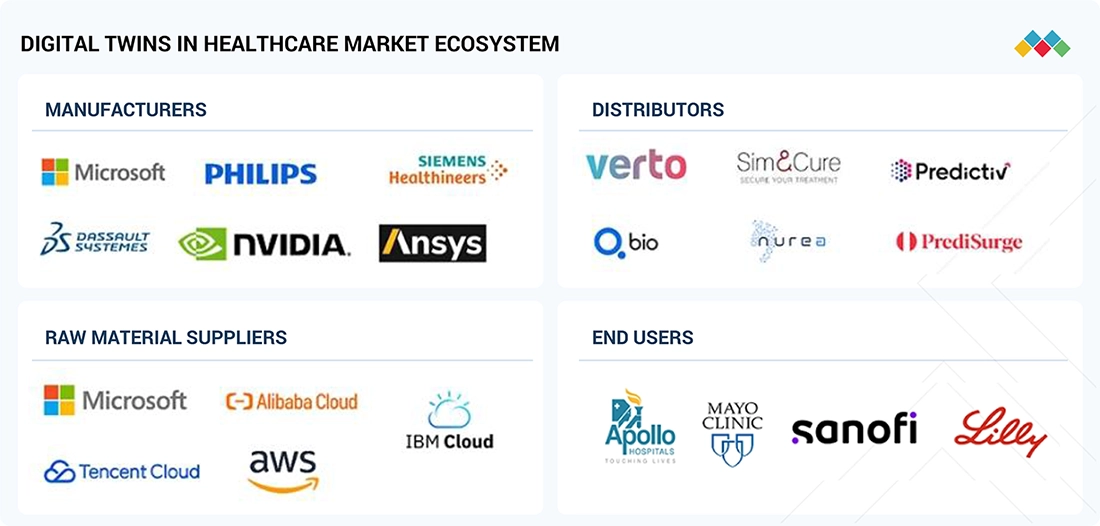
In terms of the market ecosystem of the digital twins in the healthcare industry, technology and platform providers include such companies as Microsoft Corporation, Amazon Web Services, and Dassault Systemes, whose products consist of cloud-based solutions for creating and maintaining digital twins infrastructure, simulation platforms, and AI-enabled modeling. Other technology players who contribute to digital twin technology development in the healthcare market are healthcare companies, such as Siemens Healthineers AG and Koninklijke Philips N.V., who are implementing digital twins in their products related to imaging, diagnostics, and hospital management. Data integration enablers, such as e-health record keeping services, medical image storage solutions, and IoT devices, provide information needed for creating digital twins in healthcare. Furthermore, cloud and analytics service providers, such as Google Cloud, ensure the availability of scalable computing resources needed for digital twin modeling in healthcare. Companies involved in pharmaceutical research, such as pharmaceutical and biotech companies, CROs, and research organizations, are using digital twins in healthcare for modeling disease and conducting clinical studies. Other participants of the ecosystem are regulatory authorities, such as FDA and EMA, who support modeling and simulation initiatives.
Logos and trademarks shown above are the property of their respective owners. Their use here is for informational and illustrative purposes only.
MARKET SEGMENTS
Source: Secondary Research, Interviews with Experts, MarketsandMarkets Analysis
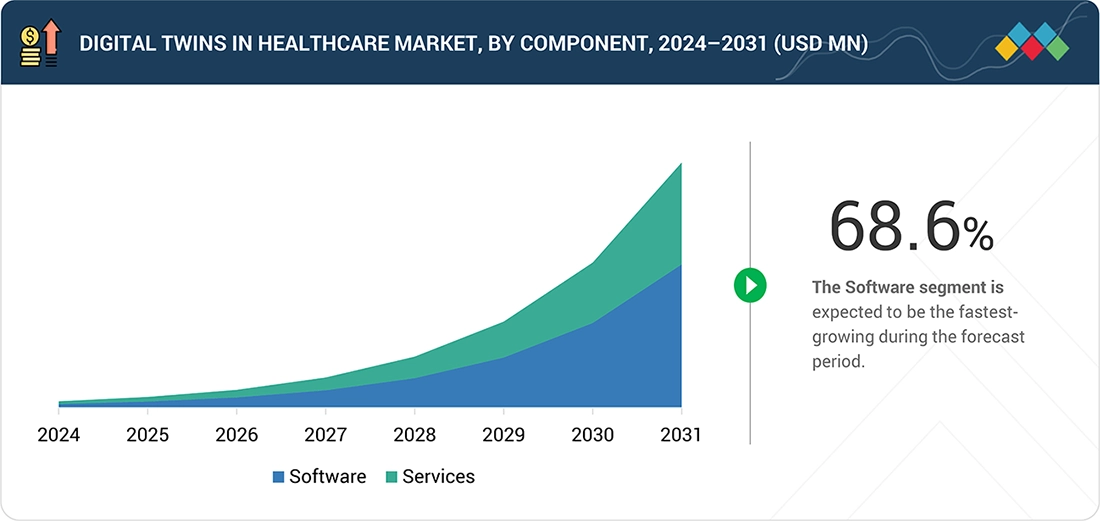
In 2025, the software segment held the largest share of the digital twins in healthcare market owing to the growing deployment of AI-based simulation platforms and cloud-integrated twin engines for patient-specific modeling, predictive diagnostics, and drug discovery. Software solutions enable seamless interoperability across EHR, imaging, and IoT data streams, empowering pharma firms, device manufacturers, and providers to simulate real-world scenarios and optimize outcomes across R&D, clinical trials, and personalized care workflows.
In 2025, process twins accounted for the largest share of the digital twins in healthcare market, driven by their extensive use in optimizing clinical workflows, manufacturing processes, and supply chain operations. Pharma and medtech companies increasingly deploy process twins to simulate production lines, predict maintenance needs, and enhance regulatory compliance. Healthcare providers also leverage them to streamline hospital operations, reduce downtime, and ensure consistent, data-driven decision-making across complex care environments.
In 2025, personalized medicine held the largest share of the digital twins in healthcare market by application. The dominance stems from the growing use of patient-specific digital replicas to simulate treatment responses, optimize therapy selection, and monitor disease progression in real time. Integration of genomic, clinical, and lifestyle data through AI-driven twin models enables precision diagnostics and tailored care pathways, improving patient outcomes and reducing trial-and-error in treatment planning.
In 2025, healthcare providers held the largest share of the digital twins in healthcare market by end user, primarily due to their increasing adoption of real-time patient modeling and predictive analytics to enhance clinical decision-making. Hospitals and health systems are deploying digital twin solutions to simulate patient-specific scenarios, optimize treatment pathways, and improve operational efficiency. The technology also supports personalized care planning, resource allocation, and proactive monitoring, ultimately improving patient outcomes and reducing care delivery costs.
REGION
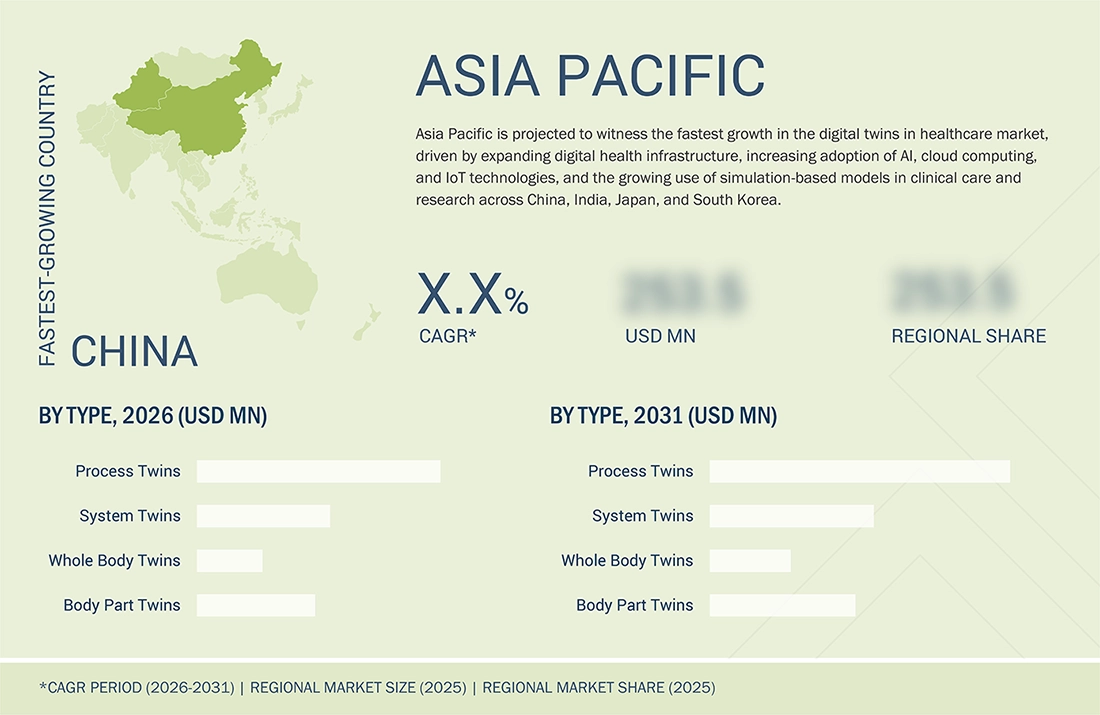
Asia Pacific to register highest CAGR in digital twins in healthcare market during forecast period (2026–2031)
The Asia Pacific market is expected to register the fastest growth in the digital twins in healthcare market during the forecast period, driven by increasing healthcare spending, rising burden of chronic diseases, and rapid adoption of advanced digital technologies such as AI, cloud computing, and IoT. Government initiatives that aim towards digitalization and the development of healthcare information technology infrastructure are also aiding in the development of the market. Large populations within emerging countries like China and India offer immense opportunities to use scalable healthcare solutions such as digital twins. Simulation-based modeling for decision-making purposes, both clinical and operational, is also one of the key factors responsible for market growth. Precision medicine initiatives combined with technological improvements in the area of real-time data analysis are another key reason behind the adoption of digital twin technology in the Asia Pacific region.
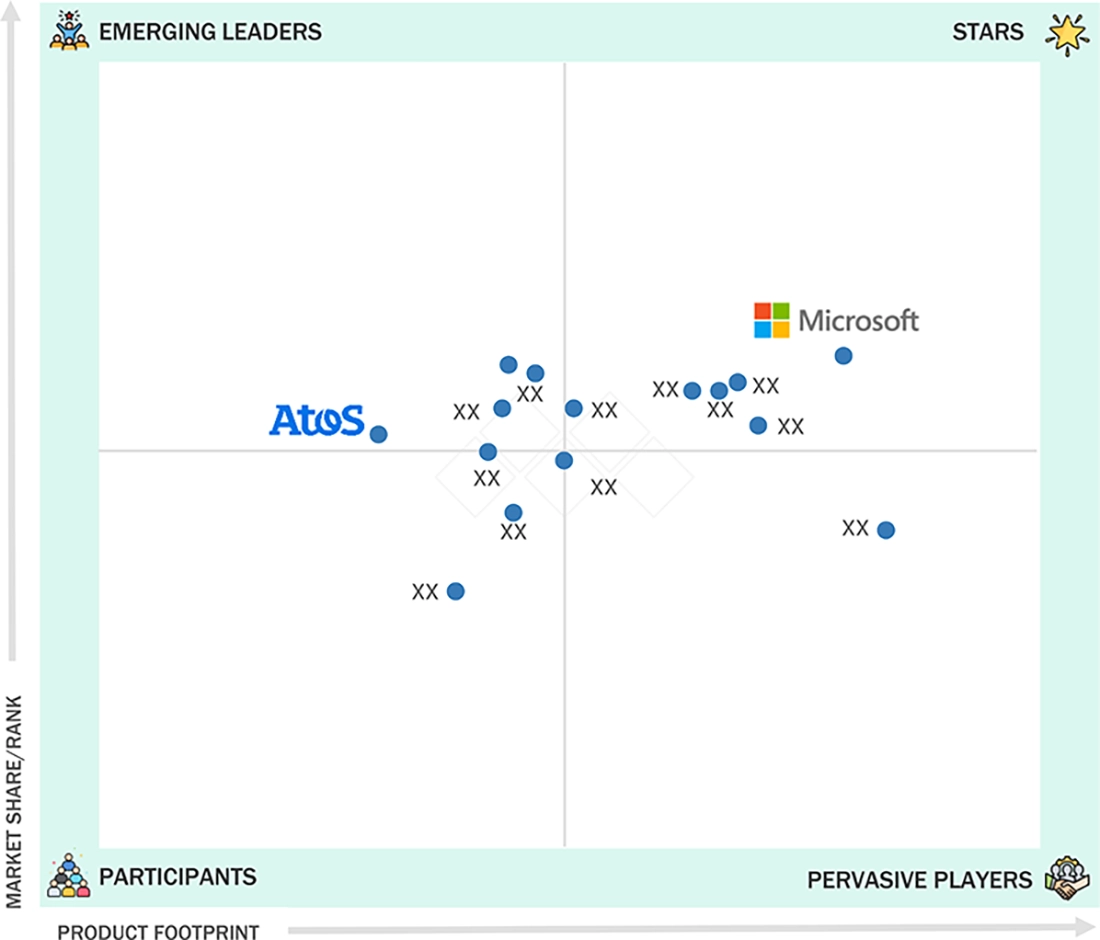
DIGITAL TWINS IN HEALTHCARE MARKET: COMPANY EVALUATION MATRIX
Microsoft Corporation (Star Player) is a major contributor to the digital twins in healthcare market, driven by its strong capabilities in cloud computing, AI, and data integration. Through platforms such as Azure Digital Twins, Microsoft enables the development of patient-specific and system-level digital twins, supporting applications in clinical decision-making, hospital operations, and predictive analytics. Atos SE (Emerging Leader) is gaining traction in the market by leveraging high-performance computing, AI, and digital simulation technologies to develop healthcare-focused digital twin solutions. Atos is expanding its footprint by offering advanced simulation and data-driven platforms that support precision medicine, clinical research, and operational optimization.
Source: Secondary Research, Interviews with Experts, MarketsandMarkets Analysis
KEY MARKET PLAYERS
- Siemens Healthineers AG (Germany)
- Dassault Systèmes (France)
- Microsoft Corporation (US)
- Koninklijke Philips N.V. (Netherlands)
- Faststream Technologies (India)
- Twin Ltd (UK)
- IBM (US)
- NVIDIA Corporation (US)
- GE Healthcare (US)
- Nurea (France)
- Ansys. Inc (US)
- Rescale (US)
- Predictive (US)
- Verto Health (Canada)
MARKET SCOPE
| REPORT METRIC | DETAILS |
|---|---|
| Market Size in 2025 (Value) (Base Year) | USD 4.47 BN |
| Market Size in 2026 (Value) (Estimated Year) | USD 7.47 Billion |
| Market Forecast in 2031 (Value) (Forecast Year) | USD 101.19 Billion |
| CAGR | 68.4% |
| Years Considered | 2024–2031 |
| Base Year | 2025 |
| Forecast Period | 2026–2031 |
| Units Considered | USD Billion |
| Report Coverage | Revenue forecast, company ranking, competitive landscape, growth factors, and trends |
| Segments Covered |
|
| Regions Covered | North America, Asia Pacific, Europe, the Middle East & Africa, Latin America |
WHAT IS IN IT FOR YOU: DIGITAL TWINS IN HEALTHCARE MARKET REPORT CONTENT GUIDE
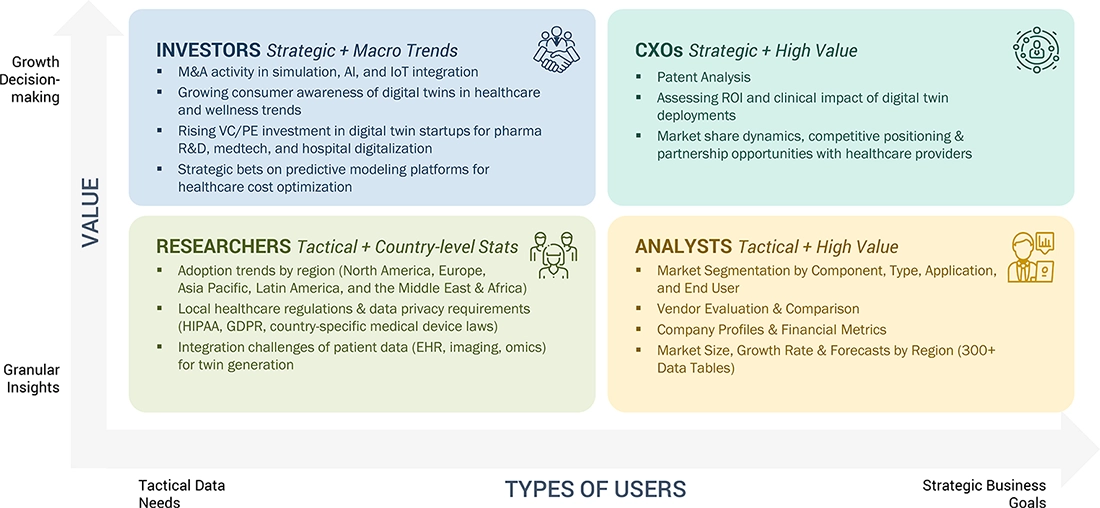
DELIVERED CUSTOMIZATIONS
We have successfully delivered the following deep-dive customizations:
| CLIENT REQUEST | CUSTOMIZATION DELIVERED | VALUE ADDS |
|---|---|---|
| Competitive Landscape Mapping | In-depth information on key digital twin providers, their platforms, and market share across applications such as patient twins, organ-level twins, and hospital/system twins, along with AI- and simulation-based solutions offered by them. | Enables benchmarking of digital twin capabilities, identifies differentiation in simulation accuracy, data integration, and scalability, and supports portfolio optimization, partnerships, licensing, and M&A strategies. |
| Market Entry & Growth Strategy | Regional market assessment of the digital twins in healthcare market in terms of adoption of simulation technologies, healthcare digitalization levels, disease burden, and regulatory acceptance across pharmaceutical, provider, and research ecosystems. | Reduces go-to-market risk, accelerates adoption through localized strategies, and supports expansion into emerging healthcare markets adopting digital twin technologies. |
| Regulatory & Operational Risk Analysis | Assessment of compliance with regulatory frameworks governing AI/ML models, simulation-based evidence, and healthcare data privacy, including FDA, EMA, HIPAA, GDPR, and interoperability standards such as HL7 and FHIR. | Supports regulatory readiness, risk mitigation, and governance of digital twin models, ensuring alignment with patient safety, data privacy, and clinical validation requirements. |
| Technology Adoption Trends | Insights into the adoption of AI/ML, cloud computing, IoT, and simulation platforms in digital twin applications across clinical care, hospital operations, drug development, and precision medicine. | Guides R&D prioritization, informs investments in digital twin platforms, and helps stakeholders align solutions with clinical outcomes, operational efficiency, and predictive healthcare delivery. |
RECENT DEVELOPMENTS
- March 2025 : NVIDIA launched the NVIDIA Isaac for Healthcare, an AI-powered development platform for medical robotics. This platform incorporates MONAI to provide pre-trained models alongside advanced AI frameworks, such as MAISI and Vista-3D, which generate synthetic anatomical data necessary for simulation workflows.
- March 2025 : NVIDIA and GE HealthCare collaborated to advance the development of autonomous diagnostic imaging with physical AI. GE HealthCare utilizes the new NVIDIA Isaac for a healthcare medical device simulation platform. This platform includes pre-trained models and physics-based simulations of sensors, anatomy, and environments.
- December 2024 : Philips and Mayo Clinic entered a research collaboration to advance MRI technology for cardiac applications. The partnership aims to leverage AI capabilities and the expertise of Mayo Clinic physicians to enhance operational efficiency by reducing the duration of complex MRI exams and streamlining workflows for radiologists.
Table of Contents
 Exclusive indicates content/data unique to MarketsandMarkets and not available with any competitors.
TITLE
PAGE NO
1
INTRODUCTION
15
2
EXECUTIVE SUMMARY
3
PREMIUM INSIGHTS
4
MARKET OVERVIEW
4.1
INTRODUCTION
4.2
MARKET DYNAMICS
4.2.1
DRIVERS
4.2.1.1
INCREASING INVESTMENTS BY PUBLIC AND PRIVATE ENTITIES
4.2.1.2
GROWING APPLICATIONS OF DIGITAL TWINS
4.2.1.3
TECHNOLOGICAL ADVANCEMENTS
4.2.1.4
GROWING FUNDING AND INVESTMENTS IN DIGITAL TWIN STARTUPS
4.2.2
RESTRAINTS
4.2.2.1
MANAGING DATA QUALITY, PRIVACY ISSUES, AND HIGH IMPLEMENTATION COSTS
4.2.3
OPPORTUNITIES
4.2.3.1
INCREASING FOCUS ON CUTTING-EDGE REAL-TIME DATA ANALYTICS
4.2.3.2
GROWING IMPORTANCE OF DIGITAL TWINS IN EMERGING ECONOMIES
4.2.4
CHALLENGES
4.2.4.1
LACK OF SKILLED PROFESSIONALS
4.2.4.2
INTEGRATION WITH EXISTING SYSTEMS AND OUTDATED DIGITAL INFRASTRUCTURE
4.3
UNMET NEEDS AND WHITE SPACES
4.4
INTERCONNECTED MARKETS AND CROSS-SECTOR OPPORTUNITIES
4.5
STRATEGIC MOVES BY TIER-1/2/3 PLAYERS
4
INDUSTRY TRENDS
4.1
PORTER’S FIVE FORCES ANALYSIS
4.2
MACROECONOMICS INDICATORS
4.2.1
INTRODUCTION
4.2.2
GDP TRENDS AND FORECAST
4.2.3
TRENDS IN GLOBAL HEALTHCARE IT INDUSTRY
4.3
SUPPLY CHAIN ANALYSIS
4.4
ECOSYSTEM ANALYSIS
4.5
PRICING ANALYSIS
4.5.1
INDICATIVE PRICE FOR DIGITAL TWINS IN HEALTHCARE, BY TYPE (2025)
4.5.2
INDICATIVE PRICE FOR DIGITAL TWINS IN HEALTHCARE, BY REGION (2025)
4.6
KEY CONFERENCES AND EVENTS, 2026–2027
4.7
TRENDS/DISRUPTIONS IMPACTING CUSTOMER BUSINESS
4.8
INVESTMENT AND FUNDING SCENARIO
4.9
CASE STUDY ANALYSIS
4.10
IMPACT OF 2024 US TARIFF – DIGITAL TWINS IN HEALTHCARE MARKET
4.10.1
INTRODUCTION
4.10.2
KEY TARIFF RATES
4.10.3
PRICE IMPACT ANALYSIS
4.10.4
IMPACT ON COUNTRIES/REGIONS
4.10.4.1
US
4.10.4.2
EUROPE
4.10.4.3
APAC
4.10.4
IMPACT ON END-USE INDUSTRIES
6
TECHNOLOGICAL ADVANCEMENTS, AI-DRIVEN IMPACT, PATENTS, INNOVATIONS, AND FUTURE APPLICATIONS
6.1
KEY EMERGING TECHNOLOGIES
6.1.1
AI/ML & SIMULATION MODELS
6.1.2
CLOUD COMPUTING AND HIGH-PERFORMANCE COMPUTING (HPC)
6.1.3
DATA INTEGRATION PLATFORMS
6.2
COMPLEMENTARY TECHNOLOGIES
6.2.1
INTERNET OF MEDICAL THINGS (IOMT) AND CONNECTED DEVICES
6.2.2
MEDICAL IMAGING & IMAGING AI
6.3
ADJACENT TECHNOLOGIES
6.3.1
CLINICAL DECISION SUPPORT SYSTEMS
6.3.2
AR/VR FOR SURGICAL SIMULATION & TRAINING
6.4
TECHNOLOGY/PRODUCT ROADMAP
6.5
PATENT ANALYSIS
6.6
FUTURE APPLICATIONS
6.7
IMPACT OF AI/GEN AI ON DIGITAL TWINS IN HEALTHCARE MARKET
6.7.1
TOP USE CASES AND MARKET POTENTIAL
6.7.2
BEST PRACTICES FOLLOWED BY MANUFACTURERS IN DIGITAL TWINS IN HEALTHCARE MARKET
6.7.3
CASE STUDIES OF AI IMPLEMENTATION IN DIGITAL TWINS IN HEALTHCARE MARKET
6.7.4
INTERCONNECTED ECOSYSTEM AND IMPACT ON MARKET PLAYERS
6.7.5
CLIENTS’ READINESS TO ADOPT AI-INTEGRATED PROCESSES FOR DIGITAL TWINS IN HEALTHCARE SOLUTIONS
7
REGULATORY LANDSCAPE
7.1
REGIONAL REGULATIONS AND COMPLIANCE
7.1.1
REGULATORY BODIES, GOVERNMENT AGENCIES,
AND OTHER ORGANIZATIONS
7.1.2
INDUSTRY STANDARDS
8
CUSTOMER LANDSCAPE & BUYER BEHAVIOR
8.1
INTRODUCTION
8.2
DECISION-MAKING PROCESS
8.3
KEY STAKEHOLDERS INVOLVED IN BUYING PROCESS AND THEIR EVALUATION CRITERIA
8.3.1
KEY STAKEHOLDERS IN BUYING PROCESS
8.3.2
BUYING CRITERIA
8.4
ADOPTION BARRIERS & INTERNAL CHALLENGES
8.5
UNMET NEEDS FROM VARIOUS END-USE INDUSTRIES
8.6
MARKET PROFITABILITY
9
DIGITAL TWINS IN HEALTHCARE MARKET, BY COMPONENT (MARKET SIZE &
FORECAST TO 2031)
9.1
INTRODUCTION
9.2
SERVICES
9.3
SOFTWARE
10
DIGITAL TWINS IN HEALTHCARE MARKET, BY TYPE (MARKET SIZE & FORECAST TO 2031)
10.1
INTRODUCTION
10.2
PROCESS TWINS
10.3
SYSTEM TWINS
10.4
WHOLE BODY TWINS
10.5
BODY PART TWINS
11
DIGITAL TWINS IN HEALTHCARE MARKET, BY APPLICATION (MARKET SIZE & FORECAST TO 2031)
11.1
INTRODUCTION
11.2
DRUG DISCOVERY & DEVELOPMENT
11.3
PERSONALIZED MEDICINE
11.4
SURGICAL PLANNING & MEDICAL EDUCATION
11.5
MEDICAL DEVICE DESIGN & TESTING
11.6
HEALTHCARE WORKFLOW OPTIMIZATION & ASSET MANAGEMENT
11.7
OTHER APPLICATIONS
12
DIGITAL TWINS IN HEALTHCARE MARKET, BY END USER (MARKET SIZE & FORECAST TO 2031)
12.1
INTRODUCTION
12.2
PHARMA & BIOPHARMA COMPANIES
12.3
RESEARCH & ACADEMIA
12.4
HEALTHCARE PROVIDERS
12.5
MEDICAL DEVICE COMPANIES
12.6
OTHER END USERS
13
DIGITAL TWINS IN HEALTHCARE MARKET, BY REGION (MARKET SIZE &
FORECAST TO 2031)
13.1
INTRODUCTION
13.2
NORTH AMERICA
13.2.1
US
13.2.2
CANADA
13.3
EUROPE
13.3.1
GERMANY
13.3.2
FRANCE
13.3.3
UK
13.3.4
ITALY
13.3.5
SPAIN
13.3.6
REST OF EUROPE
13.4
ASIA PACIFIC
13.4.1
CHINA
13.4.2
JAPAN
13.4.3
INDIA
13.4.4
AUSTRALIA
13.4.5
SOUTH KOREA
13.4.6
REST OF ASIA PACIFIC
13.5
LATIN AMERICA
13.4.1
BRAZIL
13.4.2
MEXICO
13.4.3
REST OF LATIN AMERICA
13.6
MIDDLE EAST & AFRICA
13.6.1
GCC COUNTRIES
13.6.1.1
SAUDI ARABIA
13.6.1.2
UAE
13.6.1.3
REST OF GCC
13.6.2
SOUTH AFRICA
13.6.3
REST OF MIDDLE EAST & AFRICA
14
COMPETITIVE LANDSCAPE
STRATEGIC ASSESSMENT OF LEADING PLAYERS, MARKET SHARE, REVENUE ANALYSIS, COMPANY POSITIONING, AND COMPETITIVE BENCHMARKS INFLUENCING MARKET POTENTIAL
14.1
OVERVIEW
14.2
KEY PLAYER COMPETITIVE STRATEGIES/RIGHT TO WIN (JANUARY 2022–MARCH 2026)
14.2.1
COMPETITIVE STRATEGIES INITIATIVES
14.2.2
OPERATIONAL STRATEGIES INITIATIVES (WORKFORCE UPSKILLING, LEADERSHIP DEVELOPMENT, GLOBAL COLLABORATIONS, AND ORGANIZATIONAL AGILITY)
14.3
REVENUE ANALYSIS (2021-2025)
14.4
MARKET SHARE ANALYSIS (2025)
14.5
BRAND/SOFTWARE COMPARATIVE ANALYSIS
14.6
COMPANY EVALUATION MATRIX: KEY PLAYERS,
14.6.1
STARS
14.6.2
EMERGING LEADERS
14.6.3
PERVASIVE PLAYERS
14.6.4
PARTICIPANTS
14.6.4
COMPANY FOOTPRINT: KEY PLAYERS,
14.6.4.1
COMPANY FOOTPRINT
14.6.4.2
REGION FOOTPRINT
14.6.4.3
APPLICATION FOOTPRINT
14.6.4.4
TYPE FOOTPRINT
14.6.4.5
END USER FOOTPRINT
14.7
COMPANY EVALUATION MATRIX: STARTUPS/SMES,
14.7.1
PROGRESSIVE COMPANIES
14.7.2
DYNAMIC COMPANIES
14.7.3
RESPONSIVE COMPANIES
14.7.4
STARTING BLOCKS
14.7.4
COMPETITIVE BENCHMARKING: STARTUPS/SMES,
14.7.4.1
DETAILED LIST OF KEY STARTUPS/SMES
14.7.4.2
COMPETITIVE BENCHMARKING OF KEY STARTUPS/SMES
14.8
COMPANY VALUATION AND FINANCIAL METRICS
14.9
COMPETITIVE SCENARIOS
14.9.1
PRODUCT LAUNCHES & UPGRADES
14.9.2
DEALS
14.9.3
EXPANSIONS
14.9.4
OTHERS
15
COMPANY PROFILES
IN-DEPTH REVIEW OF COMPANIES, PRODUCTS, SERVICES, RECENT INITIATIVES, AND POSITIONING STRATEGIES IN THE DIGITAL TWINS IN HEALTHCARE MARKET LANDSCAPE
15.1
KEY PLAYERS
15.1.1
SIEMENS HEALTHINEERS AG
14.7.4.1
BUSINESS OVERVIEW
14.7.4.2
PRODUCTS OFFERED
14.7.4.1
RECENT DEVELOPMENTS
14.7.4.2
MNM VIEW
15.1.2
DASSAULT SYSTÈMES
15.1.3
MICROSOFT CORPORATION
15.1.4
KONINKLIJKE PHILIPS N.V.
15.1.5
AMAZON WEB SERVICES, INC.
15.1.6
GE HEALTHCARE
15.1.7
ORACLE CORPORATION
15.1.8
IBM
15.1.9
PTC
15.1.10
SAP
15.1.11
ATOS SE
15.1.12
NVIDIA CORPORATION
15.1.13
ANSYS INC.
15.1.14
FASTSTREAM TECHNOLOGIES
15.1.15
RESCALE, INC.
15.1
OTHER PLAYERS
15.2.1
TWIN HEALTH
15.2.2
VERTO
15.2.3
QBIO
15.2.4
THOUGHTWIRE
15.2.5
SIM AND CURE
15.2.6
PREDICTIV
15.2.7
NUREA
15.2.8
UNLEARN.AI, INC.
15.2.9
VIRTONOMY GMBH
15.2.10
PREDISURGE
16
RESEARCH METHODOLOGY
16.1
RESEARCH DATA
16.1.1
SECONDARY DATA
16.1.1.1
KEY DATA FROM SECONDARY SOURCES
16.1.2
PRIMARY DATA
16.1.2.1
KEY DATA FROM PRIMARY SOURCES
16.1.2.2
KEY PRIMARY PARTICIPANTS
16.1.2.3
BREAKDOWN OF PRIMARY INTERVIEWS
16.1.2.4
KEY INDUSTRY INSIGHTS
16.2
MARKET SIZE ESTIMATION
16.2.1
BOTTOM-UP APPROACH
16.2.2
TOP-DOWN APPROACH
16.2.3
BASE NUMBER CALCULATION
16.3
MARKET FORECAST APPROACH
16.3.1
SUPPLY SIDE
16.3.2
DEMAND SIDE
16.4
DATA TRIANGULATION
16.5
FACTOR ANALYSIS
16.6
RESEARCH ASSUMPTIONS
16.7
RESEARCH LIMITATIONS AND RISK ASSESSMENT
17
APPENDIX
17.1
DISCUSSION GUIDE
17.2
KNOWLEDGESTORE: MARKETSANDMARKETS’ SUBSCRIPTION PORTAL
17.3
CUSTOMIZATION OPTIONS
17.4
RELATED REPORTS
17.5
AUTHOR DETAILS
Methodology
This research study involved the extensive use of both primary and secondary sources. It involved the study of various factors affecting the industry to identify the segmentation types, industry trends, key players, the competitive landscape of market players, and key market dynamics such as drivers, opportunities, challenges, restraints, and key player strategies.
Secondary Research
This research study involved the wide use of secondary sources, directories, databases such as Dun & Bradstreet, Bloomberg Businessweek, and Factiva, white papers, annual reports, and companies’ house documents. Secondary research was undertaken to identify and collect information for this extensive, technical, market-oriented, and commercial study of the digital twins in healthcare market. It was also used to obtain important information about the top players, market classification, and segmentation according to industry trends to the bottom-most level, geographic markets, and key developments related to the market. A database of the key industry leaders was also prepared using secondary research.
Primary Research
In the primary research process, various supply-side and demand-side sources were interviewed to obtain qualitative and quantitative information for this report. Primary sources from the supply side included industry experts such as CEOs, vice presidents, marketing and sales directors, technology & innovation directors, engineers, and related key executives from various companies and organizations operating in the digital twins in healthcare market. Primary sources from the demand side included personnel from hospitals (small, medium-sized, and large hospitals), diagnostic centers, and stakeholders in corporate & government bodies.

Note: Tiers are defined based on a company’s total revenue, as of 2025: Tier 1 = >USD 1 billion, Tier 2 = USD 500 million to USD 1 billion, and Tier 3 = <USD 500 million.
To know about the assumptions considered for the study, download the pdf brochure
Market Size Estimation
The total size of the digital twins in healthcare market was arrived at after data triangulation through the two approaches mentioned below. After the completion of each approach, the weighted average of these approaches was taken based on the level of assumptions used in each approach.
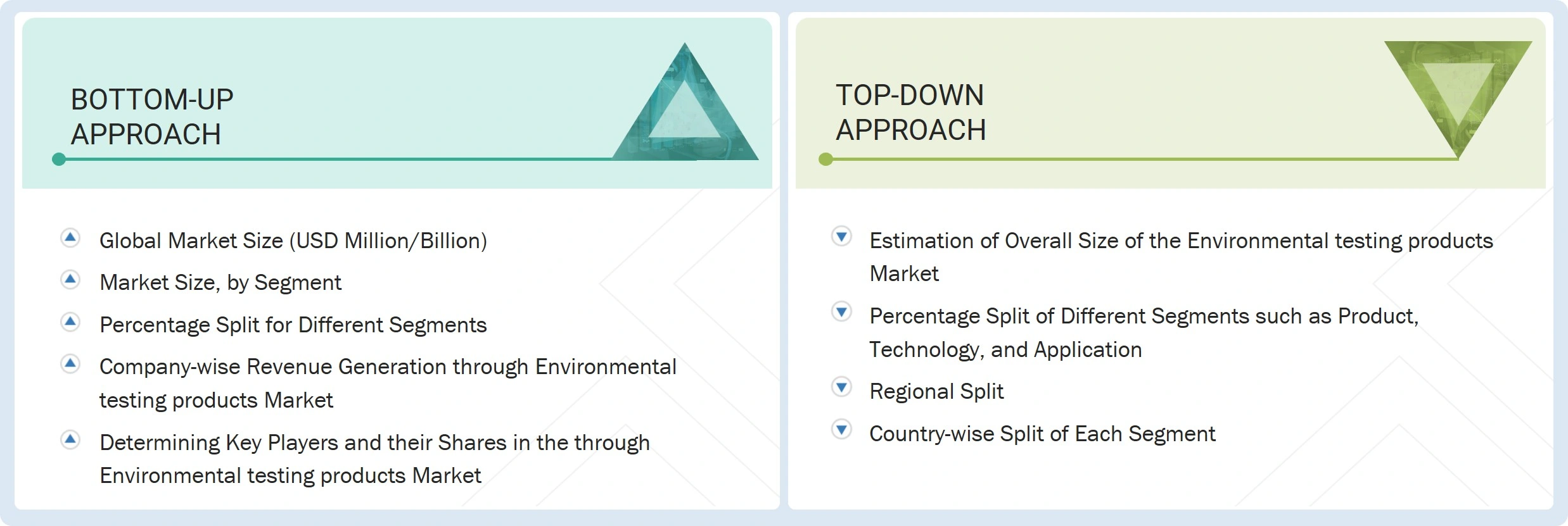
Data Triangulation
The size of the digital twins in healthcare market was estimated through segmental extrapolation using the bottom-up approach. The methodology used is as follows:
- Revenues for individual companies were gathered from public sources and databases.
- Shares of leading players in the digital twins in healthcare market were gathered from secondary sources to the extent available. In some instances, shares of digital twins in healthcare businesses have been ascertained after a detailed analysis of various parameters, including product portfolios, market positioning, selling price, and geographic reach & strength.
- Individual shares or revenue estimates were validated through interviews with experts.
The total revenue in the digital twins in healthcare market was determined by extrapolating the market share data of major companies.
Market Definition
According to the Digital Twin Consortium, a digital twin is a virtual representation of real-world entities and processes synchronized at a specified frequency and fidelity. This allows end users to monitor what is happening inside the physical asset in real-time. By providing a holistic view of real-time behavior in a real-world environment mapped to a constantly updated virtual model, digital twins make it possible to anticipate maintenance needs, optimize performance, and avoid costly failures.
Key Stakeholders
- Healthcare Providers
- Healthcare Vendors
- Technology Developers
- Patients
- Regulators and Policymakers
- Insurance companies and payers
- Academic Research Institutes
- Imagining and Diagnostic Labs
- Government Institutions
- Market Research and Consulting Firms
- Venture Capitalists and Investors
Report Objectives
- To define, describe, and forecast the digital twins in healthcare market based on component, application, end user, and region
- To provide detailed information regarding the major factors influencing the growth of the market (drivers, restraints, opportunities, and industry-specific challenges)
- To strategically analyze micromarkets with respect to individual growth trends, prospects, and contributions to the overall market
- To analyze opportunities in the market for stakeholders and provide details of the competitive landscape for market leaders
- To forecast the size of the market with respect to three geographic regions—North America, Europe, Asia Pacific (APAC), Latin America, and the Middle East & Africa
- To profile the key players and comprehensively analyze their core competencies and market shares
- To track and analyze competitive developments such as product/service launches & enhancements, agreements, expansions, partnerships, and collaborations
- To benchmark players within the market using the proprietary “Company Evaluation Matrix” framework, which analyzes market players on various parameters within the broad categories of business and product strategy.
Available customizations:
With the given market data, MarketsandMarkets offers customizations as per your company’s specific needs. The following customization options are available for the report:
Company Information
- Detailed analysis and profiling of additional market players (up to 5)
Geographic Analysis
- Further breakdown of the Rest of Europe digital twins in healthcare market into Denmark, Norway, and others
- Further breakdown of the Rest of Asia Pacific digital twins in healthcare market into Vietnam, New Zealand, Australia, South Korea, and others.


Still Researching the
Digital Twins in Healthcare Ecosystem?
See the competitors, opportunities, and growth signals shaping it - instantly.
Generate 15+ consulting-grade strategic insights tailored to your growth question.
Explore Digital Twins in Healthcare Intelligence
Powered by 17 years of MarketsandMarkets intelligence