








- DESCRIPTION
- TABLE OF CONTENTS
- METHODOLOGY
- DOWNLOAD PDF
Military Cloud Computing Market by Offering (Service Models, Migration & Modernization, Integration & Engineering, Managed Operations, Security, Compliance & Authorization, FinOps), Deployment, End User, Application, and Region - Global Forecast to 2031

USD 34.32 BN
MARKET SIZE, 2031

CAGR 19.9%
(2026-2031)

300
REPORT PAGES

180
MARKET TABLES
OVERVIEW
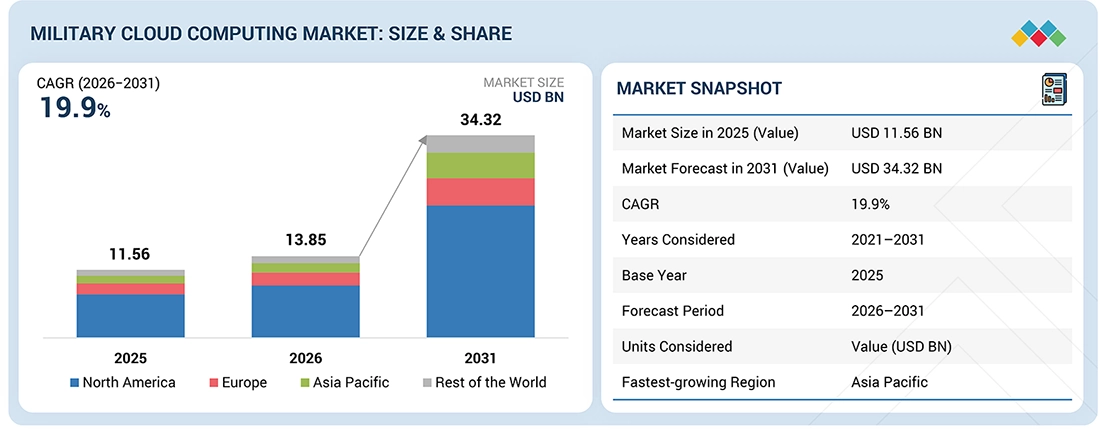
Source: Secondary Research, Interviews with Experts, MarketsandMarkets Analysis
The Military Cloud Computing Market is projected to grow from USD 13.85 billion in 2026 to USD 34.32 billion by 2031, with a Compound Annual Growth Rate (CAGR) of 19.9%. This growth is fueled by the necessity to host and manage mission-critical systems, including intelligence, surveillance, reconnaissance (ISR), logistics, readiness, and training, within secure environments such as public, private, hybrid, and tactical edge clouds. There is increasing demand for migration, integration, managed operations, compliance, and cost control among defense users.
KEY TAKEAWAYS
-
By Region
North America is expected to account for the largest market share during the forecast period due to high US defense cloud spending, large DoD cloud programs such as JWCC, and strong use of secure cloud services for mission, ISR, logistics, and command systems.
-
By Offering
By offering, the cloud service model segment is projected to register the highest CAGR of 21.1% during the forecast period because defense users need scalable IaaS, PaaS and SaaS to run mission apps, ISR data, logistics, readiness and command systems without building every cloud layer themselves.
-
By Application
By application, the command, control, and mission applications segment is expected to dominate the market during the forecast period because defense forces rely on cloud systems to share operational data, support faster decisions and connect land, naval, air, space and defense agency users.
-
By End User
By end user, the other defense agencies segment is estimated to account for 35.8% market share in 2026 because joint commands, defense intelligence and ISR agencies manage large data-heavy cloud workloads that support cross-service operations, intelligence sharing and mission planning.
-
By Deployment
By deployment, the public cloud segment is expected to dominate the market during the forecast period because defense users need scalable and lower-maintenance cloud capacity for mission applications, ISR data, logistics, readiness and secure collaboration across multiple agencies.
-
Competitive Landscape - Key Players
Google, Microsoft, and General Dynamics Corporation were identified as some of the star players in the military cloud computing market, given their strong market share and product footprint.
-
Competitive Landscape - Startups/SMEs
Wind River has identified itself among startups and SMEs by securing strong footholds in specialized niche areas, underscoring its potential as an emerging market leader.
Growth in the Military Cloud Computing Industry is supported by defense forces moving mission data, command applications, ISR workloads, logistics, readiness and training systems to secure cloud environments. Demand is driven by the need for faster deployment, better access across defense users, managed cloud operations, compliance support, cloud migration and tactical edge cloud use.
TRENDS & DISRUPTIONS IMPACTING CUSTOMERS' CUSTOMERS
The military cloud computing market is primarily driven by the need to execute mission applications, process ISR (Intelligence, Surveillance, and Reconnaissance) data, manage logistics, maintain readiness, conduct training, and operate command systems within secure cloud environments. Historically, this market has focused on legacy data center hosting, on-premises servers and storage, enterprise IT outsourcing, basic cloud migration, network support, and consulting for security and compliance. It is now shifting toward Infrastructure as a Service (IaaS), Platform as a Service (PaaS), Software as a Service (SaaS), cloud migration and modernization, cloud integration, managed cloud operations, tactical edge cloud solutions, hybrid cloud management, cloud security and authorization, and cloud cost governance. These changes are driven by an increase in data volumes, the necessity for joint operations, the demand for quicker software solutions, requirements for secure access, and the use of cloud technology in field conditions. This evolution impacts various entities, including defense ministries, ground, naval, air, and space forces, joint commands, defense intelligence agencies, ISR agencies, as well as primes and system integrators that provide support to commanders, warfighters, mission planners, analysts, platform operators, and cloud operations teams.
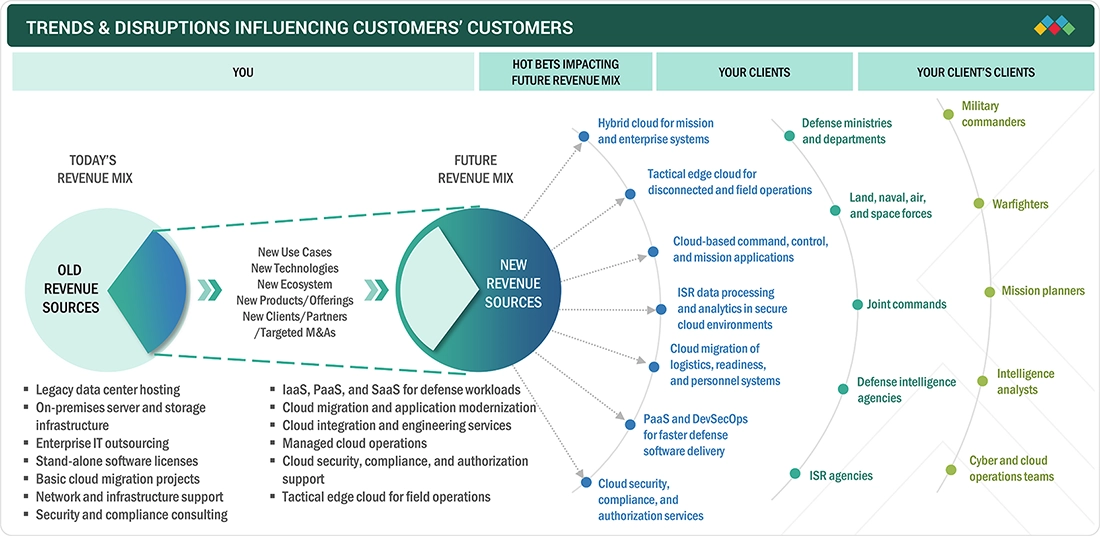
Source: Secondary Research, Interviews with Experts, MarketsandMarkets Analysis
MARKET DYNAMICS

Drivers
Impact
Level
-
Growing battlefield data volumes pushing militaries toward cloud-based processing

-
Joint operations increasing need for shared cloud-based mission systems


RESTRAINTS
Impact
Level
-
Old defense IT systems making cloud transition slow and complex

-
Secure classified cloud setups requiring heavy early investment


OPPORTUNITIES
Impact
Level
-
Field-level cloud use opening new demand for tactical edge solutions

-
Approved defense software platforms creating new cloud revenue paths


CHALLENGES
Impact
Level
-
Military cloud systems facing high exposure to advanced cyberattacks

-
Limited cleared cloud talent delaying secure deployment and operations

Source: Secondary Research, Interviews with Experts, MarketsandMarkets Analysis
Modern military operations rely heavily on vast quantities of data from sensors, platforms, satellites, and field systems. Utilizing cloud-based processing enables defense users to store, sort, and access this data more quickly for command, intelligence, surveillance, reconnaissance (ISR), logistics, and mission planning.
Many defense organizations continue to utilize older systems that were designed for separate military branches, fixed locations, and closed networks. Transitioning these systems to cloud environments can be a time-consuming process because it requires careful handling of data formats, security protocols, software dependencies, and mission-related risks.
Defense users require cloud capabilities closer to deployed forces, especially in areas where network links are weak or disrupted. This generates a demand for tactical edge cloud systems that can support local data processing, mission applications, and ensure secure access during field operations.
As more defense data and mission systems transition to cloud and hybrid environments, attackers gain additional points to target. Military cloud users must manage risks associated with identity access, APIs, data movement, third-party tools, and interconnected mission networks.
MILITARY CLOUD COMPUTING MARKET: COMMERCIAL USE CASES ACROSS INDUSTRIES
| COMPANY | USE CASE DESCRIPTION | BENEFITS |
|---|---|---|
|
|
AWS was selected under the US DoD JWCC contract to provide cloud services across security domains and classification levels, from headquarters to tactical edge locations | It supports mission applications, ISR data, command systems, and secure workload hosting | Supports approved cloud access | Covers classified and unclassified workloads | Helps mission teams use cloud capacity across fixed and tactical locations |
|
|
Google Public Sector used a Google Distributed Cloud air-gapped appliance in the US Air Force Mobility Guardian 2025 exercise for tactical edge cloud use in disconnected or low-bandwidth conditions | It supported local processing, secure collaboration, and AI-related field tasks | Supports cloud use in field conditions | Allows local processing when connectivity is limited | Helps with situational awareness, translation, OCR, and maintenance support |
|
|
Dell EMC Tactical Microsoft Azure Stack provides Azure-consistent cloud capability for remote and rugged environments with limited connectivity | It supports tactical edge cloud use, local data processing, and hybrid connection back to Azure Government | Supports tactical edge cloud use | Enables local processing in low-connectivity areas | Helps defense users run hybrid cloud workloads closer to deployed units |



Logos and trademarks shown above are the property of their respective owners. Their use here is for informational and illustrative purposes only.
MARKET ECOSYSTEM
The military cloud computing market comprises several key participants, including cloud platform, software, and infrastructure providers; cloud integration & managed service providers, as well as end users. Cloud platform, software, and infrastructure providers—such as Dell, Google, Microsoft, Amazon, and Oracle—offer various cloud service models. These include computing, storage, networking, and cloud software solutions across public, private, hybrid, and tactical edge cloud environments specifically designed for defense workloads. Cloud integration and managed services providers, including RTX, Leidos, Capgemini, Accenture, and General Dynamics, assist defense users in transitioning legacy systems to the cloud. They facilitate the integration of cloud platforms with mission systems, manage cloud operations, ensure security and compliance, and support the maintenance of cloud-based applications. End users in this ecosystem include land, naval, air, space, and other defense agencies. These entities utilize military cloud systems for various applications, such as command and mission operations, intelligence, surveillance, and reconnaissance (ISR) data processing, logistics, readiness, personnel management, training, simulation, secure collaboration, and operations in both fixed and deployed locations.
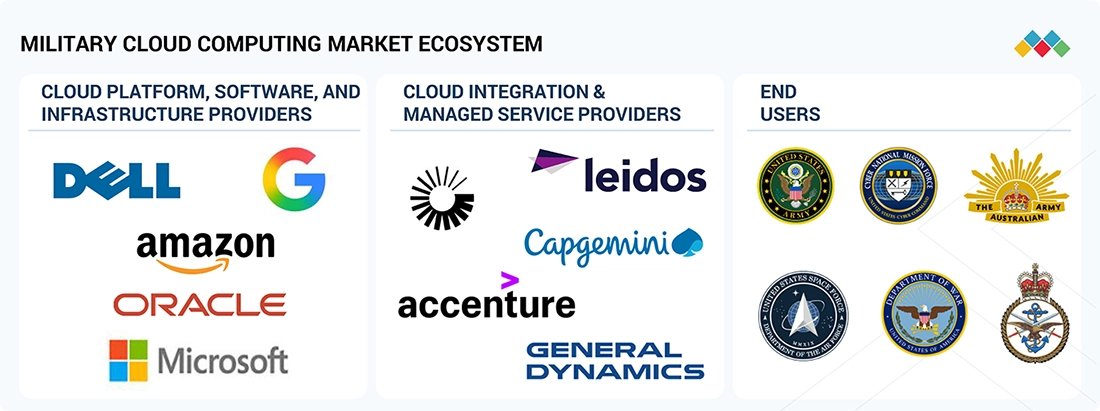
Logos and trademarks shown above are the property of their respective owners. Their use here is for informational and illustrative purposes only.
MARKET SEGMENTS
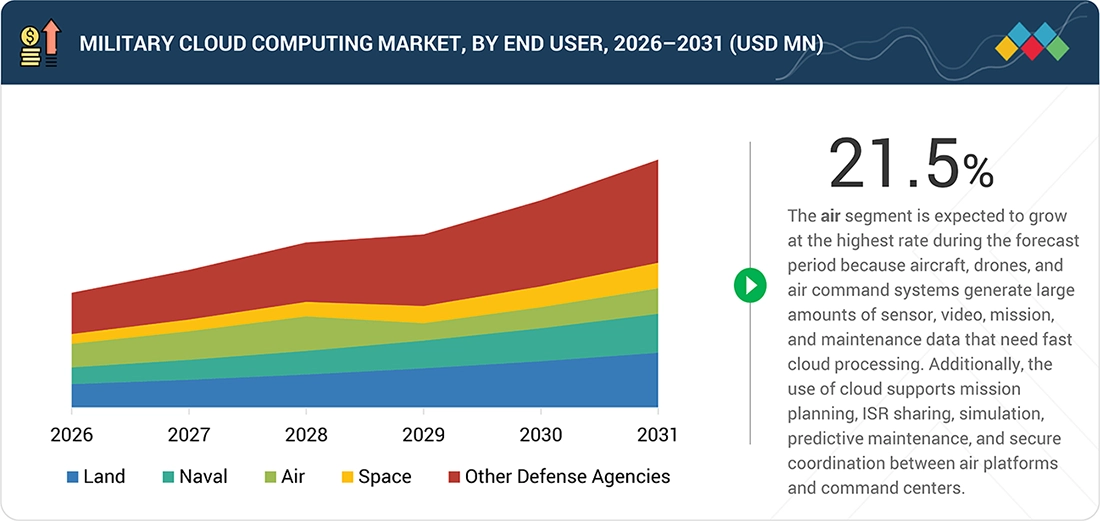
Source: Secondary Research, Interviews with Experts, MarketsandMarkets Analysis
The cloud service models segment is expected to lead during the forecast period, as IaaS, PaaS, and SaaS serve as the foundational platforms for hosting defense applications, storing mission data, conducting analytics, and ensuring secure access. Most migration, integration, and managed cloud operations rely on these service models, which account for a significant portion of military cloud spending.
The ISR data processing & analytics segment is projected to experience the highest compound annual growth rate (CAGR) during the forecast period. This growth is driven by the need for defense forces to quickly manage data from various sources, including sensors, drones, aircraft, satellites, ships, and ground platforms. Cloud systems facilitate large data storage, rapid processing, and collaborative analysis, enabling intelligence teams and commanders to effectively utilize ISR data for surveillance, threat detection, planning, and mission support.
The defense agencies segment is expected to lead the market during the forecast period. This is due to joint commands, defense intelligence, and ISR (Intelligence, Surveillance, and Reconnaissance) agencies managing substantial shared workloads across different services. These workloads encompass mission data, analytics, planning, and secure information exchange. Users in this segment require cloud systems that can facilitate cross-domain access, handle large data volumes, and enable coordination across land, naval, air, and space operations.
The ISR (Intelligence, Surveillance, and Reconnaissance) data processing and analytics segment is expected to experience the highest growth rate during the forecast period. This is due to defense forces increasingly relying on data from sensors, satellites, drones, and various platforms that need to be processed swiftly for intelligence gathering and mission planning. Cloud systems facilitate the storage, integration, and analysis of this data across different units, eliminating the dependency on fixed local systems.
REGION
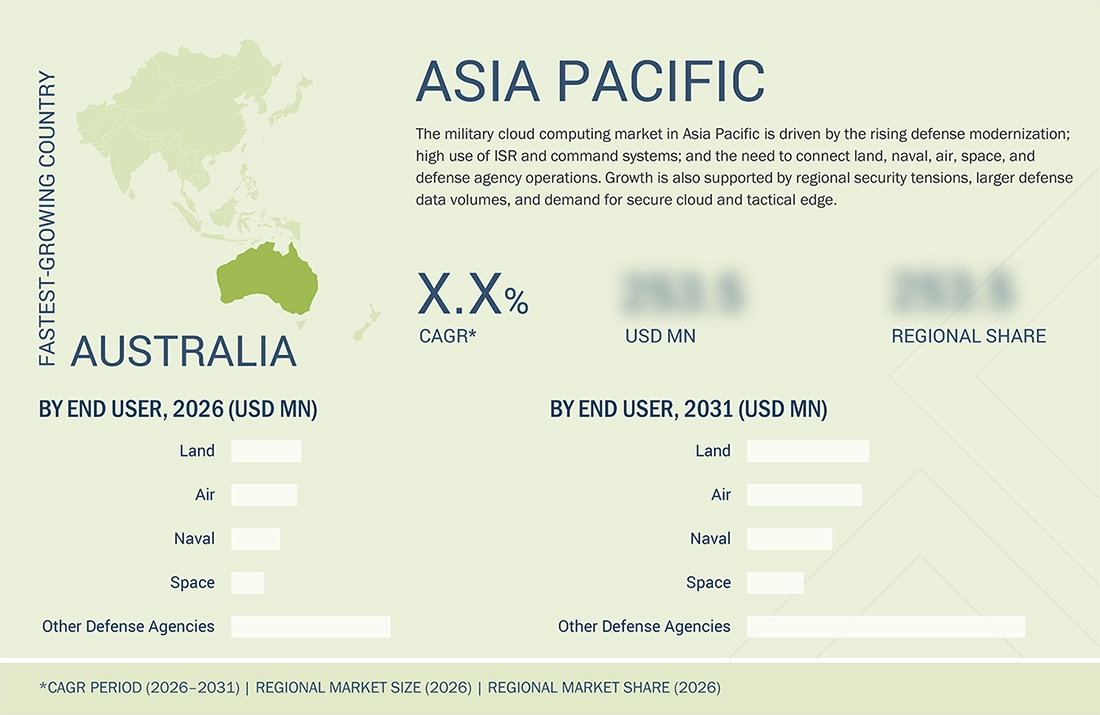
Asia Pacific to be fastest-growing region in military cloud computing market during forecast period
The Asia Pacific region is expected to experience the highest growth rate during the forecast period. This growth is attributed to countries in the area increasing their defense budgets, modernizing military networks, and adopting more digital systems for Intelligence, Surveillance, and Reconnaissance (ISR); command; logistics; and joint operations. Additionally, rising regional security concerns and the need to enhance connectivity among forces across vast land and maritime areas are further driving the adoption of cloud technologies.
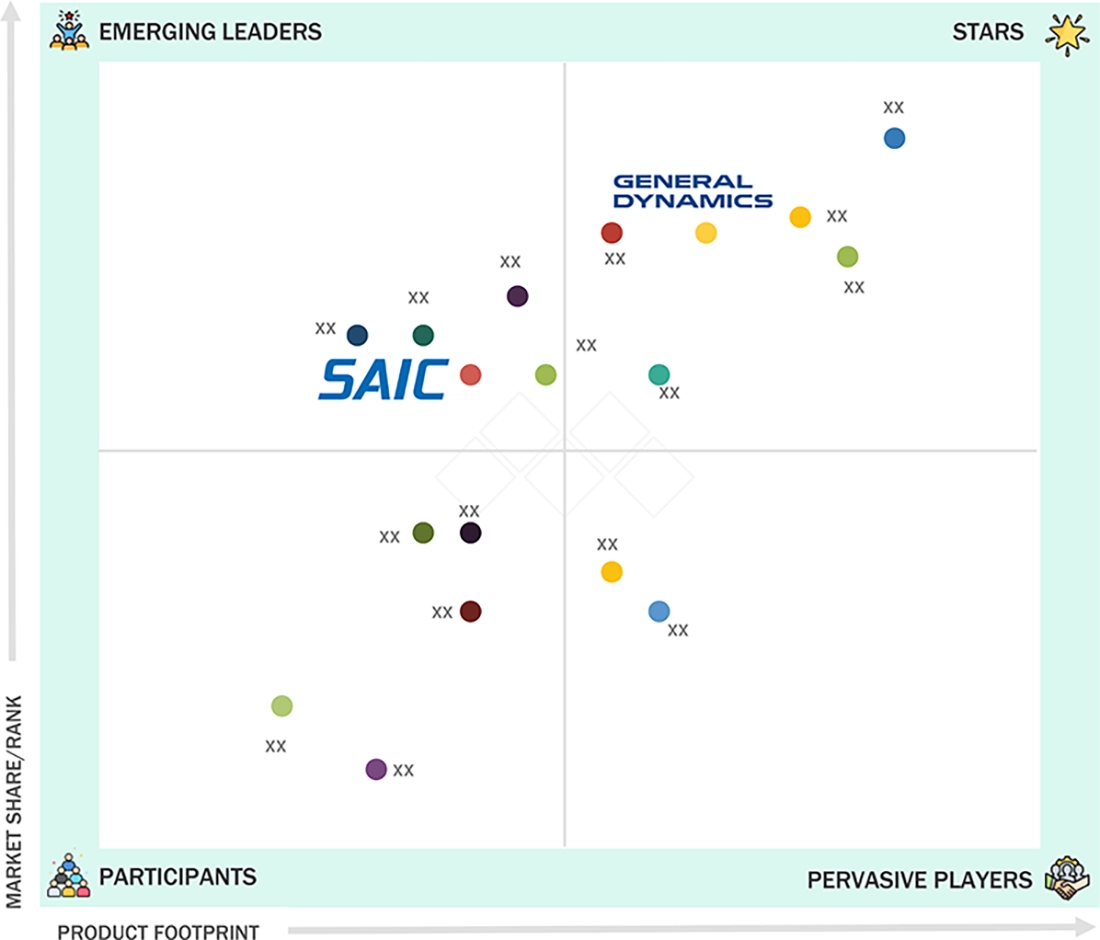
MILITARY CLOUD COMPUTING MARKET: COMPANY EVALUATION MATRIX
In the military cloud computing market matrix, General Dynamics Corporation is categorized as a "Star" due to its strong access to defense customers and its extensive capabilities in cloud migration, integration, managed cloud operations, secure defense IT, mission applications, and tactical-edge support within its defense IT division. SAIC, on the other hand, is classified as an "Emerging Leader" because it plays a distinct role in defense cloud migration, mission IT, network operations, and secure modernization efforts. SAIC's cloud footprint seems more service-oriented and less comprehensive compared to General Dynamics in terms of platform, infrastructure, and managed operations. In summary, companies with broader defense cloud portfolios, stronger relationships with military customers, and extensive coverage across public, private, hybrid, and tactical-edge clouds are ranked higher in the matrix. Conversely, companies with more limited cloud roles or lower defense cloud scale are placed at the lower end.
Source: Secondary Research, Interviews with Experts, MarketsandMarkets Analysis
MARKET SCOPE
| REPORT METRIC | DETAILS |
|---|---|
| Market Size in 2025 (Value) | USD 11.56 Billion |
| Market Size in 2026 (Value) | USD 13.85 Billion |
| Market Forecast in 2031 (Value) | USD 34.32 Billion |
| CAGR | 19.9% |
| Years Considered | 2021–2031 |
| Base Year | 2025 |
| Forecast Period | 2026–2031 |
| Units Considered | USD Billion |
| Report Coverage | Revenue Forecast, Company Ranking, Competitive Landscape, Growth Factors, and Trends |
| Segments Covered |
|
| Regions Covered | North America, Asia Pacific, Europe, and Rest of the World |
WHAT IS IN IT FOR YOU: MILITARY CLOUD COMPUTING MARKET REPORT CONTENT GUIDE
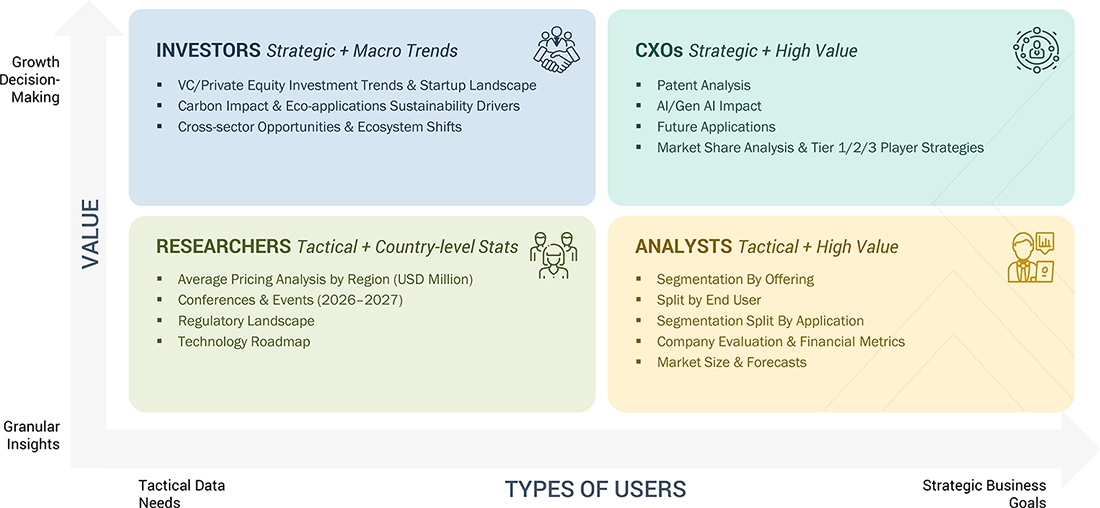
DELIVERED CUSTOMIZATIONS
We have successfully delivered the following deep-dive customizations:
| CLIENT REQUEST | CUSTOMIZATION DELIVERED | VALUE ADDS |
|---|---|---|
| Leading Manufacturer | Additional segment breakdown for countries | Additional country-level market sizing tables for segments/subsegments covered at the regional/global level to gain an understanding of market potential by each country |
| Emerging Leader | Additional company profiles | Competitive information on targeted players to gain granular insights on direct competition |
| Regional Market Leader | Additional country market estimates | Additional country-level deep dive for a more targeted understanding of the total addressable market |
RECENT DEVELOPMENTS
- February 2026 : Oracle was awarded a task order worth USD 88 million from the US Department of the Air Force to provide OCI (Oracle Cloud Infrastructure) services for the Cloud One program. This award aimed to support secure cloud modernization for the Air Force and other users within the Department of Defense at various classification levels.
- December 2025 : Australia's Department of Defence entered into a multi-year Deed of Standing Offer with Google Australia to deliver secure, air-gapped hyperscale cloud capabilities for the Defence ICT environment.
- January 2025 : Amazon Web Services (AWS) received an order from the Navy under the Department of the Navy Enterprise Software Licensing Amazon Web Services Blanket Purchase Agreement (DON ESL AWS BPA). This order included the provision of AWS GovCloud, AWS Marketplace, cloud consumption services, and enterprise support. It supported the Naval Air Systems Command (NAWCAD) and Navy mission owners by providing access to AWS cloud services for developing capabilities aimed at enhancing warfighter effectiveness.
Table of Contents
 Exclusive indicates content/data unique to MarketsandMarkets and not available with any competitors.
TITLE
PAGE NO
1
INTRODUCTION
15
2
EXECUTIVE SUMMARY
3
PREMIUM INSIGHTS
4
MARKET OVERVIEW
4.1
INTRODUCTION
4.2
MARKET DYNAMICS
4.2.1.1
DRIVERS
4.2.1.2
RESTRAINTS
4.2.1.3
OPPORTUNITIES
4.2.1.4
CHALLENGES
4.3
UNMET NEEDS & WHITE SPACES
4.4
INTERCONNECTED MARKETS AND CROSS-SECTOR OPPORTUNITIES
4.5
STRATEGIC MOVES BY TIER-1/2/3 PLAYERS
5
INDUSTRY TRENDS
5.1
ECOSYSTEM ANALYSIS
5.2
VALUE CHAIN ANALYSIS
5.3
PRICING ANALYSIS
5.4
CASE STUDY ANALYSIS
5.5
KEY CONFERENCES & EVENTS 2026-2027
5.6
INVESTMENT AND FUNDING SCENARIO
5.7
TRENDS/DISRUPTION IMPACTING CUSTOMER’S BUSINESS
5.8
TOTAL COST OF OWNERSHIP (TCO)
5.9
MACROECONOMIC OUTLOOK
5.9.1.1
INTRODUCTION
5.9.1.2
GDP TRENDS AND FORECAST
5.9.1.3
TRENDS IN GLOBAL CLOUD COMPUTING IN MILITARY
5.9.1.4
TRENDS IN GLOBAL DEFENSE INDUSTRY
5.10
BUSINESS MODEL
5.10.1.1
INTRODUCTION
5.10.1.2
OUTSOURCE
5.10.1.3
IN-HOUSE
6
TECHNOLOGICAL ADVANCEMENTS, AI-DRIVEN IMPACT, PATENTS, INNOVATIONS, AND FUTURE APPLICATIONS
6.1
KEY EMERGING TECHNOLOGIES
6.2
COMPLEMENTARY TECHNOLOGIES
6.3
ADJACENT TECHNOLOGIES
6.4
TECHNOLOGY ROADMAP
6.5
PATENT ANALYSIS
6.6
FUTURE APPLICATIONS
6.7
IMPACT OF AI/GEN AI ON MILITARY CLOUD COMPUTING MARKET
6.7.1.1
TOP USE CASES AND MARKET POTENTIAL
6.7.1.2
BEST PRACTICES FOLLOWED BY MANUFACTURERS AND SERVICE PROVIDERS
6.7.1.3
CASE STUDIES OF AI IMPLEMENTATION IN THE MILITARY CLOUD COMPUTING MARKET
6.7.1.4
INTERCONNECTED ADJACENT ECOSYSTEM AND IMPACT ON MARKET PLAYERS
6.7.1.5
CLIENTS’ READINESS TO ADOPT CLOUD COMPUTING IN MILITARY
6.8
SUCCESS STORIES AND REAL-WORLD APPLICATIONS
7
REGULATORY LANDSCAPE AND SUSTAINABILITY INITIATIVES
7.1
REGIONAL REGULATIONS AND COMPLIANCE
7.1.1.1
REGULATORY BODIES, GOVERNMENT AGENCIES, AND OTHER ORGANIZATIONS
7.1.1.2
INDUSTRY STANDARDS
7.2
SUSTAINABILITY INITIATIVES
7.3
IMPACT OF REGULATORY POLICIES ON SUSTAINABILITY INITIATIVES
8
CUSTOMER LANDSCAPE & BUYER BEHAVIOR
8.1
DECISION-MAKING PROCESS
8.2
KEY STAKEHOLDERS IN BUYING PROCESS AND THEIR EVALUATION CRITERIA
8.2.1.1
KEY STAKEHOLDERS IN BUYING PROCESS
8.2.1.2
BUYING CRITERIA
8.3
ADOPTION BARRIERS & INTERNAL CHALLENGES
8.4
UNMET NEEDS FROM VARIOUS END-USERS
9
MILITARY CLOUD COMPUTING MARKET, BY OFFERING
9.1
INTRODUCTION
9.2
CLOUD SERVICE MODELS
9.2.1.1
INFRASTRUCTURE AS A SERVICE (IAAS)
9.2.1.1.1
COMPUTE SERVICES
9.2.1.1.2
STORAGE, BACKUP, AND DISASTER RECOVERY SERVICES
9.2.1.1.3
NETWORK AND CONNECTIVITY SERVICES
9.2.1.2
PLATFORM AS A SERVICE (PAAS)
9.2.1.2.1
DATABASE AND DATA MANAGEMENT PLATFORMS
9.2.1.2.2
CONTAINER AND KUBERNETES PLATFORMS
9.2.1.2.3
MIDDLEWARE AND API MANAGEMENT PLATFORMS
9.2.1.2.4
DEVSECOPS AND APPLICATION DEVELOPMENT PLATFORMS
9.2.1.2.5
AI/ML DEVELOPMENT PLATFORMS
9.2.1.3
SOFTWARE AS A SERVICE (SAAS)
9.2.1.3.1
PRODUCTIVITY AND COLLABORATION SOFTWARE
9.2.1.3.2
ENTERPRISE RESOURCE PLANNING AND BUSINESS APPLICATIONS
9.2.1.3.3
LOGISTICS AND MAINTENANCE APPLICATIONS
9.2.1.3.4
MISSION AND COMMAND APPLICATIONS
9.2.1.3.5
ANALYTICS AND DATA VISUALIZATION APPLICATIONS
9.3
CLOUD MIGRATION AND MODERNIZATION SERVICES
9.3.1.1
CLOUD READINESS ASSESSMENT
9.3.1.2
APPLICATION RATIONALIZATION
9.3.1.3
REHOSTING AND REPLATFORMING
9.3.1.4
APPLICATION REFACTORING AND MODERNIZATION
9.3.1.5
DATA MIGRATION SERVICES
11.4
CLOUD INTEGRATION AND ENGINEERING SERVICES
9.4.1.1
CLOUD ARCHITECTURE AND DESIGN
9.4.1.2
LEGACY SYSTEM INTEGRATION
9.4.1.3
API AND DATA INTEGRATION
9.4.1.4
MULTI-CLOUD AND HYBRID CLOUD INTEGRATION
9.4.1.5
MISSION SYSTEM INTEGRATION
9.5
MANAGED CLOUD OPERATIONS
9.5.1.1
CLOUD MONITORING AND ADMINISTRATION
9.5.1.2
WORKLOAD PERFORMANCE MANAGEMENT
9.5.1.3
CLOUD SERVICE DESK AND SUPPORT
9.5.1.4
AVAILABILITY AND RELIABILITY MANAGEMENT
9.5.1.5
MANAGED MULTI-CLOUD OPERATIONS
9.6
CLOUD SECURITY, COMPLIANCE, AND AUTHORIZATION SERVICES
9.6.1.1
CLOUD SECURITY ARCHITECTURE
9.6.1.2
IDENTITY, ACCESS, AND PRIVILEGE MANAGEMENT FOR CLOUD
9.6.1.3
ENCRYPTION AND KEY MANAGEMENT
9.6.1.4
LOGGING, MONITORING, AND AUDIT READINESS
9.6.1.5
AUTHORIZATION TO OPERATE AND COMPLIANCE SUPPORT
9.6.1.6
ZERO TRUST ALIGNMENT FOR CLOUD ENVIRONMENTS
9.7
CLOUD COST MANAGEMENT AND GOVERNANCE, FINOPS
9.7.1.1
CLOUD SPEND MONITORING
9.7.1.2
USAGE AND COST OPTIMIZATION
9.7.1.3
CHARGEBACK AND SHOWBACK MODELS
9.7.1.4
CLOUD PROCUREMENT GOVERNANCE
9.7.1.5
LICENSE AND SUBSCRIPTION OPTIMIZATION
10
MILITARY CLOUD COMPUTING MARKET, BY DEPLOYMENT
10.1
INTRODUCTION
10.2
PUBLIC CLOUD
10.3
PRIVATE CLOUD
10.4
HYBRID CLOUD
10.5
TACTICAL EDGE CLOUD
11
MILITARY CLOUD COMPUTING MARKET, BY END USER
11.1
INTRODUCTION
11.2
ARMY
11.3
NAVY
11.4
AIR FORCE
11.5
SPACE FORCE
11.6
OTHER DEFENSE AGENCIES (JOINT COMMANDS, DEFENSE INTELLIGENCE, AND ISR AGENCIES)
12
MILITARY CLOUD COMPUTING MARKET, BY APPLICATION
12.1
INTRODUCTION
12.2
COMMAND, CONTROL, AND MISSION APPLICATIONS
12.3
ISR DATA PROCESSING AND ANALYTICS
12.4
LOGISTICS, MAINTENANCE, AND READINESS MANAGEMENT
12.5
TRAINING, SIMULATION, AND DIGITAL ENGINEERING
12.6
OTHERS (CYBER MISSION SUPPORT CLOUD, IT, AND COLLABORATION)
13
MILITARY CLOUD COMPUTING MARKET, REGIONAL ANALYSIS
13.1
INTRODUCTION
13.2
NORTH AMERICA
13.2.1.1
US
13.2.1.2
CANADA
13.3
EUROPE
13.3.1.1
UK
13.3.1.2
FRANCE
13.3.1.3
GERMANY
13.3.1.4
ITALY
13.3.1.5
SPAIN
13.3.1.6
REST OF THE EUROPE
13.4
ASIA PACIFIC
13.4.1.1
INDIA
13.4.1.2
JAPAN
13.4.1.3
SOUTH KOREA
13.4.1.4
AUSTRALIA
13.4.1.5
REST OF ASIA PACIFIC
13.5
REST OF THE WORLD
13.5.1.1
MIDDLE EAST & AFRICA
13.5.1.2
LATIN AMERICA
14
COMPETITIVE LANDSCAPES
14.1
OVERVIEW
14.2
KEY PLAYER COMPETITIVE STRATEGIES/RIGHT TO WIN (AUGUST 2021 – APRIL 2026)
14.3
MARKET SHARE ANALYSIS,
14.4
REVENUE ANALYSIS, 2021-2025
14.5
COMPANY EVALUATION MATRIX: KEY PLAYERS,
14.5.1.1
STARS
14.5.1.2
EMERGING LEADERS
14.5.1.3
PERVASIVE PLAYERS
14.5.1.4
PARTICIPANTS
14.5.1.5
COMPANY FOOTPRINT: KEY PLAYERS,
14.5.5.1
COMPANY FOOTPRINT
14.5.5.2
REGION FOOTPRINT
14.5.5.3
END-USER FOOTPRINT
14.5.5.4
DEPLOYMENT FOOTPRINT
144.5.5.5
SERVICE MODEL FOOTPRINT
14.6
COMPANY VALUATION AND FINANCIAL METRICS
14.7
COMPANY EVALUATION MATRIX: START-UPS/SME,
14.7.1.1
PROGRESSIVE COMPANIES
14.7.1.2
RESPONSIVE COMPANIES
14.7.1.3
DYNAMIC COMPANIES
14.7.1.4
STARTING BLOCKS
14.7.1.5
COMPETITIVE BENCHMARKING: STARTUPS/SMES,
22.7.5.1
DETAILED LIST OF STARTUPS/SMES
22.7.5.2
COMPETITIVE BENCHMARKING OF KEY STARTUPS/SMES
14.8
TECHNOLOGY COMPARISON
14.9
COMPETITIVE SCENARIO
14.9.1.1
PRODUCT LAUNCHES
14.9.1.2
DEALS
14.9.1.3
EXPANSIONS
15
COMPANY PROFILES
15.1
KEY PLAYER
15.1.1.1
AMAZON
15.1.1.2
15.1.1.3
MICROSOFT CORPORATION
15.1.1.4
ORACLE
15.1.1.5
GENERAL DYANMICS CORPORATION
15.1.1.6
DELL TECHNOLOGIES
15.1.1.7
THALES GROUP
15.1.1.8
IBM
15.1.1.9
CISCO
15.1.1.10
ATOS
15.1.1.11
BAE SYSTEMS
15.1.1.12
RTX
15.1.1.13
SAIC
15.1.1.14
RACKSPACE TECHNOLOGIES INC.
15.1.1.15
CAPGEMINI
15.1.1.16
SALESFORCE
15.2
OTHER PLAYERS
15.2.1.1
CGI
15.2.1.2
DXC TECHNOLOGY
15.2.1.3
SOAR TECHNOLOGY
15.2.1.4
SPARKCOGNITION
15.2.1.5
HADEAN
15.2.1.6
PERATON
15.2.1.7
SMARTRONIX
15.2.1.8
WIND RIVER
15.2.1.9
SPLUNK
16
RESEARCH METHODOLOGY
16.1
RESEARCH DATA
16.1.1.1
SECONDARY DATA
16.1.1.2
KEY DATA FROM SECONDARY SOURCES
16.1.1.3
LIST OF KEY SECONDARY SOURCES
16.1.1.4
PRIMARY DATA
16.1.1.5
KEY DATA FROM PRIMARY SOURCES
16.1.1.6
KEY PRIMARY PARTICIPANTS
16.1.1.7
BREAKDOWN OF PRIMARY INTERVIEWS
16.1.1.8
KEY INDUSTRY INSIGHTS
16.2
MARKET SIZE ESTIMATION
16.2.1.1
BOTTOM-UP APPROACH
16.2.1.2
TOP-DOWN APPROACH
16.2.1.3
MARKET SIZE CALCULATION FOR BASE YEAR
16.3
MARKET FORECAST APPROACH
16.3.1.1
SUPPLY SIDE
16.3.1.2
DEMAND SIDE
16.4
DATA TRIANGULATION
16.5
FACTOR ANALYSIS
16.6
RESEARCH ASSUMPTIONS
16.7
RESEARCH LIMITATIONS AND RISK ASSESSMENT
17
APPENDIX
17.1
DISCUSSION GUIDE
17.2
KNOWLEDGESTORE: MARKETSANDMARKETS’ SUBSCRIPTION PORTAL
17.3
CUSTOMIZATION OPTIONS
17.4
RELATED REPORTS
17.5
AUTHOR DETAILS
Methodology
The study involved four major activities to estimate the current size of the military cloud computing market. Exhaustive secondary research was conducted to gather information on the military cloud computing market, its adjacent markets, and its parent market. The next step was to validate these findings, assumptions, and sizing with industry experts across the value chain through primary research. Demand-side analysis was conducted to estimate the overall market size. Thereafter, data triangulation procedures were employed to estimate the sizes of various segments and subsegments within the military cloud computing market.
Secondary Research
During the secondary research process, various sources were consulted to identify and collect information for this study. The secondary sources included government sources, such as SIPRI; corporate filings, including annual reports, press releases, and investor presentations; white papers, journals, and certified publications; and articles from recognized authors, directories, and databases.
Primary Research
Extensive primary research was conducted after acquiring information on the military cloud computing market through secondary research. Several primary interviews were conducted with market experts from the demand and supply sides across major countries of North America, Europe, Asia Pacific, and the Rest of the World (RoW). Primary data was collected through questionnaires, emails, and telephonic interviews.
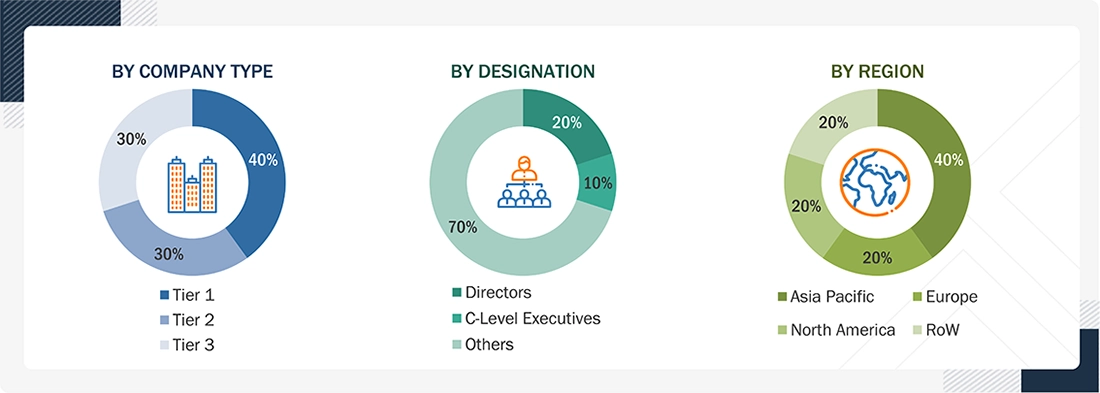
To know about the assumptions considered for the study, download the pdf brochure
Market Size Estimation
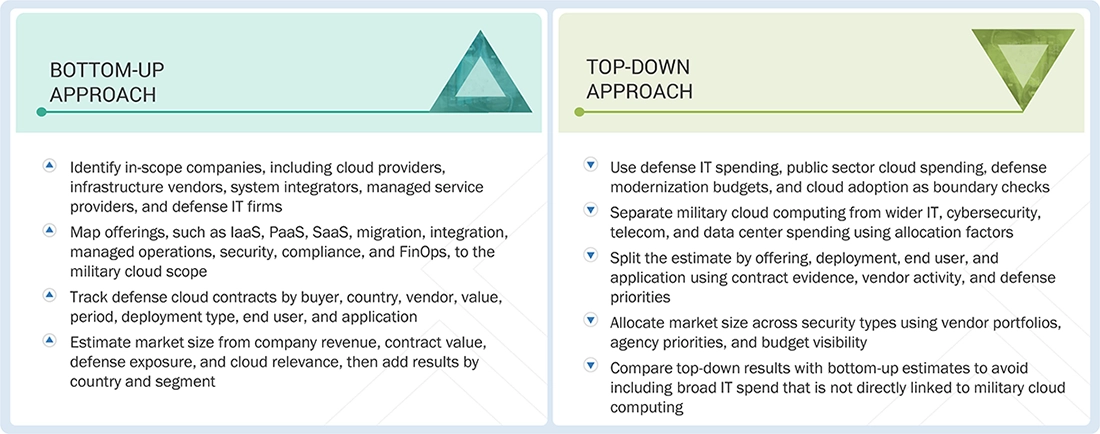
Top-down and bottom-up approaches were used to estimate and validate the size of the military cloud computing market. The bottom-up approach was used as the main method, while the top-down approach was used as a reasonableness check.
The research methodology used to estimate the market size included the following details:
- Key companies in the military cloud computing market were identified through secondary research. These included cloud providers, infrastructure vendors, system integrators, managed service providers, defense IT firms, SaaS providers and tactical edge cloud providers. Their military cloud revenue was estimated using company revenue, business segment revenue, contract awards, defense exposure, product fit, and geographic presence.
- Market shares, splits, and breakdowns were determined using public sources, company filings, contract databases, defense procurement records, and vendor disclosures. The market was split by offering, deployment, end user, application, country, and region, based on visible contracts and company-level revenue allocation.
- Top-down checks were used to test whether the final estimates were reasonable against broader defense IT spending, public sector cloud spending, defense digital modernization budgets, and cloud adoption levels. The final data was reviewed to avoid including general IT, telecom, cybersecurity, or data center spending that was not directly linked to military cloud computing.
Military Cloud Computing Market : Top-Down and Bottom-Up Approach
Data Triangulation
After determining the overall market size, the total market was classified into several segments and subsegments. The data triangulation and market breakdown procedures explained below were implemented, wherever applicable, to complete the overall market engineering process and arrive at the estimated market numbers for the market segments and subsegments. The data was triangulated by examining various factors and trends on both the demand and supply sides. Additionally, the market size was validated using top-down and bottom-up approaches.
Market Definition
Military cloud computing includes cloud infrastructure, platforms, software, migration, integration, managed operations, cloud security, compliance, and cost management used by defense organizations. Cloud storage is part of the market, but the market also covers wider cloud services and support, not storage alone.
Key Stakeholders
- Cloud Platform Providers
- Cloud Infrastructure and Software Providers
- Cloud Integration and Managed Services Providers
- Defense End Users
- Government and Defense Procurement Bodies
- Cybersecurity, Compliance, and Authorization Bodies
- Defense Primes and Mission System Integrators
- Tactical Edge and Communications Providers
Report Objectives
- To define, describe, and forecast the military cloud computing market based on offering, application, end user, deployment, and region in terms of value
- To forecast the size of various segments of the market across North America, Europe, Asia Pacific and RoW, in terms of value
- To identify and analyze the drivers, restraints, opportunities, and challenges influencing the growth of the market
- To identify industry trends, market trends, and technology trends currently prevailing in the military cloud computing market
- To provide an overview of the regulatory landscape with respect to military cloud computing across regions
- To analyze micromarkets with respect to individual growth trends, prospects, and their contribution to the overall market
- To analyze opportunities in the market for stakeholders by identifying key market trends
- To profile key market players and comprehensively analyze their market share and core competencies
- To evaluate the degree of competition in the market by analyzing recent developments, such as contracts, agreements, and acquisitions adopted by leading market players
- To identify detailed financial positions, key products, and unique selling points of leading companies in the market
- To provide a detailed competitive landscape of the market, along with market share analysis and revenue analysis of key players
Available customizations:
MarketsandMarkets offers the following customizations for this market report:
- Additional country-level analysis of the military cloud computing market
- Profiling of other market players (Up to 5)
Product Analysis
- Product matrix, which provides a detailed comparison of the product portfolios of each company in the military cloud computing market
Personalize This Research
- Triangulate with your Own Data
- Get Data as per your Format and Definition
- Gain a Deeper Dive on a Specific Application, Geography, Customer or Competitor
- Any level of Personalization
Let Us Help You
- What are the Known and Unknown Adjacencies Impacting the Military Cloud Computing Market
- What will your New Revenue Sources be?
- Who will be your Top Customer; what will make them switch?
- Defend your Market Share or Win Competitors
- Get a Scorecard for Target Partners

Leading technology innovator in Aerospace and Defense
MarketsandMarkets has been crucial to our research findings and so far, they are the best source we've been able to locate. I'm sure nobody has the predictions nailed, but they seem to know it better than most.
