






- DESCRIPTION
- TABLE OF CONTENTS
- METHODOLOGY
- DOWNLOAD PDF
North America Probiotics Market by Product Type (Functional Food & Beverages, Dietary Supplements, and Feed), Ingredient (Bacteria and Yeast), End User (Human and Animal), Distribution Channel, and Region - Forecast to 2030

USD 21.92 BN
MARKET SIZE, 2030

CAGR 8.2%
(2025-2030)

250
REPORT PAGES

200
MARKET TABLES
OVERVIEW
Source: Secondary Research, Interviews with Experts, MarketsandMarkets Analysis
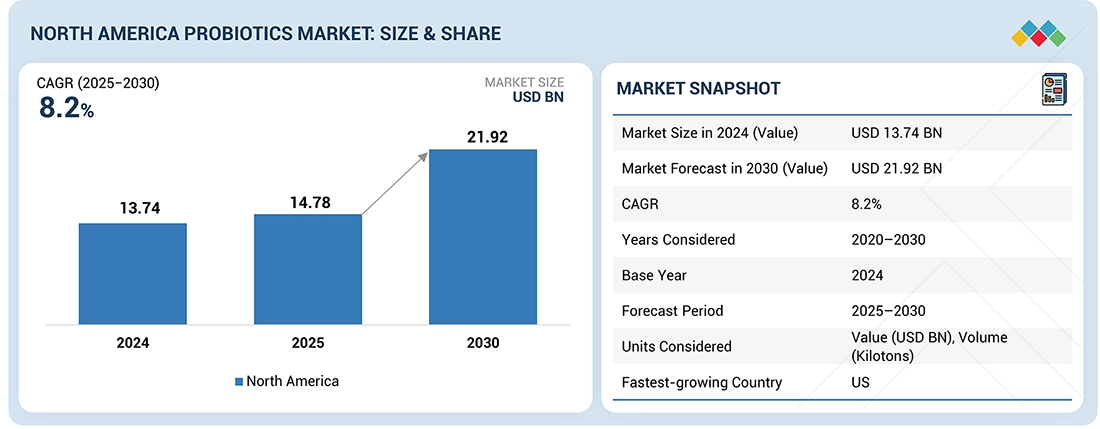
The North America probiotics market is projected to reach USD 21.92 billion by 2030 from USD 14.78 billion in 2025, at a CAGR of 8.2% from 2025 to 2030. The market is expanding due to growing consumer focus on digestive wellness, immune health, and the broader preventive-nutrition trend across the region. Demand for clinically validated probiotics continues to rise as manufacturers incorporate them into foods, beverages, dietary supplements, and functional snacks tailored to specific health outcomes. Adoption of scientifically supported probiotic formulations is increasing, supported by strong retail penetration, extensive product innovation, and heightened awareness driven by healthcare professionals. Market growth is further strengthened by advances in stability, delivery formats, and research linking the gut microbiome to metabolic, cognitive, and overall health.
KEY TAKEAWAYS
-
BY COUNTRY
The US probiotics market is projected to register the highest CAGR of 8.1% during the forecast period.
-
BY PRODUCT TYPE
By product type, the functional food & beverage segment is estimated to hold a significant market share of 74.59%.
-
BY INGREDIENT
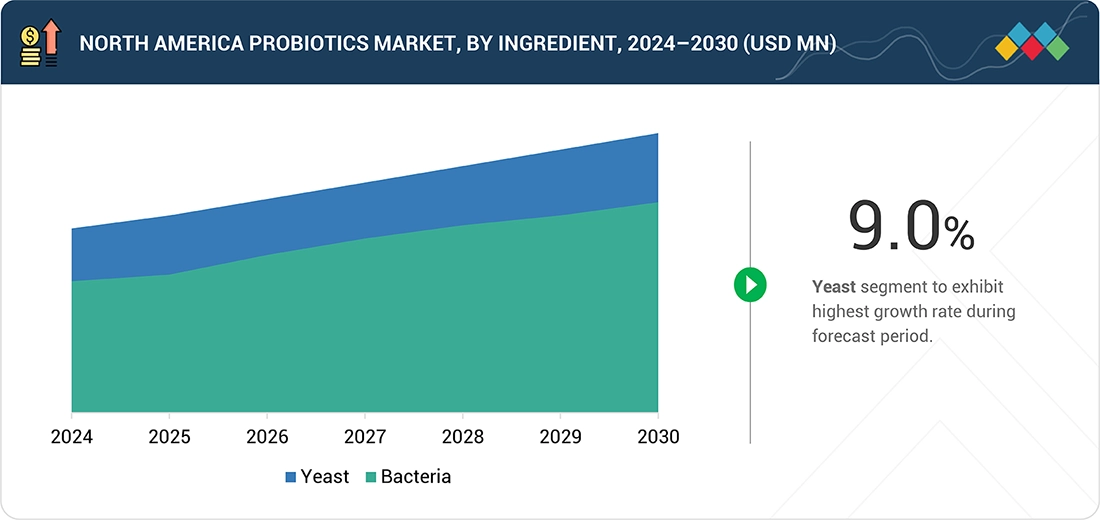
By ingredient, the yeast segment is projected to grow at the highest rate from 2025 to 2030.
-
BY DISTRIBUTION CHANNEL
By distribution channel, the online segment is projected to witness the fastest growth during the forecast period.
-
BY END USER
By end user, the human segment is estimated to dominate the market. It is also projected to register the highest CAGR of 8.1%.
-
COMPETITIVE LANDSCAPE
ADM, Probi USA Inc., Danone North America Public Benefit Corporation, International Flavors & Fragrances Inc., and Nestlé USA were identified as leading players in the North America probiotics market, supported by their strong product portfolios.
The North America probiotics market is poised for steady growth, supported by rising demand for products that promote digestive wellness and immune support. Increasing use of probiotics across foods, beverages, and supplements, along with greater consumer awareness of gut health, is strengthening market momentum. Innovation in convenient and shelf-stable formats, paired with expanding retail availability, is further driving adoption. Continued investment in evidence-based probiotic solutions is expected to support long-term market development.
TRENDS & DISRUPTIONS IMPACTING CUSTOMERS' CUSTOMERS
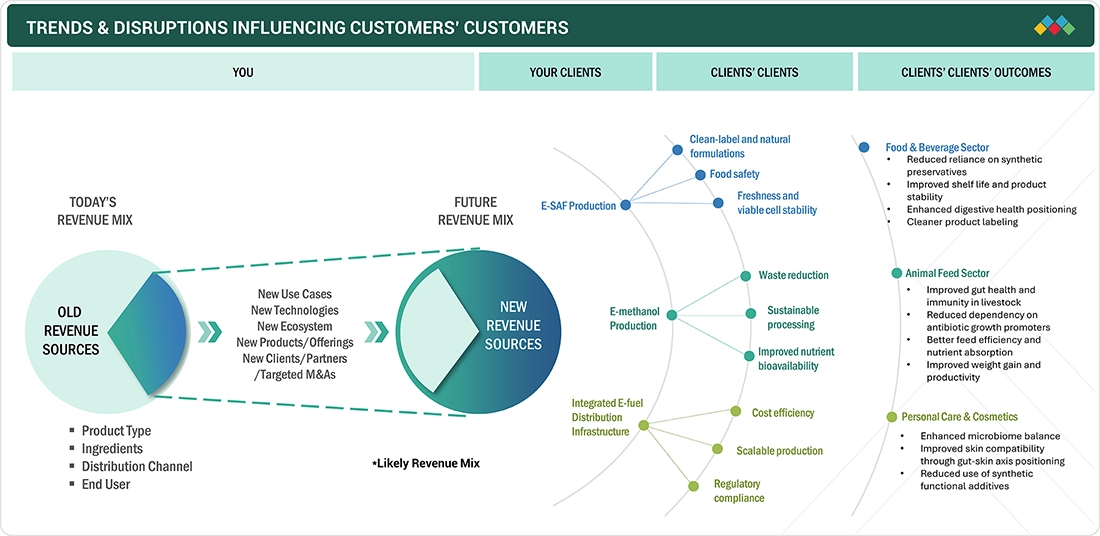
The North America probiotics market is experiencing notable shifts driven by the rise of non-dairy and plant-based probiotic formats, the expansion of shelf-stable products, and growing consumer interest in multifunctional wellness solutions. Innovation in convenient delivery forms such as gummies, shots, and functional snacks is reshaping category engagement, while digital retail channels accelerate access to specialized probiotic offerings. At the same time, increasing scrutiny on product claims and heightened demand for clinically supported formulations are prompting companies to refine positioning and invest in quality differentiation. These developments are redefining competitive strategies and influencing future market direction.
Source: Secondary Research, Interviews with Experts, MarketsandMarkets Analysis
MARKET DYNAMICS

Drivers
Impact
Level
-
Rising consumer focus on digestive wellness and immune health

-
Expansion of probiotic-enriched product formats


RESTRAINTS
Impact
Level
-
Viability and stability limitations across different delivery formats

-
Regulatory scrutiny around health claims and labeling


OPPORTUNITIES
Impact
Level
-
Expansion through personalized and targeted wellness solutions

-
Growth of plant-based and non-dairy probiotic categories


CHALLENGES
Impact
Level
-
Intensifying competition from emerging functional ingredients

-
Supply chain pressures for high-quality, clinically supported ingredients

Source: Secondary Research, Interviews with Experts, MarketsandMarkets Analysis
A major driver of the North America probiotics market is the growing consumer emphasis on maintaining digestive balance and supporting immune function through everyday nutrition. Probiotics are increasingly incorporated into routine wellness habits as shoppers seek convenient, food-based approaches to health management. This shift is further reinforced by strong retail availability of probiotic yogurts, beverages, and supplements, which encourages consistent use and broadens market engagement.
One of the key restraints in the probiotic market is the challenge of maintaining live cultures throughout processing, storage, and consumption. Temperature fluctuations, moisture exposure, and formulation conditions can reduce the functional effectiveness of probiotics in certain foods and beverages. These stability concerns limit flexibility in product development and may restrict adoption in categories where maintaining viability is difficult.
A significant opportunity for the probiotics market lies in developing products tailored to specific wellness needs such as digestive comfort, women’s health, metabolic support, and immune maintenance. As consumers increasingly seek individualized approaches, brands can differentiate through clear benefit positioning and specialized formulations. This aligns well with North America’s growing interest in customized nutrition and supports premium product growth across retail and e-commerce channels.
A key challenge for the probiotics market is the rising competition from other gut-health ingredients, including prebiotics, postbiotics, and dietary fibers. These alternatives offer stability advantages and are often easier to incorporate into diverse product formats, prompting companies to strengthen product differentiation. As functional ingredient portfolios expand, probiotic brands must work harder to maintain visibility and communicate clear value to consumers.
NORTH AMERICA PROBIOTICS MARKET: COMMERCIAL USE CASES ACROSS INDUSTRIES
| COMPANY | USE CASE DESCRIPTION | BENEFITS |
|---|---|---|
|
|
Uses probiotics in yogurt and dairy-alternative products to support everyday digestive wellness across mainstream retail categories | Provides consumers with convenient daily options that help maintain digestive balance |
|
|
Incorporates probiotics into yogurt cups and drinkable products aimed at promoting general wellness through accessible food formats | Delivers familiar, easy-to-consume foods that support routine gut health |
|
|
Adds probiotics to kefir beverages for consumers seeking functional nutrition aligned with digestive and immune support | Offers nutrient-rich, ready-to-drink options that enhance digestive comfort |
|
|
Integrates probiotics into select breakfast and snack products to expand functional nutrition beyond dairy categories | Enables convenient, everyday consumption of probiotics through shelf-stable formats |



Logos and trademarks shown above are the property of their respective owners. Their use here is for informational and illustrative purposes only.
MARKET ECOSYSTEM
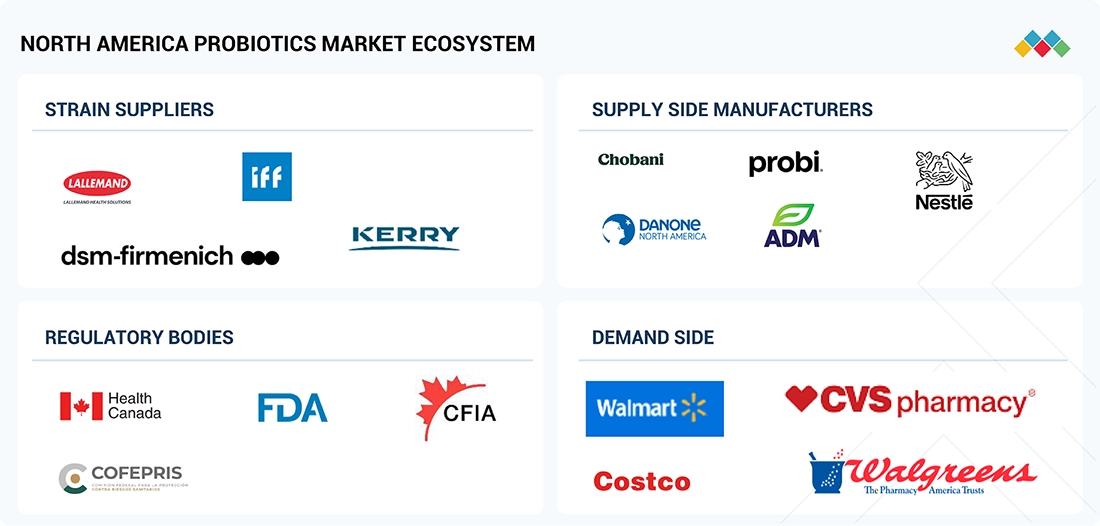
The North America probiotics market ecosystem includes food and beverage companies and supplement manufacturers that integrate probiotics into consumer products, supported by retailers and online platforms that ensure market reach. Regulatory agencies oversee labeling and health claim compliance, while research institutions and product developers advance formulation technologies. Healthcare professionals and nutrition advisors further influence consumer adoption. This ecosystem is driven by innovation, regulatory oversight, and growing demand for accessible digestive and immune health solutions.
Logos and trademarks shown above are the property of their respective owners. Their use here is for informational and illustrative purposes only.
MARKET SEGMENTS
Source: Secondary Research, Interviews with Experts, MarketsandMarkets Analysis
The functional food & beverage segment holds a significant share of the North America probiotics market, supported by strong consumption of probiotic yogurts, fermented dairy alternatives, and fortified beverages. These products benefit from high retail visibility and daily-use positioning, making them the preferred choice for consumers integrating probiotic intake into routine nutrition.
By ingredient, the yeast segment is projected to grow at the fastest rate, driven by its stability advantages and suitability for bakery, beverage, and supplement applications. Yeast-based probiotics offer improved survival in varied processing and storage conditions, expanding their use in shelf-stable and non-dairy products across the region.
By distribution channel, the online segment is projected to exhibit the fastest growth during the forecast period, supported by expanding e-commerce penetration, subscription-based supplement purchasing, and consumer preference for convenient access to specialized probiotic products. Digital platforms also facilitate broader brand visibility and targeted wellness marketing.
By end user, the human segment is expected to dominate the market, growing at the highest rate due to rising demand for digestive and immune health solutions across adults, children, and seniors. Increased consumer awareness, healthcare practitioner recommendations, and product innovation across food, beverage, and supplement formats reinforce this segment’s leadership.
REGION
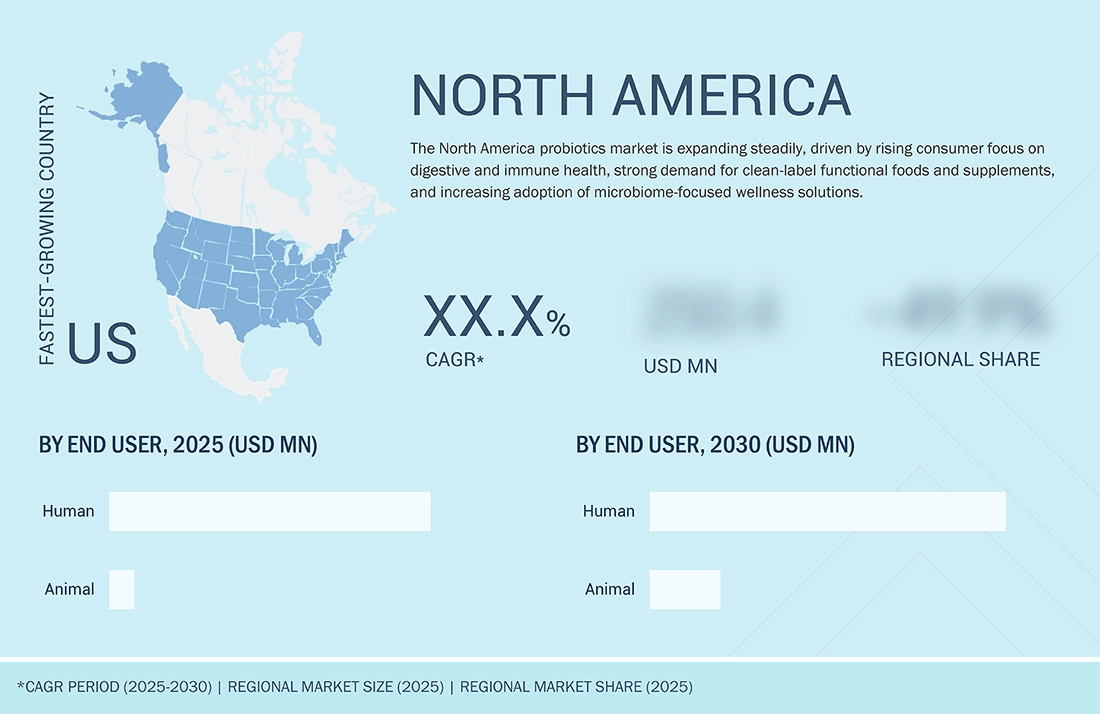
US to be fastest-growing country in North America probiotics market during forecast period
The US is anticipated to be the fastest-growing market for probiotics in the North American region during the forecast period, supported by strong consumer interest in digestive wellness, immunity, and functional nutrition. Growth is reinforced by high demand for probiotic-fortified foods, beverages, and supplements, along with expanding adoption of non-dairy and shelf-stable formats. The country’s advanced retail infrastructure, rising e-commerce penetration, and increasing influence of healthcare professionals further accelerate market momentum. Continued investment in product innovation, labeling compliance, and science-backed wellness solutions is expected to boost the expansion of the probiotic market in the US.
NORTH AMERICA PROBIOTICS MARKET: COMPANY EVALUATION MATRIX
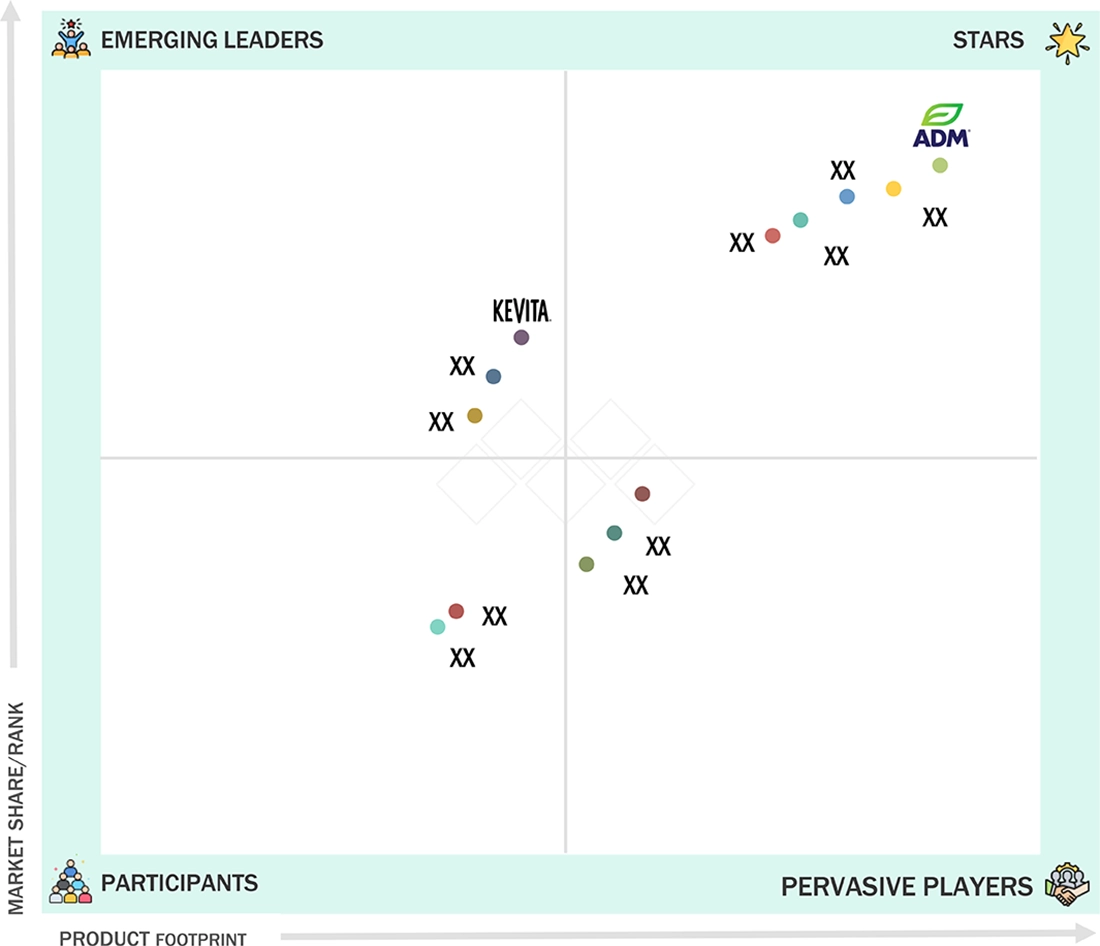
A competitive landscape framework for the North America probiotics market classifies companies as Stars, Emerging Leaders, Participants, or Pervasive Players based on their innovation capabilities, market reach, and growth prospects. ADM is positioned as a Star player, reflecting its expanding probiotic portfolio, strong R&D capabilities, and broad integration across functional foods, beverages, and supplements. Kevita is identified as an Emerging Leader, supported by its focus on probiotic beverages and growing presence in refrigerated functional drink categories. Participants generally represent niche or regional players, while Pervasive Players maintain a broad market presence with established portfolios but limited innovation momentum.
Source: Secondary Research, Interviews with Experts, MarketsandMarkets Analysis
KEY MARKET PLAYERS
- ADM (US)
- Probi USA Inc. (US)
- Danone North America Public Benefit Corporation (US)
- International Flavors & Fragrances Inc. (US)
- Nestle USA (US)
- Lifeway Foods , Inc. (US)
- Lactalis American Group, Inc. (US)
- Kevita (US)
- Nature’s Bounty (US)
- Renewlife (US
- Garden of Life (US)
- Jarrow Formulas, Inc. (US)
- Now Foods (US)
- Kerry Group plc (Ireland)
- Chobani, LLC. (US)
MARKET SCOPE
| REPORT METRIC | DETAILS |
|---|---|
| Market Size in 2024 (Value) | USD 13.74 Billion |
| Market Forecast in 2030 (value) | USD 21.92 Billion |
| Growth Rate | CAGR of 8.2% during 2025-2030 |
| Years Considered | 2020-2030 |
| Base Year | 2024 |
| Forecast Period | 2025-2030 |
| Units Considered | Value (USD Million/Billion), Volume (Kilotons) |
| Report Coverage | Revenue forecast, company ranking, competitive landscape, growth factors, and trends. |
| Segments Covered |
|
| Countries Covered | US, Canada, Mexico |
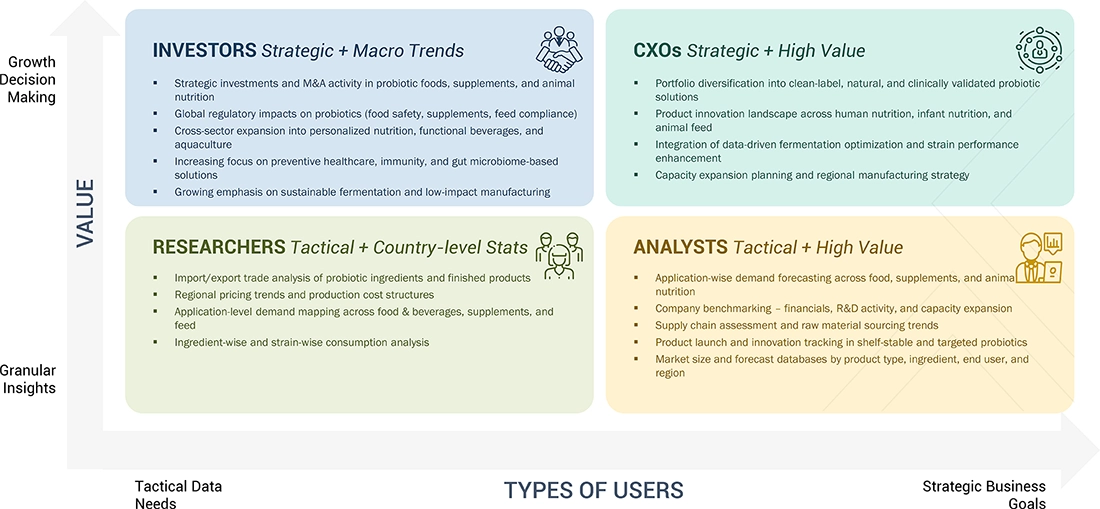
WHAT IS IN IT FOR YOU: NORTH AMERICA PROBIOTICS MARKET REPORT CONTENT GUIDE
DELIVERED CUSTOMIZATIONS
We have successfully delivered the following deep-dive customizations:
| CLIENT REQUEST | CUSTOMIZATION DELIVERED | VALUE ADDS |
|---|---|---|
| Probiotic Ingredients Market |
|
|
| US Digestive Health Enzymes |
|
|
| Feed Yeast Market |
|
|
RECENT DEVELOPMENTS
- June 2025 : Lifeway Foods, Inc. expanded the distribution of its kefir and farmer cheese probiotic products into major US retailers, including Amazon Fresh, BJ’s Wholesale Club, and CVS.
- April 2023 : ADM partnered with Brightseed to explore interactions between dietary bioactives and the gut microbiome, aiming to develop evidence-based synbiotic products for human nutrition.
- November 2021 : ADM completed its acquisition of Deerland Probiotics & Enzymes, adding probiotic, prebiotic, and enzyme technologies to its Health & Wellness portfolio.
- August 2021 : Nestlé Health Science completed its acquisition of Supplement Brands from The Bountiful Company, gaining major North American probiotic/VMS brands.
Table of Contents
 Exclusive indicates content/data unique to MarketsandMarkets and not available with any competitors.
TITLE
PAGE NO
1
INTRODUCTION
15
2
EXECUTIVE SUMMARY
3
PREMIUM INSIGHTS
4
MARKET OVERVIEW
4.1
INTRODUCTION
4.2
MARKET DYNAMICS
4.2.1
DRIVERS
4.2.1.1
RISING CONSUMER AWARENESS OF GUT HEALTH AND IMMUNITY
4.2.1.2
GROWTH OF FUNCTIONAL FOODS & BEVERAGES AND DIVERSE DELIVERY FORMATS
4.2.1.3
PREVENTIVE HEALTHCARE AND LIFESTYLE TRENDS
4.2.1.4
E-COMMERCE AND DIRECT-TO-CONSUMER DISTRIBUTION
4.2.2
RESTRAINTS
4.2.2.1
REGULATORY AMBIGUITY AROUND HEALTH CLAIMS AND PRODUCT CLASSIFICATION
4.2.2.2
STABILITY, SHELF-LIFE, AND SUPPLY-CHAIN COMPLEXITY
4.2.2.3
HIGH PRODUCTION COSTS
4.2.3
OPPORTUNITIES
4.2.3.1
NEXT-GENERATION PROBIOTIC FORMULATIONS
4.2.3.2
EXPANSION INTO NEW CATEGORIES
4.2.3.3
ADVANCES IN DELIVERY AND PROTECTION TECHNOLOGIES
4.2.4
CHALLENGES
4.2.4.1
INTENSE COMPETITION AND COMMODITIZATION
4.2.4.2
COMPLEX MANUFACTURING AND QUALITY CONTROL REQUIREMENTS
4.3
UNMET NEEDS AND WHITE SPACES
4.4
INTERCONNECTED MARKETS AND CROSS-SECTOR OPPORTUNITIES
4.5
STRATEGIC MOVES BY TIER-1/2/3 PLAYERS
5
INDUSTRY TRENDS
5.1
PORTER'S FIVE FORCES ANALYSIS
5.2
MACROECONOMICS INDICATORS
5.2.1
INTRODUCTION
5.2.2
GDP TRENDS AND FORECAST
5.2.3
TRENDS IN NORTH AMERICAN PROBIOTICS INDUSTRY
5.3
SUPPLY CHAIN ANALYSIS
5.4
VALUE CHAIN ANALYSIS
5.5
ECOSYSTEM ANALYSIS
5.6
PRICING ANALYSIS
5.6.1
AVERAGE SELLING PRICE TREND OF KEY PLAYERS, BY PRODUCT TYPE (2020–2024)
5.6.2
AVERAGE SELLING PRICE TREND, BY INGREDIENT (2020–2024)
5.6.3
AVERAGE SELLING PRICE TREND, BY REGION (2020–2024)
5.7
TRADE ANALYSIS
5.7.1
IMPORT SCENARIO (HS CODE)
5.7.2
EXPORT SCENARIO (HS CODE)
5.8
KEY CONFERENCES & EVENTS IN 2025–2026
5.9
TRENDS/DISRUPTIONS IMPACTING CUSTOMER BUSINESS
5.10
INVESTMENT AND FUNDING SCENARIO
5.11
CASE STUDY ANALYSIS
5.12
IMPACT OF 2025 US TARIFF – NORTH AMERICA PROBIOTICS MARKET
5.12.1
INTRODUCTION
5.12.2
KEY TARIFF RATES
5.12.3
PRICE IMPACT ANALYSIS
5.12.4
IMPACT ON COUNTRIES
5.12.5
IMPACT ON END-USE INDUSTRIES
6
STRATEGIC DISRUPTION THROUGH TECHNOLOGY, PATENTS, DIGITAL, AND AI ADOPTIONS
6.1
KEY EMERGING TECHNOLOGIES
6.2
COMPLEMENTARY TECHNOLOGIES
6.3
TECHNOLOGY/PRODUCT ROADMAP
6.4
PATENT ANALYSIS
6.5
FUTURE APPLICATIONS
6.6
IMPACT OF AI/GEN AI ON NORTH AMERICA PROBIOTICS MARKET
6.6.1
TOP USE CASES AND MARKET POTENTIAL
6.6.2
BEST PRACTICES IN NORTH AMERICA PROBIOTICS MARKET
6.6.3
CASE STUDIES OF AI IMPLEMENTATION IN NORTH AMERICA PROBIOTICS MARKET
6.6.4
INTERCONNECTED ADJACENT ECOSYSTEM AND IMPACT ON MARKET PLAYERS
6.6.5
CLIENTS’ READINESS TO ADOPT GENERATIVE AI IN NORTH AMERICA PROBIOTICS MARKET
6.7
SUCCESS STORIES AND REAL-WORLD APPLICATIONS
7
SUSTAINABILITY AND REGULATORY LANDSCAPE
7.1
REGIONAL REGULATIONS AND COMPLIANCE
7.1.1
REGULATORY BODIES, GOVERNMENT AGENCIES, AND OTHER ORGANIZATIONS
7.1.2
INDUSTRY STANDARDS
7.2
SUSTAINABILITY INITIATIVES
7.3
SUSTAINABILITY IMPACT AND REGULATORY POLICY INITIATIVES
7.4
CERTIFICATIONS, LABELING, ECO-STANDARDS
8
CUSTOMER LANDSCAPE AND BUYER BEHAVIOR
8.1
DECISION-MAKING PROCESS
8.2
BUYER STAKEHOLDERS AND BUYING EVALUATION CRITERIA
8.3
ADOPTION BARRIERS &AND INTERNAL CHALLENGES
8.4
UNMET NEEDS FROM VARIOUS END-USE INDUSTRIES
8.5
MARKET PROFITABILITY
9
NORTH AMERICA PROBIOTICS MARKET, BY PRODUCT TYPE (MARKET SIZE & FORECAST TO 2030 – IN VALUE, USD MILLION)
TYPE-WISE DEMAND POTENTIAL AND GROWTH PATHWAYS
9.1
INTRODUCTION
9.2
FUNCTIONAL FOOD & BEVERAGES
9.2.1.1
GROWING USE OF PROBIOTIC-FORTIFIED YOGURTS, BEVERAGES, AND FERMENTED FOODS ACROSS NORTH AMERICA TO FUEL MARKET
9.2.2
DAIRY PRODUCTS
9.2.3
NONDAIRY BEVERAGES
9.2.4
INFANT FORMULA
9.2.5
CEREALS
9.2.6
OTHER FUNCTIONAL FOOD & BEVERAGES
9.3
DIETARY SUPPLEMENTS
9.3.1.1
INCREASING ADOPTION OF PROBIOTIC SUPPLEMENTS FOR DIGESTIVE WELLNESS AND IMMUNITY SUPPORT TO DRIVE MARKET
9.3.2
TABLETS
9.3.3
CAPSULES
9.3.4
POWDERS
9.3.5
LIQUIDS
9.3.6
SOFT GELS
9.3.7
GEL CAPS
9.4
FEED
9.4.1.1
RISING USE OF PROBIOTICS IN ANIMAL FEED TO IMPROVE GUT HEALTH, IMMUNITY, AND PRODUCTIVITY IN LIVESTOCK AND PETS TO DRIVE MARKET
10
NORTH AMERICA PROBIOTICS MARKET, BY INGREDIENT (MARKET SIZE & FORECAST TO 2030 – IN VALUE, USD MILLION)
INGREDIENTS-WISE DEMAND POTENTIAL AND GROWTH PATHWAYS
10.1
INTRODUCTION
10.2
BACTERIA
10.2.1.1.1
GROWING RELIANCE ON CLINICALLY VALIDATED BACTERIAL STRAINS FOR GUT HEALTH AND IMMUNE SUPPORT TO DRIVE MARKET
10.2.2
LACTOBACILLIX
10.2.2.1
LACTOBACILLUS ACIDOPHILUS
10.2.2.2
LACTOBACILLUS RHAMNOSUS
10.2.2.3
LACTOBACILLUS CASEI
10.2.2.4
LACTOBACILLUS REUTERI
10.2.3
BIFIDOBACTERIUM
10.2.4
STREPTOCOCCUS THERMOPHILUS
10.3
YEAST
10.3.1.1.1
INCREASING USE OF PROBIOTIC YEASTS FOR GASTROINTESTINAL BALANCE AND HIGH-STABILITY FORMULATIONS TO FUEL MARKET
10.3.2
SACCHAROMYCES BOULARDII
10.3.3
OTHER YEASTS
11
NORTH AMERICA PROBIOTICS MARKET, BY DISTRIBUTION CHANNEL (MARKET SIZE & FORECAST TO 2030 – IN VALUE, USD MILLION)
11.1
INTRODUCTION
11.2
HYPERMARKETS/SUPERMARKETS
11.2.1.1
WIDE PRODUCT AVAILABILITY AND STRONG CONSUMER FOOTFALL IN LARGE RETAIL CHAINS TO DRIVE MARKET
11.3
PHARMACIES/DRUGSTORES
11.3.1.1
GROWING CONSUMER TRUST IN PHARMACIST-RECOMMENDED PROBIOTIC PRODUCTS TO BOOST MARKET
11.4
SPECIALTY STORES
11.4.1.1
RISING DEMAND FOR PREMIUM AND CLINICALLY BACKED PROBIOTIC FORMULATIONS TO FUEL MARKET
11.5
ONLINE
11.5.1.1
EXPANSION OF E-COMMERCE AND SUBSCRIPTION-BASED PROBIOTIC PURCHASES TO DRIVE MARKET
11.6
CONVENIENCE STORES/SMALL RETAIL FORMATS
11.6.1.1
EASY ACCESS TO SINGLE-SERVE PROBIOTIC BEVERAGES AND SUPPLEMENTS TO BOOST MARKET
12
NORTH AMERICA PROBIOTICS MARKET, BY END USER (MARKET SIZE & FORECAST TO 2030 – IN VALUE, USD MILLION)
12.1
INTRODUCTION
12.2
HUMAN
12.2.1.1
GROWING FOCUS ON DIGESTIVE WELLNESS AND IMMUNITY INCREASING PROBIOTIC ADOPTION AMONG CONSUMERS TO DRIVE MARKET
12.3
ANIMAL
12.3.1.1
RISING USE OF PROBIOTICS IN PET AND LIVESTOCK NUTRITION TO SUPPORT GUT HEALTH AND OVERALL PRODUCTIVITY TO DRIVE MARKET
13
NORTH AMERICA PROBIOTICS MARKET, BY COUNTRY
13.1
US
13.1.1
HIGH CONSUMER AWARENESS OF GUT HEALTH AND STRONG UPTAKE OF PROBIOTIC SUPPLEMENTS
13.2
CANADA
13.2.1
GROWING DEMAND FOR FUNCTIONAL FOODS ENRICHED WITH PROBIOTICS ACROSS MAJOR RETAIL CHANNELS
13.3
MEXICO
13.3.1
INCREASING CONSUMPTION OF PROBIOTIC BEVERAGES AND FERMENTED DAIRY PRODUCTS
14
COMPETITIVE LANDSCAPE
STRATEGIC ASSESSMENT OF LEADING PLAYERS, MARKET SHARE, REVENUE ANALYSIS, COMPANY POSITIONING, AND COMPETITIVE BENCHMARKS INFLUENCING MARKET POTENTIAL
14.1
OVERVIEW
14.2
KEY PLAYER STRATEGIES/RIGHT TO WIN
14.2.1
COMPETITIVE STRATEGIES
14.3
REVENUE ANALYSIS, 2022–2024
14.4
MARKET SHARE ANALYSIS,
14.5
BRAND/PRODUCT COMPARISON
14.6
COMPANY EVALUATION MATRIX: KEY PLAYERS,
14.6.1
STARS
14.6.2
EMERGING LEADERS
14.6.3
PERVASIVE PLAYERS
14.6.4
PARTICIPANTS
14.6.5
COMPANY FOOTPRINT: KEY PLAYERS,
14.6.5.1
COMPANY FOOTPRINT
14.6.5.2
COUNTRY FOOTPRINT
14.6.5.3
TYPE FOOTPRINT
14.6.5.4
APPLICATION FOOTPRINT
14.7
COMPANY EVALUATION MATRIX: STARTUPS/SMES,
14.7.1
PROGRESSIVE COMPANIES
14.7.2
RESPONSIVE COMPANIES
14.7.3
DYNAMIC COMPANIES
14.7.4
STARTING BLOCKS
14.7.5
COMPETITIVE BENCHMARKING: KEY STARTUPS/SMES
14.7.5.1
DETAILED LIST OF KEY STARTUPS/SMES
14.7.5.2
COMPETITIVE BENCHMARKING OF KEY STARTUPS/SMES
14.8
COMPETITIVE SCENARIO
14.8.1
PRODUCT LAUNCHES
14.8.2
DEALS
14.8.3
EXPANSIONS
14.8.4
OTHER DEVELOPMENTS
15
COMPANY PROFILES
IN-DEPTH REVIEW OF COMPANIES, PRODUCTS, SERVICES, RECENT INITIATIVES, AND POSITIONING STRATEGIES IN NORTH AMERICA PROBIOTICS MARKET LANDSCAPE
15.1
KEY PLAYERS
15.1.1
ADM
15.1.1.1
BUSINESS OVERVIEW
15.1.1.2
PRODUCTS/SOLUTIONS/SERVICES OFFERED
15.1.1.3
MNM VIEW
15.1.1.3.1
KEY STRENGTHS
15.1.1.3.2
STRATEGIC CHOICES
15.1.1.3.3
WEAKNESSES/COMPETITIVE THREATS
15.1.2
NESTLE USA
15.1.2.1
BUSINESS OVERVIEW
15.1.2.2
PRODUCTS/SOLUTIONS/SERVICES OFFERED
15.1.2.3
MNM VIEW
15.1.2.3.1
KEY STRENGTHS
15.1.2.3.2
STRATEGIC CHOICES
15.1.2.3.3
WEAKNESSES/COMPETITIVE THREATS
15.1.3
PROBI USA INC.
15.1.3.1
BUSINESS OVERVIEW
15.1.3.2
PRODUCTS/SOLUTIONS/SERVICES OFFERED
15.1.3.3
MNM VIEW
15.1.3.3.1
KEY STRENGTHS
15.1.3.3.2
STRATEGIC CHOICES
15.1.3.3.3
WEAKNESSES/COMPETITIVE THREATS
15.1.4
DANONE NORTH AMERICA PUBLIC BENEFIT CORPORATION
15.1.4.1
BUSINESS OVERVIEW
15.1.4.2
PRODUCTS/SOLUTIONS/SERVICES OFFERED
15.1.4.3
MNM VIEW
15.1.4.3.1
KEY STRENGTHS
15.1.4.3.2
STRATEGIC CHOICES
15.1.4.3.3
WEAKNESSES/COMPETITIVE THREATS
15.1.5
INTERNATIONAL FLAVORS & FRAGRANCES INC.
15.1.5.1
BUSINESS OVERVIEW
15.1.5.2
PRODUCTS/SOLUTIONS/SERVICES OFFERED
15.1.5.3
MNM VIEW
15.1.5.3.1
KEY STRENGTHS
15.1.5.3.2
STRATEGIC CHOICES
15.1.5.3.3
WEAKNESSES/COMPETITIVE THREATS
15.1.6
LIFEWAY FOODS, INC.
15.1.6.1
BUSINESS OVERVIEW
15.1.6.2
PRODUCTS/SOLUTIONS/SERVICES OFFERED
15.1.6.3
MNM VIEW
15.1.6.3.1
KEY STRENGTHS
15.1.6.3.2
STRATEGIC CHOICES
15.1.6.3.3
WEAKNESSES/COMPETITIVE THREATS
15.1.7
LACTALIS AMERICAN GROUP, INC.
15.1.7.1
BUSINESS OVERVIEW
15.1.7.2
PRODUCTS/SOLUTIONS/SERVICES OFFERED
15.1.7.3
MNM VIEW
15.1.7.3.1
KEY STRENGTHS
15.1.7.3.2
STRATEGIC CHOICES
15.1.7.3.3
WEAKNESSES/COMPETITIVE THREATS
15.1.8
KERRY GROUP PLC.
15.1.8.1
BUSINESS OVERVIEW
15.1.8.2
PRODUCTS/SOLUTIONS/SERVICES OFFERED
15.1.8.3
MNM VIEW
15.1.8.3.1
KEY STRENGTHS
15.1.8.3.2
STRATEGIC CHOICES
15.1.8.3.3
WEAKNESSES/COMPETITIVE THREATS
15.1.9
NOW FOODS
15.1.9.1
BUSINESS OVERVIEW
15.1.9.2
PRODUCTS/SOLUTIONS/SERVICES OFFERED
15.1.9.3
MNM VIEW
15.1.9.3.1
KEY STRENGTHS
15.1.9.3.2
STRATEGIC CHOICES
15.1.9.3.3
WEAKNESSES/COMPETITIVE THREATS
15.1.10
NATURE’S BOUNTY
15.1.10.1
BUSINESS OVERVIEW
15.1.10.2
PRODUCTS/SOLUTIONS/SERVICES OFFERED
15.1.10.3
MNM VIEW
15.1.10.3.1
KEY STRENGTHS
15.1.10.3.2
STRATEGIC CHOICES
15.1.10.3.3
WEAKNESSES/COMPETITIVE THREATS
15.1.11
RENEWLIFE
15.1.11.1
BUSINESS OVERVIEW
15.1.11.2
PRODUCTS/SOLUTIONS/SERVICES OFFERED
15.1.11.3
MNM VIEW
15.1.11.3.1
KEY STRENGTHS
15.1.11.3.2
STRATEGIC CHOICES
15.1.11.3.3
WEAKNESSES/COMPETITIVE THREATS
15.1.12
GARDEN OF LIFE
15.1.12.1
BUSINESS OVERVIEW
15.1.12.2
PRODUCTS/SOLUTIONS/SERVICES OFFERED
15.1.12.3
MNM VIEW
15.1.12.3.1
KEY STRENGTHS
15.1.12.3.2
STRATEGIC CHOICES
15.1.12.3.3
WEAKNESSES/COMPETITIVE THREATS
15.1.13
JARROW FORMULAS, INC.
15.1.13.1
BUSINESS OVERVIEW
15.1.13.2
PRODUCTS/SOLUTIONS/SERVICES OFFERED
15.1.13.3
MNM VIEW
15.1.13.3.1
KEY STRENGTHS
15.1.13.3.2
STRATEGIC CHOICES
15.1.13.3.3
WEAKNESSES/COMPETITIVE THREATS
15.1.14
KEVITA
15.1.14.1
BUSINESS OVERVIEW
15.1.14.2
PRODUCTS/SOLUTIONS/SERVICES OFFERED
15.1.14.3
MNM VIEW
15.1.14.3.1
KEY STRENGTHS
15.1.14.3.2
STRATEGIC CHOICES
15.1.14.3.3
WEAKNESSES/COMPETITIVE THREATS
15.1.15
CHOBANI, LLC.
15.1.15.1
BUSINESS OVERVIEW
15.1.15.2
PRODUCTS/SOLUTIONS/SERVICES OFFERED
15.1.15.3
MNM VIEW
15.1.15.3.1
KEY STRENGTHS
15.1.15.3.2
STRATEGIC CHOICES
15.1.15.3.3
WEAKNESSES/COMPETITIVE THREATS
15.2
OTHER PLAYERS
15.2.1
JAMIESON VITAMINS
15.2.1.1
BUSINESS OVERVIEW
15.2.1.2
PRODUCTS/SOLUTIONS/SERVICES OFFERED
15.2.1.3
MNM VIEW
15.2.2
GENUINE HEALTH
15.2.2.1
BUSINESS OVERVIEW
15.2.2.2
PRODUCTS/SOLUTIONS/SERVICES OFFERED
15.2.2.3
MNM VIEW
15.2.3
AMWAY
15.2.3.1
BUSINESS OVERVIEW
15.2.3.2
PRODUCTS/SOLUTIONS/SERVICES OFFERED
15.2.3.3
MNM VIEW
15.2.3.4
ELANCO
15.2.3.5
BUSINESS OVERVIEW
15.2.3.6
PRODUCTS/SOLUTIONS/SERVICES OFFERED
15.2.3.7
MNM VIEW
15.2.4
NATURAL FACTORS USA
15.2.4.1
BUSINESS OVERVIEW
15.2.4.2
PRODUCTS/SOLUTIONS/SERVICES OFFERED
15.2.4.3
MNM VIEW
15.2.4.4
ORGANIKA HEALTH PRODUCTS
15.2.4.5
BUSINESS OVERVIEW
15.2.4.6
PRODUCTS/SOLUTIONS/SERVICES OFFERED
15.2.4.7
MNM VIEW
16
RESEARCH METHODOLOGY
16.1
RESEARCH DATA
16.1.1
SECONDARY DATA
16.1.1.1
KEY DATA FROM SECONDARY SOURCES
16.1.2
PRIMARY DATA
16.1.2.1
KEY DATA FROM PRIMARY SOURCES
16.1.2.2
KEY PRIMARY PARTICIPANTS
16.1.2.3
BREAKDOWN OF PRIMARY INTERVIEWS
16.1.2.4
KEY INDUSTRY INSIGHTS
16.2
MARKET SIZE ESTIMATION
16.2.1
BOTTOM-UP APPROACH
16.2.2
TOP-DOWN APPROACH
16.2.3
BASE NUMBER CALCULATION
16.3
MARKET FORECAST APPROACH
16.3.1
SUPPLY SIDE
16.3.2
DEMAND SIDE
16.4
DATA TRIANGULATION
16.5
FACTOR ANALYSIS
16.6
RESEARCH ASSUMPTIONS
16.7
RESEARCH LIMITATIONS AND RISK ASSESSMENT
17
APPENDIX
17.1
DISCUSSION GUIDE
17.2
KNOWLEDGESTORE: MARKETSANDMARKETS’ SUBSCRIPTION PORTAL
17.3
CUSTOMIZATION OPTIONS
17.4
RELATED REPORTS
17.5
AUTHOR DETAILS
Methodology
This research involves the extensive use of secondary sources; directories; and databases (Bloomberg and Factiva) to identify and collect information useful for a technical, market-oriented, and commercial study of the North America Probiotics Market. In-depth interviews were conducted with various primary respondents, such as key industry participants, Subject Matter Experts (SMEs), C-level executives of key market players, and industry consultants, to obtain and verify critical qualitative and quantitative information and to assess prospects.
Secondary Research
In the secondary research process, various sources, such as the Food and Agricultural Organization (FAO), United States Department of Agriculture (USDA), U.S. Food and Drug Administration (FDA) U.S. Food and Drug Administration (FDA), European Food Safety Authority (EFSA), World Health Organization (WHO), Consumer Healthcare Products Association (CHPA), European Federation of Associations of Health Product Manufacturers (EHPM), Canadian Health Food Association (CHFA), and Health Food Manufacturers' Association (HFMA), associations were referred to identify and collect information for this study. The secondary sources also include journals, press releases, investor presentations of companies, whitepapers, certified publications, articles by recognized authors and regulatory bodies, trade directories, and paid databases.
Primary Research
The North America Probiotics Market encompasses various stakeholders involved in the supply chain, raw material manufacturers, raw material suppliers, regulatory organizations, and research institutions. To gather comprehensive information, primary sources from both the supply and demand sides were engaged. Primary interviewees from the supply side consisted of manufacturers, distributors, importers, and technology providers involved in the production and distribution of Probiotics. On the demand side, key opinion leaders, executives, and CEOs of companies in the Probiotics industry were approached through questionnaires, emails, and telephonic interviews. This approach ensured a comprehensive and well-rounded understanding of the North America Probiotics Market from various perspectives.
Market Size Estimation
The top-down and bottom-up approaches were used to estimate and validate the market’s and various dependent submarkets’ size. The research methodology used to estimate the market size includes extensive secondary research of key players, reports, reviews, and newsletters of top market players, along with extensive interviews from leaders, such as CEOs, directors, and marketing executives.
North America Probiotics Market: Data Triangluation
After arriving at the overall size from the market size estimation process explained above, the total market was split into several segments and subsegments. The data triangulation and market breakdown procedures explained below were implemented, wherever applicable, to complete the overall market engineering process and arrive at the exact statistics for various market segments and subsegments. The data was triangulated by studying various factors and trends from the demand and supply sides. Along with this, the market size was validated using both the top-down and bottom-up approaches.
Market Definition
The joint Food and Agriculture Organization (FAO)/World Health Organization (WHO) working group defines probiotics as “live micro-organisms, which when administered in adequate amounts confer a health benefit on the host” (FAO/ WHO, 2001).
Probiotics are living microorganisms that have been shown to provide specific health benefits to consumers. They are known to support gut health and help in running the digestive system smoothly. Yogurt is one of the prime natural sources of probiotics.
According to the National Center for Complementary and Integrative Health, “Probiotics are live microorganisms that are intended to have health benefits when consumed or applied to the body.” The major function of probiotics is to maintain a healthy balance in the body. Several types of microorganisms are present in probiotics, and they may have different effects on the body. The most common bacteria belong to the group called Lactobacillus and Bifidobacterium.
Key Stakeholders
- Manufacturers, Importers and Exporters, Traders, Distributors, and Suppliers of Probiotics
- Nutraceutical Manufacturers
- Food Processors and Manufacturers
- Government and Research Organizations
- Trade Associations and Industry Bodies
-
Regulatory bodies and associations are as follows:
- Food Agriculture Organization (FAO)
- World Health Organization (WHO)
- International Dairy Federation (IDF)
- European Food & Feed Cultures Association (EFFCA)
- National Yogurt Association (NYA)
- International Scientific Association for Probiotics and Prebiotics (ISAPP)
- International Probiotics Association (IPA)
- Council for Responsible Nutrition (CRN)
- National Yogurt Association (NYA)
- International Frozen Yogurt Association (IFYA)
- American Nutrition Association (ANA)
Report Objectives
- To define, segment, and project the North America market for Probiotics on the basis of product type, ingredient, distribution channel, end user, and region
- To provide detailed information regarding the key factors influencing the growth of the market (drivers, restraints, opportunities, and industry-specific challenges)
- To strategically analyze the micro markets with respect to individual growth trends, future prospects, and their contribution to the total market
- To analyze the opportunities in the market for stakeholders and provide a competitive landscape of the market leaders
- To project the size of the market and its submarkets, in terms of value with respect to the regions (along with the key countries)
- To strategically profile the key players and comprehensively analyze their market position and core competencies
- To analyze competitive developments in the North America Probiotics Market, including joint ventures, mergers & acquisitions, new product developments, and research & development activities
Available Customizations:
With the given market data, MarketsandMarkets offers customizations according to company-specific scientific needs.
The following customization options are available for the report:
Product Analysis
- Product Matrix, which gives a detailed comparison of the product portfolio of each company
Company Information
- Detailed analyses and profiling of additional market players
⚡ Growth Signals
Personalize This Research
- Triangulate with your Own Data
- Get Data as per your Format and Definition
- Gain a Deeper Dive on a Specific Application, Geography, Customer or Competitor
- Any level of Personalization
Let Us Help You
- What are the Known and Unknown Adjacencies Impacting the North America Probiotics Market
- What will your New Revenue Sources be?
- Who will be your Top Customer; what will make them switch?
- Defend your Market Share or Win Competitors
- Get a Scorecard for Target Partners


Business Innovation Director
US Based Leading Agribusiness,
Food and Ingredients Manufacturer
I highly appreciate the team's efficiency for a well-conducted study that helped us clarify some blind spots in the area of proteins. Although compiling information for B2B ingredients is very difficult, the MnM team pulled out the task successfully. The quality of research, level of insights, and the responsiveness of the team were commendable!
What the North America Probiotics Report Didn't Show You?
Explore the strategic intelligence behind the North America Probiotics Market
- 🏆 Competitors
- 🎯 Opportunities
- 📈 Growth Signals
Generate 15+ consulting-grade insights instantly
Powered by 17 years of MarketsandMarkets intelligence
