









- DESCRIPTION
- TABLE OF CONTENTS
- METHODOLOGY
- DOWNLOAD PDF
Europe Medical Tubing Market by Material (Plastics, Rubber, Specialty Polymers), Application (Bulk Disposable Tubing, Catheters & Cannulas, Drug Delivery Systems), Structure (Single Lumen, Multi Lumen, Co-Extruded, Braided), and Country - Forecast to 2030

USD 5.14 BN
MARKET SIZE, 2030

CAGR 7.1%
(2026-2030)

300+
REPORT PAGES

230+
MARKET TABLES
OVERVIEW
Source: Secondary Research, Interviews with Experts, MarketsandMarkets Analysis
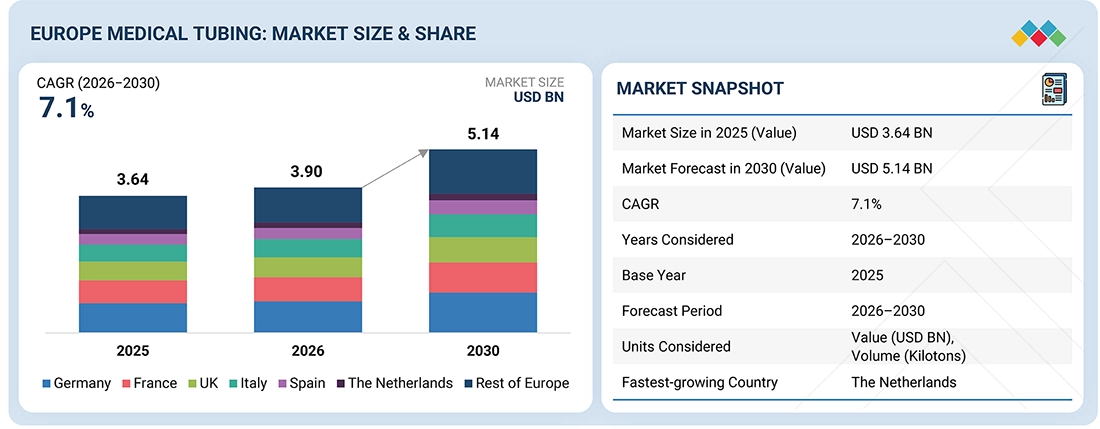
The Europe medical tubing market size is projected to grow from USD 3.64 billion in 2025 to USD 5.14 billion by 2030, registering a CAGR of 7.1% during the forecast period. The growing number of elderly people and the increasing use of less invasive surgeries are the main reasons for the rise in demand for medical tubing. The EU MDR and sustainability regulations also fuel the demand for superior, biocompatible polymer materials in high-tech medical devices.
KEY TAKEAWAYS
-
By Country
Germany dominated the Europe medical tubing market with a share of 23%, in terms of value, in 2025.
-
By Material
Based on material, the rubber segment leads the Europe medical tubing market with a share of 57.2% in 2025, in terms of value.
-
By Structure
The braided tubing segment is expected to record the highest CAGR of 8.9%, in terms of value, during the forecast period.
-
By Application
The drug delivery system is the fastest-growing application of the medical tubing market in Europe.
-
COMPETITIVE LANDSCAPE- KEY PLAYERS
Companies such as B. Braun and Trelleborg Medical were identified as some of the star players in the Europe medical tubing market, given their strong market share and product footprint.
-
COMPETITIVE LANDSCAPE- STARTUPS
Spolyflon Medical, Puresil Techniflex, and Flexicare Medical, among others, have distinguished themselves among startups and SMEs by securing strong footholds in specialized niche areas, underscoring their potential as emerging market leaders.
The Europe medical tubing market is witnessing steady growth, driven by the rising adoption of non-invasive operations, chronic disease management, and high-quality loss tubing. Furthermore, innovations in multi-lumen, co-extruded, and braided forms, together with the adoption of silicone, TPU, and specialty polymers, are increasing performance levels. Market trends are also influenced by the tactical partnerships of OEMs with tubing producers, increased funding for clean-room production, and the invention of eco-friendly and bioabsorbable materials.
TRENDS & DISRUPTIONS IMPACTING CUSTOMERS' CUSTOMERS
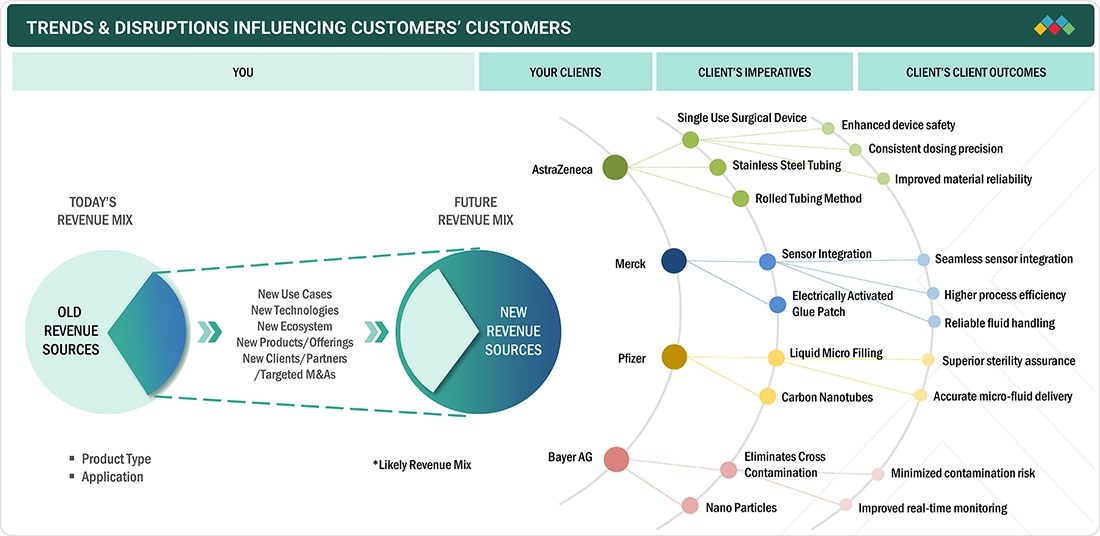
The demand for higher-quality materials, changing regulations, and the emergence of new companies in the supply chain are driving profound changes in the Europe medical tubing market. The introduction of biocompatible polymers as well as smart tubing alternatives has been the basis of recent product variations. Additionally, firms are under stress due to issues stemming from the supply chain, and they are also being compelled to adopt sustainability, which is resulting in the use of new production techniques.
Source: Secondary Research, Interviews with Experts, MarketsandMarkets Analysis
MARKET DYNAMICS

Drivers
Impact
Level
-
Ageing population & chronic-care demand

-
Rise of minimally invasive and catheter-based procedures


RESTRAINTS
Impact
Level
-
Stringent regulatory burden (EU MDR)

-
Procurement cost pressure in public healthcare


OPPORTUNITIES
Impact
Level
-
Nearshoring & localized manufacturing

-
Sustainable & specialty-material innovations


CHALLENGES
Impact
Level
-
Supply-chain volatility & geopolitical sourcing risks

-
Workforce & capacity constraints in EU manufacturing

Source: Secondary Research, Interviews with Experts, MarketsandMarkets Analysis
An aging population and the increasing requirement for chronic care are the major long-term factors that will continue to drive the medical tubing market in Europe. One of the world's oldest populations, Europe is also experiencing a rapid increase in the number of individuals aged 65 and above, with Germany, Italy, France, and Spain being the most affected countries. The change in age distribution is resulting in a corresponding increase in chronic diseases like cardiovascular diseases, diabetes, kidney failure, and lung diseases. Hence, there is a growing need for medical tubing in dialysis systems, vascular access devices, infusion therapies, urinary catheters, and respiratory care. Long-term treatments, regular hospital visits, and an increase in home-care options are additional factors contributing to the demand for high-quality, disposable tubing assemblies. Minimally invasive procedures and supportive therapies cannot be performed without precise tubing. The co-occurrence of an aged population and a high prevalence of chronic diseases results in uninterrupted and continuous demand for medical tubing in Europe.
The EU Medical Device Regulation (EU MDR) imposes heavy regulatory requirements, which substantially lower the demand for the Europe medical tubing market. They are the main source of confusion, extra costs, and long periods for manufacturers to get their products out of the market. The regulation lays down stricter requirements for clinical evidence, material traceability, biocompatibility testing, labeling, and post-market monitoring, even for the least risky components, such as medical tubing. This situation is much worse for small and medium-sized tubing manufacturers as they have fewer regulatory resources, and thus higher certification costs. The situation has been further aggravated by the lack of notified bodies causing delays in the certification process, which in turn, slow down new product launches and technology upgrades. Regulatory measures increase the costs of manufacturing and quality control, thus, making it unprofitable for manufacturers to innovate and enter the market.
The Europe medical tubing market presents a significant opportunity through nearshoring and localized manufacturing. The medical and health sectors, as well as OEMs, are putting more emphasis on the resilience, reliability, and quickness of the supply chain. If global logistics disruptions and stringent regulations for medical devices persist, manufacturers will need to shift their production to markets where these products will be utilized. Moving or expanding tubing extrusion plants in Europe provides the manufacturer with the advantages of tight quality control, quick customer response, and compliance with EU MDR standards. Additionally, local production enables product customization, allows for small quantities, and facilitates partnering with local neighbors in the medical device industry. The shift in production to Europe is partly due to the increasing pressure for sustainable operations and minimal carbon footprints, which are becoming more prevalent. Nearshoring, while making manufacturers more competitive, is also helping them meet the demand for high-performance medical tubing, which is intensifying in Europe.
The medical tubing market in Europe is highly impacted by volatility in supply chains and geopolitical sourcing risks. They cause shortages of materials, cost variations, and uncertain deliveries, which interfere with smooth production and contracts with buyers. The reliance on non-EU countries for the supply of polymers, specialized additives, and extrusion parts makes extruders vulnerable to trade disruptions, export controls, and shipping delays. On the other hand, sudden tariffs, sanctions, and hikes in energy prices not only increase the cost of inputs but also lower the margins. Such risks add significant complexity to the potential of dual sourcing, as they require more qualification time and a greater regulatory burden. Manufacturers are caught in a situation where they must either maintain higher inventory levels or invest in costly near-term capacity buffers. For small and mid-sized tubing suppliers, it is difficult to flexibly adapt their manufacturing processes and absorb such shocks.
EUROPE MEDICAL TUBING MARKET: COMMERCIAL USE CASES ACROSS INDUSTRIES
| COMPANY | USE CASE DESCRIPTION | BENEFITS |
|---|---|---|
|
|
Medical tubing used in infusion therapy sets, catheters, and dialysis lines for hospitals and home-care applications | Safety, precise fluid delivery, high biocompatibility, reduced infection risk, and improved patient outcomes |
|
|
Catheter and cannula tubing for vascular access, intensive care, and minimally invasive procedures across European hospitals | High reliability, precision performance, flexible customization, and regulatory compliance |
|
|
Multi-lumen, silicone, and thermoplastic tubing for respiratory therapy, surgical instruments, and diagnostic devices | Enhanced procedural efficiency, reduced device failure risk, improved patient safety, and supported complex device functionality |
|
|
Extruded and assembled medical tubing for interventional cardiology, urology, and home-care systems | Offers precision fluid/drug delivery, long-term durability, compatibility with minimally invasive procedures, and regulatory compliance |
|
|
Tubing used in intermittent and indwelling catheters, urology devices, and home-care therapy sets | Improved patient comfort, reduced hospital visits, safe disposable use, and supported chronic-care therapy adoption |

Logos and trademarks shown above are the property of their respective owners. Their use here is for informational and illustrative purposes only.
MARKET ECOSYSTEM
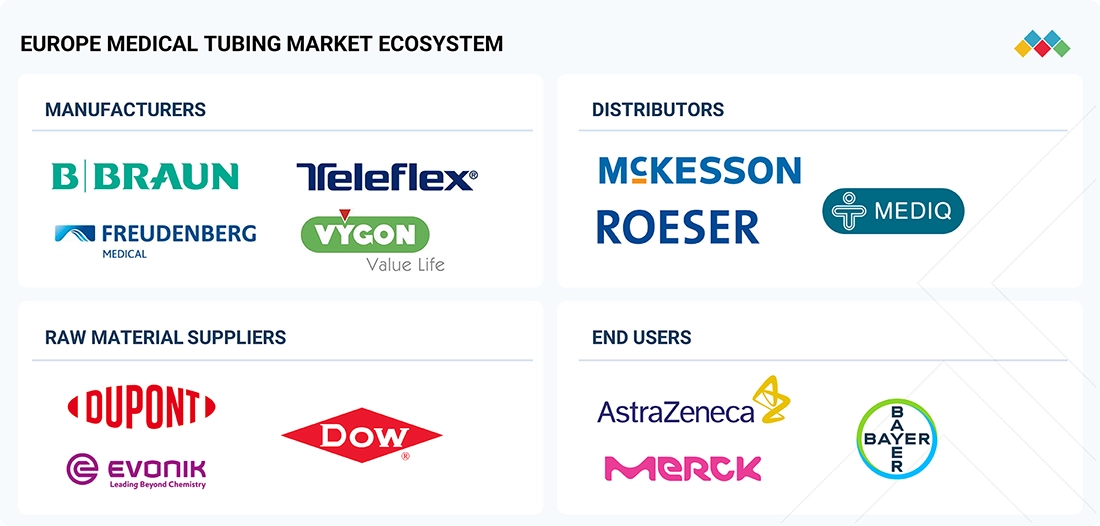
The medical tubing ecosystem in Europe consists of raw material suppliers that offer medical-grade polymers, silicones, and fluoropolymers, along with specialty additives, to tubing manufacturers who produce high-precision, biocompatible tubing for various medical applications. Distributors, contract manufacturers, and medical device OEMs connect tubing producers with end users and provide finished tubing sets for hospitals, home-care, diagnostics, and minimally invasive therapies. The collaboration of these stakeholders facilitates a seamless transition from sourcing certified materials to producing regulatory-compliant, high-performance tubing, thereby delivering safe and reliable solutions for incorporation into critical medical devices and patient care systems.
Logos and trademarks shown above are the property of their respective owners. Their use here is for informational and illustrative purposes only.
MARKET SEGMENTS
Source: Secondary Research, Interviews with Experts, MarketsandMarkets Analysis
The market for medical tubing consists of various segments, such as single-lumen, co-extruded, multi-lumen, tapered or bump, and braided tubing. Among all these, multi-lumen tubing is the largest segment owing to its support for complex fluid handling and multifunctional uses. On the other hand, single-lumen and co-extruded tubing remain the most popular choices for uncomplicated and less demanding medical procedures.
The market for medical tubing is segmented based on material into plastics, rubbers, specialty polymers, and other materials. The rubber segment, which includes silicone and TPE, leads the market due to its flexibility, biocompatibility, and suitability for long-term or implantable applications. Plastics have a major share in the market for disposable applications due to their low cost and versatility. Specialty polymers like fluoropolymers and PEEK are slowly gaining popularity in the applications that require chemical resistance and precision. Other materials used in the market are bioabsorbable polymers.
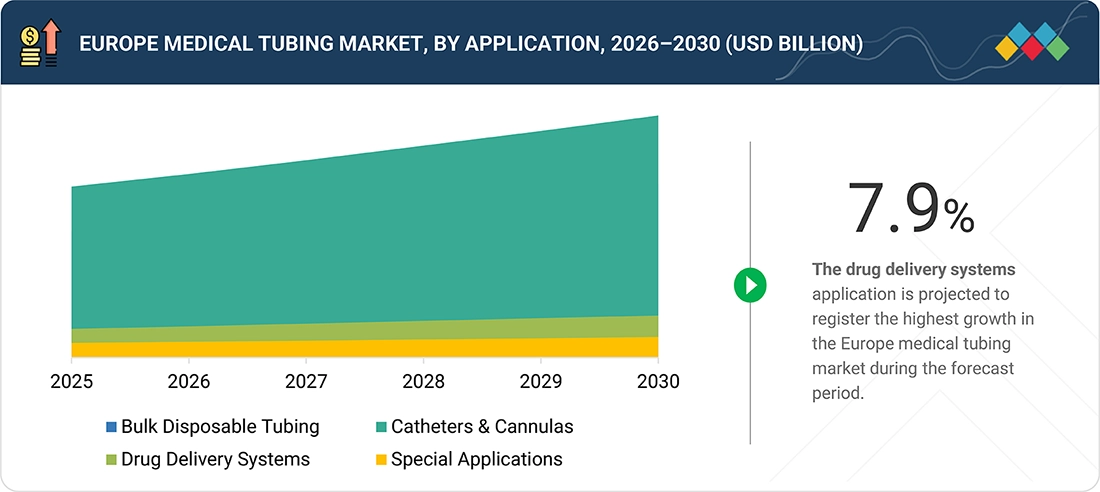
The medical tubing market has been categorized into various segments, namely, bulk disposable tubing, catheters & cannulas, drug delivery systems, and special applications. The catheters & cannulas segment lead the market due to their utilization in minimally invasive procedures and patient care that lasts for long periods. On the other hand, drug delivery and special applications are experiencing high growth.
REGION
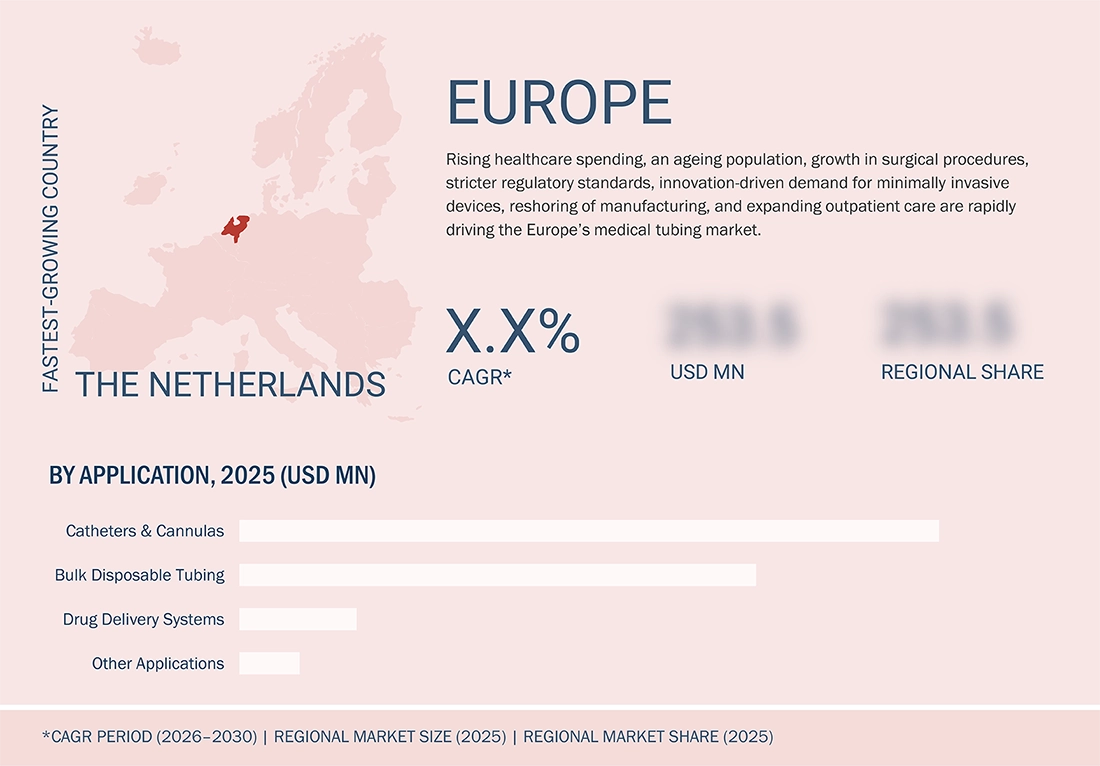
The Netherlands to be fastest-growing country in Europe medical tubing market during forecast period
The Netherlands is projected to be the fastest-growing medical tubing market in Europe during the forecast period. This high growth is attributed to its robust healthcare system, a strong medical device manufacturing base, and increasing acceptance of new medical technologies. Many of the world's top medical device firms and contract manufacturers have set up their plants in the country, which consequently leads to the need for a significant amount of precise tubing to be used in making catheters, drug delivery systems, and minimally invasive devices. The Dutch healthcare system is dedicated to delivering the highest quality patient care possible. This fuels the demand for single-use and specialty medical tubing that meets the stringent safety and regulatory requirements. The rise in the number of chronic disease cases, along with an increase in the elderly population, is also fueling the demand for sophisticated tubing solutions. The Netherlands' geographic position in Europe not only makes it easy to ship products to neighboring countries but also supports the establishment of efficient supply chains that can respond quickly to market demands.
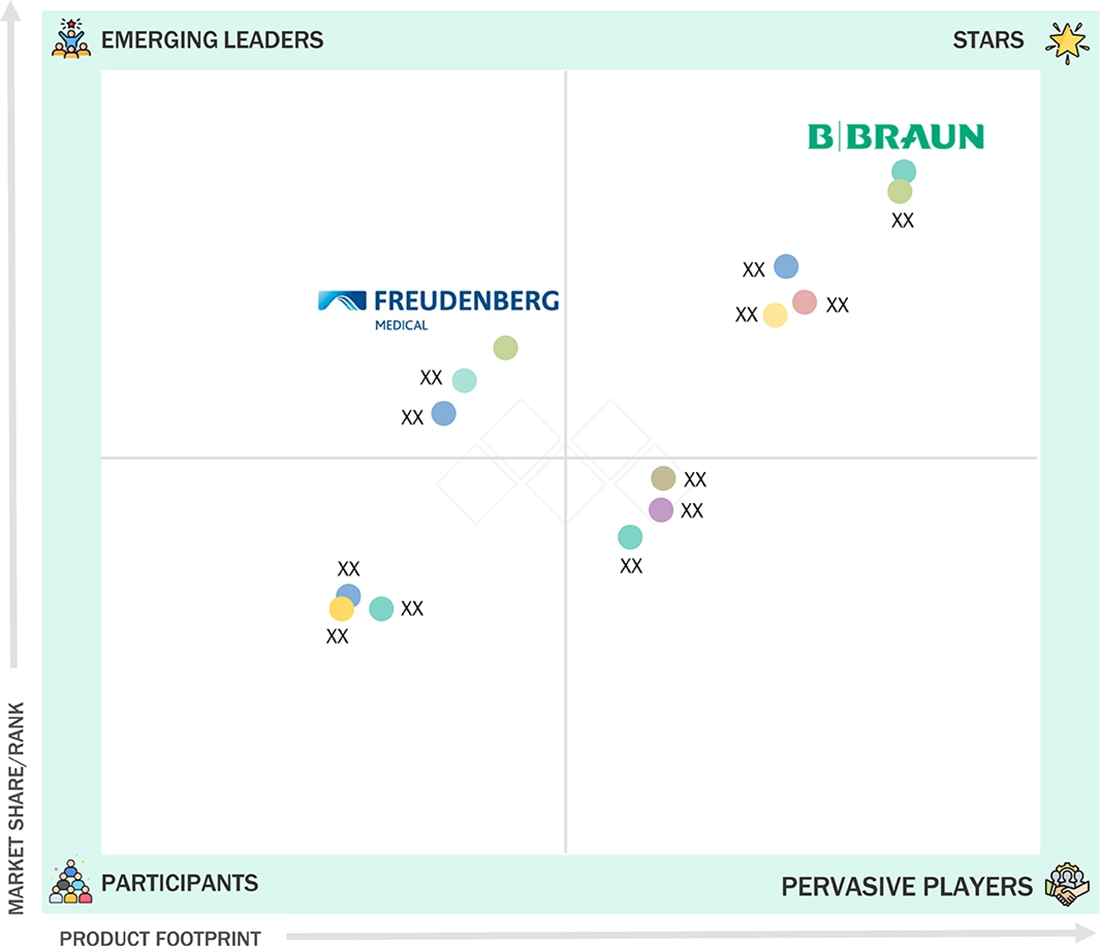
EUROPE MEDICAL TUBING MARKET: COMPANY EVALUATION MATRIX
In the Europe medical tubing market matrix, B. Braun (Star) leads with a strong regional presence and a broad portfolio of infusion, vascular access, and specialty tubing supported by its integrated manufacturing and wide hospital network. Freudenberg Medical (Emerging Leader) is strengthening its position through expansion in biopharma and single-use assemblies, leveraging its silicone extrusion and molding expertise to target high-growth segments such as mRNA and cell therapies.
Source: Secondary Research, Interviews with Experts, MarketsandMarkets Analysis
KEY MARKET PLAYERS
- 1. Freudenberg Medical (US)
- 2. RAUMEDIC AG (Germany)
- 3. Vygon (France)
- 4. B. Braun (Germany)
- 5. Saint-Gobain (France)
- 6. Trelleborg Medical (Sweden)
- 7. Teleflex (US)
- 8. Coloplast (Denmark)
- 9. Smiths Medical (US)
- 10. TE Connectivity (Ireland)
MARKET SCOPE
| REPORT METRIC | DETAILS |
|---|---|
| Market Size in 2025 (Value) | USD 3.64 Billion |
| Market Forecast in 2030 (value) | USD 5.14 Billion |
| Growth Rate | CAGR of 7.1% from 2026-2030 |
| Years Considered | 2021-2030 |
| Base Year | 2025 |
| Forecast Period | 2026–2030 |
| Units Considered | Value (USD Billion), Volume (Kiloton) |
| Report Coverage | Revenue forecast, company ranking, competitive landscape, growth factors, and trends |
| Segments Covered |
|
| Countries Covered | Germany, France, UK, Italy, Spain, Netherlands, and Rest of Europe |
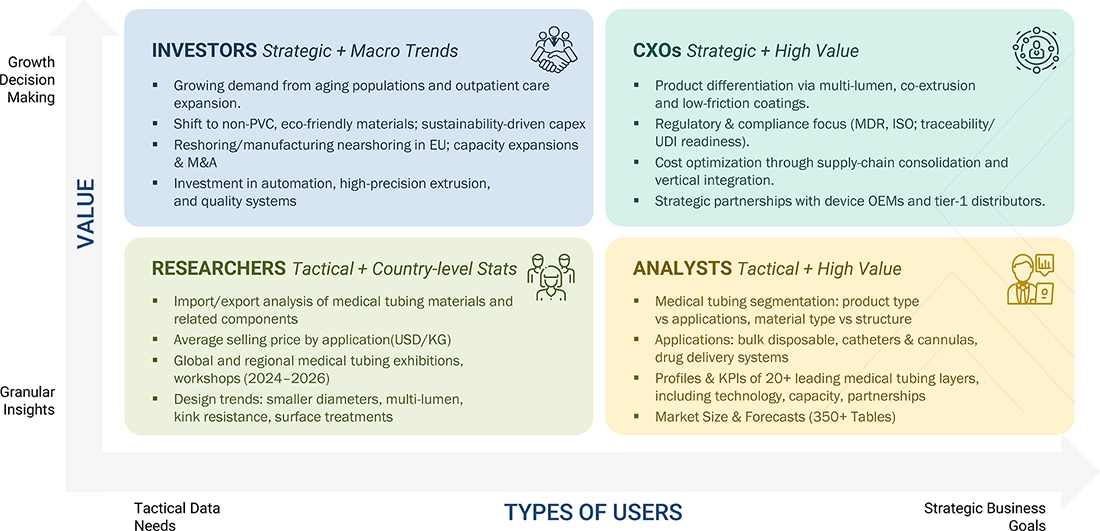
WHAT IS IN IT FOR YOU: EUROPE MEDICAL TUBING MARKET REPORT CONTENT GUIDE
DELIVERED CUSTOMIZATIONS
We have successfully delivered the following deep-dive customizations:
| CLIENT REQUEST | CUSTOMIZATION DELIVERED | VALUE ADDS |
|---|---|---|
| US-based Medical Device Manufacturer |
|
|
| Hospital & Healthcare Systems |
|
|
| Catheter & Cannula OEMs |
|
|
| European Medical Tubing Raw Material Supplier |
|
|
| Drug Delivery System OEMs |
|
|
RECENT DEVELOPMENTS
- Aug-24 : Freudenberg Medical expanded its biopharma portfolio with custom single-use assemblies, leveraging its silicone extrusion and molding expertise to strengthen its position in the biopharma market.
- October 2023 : RAUMEDIC AG expanded its biocompatible fluid-processing tubing portfolio with new brands made from braided silicone, standard silicone, PVC, TPE, and FEP, strengthening its offerings across diverse medical applications.
- July 2021 : RAUMEDIC AG undertook the expansion of its presence with two new production facilities at its German headquarters, scheduled for completion by 2025, to boost silicone tubing manufacturing and strengthen its position in Europe’s pharmaceutical and vaccine sectors.
- September 2020 : Freudenberg Medical acquired dedicated manufacturing equipment and assets from Merit Medical Systems to strengthen its hypotube production capacity.
Table of Contents
 Exclusive indicates content/data unique to MarketsandMarkets and not available with any competitors.
TITLE
PAGE NO
1
INTRODUCTION
15
2
EXECUTIVE SUMMARY
3
PREMIUM INSIGHTS
4
MARKET OVERVIEW
4.1
INTRODUCTION
4.2
MARKET DYNAMICS
4.2.1
DRIVERS
4.2.1.1
AGEING POPULATION & CHRONIC-CARE DEMAND
4.2.1.2
RISE OF MINIMALLY INVASIVE AND CATHETER-BASED PROCEDURES
4.2.2
RESTRAINTS
4.2.1.3
STRINGENT REGULATORY BURDEN (EU MDR)
4.2.1.4
PROCUREMENT COST PRESSURE IN PUBLIC HEALTHCARE
4.2.3
OPPORTUNITIES
4.2.3.1
NEARSHORING & LOCALIZED MANUFACTURING
4.2.3.2
SUSTAINABLE & SPECIALTY-MATERIAL INNOVATIONS
4.2.4
CHALLENGES
4.2.4.1
SUPPLY-CHAIN VOLATILITY & GEOPOLITICAL SOURCING RISKS
4.2.4.2
WORKFORCE & CAPACITY CONSTRAINTS IN EU MANUFACTURING
4.3
UNMET NEEDS AND WHITE SPACES
4.4
INTERCONNECTED MARKETS AND CROSS-SECTOR OPPORTUNITIES
4.5
STRATEGIC MOVES BY TIER-1/2/3 PLAYERS
5
INDUSTRY TRENDS
5.1
PORTER'S FIVE FORCES ANALYSIS
5.2
MACROECONOMIC OUTLOOK
5.2.1
INTRODUCTION
5.2.2
GDP TRENDS AND FORECAST
5.2.3
TRENDS IN HEALTHCARE AND MEDICAL INDUSTRY
5.3
VALUE CHAIN ANALYSIS
5.4
ECOSYSTEM ANALYSIS
5.5
PRICING ANALYSIS
5.5.1
AVERAGE SELLING PRICE OF KEY PLAYERS, BY APPLICATION (2024)
5.5.2
AVERAGE SELLING PRICE TREND, BY REGION (2022-2024)
5.6
TRADE ANALYSIS
5.6.1
IMPORT SCENARIO (HS CODE 3917)
5.6.2
EXPORT SCENARIO (HS CODE 3917)
5.7
KEY CONFERENCE & EVENTS IN 2025-2026
5.8
TRENDS/DISRUPTIONS IMPACTING CUSTOMER BUSINESS
5.9
INVESTMENT AND FUNDING SCENARIO
5.10
CASE STUDY ANALYSIS
5.11
IMPACT OF 2025 US TARIFF - EUROPE MEDICAL TUBING MARKET
5.11.1
INTRODUCTION
5.11.2
KEY TARIFF RATES
5.11.3
PRICE IMPACT ANALYSIS
5.11.4
IMPACT ON COUNTRY/REGION*
5.11.4.2
EUROPE
5.11.5
IMPACT ON END-USE INDUSTRIES
*(MARKET CONSUMPTION IMPACT, TRADE BALANCE ADJUSTMENTS, PRICING ANALYSIS, COMPANIES IMPACTED, AND COMPANIES’ STRATEGIES)
6
TECHNOLOGICAL ADVANCEMENTS, AI-DRIVEN IMPACT, PATENTS, INNOVATIONS, AND FUTURE APPLICATIONS
6.1
KEY TECHNOLOGIES
6.1.1
MICRO EXTRUSION TECHNOLOGIES
6.1.2
SMART & SENSOR-EMBEDDED TUBING
6.2
COMPLEMENTARY TECHNOLOGIES
6.2.1
NANOTECHNOLOGY FOR COATING
6.2.2
LASER PROCESSING
6.3
ADJACENT TECHNOLOGIES
6.3.1
ADVANCED IMAGING TECHNOLOGY
6.4
TECHNOLOGY/PRODUCT ROADMAP
6.5
PATENT ANALYSIS
6.6
FUTURE APPLICATIONS
6.7
IMPACT OF AI/GEN AI ON EUROPE MEDICAL TUBING MARKET
6.7.1
TOP USE CASES AND MARKET POTENTIAL
6.7.2
BEST PRACTICES FOLLOWED BY MANUFACTURERS/OEMS IN EUROPE MEDICAL TUBING MARKET
6.7.3
CASE STUDIES RELATED TO AI IMPLEMENTATION IN EUROPE MEDICAL TUBING MARKET
6.7.4
INTERCONNECTED ECOSYSTEM AND IMPACT ON MARKET PLAYERS
6.7.5
CLIENT'S READINESS TO ADOPT GENERATIVE AI IN EUROPE MEDICAL TUBING MARKET
7
REGULATORY LANDSCAPE AND SUSTAINABILITY INITIATIVES
7.1
REGIONAL REGULATIONS AND COMPLIANCE
7.1.1
REGULATORY BODIES, GOVERNMENT AGENCIES, AND OTHER ORGANIZATIONS
7.1.2
INDUSTRY STANDARDS
7.2
SUSTAINABILITY INITIATIVES
7.3
IMPACT OF REGULATORY POLICIES ON SUSTAINABILITY INITIATIVES
8
CUSTOMER LANDSCAPE & BUYER BEHAVIOR
8.1
INTRODUCTION
8.2
DECISION-MAKING PROCESS
8.3
KEY STAKEHOLDERS INVOLVED IN BUYING PROCESS AND THEIR EVALUATION CRITERIA
8.3.1
KEY STAKEHOLDERS IN BUYING PROCESS
8.3.2
BUYING CRITERIA
8.4
ADOPTION BARRIERS AND INTERNAL CHALLENGES
8.5
UNMET NEEDS OF VARIOUS END-USE INDUSTRIES
9
EUROPE MEDICAL TUBING MARKET, BY MATERIAL
COMPARATIVE ASSESSMENT OF KEY EUROPE MEDICAL TUBING MATERIALS, THEIR MARKET POTENTIAL, AND DEMAND PATTERNS BY VARIOUS SUPPLIER COMPANIES
9.1
INTRODUCTION
9.2
INTRODUCTION
9.3
PLASTICS
9.4
RUBBERS
9.5
SPECIALTY POLYMERS
9.6
OTHER MATERIALS
10
EUROPE MEDICAL TUBING MARKET, BY APPLICATION
APPLICATION-SPECIFIC ADOPTION DRIVERS, DEMAND DYNAMICS, AND MARKET POTENTIAL ACROSS EACH APPLICATION
10.1
INTRODUCTION
10.2
BULK DISPOSABLE TUBING
10.3
CATHETERS & CANNULAS
10.4
DRUG DELIVERY SYSTEM
10.5
OTHER APPLICATIONS
11
EUROPE MEDICAL TUBING MARKET, BY STRUCTURE
STRUCTURE-WISE DEMAND POTENTIAL AND GROWTH PATHWAYS SHAPING EUROPE MEDICAL TUBING ADOPTION
11.1
INTRODUCTION
11.2
SINGLE-LUMEN
11.3
MULTI-LUMEN
11.4
CO-EXTRUDED
11.5
TAPERED OR BUMP TUBING
11.6
BRAIDED TUBING
12
EUROPE MEDICAL TUBING MARKET, BY REGION
ASSESSING GROWTH PATTERNS, INDUSTRY FORCES, REGULATORY LANDSCAPE, AND MARKET POTENTIAL ACROSS KEY COUNTRIES
15.1
INTRODUCTION
15.2
EUROPE
15.2.1
GERMANY
15.2.2
FRANCE
15.2.3
UK
15.2.4
ITALY
15.2.5
SPAIN
15.2.6
NETHERLANDS
15.2.7
REST OF EUROPE
16
COMPETITIVE LANDSCAPE
STRATEGIC ASSESSMENT OF LEADING PLAYERS, MARKET SHARE, REVENUE ANALYSIS, COMPANY POSITIONING, AND COMPETITIVE BENCHMARKS INFLUENCING MARKET POTENTIAL
16.1
INTRODUCTION
16.2
KEY PLAYERS' STRATEGIES/RIGHT TO WIN (JANUARY 2021-DECEMBER 2025)
16.3
REVENUE ANALYSIS,
16.4
MARKET SHARE ANALYSIS, 2022-2024
16.5
BRAND COMPARISON
16.6
COMPANY EVALUATION MATRIX: KEY PLAYERS,
16.6.1
STARS
16.6.2
EMERGING LEADERS
16.6.3
PERVASIVE PLAYERS
16.6.4
PARTICIPANTS
16.6.5
COMPANY FOOTPRINT: KEY PLAYERS,
16.6.5.1
COMPANY FOOTPRINT
16.6.5.2
COUNTRY FOOTPRINT
16.6.5.3
MATERIAL FOOTPRINT
16.6.5.4
APPLICATION FOOTPRINT
16.6.5.5
STRUCTURE FOOTPRINT
16.7
COMPANY EVALUATION MATRIX: STARTUPS/SMES,
16.7.1
PROGRESSIVE COMPANIES
16.7.2
RESPONSIVE COMPANIES
16.7.3
DYNAMIC COMPANIES
16.7.4
STARTING BLOCKS
16.7.5
COMPETITIVE BENCHMARKING: STARTUPS/SMES,
16.7.5.1
DETAILED LIST OF KEY STARTUPS/SMES
16.7.5.2
COMPETITIVE BENCHMARKING OF KEY STARTUPS/SMES
16.8
COMPANY VALUATION AND FINANCIAL METRICS
16.9
COMPETITIVE SCENARIO
16.9.1
PRODUCT LAUNCHES
16.9.2
DEALS
16.9.3
EXPANSIONS
17
COMPANY PROFILES
* (BUSINESS OVERVIEW, PRODUCTS MIX, RECENT DEVELOPMENTS, MNM VIEW)
IN-DEPTH REVIEW OF COMPANIES, PRODUCTS, SERVICES, RECENT INITIATIVES, AND POSITIONING STRATEGIES IN EUROPE MEDICAL TUBING MARKET LANDSCAPE
17.1
KEY PLAYERS
17.1.1
PALL CORPORATION
17.1.2
RAUMEDIC AG
17.1.3
VYGON
17.1.4
B. BRAUN
17.1.5
SAINT GOBAIN
17.1.6
TRELLEBORG MEDICAL
17.1.7
TELEFLEX
17.1.8
COLOPLAST
17.1.9
SMITHS MEDICAL
17.1.10
TE CONNECTIVITY
17.2
OTHER PLAYERS
17.2.1
OPTINOVA GROUP
17.2.2
NOVOPLAST SCHLAUCHTECHNIK
17.2.3
SPOLYFLON MEDICAL
17.2.4
PURESIL TECHNIFLEX
17.2.5
FLEXICARE MEDICAL
17.2.6
APT ADVANCED POLYMER TUBING GMBH
17.2.7
PRIMASIL
17.2.8
ECM EUROPE BV
17.2.9
NOLATO
17.2.10
BIOCON
*DETAILS MIGHT NOT BE CAPTURED IN CASE OF UNLISTED COMPANIES.
NOTE: THIS IS THE TENTATIVE LIST. WE WILL PROVIDE YOU WITH COMPANY PROFILES OF MAJOR COMPANIES IN THIS MARKET.
18
RESEARCH METHODOLOGY
18.1
RESEARCH DATA
18.1.1
SECONDARY DATA
18.1.1.1
KEY DATA FROM SECONDARY SOURCES
18.1.1.2
LIST OF KEY SECONDARY SOURCES
18.1.2
PRIMARY DATA
18.1.2.1
KEY DATA FROM PRIMARY SOURCES
18.1.2.2
KEY PRIMARY PARTICIPANTS
18.1.2.3
BREAKDOWN OF PRIMARY INTERVIEWS
18.1.2.4
KEY INDUSTRY INSIGHTS
18.2
MARKET SIZE ESTIMATION
18.2.1
BOTTOM-UP APPROACH
18.2.2
TOP-DOWN APPROACH
18.2.3
BASE NUMBER CALCULATION
18.3
MARKET FORECAST APPROACH
18.3.1
SUPPLY SIDE
18.3.2
DEMAND SIDE
18.4
DATA TRIANGULATION
18.5
FACTOR ANALYSIS
18.6
RESEARCH ASSUMPTIONS AND LIMITATIONS
18.7
RISK ASSESSMENT
19
APPENDIX
19.1
DISCUSSION GUIDE
19.2
KNOWLEDGESTORE: MARKETSANDMARKETS' SUBSCRIPTION PORTAL
19.3
CUSTOMIZATION OPTIONS
19.4
RELATED REPORTS
19.5
AUTHOR DETAILS
Methodology
The study involved four major activities for estimating the current size of the Europe medical tubing market. Exhaustive secondary research was conducted to collect information on the market, the peer product market, and the parent product group market. The next step was to validate these findings, assumptions, and sizes with the industry experts across the value chain of Europe medical tubing through primary research. Both the top-down and bottom-up approaches were employed to estimate the overall size of the Europe medical tubing market. After that, market breakdown and data triangulation procedures were used to determine the size of different segments and sub-segments of the market.
Secondary Research
In the secondary research process, various secondary sources such as Hoovers, Factiva, Bloomberg BusinessWeek, and Dun & Bradstreet were referred, to identify and collect information for this study on the Europe medical tubing market. These secondary sources included annual reports, press releases & investor presentations of companies; white papers; certified publications; articles by recognized authors; regulatory bodies, trade directories, and databases.
Primary Research
The Europe medical tubing market comprises several stakeholders in the supply chain, which include raw material suppliers, distributors, end-product manufacturers, buyers, and regulatory organizations. Various primary sources from the supply and demand sides of the markets have been interviewed to obtain qualitative and quantitative information. The primary participants from the demand side include key opinion leaders, executives, vice presidents, and CEOs of companies in the Europe medical tubing market. Primary sources from the supply side include associations and institutions involved in the Europe medical tubing market, key opinion leaders, and processing players.
To know about the assumptions considered for the study, download the pdf brochure
Market Size Estimation
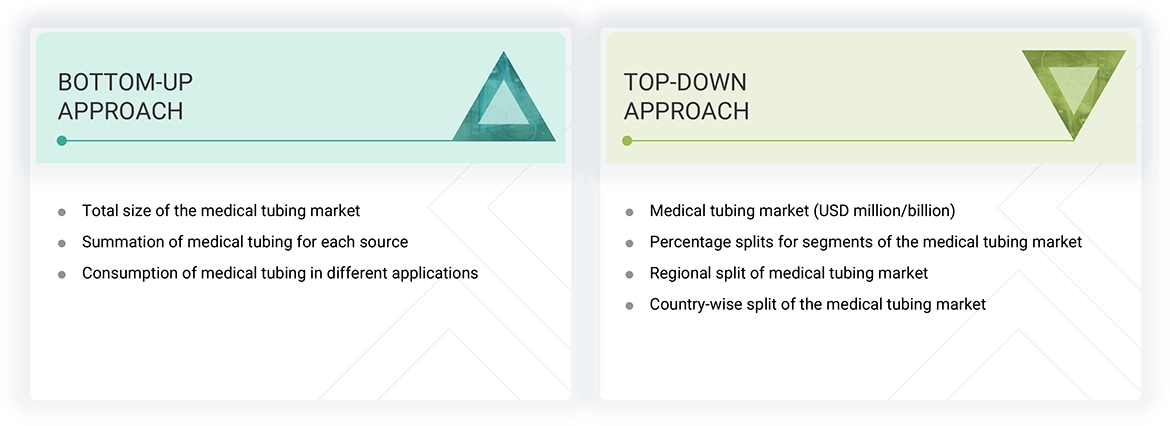
The bottom-up and top-down approaches have been used to estimate the Europe medical tubing market by material, application, structure, and region. The research methodology used to calculate the market size includes the following steps:
- The key players in the industry and markets were identified through extensive secondary research.
- In terms of value, the industry’s supply chain and market size were determined through primary and secondary research processes.
- All percentage shares, splits, and breakdowns were determined using secondary sources and verified through primary sources.
- All possible parameters that affect the markets covered in this research study were accounted for, viewed in extensive detail, verified through primary research, and analyzed to obtain the final quantitative and qualitative data.
- The research included studying reports, reviews, and newsletters of top market players and extensive interviews with leaders such as directors and marketing executives to obtain opinions.
The following figure illustrates the overall market size estimation process employed for this study.
Data Triangulation
After arriving at the overall size of the Europe medical tubing market from the estimation process explained above, the total market was split into several segments and sub-segments. The data triangulation and market breakdown procedures were employed, wherever applicable, to complete the overall market engineering process and arrive at the exact statistics for all segments and subsegments. The data was triangulated by studying various factors and trends from both the demand and supply sides. Along with this, the market size was validated using both the top-down and bottom-up approaches.
Market Definition
Medical tubing is flexible, hollow tubing used in a range of medical and pharmaceutical uses for the transfer of fluids and gases. Medical tubing is a critical component in healthcare environments for uses including drug delivery, respiratory therapy, catheters, intravenous (IV) therapy, and peristaltic pumps. Medical tubing is produced from materials such as silicone, polyvinyl chloride (PVC), thermoplastic elastomers (TPE), and polyethylene, providing biocompatibility, chemical resistance, and flexibility. The market for medical tubing is growing due to improving healthcare spending, expanding demand for minimally invasive treatments, and technological innovation in medical devices. The growing prevalence of chronic diseases, such as cardiovascular diseases and diabetes, has also fueled demand for Europe medical tubing solutions.
Stakeholders
- Europe Medical Tubing Manufacturers
- Raw Material Suppliers
- Regulatory Bodies and Government Agencies
- Distributors and Suppliers
- End-Use Industries
- Associations and Industrial Bodies
- Market Research and Consulting Firms
Report Objectives
- To define, describe, and forecast the size of the Europe medical tubing market in terms of value and volume.
- To provide detailed information regarding the key factors influencing the growth of the market (drivers, restraints, opportunities, and challenges).
- To forecast the market size based on material, application, structure, and region.
- To strategically analyze micro markets with respect to individual growth trends, prospects, and contributions to the total market.
- To analyze the opportunities in the market for stakeholders and provide details of the competitive landscape for the market leaders.
- To strategically profile leading players and comprehensively analyze their key developments such as new product launches, expansions, and deals in the Europe medical tubing market.
- To strategically profile key players and comprehensively analyze their market shares and core competencies.
- To study the impact of AI/Gen AI on the market under study, along with the macroeconomic outlook.
⚡ Growth Signals
Personalize This Research
- Triangulate with your Own Data
- Get Data as per your Format and Definition
- Gain a Deeper Dive on a Specific Application, Geography, Customer or Competitor
- Any level of Personalization
Let Us Help You
- What are the Known and Unknown Adjacencies Impacting the Europe Medical Tubing Market
- What will your New Revenue Sources be?
- Who will be your Top Customer; what will make them switch?
- Defend your Market Share or Win Competitors
- Get a Scorecard for Target Partners


We at Nissan Chemicals Corporation have been clients of MarketsandMarkets for more than a year now. We recently consulted MarketsandMarkets for a study, the team at MarketsandMarkets was extremely professional and organized. The business insights were very detailed and aligned well with our expectations that really helped us formulate the Business Plans and device new strategies for development themes. MarketsandMarkets offers a unique combination of expertise and dedicated engagement model. Their research findings have helped us in designing our Pricing Strategy which will make it easier for us to predict the future sales and profits for the next ten years. We look forward to working with MarketsandMarkets in the future.
VP of Strategy & New Business Development
Leading Specialty Chemical Company
The MarketsandMarkets Engagement Model, composed of both the Knowledge Store and advisory custom research, has greatly helped us in understanding our markets and making strategic decisions. The Knowledge Store is a fast way to allow everyone in our organization to understand more about most any market they are interested in. The ability to then get custom research done and get answers to specific strategic questions and market insight has been spectacular. The Markets and Markets team feel more like colleagues than vendors and their services have helped us change our culture where statements of things like growth opportunities and competitive position are always backed by industry research.

Rich Gibson,
Director, Corporate Strategy
Milliken & Company,
Leading Industrial Manufacturer of specialty chemical, floor covering, performance and protective textile materials, and healthcare
MarketsandMarkets is a trusted resource that helps us to better understand markets that are near-adjacencies-whether its technology, value chain or geography. Their Knowledge Store platform provides a dashboard of markets and their characteristics which is easy to use and saves us time.
Adam Shaw,
Market Development and Strategy Manager
AdvanSix Inc. USA,
An American Leader in Chemicals
The Knowledge Store from MarketsandMarkets is a valuable tool which has helped my team acquire greater insight in to the end markets that our business serves. This has enabled us to help our company build stronger strategies throughout our planning process.
TOSHIO KINOSHITA
Senior Chif Consultion Research & Consulting Division
Mitsubishi Chemical Research Corporation,
Leading Manufacturer of Chemical Products

We recently engaged with MarketsandMarkets for a study, the team not only clearly understood our business objectives but was also extremely professional in the way they handled the entire project. The study was efficiently conducted in a phase-wise manner, and the engagement model furnished us with high-quality business insights that far exceeded our expectations at each phase. We were especially happy that MarketsandMarkets could provide us with both, an English as well as a Japanese version of the study. A special thanks to the Analyst Team and Client Services Team, whose fluency in Japanese enhanced our comfort level, as we could converse with them in our preferred language.
Independent entrepreneurs
Arrow Precision
We approached MarketsandMarkets for study on Proppants Market, and their work exceeded our expectations. The study conducted was comprehensive and enabled us to view the market through the various dimensions. In addition, the team was extraordinarily responsive throughout the process and resolved our queries on time. I strongly recommend MarketsandMarkets and will certainly consider them for additional market assessments we will need in the future.
Global engineering company, Japan
Deputy Manager,
Strategic Planning Office
The high-quality insights shared by the MarketsandMarkets team helped us understand the pharmaceutical plant designers in a specific geography. It also captured the risks that we may likely face in communicating with our potential partners. The study would enable us identify partners, which would impact our future growth.

Still Researching the
Europe Medical Tubing Ecosystem?
See the competitors, opportunities, and growth signals shaping it - instantly.
Generate 15+ consulting-grade strategic insights tailored to your growth question.
Explore Europe Medical Tubing Intelligence
Powered by 17 years of MarketsandMarkets intelligence
