




- DESCRIPTION
- TABLE OF CONTENTS
- METHODOLOGY
- DOWNLOAD PDF
Wireless Charging Market for Electric Vehicles by Charging System (Inductive, Capacitive, Magnetic Power Transfer), Propulsion, Charging Type (Stationary, Dynamic Wireless Charging), Component, Power Supply, and Vehicle Type - Global Forecast to 2032

USD 0.82 BN
MARKET SIZE, 2032

CAGR 38.7%
(2026-2032)

250+
REPORT PAGES

230+
MARKET TABLES
OVERVIEW
Source: Secondary Research, Interviews with Experts, MarketsandMarkets Analysis
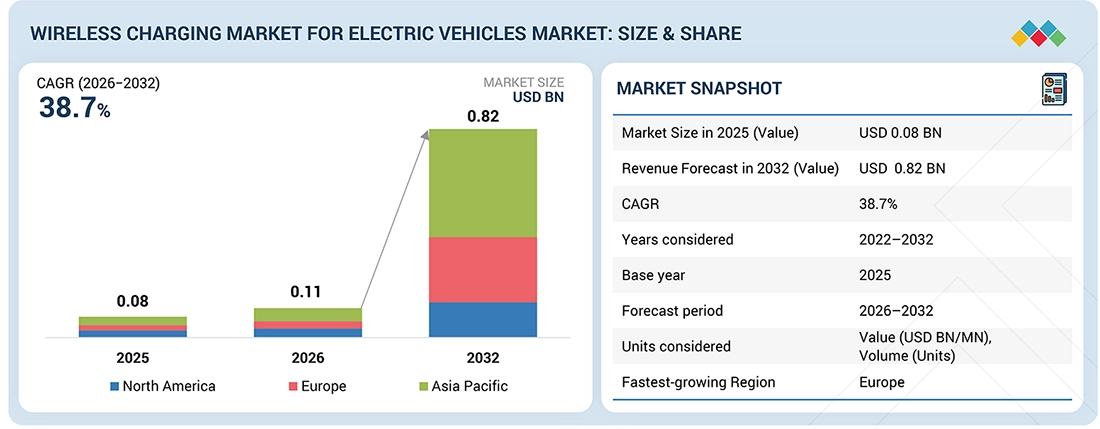
The wireless charging market for electric vehicles is expected to reach USD 0.82 billion by 2032, from USD 0.11 billion in 2026, with a CAGR of 38.7%. The adoption of wireless charging for EVs is driven by fleet operations and urban mobility, which reduces downtime and improves vehicle utilization. Companies are working on improving system efficiency, alignment, and compatibility across vehicles and charging infrastructure, along with integration into parking and energy management systems. Currently, deployments are concentrated in residential parking, fleet depots, and public transport corridors, with demand expected to expand further as costs reduce and infrastructure improves.
KEY TAKEAWAYS
-
BY REGION
Europe is expected to register the fastest growth, supported by strong policy support, smart city initiatives, and early deployments.
-
BY CHARGING TYPE
Stationary wireless charging leads adoption, while dynamic charging is gaining interest for future mobility and fleet applications.
-
BY CHARGING SYSTEM
Inductive charging dominates the market, while magnetic resonance systems are expected to record a CAGR of 85.1% from 2026 to 2032.
-
BY APPLICATION
Home charging units hold the largest share, while commercial applications are expected to grow at a CAGR of 38.7% during the forecast period.
-
BY VEHICLE TYPE
Passenger cars account for the largest share and are expected to register a CAGR of 41.5% from 2026 to 2032.
-
BY COMPONENT
Vehicle charging pads hold the largest share, driven by their role as the primary interface for energy transfer.
-
BY POWER SUPPLY RANGE
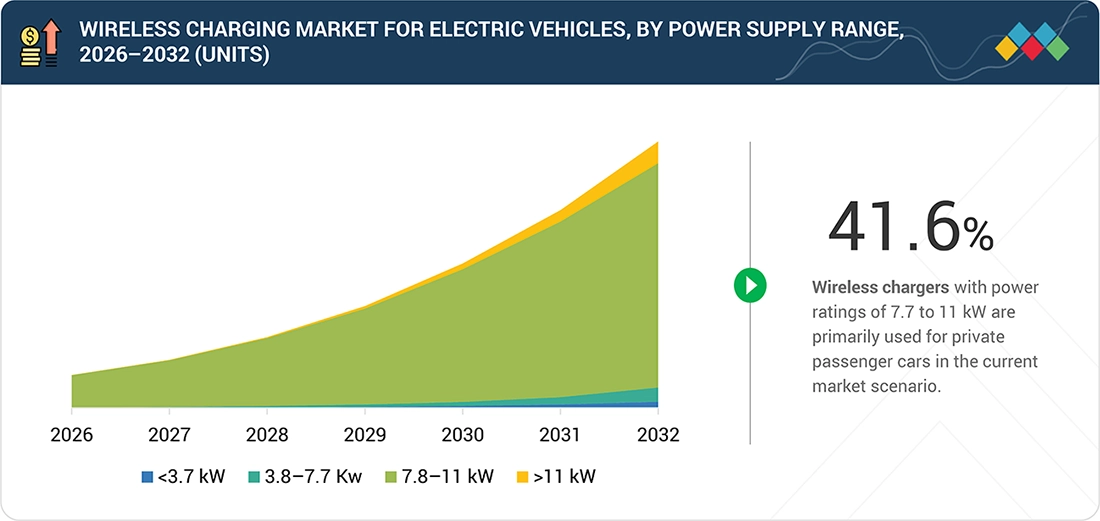
The 7.7–11 kW segment is expected to dominate the market during the forecast period.
-
BY PROPULSION
BEVs are expected to grow at a CAGR of 38.5% during the forecast period.
-
COMPETITIVE LANDSCAPE
The market is led by key players such as Electreon, WiTricity, ENRX, HEVO Inc., and Plugless Power Inc. These companies are focused on advancing inductive and resonant charging technologies, supported by OEM partnerships and pilot deployments.
-
Competitive Landscape
Companies such as Wave Charging LLC, Wiferion, Easelink GmbH, Magment GmbH, and Spark Connected have built strong positions in niche segments such as fleet, residential, and infrastructure charging, supporting innovation and early-stage deployments in the wireless charging market.
The wireless charging market for electric vehicles is growing rapidly, driven by rising BEV adoption, ongoing advancements in charging technologies, and increasing focus on standardization. Government support for zero-emission mobility and increased OEM participation are further accelerating development. At the same time, integration with smart infrastructure and urban mobility systems is expanding use cases. Wireless charging is expected to play a key role in enabling efficient and scalable electric transportation.
TRENDS & DISRUPTIONS IMPACTING CUSTOMERS' CUSTOMERS
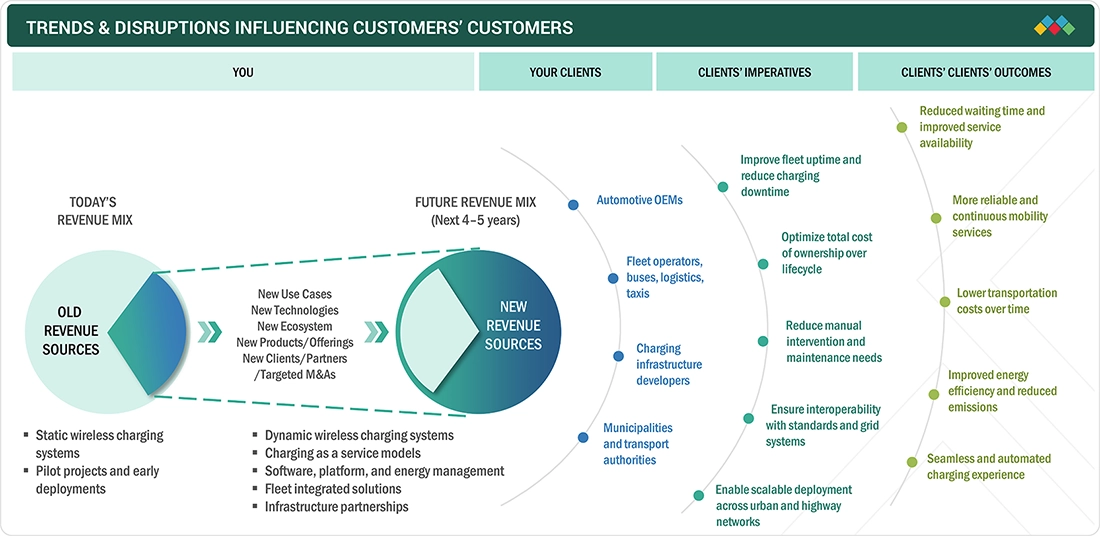
This illustrates how companies in the wireless charging market for electric vehicles are shifting from early-stage static systems and pilot deployments toward scalable, high-value solutions. The focus is moving to dynamic charging, fleet applications, and integrated energy management supported by partnerships across OEMs, infrastructure providers, and cities. As customer needs evolve, there is increasing emphasis on efficiency, interoperability, and reducing operational costs, leading to improved uptime, seamless charging experience, and more reliable mobility outcomes.
Source: Secondary Research, Interviews with Experts, MarketsandMarkets Analysis
MARKET DYNAMICS

Drivers
Impact
Level
-
Supporting automated and cost-effective EV charging to enable scalable urban mobility

-
Increased participation of OEMs in the wireless charging ecosystem


RESTRAINTS
Impact
Level
-
High cost and complexity associated with integrating in vehicle wireless charging systems

-
Lower energy transfer efficiency compared to conventional wired charging solutions


OPPORTUNITIES
Impact
Level
-
Growing adoption of wireless charging within smart city infrastructure

-
Rising investments in dynamic wireless charging technology


CHALLENGES
Impact
Level
-
Lack of standardized vehicle integration frameworks across the ecosystem

-
High setup and installation costs for public wireless charging infrastructure

Source: Secondary Research, Interviews with Experts, MarketsandMarkets Analysis
Wireless charging for electric vehicles enables automatic energy transfer without manual plug-in, improving ease of use and reducing operational effort. It supports frequent and opportunity charging, which increases vehicle uptime, especially for urban fleets and public transport. This helps cities scale EV adoption with more efficient operations and lower dependency on manual infrastructure.
Wireless charging systems currently operate at lower efficiency compared to wired solutions, leading to higher energy losses during transfer. This can increase overall charging costs and impact energy utilization, especially in high usage scenarios. While technology improvements are ongoing, efficiency remains a key limitation for large-scale adoption.
Wireless charging is gaining traction as part of smart city initiatives, with integration into roads, parking spaces, and transit systems. It supports automated, seamless charging for public transport and urban fleets. This creates strong potential for large-scale deployment as cities invest in connected and efficient mobility infrastructure.
Wireless charging systems face limited standardization across vehicle models, creating compatibility issues. This restricts seamless adoption and increases reliance on custom integrations or retrofitting. It adds complexity for OEMs and infrastructure providers, slowing large-scale deployment.
WIRELESS CHARGING MARKET: COMMERCIAL USE CASES ACROSS INDUSTRIES
| COMPANY | USE CASE DESCRIPTION | BENEFITS |
|---|---|---|
|
|
Road-embedded wireless charging systems for public transport and logistics vehicles | Continuous energy supply during travel, smaller onboard battery requirement, lower vehicle weight and cost |
|
|
Magnetic resonance-based wireless charging solutions for passenger cars and light commercial vehicles | Convenient hands-free charging, high efficiency transfer up to 11 kW, supports interoperability across multiple EV models |
|
|
Inductive wireless charging systems for public transport, industrial vehicles, and high-power applications | High power transfer for heavy duty vehicles, reliable in harsh environments, reduced maintenance, supports opportunity charging for fleets |
|
|
Smart wireless charging platforms integrated with mobile apps and grid services | Compact design for urban environments, enhanced user experience with app-based monitoring, potential for V2G integration |
|
|
Aftermarket wireless charging kits for popular EV models | Easy retrofit installation, improved user convenience, reduced wear and tear on charging connectors |





Logos and trademarks shown above are the property of their respective owners. Their use here is for informational and illustrative purposes only.
MARKET ECOSYSTEM
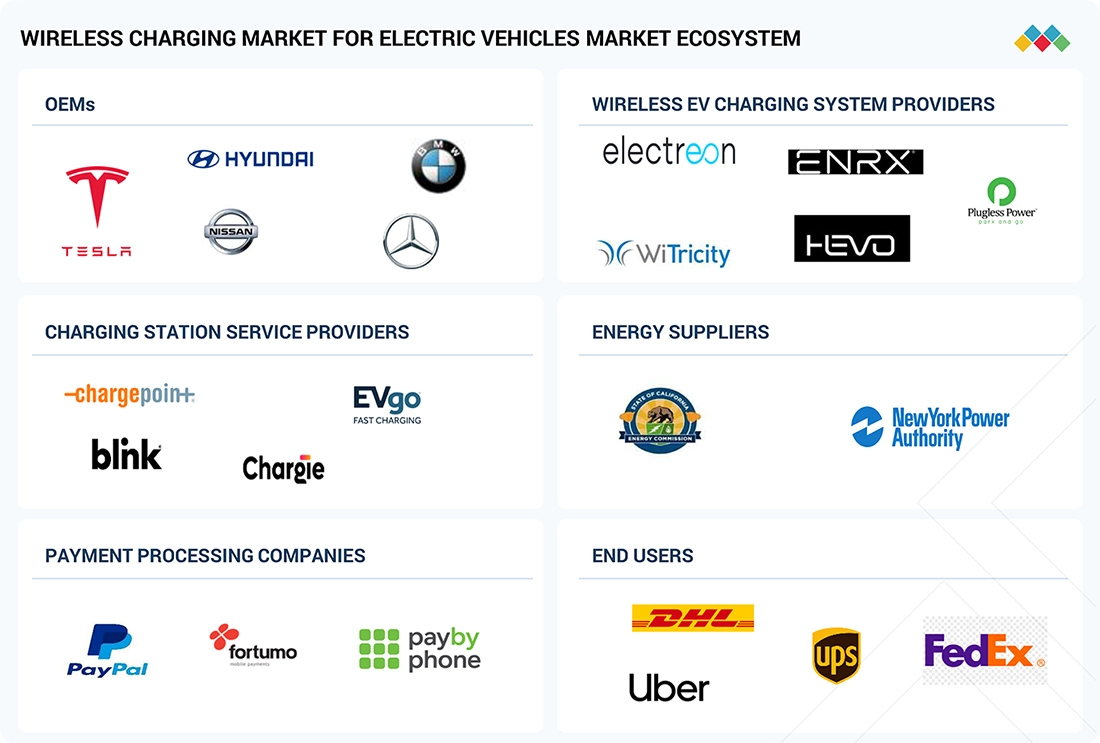
The ecosystem analysis highlights the key stakeholders involved in the wireless charging market for electric vehicles, showing how they work together across the value chain. It includes OEMs driving vehicle integration, wireless charging system providers developing core technologies, and charging service providers enabling infrastructure deployment. Energy suppliers support grid connectivity, while payment processing companies facilitate transactions. End users such as passenger cars, buses, and commercial fleets represent the demand side, shaping adoption and use cases across the market.
Logos and trademarks shown above are the property of their respective owners. Their use here is for informational and illustrative purposes only.
MARKET SEGMENTS
Source: Secondary Research, Interviews with Experts, MarketsandMarkets Analysis
Inductive power transfer remains the most widely adopted technology, using electromagnetic induction for safe and efficient energy transfer. Magnetic resonance and dynamic charging are gaining traction, especially for applications requiring higher flexibility and in-motion charging, though adoption is still at an early stage compared to inductive systems.
A wireless charging system includes a ground-based charging pad with a primary coil, a vehicle-mounted receiver pad with a secondary coil, and a power control unit that manages power flow. The system transfers energy through an electromagnetic field, with increasing focus on improving efficiency, alignment, and real-time control.
7.8–11 kW systems currently lead adoption, supporting passenger vehicles and basic fleet applications in parking environments. Higher power systems (>11 kW) are being deployed for buses and commercial fleets, driven by partnerships between OEMs and infrastructure providers.
Wireless charging is more critical for BEVs due to higher battery capacity and energy demand. It enables automated and frequent charging without manual intervention, supporting urban and fleet operations. Improvements in efficiency and standardization are making it more viable for large-scale BEV adoption.
Wireless charging supports both passenger cars and commercial vehicles. Passenger cars benefit from convenient and automated charging in residential and workplace settings. Commercial vehicles, including buses and logistics fleets, use wireless charging to enable frequent and opportunity charging, improving utilization and supporting continuous operations.
Wireless charging is used across home and commercial applications. Home charging units focus on convenience and ease of use for individual EV owners, with integration into residential parking setups. Commercial charging stations include fleet depots, public charging infrastructure, and transit systems, where the focus is on improving operational efficiency and reducing vehicle downtime.
Wireless charging types are categorized into stationary and dynamic. Stationary wireless charging is deployed in fixed locations such as residential areas, workplaces, and parking spaces, enabling convenient charging during vehicle idle time. Dynamic systems enable charging while the vehicle is in motion, with growing interest in applications such as public transport and highway corridors.
REGION
Europe to be the largest market for wireless charging for Electric Vehicles
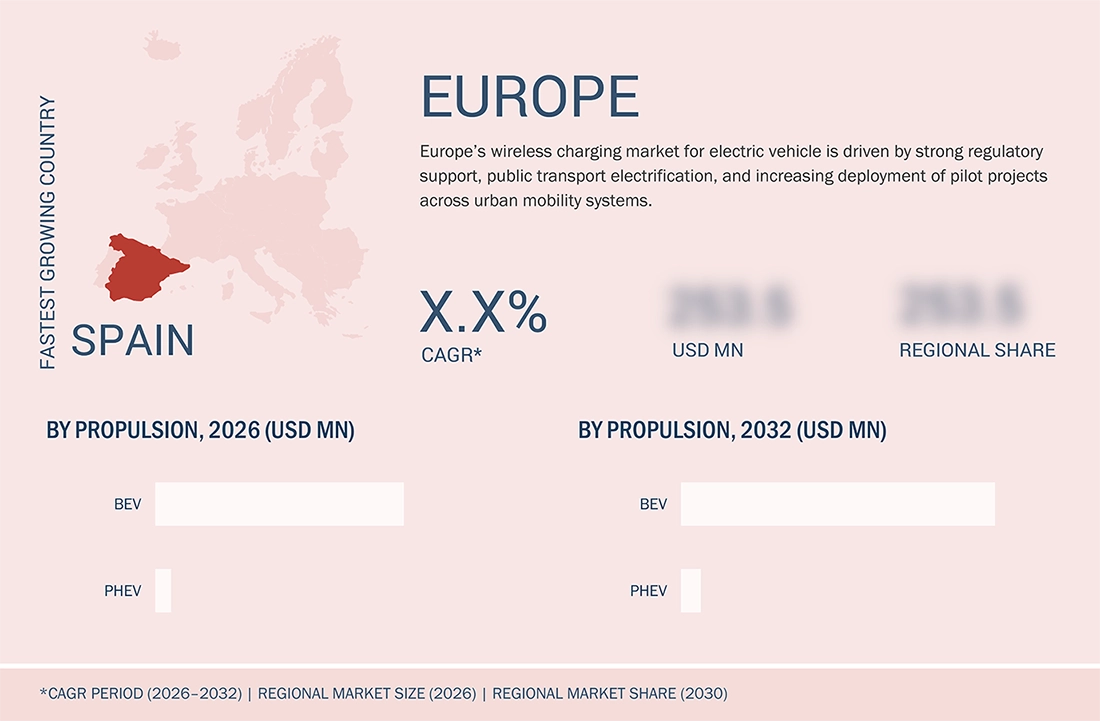
Europe is projected to be the fastest-growing market for wireless EV charging during the forecast period. Strong government support for zero-emission mobility, well-established EV adoption, and advanced charging infrastructure are driving growth in the region. Ongoing pilot projects, standardization efforts, and integration with public transport and smart city initiatives are expected to accelerate the development of wireless charging across Europe.
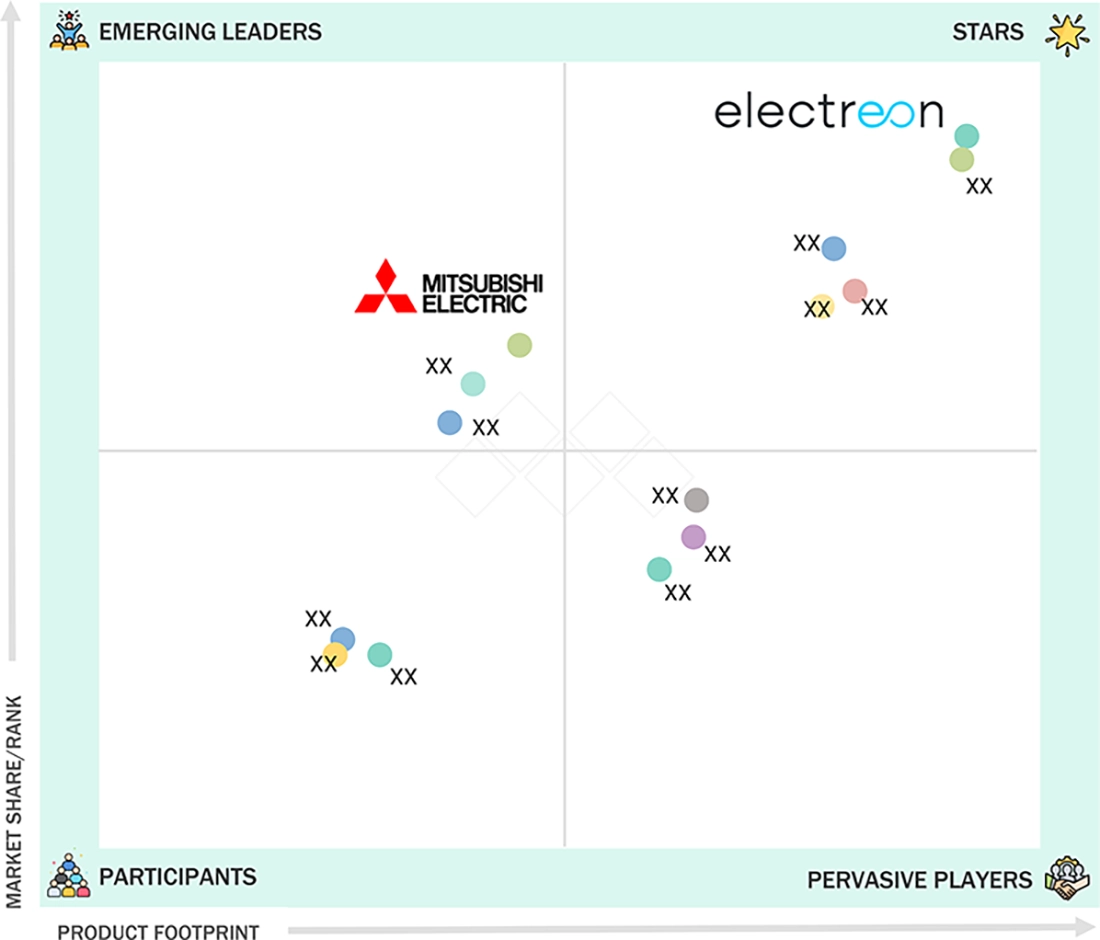
WIRELESS CHARGING MARKET: COMPANY EVALUATION MATRIX
Micro quadrants provide insights into key players in the wireless charging market for electric vehicles, outlining competitive positioning and evaluating performance across defined criteria. Electreon (Star) leverages strong capabilities in dynamic wireless charging, large scale pilot deployments, and partnerships with governments and transport authorities to drive adoption in public transport and roadway infrastructure. Mitsubishi (Emerging Leader) is advancing its position through focused investments in wireless charging technologies and integration with electric vehicle platforms, supported by its strong automotive expertise and growing involvement in next generation mobility solutions.
Source: Secondary Research, Interviews with Experts, MarketsandMarkets Analysis
KEY MARKET PLAYERS
- Electreon (Israel)
- Witricity (US)
- ENRX (Norway)
- HEVO Inc. (US)
- Plugless Power Inc. (US)
- Mitsubishi Electric Corporation (Japan)
- TGOOD Global Ltd. (China)
- Toyota Motor Corporation (Japan)
- Robert Bosch GmbH (Germany)
- Continental AG (Germany)
- Toshiba Corporation (Japan)
- HELLA GmBH & Co. KGaA (Germany)
MARKET SCOPE
| REPORT METRIC | DETAILS |
|---|---|
| Market Size in 2025 (Value) | USD 0.08 BN |
| Revenue Forecast in 2032 (Value) | USD 0.82 BN |
| Growth Rate | CAGR of 38.7% from 2026 to 2032 |
| Actual data | 2022–2032 |
| Base year | 2025 |
| Forecast period | 2026–2032 |
| Units considered | Value (USD BN/MN), Volume (Units) |
| Report Coverage | Revenue forecast, company ranking, competitive landscape, growth factors, and trends |
| Segments Covered |
|
| Regional Scope | Asia Pacific, Europe, North America |
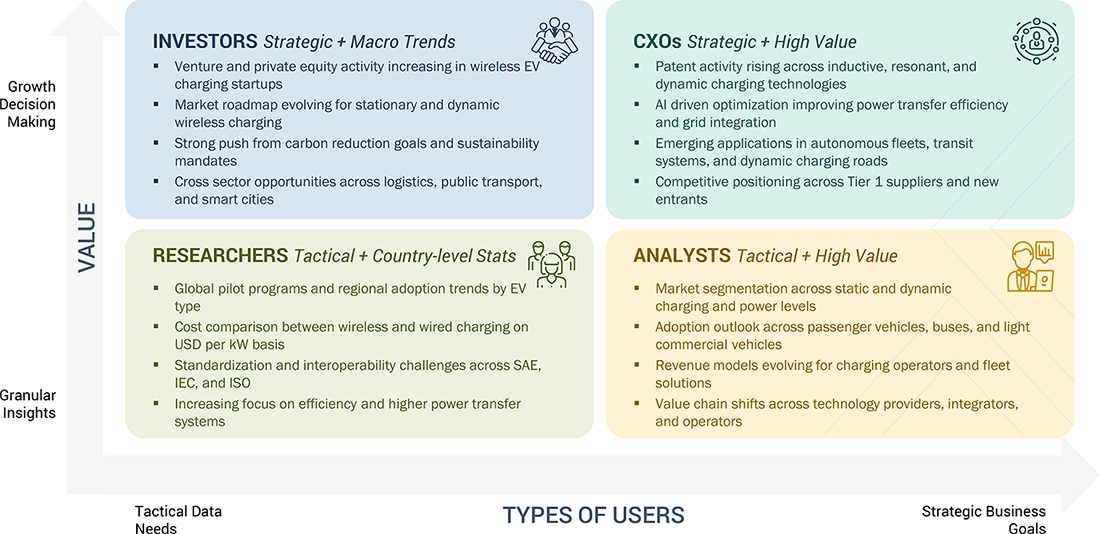
WHAT IS IN IT FOR YOU: WIRELESS CHARGING MARKET REPORT CONTENT GUIDE
DELIVERED CUSTOMIZATIONS
We have successfully delivered the following deep-dive customizations:
| CLIENT REQUEST | CUSTOMIZATION DELIVERED | VALUE ADDS |
|---|---|---|
| Global Tier-1 Automotive Supplier | Competitive benchmarking and market strategy assessment, along with evaluation of technology roadmap and integration feasibility for wireless charging modules. Partnership and pilot project mapping across passenger and commercial vehicle segments. | Identify white space opportunities for wireless systems in future EV platforms. Map M&A and collaboration targets in the wireless charging ecosystem. Optimize go to market strategies for differentiating new vehicle launches. |
| Electric Vehicle OEM (Asia Pacific) | Adoption outlook across luxury, mass, and fleet segments, along with assessment of integration requirements for factory fitted and aftermarket solutions. Regulatory impact analysis for wireless charging in urban deployments. | Inform product planning for factory fitted vs retrofit offerings. Support compliance planning for emerging global wireless charging standards. Enable positioning as early adopters in next generation mobility. |
| Automotive Electronics Supplier | Technical due diligence on inductive and resonant wireless charging systems, along with evaluation of system integration requirements for OEM and Tier-1 applications. Patent landscape review and licensing risk assessment. | Map OEM solution fit for wireless ready modules. Position as a critical supplier in the wireless charging value chain. |
RECENT DEVELOPMENTS
- 3/1/2026 12:00:00 AM : Electreon acquired InductEV, expanding its portfolio with high-power wireless charging solutions for buses and freight vehicles and strengthening its presence in North America.
- 10/1/2025 12:00:00 AM : ENRX expanded its business operations, which support the deployment of PRIMOVE wireless charging solutions for public transport electrification projects
- 9/1/2025 12:00:00 AM : Electreon demonstrated wireless charging technology, which supports the validation of dynamic charging for urban mobility applications.
- 6/1/2025 12:00:00 AM : HEVO expanded its business operations in New York City, which supports the deployment of wireless charging solutions across urban infrastructure and smart mobility projects.
- 6/1/2025 12:00:00 AM : ENRX partnered with Volvo Group, which supports the deployment of wireless charging solutions for electric buses and trucks in commercial transport applications.
Table of Contents
 Exclusive indicates content/data unique to MarketsandMarkets and not available with any competitors.
TITLE
PAGE NO
1
INTRODUCTION
15
2
RESEARCH METHODOLOGY
3
EXECUTIVE SUMMARY
4
PREMIUM INSIGHTS
5
MARKET OVERVIEW
5.1
INTRODUCTION
5.2
MARKET DYNAMICS
5.2.1
DRIVERS
5.2.2
RESTRAINTS
5.2.3
OPPORTUNITIES
5.2.4
CHALLENGES
5.3
PRICING ANALYSIS
5.4
ECOSYSTEM ANALYSIS
5.5
VALUE CHAIN ANALYSIS
5.6
CASE STUDY ANALYSIS
5.7
INVESTMENT AND FUNDING SCENARIO
5.8
PATENT ANALYSIS
5.9
TECHNOLOGY ANALYSIS
5.9.1
KEY TECHNOLOGIES
5.9.1.1
MOVING-FIELD INDUCTIVE POWER TRANSFER
5.9.1.2
RESONANT CHARGING
5.9.1.3
DYNAMIC WIRELESS CHARGING
5.9.1.4
POWER ELECTRONICS AND CONVERSION
5.9.2
COMPLEMENTARY TECHNOLOGIES
5.9.2.1
CAPACITIVE WIRELESS POWER TRANSFER
5.9.2.2
THERMAL MANAGEMENT
5.9.2.3
FOREIGN OBJECT DETECTION AND SAFETY SYSTEM
5.10
MARKET STRUCTURING AND COMPETITIVE PRIORITIES
5.11
WIRELESS CHARGING INFRASTRUCTURE AND INTEGRATION DEPENDENCIES
5.12
INVESTMENT AND CAPEX ANALYSIS
5.13
REGULATORY FRAMEWORK
5.14
KEY CONFERENCES AND EVENTS, 2026–2027
5.15
KEY STAKEHOLDERS AND BUYING CRITERIA
5.15.1
KEY STAKEHOLDERS IN BUYING PROCESS
5.15.2
BUYING CRITERIA
5.16
TRENDS/DISRUPTIONS IMPACTING CUSTOMER BUSINESS
6
WIRELESS CHARGING MARKET FOR ELECTRIC VEHICLES, BY APPLICATION
6.1
INTRODUCTION
6.2
HOME CHARGING UNITS
6.3
COMMERCIAL CHARGING STATIONS
6.4
INDUSTRY INSIGHTS
7
WIRELESS CHARGING MARKET FOR ELECTRIC VEHICLES, BY COMPONENT
7.1
INTRODUCTION
7.2
BASE CHARGING PADS
7.3
POWER CONTROL UNITS
7.4
VEHICLE CHARGING PADS
7.5
INDUSTRY INSIGHTS
8
WIRELESS CHARGING MARKET FOR ELECTRIC VEHICLES, BY CHARGING SYSTEM
8.1
INTRODUCTION
8.2
MAGNETIC POWER TRANSFER
8.3
INDUCTIVE POWER TRANSFER
8.4
CAPACITIVE POWER TRANSFER
8.5
INDUSTRY INSIGHTS
9
WIRELESS CHARGING MARKET FOR ELECTRIC VEHICLES, BY CHARGING TYPE
9.1
INTRODUCTION
9.2
DYNAMIC WIRELESS CHARGING
9.3
STATIONARY WIRELESS CHARGING
9.4
INDUSTRY INSIGHTS
10
WIRELESS CHARGING MARKET FOR ELECTRIC VEHICLES, BY POWER SUPPLY RANGE
10.1
INTRODUCTION
10.2
<3.7 KW
10.3
3.7–7.7 KW
10.4
7.8–11 KW
10.5
>11 KW
10.6
INDUSTRY INSIGHTS
11
WIRELESS CHARGING MARKET FOR ELECTRIC VEHICLES, BY VEHICLE TYPE
11.1
INTRODUCTION
11.2
PASSANGER CARS
11.3
COMMERCIAL VEHICLES
11.4
INDUSTRY INSIGHTS
12
WIRELESS CHARGING MARKET FOR ELECTRIC VEHICLES, BY PROPULSION
12.1
INTRODUCTION
12.2
BEV
12.3
PHEV
12.4
INDUSTRY INSIGHTS
13
WIRELESS CHARGING MARKET FOR ELECTRIC VEHICLES, BY REGION
13.1
INTRODUCTION
13.2
ASIA PACIFIC
13.2.1
CHINA
13.2.2
JAPAN
13.2.3
INDIA
13.2.4
SOUTH KOREA
13.3
EUROPE
13.3.1
FRANCE
13.3.2
GERMANY
13.3.3
NETHERLANDS
13.3.4
NORWAY
13.3.5
SPAIN
13.3.6
SWEDEN
13.3.7
SWITZERLAND
13.3.8
UK
13.4
NORTH AMERICA
13.4.1
US
13.4.2
CANADA
14
COMPETITIVE LANDSCAPE
14.1
INTRODUCTION
14.2
KEY PLAYER STRATEGIES/RIGHT TO WIN
14.3
REVENUE ANALYSIS, 2021–2025
14.4
MARKET SHARE ANALYSIS,
14.5
BRAND/PRODUCT COMPARISON
14.6
COMPANY VALUATION AND FINANCIAL METRICS
14.7
COMPANY EVALUATION MATRIX: KEY PLAYERS,
14.7.1
STARS
14.7.2
EMERGING LEADERS
14.7.3
PERVASIVE PLAYERS
14.7.4
PARTICIPANTS
14.7.5
COMPANY FOOTPRINT
14.7.5.1
REGION FOOTPRINT
14.7.5.2
CHARGING TYPE FOOTPRINT
14.8
COMPANY EVALUATION MATRIX: START-UPS/SMES,
14.8.1
PROGRESSIVE COMPANIES
14.8.2
RESPONSIVE COMPANIES
14.8.3
DYNAMIC COMPANIES
14.8.4
STARTING BLOCKS
14.8.5
COMPETITIVE BENCHMARKING: START-UPS/SMES,
14.8.6
LIST OF START-UPS/SMES
14.8.7
COMPETITIVE BENCHMARKING OF START-UPS/SMES
14.9
COMPETITIVE SCENARIO
14.9.1
PRODUCT LAUNCH
14.9.2
DEALS
14.9.3
EXPANSIONS
15
COMPANY PROFILES
15.1
KEY PLAYERS
15.1.1
ELECTREON
15.1.2
WITRICITY AI TECH, LLC
15.1.3
ENRX
15.1.4
HEVO INC.
15.1.5
PLUGLESS POWER INC.
15.1.6
MITSUBISHI ELECTRIC CORPORATION
15.1.7
TGOOD ELECTRIC CO. LTD.
15.1.8
TOYOTA MOTOR CORPORATION
15.1.9
ROBERT BOSCH GMBH
15.1.10
CONTINENTAL AG
15.1.11
TOSHIBA CORPORATION
15.1.12
HELLA GMBH & CO. KGAA
15.2
OTHER PLAYERS
15.2.1
IDEANOMICS INC.
15.2.2
VOLTERIO GMBH
15.2.3
MOJO MOBILITY INC.
15.2.4
BMW
15.2.5
FORTUM CORPORATION
15.2.6
HYUNDAI MOTOR COMPANY
15.2.7
PULS GMBH
15.2.8
DAIHEN CORPORATION
15.2.9
VIE GROUP CO. LTD.
15.2.10
IPT TECHNOLOGY GMBH
15.2.11
EASELINK GMBH
15.2.12
MAHLE GMBH
15.2.13
NISSAN MOTOR CO. LTD.
16
APPENDIX
Methodology
This research study involved the extensive use of secondary sources, such as company annual reports/presentations, industry association publications, automotive magazine articles, directories, technical handbooks, the World Economic Outlook, trade websites, technical articles, and databases, to identify and collect information on the wireless charging market for electric vehicles. In-depth interviews were conducted with various primary respondents, including key industry participants, subject-matter experts, C-level executives of key market players, and industry consultants, among others, to obtain and verify critical qualitative and quantitative information and assess market prospects.
Secondary Research
In the secondary research process, various secondary sources were used to identify and collect information for this study on the wireless charging market for electric vehicles. Secondary sources included annual reports, press releases, and investor presentations of companies; whitepapers, certified publications, and articles from recognized authors; directories; databases; and articles from recognized associations and government publishing sources.
Primary Research
After understanding the wireless charging market for electric vehicles through secondary research, extensive primary research was conducted. Primary interviews were conducted with market experts from both demand and supply sides across North America, Europe, and Asia Pacific. Approximately 35% of interviews were conducted from the demand side, while 65% of primary interviews were conducted from the supply side. The primary data was collected through questionnaires, emails, and telephonic interviews.
In the canvassing of primaries, various departments within organizations, such as sales and operations, were covered to provide a holistic viewpoint in this report. Primary sources from the supply side include industry experts, such as CXOs, VPs, directors from business development, marketing, product development/innovation teams, and related key executives from various companies.
To know about the assumptions considered for the study, download the pdf brochure
Market Size Estimation
The bottom-up and top-down approaches were used to estimate and validate the size of the wireless charging market for electric vehicles. In these approaches, the penetration of EVs equipped with wireless charging at a country level was considered.
Data Triangulation
After arriving at the overall size of the market through the above-mentioned methodology, this market was split into several segments and subsegments. The data triangulation and market breakdown procedures were employed, wherever applicable, to complete the overall market engineering process and arrive at the exact market value data for the key segments and subsegments. The extrapolated market data was triangulated by studying various macro indicators and regional trends from both the demand- and supply-side participants.
Market Definition
Wireless charging encompasses technologies that enable the transfer of electrical power without physical connectors, using methods such as inductive, resonant, or radio frequency charging. It includes hardware, systems, and integration charging solutions.
Key Stakeholders
- Associations, Forums, and Alliances related to Wireless Charging for Electric Vehicles
- Automobile Manufacturers
- Battery Distributors
- Battery Manufacturers
- Charging Infrastructure Providers
- Charging Services Providers
- EV Charging Pole Manufacturers
- EV Charging Station Service Providers
- EV Distributors and Retailers
- EV Manufacturers
- Government Agencies and Policymakers
- Oil & Gas Companies
- Utility Companies
- Wireless EV Charging Providers
- Wireless EV Component Manufacturers
Report Objectives
-
To define and forecast the wireless charging market for electric vehicles
(2026–2032), in terms of volume and value - To segment the market and forecast its size based on charging type, component, application, charging system, propulsion, power supply range, vehicle type, and region
- To segment the market based on application and estimate the home charging units subsegment by volume and value, and the commercial charging stations subsegment by qualitative insights
- To segment the market based on charging type and estimate the stationary and dynamic wireless charging subsegments by qualitative insights
- To segment the market and forecast its size, by volume and value, based on vehicle type—passenger cars and commercial vehicles
- To segment the market and forecast its size, by value, based on component—base charging pads, power control units, and vehicle charging pads
- To segment the market and forecast its size, by volume and value, based on power supply range—<3.7 kW, 3.8–7.7 kW, 7.8–11 kW, and >11 kW
- To segment the market and forecast its size, by volume, based on propulsion—BEV and PHEV
- To segment the market and forecast its size, by volume, based on charging system—inductive power transfer, magnetic power transfer, and capacitive power transfer
- To forecast the market size with respect to key regions, namely North America, Europe, and Asia Pacific
- To provide detailed information regarding the major factors influencing market growth (drivers, challenges, restraints, and opportunities)
- To strategically analyze the market with respect to individual growth trends, prospects, and contribution to the total market
- To strategically profile key players and comprehensively analyze their market shares and core competencies
- To analyze the opportunities for stakeholders and the competitive landscape for market leaders
- To track and analyze competitive developments such as joint ventures, mergers & acquisitions, product launches, expansions, and other activities carried out by key industry participants
Available customizations:
With the given market data, MarketsandMarkets offers customizations in accordance with a company’s specific needs.
-
Wireless Charging Market for Electric Vehicles, by Power Supply, at Country Level
(For countries covered in the report) -
Wireless Charging Market for Electric Vehicles, by Vehicle Type, at Country Level
(For countries covered in the report) -
Wireless Charging Market for Electric Vehicles, by component, at Country Level (For countries covered
in report) -
Wireless Charging Market for Electric Vehicles, by Charging Type, at Country Level (For countries covered
in report)
Company Information
-
Profiling of Additional Market Players
Key Questions Addressed by the Report
The size of the wireless charging market for electric vehicles is estimated at USD 0.09 billion in 2025.
The wireless charging market for electric vehicles is dominated by established players such as WiTricity Corporation (US), InductEV Inc. (US), ENRX (Norway), Plugless Power Inc. (US), and HEVO Inc. (US). These companies develop and supply wireless charging solutions for electric vehicles, ranging from factory-integrated systems to high-power fleet infrastructure.
Asia Pacific is projected to be the fastest-growing wireless charging market for electric vehicles, with China leading the global EV sales. China is the leading Asia Pacific wireless charging markets for electric vehicles during the forecast period. The easy availability of electronic equipment or raw materials required to manufacture power control units is expected to reduce the cost of wireless charging systems in China, which will, in turn, drive the market.
The key trends impacting the growth of the wireless charging market for electric vehicles are focused on dynamic wireless charging, OEM collaborations, and licensing models.
The countries covered in the report for the North American wireless charging market for electric vehicles are the US and Canada.
⚡ Growth Signals
Personalize This Research
- Triangulate with your Own Data
- Get Data as per your Format and Definition
- Gain a Deeper Dive on a Specific Application, Geography, Customer or Competitor
- Any level of Personalization
Let Us Help You
- What are the Known and Unknown Adjacencies Impacting the Wireless Charging Market
- What will your New Revenue Sources be?
- Who will be your Top Customer; what will make them switch?
- Defend your Market Share or Win Competitors
- Get a Scorecard for Target Partners


JIM NAAS
PRODUCT DIRECTOR, WEASLER
Weasler Engineering, a CentroMotion organization
Global Provider of Industrial Actuation & Control Solutions
Our organization was interested in learning more about the attractiveness of a particular market space. We contacted MarketsandMarkets to help us based on previous positive experiences we had with them. The results did not disappoint! We discussed our objectives with them, and the team at MarketsandMarkets developed and executed a proposal that met our needs precisely. We were very impressed by their level of expertise, the quality of the analysis and their insightful recommendations. We would not hesitate in working with them again in the future.

Matt Kardel,
Vice President
Aptiv,
A global technology company that develops safer, greener and more connected solutions.
We contracted with MarketsandMarkets to evaluate the value chain and potential go-to-market partners related to our interest in the Fleet Management space. The team successfully completed the work on time and at the pricing agreed. MarketsandMarkets listened and understood our objectives and collaborated well with us to help us get the visibility we needed to make an investment.
We have subsequently used MarketsandMarkets again related to Smart Cities to good results.
What the Wireless Charging Report Didn't Show You?
Explore the strategic intelligence behind the Wireless Charging Market
- 🏆 Competitors
- 🎯 Opportunities
- 📈 Growth Signals
Generate 15+ consulting-grade insights instantly
Powered by 17 years of MarketsandMarkets intelligence
