






- DESCRIPTION
- TABLE OF CONTENTS
- METHODOLOGY
- DOWNLOAD PDF
Ammonia Market by Type (Anhydrous, Aqueous), Sales Channel (Direct and Indirect), End-use Industry (Agriculture, Textile, Refrigeration, Mining, and Pharmaceutical), and Region - Global Forecast to 2031

USD 102.74 BN
MARKET SIZE, 2031

CAGR 3.71%
(2025-2031)

250
REPORT PAGES

250
MARKET TABLES
OVERVIEW
Source: Secondary Research, Interviews with Experts, MarketsandMarkets Analysis
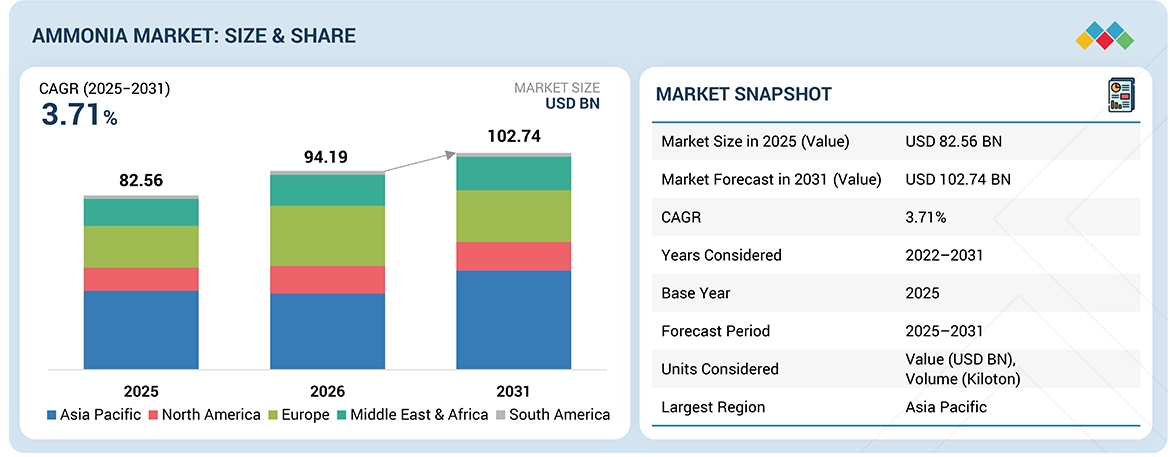
The ammonia market is projected to grow from USD 82.56 billion in 2025 to USD 102.74 billion by 2031, at a CAGR of 3.71% during the forecast period. The demand for ammonia is increasing due to the high demand from the agriculture industry for its use in fertilizers, rising population, and high demand for refrigeration.
KEY TAKEAWAYS
-
By Region
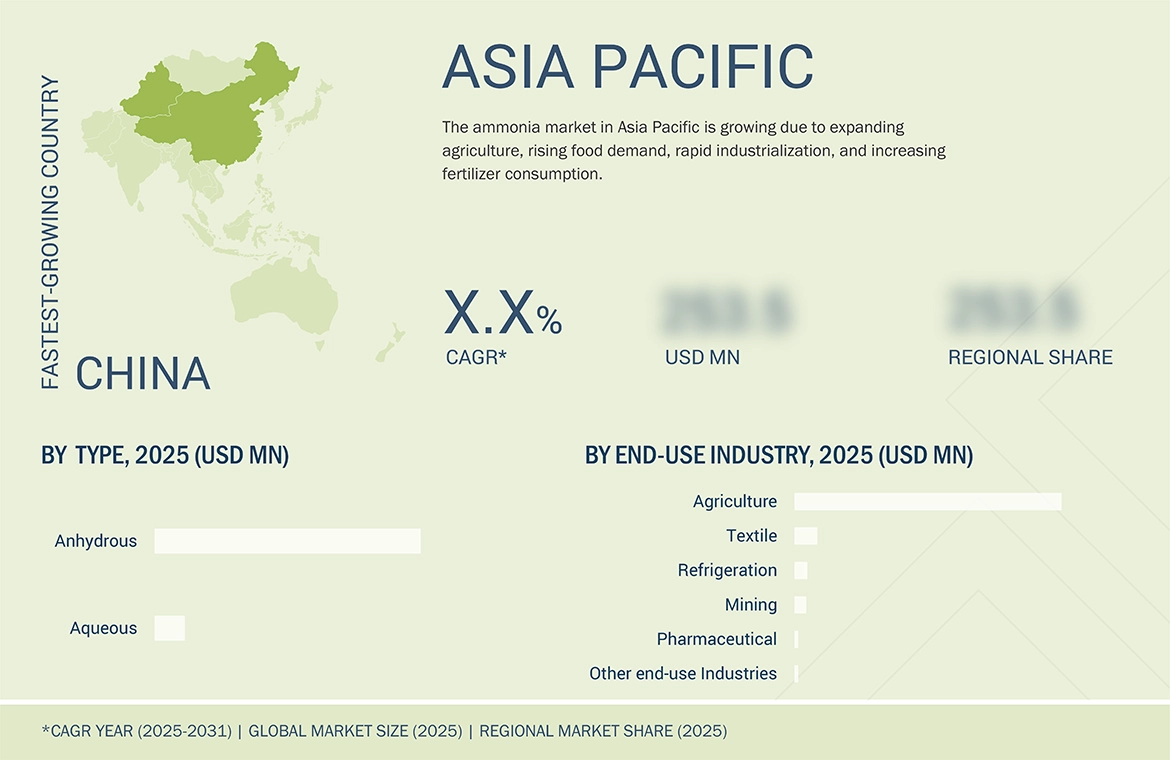
Asia Pacific accounted for a significant share of 45.3% in 2025.
-
By Type
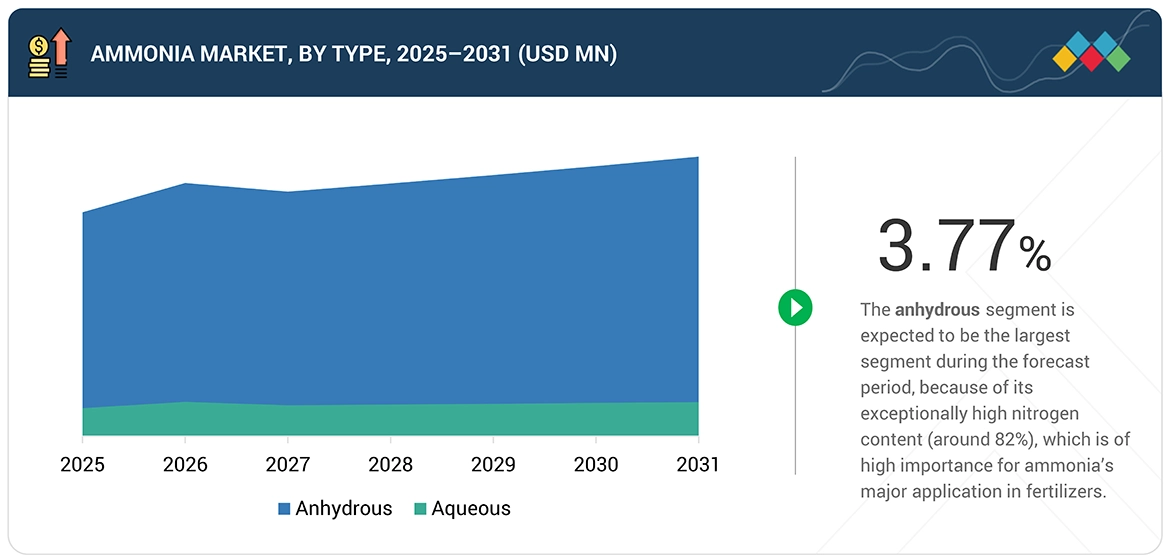
By type, the anhydrous segment is projected to register the highest CAGR (3.77%) during the period.
-
By Sales Channel
By sales channel, the direct sales segment is projected to register the highest CAGR (4.21%) during the forecast period.
-
By End-use Industry
By end-use industry, the agriculture segment dominated the market in 2025, accounting for a share of 81.6%.
-
Competitive Landscape - Key Players
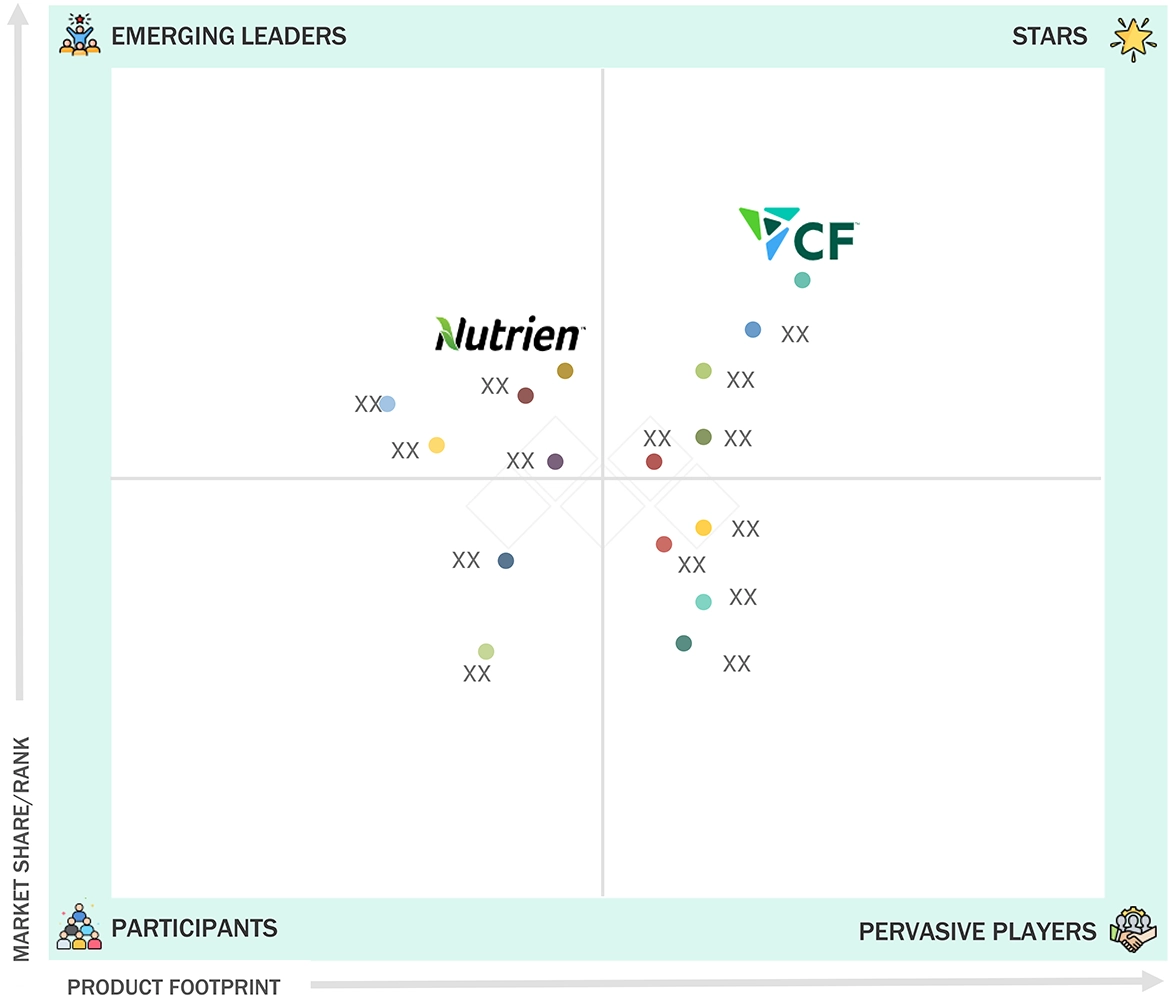
CF Industries Holdings, Inc. (US), Yara International ASA (Norway), OCI Global (Netherlands), BASF SE (Germany), and Nutrien (Canada) were identified as star players in the ammonia market (global), given their strong market share and product footprint.
-
Competitive Landscape - Startups/SMEs
TalusAg (US) and NitroVolt ApS (Denmark) have distinguished themselves among startups and SMEs by securing strong footholds in specialized niche areas, underscoring their potential as emerging market leaders.
The versatility and key chemical characteristics of ammonia are spreading it in various end-use sectors. It aids in the production of fertilizer to satisfy increasing food demand in agriculture and the processing of fabrics in the textile industry. It is energy efficient, which makes it be used in refrigeration systems, and in mining, it is utilized in explosives. It helps in the production of drugs in pharmaceuticals. Ammonia is also used in other industries, such as rubber and leather processing, preservation, and treatment, which help enhance material quality and production efficiency.
TRENDS & DISRUPTIONS IMPACTING CUSTOMERS' CUSTOMERS
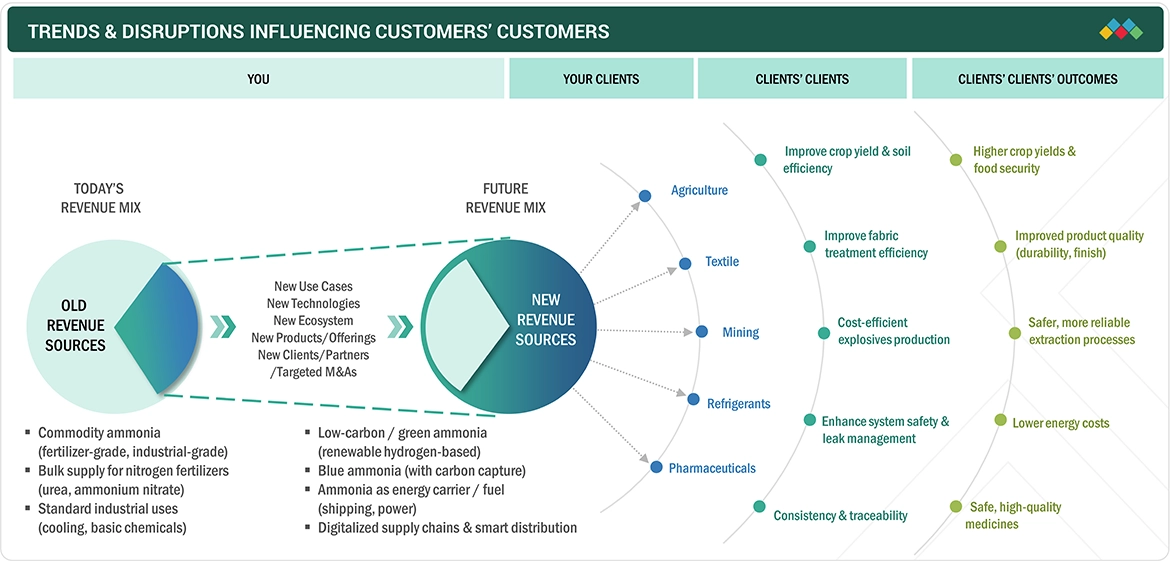
Sustainability, the energy transition, and changing industrial requirements are driving a radical shift in the ammonia market. The rapid transition to green ammonia, which is produced with renewable energy, is one of the most noticeable trends as countries work towards decarbonization and net-zero goals. This segment is experiencing exceptionally high growth rates due to its use as a low-carbon fertilizer and as an effective medium for storing and transporting energy as a hydrogen carrier. The growing use of ammonia beyond agriculture, including as a marine fuel, for power generation, and in hydrogen infrastructure, is another major trend that makes ammonia a potential clean fuel in the future. Also, demand remains pegged to fertilizers and new uses, as well as regional investments, particularly in the Asia Pacific and the Middle East, are transforming global trade patterns. In general, the market is not only changing but also becoming a strategic element of the global energy transition.
Source: Secondary Research, Interviews with Experts, MarketsandMarkets Analysis
MARKET DYNAMICS

Drivers
Impact
Level
-
Rising agricultural demand for ammonia

-
Rising demand for grain and oilseed crops and increasing population


RESTRAINTS
Impact
Level
-
Fluctuations in pricing

-
High production costs


OPPORTUNITIES
Impact
Level
-
Growing emphasis on low carbon solutions

-
Increasing demand from emerging markets


CHALLENGES
Impact
Level
-
Alternative technologies

-
Regulatory compliance

Source: Secondary Research, Interviews with Experts, MarketsandMarkets Analysis
The growing agricultural demand for ammonia is among the most powerful current influences on the global ammonia market, as ammonia is a key component of nitrogen-based fertilizers such as urea, ammonium nitrate, and ammonium sulfate. As the world keeps growing in population, the food demand is also growing tremendously, which is putting pressure on agricultural systems to enhance production and crop output. Farmers are now relying on ammonia-based fertilizers to improve soil fertility and intensify farming, particularly in areas with scarce arable land. Ammonia consumption is also enhanced by increased grain and oilseed production, which requires a high level of nitrogen to ensure proper crop growth. Moreover, further agricultural modernization and the use of precision farming methods have been enhancing the efficiency of fertilizers, promoting the further and more targeted use of ammonia-based crops. Subsidies and programs to promote agricultural development in some countries also increase the use of fertilizers, supported by the government. The growth of emerging economies in Asia, Africa and South America is particularly high, owing to the food security issues and increasing incomes that contribute to increased agricultural production. With the declining natural fertility due to climate change and soil erosion, the reliance on chemical fertilizers is growing even higher. All in all, the demand of ammonia in agriculture is still increasing because it is required to maintain food production worldwide and long-term food security.
The changes in ammonia prices pose a major constraint on the development of the world ammonia market, creating confusion for both producers and end-users. The price of ammonia is very sensitive to fluctuations in feedstock prices, especially natural gas, one of the major raw materials in the traditional Haber-Bosch process. Volatility in global energy markets directly affects production costs, leading to price volatility in pricing structures. There are also geopolitical tensions, supply chain disruptions, and changes in trade policies, which add to the unpredictability of price changes. To the agricultural users and in particular farmers in the developing economies price volatility may have a great impact on the affordability of fertilizers and hence less or slow application of fertilizers will be done thus affecting the crop yields. Industrial buyers also have a problem of long term procurement planning as there are cost structures that are not certain. Also, the seasonal fluctuations in the agricultural sector introduce spikes to the prices on a regular basis, which also increases instability. Price fluctuations are also contributed by transportation costs, storage costs, which are affected by logistical limitations and regulatory demands. Such volatility deters long-term investment in projects that require ammonia, and may slack market growth in price-sensitive areas. All in all, the problem of inconsistent pricing is one of the most critical issues that influence market stability, profitability, and adoption within the end-use industries, specifically in the economies based predominately on agriculture.
The increased interest in low-carbon solutions is a key opportunity to the ammonia market, especially with the creation of green and blue ammonia. With the world economies pledging to achieve net-zero emissions, industries are in the process of finding a cleaner substitute to the traditional production of ammonia using fossil fuels, which is very carbon-intensive. Electrolysis of renewable energy sources like wind and solar to generate hydrogen, which is then used to produce green ammonia is becoming a strong contender as a more sustainable alternative. In the same vein, blue ammonia, which involves the use of carbon capture and storage (CCS) technologies, will help the emission reduction process and make use of the current infrastructure. Such innovations make ammonia one of the enabling factors in the worldwide energy change. In addition to fertilizers, low-carbon ammonia is now being considered as a hydrogen carrier and a possible clean shipping fuel, power generation, and industrial energy system. Europe, the Asia Pacific, and the Middle East governments are heavily investing in pilot projects, subsidies and policy frameworks in an effort to accelerate adoption. Corporations are also entering into strategic alliances in order to scale the production technologies and save on costs. Competitiveness will also be enhanced over time as the technology and economies of scale will bring in a better production cost than that of conventional ammonia. On the whole, the movement to the sustainability is changing ammonia as a common product into the low-carbon energy strategy.
The current war in West Asia poses a major problem for the global ammonia market, inflating volatility across supply chains, energy markets, and trade flows. The region is vital to global energy provision, especially natural gas, which is the major feedstock for ammonia production. Any interference in the gas supply chain or transportation channels directly affects the cost of production and supply of ammonia globally. Shipment routes, insurance fees and efficiency of logistics are other geopolitical instabilities that cause delays and higher transportation costs. Consequently, international ammonia trade is less predictable, and during periods of heightened tension, prices will spike and supply shortages will be experienced. Agricultural reliance on ammonia or derivatives is a significant concern to many importing countries that risk facing uncertainty when it comes to procuring ammonia, potentially affecting the availability of fertilizers and food production cycles. Also, as perceptions of risk increase, investor confidence in large-scale ammonia projects can decline, halting capacity expansion plans in the affected areas. The volatility also interferes with long-term contracts and introduces uncertainty into global ammonia markets. This could be in the interest of some producers in other regions, but the overall market remains unstable. Therefore, geopolitical relations in West Asia continue to be a significant threat, directly affecting cost formation, the security of supply, and the stability of the ammonia market worldwide.
AMMONIA MARKET: COMMERCIAL USE CASES ACROSS INDUSTRIES
| COMPANY | USE CASE DESCRIPTION | BENEFITS |
|---|---|---|
|
|
Electrochemical ammonia removal from wastewater (Saltworks Flex EDR), enabling ammonia recovery and reuse in industrial and municipal treatment systems. | Up to 95% ammonia removal, reduced chemical use, lower costs, compliance with discharge norms, and generation of reusable fertilizer by-products. |
|
|
Low-carbon ammonia use in agriculture (CF Industries–POET) integrating green ammonia into ethanol production value chain. | Reduces ethanol carbon intensity (10%), supports sustainable farming, enables low-carbon fuel compliance, and creates premium value through traceable green fertilizer supply. |


Logos and trademarks shown above are the property of their respective owners. Their use here is for informational and illustrative purposes only.
MARKET ECOSYSTEM
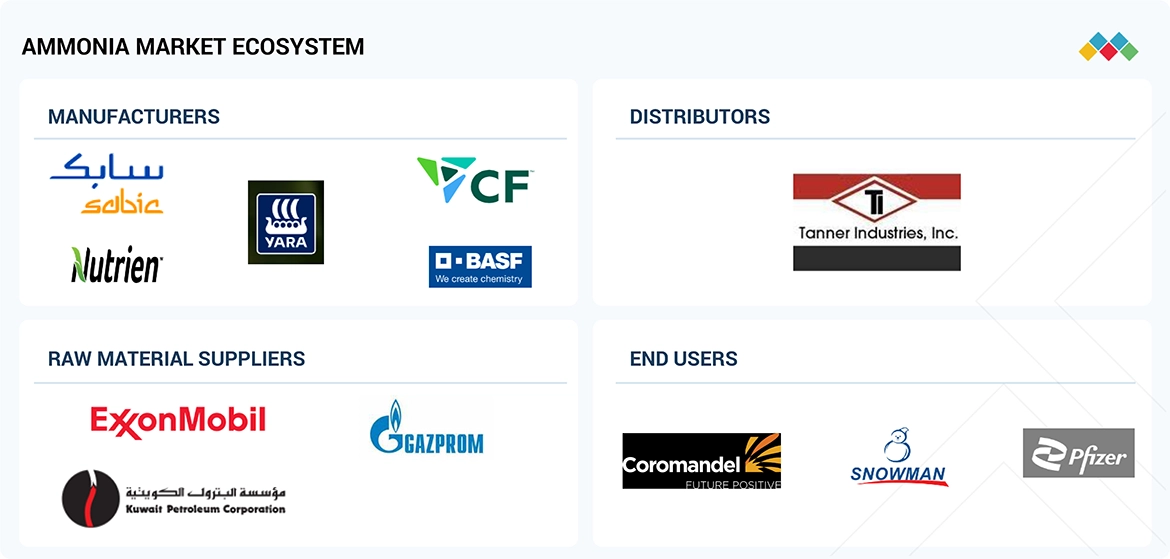
The ammonia market ecosystem begins with raw material suppliers, primarily providing natural gas (key feedstock) and, increasingly, renewable energy for green ammonia production. Manufacturers convert these inputs into ammonia using processes such as the Haber–Bosch process, supplying bulk volumes to downstream markets. Distributors and traders manage storage, transportation, and last-mile delivery, especially for fertilizers in agricultural regions. Finally, end-users, mainly agriculture, along with industries such as refrigeration, pharmaceuticals, mining, and textiles, drive demand, with agriculture dominating due to its reliance on nitrogen-based fertilizers for crop productivity.
Logos and trademarks shown above are the property of their respective owners. Their use here is for informational and illustrative purposes only.
MARKET SEGMENTS
Source: Secondary Research, Interviews with Experts, MarketsandMarkets Analysis
The largest type of segment in the ammonia market is Anhydrous ammonia mainly due to its very high content of nitrogen that is about 82 percent which is the most effective nitrogen fertilizer in the market. This high concentration enables the farmers to use low amounts and still yield high crop production, making it economically and operationally favorable. It can also be considered quite cost-effective in comparison to other nitrogen-based fertilizers on a unit of nitrogen basis which is especially crucial in large-scale farming. Also, anhydrous ammonia is a starting raw material in the manufacture of other common fertilizers like urea, ammonium nitrate, and ammonium phosphate. This further enhances its dominance since most of the ammonia used worldwide is fertilizer. Its applicability in large scale storage and transportation in mechanized farming also makes it very popular. As much as it can be used in refrigeration and industrial processes, its major demand lies in agriculture, further cementing its market leadership.
The direct sales channel prevails in the ammonia market since ammonia is mostly sold in bulk by those who use it in industries like fertilizer manufacturers and chemical producers. These customers want to buy direct to manufacturers to save the expenses they may be spending on intermediaries and they would also enjoy better prices with long term contracts. Direct sales as well provide a stable and constant supply which is essential to industries that require continuous production flow. Moreover, ammonia is a dangerous material and needs special handling, storage, and transportation. Buyers are able to work closely with the producers to make sure that safety standards and regulatory requirements are followed. It is also possible to create individual supply contracts and technical assistance with direct relationships, which is significant to maximize usage and efficiency. All in all, direct sales is the most desired and prevailing channel of distribution in the ammonia market owing to the combination of bulk sales, savings in costs, ease in logistics and reliability in supply.
The largest market segment in the ammonia market is the agriculture end-use industry since ammonia is the main building block in nitrogen fertilizers which are fundamental in the modern farming industry. Nitrogen is an essential nutrient in plant development, and nitrogen fertilizers made of ammonia are most effective in improving crop production and yield. The world is rising at a steady rate and the world population, as a result, is in need of food and hence the rise in agricultural production. Farmers are dependent on fertilizers such as ammonia because the arable land is scarce and they want to get maximum output on a unit area. The major fertilizers that are produced using ammonia include urea and ammonium nitrate which combine to constitute a huge portion of the total fertilizer consumption in the world. Also, government subsidies, farm policies and embracing of improved farming methods also enhance the demand of ammonia in this industry. Although ammonia is also employed in other industrial purposes, the extent and need of its application in agriculture makes it the mostly used industry.
REGION
Asia Pacific to be the largest region in global ammonia market during forecast period
The biggest market in the ammonia market is the Asia Pacific region because of its high population and high reliance on agriculture. Ammonia is also in high demand due to countries such as China and India, which use large amounts of fertilizer to secure food security for their populations. The agriculture sector comprises a large share of the workforce in the region, and agricultural activities often entail intensive land use, which demands high-quality fertilizers. Besides the agricultural industry, Asia Pacific boasts of a fast-expanding industrial sector that requires ammonia as a feedstock in the manufacture of textiles, pharmaceuticals, and for mining and refrigeration purposes. The region is also enjoying favorable production factors, including low labor costs and a favorable production environment, which are incentives to set up ammonia manufacturing plants. Market growth is also further supported by government incentives, greater use of modern farming methods, and the growth in food demand. Consequently, the amalgamation of agrarian reliance and industrialization renders APAC the most significant regional market in the ammonia industry.
AMMONIA MARKET: COMPANY EVALUATION MATRIX
CF Industries Holdings, Inc. (Star) is a star player in the global ammonia market due to its large-scale production capacity, strong infrastructure, and strategic positioning in nitrogen fertilizers. The company operates some of the world’s largest ammonia production facilities, particularly in North America, benefiting from access to low-cost natural gas, which is a key feedstock in ammonia production. This cost advantage allows CF Industries to maintain high profit margins and competitive pricing. Additionally, the company has a well-established distribution network, enabling efficient direct sales to major agricultural and industrial customers. Nutrien (Emerging leader) is considered a strong emerging player in the ammonia market, driven by its integrated business model and expanding global presence. Nutrien has rapidly scaled its operations across fertilizer production and retail distribution. Nutrien benefits from a vast retail network that connects directly with farmers, giving it a competitive edge in market access and demand insights. The company is also investing in innovation and sustainability, including efforts to reduce emissions and improve fertilizer efficiency. These strategic initiatives, combined with its global expansion and diversified portfolio, position Nutrien as a rising and increasingly influential player in the ammonia market.
Source: Secondary Research, Interviews with Experts, MarketsandMarkets Analysis
KEY MARKET PLAYERS
- CF Industries Holdings, Inc. (US)
- Yara International ASA (Norway)
- Saudi Basic Industries Corporation (Saudi Arabia)
- OCI Global (Netherlands)
- BASF SE (Germany)
- Nutrien (Canada)
- Qatar Fertiliser
- Company (Qatar)
- Koch Fertilizer, LLC (US)
- EuroChem Group (Switzerland)
- CSBP Limited (Australia)
MARKET SCOPE
| REPORT METRIC | DETAILS |
|---|---|
| Market Size in 2025 (Value) | USD 82.56 Billion |
| Market Forecast in 2031 (Value) | USD 102.74 Billion |
| Growth Rate | CAGR of 3.71% from 2025–2031 |
| Years Considered | 2022–2031 |
| Base Year | 2025 |
| Forecast Period | 2026–2031 |
| Units Considered | Value (USD Billion), Volume (Kiloton) |
| Report Coverage | Revenue forecast, company ranking, competitive landscape, growth factors, and trends |
| Segments Covered |
|
| Regions Covered | North America, Asia Pacific, Europe, South America, Middle East & Africa |
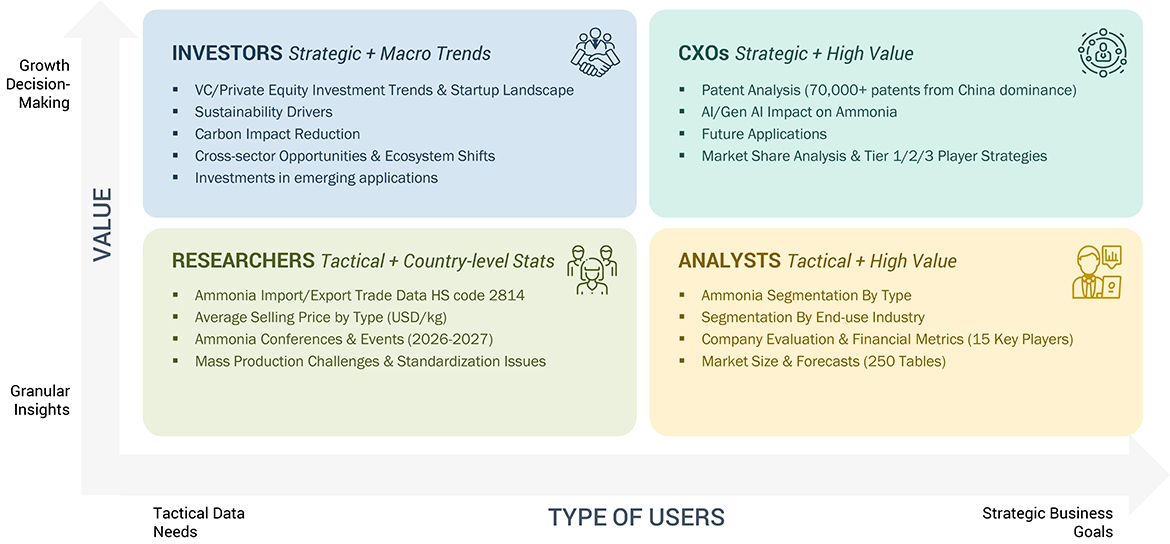
WHAT IS IN IT FOR YOU: AMMONIA MARKET REPORT CONTENT GUIDE
DELIVERED CUSTOMIZATIONS
We have successfully delivered the following deep-dive customizations:
| CLIENT REQUEST | CUSTOMIZATION DELIVERED | VALUE ADDS |
|---|---|---|
| Ammonia Market-emerging types | Detailed analysis of ammonia in emerging types which included green, bio, and blue ammonia. | Identified different emerging types of ammonia by comparing emissions, cost, scalability, and market fit for each type. |
RECENT DEVELOPMENTS
- January 2026 : CF Industries partnered with POET, world’s largest producer of biofuel, and multiple agriculture cooperatives to pilot a low-carbon fertilizer supply chain, enabling 5–6 million gallons of lower-carbon ethanol and tracking emissions from production to use. This would help CF Industries by validating its low-carbon ammonia, strengthening its role in decarbonized agriculture value chains, and expanding demand for its certified low-carbon fertilizer products.
- December 2025 : Yara International entered into advanced negotiations with Air Products to partner on low-emission ammonia projects in the US, developing a cost-competitive project portfolio aligned with USD 1.2 billion capex discipline and targeting a final investment decision by mid-2026.
- May 2025 : BASF SE became the first producer of renewable ammonia in Central Europe, launching certified renewable ammonia and ammonia solution 24.5%, at its Ludwigshafen site using renewable hydrogen to reduce natural gas consumption.
Table of Contents
 Exclusive indicates content/data unique to MarketsandMarkets and not available with any competitors.
TITLE
PAGE NO
1
INTRODUCTION
15
2
EXECUTIVE SUMMARY
3
PREMIUM INSIGHTS
4
MARKET OVERVIEW
4.1
INTRODUCTION
4.2
MARKET DYNAMICS
4.2.1
DRIVERS
4.2.1.1
RISING AGRICULTURAL DEMAND FOR AMMONIA
4.2.1.2
RISING DEMAND FOR GRAIN AND OILSEED CROPS AND INCREASING POPULATION
4.2.1.3
GROWING DEMAND FOR REFRIGERATION
4.2.2
RESTRAINTS
4.2.2.1
FLUCTUATIONS IN PRICING
4.2.2.2
HIGH PRODUCTION COSTS
4.2.3
OPPORTUNITIES
4.2.3.1
GROWING EMPHASIS ON LOW-CARBON SOLUTIONS
4.2.3.2
INCREASING DEMAND FROM EMERGING MARKETS
4.2.4
CHALLENGES
4.2.4.1
ALTERNATIVE TECHNOLOGIES
4.2.4.2
REGULATORY COMPLIANCE
4.2.4.3
ONGOING WEST ASIA WAR IMPACT ON GLOBAL AMMONIA MARKET VOLATILITY
4.3
UNMET NEEDS AND WHITE SPACES
4.4
INTERCONNECTED MARKETS AND CROSS-SECTOR OPPORTUNITIES
4.5
STRATEGIC MOVES BY TIER-1/2/3 PLAYERS
5
INDUSTRY TRENDS
5.1
PORTER’S FIVE FORCES ANALYSIS
5.2
MACROECONOMICS OUTLOOK
5.2.1
INTRODUCTION
5.2.2
GDP TRENDS AND FORECAST
5.2.3
TRENDS IN GLOBAL AMMONIA MARKET
5.3
VALUE CHAIN ANALYSIS
5.4
ECOSYSTEM ANALYSIS
5.5
PRICING ANALYSIS
5.5.1
AVERAGE SELLING PRICE TREND OF AMMONIA, BY KEY PLAYER (2021–2025)
5.5.2
AVERAGE SELLING PRICE TREND, BY REGION (2021–2025)
5.5.3
PRICING RANGE OF AMMONIA, BY TYPE (2025)
5.6
TRADE ANALYSIS
5.6.1
IMPORT SCENARIO (HS CODE 2814)
5.6.2
EXPORT SCENARIO (HS CODE 2814)
5.7
KEY CONFERENCES AND EVENTS, 2026–2027
5.8
TRENDS/DISRUPTIONS IMPACTING CUSTOMER BUSINESS
5.9
INVESTMENT AND FUNDING SCENARIO
5.10
CASE STUDY ANALYSIS
5.11
IMPACT OF 2025 US TARIFF – AMMONIA MARKET
5.11.1
INTRODUCTION
5.11.2
KEY TARIFF RATES
5.11.3
PRICE IMPACT ANALYSIS
5.11.4
IMPACT ON COUNTRIES/REGIONS
5.11.4.1
US
5.11.4.2
EUROPE
5.11.4.3
ASIA PACIFIC
5.11.5
IMPACT ON END-USE INDUSTRIES
6
TECHNOLOGICAL ADVANCEMENTS, AI-DRIVEN IMPACT, PATENTS, INNOVATIONS, AND FUTURE APPLICATIONS
6.1
KEY TECHNOLOGIES
6.1.1
HABER-BOSCH PROCESS
6.1.2
ELECTROCEHMICAL NITROGEN REDUCTION
6.2
COMPLEMENTARY TECHNOLOGIES
6.2.1
RENEWABLE ENERGY INTEGRATION
6.2.2
ADVANCED HEAT RECOVERY SYSTEMS
6.3
TECHNOLOGY/PRODUCT ROADMAP
6.4
PATENT ANALYSIS
6.5
FUTURE APPLICATIONS
6.6
IMPACT OF AI/GEN AI ON AMMONIA MARKET
6.6.1
TOP USE CASES AND MARKET POTENTIAL
6.6.2
BEST PRACTICES FOLLOWED BY MANUFACTURERS/OEMS IN AMMONIA MARKET
6.6.3
CASE STUDIES RELATED TO AI IMPLEMENTATION IN THE AMMONIA MARKET
6.6.4
INTERCONNECTED ECOSYSTEM AND IMPACT ON MARKET PLAYERS
6.6.5
CLIENTS’ READINESS TO ADOPT AI-INTEGRATED AMMONIA
7
REGULATORY LANDSCAPE AND SUSTAINABILITY INITIATIVES
7.1
REGIONAL REGULATIONS AND COMPLIANCE
7.1.1
REGULATORY BODIES, GOVERNMENT AGENCIES, AND OTHER ORGANIZATIONS
7.1.2
INDUSTRY STANDARDS
7.2
SUSTAINABILITY INITIATIVES
7.3
IMPACT OF REGULATORY POLICIES ON SUSTAINABILITY INITIATIVES
8
CUSTOMER LANDSCAPE & BUYER BEHAVIOR
8.1
DECISION-MAKING PROCESS
8.2
KEY STAKEHOLDERS INVOLVED IN BUYING PROCESS AND THEIR EVALUATION CRITERIA
8.2.1
KEY STAKEHOLDERS IN BUYING PROCESS
8.2.2
BUYING CRITERIA
8.3
ADOPTION BARRIERS & INTERNAL CHALLENGES
8.4
UNMET NEEDS OF VARIOUS END-USE INDUSTRIES
8.5
MARKET PROFITABILITY
9
AMMONIA MARKET, BY TYPE
9.1
INTRODUCTION
9.2
AQUEOUS
9.3
ANHYDROUS
10
AMMONIA MARKET, BY SALES CHANNEL
10.1
INTRODUCTION
10.2
DIRECT
10.3
INDIRECT
11
AMMONIA MARKET, BY END-USE INDUSTRY
11.1
INTRODUCTION
11.2
AGRICULTURE
11.3
TEXTILE
11.4
REFRIGERATION
11.5
MINING
11.6
PHARMACEUTICAL
11.7
OTHER END-USE INDUSTRIES
12
AMMONIA MARKET, BY REGION
12.1
INTRODUCTION
12.2
NORTH AMERICA
12.2.1
US
12.2.2
CANADA
12.2.3
MEXICO
12.3
ASIA PACIFIC
12.3.1
CHINA
12.3.2
JAPAN
12.3.3
INDIA
12.3.4
INDONESIA
12.3.5
REST OF ASIA PACIFIC
12.4
EUROPE
12.4.1
GERMANY
12.4.2
FRANCE
12.4.3
UK
12.4.4
SPAIN
12.4.5
ITALY
12.4.6
RUSSIA
12.4.7
REST OF EUROPE
12.5
SOUTH AMERICA
12.5.1
BRAZIL
12.5.2
ARGENTINA
12.5.3
REST OF SOUTH AMERICA
12.6
MIDDLE EAST & AFRICA
12.6.1
GCC COUNTRIES
12.6.1.1
SAUDI ARABIA
12.6.1.2
UAE
12.6.1.3
REST OF GCC COUNTRIES
12.6.2
IRAN
12.6.3
REST OF MIDDLE EAST & AFRICA
13
COMPETITIVE LANDSCAPE
13.1
OVERVIEW
13.2
KEY PLAYER COMPETITIVE STRATEGIES /RIGHT TO WIN (JANUARY 2021–MARCH 2026)
13.2.1
COMPETITIVE STRATEGIES INITIATIVES
13.3
REVENUE ANALYSIS (2020–2025)
13.4
MARKET SHARE ANALYSIS (2025)
13.5
PRODUCT COMPARISON
13.6
COMPANY EVALUATION MATRIX: KEY PLAYERS,
13.6.1
STARS
13.6.2
EMERGING LEADERS
13.6.3
PERVASIVE PLAYERS
13.6.4
PARTICIPANTS
13.6.5
COMPANY FOOTPRINT: KEY PLAYERS,
13.6.5.1
COMPANY FOOTPRINT
13.6.5.2
REGION FOOTPRINT
13.6.5.3
TYPE FOOTPRINT
13.6.5.4
SALES CHANNEL FOOTPRINT
13.6.5.5
END-USE INDUSTRY FOOTPRINT
13.7
COMPANY EVALUATION MATRIX: STARTUPS/SMES,
13.7.1
PROGRESSIVE COMPANIES
13.7.2
RESPONSIVE COMPANIES
13.7.3
DYNAMIC COMPANIES
13.7.4
STARTING BLOCKS
13.7.5
COMPETITIVE BENCHMARKING: STARTUPS/SMES,
13.7.5.1
DETAILED LIST OF KEY STARTUPS/SMES
13.7.5.2
COMPETITIVE BENCHMARKING OF KEY STARTUPS/SMES
13.8
COMPANY VALUATION AND FINANCIAL METRICS
13.9
COMPETITIVE SCENARIO
13.9.1
PRODUCT LAUNCHES
13.9.2
DEALS
13.9.3
EXPANSIONS
13.9.4
OTHER DEVELOPMENTS
14
COMPANY PROFILES
14.1
KEY PLAYERS
14.1.1
CF INDUSTRIES HOLDINGS, INC.
14.1.1.1
BUSINESS OVERVIEW
14.1.1.2
PRODUCTS/SOLUTIONS/SERVICES OFFERED
14.1.1.3
RECENT DEVELOPMENTS
14.1.1.4
MNM VIEW
14.1.2
YARA INTERNATIONAL ASA
14.1.2.1
BUSINESS OVERVIEW
14.1.2.2
PRODUCTS/SOLUTIONS/SERVICES OFFERED
14.1.2.3
RECENT DEVELOPMENTS
14.1.2.4
MNM VIEW
14.1.3
SAUDI BASIC INDUSTRIES CORPORATION
14.1.3.1
BUSINESS OVERVIEW
14.1.3.2
PRODUCTS/SOLUTIONS/SERVICES OFFERED
14.1.3.3
RECENT DEVELOPMENTS
14.1.3.4
MNM VIEW
14.1.4
OCI GLOBAL
14.1.4.1
BUSINESS OVERVIEW
14.1.4.2
PRODUCTS/SOLUTIONS/SERVICES OFFERED
14.1.4.3
RECENT DEVELOPMENTS
14.1.4.4
MNM VIEW
14.1.5
BASF SE
14.1.5.1
BUSINESS OVERVIEW
14.1.5.2
PRODUCTS/SOLUTIONS/SERVICES OFFERED
14.1.5.3
RECENT DEVELOPMENTS
14.1.5.4
MNM VIEW
14.1.6
NUTRIEN
14.1.6.1
BUSINESS OVERVIEW
14.1.6.2
PRODUCTS/SOLUTIONS/SERVICES OFFERED
14.1.6.3
RECENT DEVELOPMENTS
14.1.6.4
MNM VIEW
14.1.7
QATAR FERTILISER COMPANY
14.1.7.1
BUSINESS OVERVIEW
14.1.7.2
PRODUCTS/SOLUTIONS/SERVICES OFFERED
14.1.7.3
RECENT DEVELOPMENTS
14.1.7.4
MNM VIEW
14.1.8
KOCH FERTILIZER, LLC
14.1.8.1
BUSINESS OVERVIEW
14.1.8.2
PRODUCTS/SOLUTIONS/SERVICES OFFERED
14.1.8.3
RECENT DEVELOPMENTS
14.1.8.4
MNM VIEW
14.1.9
EUROCHEM GROUP
14.1.9.1
BUSINESS OVERVIEW
14.1.9.2
PRODUCTS/SOLUTIONS/SERVICES OFFERED
14.1.9.3
RECENT DEVELOPMENTS
14.1.9.4
MNM VIEW
14.1.10
CSBP LIMITED
14.1.10.1
BUSINESS OVERVIEW
14.1.10.2
PRODUCTS/SOLUTIONS/SERVICES OFFERED
14.1.10.3
RECENT DEVELOPMENTS
14.1.10.4
MNM VIEW
14.2
OTHER PLAYERS
14.2.1
GROUP DF
14.2.2
GUJARAT STATE FERTILIZERS & CHEMICALS LIMITED
14.2.3
JSC TOGLIATTIAZOT
14.2.4
PT PUPUK SRIWIDJAJA PALEMBANG
14.2.5
GULF COAST AMMONIA LLC
14.2.6
DEEPAK FERTILISERS AND PETROCHEMICALS CORPORATION LIMITED
14.2.7
JAYSONS CHEMICAL INDUSTRIES
14.2.8
MYSORE AMMONIA PVT. LTD.
14.2.9
STEELMAN GASES PVT. LTD.
14.2.10
SUMITOMO CHEMICAL CO., LTD.
14.2.11
SURAT AMMONIA AND CHEMICAL COMPANY (SACCO)
14.2.12
J.R. SIMPLOT COMPANY
14.2.13
ANMOL CHEMICALS PRIVATE LIMITED
14.2.14
UBE CORPORATION
14.2.15
GRUPA AZOTY S.A.
14.2.16
TALUGAS
14.2.17
NITROVOLT APS
15
RESEARCH METHODOLOGY
15.1
RESEARCH DATA
15.1.1
SECONDARY DATA
15.1.1.1
KEY DATA FROM SECONDARY SOURCES
15.1.2
PRIMARY DATA
15.1.2.1
KEY DATA FROM PRIMARY SOURCES
15.1.2.2
KEY PRIMARY PARTICIPANTS
15.1.2.3
BREAKDOWN OF PRIMARY INTERVIEWS
15.1.2.4
KEY INDUSTRY INSIGHTS
15.2
MARKET SIZE ESTIMATION
15.2.1
BOTTOM-UP APPROACH
15.2.2
TOP-DOWN APPROACH
15.2.3
MARKET SIZE CALCULATION FOR BASE NUMBER
15.3
MARKET FORECAST APPROACH
15.3.1
SUPPLY SIDE
15.3.2
DEMAND SIDE
15.4
DATA TRIANGULATION
15.5
FACTOR ANALYSIS
15.6
RESEARCH ASSUMPTIONS AND LIMITATIONS
15.7
RISK ASSESSMENT
16
APPENDIX
16.1
DISCUSSION GUIDE
16.2
KNOWLEDGESTORE: MARKETSANDMARKETS’ SUBSCRIPTION PORTAL
16.3
CUSTOMIZATION OPTIONS
16.4
RELATED REPORTS
16.5
AUTHOR DETAILS
Methodology
The study involved four major activities to estimate the current size of the global ammonia market. Exhaustive secondary research was carried out to collect information on the market, the peer product market, and the parent product group market. The next step was to validate these findings, assumptions, and sizes with industry experts across the ammonia value chain through primary research. The top-down and bottom-up approaches were employed to estimate the overall size of the ammonia market. Afterward, market breakdown and data triangulation were used to determine the size of market segments.
Secondary Research
The market for companies offering ammonia was determined by analyzing secondary data from paid and unpaid sources, reviewing the product portfolios of major companies in the ecosystem, and rating companies based on performance and quality. Various secondary sources, such as Business Standard, Bloomberg, World Bank, and Factiva, were referred to identify and collect information for this study on the ammonia market. In the secondary research process, various secondary sources were referred to identify and collect information related to the study. Secondary sources included annual reports, press releases, investor presentations, ammonia vendors, forums, certified publications, and white papers. Secondary research was used to obtain critical information on the industry’s value chain, the total pool of key players, market classification, and segmentation from both market- and technology-oriented perspectives.
Primary Research
In the primary research process, interviews with primary sources from the supply and demand sides were conducted to obtain qualitative and quantitative information for this report. The primary sources from the supply side included industry experts, such as Chief Executive Officers (CEOs), Vice Presidents (VPs), marketing directors, technology and innovation directors, and related key executives from several key companies and organizations operating in the ammonia market. After the completion of market engineering (calculations for market statistics, market breakdown, market size estimation, market forecasting, and data triangulation), extensive primary research was conducted to gather information and verify and validate the critical numbers derived. Primary research was also conducted to identify the segmentation types, industry trends, competitive landscape of ammonia offered by various market players, and key market dynamics, such as drivers, restraints, opportunities, challenges, industry trends, and key player strategies. In the complete market engineering process, the top-down and bottom-up approaches and several data triangulation methods were extensively used to perform the market estimation and market forecasting for the overall market segments and subsegments listed in this report. Extensive qualitative and quantitative analysis was performed on the complete market engineering process to list the key information/insights throughout the report.
Breakdown of Primary Interviews
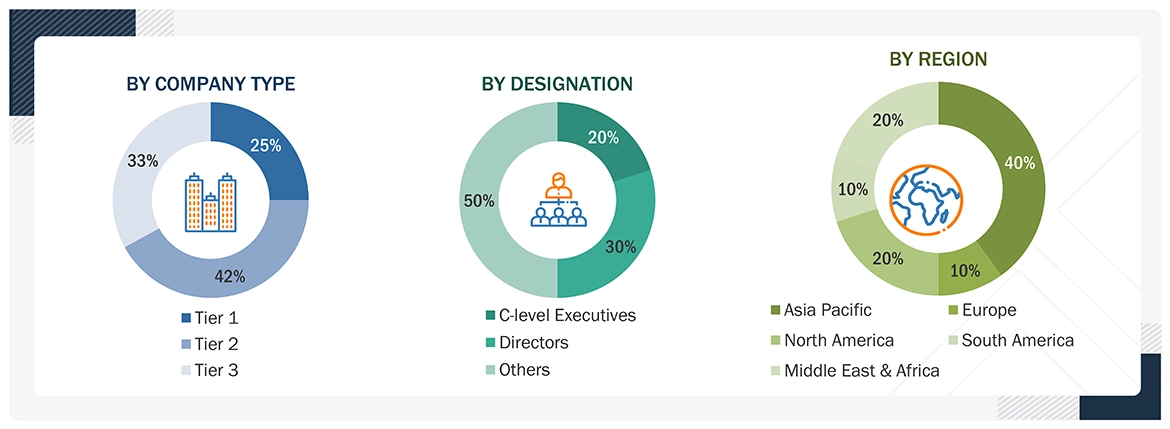
Notes:
Others include sales, marketing, and product managers.
Tier 1: > USD 1 billion; Tier 2: USD 500 million–1 billion; and Tier 3: < USD 500 million
To know about the assumptions considered for the study, download the pdf brochure
Market Size Estimation
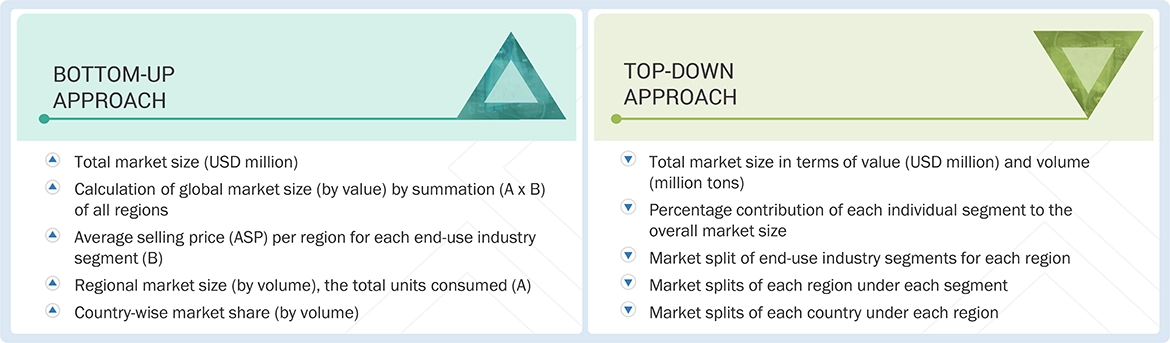
The top-down and bottom-up approaches were used to estimate and validate the size of the global ammonia market. These approaches were also used extensively to estimate the size of various dependent market segments.
The research methodology used to estimate the market size included the following approaches.
Data Triangulation
After arriving at the overall market size using the market size estimation processes, the market was split into several segments and subsegments. The data triangulation and market breakup procedures were employed, where applicable, to complete the overall market engineering process and determine the exact statistics for each market segment and subsegment. The data was triangulated by studying various factors and trends from both the demand and supply sides.
Market Definition
Ammonia is a colorless gas with a sharp, pungent smell, made of nitrogen and hydrogen. It is one of the most important industrial chemicals because it is used primarily to produce fertilizers that support global agriculture. It also has applications in textiles, refrigeration, mining, pharmaceuticals, and other uses. Ammonia is valuable in industry, but it must be handled carefully because it can be hazardous at high concentrations. It is also available in aqueous form for different uses.
Key Stakeholders
- Raw Material Suppliers
- Regulatory Bodies
- Government and Consulting Firms
- End Users
- Research and Development Organizations
- Ammonia Manufacturers, Dealers, Traders, and Suppliers.
Report Objectives
- To define, describe, and forecast the size of the global ammonia market based on type, sales channel, end-use industry, and region in terms of value and volume
- To provide detailed information on the significant drivers, restraints, opportunities, and challenges influencing the market
- To analyze and forecast the market based on type, sales channel, and end-use industry
- To strategically analyze micro markets concerning individual growth trends, prospects, and their contribution to the market
- To assess the growth opportunities in the market for stakeholders and provide details on the competitive landscape for market leaders
- To forecast the market size of segments for North America, Europe, Asia Pacific, South America, and the Middle East & Africa
- To strategically profile key players and comprehensively analyze their market shares and core competencies
- To analyze competitive developments, such as expansions, partnerships, and acquisitions in the ammonia market
- To provide the impact of AI on the ammonia market.
Available customizations:
With the given market data, MarketsandMarkets offers customizations according to client-specific needs.
The following customization options are available for the ammonia report:
Product Analysis
- A product matrix that gives a detailed comparison of the product portfolio of each company
Regional Analysis
- A further breakdown of the ammonia market for additional countries
Company Information
- Detailed analysis and profiling of additional market players (up to five)


Still Researching the
Ammonia Ecosystem?
See the competitors, opportunities, and growth signals shaping it - instantly.
Generate 15+ consulting-grade strategic insights tailored to your growth question.
Powered by 17 years of MarketsandMarkets intelligence