









- DESCRIPTION
- TABLE OF CONTENTS
- METHODOLOGY
- DOWNLOAD PDF
US Molecular Diagnostics Market by Product & Service (Kits, Instruments, Software), Test Type (Lab, PoC), Sample (Blood, Urine), Technology (PCR, NGS, ISH), Application [Infectious (Hepatitis, HIV, HAI, Flu), Cancer (Breast, Lung)] - Forecast to 2031

USD 14.32 BN
MARKET SIZE, 2031

CAGR 9.9%
(2026-2031)

200
REPORT PAGES

120
MARKET TABLES
OVERVIEW
Source: Secondary Research, Interviews with Experts, MarketsandMarkets Analysis
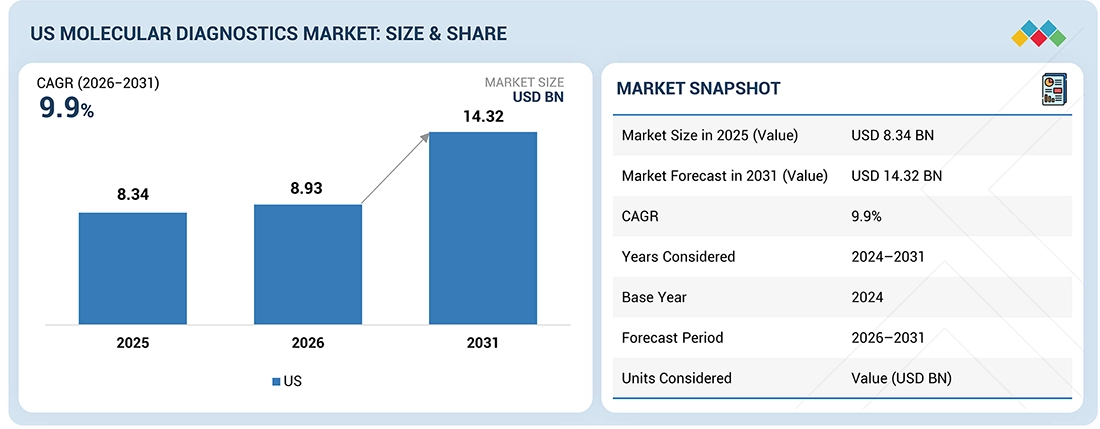
The US molecular diagnostics market, valued at US$8.34 billion in 2025, stood at US$8.93 billion in 2026 and is projected to advance at a resilient CAGR of 9.9% from 2026 to 2031, culminating in a forecasted valuation of US$14.32 billion by the end of the period. This expansion is driven by the high burden of infectious diseases & cancer, which continues to increase testing volumes across clinical settings. The growing use of molecular tests for early diagnosis, treatment selection, and disease monitoring, along with the wider adoption of personalized medicine, is further supporting demand. In addition, ongoing investments in advanced diagnostic technologies and the strong presence of well-established laboratory networks are contributing to sustained market growth.
KEY TAKEAWAYS
-
By Product & Service
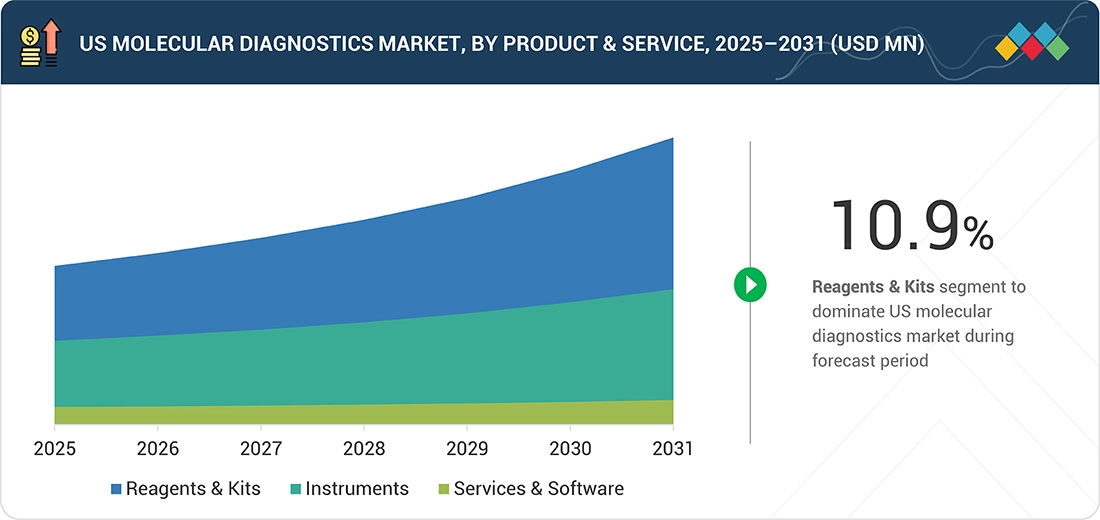
By product & service, the reagents & kits segment is expected to register the highest CAGR of 10.9% during the forecast period.
-
By Test Type
By test type, the lab tests segment accounted for the largest market share of 79.5% in 2025.
-
By Sample Type
By sample type, the blood, serum, and plasma segment accounted for the largest market share of 68.6% in 2025.
-
By Technology
By technology, the PCR segment accounted for the largest share of the market in 2025.
-
By Application
By application, the infectious disease diagnostics segment is expected to dominate the market throughout the forecast period.
-
By Technique
By technique, multiplex testing accounted for the largest market share in 2025.
-
By Clinical Application
By clinical application, the diagnostics segment is expected to dominate the market during the forecast period.
-
By End User
By end user, the diagnostic labs segment is expected to register the highest CAGR during the forecast period.
-
Competitive Landscape
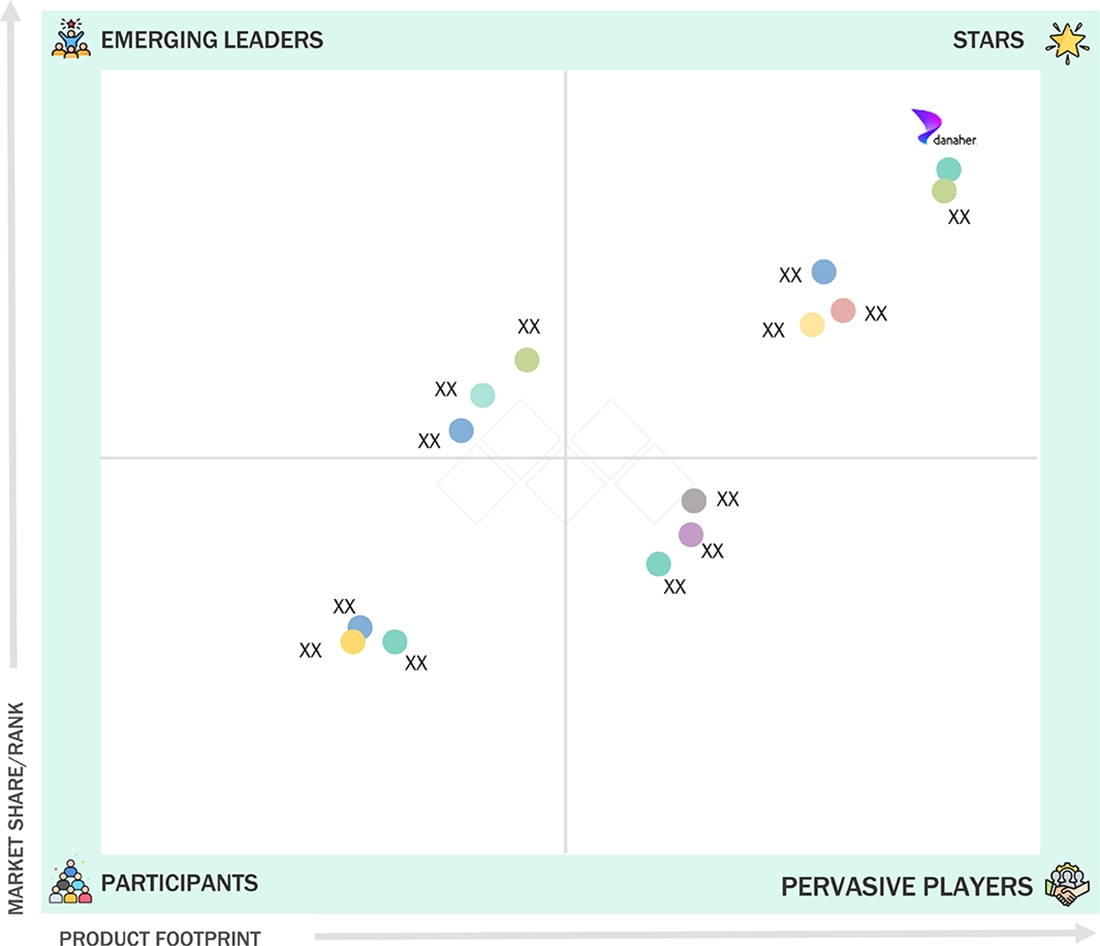
bioMérieux (France), Hologic (US), Danaher (US), Illumina (US), and Roche (Switzerland) were identified as the star players in the US molecular diagnostics market, supported by their strong market presence and extensive product portfolios.
-
Competitive Landscape
Vela Diagnostics (Singapore), Savyon Diagnostics (Israel), and Uniogen OY (Finland) have distinguished themselves among startups and SMEs by securing strong footholds in specialized niche areas.
The US molecular diagnostics market is experiencing rapid growth, driven by the rising demand for precise and accurate testing. A key factor in this expansion is the increasing number of tests available for infectious diseases, cancer, and genetic disorders. Additionally, the adoption of molecular diagnostic testing in the US is on the rise, primarily due to technological advancements and the presence of prominent companies in the market.
TRENDS & DISRUPTIONS IMPACTING CUSTOMERS' CUSTOMERS
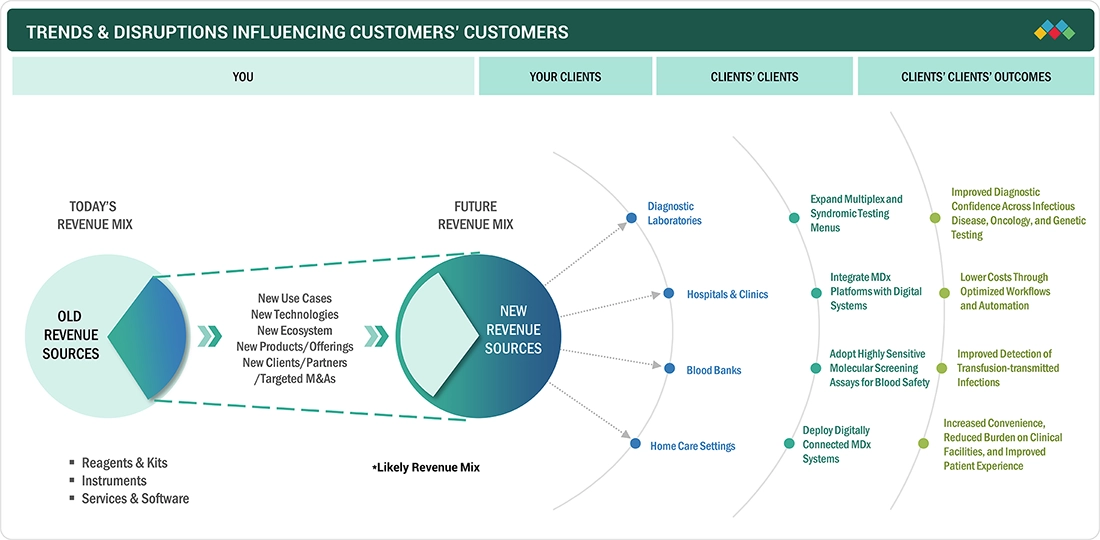
The US molecular diagnostics (MDx) market is undergoing a notable shift, driven by evolving clinical needs and technological changes. A key trend is the growing use of molecular testing beyond specialized labs, with greater integration into hospital labs and near-patient/POC settings to support faster clinical decision-making. At the same time, advances in next-generation sequencing, multiplex assays, and automation are changing how tests are developed and delivered, enabling higher throughput and broader panels from a single sample. Together, these developments are reshaping testing workflows and expanding the clinical role of MDx across the US healthcare system.
Source: Secondary Research, Interviews with Experts, MarketsandMarkets Analysis
MARKET DYNAMICS

Drivers
Impact
Level
-
Increasing prevalence of infectious diseases and cancer

-
Surge in technological advancements


RESTRAINTS
Impact
Level
-
High cost of molecular diagnostic instruments

-
Inadequate reimbursements


OPPORTUNITIES
Impact
Level
-
Growing significance of companion diagnostics

-
Increasing adoption of automation and digital tools to improve laboratory efficiency


CHALLENGES
Impact
Level
-
Operational barriers and labor shortage

-
Changing regulatory landscape

Source: Secondary Research, Interviews with Experts, MarketsandMarkets Analysis
The rising burden of infectious diseases & cancer in the US continues to drive demand for molecular diagnostics as these tests enable early detection, precise identification of disease subtypes, and effective monitoring of treatment response. Molecular methods are increasingly preferred for their high sensitivity & specificity, supporting timely clinical decision-making and improved patient outcomes across hospitals, diagnostic laboratories, and other end users.
The high initial cost of molecular diagnostic instruments and the associated expenses for maintenance, consumables, and skilled personnel remain a key restraint for market growth. Smaller laboratories and healthcare facilities may face challenges in adopting advanced molecular platforms, which can limit broader penetration, particularly outside large hospital systems and labs.
The growing importance of companion diagnostics presents a major opportunity for the US molecular diagnostics (MDx) market, driven by the expanding use of targeted therapies & personalized medicine. Companion diagnostics play a critical role in identifying patients most likely to benefit from specific treatments, particularly in oncology, thereby increasing their clinical relevance and supporting the wider adoption of molecular testing.
A continuously evolving regulatory environment poses a challenge for molecular diagnostics (MDx) providers in the US as companies must adapt to updated approval requirements, quality standards, and compliance expectations. Navigating these changes can increase development timelines & operational complexity, especially for innovative and rapidly evolving molecular technologies.
US MOLECULAR DIAGNOSTICS MARKET: COMMERCIAL USE CASES ACROSS INDUSTRIES
| COMPANY | USE CASE DESCRIPTION | BENEFITS |
|---|---|---|
|
|
Application of rapid PCR-based molecular platforms for high-throughput infectious disease testing & decentralized diagnostic workflows. | Supports faster test turnaround, improves scalability, and enables efficient deployment across diverse testing environments. |
|
|
Use of next-generation sequencing (NGS) technologies for oncology profiling, genetic analysis, and large-scale genomic testing programs. | Delivers deep genomic insights, supports precision medicine strategies, and enables scalable high-throughput analysis. |
|
|
Molecular testing solutions focused on women’s health, including HPV & sexually transmitted infection screening. | Enhances early detection, supports preventive care initiatives, and improves long-term clinical outcomes. |
|
|
Integrated molecular diagnostic systems for infectious disease testing, cancer diagnostics, and companion diagnostics in centralized labs. | Delivers high test accuracy, standardized results, and seamless integration across laboratory workflows. |
|
|
MDx solutions for rapid identification of pathogens & monitoring of healthcare-associated infections (HAIs). | Enables timely detection, supports infection control strategies, and improves disease management outcomes. |


Logos and trademarks shown above are the property of their respective owners. Their use here is for informational and illustrative purposes only.
MARKET ECOSYSTEM
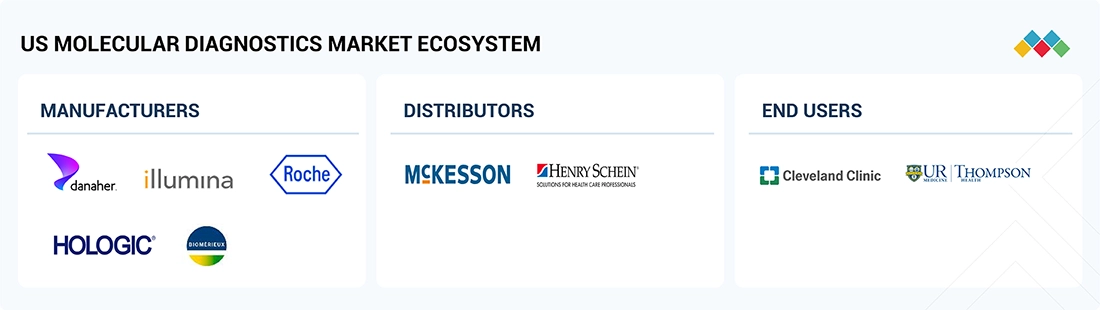
The US molecular diagnostics ecosystem consists of key stakeholders and components across the entire value chain, including products & services, test types, sample types, technologies, applications, techniques, clinical applications, and end users. The stakeholders include manufacturers engaged in developing and introducing products, distributors who sell via third parties or e-commerce platforms, and R&D partners offering outsourced development and manufacturing support. End users include hospitals & clinics, diagnostic laboratories, and other end users that apply MDx solutions in carrying out diagnostics. These constitute the key stakeholders in the US molecular diagnostics supply chain.
Logos and trademarks shown above are the property of their respective owners. Their use here is for informational and illustrative purposes only.
MARKET SEGMENTS
Source: Secondary Research, Interviews with Experts, MarketsandMarkets Analysis
On the basis of product & service, the market is segmented into reagents & kits, instruments, and services & software. In 2025, the reagents & kits segment accounted for the largest market share, primarily due to their recurring use in every molecular diagnostic test and strong demand across a broad range of applications. High testing volumes, continuous assay consumption, and regular launches of upgraded kits to meet evolving diagnostic needs also support the segment’s leading position.
On the basis of test type, the market is segmented into lab tests and PoC tests. In 2025, the lab tests segment held the largest market share, driven by their widespread use for complex and high-volume molecular testing. Lab-based testing supports a broad range of applications, including infectious disease detection, oncology, and genetic testing. It also allows for higher throughput and standardized workflows. The availability of advanced instrumentation and the ability to handle large sample volumes contribute to the dominant position of lab tests.
On the basis of sample type, the market is segmented into blood, serum, and plasma; urine; and other sample types. In 2025, the blood, serum, and plasma segment accounted for the largest market share as these specimens are most commonly used for a wide range of applications. Their compatibility with multiple molecular technologies, reliable biomarker availability, and routine use in clinical testing support high sample volumes and consistent demand, contributing to the segment’s leading position.
On the basis of technology, the market is segmented into PCR, isothermal nucleic acid amplification technology, DNA sequencing & NGS, in situ hybridization, DNA microarrays, and other technologies. In 2025, PCR accounted for the largest market share, driven by its broad use across routine molecular diagnostic applications. PCR remains widely adopted due to its high sensitivity, reliability, and ability to deliver rapid results across infectious disease testing, cancer, and genetic testing.
On the basis of application, the market is segmented into genetic testing, oncology testing, infectious disease diagnostics, and other applications. In 2025, the infectious disease diagnostics segment dominated the market, driven by high testing volumes for a wide range of viral & bacterial infections. The continued need for timely & accurate pathogen detection, routine monitoring, and disease surveillance supports a strong demand for molecular tests in this segment.
On the basis of technique, the market is segmented into multiplex testing and singleplex testing. In 2025, multiplex testing accounted for the largest market share, driven by its ability to detect multiple targets from a single sample in one run. This approach improves testing efficiency, reduces sample & reagent usage, and supports higher throughput.
On the basis of clinical application, the market is segmented into diagnostics and screening. In 2025, the diagnostics segment held the largest market share, driven by the strong demand for confirmatory and disease-specific molecular tests used in clinical decision-making.
On the basis of end user, the market is segmented into hospitals & clinics, diagnostic laboratories, and other end users. In 2025, diagnostic laboratories accounted for the largest market share, driven by their high testing volumes and capability to handle complex molecular assays.
US MOLECULAR DIAGNOSTICS MARKET: COMPANY EVALUATION MATRIX
Danaher (Star) is a leading player in the US molecular diagnostics (MDx) market due to its strong portfolio of well-established molecular testing platforms, supported by continuous innovation & automation. The company benefits from broad assay menus and scalable systems, which drive recurring demand for consumables. Additionally, Danaher’s focus on workflow efficiency, test reliability, and strategic acquisitions has enabled it to maintain a strong competitive position across key MDx applications.
Source: Secondary Research, Interviews with Experts, MarketsandMarkets Analysis
MARKET SCOPE
| REPORT METRIC | DETAILS |
|---|---|
| Market Size in 2025 (Value) | USD 8.34 Billion |
| Market Forecast in 2031 (Value) | USD 14.32 Billion |
| Growth Rate | CAGR of 9.9% from 2026–2031 |
| Years Considered | 2024–2031 |
| Base Year | 2024 |
| Forecast Period | 2026–2031 |
| Units Considered | Value (USD Million) |
| Report Coverage | Revenue forecast, company ranking, competitive landscape, growth factors, and trends |
| Segments Covered |
|
| Parent & Related Segment Reports |
Molecular Diagnostics Market Europe Molecular Diagnostics Market APAC Molecular Diagnostics Market Latin America Molecular Diagnostics Market Middle East and Africa Molecular Diagnostics Market |
WHAT IS IN IT FOR YOU: US MOLECULAR DIAGNOSTICS MARKET REPORT CONTENT GUIDE
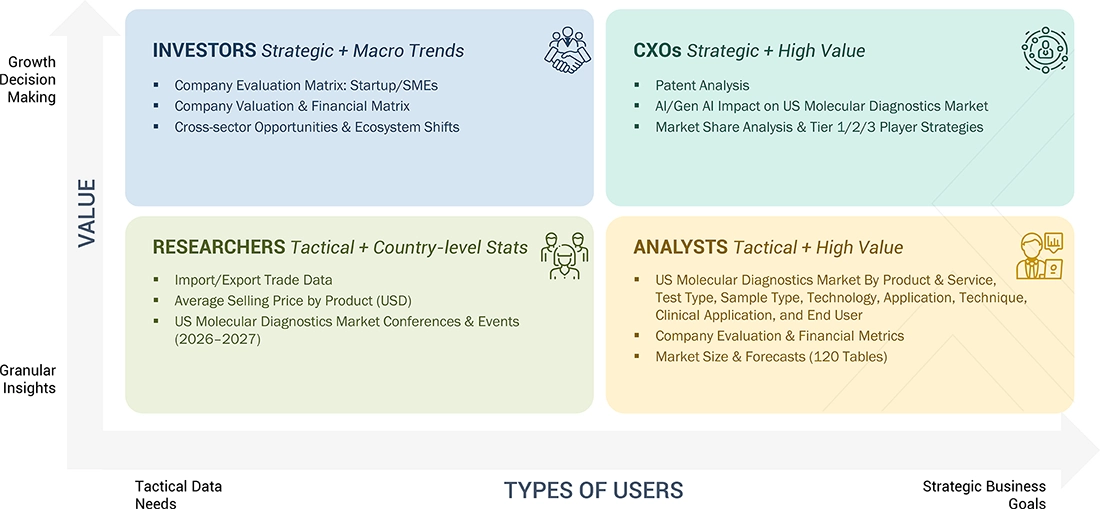
DELIVERED CUSTOMIZATIONS
We have successfully delivered the following deep-dive customizations:
| CLIENT REQUEST | CUSTOMIZATION DELIVERED | VALUE ADDS |
|---|---|---|
| Product Analysis | Product matrix, which provides a detailed comparison of the product portfolio of each company in the US molecular diagnostics market. | Enables easy comparison of competitors’ offerings, helping identify gaps, overlaps, and opportunities for differentiation. |
| Company Information | Additional five company profiles of players operating in the US molecular diagnostics market. | Provides insights into competitors’ strategies, innovation focus, and partnerships, supporting strategic planning. |
RECENT DEVELOPMENTS
- June 2025 : Cepheid (a Danaher subsidiary) announced that Health Canada had issued a medical device license for the Xpert HIV-1 Viral Load XC test. This next-generation, extended-coverage (XC) assay is designed to support the assessment of HIV viral load levels, which are used to monitor the effectiveness of antiretroviral therapy.
- May 2025 : F. Hoffmann-La Roche Ltd. (Switzerland) collaborated with Broad Clinical Labs (US) to advance & pilot innovative applications using Roche’s newly launched next-generation sequencing technology, Sequencing by Expansion (SBX). The collaboration aimed to explore the potential of SBX in advancing clinical genomics and biomedical research.
- February 2025 : Hologic, Inc. (US) received 510(k) clearance for its Aptima SARS-CoV-2 assay. The assay had previously been granted Emergency Use Authorization (EUA) in May 2020, and the clearance reflects its transition to full regulatory approval status.
- October 2024 : Illumina, Inc. (US) launched the MiSeq i100 Series, a next-generation sequencing instrument designed to deliver high benchtop speed and simplified workflows. The system is designed to support efficient and accessible NGS adoption by improving ease of use and operational efficiency.
Table of Contents
 Exclusive indicates content/data unique to MarketsandMarkets and not available with any competitors.
TITLE
PAGE NO
1
INTRODUCTION
15
2
EXECUTIVE SUMMARY
3
PREMIUM INSIGHTS
4
MARKET OVERVIEW
4.1
INTRODUCTION
4.2
MARKET DYNAMICS
4.3
INTERCONNECTED MARKETS & CROSS-SECTOR OPPORTUNITIES
4.4
STRATEGIC MOVES BY TIER-1/2/3 PLAYERS
5
INDUSTRY TRENDS
5.1
PORTER'S FIVE FORCES ANALYSIS
5.2
MACROECONOMIC INDICATORS
5.2.1
INTRODUCTION
5.2.2
GDP TRENDS & FORECAST
5.2.3
TRENDS IN US MOLECULAR DIAGNOSTICS INDUSTRY
5.3
VALUE CHAIN ANALYSIS
5.4
ECOSYSTEM ANALYSIS
5.5
PRICING ANALYSIS
5.5.1
AVERAGE SELLING PRICE TREND OF KEY PLAYERS (2024–2026)
5.5.2
AVERAGE SELLING PRICE TREND OF MOLECULAR DIAGNOSTIC INSTRUMENTS, BY TYPE (2024–2026)
5.6
TRADE ANALYSIS
5.6.1
IMPORT SCENARIO
5.6.2
EXPORT SCENARIO
5.7
KEY CONFERENCES & EVENTS, 2026–2027
5.8
TRENDS/DISRUPTIONS IMPACTING CUSTOMERS’ BUSINESSES
5.9
INVESTMENT & FUNDING SCENARIO
5.10
IMPACT OF 2025 US TARIFFS ON US MOLECULAR DIAGNOSTICS MARKET
5.10.1
INTRODUCTION
5.10.2
KEY TARIFF RATES
5.10.3
PRICE IMPACT ANALYSIS
5.10.4
IMPACT ON END-USER INDUSTRIES
6
STRATEGIC DISRUPTIONS THROUGH TECHNOLOGY, PATENTS, AND DIGITAL & AI ADOPTION
6.1
KEY EMERGING TECHNOLOGIES
6.2
COMPLEMENTARY TECHNOLOGIES
6.3
TECHNOLOGY/PRODUCT ROADMAP
6.4
PATENT ANALYSIS
6.5
IMPACT OF AI/GEN AI ON US MOLECULAR DIAGNOSTICS MARKET
6.5.1
TOP USE CASES & MARKET POTENTIAL
6.5.2
CASE STUDIES OF AI IMPLEMENTATION IN US MOLECULAR DIAGNOSTICS MARKET
6.5.3
INTERCONNECTED ADJACENT ECOSYSTEMS & IMPACT ON MARKET PLAYERS
6.5.4
CLIENTS’ READINESS TO ADOPT GENERATIVE AI IN US MOLECULAR DIAGNOSTICS MARKET
7
REGULATORY LANDSCAPE
7.1
REGIONAL REGULATIONS & COMPLIANCE
7.1.1
REGULATORY BODIES, GOVERNMENT AGENCIES, AND OTHER ORGANIZATIONS
7.1.2
INDUSTRY STANDARDS
8
CUSTOMER LANDSCAPE & BUYER BEHAVIOR
8.1
DECISION-MAKING PROCESS
8.2
BUYER STAKEHOLDERS & BUYING EVALUATION CRITERIA
8.3
ADOPTION BARRIERS & INTERNAL CHALLENGES
8.4
UNMET NEEDS FROM VARIOUS END-USER INDUSTRIES
9
US MOLECULAR DIAGNOSTICS MARKET, BY PRODUCT & SERVICE (MARKET SIZE & FORECAST TO 2031 – USD MILLION)
9.1
INTRODUCTION
9.2
REAGENT & KITS
9.3
INSTRUMENTS
9.4
SERVICES & SOFTWARE
10
US MOLECULAR DIAGNOSTICS MARKET, BY TEST TYPE (MARKET SIZE & FORECAST TO 2031 – USD MILLION)
10.1
INTRODUCTION
10.2
LAB TESTS
10.3
POC TESTS
11
US MOLECULAR DIAGNOSTICS MARKET, BY SAMPLE TYPE (MARKET SIZE & FORECAST TO 2031 – USD MILLION)
11.1
INTRODUCTION
11.2
BLOOD, SERUM, AND PLASMA
11.3
URINE
11.4
OTHER SAMPLE TYPES
12
US MOLECULAR DIAGNOSTICS MARKET, BY TECHNOLOGY (MARKET SIZE & FORECAST TO 2031 – USD MILLION)
12.1
INTRODUCTION
12.2
POLYMERASE CHAIN REACTION
12.3
ISOTHERMAL NUCLEIC ACID AMPLIFICATION TECHNOLOGY
12.4
DNA SEQUENCING & NEXT-GENERATION SEQUENCING
12.5
IN SITU HYBRIDIZATION
12.6
DNA MICROARRAYS
12.7
OTHER TECHNOLOGIES
13
US MOLECULAR DIAGNOSTICS MARKET, BY APPLICATION (MARKET SIZE & FORECAST TO 2031 – USD MILLION)
13.1
INTRODUCTION
13.2
INFECTIOUS DISEASE DIAGNOSTICS
13.2.1
SEXUALLY TRANSMITTED DISEASES
13.2.1.1
CT/NG
13.2.1.2
HIV
13.2.1.3
HPV
13.2.1.4
SYPHILIS
13.2.1.5
OTHER SEXUALLY TRANSMITTED DISEASES
13.2.2
HEPATITIS
13.2.2.1
HEPATITIS B
13.2.2.2
HEPATITIS C
13.2.2.3
OTHER HEPATITIS DISEASES
13.2.3
RESPIRATORY INFECTIOUS DISEASES
13.2.3.1
TUBERCULOSIS
13.2.3.2
INFLUENZA
13.2.3.3
PHARYNGITIS
13.2.3.4
OTHER RESPIRATORY INFECTIOUS DISEASES
13.2.4
HOSPITAL-ACQUIRED INFECTIONS
13.2.5
VECTOR-BORNE DISEASES
13.2.6
OTHER INFECTIOUS DISEASES
13.3
ONCOLOGY TESTING
13.3.1
BREAST CANCER
13.3.2
COLORECTAL CANCER
13.3.3
LUNG CANCER
13.3.4
PROSTATE CANCER
13.3.5
OTHER CANCER TYPES
13.4
GENETIC TESTING
13.5
OTHER APPLICATIONS
14
US MOLECULAR DIAGNOSTICS MARKET, BY TECHNIQUE (MARKET SIZE & FORECAST TO 2031 – USD MILLION)
14.1
INTRODUCTION
14.2
MULTIPLEX TESTING
14.3
SINGLEPLEX TESTING
15
US MOLECULAR DIAGNOSTICS MARKET, BY CLINICAL APPLICATION (MARKET SIZE & FORECAST TO 2031 – USD MILLION)
15.1
INTRODUCTION
15.2
DIAGNOSTIC
15.3
SCREENING
16
US MOLECULAR DIAGNOSTICS MARKET, BY END USER (MARKET SIZE & FORECAST TO 2031 – USD MILLION)
16.1
INTRODUCTION
16.2
HOSPITALS & CLINICS
16.3
DIAGNOSTIC LABORATORIES
16.4
OTHER END USERS
17
COMPETITIVE LANDSCAPE
17.1
INTRODUCTION
17.2
KEY PLAYER STRATEGIES/RIGHT TO WIN
17.3
REVENUE ANALYSIS, 2021–2025
17.4
MARKET SHARE ANALYSIS,
17.5
COMPANY VALUATION & FINANCIAL METRICS
17.6
BRAND COMPARISON
17.7
COMPANY EVALUATION MATRIX: KEY PLAYERS,
17.7.1
STARS
17.7.2
EMERGING LEADERS
17.7.3
PERVASIVE PLAYERS
17.7.4
PARTICIPANTS
17.7.5
COMPANY FOOTPRINT: KEY PLAYERS,
17.7.5.1
COMPANY FOOTPRINT
17.7.5.2
PRODUCT & SERVICE
17.7.5.3
TEST TYPE FOOTPRINT
17.7.5.4
SAMPLE TYPE FOOTPRINT
17.7.5.5
APPLICATION FOOTPRINT
17.8
COMPANY EVALUATION MATRIX: STARTUPS/SMES,
17.8.1
PROGRESSIVE COMPANIES
17.8.2
RESPONSIVE COMPANIES
17.8.3
DYNAMIC COMPANIES
17.8.4
STARTING BLOCKS
17.8.5
COMPETITIVE BENCHMARKING: STARTUPS/SMES,
17.8.5.1
DETAILED LIST OF KEY STARTUPS/SMES
17.8.5.2
COMPETITIVE BENCHMARKING OF KEY STARTUPS/SMES
17.9
COMPETITIVE SITUATION
18
COMPANY PROFILES
18.1
KEY PLAYERS
18.1.1
DANAHER CORPORATION
18.1.2
F. HOFFMANN-LA ROCHE LTD.
18.1.3
HOLOGIC, INC.
18.1.4
SIEMENS HEALTHINEERS AG
18.1.5
THERMO FISHER SCIENTIFIC INC.
18.1.6
ILLUMINA, INC.
18.1.7
HOLOGIC, INC.
18.1.8
ABBOTT
18.1.9
BIOMÉRIEUX
18.1.10
QIAGEN
18.1.11
REVVITY
18.1.12
BECTON, DICKINSON AND COMPANY
18.1.13
MYRIAD GENETICS, INC.
18.1.14
QUIDELORTHO CORPORATION
18.1.15
DIASORIN S P A
18.1.16
GRIFOLS, S.A.
18.1.17
EXACT SCIENCES CORPORATION
18.1.18
GENETIC SIGNATURES
18.2
OTHER PLAYERS
18.2.1
AGILENT TECHNOLOGIES, INC.
18.2.2
MDXHEALTH
18.2.3
BIOCARTIS
18.2.4
BRUKER CORPORATION
18.2.5
UNIOGEN OY
18.2.6
AMOY DIAGNOSTICS CO., LTD.
18.2.7
VELA DIAGNOSTICS
19
RESEARCH METHODOLOGY
19.1
RESEARCH DATA
19.1.1
SECONDARY DATA
19.1.1.1
KEY DATA FROM SECONDARY SOURCES
19.1.2
PRIMARY DATA
19.1.3
MARKET SIZE ESTIMATION
19.1.3.1
BOTTOM-UP APPROACH
19.1.3.2
TOP-DOWN APPROACH
19.1.3.3
BASE NUMBER CALCULATION
19.1.4
MARKET FORECAST APPROACH
19.1.4.1
SUPPLY SIDE
19.1.4.2
DEMAND SIDE
19.1.5
DATA TRIANGULATION
19.1.6
FACTOR ANALYSIS
19.1.7
RESEARCH ASSUMPTIONS
19.1.8
RESEARCH LIMITATIONS & RISK ASSESSMENT
20
APPENDIX
20.1
DISCUSSION GUIDE
20.2
KNOWLEDGESTORE: MARKETSANDMARKETS’ SUBSCRIPTION PORTAL
20.3
CUSTOMIZATION OPTIONS
20.4
RELATED REPORTS
20.5
AUTHOR DETAILS
Methodology
The study involved major activities in estimating the current market size for the global US Molecular Diagnostics Market. Exhaustive secondary research was done to collect information on the US Molecular Diagnostics Market. The next step was to validate these findings, assumptions, and sizing with industry experts across the value chain using primary research. Different approaches, such as top-down and bottom-up, were employed to estimate the total market size. After that, the market breakup and data triangulation procedures were used to estimate the market size of the segments and subsegments of the US Molecular Diagnostics Market.
The four steps involved in estimating the market size are as follows:
Secondary Research
In the secondary research process, various secondary sources such as annual reports, press releases & investor presentations of companies, white papers, certified publications, articles by recognized authors, gold-standard & silver-standard websites, regulatory bodies, and databases (such as D&B Hoovers, Bloomberg Business, and Factiva) were referred to, to identify and collect information for this study.
Primary Research
In the primary research process, various sources from the supply and demand sides were interviewed to obtain qualitative and quantitative information for this report. Primary sources mainly include industry experts from the core and related industries and preferred suppliers, manufacturers, distributors, service providers, technology developers, researchers, and organizations related to all segments of this industry’s value chain. In-depth interviews were conducted with primary respondents, including key industry participants, subject-matter experts, C-level executives of key market players, and industry consultants, to obtain and verify critical qualitative and quantitative information and assess prospects.
Market Size Estimation
The top-down and bottom-up approaches were used to estimate and validate the US Molecular Diagnostics Market’s total size. These methods were also used extensively to estimate the size of various subsegments in the market.
- The key players in the industry have been identified through extensive secondary research.
- Primary and secondary research have determined the revenues generated by leading players operating in the US Molecular Diagnostics Market.
- All percentage share, splits, and breakdowns have been determined using secondary sources and verified through primary sources.
Data Triangulation
After arriving at the overall market size by applying the process mentioned above, the total market was split into several segments and subsegments. To complete the overall market engineering process and arrive at the exact statistics for all segments and subsegments, data triangulation and market breakdown procedures were employed, wherever applicable. The data was triangulated by studying various factors and trends from both the demand and supply sides.
Market Definition
Molecular diagnostics is a technique used to identify and analyze nucleic acids or proteins at a molecular level. This technique assesses an individual’s genetic makeup to identify a predisposition to any particular disease or condition and diagnose it.
Stakeholders
- Senior Management
- End Users
- Finance/Procurement Department
- R&D Department
Report Objectives
- To define, describe, segment, and forecast the global US Molecular Diagnostics Market by product & service, test type, sample type, technology, application, technique, clinical application, end user, and region
- To provide detailed information regarding the major factors (such as drivers, restraints, opportunities, and challenges) influencing market growth
- To analyze the micromarkets1 concerning individual growth trends, prospects, and contributions to the overall US Molecular Diagnostics Market
- To analyze market opportunities for stakeholders and provide details of the competitive landscape for key players
- To forecast the size of the market with respect to five regions, namely North America, Europe, the Asia Pacific, Latin America, and the Middle East & Africa
- To profile the key players and comprehensively analyze their product portfolios, market positions, and core competencies2
- To track and analyze company developments, such as product launches & approvals, partnerships, acquisitions, agreements, and other developments
- To benchmark players within the US Molecular Diagnostics Market using the Company Evaluation Matrix framework, which analyzes market players on various parameters within the broad categories of business strategy, market share, and product offerings
- To study the impact of AI/Gen AI on the US Molecular Diagnostics Market, along with the macroeconomic outlook for each region
⚡ Growth Signals
Personalize This Research
- Triangulate with your Own Data
- Get Data as per your Format and Definition
- Gain a Deeper Dive on a Specific Application, Geography, Customer or Competitor
- Any level of Personalization
Let Us Help You
- What are the Known and Unknown Adjacencies Impacting the US Molecular Diagnostics Market
- What will your New Revenue Sources be?
- Who will be your Top Customer; what will make them switch?
- Defend your Market Share or Win Competitors
- Get a Scorecard for Target Partners


JAYANT RAJPUROHIT
Director of Market Insights, Data and Analytics
SFI Health,
Leading Pharmaceutical Company

We at SFI Health approached MarketsandMarkets for an Opportunity Assessment on "Incidence and Prevalence of Focus Indications" as we wanted to know the most attractive HCPs like Physician, Functional MD, Naturopath and Pharmacist. The project was critical for us to ensure our focus on the right target which would enable sustainable growth and profitability for SFI Health. The business insights provided exceeded our expectations and we were extremely impressed. The team at MarketsandMarkets is highly professional and detail oriented and very well understood our business needs. MarketsandMarkets offers a unique combination of expertise and dedicated engagement model. We identified 2 new products to be launched in coming months, based on the research findings provided by MarketsandMarkets. We are happy with the services and would strongly recommend MarketsandMarkets to my peers in the industry.

BEATRIZ DE LA CALLE
Head of Commercial Analytics
Qualicaps,
Leading Pharmaceutical Company

We partnered with MarketsandMarkets for an assessment study on hard empty capsules. The team was extremely professional in understanding our business requirements and we received timely responses to all our queries. The market intelligence and the recommendations has met our business requirements. We were extremely impressed to see the final study results; it really exceeded our expectations. The market intelligence offered by MarketsandMarkets, and clarity on next steps will help us achieve our business objective for the Year 2021. We are happy with the services and would strongly recommend MarketsandMarkets to my peers in the industry.

Bob Williams,
Senior Director Business Development & Innovation
Bracco Diagnostics Inc.,
Italian Multinational in life sciences sector and a World Leader in imaging diagnostics
We were pleased with targeted insights that MarketsandMarkets identified from a custom study on the 'Radiation Dose Management Solutions Market'. Your team identified and characterized the market participants as well as underlying trends accurately. This study was useful to Bracco in formulating business strategies for our dose monitoring product lines and we thank MarketsandMarkets for the job well done.
Cody Coonradt,
Market Development and Strategy Manager
3M Health Information Systems,
Leader in Health care Coding, Payment & Analytics Solutions.
The value for our organization comes from three things: depth of research, specificity of segments and being easy to work with. As important as the first two are, the third can't be underestimated. MarketsandMarkets, maybe more than any other research vendor, wants to know what is top of mind for our team and what big questions we are grappling to answer.
Their customer first approach and high value engagement model, have given us great analysis and excellent value for money

Still Researching the
US Molecular Diagnostics Ecosystem?
See the competitors, opportunities, and growth signals shaping it - instantly.
Generate 15+ consulting-grade strategic insights tailored to your growth question.
Explore US Molecular Diagnostics Intelligence
Powered by 17 years of MarketsandMarkets intelligence
