



- DESCRIPTION
- TABLE OF CONTENTS
- METHODOLOGY
- DOWNLOAD PDF
N-Butanol Market By Grade (Industrial, Pharmaceutical, Other Grades), Application (Butyl Carboxylate, Direct Solvents, Specialty Chemicals, Rubber & Plasticizers, Other Applications), Distribution Channel (Retailers, Distributors and Traders, Direct Imports, Direct Company Sales, Other Distribution Channels), End-use Industry (Agriculture, Building & Construction, Paints & Coatings, Adhesives & Sealants, Pharmaceutical, Chemical, Personal Care, Other End-use Industries), and Region - Global Forecast to 2031

USD 8.77 (BN)
MARKET SIZE, 2031

CAGR 5.2%
(2026-2031)

250
REPORT PAGES

68
MARKET TABLES
OVERVIEW
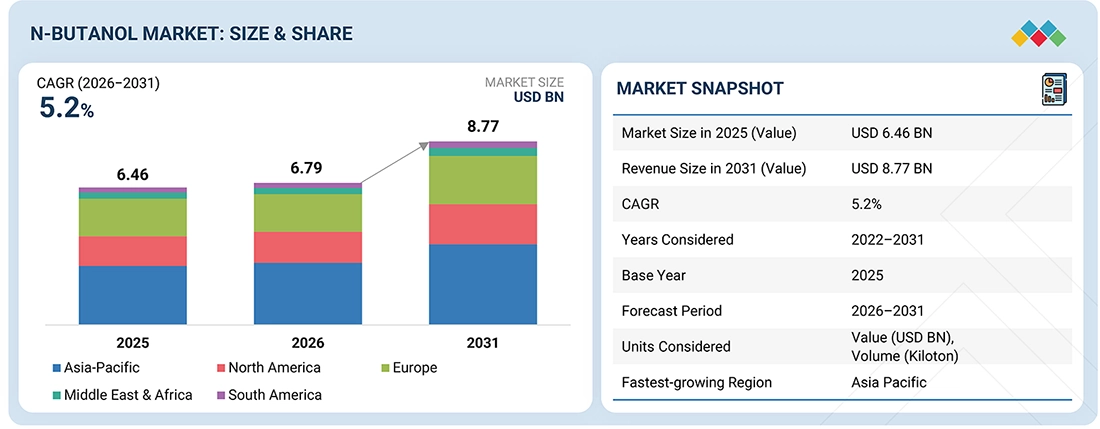
Source: Secondary Research, Interviews with Experts, MarketsandMarkets Analysis
The n-butanol market is projected to grow from USD 6.79 billion in 2026 to USD 8.77 billion by 2031, at a CAGR of 5.2% during the forecast period. The n-butanol market is expected to witness healthy growth over the forecast period owing to its diverse use as an intermediate and as a solvent across a range of end-use industries. Some of the primary drivers anticipated to spur demand for n-butanol include its use in paints and coatings, adhesives and sealants and chemicals. N-butanol is required to produce high-quality butyl derivatives, such as acrylates, acetates, and glycol ethers, which enhance product properties. Additionally, rising urbanization, coupled with the expansion of infrastructure, has created more demand from the building & construction industry owing to their extensive use of paints and coatings, as well as adhesives. Some other key factors that are anticipated to drive demand for n-butanol include its use in producing better quality coatings with improved flow and finish characteristics, along with drying capabilities in the automotive and industrial sectors. Furthermore, there has been consistent adoption by the pharmaceutical & personal care industry owing to some of its unique applications. Industrialization witnessed in developing countries, particularly the Asia Pacific region, is expected to drive downstream chemical production and capacity additions.
KEY TAKEAWAYS
-
BY REGION
Asia Pacific is the largest and fastest-growing market for n-butanol, growing at a CAGR of 5.4% during the forecast period.
-
BY GRADE TYPE
The industrial grade segment is the largest segment of the overall market and is projected to register a CAGR of 5.2% between 2026 and 2031.
-
BY END-USE INDUSTRY
Paints & Coatings is the largest growing end-use industry for the n-butanol market growing at a CAGR of 5.4% during the forecast period.
-
BY APPLICATION TYPE
The specialty chemicals segment is the fastest-growing application in the n-butanol market, growing at a CAGR of 5.8 % during the forecast period.
-
COMPETITIVE LANDSCAPE - KEY PLAYERS
The n-butanol market is driven by product innovation, capacity expansions, and strategic collaborations among global leaders, such as BASF (Germany), DOW (US), and MITSUBISHI CHEMICAL GROUP CORPORATION (Japan). These companies are focusing on capacity expansion and product launches to sustain their market position.
-
COMPETITIVE LANDSCAPE -STARTUPS/SMES
Hanwha Solutions Corporation (China), LG Chem Ltd. (South Korea), and Saudi Butanol Company Ltd (Saudi Arabia) are considered under the other players in the n-butanol market.
The n-Butanol market is driven by rising demand for chemical intermediates and high-performance solvents across major end-use industries. The robust growth of paints & coatings, adhesives & sealants, and chemical manufacturing sectors is fueling the demand for n-butanol. Moreover, increased urbanization and infrastructure development are major factors that fuel the growth of the n-butanol market due to high consumption of construction-related coating products and adhesives. The rapid growth of the automobile and industrial sectors, which require high-quality coating with better finish and faster drying time, is boosting the market growth. Other major factors include the increasing demand for pharmaceuticals and personal care. Rapid industrialization in Asia Pacific is boosting the production capacity and chemical usage downstream. Innovations in chemical processing technology, growing production capacity of oxo-alcohols, and focus on solvent-based solutions also support the market growth.
TRENDS & DISRUPTIONS IMPACTING CUSTOMERS' CUSTOMERS
Several trends and disruptions are prevalent in the n-butanol market. An important trend is the preference for effective solvents in the paints & coatings and adhesives & sealants sectors. Environmental policies are pushing for improved efficiency and reduced emissions in the oxo-alcohols value chain. Increased new capacity additions, especially in emerging economies such as Asia Pacific, will have an effect on global logistics and provide more chemicals. Another disruption has been the increased cost of basic materials such as propylene. Increased demand from users such as the automotive and building & construction industries has driven demand for coating intermediates. Digitalization of chemical production & logistics processes has optimized the value chain process. Additionally, partnerships have become common practice among producers and users.
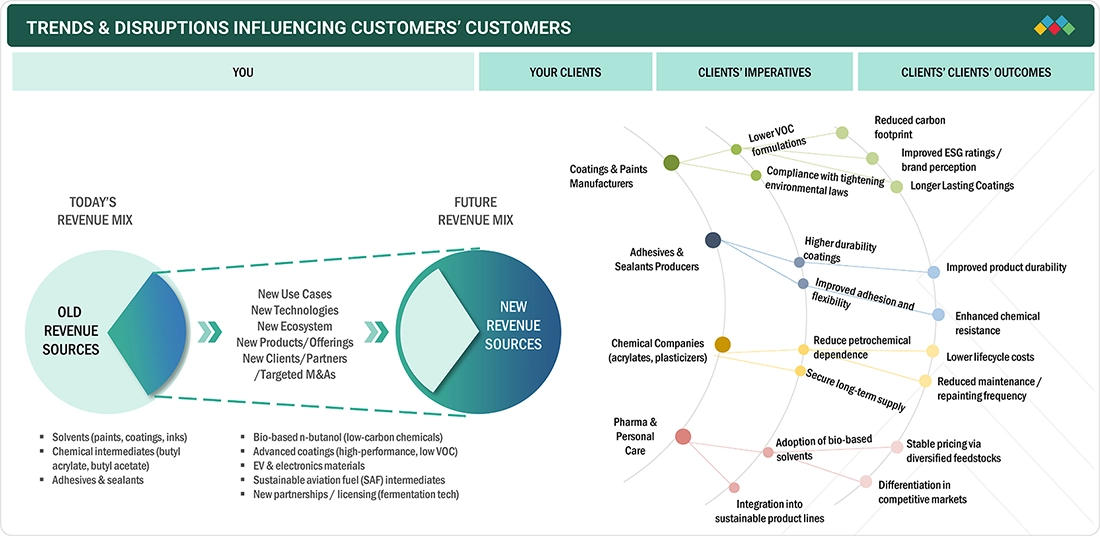
Source: Secondary Research, Interviews with Experts, MarketsandMarkets Analysis
MARKET DYNAMICS

Drivers
Impact
Level
-
Construction-Led Coatings Demand Accelerates n-Butanol Consumption Globally

-
Renewable Fuel Mandates Unlock Structural Growth for Bio-Based n-Butanol


RESTRAINTS
Impact
Level
-
Tightening Environmental Regulations Elevate Cost Pressures on n-Butanol Value Chain

-
Feedstock Volatility and Supply Disruptions Create Structural Instability in n-Butanol Markets


OPPORTUNITIES
Impact
Level
-
Pharmaceutical-Grade n-Butanol Emerges as a High-Margin Growth Lever

-
EV Transition Unlocks a New Structural Demand Channel for n-Butanol Derivatives


CHALLENGES
Impact
Level
-
Low-VOC Regulations and Waterborne Shift Threaten Solvent-Based n-Butanol Demand

Source: Secondary Research, Interviews with Experts, MarketsandMarkets Analysis
Rise in construction activities around the world acts as a key factor behind the increasing global demand for n-butanol. As more residential and commercial construction takes place, demand for paints and coatings also increases. N-butanol finds wide applications in the production of coating intermediaries such as butyl acrylate and butyl acetate. With fast-paced urbanization and construction activities, the demand for better-performing coatings is rising worldwide. This drives the demand for n-butanol.
Increasingly stringent environmental regulations act as an important constraint on the growth of the n-butanol market. Stringent emission regulations necessitate greater expenditure by companies to meet regulatory requirements. Greater expenditure results in greater operating costs, which may affect profitability and ultimately the selling prices of products. This could make it difficult for producers to remain competitive with regard to pricing.
Pharmaceutical-grade n-butanol appears to be a good growth opportunity owing to its higher purity and added-value applications. The solvent is used in formulations that require high-quality standards. With the growth of the pharmaceutical sector globally, there is an increasing demand for high-quality solvents that deliver margin improvements over industrial counterparts.
The emergence of low-VOC legislation and the transition to water-borne systems are creating challenges for players in the n-butanol market. Several manufacturing sectors, notably those dealing with paint production, have been making efforts to shift away from solvent-based products to comply with regulations. In such scenarios, there would be less use of traditional solvents, such as n-butanol.
N-BUTANOL MARKET: COMMERCIAL USE CASES ACROSS INDUSTRIES
| COMPANY | USE CASE DESCRIPTION | BENEFITS |
|---|---|---|
|
|
N-Butanol used as a key intermediate in producing butyl acrylate, butyl acetate, and glycol ethers for paints & coatings, adhesives & sealants, and construction applications | Improves coating flow and leveling, enhances drying time, provides better surface finish, and supports high-performance formulations |
|
|
N-Butanol used in coatings, adhesives, and plasticizers for automotive, construction, and industrial manufacturing sectors | Enhances durability, improves gloss and consistency, provides solvent efficiency, and ensures better adhesion properties |
|
|
N-Butanol applied in chemical intermediates, specialty solvents, and formulations for electronics, coatings, and industrial chemicals | Offers high solvency power, supports formulation stability, enables efficient processing, and improves product performance |
|
|
N-Butanol used in downstream derivatives for coatings, plasticizers, and chemical manufacturing in construction and industrial sectors | Provides versatility as a chemical building block, supports large-scale production, improves formulation efficiency, and ensures cost-effective performance |

Logos and trademarks shown above are the property of their respective owners. Their use here is for informational and illustrative purposes only.
MARKET ECOSYSTEM
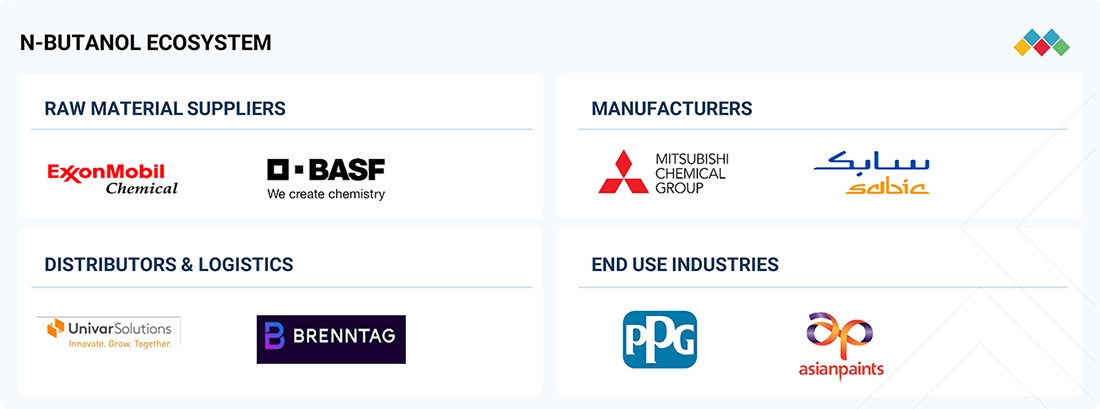
The n-butanol market ecosystem comprises raw material suppliers, n-butanol manufacturers, derivative manufacturers, distributors/logistics providers, and users of the final products. The raw material suppliers are mainly from the petrochemical sector that supply feedstocks such as propylene and synthesis gases that are used in oxo process to manufacture n-butanol. This is done through the use of well-known chemical manufacturing processes. Derivative producers use n-butanol as their raw material to make important derivatives such as butyl acrylate, butyl acetate, and glycol ethers. Distributors/logistics players assist in transporting n-butanol to various end-use industries. The end users comprise paints & coatings, adhesives, construction, automobile, pharmaceutical, and personal care industries, among others. In these industries, n-butanol serves as a solvent and/or intermediate chemical for their products.
Logos and trademarks shown above are the property of their respective owners. Their use here is for informational and illustrative purposes only.
MARKET SEGMENTS
Source: Secondary Research, Interviews with Experts, MarketsandMarkets Analysis
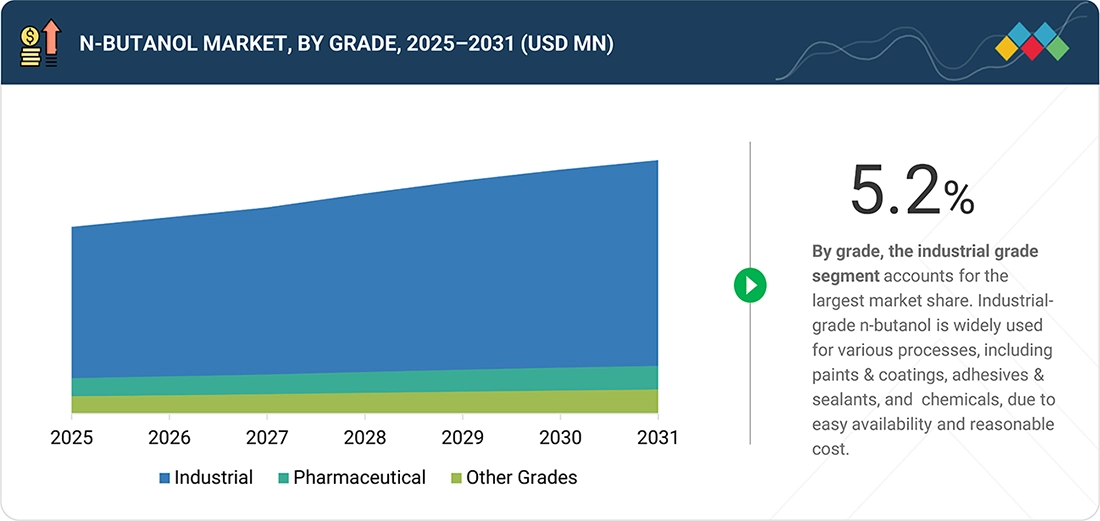
The n-butanol market is segmented based on grade into industrial grade, pharmaceutical grade, and others. These grades have been classified according to the usage of the product. Industrial-grade n-butanol is the dominant segment in the overall market. Industrial-grade n-butanol is widely used for various processes, including paints & coatings, adhesives & sealants, and chemicals, due to easy availability and reasonable cost. Some examples of derivatives made from industrial-grade n-butanol include butyl acrylate and butyl acetate. These derivatives help improve performance features like flow, glossiness, and drying. Another important grade of n-butanol is the pharmaceutical-grade, which includes n-butanol that finds usage in processes like drug formulation, extraction, and analysis. The use of pharmaceutical-grade n-butanol helps to ensure that the end product is safe and consistent. Other grades include specialty and laboratory grades of n-butanol. These types of grades find application in personal care products and specialty chemicals.
The n-butanol market is segmented based on application into butyl carboxylates, direct solvents, specialty chemicals, rubber & plasticizers, and others. The butyl carboxylates segment is the largest application, which includes products such as butyl acrylate, butyl acetate, and glycol ethers, that have wide applications in paints & coatings, adhesives, and surface treatments. Butyl acrylate is used as an ingredient in paints & coatings and adhesives, while butyl acetate is used as a solvent for paint making. On the other hand, glycol ethers are used in paints & coatings and cleaning solutions due to their good solubility and stability. In direct solvent applications, n-butanol is widely used in paints and coatings, as well as in industrial cleaning solutions, to improve resin dissolution. In the specialty chemicals application, n-butanol is used to produce a host of various chemical products. In the rubber & plasticizers application, it is used to develop plasticizers that add to the flexibility of rubber and plastic products.
The end-use industries for n-butanol include paints & coatings, adhesives & sealants, building & construction, chemicals, pharmaceuticals, personal care, agriculture, and other industries. The paints & coatings industry is a major consumer, using n-butanol as an input to produce derivatives such as butyl acrylate, butyl acetate, and glycol ethers. These derivatives help improve flow characteristics, curing time, and coating finish. The adhesives & sealants industry uses these derivatives to improve the efficiency and effectiveness of adhesive applications. The demand in the building and construction sector comes indirectly and is driven by the usage of coatings and adhesive systems in residential/commercial infrastructure. The chemical industry is a major consumer of n-butanol, as it serves as a raw material for various downstream products. The pharmaceutical industry uses high-grade n-butanol in limited quantities due to strict purity requirements for certain process operations. In the personal care and agriculture sectors, n-butanol finds niche applications through its use in selected formulations. Demand from other end-use sectors, including automotive and industrial manufacturing, comes mainly through coating applications and specialty chemicals.
REGION
Asia Pacific to be fastest-growing region in n-butanol market during forecast period
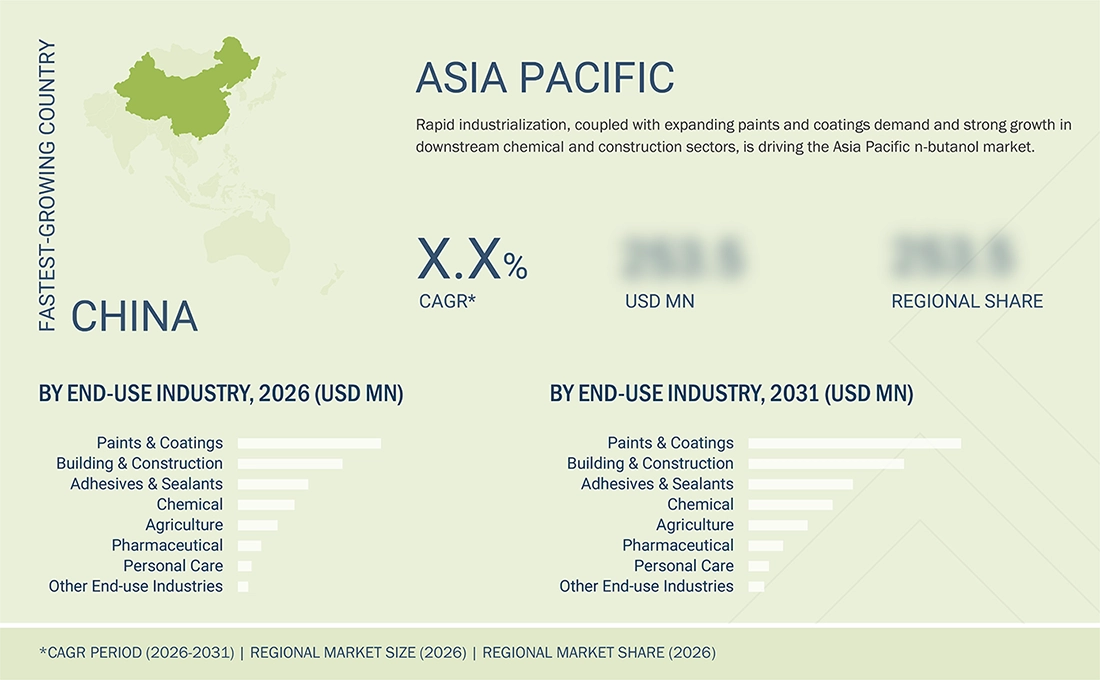
The Asia Pacific region is experiencing rapid growth in the n-butanol market due to industrial development, high levels of manufacturing activity, and an increase in demand for downstream chemicals. China and India are leading the way in terms of increasing investments in the construction, automotive, and packaging industries. Urbanization and the development of infrastructure are creating increased demand for both architectural coatings and industrial solvents. In addition, the Asia Pacific region has advantages in production costs and availability of feedstocks. Government initiatives to promote manufacturing and exports further contribute to the growth of the market for n-butanol. The existence of both large multinational and regional chemical producers supports supply chains throughout Asia Pacific, making it the most dynamic and fastest growing region in the global n-butanol market.
N-BUTANOL MARKET: COMPANY EVALUATION MATRIX
In the n-Butanol market, BASF (Star) leads with a dominant market share and a strong geographical presence. OXEA Gmbh (Emerging leader) leverages deep specialty-chemicals heritage, advanced R&D capabilities, and a broad high-value portfolio. These companies offer n-butanol for consumption in the agriculture, building & construction, paints & coatings, adhesives & sealants, and chemical industries.
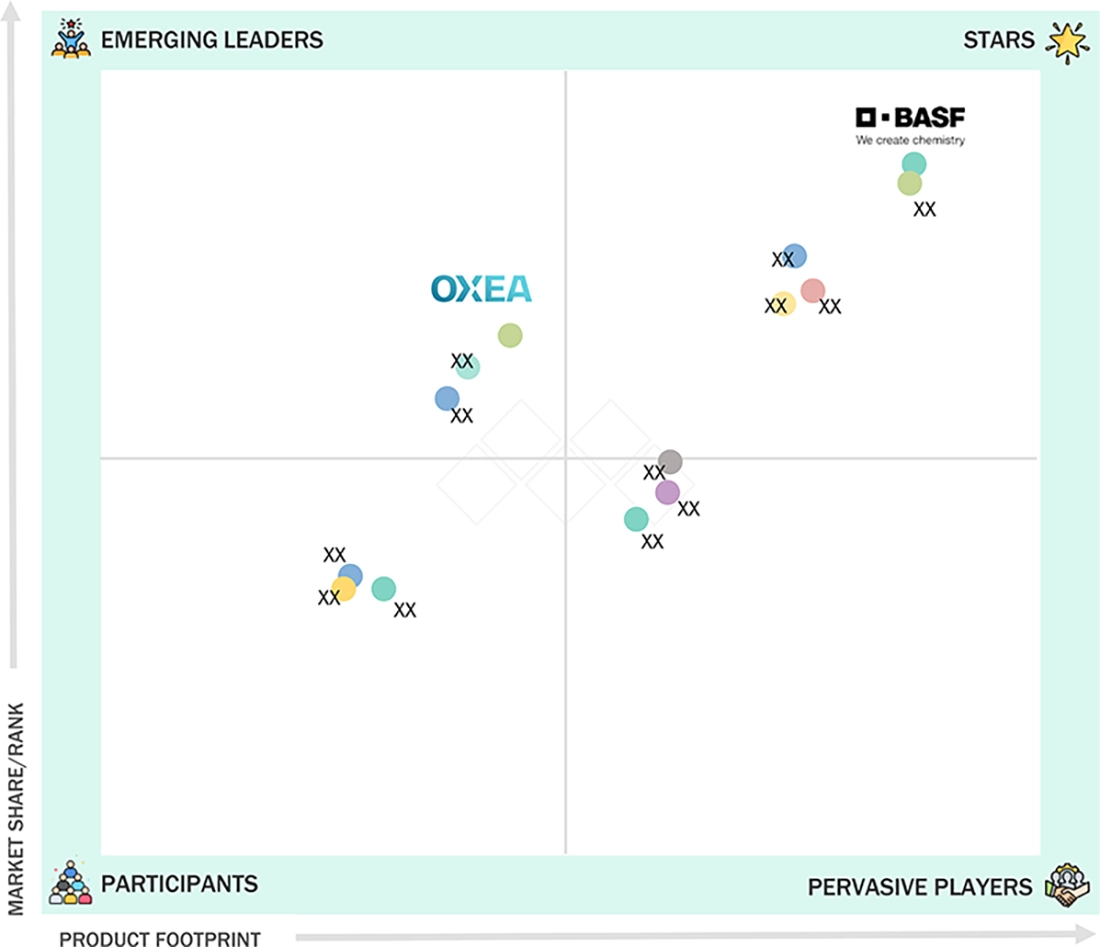
Source: Secondary Research, Interviews with Experts, MarketsandMarkets Analysis
KEY MARKET PLAYERS
- BASF (Germany)
- DOW (USA)
- SABIC (Saudi Arabia)
- MITSUBISHI CHEMICAL GROUP CORPORATION (Japan)
- INEOS (UK)
- Petronas Chemical Group Berhad (Malaysia)
- Sasol Limited (South Africa)
- PetroChina Company (China)
- Eastman Chemical Company (US)
- OXEA GmbH (Germany)
MARKET SCOPE
| REPORT METRIC | DETAILS |
|---|---|
| Market Size in 2025 (Value) | USD 6.46 Billion |
| Market Size in 2026 (Value) | USD 6.79 Billion |
| Market Forecast in 2031 (Value) | USD 8.77 Billion |
| Growth Rate | CAGR of 5.2% from 2026–2031 |
| Actual data | 2022–2031 |
| Base year | 2025 |
| Forecast period | 2026–2031 |
| Units considered | Value (USD Million/Billion), Volume (Kiloton) |
| Report Coverage | Revenue forecast, company ranking, competitive landscape, growth factors, and trends |
| Segments Covered |
|
| Regions Covered | Asia Pacific, Europe, North America, Middle East & Africa, and South America |
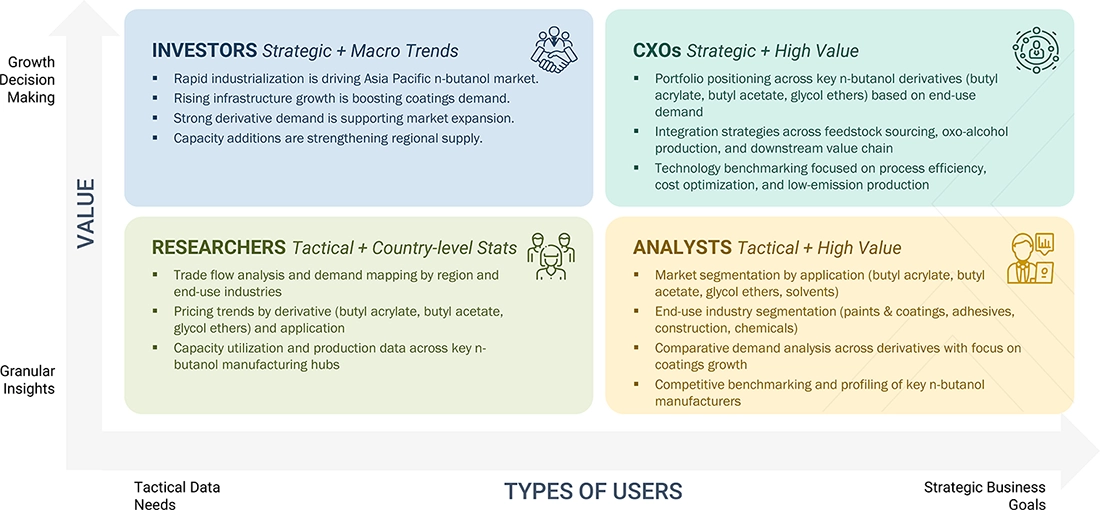
WHAT IS IN IT FOR YOU: N-BUTANOL MARKET REPORT CONTENT GUIDE
DELIVERED CUSTOMIZATIONS
We have successfully delivered the following deep-dive customizations:
| CLIENT REQUEST | CUSTOMIZATION DELIVERED | VALUE ADDS |
|---|---|---|
| Country-Level Breakdown | Instead of regional coverage alone, the report provides country-specific analysis for key n-butanol markets, including China, the US, Germany, India, Japan, and South Korea. The analysis includes demand by end-use industries (paints & coatings, adhesives & sealants, construction, chemicals), production capacity by major players, import-export dynamics, feedstock trends (propylene/syngas), regulatory frameworks, and sustainability initiatives impacting oxo-alcohol production. | Helps stakeholders identify high-growth markets, understand supply and demand dynamics, assess feedstock availability, evaluate regulatory impacts, and forecast country-level demand for N-butanol and its derivatives with greater accuracy |
| Application-Specific Deep Dive | Customized analysis of n-butanol consumption by application, including butyl acrylate, butyl acetate, glycol ethers, plasticizers, and direct solvent use. Each segment is evaluated based on demand outlook, performance characteristics (solvency, evaporation rate, compatibility), regulatory environment, and margin potential. | Enables clients to prioritize high-growth applications such as coatings, adhesives, and chemical intermediates, align product strategies with downstream demand trends, and optimize investment and expansion decisions |
| Material & Processing Segmentation | Comparative analysis of n-butanol based on production routes and integration, including conventional oxo process and emerging bio-based pathways. Covers feedstock sourcing, process efficiency, cost structures, downstream derivative integration, and environmental impact of production technologies. | Detailed profiling of leading global and regional n-butanol producers, covering production capacities, plant locations, product portfolios, pricing trends, partnerships, and expansion strategies; Supports benchmarking of integration across the oxo-alcohol value chain and regional positioning |
| Competitive Benchmarking | Detailed profiling of leading global and regional n-butanol producers, covering production capacities, plant locations, product portfolios, pricing trends, partnerships, acquisitions, and integration across the oxo-alcohol value chain. Includes benchmarking of feedstock sourcing strategies, process technologies, downstream derivative integration (butyl acrylate, butyl acetate, glycol ethers), and regional market positioning. | Provides a clear competitive landscape, helping identify key market players, capacity expansion trends, strategic alliances, pricing dynamics, and differentiation based on cost efficiency, backward integration, and supply chain strength in the global n-butanol market |
RECENT DEVELOPMENTS
- August 2024 : BASF announced a strategic partnership with UPC Technology Corporation to strengthen long-term collaboration in oxo-alcohols and catalysts. The agreement includes the future supply of n-butanol and 2-ethylhexanol from BASF’s upcoming Verbund site in Zhanjiang, China. This collaboration aims to support downstream plasticizer production and enhance supply chain integration in the Asia-Pacific region while jointly exploring low-carbon chemical solutions.
- July 2024 : As n-butanol is frequently used as a solvent and intermediary in the creation of plasticizers like butyl acetate and butyl acrylate, Univar’s decision to become Eastman’s preferred distributor for plasticizers influences the chemical as well. These plasticizers enhance the flexibility and toughness of certain polymers and coatings. Univar indirectly supports the n-butanol industry by facilitating the sale of Eastman products, including sustainable options such as BenzoflexTM 9-88 and Eastman 168TM SG. N-butanol is a crucial element in many of these formulations.
Table of Contents
 Exclusive indicates content/data unique to MarketsandMarkets and not available with any competitors.
TITLE
PAGE NO
1
INTRODUCTION
15
2
EXECUTIVE SUMMARY
3
PREMIUM INSIGHTS
4
MARKET OVERVIEW
4.1
INTRODUCTION
4.2
MARKET DYNAMICS
4.2.1
DRIVERS
4.2.2
RESTRAINTS
4.2.3
OPPORTUNITIES
4.2.4
CHALLENGES
4.3
UNMET NEEDS AND WHITE SPACES
4.4
INTERCONNECTED MARKETS AND CROSS-SECTOR OPPORTUNITIES
4.5
STRATEGIC MOVES BY TIER-1/2/3 PLAYERS
5
INDUSTRY TRENDS
5.1
PORTER’S FIVE FORCES ANALYSIS
5.2
MACROECONOMICS OUTLOOK
5.2.1
INTRODUCTION
5.2.2
GDP TRENDS AND FORECAST
5.2.3
TRENDS IN GLOBAL PAINTS & COATINGS INDUSTRY
5.3
SUPPLY CHAIN ANALYSIS
5.4
ECOSYSTEM ANALYSIS
5.5
PRICING ANALYSIS (2022-2025)
5.5.1
AVERAGE SELLING PRICE OF KEY PLAYERS, BY GRADE (2025)
5.5.2
AVERAGE SELLING PRICE TREND, BY REGION (2022-2025)
5.5.3
AVERAGE SELLING PRICE TREND, BY GRADE (2022-2025)
5.5.4
AVERAGE SELLING PRICE TREND, BY END-USE INDUSTRY (2022-2025)
5.6
TRADE ANALYSIS
5.6.1
IMPORT SCENARIO (HS CODE 290513)
5.6.2
EXPORT SCENARIO (HS CODE 290513)
5.7
KEY CONFERENCES AND EVENTS, 2026–2027
5.8
TRENDS/DISRUPTIONS IMPACTING CUSTOMER BUSINESS
5.9
INVESTMENT AND FUNDING SCENARIO
5.10
CASE STUDY ANALYSIS
5.11
IMPACT OF 2025 US TARIFF – N-BUTANOL MARKET
5.11
INTRODUCTION
5.11.2
KEY TARIFF RATES
5.11.3
PRICE IMPACT ANALYSIS
5.11.4
IMPACT ON COUNTRIES/REGIONS
5.11.4.1
US
5.11.4.2
EUROPE
5.11.4.3
APAC
5.11.5
IMPACT ON END-USE INDUSTRIES
6
TECHNOLOGICAL ADVANCEMENTS, AI-DRIVEN IMPACT, PATENTS, INNOVATIONS, AND FUTURE APPLICATIONS
6.1
KEY EMERGING TECHNOLOGIES
6.1.1
OXO PROCESS (HYDROFORMYLATION TECHNOLOGY)
6.1.2
ADVANCED CATALYST TECHNOLOGIES
6.2
COMPLEMENTARY TECHNOLOGIES
6.2.1
PROPYLENE PRODUCTION TECHNOLOGIES (STEAM CRACKING & PDH)
6.2.2
SYNGAS PRODUCTION TECHNOLOGIES (STEAM REFORMING & GASIFICATION)
6.3
ADJACENT TECHNOLOGIES
6.3.1
BUTYL ACRYLATE PRODUCTION TECHNOLOGY
6.4
TECHNOLOGY/PRODUCT ROADMAP
6.5
PATENT ANALYSIS
6.6
FUTURE APPLICATIONS
6.7
IMPACT OF AI/GEN AI ON N-BUTANOL MARKET
6.7.1
TOP USE CASES AND MARKET POTENTIAL
6.7.2
BEST PRACTICES FOLLOWED BY MANUFACTURERS/OEMS IN N-BUTANOL MARKET
6.7.3
CASE STUDIES RELATED TO AI IMPLEMENTATION IN N-BUTANOL MARKET
6.7.4
INTERCONNECTED ADJACENT ECOSYSTEM AND IMPACT ON MARKET PLAYERS
6.7.5
CLIENTS’ READINESS TO ADOPT AI-INTEGRATED N-BUTANOL PRODUCTION
6.7
SUCCESS STORIES AND REAL-WORLD APPLICATIONS
7
REGULATORY LANDSCAPE AND SUSTAINABILITY INITIATIVES
7.1
REGIONAL REGULATIONS AND COMPLIANCE
7.1.1
REGULATORY BODIES, GOVERNMENT AGENCIES, AND OTHER ORGANIZATIONS
7.1.2
INDUSTRY STANDARDS
7.2
SUSTAINABILITY INITIATIVES
7.3
IMPACT OF REGULATORY POLICIES ON SUSTAINABILITY INITIATIVES
8
CUSTOMER LANDSCAPE & BUYER BEHAVIOR
8.1
INTRODUCTION
8.2
DECISION-MAKING PROCESS
8.3
KEY STAKEHOLDERS INVOLVED IN BUYING PROCESS AND THEIR EVALUATION CRITERIA
8.3.1
KEY STAKEHOLDERS IN BUYING PROCESS
8.3.2
BUYING CRITERIA
8.4
ADOPTION BARRIERS AND INTERNAL CHALLENGES
8.5
UNMET NEEDS OF VARIOUS END-USE INDUSTRIES
8.6
MARKET PROFITABILITY
9
N-BUTANOL MARKET, BY GRADE (COMPARATIVE ASSESSMENT OF KEY N-BUTANOL GRADES, THEIR MARKET POTENTIAL, AND DEMAND PATTERNS BY VARIOUS SUPPLIER COMPANIES)
9.1
INTRODUCTION
9.2
INDUSTRIAL
9.3
PHARMACEUTICAL
9.4
OTHER GRADES
10
N-BUTANOL MARKET, BY APPLICATION (APPLICATION WISE DEMAND POTENTIAL AND GROWTH PATHWAYS SHAPING N-BUTANOL ADOPTION IN DIVERSE INDUSTRIES)
10.1
INTRODUCTION
10.2
BUTYL CARBOXYLATE
10.3
DIRECT SOLVENTS
10.4
SPECIALTY CHEMICALS
10.5
RUBBER & PLASTICIZERS
10.6
OTHER APPLICATIONS
11
N-BUTANOL MARKET, BY DISTRIBUTION CHANNEL (DISTRIBUTION CHANNEL WISE DEMAND POTENTIAL AND GROWTH PATHWAYS SHAPING N-BUTANOL ADOPTION IN DIVERSE INDUSTRIES)
11.1
INTRODUCTION
11.2
RETAILERS
11.3
DISTRIBUTORS & TRADERS
11.4
DIRECT IMPORTS
11.5
DIRECT COMPANY SALES
11.5
OTHER DISTRIBUTION CHANNELS
12
N-BUTANOL MARKET, BY END-USE INDUSTRY (END-USE INDUSTRY WISE DEMAND POTENTIAL AND GROWTH PATHWAYS SHAPING N-BUTANOL ADOPTION IN DIVERSE INDUSTRIES)
12.1
INTRODUCTION
12.2
AGRICULTURE
12.3
BUIDING & CONSTRUCTION
12.4
PAINTS & COATINGS
12.5
ADHESIVES & SEALANTS
12.6
PHARMACEUTICALS
12.7
CHEMICAL
12.8
PERSONAL CARE
12.9
OTHER END-USE INDUSTRIES
13
N-BUTANOL MARKET, BY REGION (ASSESSING GROWTH PATTERNS, INDUSTRY FORCES, REGULATORY LANDSCAPE, AND MARKET POTENTIAL ACROSS KEY GEOGRAPHIES AND COUNTRIES)
13.1
INTRODUCTION
13.2
NORTH AMERICA
13.2.1
US
13.2.2
CANADA
13.2.3
MEXICO
13.3
EUROPE
13.3.1
GERMANY
13.3.2
ITALY
13.3.3
FRANCE
13.3.4
UK
13.3.5
SPAIN
13.3.6
REST OF EUROPE
13.4
ASIA PACIFIC
13.4.1
CHINA
13.4.2
JAPAN
13.4.3
INDIA
13.4.4
SOUTH KOREA
13.4.5
REST OF ASIA PACIFIC
13.5
MIDDLE EAST & AFRICA
13.5.1
GCC COUNTRIES
13.5.1.1
UAE
13.5.1.2
SAUDI ARABIA
13.5.1.3
REST OF GCC COUNTRIES
13.5.2
SOUTH AFRICA
13.5.5
REST OF MIDDLE EAST & AFRICA
13.6
SOUTH AMERICA
13.1
BRAZIL
13.2
ARGENTINA
13.3
REST OF SOUTH AMERICA
14
COMPETITIVE LANDSCAPE (STRATEGIC ASSESSMENT OF LEADING PLAYERS, MARKET SHARE, REVENUE ANALYSIS, COMPANY POSITIONING, AND COMPETITIVE BENCHMARKS INFLUENCING MARKET POTENTIAL)
14.1
OVERVIEW
14.2
KEY PLAYERS’ STRATEGIES/RIGHT TO WIN (JANUARY 2021-MARCH 2026)
14.3
REVENUE ANALYSIS (2022-2025)
14.4
MARKET SHARE ANALYSIS (2025)
14.5
PRODUCT COMPARISON
14.6
COMPANY EVALUATION MATRIX: KEY PLAYERS,
14.6.1
STARS
14.6.2
EMERGING LEADERS
14.6.3
PERVASIVE PLAYERS
14.6.4
PARTICIPANTS
14.6.5
COMPANY FOOTPRINT: KEY PLAYERS,
14.6.5.1
COMPANY FOOTPRINT
14.6.5.2
REGION FOOTPRINT
14.6.5.3
GRADE FOOTPRINT
14.6.5.4
APPLICATION FOOTPRINT
14.6.5.5
END-USE INDUSTRY FOOTPRINT
14.7
COMPANY EVALUATION MATRIX: STARTUPS/SMES,
14.7.1
PROGRESSIVE COMPANIES
14.7.2
RESPONSIVE COMPANIES
14.7.3
DYNAMIC COMPANIES
14.7.4
STARTING BLOCKS
14.7.5
COMPETITIVE BENCHMARKING: STARTUPS/SMES,
14.7.5.1
DETAILED LIST OF KEY STARTUPS/SMES
14.7.5.2
COMPETITIVE BENCHMARKING OF KEY STARTUPS/SMES
14.8
COMPANY VALUATION AND FINANCIAL METRICS
14.9
COMPETITIVE SCENARIO
14.9.1
PRODUCT LAUNCHES
14.9.2
DEALS
14.9.3
EXPANSIONS
15
COMPANY PROFILES (IN-DEPTH REVIEW OF COMPANIES, PRODUCTS, SERVICES, RECENT INITIATIVES, AND POSITIONING STRATEGIES IN N-BUTANOL MARKET LANDSCAPE)
15.1
KEY PLAYERS
15.1.1
BASF
15.1.1.1
BUSINESS OVERVIEW
15.1.1.2
PRODUCTS/SOLUTIONS/SERVICES OFFERED
15.1.1.3
RECENT DEVELOPMENTS
15.1.1.4
MNM VIEW
15.1.2
INEOS
15.1.2.1
BUSINESS OVERVIEW
15.1.2.2
PRODUCTS/SOLUTIONS/SERVICES OFFERED
15.1.2.3
RECENT DEVELOPMENTS
15.1.2.4
MNM VIEW
15.1.3
MITSUBISHI CHEMICAL GROUP CORPORATION
15.1.3.1
BUSINESS OVERVIEW
15.1.3.2
PRODUCTS/SOLUTIONS/SERVICES OFFERED
15.1.3.3
RECENT DEVELOPMENTS
15.1.3.4
MNM VIEW
15.1.4
SABIC
15.1.4.1
BUSINESS OVERVIEW
15.1.4.2
PRODUCTS/SOLUTIONS/SERVICES OFFERED
15.1.4.3
RECENT DEVELOPMENTS
15.1.4.4
MNM VIEW
15.1.5
DOW
15.1.5.1
BUSINESS OVERVIEW
15.1.5.2
PRODUCTS/SOLUTIONS/SERVICES OFFERED
15.1.5.3
RECENT DEVELOPMENTS
15.1.5.4
MNM VIEW
15.1.6
EASTMAN CHEMICAL COMPANY
15.1.6.1
BUSINESS OVERVIEW
15.1.6.2
PRODUCTS/SOLUTIONS/SERVICES OFFERED
15.1.6.3
RECENT DEVELOPMENTS
15.1.6.4
MNM VIEW
15.1.7
SASOL LIMITED
15.1.7.1
BUSINESS OVERVIEW
15.1.7.2
PRODUCTS/SOLUTIONS/SERVICES OFFERED
15.1.7.3
RECENT DEVELOPMENTS
15.1.7.4
MNM VIEW
15.1.8
OXEA GMBH
15.1.8.1
BUSINESS OVERVIEW
15.1.8.2
PRODUCTS/SOLUTIONS/SERVICES OFFERED
15.1.8.3
RECENT DEVELOPMENTS
15.1.8.4
MNM VIEW
15.1.9
PETROCHINA COMPANY LIMITED
15.1.9.1
BUSINESS OVERVIEW
15.1.9.2
PRODUCTS/SOLUTIONS/SERVICES OFFERED
15.1.9.3
RECENT DEVELOPMENTS
15.1.9.4
MNM VIEW
15.1.10
PETRONAS CHEMICALS GROUP BERHAD
15.1.10.1
BUSINESS OVERVIEW
15.1.10.2
PRODUCTS/SOLUTIONS/SERVICES OFFERED
15.1.10.3
MNM VIEW
15.2
OTHER PLAYERS
15.2.1
GRUPA AZOTY
15.2.2
WANHUA
15.2.3
THE ANDHRA PETROCHEMICALS LIMITED
15.2.4
LG CHEM LTD.
15.2.5
HANWHA SOLUTIONS CORPORATION
15.2.6
EVONIK INDUSTRIES AG
15.2.7
CHINA PETROCHEMICAL CORPORATION
15.2.8
KN NEOCHEM CO., LTD.
15.2.9
GREEN BIOLOGICS LTD.
15.2.10
FORMOSA PLASTICS CORPORATION
15.2.11
ELEKEIROZ S.A.
15.2.12
SAUDI BUTANOL COMPANY LIMITED
15.2.13
TOKYO CHEMICAL INDUSTRY CO. LTD.
15.2.14
KR CHEMICALS
15.2.15
LUXI CHEMICAL GROUP CO., LTD.
16
RESEARCH METHODOLOGY
16.1
RESEARCH DATA
16.1.1
SECONDARY DATA
16.1.1.1
KEY DATA FROM SECONDARY SOURCES
16.1.1.2
LIST OF KEY SECONDARY SOURCES
16.1.2
PRIMARY DATA
16.1.2.1
KEY DATA FROM PRIMARY SOURCES
16.1.2.2
KEY PRIMARY PARTICIPANTS
16.1.2.3
BREAKDOWN OF PRIMARY INTERVIEWS
16.1.2.4
KEY INDUSTRY INSIGHTS
16.2
MARKET SIZE ESTIMATION
16.2.1
BOTTOM-UP APPROACH
16.2.2
TOP-DOWN APPROACH
16.2.3
MARKET SIZE CALCULATION FOR BASE YEAR
16.3
MARKET FORECAST APPROACH
16.3.1
SUPPLY SIDE
16.3.2
DEMAND SIDE
16.4
DATA TRIANGULATION
16.5
FACTOR ANALYSIS
16.6
RESEARCH ASSUMPTIONS AND LIMITATIONS
16.7
RISK ASSESSMENT
17
APPENDIX
17.1
DISCUSSION GUIDE
17.2
KNOWLEDGESTORE: MARKETSANDMARKETS’ SUBSCRIPTION PORTAL
17.3
CUSTOMIZATION OPTIONS
17.4
RELATED REPORTS
17.5
AUTHOR DETAILS
Methodology
The study involved four major activities in estimating the size of the n-butanol market. Exhaustive secondary research was done to collect information on the market, the peer market, and the parent market. The next step was to validate these findings, assumptions, and sizing with industry experts across the value chain through primary research. Both top-down and bottom-up approaches were employed to estimate the complete market size. Thereafter, the market breakdown and data triangulation procedures were used to estimate the market size of the segments and subsegments.
Secondary Research
In the secondary research process, various secondary sources have been referred to for identifying and collecting information for this study. These secondary sources include annual reports, press releases, investor presentations of companies, white papers, certified publications, trade directories, articles from recognized authors, gold standard and silver standard websites, and databases.
Secondary research has been used to obtain key information about the value chain of the industry, monetary chain of the market, the total pool of key n-butanol players, market classification and segmentation according to industry trends to the bottom-most level, and regional markets. It was also used to obtain information about the key developments from a market-oriented perspective.
Primary Research
The n-butanol market comprises several stakeholders in the value chain, which include raw material suppliers, manufacturers, distributors, and end users. Various primary sources from the supply and demand sides of the n-butanol market have been interviewed to obtain qualitative and quantitative information. The primary interviewees from the demand side include key opinion leaders in end-use sectors. The primary sources from the supply side include manufacturers, associations, and institutions involved in the n-butanol industry.
Primary interviews were conducted to gather insights such as market statistics, data on revenue collected from the products and services, market breakdowns, market size estimations, market forecasting, and data triangulation. Primary research also helped in understanding the various trends related to grade, application, end-use industry, distribution channel, and region. Stakeholders from the demand side, such as CIOs, CTOs, and CSOs, were interviewed to understand the buyer’s perspective on the suppliers, products, component providers, and their current usage of n-butanol and future outlook of their business, which will affect the overall market.
The breakdown of profiles of the primary interviewees is illustrated in the figure below:

Note: Tier 1, Tier 2, and Tier 3 companies are classified based on their market revenue in 2025 available in the public domain, product portfolios, and geographical presence.
Other designations include sales representatives, production heads, and technicians.
To know about the assumptions considered for the study, download the pdf brochure
Market Size Estimation
- The top-down approach was used to estimate and validate the size of various submarkets for n-butanol for each region. The research methodology used to estimate the market size included the following steps:
- The key players in the industry have been identified through extensive secondary research.
- The supply chain of the industry has been determined through primary and secondary research.
- The global market was then segmented into five major regions and validated by industry experts.
- All percentage shares, splits, and breakdowns based on grade, application, end-use industry, distribution channel, and regions were determined using secondary sources and verified through primary sources.
- All possible parameters that affect the markets covered in this research study were accounted for, viewed in extensive detail, verified through primary research, and analyzed to get the final quantitative and qualitative data. This data was consolidated and added with detailed inputs and analysis and presented in this report.
N-Butanol Market : Top-Down and Bottom-Up Approach

Data Triangulation
After arriving at the total market size from the estimation process explained above, the overall market has been split into several segments and sub-segments. To complete the overall market engineering process and arrive at the exact statistics for all the segments and sub-segments, the data triangulation and market breakdown procedures have been employed, wherever applicable. The data has been triangulated by studying various factors and trends from both the demand and supply sides. Along with this, the market size has been validated by using both the top-down and bottom-up approaches and primary interviews. Hence, for every data segment, there have been three sources—top-down approach, bottom-up approach, and expert interviews. The data was assumed correct when the values arrived from the three sources matched.
Market Definition
The n-butanol market refers to the global production, distribution, and consumption of n-butanol (normal butanol), a four-carbon linear alcohol primarily manufactured through the oxo (hydroformylation) process using propylene as a feedstock. It encompasses all commercial activities related to its use as both a chemical intermediate and solvent across multiple industries. From a scope perspective, the market includes different grades (industrial, pharmaceutical, and specialty/bio-based), as well as its consumption across key applications such as butyl acrylate, butyl acetate, glycol ethers, direct solvents, plasticizers, and specialty chemicals. These applications further translate into demand from end-use industries such as paints & coatings, adhesives & sealants, construction, chemicals, pharmaceuticals, personal care, and agriculture. Geographically, the market spans major regions, including Asia Pacific, North America, Europe, the Middle East & Africa, and South America, each characterized by varying levels of production integration, regulatory frameworks, and demand drivers. The market also captures trade flows, as n-butanol is widely exported from feedstock-advantaged regions to import-dependent markets.
Key Stakeholders
- N-butanol manufacturers
- N-butanol traders, distributors, and suppliers
- Raw material suppliers
- Government and private research organizations
- Associations and industrial bodies
- R&D institutions
- Environmental support agencies
Report Objectives
- To define, describe, and forecast the size of the n-butanol market, in terms of value and volume
- To provide detailed information regarding the major factors (drivers, opportunities, restraints, and challenges) influencing the growth of the market
- To estimate and forecast the market size based on grade, application, distribution channel, end-use industry, and region
- To forecast the size of the market with respect to major regions, namely, Europe, North America, Asia Pacific, the Middle East & Africa, and South America, along with their key countries
- To strategically analyze micromarkets with respect to individual growth trends, prospects, and their contribution to the overall market
- To analyze opportunities in the market for stakeholders and provide a competitive landscape of market leaders
- To track and analyze recent developments such as product launch, collaboration, contract, acquisition, and expansion in the market
- To strategically profile key market players and comprehensively analyze their core competencies
Available Customizations
Along with the given market data, MarketsandMarkets offers customizations according to the company’s specific needs. The following customization options are available for the report:
Regional Analysis
- Further breakdown of a region with respect to a particular country or additional end-use industry
Regional Analysis
- Further breakdown of a region with respect to a particular country or additional end-use industry
Regional Analysis
- Further breakdown of a region with respect to a particular country or additional end-use industry
⚡ Growth Signals
Personalize This Research
- Triangulate with your Own Data
- Get Data as per your Format and Definition
- Gain a Deeper Dive on a Specific Application, Geography, Customer or Competitor
- Any level of Personalization
Let Us Help You
- What are the Known and Unknown Adjacencies Impacting the N-Butanol Market
- What will your New Revenue Sources be?
- Who will be your Top Customer; what will make them switch?
- Defend your Market Share or Win Competitors
- Get a Scorecard for Target Partners


We at Nissan Chemicals Corporation have been clients of MarketsandMarkets for more than a year now. We recently consulted MarketsandMarkets for a study, the team at MarketsandMarkets was extremely professional and organized. The business insights were very detailed and aligned well with our expectations that really helped us formulate the Business Plans and device new strategies for development themes. MarketsandMarkets offers a unique combination of expertise and dedicated engagement model. Their research findings have helped us in designing our Pricing Strategy which will make it easier for us to predict the future sales and profits for the next ten years. We look forward to working with MarketsandMarkets in the future.
VP of Strategy & New Business Development
Leading Specialty Chemical Company
The MarketsandMarkets Engagement Model, composed of both the Knowledge Store and advisory custom research, has greatly helped us in understanding our markets and making strategic decisions. The Knowledge Store is a fast way to allow everyone in our organization to understand more about most any market they are interested in. The ability to then get custom research done and get answers to specific strategic questions and market insight has been spectacular. The Markets and Markets team feel more like colleagues than vendors and their services have helped us change our culture where statements of things like growth opportunities and competitive position are always backed by industry research.

Rich Gibson,
Director, Corporate Strategy
Milliken & Company,
Leading Industrial Manufacturer of specialty chemical, floor covering, performance and protective textile materials, and healthcare
MarketsandMarkets is a trusted resource that helps us to better understand markets that are near-adjacencies-whether its technology, value chain or geography. Their Knowledge Store platform provides a dashboard of markets and their characteristics which is easy to use and saves us time.
Adam Shaw,
Market Development and Strategy Manager
AdvanSix Inc. USA,
An American Leader in Chemicals
The Knowledge Store from MarketsandMarkets is a valuable tool which has helped my team acquire greater insight in to the end markets that our business serves. This has enabled us to help our company build stronger strategies throughout our planning process.
TOSHIO KINOSHITA
Senior Chif Consultion Research & Consulting Division
Mitsubishi Chemical Research Corporation,
Leading Manufacturer of Chemical Products

We recently engaged with MarketsandMarkets for a study, the team not only clearly understood our business objectives but was also extremely professional in the way they handled the entire project. The study was efficiently conducted in a phase-wise manner, and the engagement model furnished us with high-quality business insights that far exceeded our expectations at each phase. We were especially happy that MarketsandMarkets could provide us with both, an English as well as a Japanese version of the study. A special thanks to the Analyst Team and Client Services Team, whose fluency in Japanese enhanced our comfort level, as we could converse with them in our preferred language.
Independent entrepreneurs
Arrow Precision
We approached MarketsandMarkets for study on Proppants Market, and their work exceeded our expectations. The study conducted was comprehensive and enabled us to view the market through the various dimensions. In addition, the team was extraordinarily responsive throughout the process and resolved our queries on time. I strongly recommend MarketsandMarkets and will certainly consider them for additional market assessments we will need in the future.
Global engineering company, Japan
Deputy Manager,
Strategic Planning Office
The high-quality insights shared by the MarketsandMarkets team helped us understand the pharmaceutical plant designers in a specific geography. It also captured the risks that we may likely face in communicating with our potential partners. The study would enable us identify partners, which would impact our future growth.

Still Researching the
N-Butanol Ecosystem?
See the competitors, opportunities, and growth signals shaping it - instantly.
Generate 15+ consulting-grade strategic insights tailored to your growth question.
Explore N-Butanol Intelligence
Powered by 17 years of MarketsandMarkets intelligence
