







- DESCRIPTION
- TABLE OF CONTENTS
- METHODOLOGY
- Download FREE Sample
Asia Pacific Security Testing Market by Type (Network, Application, Device, Social Engineering), Network Security Testing (Penetration Testing, Vulnerability Scanning, Firewall), Application Testing Tools (RASP, SAST, DAST, IAST) - Global Forecast to 2031

USD 9.80 BN
MARKET SIZE, 2031

CAGR 27.3%
(2025-2031)

300
REPORT PAGES

400
MARKET TABLES
OVERVIEW
Source: Secondary Research, Interviews with Experts, MarketsandMarkets Analysis
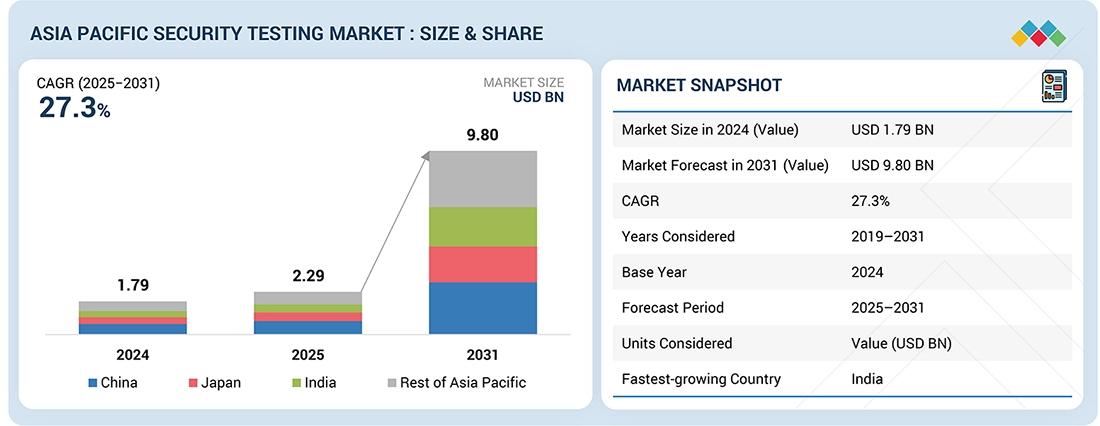
The Asia Pacific security testing market is projected to reach USD 9.80 billion by 2031 from USD 2.29 billion in 2025, at a CAGR of 27.3% from 2025 to 2031. The Asia Pacific security testing market is expanding rapidly because of the high adoption of cloud, mobile, and web applications, which widens the surface of attacks and makes it more vulnerable to cyber threats. The increasing reliance on third-party and open-source elements introduces risks in the software supply chain. Security testing solutions are being utilized by organizations to identify, evaluate, and fix vulnerabilities during the development cycle and to ensure high protection and compliance with regulatory standards.
KEY TAKEAWAYS
-
BY SECURITY TESTING TYPE
By security testing type, the network security segment is expected to dominate the market in 2025.
-
BY NETWORK SECURITY TESTING TYPE
By network security testing type, the WiFi/wireless security testing segment is expected to grow at the fastest CAGR of 30.1% during the forecast period.
-
BY APPLICATION SECURITY TESTING TYPE
By application security testing type, the mobile application security testing segment is expected to be the fastest-growing segment with a CAGR of 31.4% during the forecast period.
-
BY APPLICATION SECURITY TESTING TOOLS
By application security testing tools, the interactive application security testing (IAST) segment is expected to grow at the highest CAGR of 32.7% during the forecast period.
-
BY DEPLOYMENT MODE
By deployment mode, the on-premise segment is expected to dominate the market during the forecast period.
-
BY ORGANIZATION SIZE
By organization size, the SMEs segment is projected to register the highest CAGR during the forecast period.
-
BY VERTICAL
By vertical, the BFSI segment is expected to dominate the market during the forecast period.
-
COMPETITIVE LANDSCAPE - KEY PLAYERS
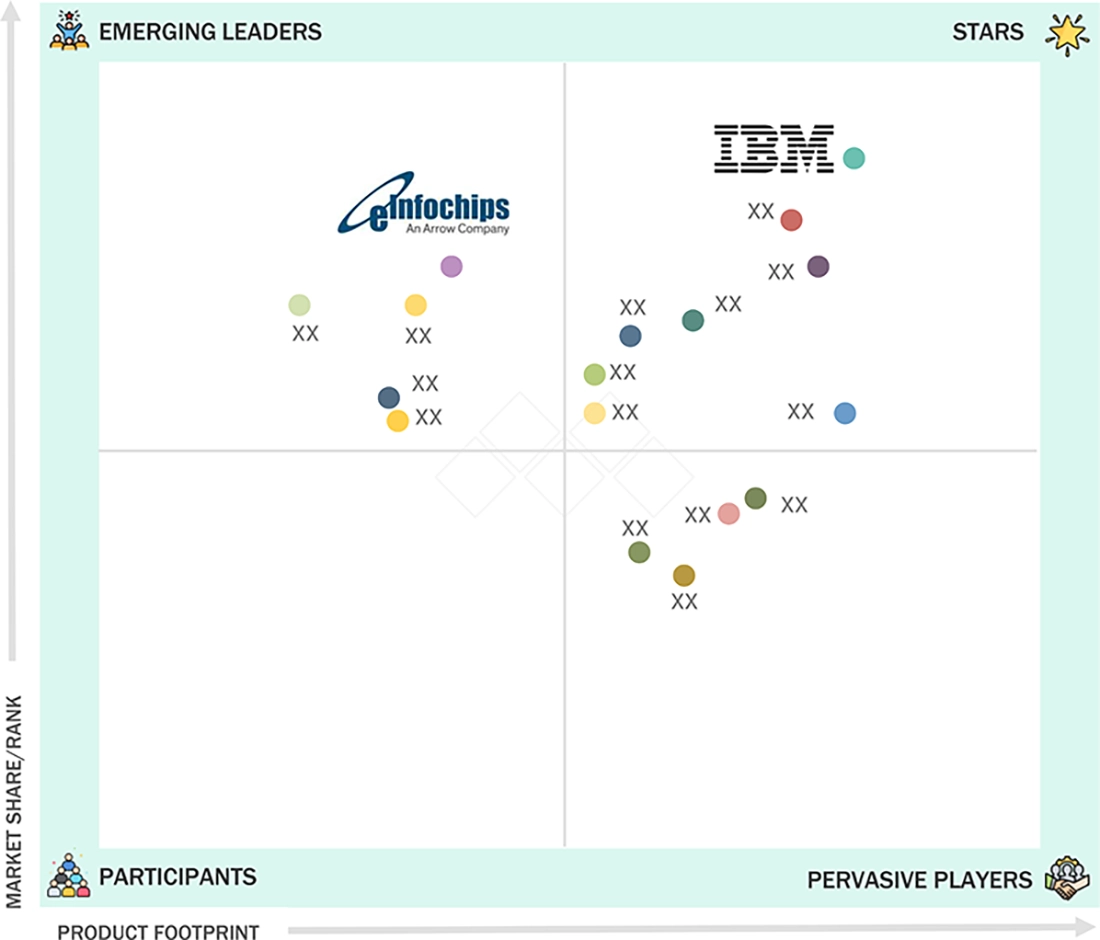
The companies considered to be star players in the Asia Pacific security testing market are IBM, HCL Tech, and eInfochips. Due to their comprehensive security testing platforms, strong enterprise adoption, and mature cybersecurity ecosystems, these vendors deliver scalable, robust, and cloud-ready testing solutions. They effectively support large and complex organizational environments across the region.
-
COMPETITIVE LANDSCAPE - STARTUPS
Invicti, Cobalt, and HackerOne are the major startups/SMEs in the market due to their cost-effective and flexible security testing solutions. They offer application, network, and human-centric testing and easily integrate with the existing IT infrastructures, making them well-suited in fast-growing enterprises in Asia Pacific.
To minimize the risks and threats to the security and integrity of complex software ecosystems, organizations are under increasing pressure to maintain the security and integrity of ecosystems built with numerous third-party and open-source components. Securing applications is important as they get more modular and interconnected, as it allows the discovery of concealed vulnerabilities, confirms the quality of code, and allows proactive risk management during the software development and deployment lifecycle.
TRENDS & DISRUPTIONS IMPACTING CUSTOMERS' CUSTOMERS
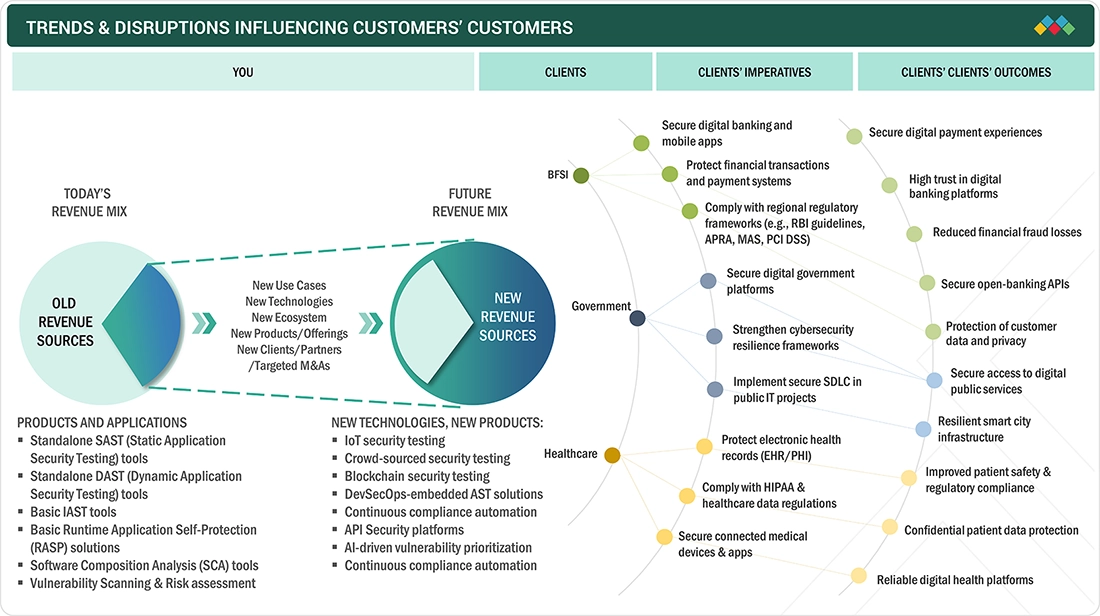
With organizations moving beyond traditional vulnerability scanning to continuous and integrated security testing, advanced AST platforms, DevSecOps integration, and AI-driven vulnerability prioritization are fueling market growth. Rising investments in BFSI, government, and healthcare sectors are increasing demand for end-to-end security testing. Businesses are leveraging cloud-native, IoT, and API security solutions to protect sensitive data, ensure regulatory compliance, and secure critical digital applications across the Asia Pacific region.
Source: Secondary Research, Interviews with Experts, MarketsandMarkets Analysis
MARKET DYNAMICS

Drivers
Impact
Level
-
Rising regulatory compliance pressures

-
Increasing integration with DevSecOps


RESTRAINTS
Impact
Level
-
High cost of security testing tools & services

-
Resistance to change in legacy systems


OPPORTUNITIES
Impact
Level
-
AI-driven testing & vulnerability prioritization

-
Growth of managed security testing services (MSTS)


CHALLENGES
Impact
Level
-
Limited awareness of security testing benefits

-
Third-party vendor dependency

Source: Secondary Research, Interviews with Experts, MarketsandMarkets Analysis
Regulatory compliance in Asia Pacific is enhancing amongst nations such as India, Singapore, and Australia. There is strict data protection, financial, and digital service regulation, which makes organizations invest in continuous security testing. Regulatory compliance is a major source of growth as firms are turning to powerful AST, network, and device testing solutions to comply with domestic regulations, to protect and secure sensitive information, and to evade fines.
The high initial cost of full-fledged security testing tools and managed services is a major restraint to many organizations in Asia Pacific, particularly to SMEs. Solutions like SAST, DAST, and AI-driven tools are usually enterprise-grade and require significant investment. Hence, they are not adopted by smaller firms. The market penetration and popularization of advanced security testing practices are also hindered by cost barriers that slow down the process of market penetration.
AI and machine learning solutions are gaining traction in Asia Pacific to automate vulnerability detection, risk scoring, and prioritization of remediation. This is a significant market opportunity as businesses across BFSI, healthcare, and telecom are using AI-based AST and network testing solutions to delegate manual effort, expedite DevSecOps pipelines, and reactively respond to new cyber threats.
Despite the rising risks of cybercrime, organizations in Asia Pacific face a lack of understanding of the importance of security testing beyond mere compliance. Businesses also underestimate the effects of application, network, and human-centric security risks, which is a major challenge to market growth in the Asia Pacific region.
ASIA PACIFIC SECURITY TESTING MARKET: COMMERCIAL USE CASES ACROSS INDUSTRIES
| COMPANY | USE CASE DESCRIPTION | BENEFITS |
|---|---|---|
|
|
Checkmarx introduced static application security testing (SAST) to Trade-Van to scan source code and identify vulnerabilities early, while also aligning with DevSecOps processes. | Scan time reduced significantly (days to minutes) | Better developer adoption | Faster deployments and enhanced compliance posture |
|
|
Kakao team implemented Acunetix by Invicti to intensify the testing of application security and automate repeated security testing. | Web apps scanned more quickly and automatically with less human involvement | Enhanced support and greater coverage in authentication | Wider coverage |
|
|
Cigniti Technologies conducted web application penetration testing to identify serious vulnerabilities and enhance the security posture. | Better security at the application level | Minimization of exposure to risks | Higher security standards compliance |
|
|
Invicti deployed its web application security testing to Fluidra (a Global Pool & Wellness Company) to automate vulnerability scans and assist development teams. | Scanning efficiency improved | Manual security operations minimized | Remediation accelerated |




Logos and trademarks shown above are the property of their respective owners. Their use here is for informational and illustrative purposes only.
MARKET ECOSYSTEM
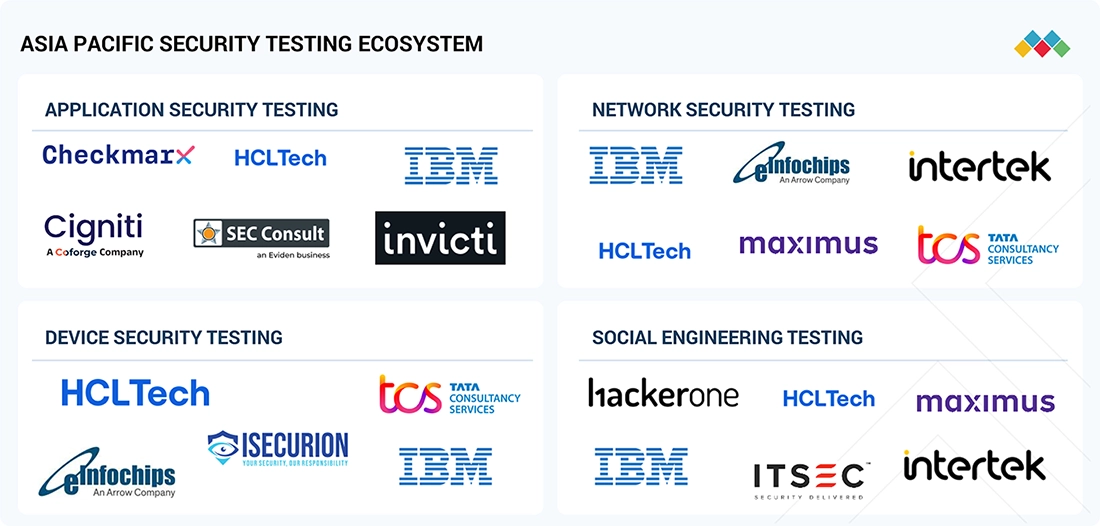
The security testing ecosystem in the Asia Pacific market revolves around application testing, network testing, device testing, and social engineering testing to address the diverse, rapidly evolving threat environment faced by businesses in this market. The vendors in these segments provide specialized services and tools to detect vulnerabilities, test security controls, and recreate realistic attack environments. This ecosystem helps organizations in the region enhance cyber resilience, increase risk visibility, and defend digital assets across multi-layered, multi-cloud, and highly connected ecosystems.
Logos and trademarks shown above are the property of their respective owners. Their use here is for informational and illustrative purposes only.
MARKET SEGMENTS
Source: Secondary Research, Interviews with Experts, MarketsandMarkets Analysis
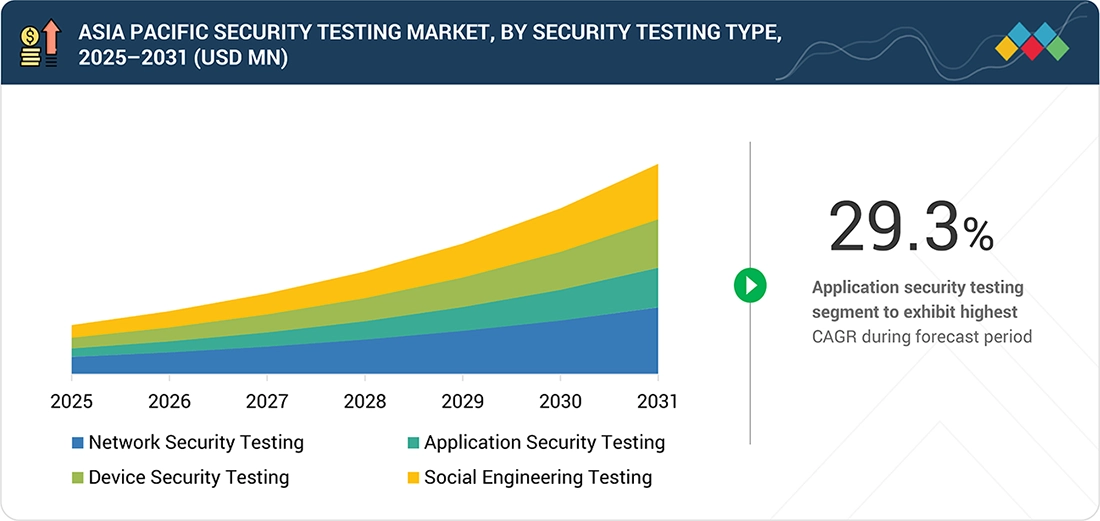
The network security testing segment is expected to dominate the Asia Pacific security testing market, due to the increasing need to protect enterprise networks with high levels of security against dynamic cyber threats. Organizations are allocating resources to network testing solutions to identify potential weak areas, evaluate security measures, and enhance cyber resilience as their IT systems become more sophisticated and interdependent.
Vulnerability scanning is likely to lead the Asia Pacific network security testing segment because of the need to act proactively to detect and address security vulnerabilities. To improve the visibility of the threat, guarantee compliance, and minimize possible exposure to cyberattacks within the distributed networks and cloud-based systems, enterprises are utilizing high-end scanning tools.
Web application security testing is projected to lead the Asia Pacific application security testing segment, driven by the rising adoption of web-based applications and digital services. Organizations are prioritizing web application security assessments to detect vulnerabilities, enforce secure coding practices, and mitigate risks in dynamic, cloud-enabled, and highly interconnected business environments.
The static application security testing (SAST) tools segment is anticipated to dominate the market, with the growing emphasis on the application of code analysis and secure development practices in the early stage. Businesses are implementing SAST solutions to identify weaknesses during the development phase, apply secure coding principles, and minimize potential security threats in complex software environments.
The on-premises deployment segment is expected to dominate the Asia Pacific security testing market, as enterprises seek greater control over sensitive data and security processes. Companies are focusing on on-premises solutions to comply with local rules and regulations, secure critical assets, and maintain visibility and control over internal security testing processes.
The Asia Pacific security testing market is expected to be dominated by large enterprises, driven by the presence of large IT infrastructures and rising cybersecurity investment. These organizations consider high-level security testing measures part of their mitigation plans, aiming to meet regulatory requirements and enhance resilience against advanced cyberattacks in sophisticated, cloud-based, and highly interconnected operational settings.
The BFSI vertical is expected to lead the Asia Pacific security testing market due to stringent regulatory requirements and the need to safeguard financial information. Financial institutions, insurance companies, and banks are investing heavily in end-to-end security testing packages to protect digital assets, improve risk transparency, and uphold confidence in highly dynamic and interconnected financial ecosystems.
REGION
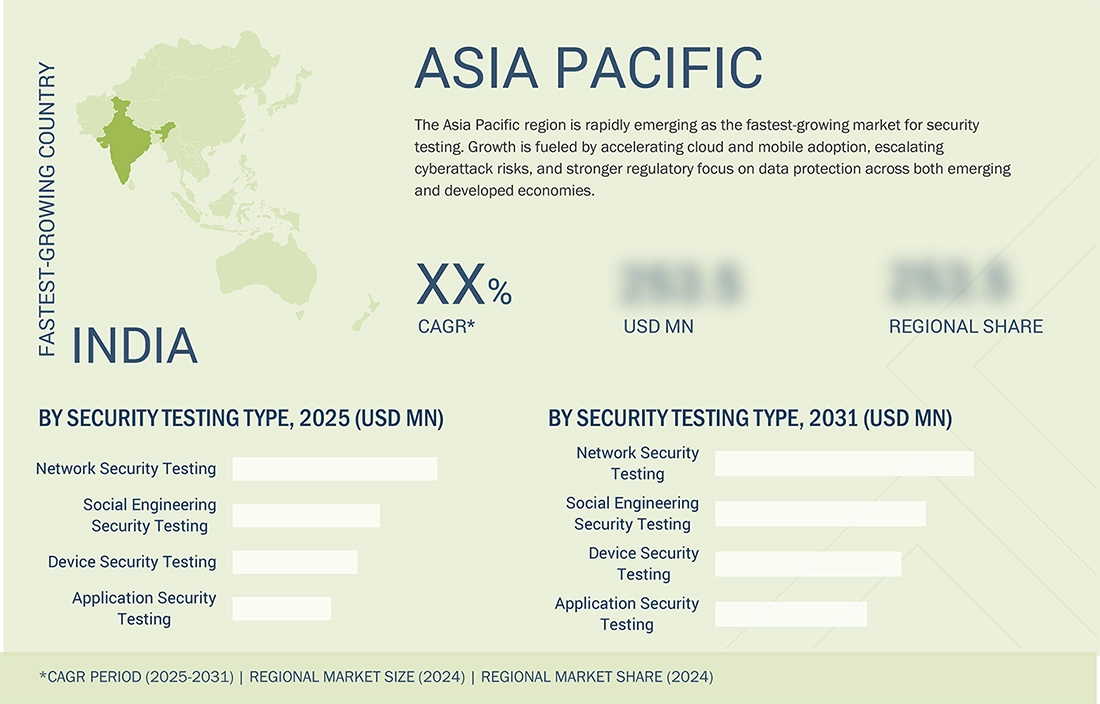
India to be fastest-growing country in Asia Pacific security testing market during forecast period
In the Asia Pacific region, India is one of the fastest-growing security testing markets due to increasing digital adoption and rising cybersecurity threats. Application, network, and device security testing solutions are actively being implemented by businesses, BFSI, and government organizations. Service providers have a great growth potential in India, since these solutions aid organizations in detecting their vulnerabilities, increasing cyber resilience, and safeguarding important digital properties.
ASIA PACIFIC SECURITY TESTING MARKET: COMPANY EVALUATION MATRIX
IBM (Star) dominates the Asia Pacific security testing market due to its comprehensive security testing solutions, strong presence among large enterprises, and AI-driven security innovations. eInfochips (Emerging Leader) is enhancing capabilities in application, network, and device security testing and is gradually transitioning to the Leaders quadrant as regional demand for secure, compliant, and resilient digital environments grows.
Source: Secondary Research, Interviews with Experts, MarketsandMarkets Analysis
KEY MARKET PLAYERS
- IBM (US)
- HCLTech (India)
- Maximus Consulting (Hong Kong)
- SEC Consult (ATOS) (Switzerland)
- TCS (Mumbai)
- Black Duck (Synopsys) (US)
- OpenText (Canada)
- Cigniti Technologies (India)
- eInfochips (US)
- Qualitest (UK)
- Intertek (UK)
- DXC Technology (US)
- Checkmarx (US)
- ITSEC (Indonesia)
MARKET SCOPE
| REPORT METRIC | DETAILS |
|---|---|
| Market Size in 2024 (Value) | USD 1.79 Billion |
| Market Forecast in 2031 (Value) | USD 9.80 Billion |
| Growth Rate | CAGR of 27.3% from 2025-2031 |
| Years Considered | 2019-2031 |
| Base Year | 2024 |
| Forecast Period | 2025-2031 |
| Units Considered | Value (USD Billion) |
| Report Coverage | Revenue forecast, company ranking, competitive landscape, growth factors, and trends |
| Segments Covered |
|
WHAT IS IN IT FOR YOU: ASIA PACIFIC SECURITY TESTING MARKET REPORT CONTENT GUIDE
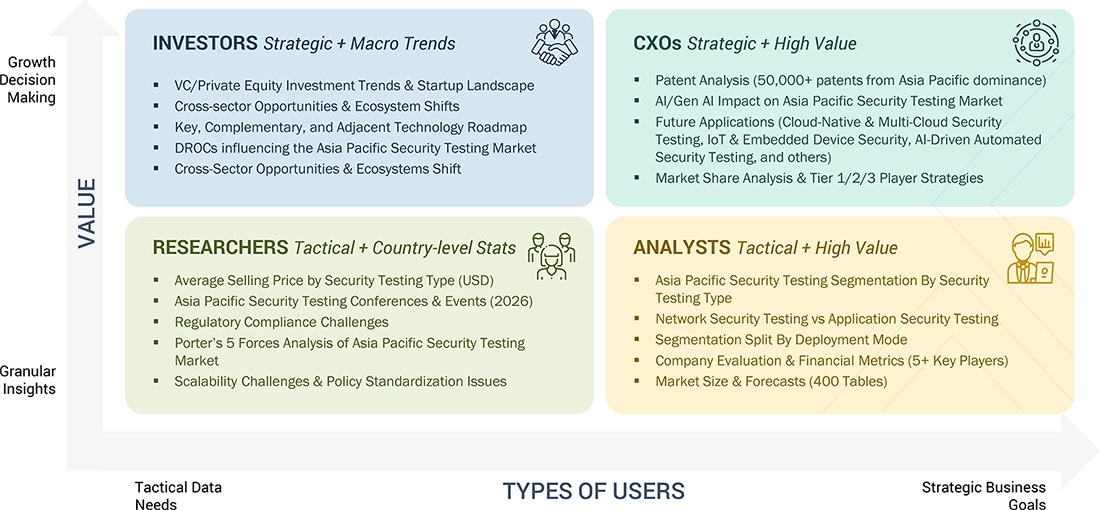
DELIVERED CUSTOMIZATIONS
We have successfully delivered the following deep-dive customizations:
| CLIENT REQUEST | CUSTOMIZATION DELIVERED | VALUE ADDS |
|---|---|---|
| Leading Solution Provider (APAC) | Product Analysis: Security Testing Matrix providing an in-depth comparison of leading Asia Pacific vendors’ capabilities, including application security testing (SAST, DAST, SCA), network and penetration testing, cloud and API security testing, automation and CI/CD integration, reporting and analytics, compliance alignment, and on-premises and cloud deployment flexibility | Stronger understanding of competitive security testing positioning, product breadth, testing depth, automation maturity, and integration capabilities, supporting informed investment decisions, platform consolidation strategies, and long-term application and infrastructure security roadmaps in the Asia Pacific region |
| Leading Service Provider (APAC) | Company Information: Detailed profiling and evaluation of additional Asia Pacific security testing vendors and service providers (up to 5), covering testing methodologies, penetration testing frameworks, DevSecOps alignment, managed security testing services, industry certifications, regional delivery capabilities, and strategic partnerships across regulated industries and hybrid IT environments | Comprehensive view of evolving Asia Pacific security testing services landscape, highlighting managed testing growth opportunities, increasing demand for continuous testing, vendor differentiation potential, and expansion areas driven by cloud adoption, regulatory requirements, and enterprise digital transformation initiatives |
RECENT DEVELOPMENTS
- September 2025 : Pentera expanded across APAC from its Singapore hub, enhancing its automated penetration testing platform with AI to simulate real-world attacks and prioritize vulnerabilities, driving adoption of continuous security testing in regional enterprises.
- August 2025 : HCLTech expanded its security portfolio in APAC, with Tech Data distributing HCL AppScan for application vulnerability testing across ten markets. This move is boosting adoption of enterprise security testing tools, helping organizations strengthen cyber resilience and streamline vulnerability management in the region.
- March 2024 : HackerOne partnered with enterprise DevSecOps teams to expand continuous crowdsourced security testing programs, supporting the identification of complex and real-world application vulnerabilities beyond automated testing tools.
- February 2025 : Checkmarx introduced advanced cloud-native and API security testing features designed to improve risk visibility across microservices-based architectures and support continuous security testing in DevSecOps environments.
Table of Contents
 Exclusive indicates content/data unique to MarketsandMarkets and not available with any competitors.
TITLE
PAGE NO
1
INTRODUCTION
15
2
EXECUTIVE SUMMARY
3
PREMIUM INSIGHTS
4
MARKET OVERVIEW
4.1
INTRODUCTION
4.2
MARKET DYNAMICS
4.2.1
DRIVERS
4.2.2
RESTRAINTS
4.2.3
OPPORTUNITIES
4.2.4
CHALLENGES
4.3
UNMET NEEDS AND WHITE SPACES
4.4
INTERCONNECTED MARKETS AND CROSS-SECTOR OPPORTUNITIES
4.5
STRATEGIC MOVES BY TIER-1/2/3 PLAYERS
5
INDUSTRY TRENDS
5.1
PORTER'S FIVE FORCES ANALYSIS
5.2
MACROECONOMIC OUTLOOK
5.2.1
INTRODUCTION
5.2.2
GDP TRENDS AND FORECAST
5.2.3
TRENDS IN ASIA PACIFIC ICT INDUSTRY
5.2.4
TRENDS IN ASIA PACIFIC CYBERSECURITY INDUSTRY
5.3
VALUE CHAIN ANALYSIS
5.4
ECOSYSTEM ANALYSIS
5.5
PRICING ANALYSIS
5.6
KEY CONFERENCES AND EVENTS (2026-27)
5.7
TRENDS/DISRUPTIONS IMPACTING CUSTOMERS' BUSINESS
5.8
INVESTMENT AND FUNDING SCENARIO
5.9
CASE STUDY ANALYSIS
5.10
IMPACT OF 2025 US TARIFF – ASIA PACIFIC SECURITY TESTING MARKET
5.10.1
INTRODUCTION
5.10.2
KEY TARIFF RATES
5.10.3
PRICE IMPACT ANALYSIS
5.10.4
IMPACT ON COUNTRIES/REGIONS
5.10.4.1
US
5.10.4.2
ASIA PACIFIC
5.10.5
IMPACT ON END-USE INDUSTRIES
6
TECHNOLOGICAL ADVANCEMENTS, AI-DRIVEN IMPACT, PATENTS, INNOVATIONS, AND FUTURE APPLICATIONS
6.1
KEY TECHNOLOGIES/KEY EMERGING TECHNOLOGIES
6.2
COMPLEMENTARY TECHNOLOGIES
6.3
ADJACENT TECHNOLOGIES
6.4
TECHNOLOGY/PRODUCT ROADMAP
6.5
PATENT ANALYSIS
6.6
FUTURE APPLICATIONS (AS APPLICABLE)
6.7
IMPACT OF AI/GEN AI ON SECURITY TESTING MARKET IN ASIA PACIFIC
6.7.1
TOP USE CASES AND MARKET POTENTIAL
6.7.2
BEST PRACTICES IN ASIA PACIFIC SECURITY TESTING MARKET
6.7.3
CASE STUDIES OF AI IMPLEMENTATION IN ASIA PACIFIC SECURITY TESTING MARKET
6.7.4
INTERCONNECTED ECOSYSTEM AND IMPACT ON MARKET PLAYERS
6.7.5
CLIENTS' READINESS TO ADOPT AI IN ASIA PACIFIC SECURITY TESTING MARKET
7
REGULATORY LANDSCAPE
7.1
REGIONAL REGULATIONS AND COMPLIANCE
7.1.1
REGULATORY BODIES, GOVERNMENT AGENCIES, AND OTHER ORGANIZATIONS
7.1.2
INDUSTRY STANDARDS
8
CUSTOMER LANDSCAPE & BUYER BEHAVIOR
8.1
DECISION-MAKING PROCESS
8.2
KEY STAKEHOLDERS INVOLVED IN BUYING PROCESS AND THEIR EVALUATION CRITERIA
8.2.1
KEY STAKEHOLDERS IN BUYING PROCESS
8.2.2
BUYING CRITERIA
8.3
ADOPTION BARRIERS & INTERNAL CHALLENGES
8.4
UNMET NEEDS FROM VARIOUS END-USE INDUSTRIES
9
ASIA PACIFIC SECURITY TESTING MARKET, BY SECURITY TESTING TYPE
9.1
INTRODUCTION
9.1.1
SECURITY TESTING TYPE: ASIA PACIFIC SECURITY TESTING MARKET DRIVERS
9.2
NETWORK SECURITY TESTING
9.3
APPLICATION SECURITY TESTING
9.4
DEVICE SECURITY TESTING
9.5
SOCIAL ENGINEERING TESTING
10
ASIA PACIFIC SECURITY TESTING MARKET, BY NETWORK SECURITY TESTING TYPE
10.1
INTRODUCTION
10.1.1
NETWORK SECURITY TESTING TYPE: ASIA PACIFIC SECURITY TESTING MARKET DRIVERS
10.2
NETWORK PENETRATION TESTING
10.3
VULNERABILITY SCANNING
10.4
WI-FI/WIRELESS SECURITY TESTING
10.5
FIREWALL SECURITY TESTING
10.6
NETWORK CONFIGURATION AUDITING
11
ASIA PACIFIC SECURITY TESTING MARKET, BY APPLICATION SECURITY TESTING TYPE
11.1
INTRODUCTION
11.1.1
APPLICATION SECURITY TESTING TYPE: ASIA PACIFIC SECURITY TESTING MARKET DRIVERS
11.2
MOBILE APPLICATION SECURITY TESTING
11.3
WEB APPLICATION SECURITY TESTING
11.4
API SECURITY TESTING
11.5
SECURE CODE REVIEW
12
ASIA PACIFIC SECURITY TESTING MARKET, BY APPLICATION SECURITY TESTING TOOLS
12.1
INTRODUCTION
12.1.1
APPLICATION SECURITY TESTING TOOLS: ASIA PACIFIC SECURITY TESTING MARKET DRIVERS
12.2
RUNTIME APPLICATION SELF-PROTECTION (RASP)
12.3
STATIC APPLICATION SECURITY TESTING (SAST)
12.4
DYNAMIC APPLICATION SECURITY TESTING (DAST)
12.5
INTERACTIVE APPLICATION SECURITY TESTING (IAST)
13
ASIA PACIFIC SECURITY TESTING MARKET, BY DEPLOYMENT MODE
13.1
INTRODUCTION
13.1.1
DEPLOYMENT MODE: ASIA PACIFIC SECURITY TESTING MARKET DRIVERS
13.2
ON-PREMISES
13.3
CLOUD
14
ASIA PACIFIC SECURITY TESTING MARKET, BY ORGANIZATION SIZE
14.1
INTRODUCTION
14.1.1
ORGANIZATION SIZE: ASIA PACIFIC SECURITY TESTING MARKET DRIVERS
14.2
LARGE ENTERPRISES
14.3
SMALL AND MEDIUM-SIZED ENTERPRISES
15
ASIA PACIFIC SECURITY TESTING MARKET, BY VERTICAL
15.1
INTRODUCTION
15.1.1
VERTICAL: ASIA PACIFIC SECURITY TESTING MARKET DRIVERS
15.2
BANKING, FINANCIAL SERVICES, AND INSURANCE (BFSI)
15.3
HEALTHCARE
15.4
GOVERNMENT
15.5
IT & ITES
15.6
TELECOMMUNICATIONS
15.7
MANUFACTURING
15.8
RETAIL & ECOMMERCE
15.9
EDUCATION
15.10
ENERGY & UTILITIES
15.11
OTHER VERTICALS
16
SECURITY TESTING MARKET, BY COUNTRY
16.1
INTRODUCTION
16.2
ASIA PACIFIC
16.2.1
ASIA PACIFIC: MARKET DRIVERS
16.2.2
CHINA
16.2.3
JAPAN
16.2.4
INDIA
16.2.5
REST OF ASIA PACIFIC
17
COMPETITIVE LANDSCAPE
17.1
OVERVIEW
17.2
KEY PLAYERS' STRATEGIES/RIGHT TO WIN, 2023-2025
17.3
REVENUE ANALYSIS,
17.4
MARKET SHARE ANALYSIS,
17.5
BRAND/PRODUCT/TECHNOLOGY COMPARISON,
17.6
COMPANY EVALUATION MATRIX: KEY PLAYERS,
17.6.1
STARS
17.6.2
EMERGING LEADERS
17.6.3
PERVASIVE PLAYERS
17.6.4
PARTICIPANTS
17.6.5
COMPANY FOOTPRINT: KEY PLAYERS,
17.6.5.1
COMPANY FOOTPRINT
17.6.5.2
TYPE FOOTPRINT
17.6.5.3
VERTICAL FOOTPRINT
17.7
COMPANY EVALUATION MATRIX: STARTUPS/SMES,
17.7.1
PROGRESSIVE COMPANIES
17.7.2
RESPONSIVE COMPANIES
17.7.3
DYNAMIC COMPANIES
17.7.4
STARTING BLOCKS
17.7.5
COMPETITIVE BENCHMARKING: STARTUPS/SMES,
17.7.5.1
DETAILED LIST OF KEY STARTUPS/SMES
17.7.5.2
COMPETITIVE BENCHMARKING OF KEY STARTUPS/SMES
17.8
COMPANY VALUATION AND FINANCIAL METRICS,
17.9
COMPETITIVE SCENARIO
17.9.1
PRODUCT LAUNCHES
17.9.2
DEALS
17.9.3
EXPANSIONS
18
COMPANY PROFILES
18.1
KEY PLAYERS
18.1.1
IBM
18.1.2
HCLTECH
18.1.3
MAXIMUS CONSULTING
18.1.4
SEC CONSULT
18.1.5
TCS
18.1.6
BLACK DUCK (SYNOPSYS)
18.1.7
OPENTEXT
18.1.8
EINFOCHIPS
18.1.9
CIGNITI TECHNOLOGIES
18.1.10
QUALITEST
18.1.11
INTERTEK
18.1.12
DXC TECHNOLOGY
18.1.13
CHECKMARX
18.1.14
ITSEC
18.1.15
ONWARD SECURITY
18.1.16
APPSECURE
18.1.17
ISECURION
18.1.18
PENTERA
18.1.19
HACKERONE
18.1.20
INVICTI
18.1.21
CONTRAST SECURITY
18.1.22
DATAART
18.1.23
COBALT
19
RESEARCH METHODOLOGY
19.1
RESEARCH DATA
19.1.1
SECONDARY DATA
19.1.1.1
KEY DATA FROM SECONDARY SOURCES
19.1.1.2
LIST OF KEY SECONDARY SOURCES
19.1.2
PRIMARY DATA
19.1.2.1
KEY DATA FROM PRIMARY SOURCES
19.1.2.2
KEY PRIMARY PARTICIPANTS
19.1.2.3
BREAKDOWN OF PRIMARY INTERVIEWS
19.1.2.4
KEY INDUSTRY INSIGHTS
19.2
MARKET SIZE ESTIMATION
19.2.1
BOTTOM-UP APPROACH
19.2.2
TOP-DOWN APPROACH
19.2.3
MARKET SIZE CALCULATION FOR BASE YEAR
19.3
MARKET FORECAST APPROACH
19.3.1
SUPPLY SIDE
19.3.2
DEMAND SIDE
19.4
DATA TRIANGULATION
19.5
FACTOR ANALYSIS
19.6
RESEARCH ASSUMPTIONS AND LIMITATIONS
19.7
RISK ASSESSMENT
20
APPENDIX
20.1
DISCUSSION GUIDE
20.2
KNOWLEDGE STORE: MARKETSANDMARKETS' SUBSCRIPTION PORTAL
20.3
AVAILABLE CUSTOMIZATIONS
20.4
RELATED REPORTS
20.5
AUTHOR DETAILS
Methodology
Secondary research was conducted to collect information useful for this technical, market-oriented, and commercial study of the asia pacific security testing market. The next step involved validating these findings, assumptions, and sizing with industry experts across the value chain using primary research. Different approaches, including top-down and bottom-up methods, were employed to estimate the total market size. After that, the market breakup and data triangulation procedures were used to estimate the market size of the segments and subsegments of the asia pacific security testing market.
Secondary Research
During the secondary research process, various secondary sources were consulted to identify and collect information relevant to the study. The secondary sources included annual reports, press releases, investor presentations of asia pacific security testing vendors, forums, certified publications, and whitepapers. The secondary research was mainly used to obtain key information about the industry’s supply chain, the total pool of key players, market classification and segmentation according to industry trends to the bottom-most level, regional markets, and key developments from both market- and technology-oriented perspectives, all of which were further validated by primary sources.
Primary Research
In the primary research process, various primary sources from both the supply and demand sides were interviewed to obtain qualitative and quantitative information for this report. The primary sources from the supply side included various industry experts, including chief executive officers (CEOs), vice presidents (VPs), marketing directors, technology and innovation directors, and related key executives from various key companies and organizations operating in the asia pacific security testing market.
In the market engineering process, top-down and bottom-up approaches were extensively used, along with several data triangulation methods, to perform market estimation and forecasting for the overall market segments and subsegments listed in this report. Extensive qualitative and quantitative analysis was conducted across the complete market engineering process to present key information/insights throughout the report.
After the complete market engineering process (including calculations for market statistics, market breakups, market size estimations, market forecasts, and data triangulation), extensive primary research was conducted to gather information and verify & validate the critical numbers arrived at. The primary research was also conducted to identify segmentation types, the competitive landscape of asia pacific security testing market players, and key market dynamics, such as drivers, restraints, opportunities, and challenges, as well as key strategies.
The following is a breakdown of the primary respondents:
To know about the assumptions considered for the study, download the pdf brochure
Market Size Estimation
Top-down and bottom-up approaches were employed to estimate and validate the size of the asia pacific security testing market, as well as the size of various dependent sub-segments within the overall asia pacific security testing market. The research methodology used to estimate the market size includes the following details: critical players in the market were identified through secondary research, and their market shares in the respective regions were determined through primary and secondary research. This entire procedure involved studying the annual and financial reports of the top market players and conducting extensive interviews with key industry leaders, including CEOs, VPs, directors, and marketing executives, to gather valuable insights.
All percentage splits and breakdowns were determined using secondary sources and verified through primary sources. All possible parameters that affect the market covered in this research study were accounted for, examined in detail, verified through primary research, and analyzed to yield final quantitative and qualitative data. This data was consolidated and added to detailed inputs and analysis from MarketsandMarkets.
Data Triangulation
The market was split into several segments and subsegments after determining the overall market size using the market sizing processes described above. The data triangulation and market breakup procedures were employed, wherever applicable, to complete the overall market engineering process and arrive at the exact statistics of each market segment and subsegment. The data was triangulated by studying various factors and trends from both the demand and supply sides.
Market Definition
Asia pacific security testing is an activity that identifies vulnerabilities in software, hardware, and services by using highly automated tools or through manual attacks by skilled information security practitioners. It helps organizations maintain confidentiality, integrity, availability, authentication, authorization, and non-repudiation of sensitive information.
Key Stakeholders
- Chief Technology and Data Officers
- Consulting Service Providers
- Cybersecurity Professionals
- Business Analysts
- Information Technology (IT) Professionals
- Government Agencies
- Investors and Venture Capitalists
- Small and Medium-sized Enterprises (SMEs) and Large Enterprises
- Third-party Providers
- Consultants/Consultancies/Advisory Firms
Report Objectives
- To describe and forecast the asia pacific security testing market by asia pacific security testing type, network asia pacific security testing type, application asia pacific security testing type, application asia pacific security testing tool, deployment mode, organization size, vertical, and region from 2025 to 2031, and analyze the various macroeconomic and microeconomic factors that affect market growth
- To forecast the market size of five major regions: North America, Europe, Asia Pacific, the Middle East & Africa, and Latin America
- To analyze the subsegments of the market with respect to individual growth trends, prospects, and contributions to the overall market
- To provide detailed information regarding major factors (drivers, restraints, opportunities, and challenges) influencing the growth of the market
- To analyze opportunities in the market for stakeholders and provide details of the competitive landscape of major players
- To profile key market players; provide a comparative analysis based on the business overviews, regional presence, product offerings, business strategies, and key financials; and illustrate the competitive landscape of the market
- To analyze competitive developments, such as mergers & acquisitions, product developments, partnerships and collaborations, and research & development (R&D) activities, in the market.
Available customizations:
With the given market data, MarketsandMarkets offers customizations based on company-specific needs. The following customization options are available for the report:
GEOGRAPHIC ANALYSIS
- Further breakup of the Asia Pacific market into countries contributes to the rest of the regional market size.
- Further breakup of the North American market into countries contributes to the rest of the regional market size.
- Further breakup of the Latin American market into countries contributing to the rest of the regional market size.
- Further breakup of the Middle East & African market into countries contributing to the rest of the regional market size.
- Further breakup of the European market into countries contributes to the rest of the regional market size.
Company information
- Detailed analysis and profiling of additional market players (up to 5)
⚡ Growth Signals
Personalize This Research
- Triangulate with your Own Data
- Get Data as per your Format and Definition
- Gain a Deeper Dive on a Specific Application, Geography, Customer or Competitor
- Any level of Personalization
Let Us Help You
- What are the Known and Unknown Adjacencies Impacting the Asia Pacific Security Testing Market
- What will your New Revenue Sources be?
- Who will be your Top Customer; what will make them switch?
- Defend your Market Share or Win Competitors
- Get a Scorecard for Target Partners

Leading IT Company in US
The research and discussions with the MarketsandMarkets team were insightful and influential towards driving our team's strategic direction. After engaging with the analyst team, we were able to have focused use cases, a targeted market segment, and strategic partners to consider as part of our GTM. The insights shared by MarketsandMarkets captured some useful information that we could leverage to develop our point of view for the next steps. The market reports were a great start for the project, but the analyst hours made a rough diamond turn into a polished gem of a project

Still Researching the
Asia Pacific Security Testing Ecosystem?
See the competitors, opportunity evaluation, and growth signals shaping it - Instantly!
Generate 15+ consulting-grade strategic intelligence outputs - from competitor analysis to board-ready strategy decks, tailored to your Asia Pacific Security Testing growth question.
