



- DESCRIPTION
- TABLE OF CONTENTS
- METHODOLOGY
- Download FREE Sample
Asia Pacific Mass Notification System Market by Software (Public Warning & Emergency Alerting, Operational & IT Alerting), Hardware (Fire Alarm Systems, Duress Buttons), Application (Critical Event Management, Reporting and Analytics) - Forecast to 2030

USD 20.22 BN
MARKET SIZE, 2030

CAGR 25.6%
(2025-2030)

250
REPORT PAGES

280
MARKET TABLES
OVERVIEW
Source: Secondary Research, Interviews with Experts, MarketsandMarkets Analysis
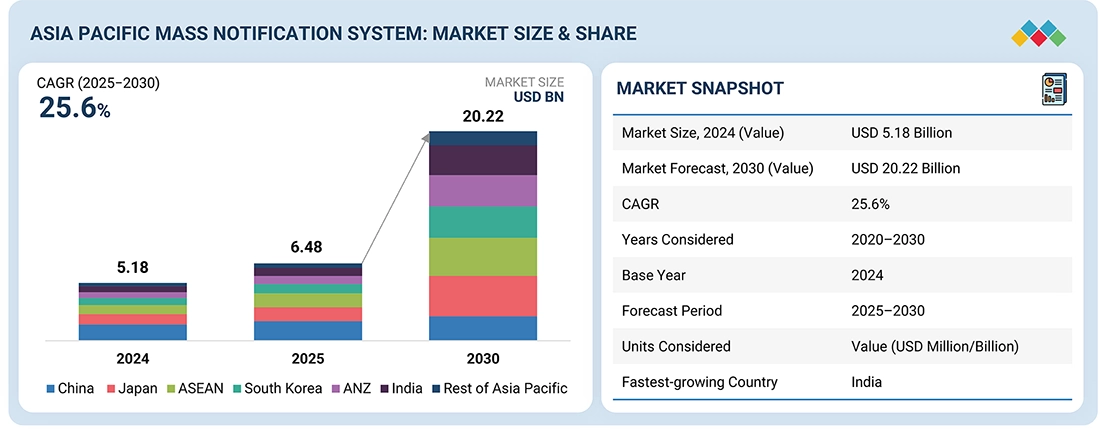
The Asia Pacific mass notification system is projected to grow from USD 6.48 billion in 2025 to USD 20.22 billion by 2030, at a CAGR of 25.6% during the forecast period. The market is steadily expanding as organizations focus on faster and more reliable emergency communication. Governments and enterprises are investing in real-time alerting platforms to reduce risks and improve emergency response. South Korea has upgraded its emergency alert system to provide clearer guidance to the public. Rapid urban growth and infrastructure development are also supporting MNS adoption.
KEY TAKEAWAYS
-
By Offering
Within the subsegments of offerings, the electronic messaging displays are projected to be the fastest-growing segment, at a CAGR of 27.2%, during the forecast period.
-
By Communication Channel
By communication channel, the voice communication segment is estimated to dominate the market, with share of 40.5% in 2025.
-
By Application
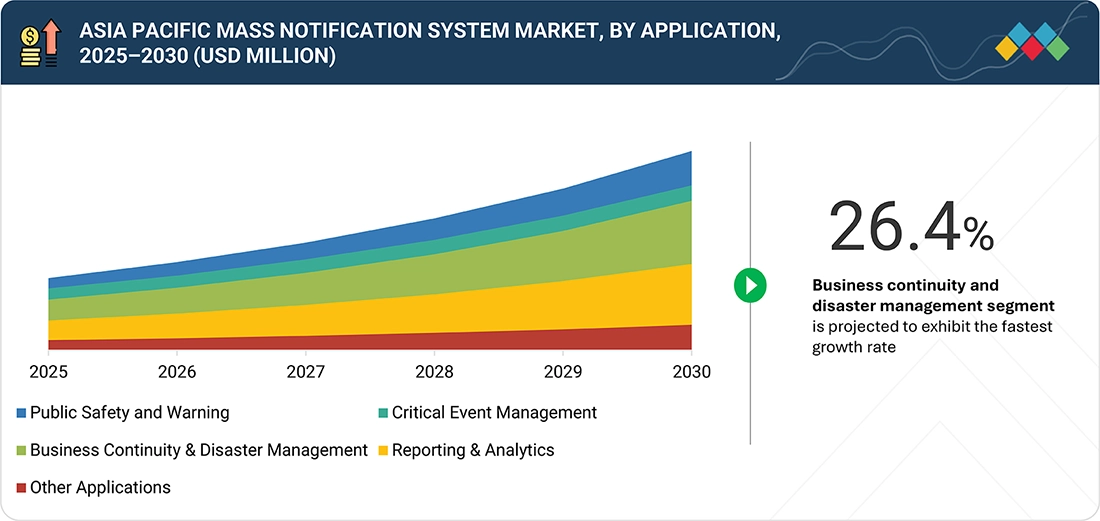
By application, the business continuity & disaster management segment is anticipated to be the fastest-growing segment, with a CAGR of 26.4% during the forecast period.
-
By Vertical
By vertical, the BFSI segment is estimated to dominate the market in 2025.
-
Competitive Landscape - Key Players
Eaton, Johnson Controls, and Siemens AG were identified as leading players in the Asia Pacific mass notification system market due to their strong product innovation, broad industry coverage, and solid operational and financial performance.
-
Competitive Landscape - Startups
Iluminr, Convergint, and RapidReach have distinguished themselves among startups and SMEs through robust product portfolios and effective business strategies.
The mass notification system market is expanding as governments and enterprises strengthen emergency communication and public safety readiness in the region. Smart cities in China and India require scalable communication systems to deliver timely warnings. The surge in demand for mobile applications, IP-based devices, and cloud-based alerting platforms fuels demand in the Asia Pacific. Vendors such as Everbridge and Johnson Controls witness strong demand across financial services to send instant alerts for workspace disruptions.
TRENDS & DISRUPTIONS IMPACTING CUSTOMERS' CUSTOMERS
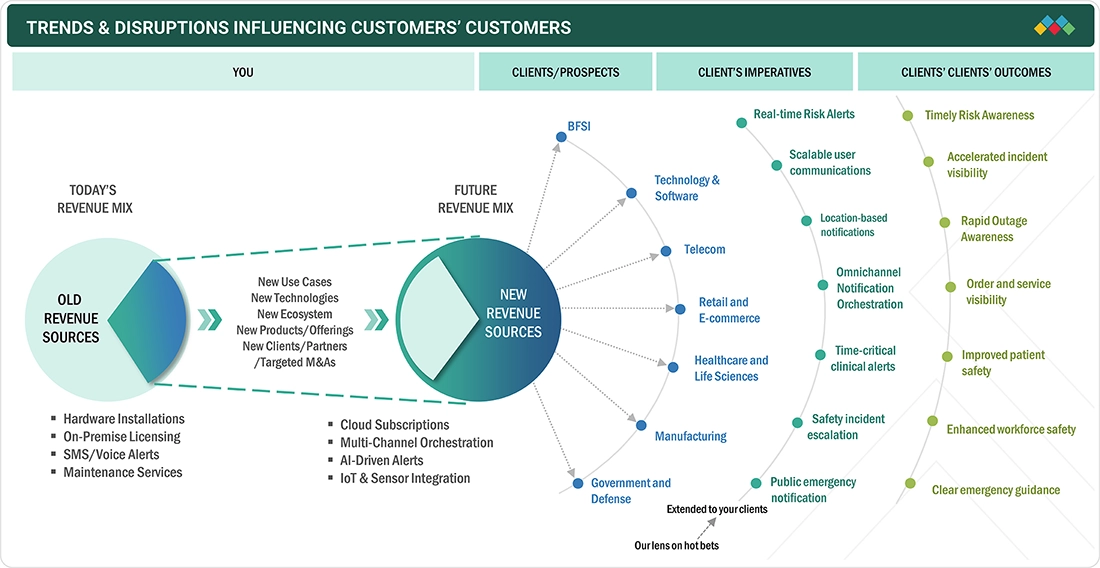
The Asia Pacific mass notification system market is estimated to grow at a CAGR of 25.6% by value during the forecast period. The rise in safety concerns, technological advancements, and the need for real-time communication are propelling MNS demand across leading countries such as China, Australia, and Singapore. Organizations seek efficient ways to disseminate critical information during emergencies, driving the demand for versatile notification solutions. Moreover, schools and universities in Japan and India are implementing crisis & event notification platforms for emergency evacuations, crisis alert notifications, and staff communications.
Source: Secondary Research, Interviews with Experts, MarketsandMarkets Analysis
MARKET DYNAMICS

Drivers
Impact
Level
-
Government Disaster Preparedness Initiatives Across Japan, Australia, India, and Southeast Asia

-
Rising Investment in Smart Cities, Transportation Networks, and Critical National Infrastructure


RESTRAINTS
Impact
Level
-
Budget Constraints and Cost Sensitivity across Emerging Countries in the Region

-
Complex Regional Data Sovereignty, Localization, and Compliance Requirements


OPPORTUNITIES
Impact
Level
-
Advancements in Public Alerting and Disaster Warning Systems driven by frequent natural disasters across Japan, Southeast Asia, India, and Australia

-
Growth of Integrated, Multi-Channel Emergency Communication Platforms


CHALLENGES
Impact
Level
-
Fragmented Communication Ecosystems and Interoperability Gaps Across Countries

-
Uneven Technology Maturity and Awareness Levels Between Developed and Developing Economies

Source: Secondary Research, Interviews with Experts, MarketsandMarkets Analysis
Governments across Japan, Australia, India, and Southeast Asia are making disaster readiness a top priority. Governments are investing heavily in public warning and emergency alerting platforms to deliver geo-targeted warnings during emergencies. Moreover, strong support for coordination with law enforcement to propel mass notification and alerting solutions demand across the region. For instance, the Cell Broadcast Alert System in India, in collaboration with the National Disaster Management Authority and the Department of Telecommunications, aims to provide timely information to citizens during emergencies.
Many emerging countries in the Asia Pacific have limited budgets but represent high growth opportunities in the market. Deploying MNS entails significant expenses for hardware, software licensing, infrastructure setup, staffing, and initial customization. Hence, cost sensitivity also slows upgrades to modern, cloud-based, or multi-channel alerting systems.
Frequent natural disasters are driving demand for better warning systems across the region. Governments need to upgrade mobile alerts, cell broadcast, and digital platforms to ensure critical information reaches people quickly. Advancements in AI & analytics technologies allow real time updates, location based alerts, and multi language messages. Hence, the region witnesses lucrative growth opportunities for advanced MNS and public alerting vendors.
Different countries use different networks, standards, and technologies for emergency communication. Many rural areas in India and Southeast Asia still depend on basic mobile messages or satellite sirens. Because of this, mass notification platforms find it hard to send the same alert across all channels like SMS, email, sirens, and social media. This makes it harder to reach everyone during disasters or health emergencies.
ASIA PACIFIC MASS NOTIFICATION SYSTEM MARKET: COMMERCIAL USE CASES ACROSS INDUSTRIES
| COMPANY | USE CASE DESCRIPTION | BENEFITS |
|---|---|---|
|
|
WIRES implemented xMatters to expedite animal rescue by reducing the amount of manual work required. With volunteers in the xMatters system, the rescue team can now contact available, qualified, local volunteers instantly. | WIRES achieved more consistent response times | Enhanced ability to contact the right-trained volunteers based on skills and location | Improved outcomes for injured, orphaned, and displaced wildlife across the region |
|
|
Wesfarmers Chemicals, Energy & Fertilizers (WesCEF) implemented Everbridge’s xMatters platform to automate incident reporting and leverage pre-formatted digital forms with contextual prompts. | WesCEF realized increased data accuracy through standardized electronic forms, greater flexibility to update workflows on the fly, and improved confidence and timeliness in emergency communication. |
|
|
The International School Yangon deployed BlackBerry AtHoc’s emergency notification system to enhance emergency communications and ensure rapid alerting. The platform enables coordinated alerts, real-time status tracking, and streamlined communications. | Improved critical event readiness, faster mass notifications, and enhanced ability to confirm safety and coordinate responses during emergencies | Enhanced preparedness for natural disasters, security threats, and operational disruptions |



Logos and trademarks shown above are the property of their respective owners. Their use here is for informational and illustrative purposes only.
MARKET ECOSYSTEM
The Asia Pacific mass notification system market ecosystem includes a mix of regional and global players addressing diverse safety and communication needs. Regional players such as iluminr, Convergint, CriticalArc, Instacom, Moobicast, and RapidReach focus on localized compliance, critical infrastructure coverage, and integrated safety systems. Global players, including Siemens, Alertus, and OnSolve, bring scalable platforms, advanced analytics, and multi-region deployment capabilities, supporting large enterprises and cross-border emergency communication requirements.
Logos and trademarks shown above are the property of their respective owners. Their use here is for informational and illustrative purposes only.
MARKET SEGMENTS
Source: Secondary Research, Interviews with Experts, MarketsandMarkets Analysis
Public warning and emergency alerting platforms are deployed across governments, telecommunications, and public sectors to deliver alerts, especially to people in affected areas using location data. Countries such as Japan, India, Indonesia, and the Philippines deal with earthquakes, floods, and cyclones. Governments need shown systems that can reach millions of people at the same time and support cell broadcast and location based warnings.
Voice communication remains a key communication channel as it offers message clarity, speed, and reliability across different user groups. The region has large, diverse, and highly populated countries, where clear and fast communication during emergencies is critical. Voice alerts are easy to understand and reach people who may not read text messages, including the elderly, rural populations, and those with limited literacy or local language preferences. During disasters such as earthquakes, floods, typhoons, and industrial accidents, spoken instructions help people react quickly and correctly.
Public safety and warning applications form the backbone of mass notification systems. Public warning & emergency alerting platforms support government authorities to send alerts during emergencies such as severe weather, security incidents, and infrastructure failures in real time. These platforms are effective in protecting communities and coordinating response activities. Voice calls and recorded messages provide direct instructions for evacuations, lockdowns, and safety guidance.
Outdoor facilities are increasingly using mass notification systems to ensure rapid communication in large open areas. Integrated hardware, such as outdoor speakers, sirens, and digital signage, is used in places like industrial parks, transport hubs, and stadiums. The wide coverage and durability of such notification devices are more suitable for busy and crowded spaces.
BFSI organizations rely on mass notification systems to maintain business continuity, protect employees and customers, and respond swiftly to operational or security-related disruptions. These systems support crisis communication, fraud alerts, evacuation coordination, and IT outage notifications. Strong compliance requirements and the need for resilient communication drive adoption across banks, insurance companies, and financial institutions.
REGION
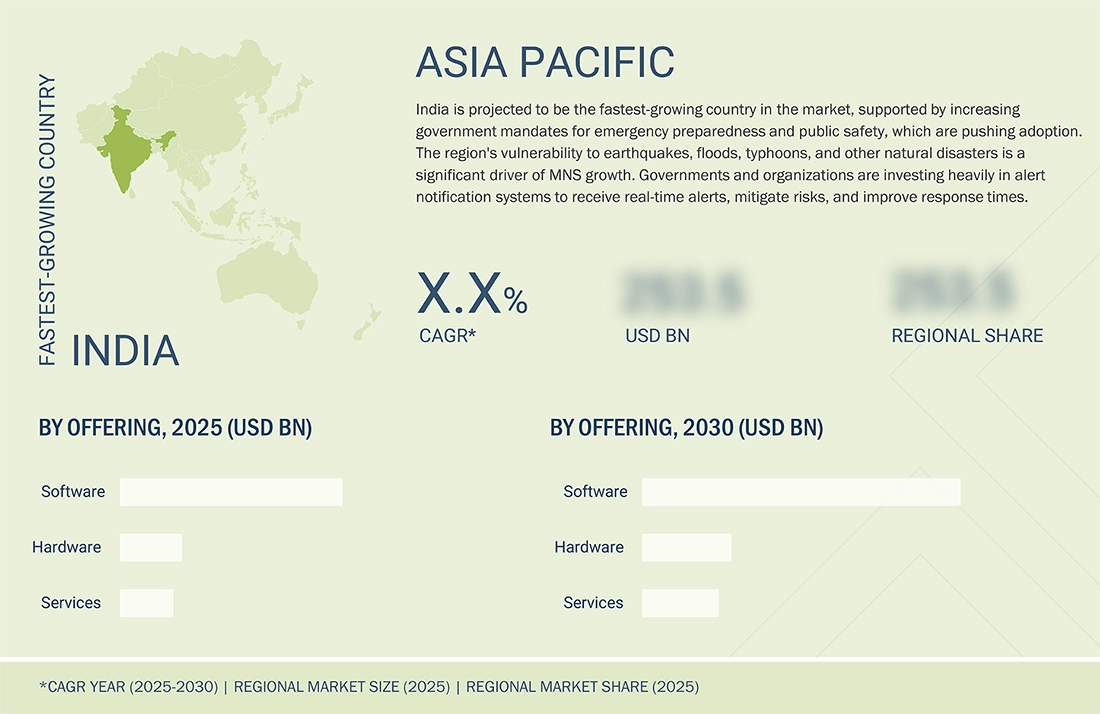
India to be fastest-growing country in Asia Pacific mass notification system during forecast period
India has more than 659 million smartphone users, with mobile penetration above 47% in 2025, which is revolutionizing mass communication. The demand for mobile-based alerting tools for public safety in India is expected to gain traction in the coming years. Government rules on emergency preparedness are further increasing adoption. National platforms such as Sachet and the Cell Broadcast Alert System now send near-real-time disaster warnings through multiple channels, improving public awareness and response.
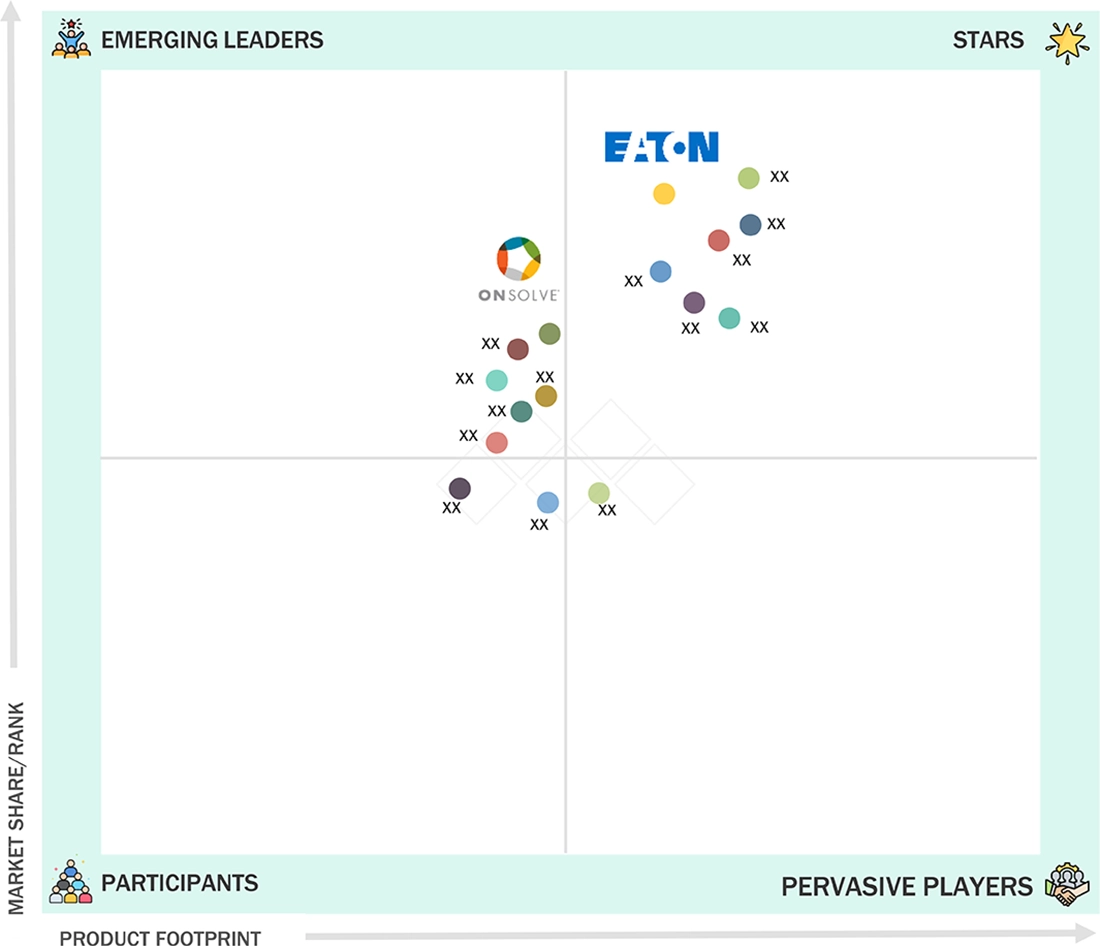
ASIA PACIFIC MASS NOTIFICATION SYSTEM MARKET: COMPANY EVALUATION MATRIX
In the mass notification system market matrix, Eaton (Star) leads through its reliable emergency communication platforms and strong presence in critical infrastructure, industrial facilities, and public safety environments. Its scalable systems, integrated voice and alerting solutions, and focus on system reliability reinforce its position as a trusted market leader. OnSolve (Emerging Leader) is gaining traction with AI-enabled critical event management capabilities that support faster threat detection, risk analysis, and multi-channel alert delivery. Its emphasis on intelligent automation and data-driven decision support positions it as a growing challenger in the MNS landscape.
Source: Secondary Research, Interviews with Experts, MarketsandMarkets Analysis
KEY MARKET PLAYERS
- Siemens AG (Germany)
- Everbridge (US)
- Honeywell (US)
- Eaton (Ireland)
- Motorola Solutions (US)
- Blackberry (Canada)
- Johnson Controls (Ireland)
- OnSolve (US)
- AlertMedia (US)
- Alertus Technologies (US)
- CriticalArc (Australia)
- Iluminr (Australia)
- Convergint (US)
- Moobicast (Singapore)
- RapidReach (US)
MARKET SCOPE
| REPORT METRIC | DETAILS |
|---|---|
| Market Size, 2024 (Value) | USD 5.18 Billion |
| Market Forecast, 2030 (value) | USD 20.22 Billion |
| Growth Rate | 25.6% |
| Years Considered | 2020–2030 |
| Base Year | 2024 |
| Forecast Period | 2025–2030 |
| Units Considered | Value (USD Million/Billion) |
| Report Coverage | Revenue forecast, company ranking, competitive landscape, growth factors, and trends |
| Segments Covered |
|
| Countries Covered | China, Japan, ASEAN, India, Australia & New Zealand, South Korea, Rest of Asia Pacific |
WHAT IS IN IT FOR YOU: ASIA PACIFIC MASS NOTIFICATION SYSTEM MARKET REPORT CONTENT GUIDE
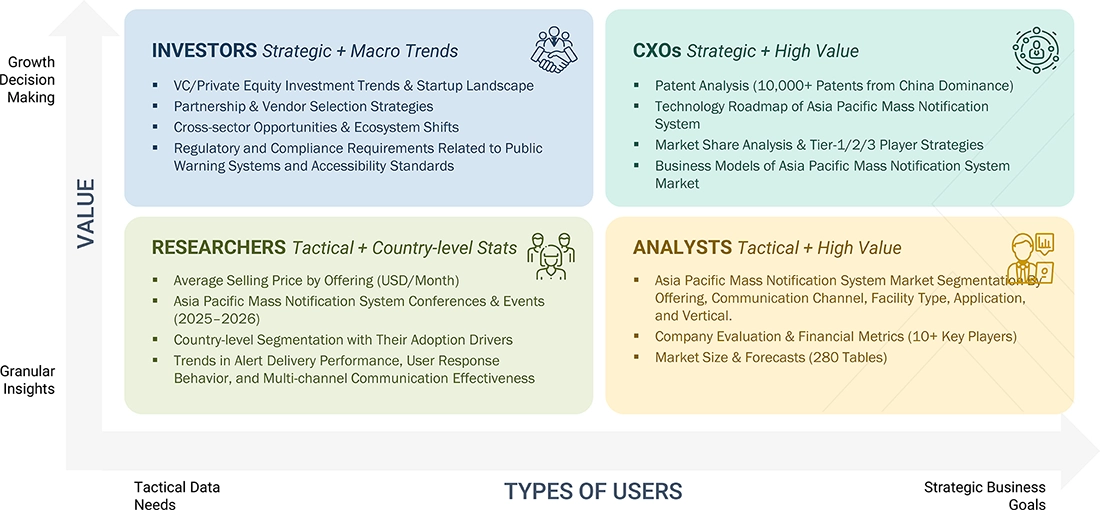
DELIVERED CUSTOMIZATIONS
We have successfully delivered the following deep-dive customizations:
| CLIENT REQUEST | CUSTOMIZATION DELIVERED | VALUE ADDS |
|---|---|---|
| Leading Mass Notification System Vendor |
|
|
| Leading Mass Notification System Vendor |
|
|
RECENT DEVELOPMENTS
- September 2025 : Everbridge expanded its collaboration with Johnson Controls to launch managed critical event management services. The deal combined Everbridge’s CEM platform with Johnson Controls’ managed security services, enabling organizations to improve emergency response, simplify operations, and strengthen mass notification and risk management capabilities.
- July 2024 : Altor acquired a majority stake in F24 AG and partnered with the company’s management team to support long-term growth. The deal strengthened F24’s position in Asia Pacific by enabling increased investment in crisis management and mass notification software development and regional market expansion.
- April 2024 : Johnson Controls renewed its partnership with Everbridge to further integrate critical event management and mass notification solutions with building and security systems. The collaboration helps organizations detect risks faster, coordinate responses, and deliver timely alerts across facilities using connected safety and communication platforms.
Table of Contents
 Exclusive indicates content/data unique to MarketsandMarkets and not available with any competitors.
TITLE
PAGE NO
1
INTRODUCTION
15
2
EXECUTIVE SUMMARY
3
PREMIUM INSIGHTS
4
MARKET OVERVIEW
4.1
INTRODUCTION
4.2
MARKET DYNAMICS
4.2.1
DRIVERS
4.2.1.1
GOVERNMENT DISASTER PREPAREDNESS INITIATIVES ACROSS JAPAN, AUSTRALIA, INDIA, AND SOUTHEAST ASIA
4.2.1.2
RISING INVESTMENT IN SMART CITIES, TRANSPORTATION NETWORKS, AND CRITICAL NATIONAL INFRASTRUCTURE
4.2.2
RESTRAINTS
4.2.2.1
COMPLEX REGIONAL DATA SOVEREIGNTY, LOCALIZATION, AND COMPLIANCE REQUIREMENTS
4.2.2.2
BUDGET CONSTRAINTS AND COST SENSITIVITY ACROSS EMERGING COUNTRIES IN THE REGION
4.2.3
OPPORTUNITIES
4.2.3.1
ADVANCEMENTS IN PUBLIC ALERTING AND DISASTER WARNING SYSTEMS DRIVEN BY FREQUENT NATURAL DISASTERS ACROSS JAPAN, SOUTHEAST ASIA, INDIA, AND AUSTRALIA
4.2.3.2
GROWTH OF INTEGRATED, MULTI-CHANNEL EMERGENCY COMMUNICATION PLATFORMS
4.2.4
CHALLENGES
4.2.4.1
FRAGMENTED COMMUNICATION ECOSYSTEMS AND INTEROPERABILITY GAPS ACROSS COUNTRIES
4.2.4.2
UNEVEN TECHNOLOGY MATURITY AND ASWARENESS LEVELS BETWEEN DEVELOPED AND DEVELOPING ECONOMIES
4.3
UNMET NEEDS AND WHITE SPACES
4.4
INTERCONNECTED MARKETS AND CROSS-SECTOR OPPORTUNITIES
4.5
STRATEGIC MOVES BY TIER-1/2/3 PLAYERS
5
INDUSTRY TRENDS
5.1
PORTER’S FIVE FORCES ANALYSIS
5.2
MACROECONOMIC OUTLOOK
5.2.1
INTRODUCTION
5.2.2
GDP TRENDS AND FORECAST
5.2.3
TRENDS IN INCIDENT AND EMERGENCY MANAGEMENT MARKET INDUSTRY
5.2.4
TRENDS IN A2P MESSAGING MARKET INDUSTRY
5.3
SUPPLY CHAIN ANALYSIS
5.4
ECOSYSTEM ANALYSIS
5.5
PRICING ANALYSIS
5.5.1
AVERAGE SELLING PRICE OF OFFERING, BY KEY PLAYERS,
5.5.2
AVERAGE SELLING PRICE, BY APPLICATION,
5.6
KEY CONFERENCES AND EVENTS, 2025–2026
5.7
TRENDS/DISRUPTIONS IMPACTING CUSTOMER BUSINESS
5.8
INVESTMENT AND FUNDING SCENARIO
5.9
CASE STUDY ANALYSIS
6
TECHNOLOGICAL ADVANCEMENTS, AI-DRIVEN IMPACT, PATENTS, INNOVATIONS, AND FUTURE APPLICATIONS
6.1
KEY EMERGING TECHNOLOGIES
6.1.1
CLOUD COMPUTING
6.1.2
BIG DATA
6.1.3
IOT
6.1.4
PREDICTIVE ANALYTICS
6.1.5
A2P MESSAGING
6.2
COMPLEMENTARY TECHNOLOGIES
6.2.1
GIS
6.2.2
GEOFENCING
6.2.3
LOCATION ANALYTICS
6.3
ADJACENT TECHNOLOGIES
6.3.1
BLOCKCHAIN
6.3.2
AI
6.4
TECHNOLOGY/PRODUCT ROADMAP
6.5
PATENT ANALYSIS
6.5.1
METHODOLOGY
6.5.2
PATENTS FILED, BY DOCUMENT TYPE, 2015–2025
6.5.3
INNOVATION AND PATENT APPLICATIONS
6.6
FUTURE APPLICATIONS
6.7
IMPACT OF AI/GEN AI ON ASIA PACIFIC MASS NOTIFICATION SYSTEM MARKET
6.7.1
TOP USE CASES AND MARKET POTENTIAL
6.7.2
BEST PRACTICES FOLLOWED BY MANUFACTURERS/OEMS IN THE ASIA PACIFIC MASS NOTIFICATION SYSTEM MARKET
6.7.3
CASE STUDIES RELATED TO AI IMPLEMENTATION IN THE ASIA PACIFIC MASS NOTIFICATION SYSTEM MARKET
6.7.4
INTERCONNECTED ECOSYSTEM AND IMPACT ON MARKET PLAYERS
6.7.5
CLIENT’S READINESS TO ADOPT AI-INTEGRATED SOLUTIONS
6.8
REAL-WORLD APPLICATIONS
7
REGULATORY LANDSCAPE
7.1
REGULATIONS AND COMPLIANCE
7.1.1
REGULATORY BODIES, GOVERNMENT AGENCIES, AND OTHER ORGANIZATIONS
7.1.2
INDUSTRY STANDARDS
8
CUSTOMER LANDSCAPE & BUYER BEHAVIOR
8.1
INTRODUCTION
8.2
DECISION-MAKING PROCESS
8.3
KEY STAKEHOLDERS INVOLVED IN BUYING PROCESS AND THEIR EVALUATION CRITERIA
8.3.1
KEY STAKEHOLDERS IN BUYING PROCESS
8.3.2
BUYING CRITERIA
8.4
ADOPTION BARRIERS & INTERNAL CHALLENGES
8.5
UNMET NEEDS FROM VARIOUS END-USE INDUSTRIES
8.6
MARKET PROFITABILITY
9
ASIA PACIFIC MASS NOTIFICATION SYSTEM MARKET, BY OFFERING
9.1
INTRODUCTION
9.1.1
OFFERING: ASIA PACIFIC MASS NOTIFICATION SYSTEM MARKET DRIVERS
9.2
SOFTWARE
9.2.1
BY TYPE
9.2.1.1
CRISIS & EVENT NOTIFICATION PLATFORM
9.2.1.2
CAMPUS & FACILITY NOTIFICATION SOFTWARE
9.2.1.3
PUBLIC WARNING & EMERGENCY ALERTING PLATFORM
9.2.1.4
OPERATIONAL & IT ALERTING SOFTWARE
9.2.1.5
OTHER SOFTWARE TYPES
9.2.2
BY INTEGRATION
9.2.2.1
STANDALONE
9.2.2.2
INTEGRATED
9.2.3
BY DEPLOYMENT MODE
9.2.3.1
CLOUD
9.2.3.2
ON-PREMISES
9.3
HARDWARE
9.3.1
FIRE ALARM SYSTEMS
9.3.2
PUBLIC ADDRESS SYSTEMS
9.3.3
DURESS BUTTON
9.3.4
ELECTRONIC MESSAGING DISPLAYS
9.3.5
VISUAL ALERT DEVICES
9.3.6
SIRENS
9.4
SERVICES
9.4.1
PROFESSIONAL SERVICES
9.4.1.1
CONSULTING AND PLANNING SERVICES
9.4.1.1.1
SYSTEM INTEGRATION CONSULTING
9.4.1.1.2
EMERGENCY PREPAREDNESS PLANNING
9.4.1.1.3
COMMUNICATION STRATEGY DEVELOPMENT
9.4.1.1.4
CRISIS COMMUNICATION PLANNING
9.4.1.1.5
COMPLIANCE AND REGULATION ADVISORY
9.4.1.2
TRAINING AND SUPPORT SERVICES
9.4.1.2.1
USER TRAINING WORKSHOPS
9.4.1.2.2
TECHNICAL SUPPORT AND HELPDESK
9.4.1.2.3
USER ONBOARDING AND ORIENTATION
9.4.1.2.4
TRAINING MATERIALS DEVELOPMENT
9.4.1.2.5
TROUBLESHOOTING AND ISSUE RESOLUTION
9.4.2
MANAGED SERVICES
9.4.2.1
MANAGED ALERT CREATION AND DELIVERY
9.4.2.2
24/7 MONITORING AND RESPONSE
9.4.2.3
EMERGENCY EVENT COORDINATION
9.4.2.4
DEDICATED EMERGENCY RESPONSE TEAMS
9.4.2.5
CONTENT CREATION AND MANAGEMENT
ASIA PACIFIC MASS NOTIFICATION SYSTEM MARKET, BY COMMUNICATION CHANNEL
9.5
INTRODUCTION
9.5.1
COMMUNICATION CHANNEL: ASIA PACIFIC NOTIFICATION SYSTEM MARKET DRIVERS
9.6
TEXT-BASED COMMUNICATION
9.6.1
SMS ALERTS
9.6.2
EMAIL NOTIFICATIONS
9.7
VOICE COMMUNICATION
9.7.1
PHONE CALL ALERTS
9.7.2
PA SYSTEM ANNOUNCEMENTS
9.8
DIGITAL COMMUNICATION
9.8.1
MOBILE APP NOTIFICATIONS
9.8.2
DESKTOP ALERTS
9.8.3
AUDIO-VISUAL ALERTS
10
ASIA PACIFIC MASS NOTIFICATION SYSTEM MARKET, BY FACILITY TYPE
10.1
INTRODUCTION
10.1.1
FACILITY TYPE: ASIA PACIFIC MASS NOTIFICATION SYSTEM MARKET DRIVERS
10.2
INDOOR FACILITIES
10.2.1
OFFICE BUILDINGS
10.2.2
SHOPPING MALLS
10.2.3
OTHER INDOOR FACILITY TYPES
10.3
OUTDOOR FACILITIES
10.3.1
PARKS
10.3.2
OPEN-AIR VENUES
10.3.3
OTHER OUTDOOR FACILITY TYPES
ASIA PACIFIC MASS NOTIFICATION SYSTEM MARKET, BY APPLICATION
10.4
INTRODUCTION
10.4.1
APPLICATION: ASIA PACIFIC MASS NOTIFICATION SYSTEM MARKET DRIVERS
10.5
CRITICAL EVENT MANAGEMENT
10.5.1
INCIDENT RESPONSE
10.5.2
EMERGENCY NOTIFICATION
10.5.3
REAL TIME VISIBILITY
10.5.4
EVENT DETECTION AND MONITORING
10.5.5
OTHER CRITICAL EVENT MANAGEMENT APPLICATIONS
10.6
PUBLIC SAFETY AND WARNING
10.6.1
PUBLIC SAFETY DRILLS AND EXERCISES
10.6.2
GOVERNMENT AND LAW ENFORCEMENT UPDATES
10.6.3
TRAFFIC AND TRANSPORTATION ALERTS
10.6.4
EVACUATION NOTICES
10.6.5
PUBLIC HEALTH NOTIFICATIONS
10.6.6
AMBER ALERTS AND MISSING PERSON NOTIFICATIONS
10.6.7
OTHER PUBLIC SAFETY AND WARNING APPLICATIONS
10.7
BUSINESS CONTINUITY & DISASTER MANAGEMENT
10.7.1
EMERGENCY RESPONSE PLANS & WORKFLOWS
10.7.2
BUSINESS CONTINUITY ACTIVATION
10.7.3
EMPLOYEE SAFETY & ACCOUNTABILITY
10.7.4
SUPPLY CHAIN & VENDOR COMMUNICATION
10.7.5
FACILITY & ASSET MANAGEMENT
10.7.6
CUSTOMER COMMUNICATION & SERVICE UPDATES
10.7.7
OTHER BUSINESS CONTINUITY & DISASTER MANAGEMENT APPLICATIONS
10.8
REPORTING & ANALYTICS
10.8.1
RECIPIENT BEHAVIOR ANALYSIS
10.8.2
SYSTEM PERFORMANCE ANALYTICS
10.8.3
EMERGENCY RESPONSE ANALYTICS
10.8.4
OTHER REPORTING & ANALYTICS APPLICATIONS
10.9
OTHER APPLICATIONS
11
ASIA PACIFIC MASS NOTIFICATION SYSTEM MARKET, BY VERTICAL
11.1
INTRODUCTION
11.1.1
VERTICAL: ASIA PACIFIC MASS NOTIFICATION SYSTEM MARKET DRIVERS
11.2
BFSI
11.2.1
BANKS
11.2.2
FINANCIAL INSTITUTIONS
11.2.3
OTHER BFSI SUBVERTICALS
11.3
RETAIL & ECOMMERCE
11.3.1
RETAIL CHAINS
11.3.2
ECOMMERCE PLATFORMS
11.3.3
OTHER RETAIL & ECOMMERCE SUBVERTICALS
11.4
TRANSPORTATION & LOGISTICS
11.4.1
AIRPORTS
11.4.2
PORTS
11.4.3
PUBLIC TRANSPORTATION HUBS
11.4.4
OTHER TRANSPORTATION & LOGISTICS SUBVERTICALS
11.5
GOVERNMENT & DEFENSE
11.5.1
EMERGENCY SERVICES
11.5.2
MUNICIPALITIES & LOCAL GOVERNMENT
11.5.3
FEDERAL AGENCIES
11.5.4
OTHER GOVERNMENT & DEFENSE SUBVERTICALS
11.6
HEALTHCARE & LIFE SCIENCES
11.6.1
HOSPITALS & MEDICAL FACILITIES
11.6.2
HEALTHCARE NETWORKS
11.6.3
OTHER HEALTHCARE & LIFE SCIENCES SUBVERTICALS
11.7
TELECOM
11.7.1
TELECOMMUNICATION COMPANIES
11.7.2
DATA CENTERS
11.7.3
OTHER TELECOM SUBVERTICALS
11.8
ENERGY & UTILITIES
11.8.1
POWER PLANTS
11.8.2
OIL & GAS FACILITIES
11.8.3
OTHER ENERGY & UTILITY SUBVERTICALS
11.9
MANUFACTURING
11.9.1
FACTORIES
11.9.2
MANUFACTURING FACILITIES
11.9.3
OTHER MANUFACTURING SUBVERTICALS
11.10
IT/ITES
11.11
MEDIA & ENTERTAINMENT
11.11.1
STADIUMS & ARENAS
11.11.2
THEME PARKS
11.11.3
THEATERS
11.11.4
OTHER MEDIA & ENTERTAINMENT SUBVERTICALS
11.12
EDUCATION
11.12.1
K-12 SCHOOLS
11.12.2
COLLEGES & UNIVERSITIES
11.12.3
EDUCATIONAL DISTRICTS
11.12.4
OTHER EDUCATION SUBVERTICALS
11.13
OTHER VERTICALS
12
ASIA PACIFIC MASS NOTIFICATION SYSTEM MARKET, BY COUNTRY
12.1
INTRODUCTION
12.1.1
COUNTRY: ASIA PACIFIC MASS NOTIFICATION SYSTEM MARKET DRIVERS
12.2
CHINA
12.3
JAPAN
12.4
ASEAN
12.5
INDIA
12.6
ANZ
12.7
SOUTH KOREA
12.8
REST OF ASIA PACIFIC
13
COMPETITIVE LANDSCAPE
13.1
OVERVIEW
13.2
KEY PLAYER STRATEGIES/RIGHT TO WIN, 2020–2024
13.3
REVENUE ANALYSIS FOR KEY PLAYERS, 2020–2024
13.4
MARKET SHARE ANALYSIS,
13.5
PRODUCT COMPARISON
13.6
COMPANY EVALUATION MATRIX: KEY PLAYERS,
13.6.1
STARS
13.6.2
EMERGING LEADERS
13.6.3
PERVASIVE PLAYERS
13.6.4
PARTICIPANTS
13.6.5
COMPANY FOOTPRINT: KEY PLAYERS,
13.6.5.1
COMPANY FOOTPRINT
13.6.5.2
OFFERING FOOTPRINT
13.6.5.3
COMMUNICATION CHANNEL FOOTPRINT
13.6.5.4
APPLICATION FOOTPRINT
13.6.5.5
VERTICAL FOOTPRINT
13.7
COMPANY EVALUATION MATRIX: STARTUPS/SMES,
13.7.1
PROGRESSIVE COMPANIES
13.7.2
RESPONSIVE COMPANIES
13.7.3
DYNAMIC COMPANIES
13.7.4
STARTING BLOCKS
13.7.5
COMPETITIVE BENCHMARKING: STARTUPS/SMES,
13.7.5.1
DETAILED LIST OF KEY STARTUPS/SMES
13.7.5.2
COMPETITIVE BENCHMARKING OF KEY STARTUPS/SMES
13.8
COMPANY VALUATION AND FINANCIAL METRICS
13.9
COMPETITIVE SCENARIO
13.9.1
PRODUCT LAUNCHES AND ENHANCEMENTS
13.9.2
DEALS
13.9.3
EXPANSIONS
14
COMPANY PROFILES
14.1
KEY PLAYERS
14.1.1
SIEMENS AG
14.1.2
EVERBRIDGE
14.1.3
HONEYWELL
14.1.4
EATON
14.1.5
MOTOROLA SOLUTIONS
14.1.6
BLACKBERRY
14.1.7
JOHNSON CONTROLS
14.1.8
SINGLEWIRE SOFTWARE
14.1.9
ONSOLVE
14.1.10
ALERTMEDIA
14.1.11
ALERTUS TECHNOLOGIES
14.1.12
F24 AG
14.1.13
HIPLINK
14.1.14
AMERICAN SIGNAL CORPORATION
14.1.15
ATI SYSTEMS
14.1.16
MIRCOM
14.2
OTHER PLAYERS
14.2.1
ILUMINR
14.2.2
CONVERGINT
14.2.3
CRITICALARC
14.2.4
INSTACOM
14.2.5
MOBIACAST
14.2.6
FORTDIGITAL
14.2.7
KONEXUS
14.2.8
RAPIDREACH
15
RESEARCH METHODOLOGY
15.1
RESEARCH DATA
15.1.1
SECONDARY DATA
15.1.1.1
KEY DATA FROM SECONDARY SOURCES
15.1.1.2
LIST OF KEY SECONDARY SOURCES
15.1.2
PRIMARY DATA
15.1.2.1
KEY DATA FROM PRIMARY SOURCES
15.1.2.2
KEY PRIMARY PARTICIPANTS
15.1.2.3
BREAKUP OF PRIMARY INTERVIEWS
15.1.2.4
KEY INDUSTRY INSIGHTS
15.2
MARKET SIZE ESTIMATION
15.2.1
BOTTOM-UP APPROACH
15.2.2
TOP-DOWN APPROACH
15.2.3
MARKET-SIZE CALCULATION FOR BASE YEAR
15.3
MARKET FORECAST APPROACH
15.3.1
SUPPLY SIDE
15.3.2
DEMAND SIDE
15.4
DATA TRIANGULATION
15.5
FACTOR ANALYSIS
15.6
RESEARCH ASSUMPTIONS AND LIMITATIONS
15.7
RISK ASSESSMENT
16
APPENDIX
16.1
DISCUSSION GUIDE
16.2
KNOWLEDGESTORE: MARKETSANDMARKETS SUBSCRIPTION PORTAL
16.3
CUSTOMIZATION OPTIONS
16.4
RELATED REPORTS
16.5
AUTHOR DETAILS
Methodology
The research methodology for the Mass Notification System market report involved the use of extensive secondary sources and directories, as well as various reputed open-source databases, to identify and collect useful information for this technical and market-oriented study. In-depth interviews were conducted with various primary respondents, including software by type; software by integration; by deployment mode; verticals; high-level executives of multiple companies offering mass notification system software, hardware & services; and industry consultants to obtain and verify critical qualitative and quantitative information and assess the market prospects and industry trends.
Secondary Research
During the secondary research process, various secondary sources were consulted to identify and collect information for the study. The secondary sources included annual reports; press releases and investor presentations of companies; white papers, certified publications.
The secondary research was utilized to gather key information about the industry’s value chain, the market’s monetary chain, the overall pool of key players, market classification and segmentation based on industry trends, and regional markets, as well as key developments from both market- and technology-oriented perspectives.
Primary Research
In the primary research process, a diverse range of stakeholders from both the supply and demand sides of the Mass notification system ecosystem were interviewed to gather qualitative and quantitative insights specific to this market. From the supply side, key industry experts, such as chief executive officers (CEOs), vice presidents (VPs), marketing directors, technology & innovation directors, as well as technical leads from vendors offering Mass notification system hardware, software & services, were consulted. Additionally, system integrators, service providers, and IT service firms that implement and support the Mass notification system solutions were included in the study. On the demand side, input from IT decision-makers, infrastructure managers, and business heads of prominent industry verticals was collected to understand the user perspectives and adoption challenges within targeted industries.
The primary research ensured that all crucial parameters affecting the Mass notification system market, from technological advancements and evolving use cases to regulatory and compliance needs, were considered. Each factor was thoroughly analyzed, verified through primary research, and evaluated to obtain precise quantitative and qualitative data for this market.
Once the initial phase of market engineering was completed, including detailed calculations for market statistics, segment-specific growth forecasts, and data triangulation, a second round of primary research was conducted. This step was crucial for refining and validating critical data points, such as Mass notification system offerings (hardware, software & services), industry adoption trends, the competitive landscape, and key market dynamics like demand drivers (Growing need for real-time, multi-channel emergency communication across organizations, Regulatory and industry-mandated requirements for emergency preparedness), challenges Balancing ease of access with strong security posture across devices and external users, Managing cross-channel consistency, false alarms, and governance across large distributed organizations), and opportunities (Advanced content lifecycle automation, intelligent sync, and metadata-driven governance, Expansion into AI-driven alert automation, multilingual messaging, and behavioral response analytics) and restraints (Balancing ease of access with strong security posture across devices and external users, Managing cross-channel consistency, false alarms, and governance across large distributed organizations).
In the comprehensive market engineering process, the top-down and bottom-up approaches, along with several data triangulation methods, were extensively employed to perform market estimation and forecasting for the overall market segments and subsegments listed in this report. Extensive qualitative and quantitative analysis was performed on the complete market engineering process to record the critical information/insights throughout the report.
Market Size Estimation
The top-down and bottom-up approaches were employed to estimate and forecast the Mass Notification System market, as well as its dependent submarkets. This multi-layered analysis was further reinforced through data triangulation, which incorporated primary and secondary research inputs. The market figures were also validated against the existing MarketsandMarkets repository for accuracy.
Asia Pacific Mass Notification System Market : Top-Down and Bottom-Up Approach
Data Triangulation
The market was divided into several segments and subsegments after determining the overall market size using the market size estimation processes described above. To complete the overall market engineering process and determine the exact statistics for each market segment and subsegment, data triangulation and market segmentation procedures were employed, wherever applicable. The overall market size was then used in the top-down approach to estimate the size of other individual markets by applying percentage splits to the market segmentation.
Market Definition
According to Everbridge, a mass notification system is a vital solution that enables the prompt and precise delivery of notifications to individuals or groups, irrespective of their location. It is a comprehensive platform, swiftly disseminating emergency messages through various communication channels like voice calls, SMS, push notifications, desktop alerts, and social media. By utilizing visual intelligence and user-friendly interfaces, a mass notification system ensures that the right message reaches the intended recipients during critical events, regardless of their devices or physical whereabouts. This system plays a pivotal role in protecting people, securing operations, and safeguarding the reputation of organizations by facilitating timely and accurate communication.
Key Stakeholders
- Mass Notification System Vendors
- Mass Notification Software Vendors
- Managed Service Providers
- Support and Maintenance Service Providers
- System Integrators (SIs)/Migration Service Providers
- Distributors and Value-added Resellers (VARs)
- Independent Software Vendors (ISVs)
- Cloud Service Providers
- Technology Providers
Report Objectives
- To define, describe, and predict the mass notification system market by offering (software, hardware, and services), communication channel, facility type, application, vertical, and region
- To provide detailed information related to major factors (drivers, restraints, opportunities, and industry-specific challenges) influencing market growth
- To analyze opportunities in the market and provide details of the competitive landscape for stakeholders and market leaders
- To analyze each submarket with respect to individual growth trends, prospects, and contributions to the overall mass notification system market
- To analyze competitive developments, such as partnerships, new product launches, mergers & acquisitions, in the mass notification system market
- To analyze the competitive developments, such as partnerships, product launches, mergers and acquisitions, in the Mass notification system market
- To analyze the impact of macroeconomic factors on the Mass Notification System market across all regions
Available Customizations
With the given market data, MarketsandMarkets offers customizations based on the company’s specific needs. The following customization options are available for the report.
Product Analysis
- Product comparative analysis, which gives a detailed comparison of innovative products being offered by prominent vendors
Company information
- Detailed analysis and profiling of additional market players (up to five)
⚡ Growth Signals
Personalize This Research
- Triangulate with your Own Data
- Get Data as per your Format and Definition
- Gain a Deeper Dive on a Specific Application, Geography, Customer or Competitor
- Any level of Personalization
Let Us Help You
- What are the Known and Unknown Adjacencies Impacting the Asia Pacific Mass Notification System Market
- What will your New Revenue Sources be?
- Who will be your Top Customer; what will make them switch?
- Defend your Market Share or Win Competitors
- Get a Scorecard for Target Partners

Leading IT Company in US
The research and discussions with the MarketsandMarkets team were insightful and influential towards driving our team's strategic direction. After engaging with the analyst team, we were able to have focused use cases, a targeted market segment, and strategic partners to consider as part of our GTM. The insights shared by MarketsandMarkets captured some useful information that we could leverage to develop our point of view for the next steps. The market reports were a great start for the project, but the analyst hours made a rough diamond turn into a polished gem of a project

Still Researching the
Asia Pacific Mass Notification System Ecosystem?
See the competitors, opportunity evaluation, and growth signals shaping it - Instantly!
Generate 15+ consulting-grade strategic intelligence outputs - from competitor analysis to board-ready strategy decks, tailored to your Asia Pacific Mass Notification System growth question.
