



- DESCRIPTION
- TABLE OF CONTENTS
- METHODOLOGY
- Download FREE Sample
Cloud Security Market by Type (CNAPP [CWPP, CSPM, CIEM, CDR, KSPM, IAC Security], CASB, Analytics and Monitoring), Deployment Mode (Private, Public, Hybrid), Vertical (Healthcare, Retail & E-commerce, Media & Entertainment) � Global Forecast to 2031

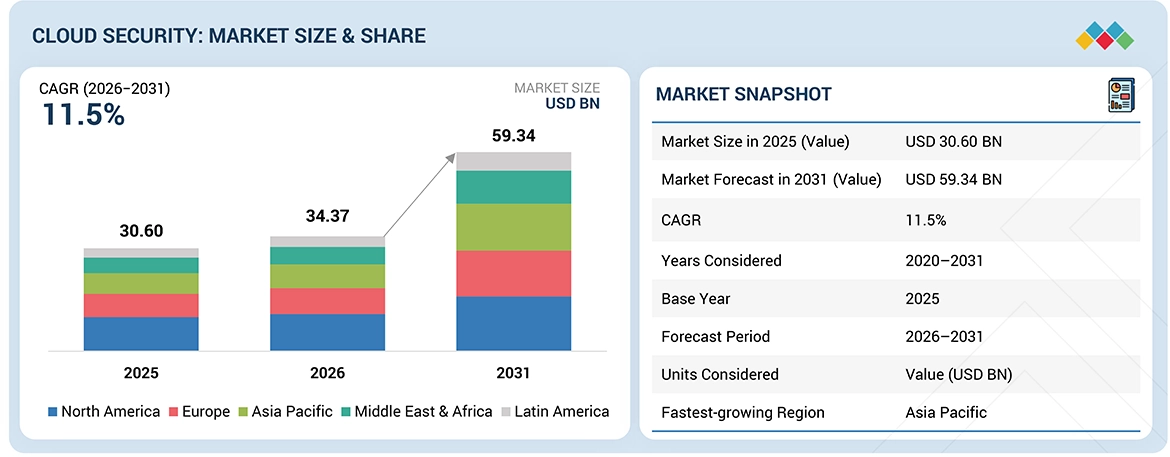
USD 59.34 BN
MARKET SIZE, 2031

CAGR 11.5%
(2026-2031)

400
REPORT PAGES

500
MARKET TABLES
OVERVIEW
Source: Secondary Research, Interviews with Experts, MarketsandMarkets Analysis
The cloud security market is projected to reach USD 59.34 billion by 2031 from USD 34.37 billion in 2026, at a CAGR of 11.5%. Multi-cloud and hybrid cloud adoption trends are driving the emergence of cloud security solutions that provide seamless visibility, compliance, and threat management across diverse infrastructure types. In addition, DevSecOps and cloud-native application development trends have made it essential for organizations to integrate security into their application development processes. The combined influence of these trends has increased demand for scalable cloud security solutions that protect dynamic workloads and enable faster application deployments.
KEY TAKEAWAYS
-
BY REGION
North America is expected to account for the largest share of 32.2% of the cloud security market in 2026.
-
BY OFFERING
By offering, the platform/solutions segment is expected to dominate the market by capturing the largest market share in 2026.
-
BY TYPE
By type, the cloud-native application protection platform (CNAPP) segment is expected to register the highest CAGR of 14.6% during the forecast period.
-
BY DEPLOYMENT MODE
By deployment mode, hybrid cloud will be the fastest-growing segment from 2026 to 2031.
-
BY ORGANIZATION SIZE
By organization size, the large enterprises segment is expected to hold the largest market share in 2026.
-
BY VERTICAL
By vertical, the healthcare and life sciences segment is likely to record the highest CAGR of 15.1% during the forecast period.
-
COMPETITIVE LANDSCAPE - KEY PLAYERS
Microsoft, AWS, and Palo Alto Networks are leading players in the cloud security market, offering integrated, AI-driven platforms spanning CNAPP, identity security, and threat detection, with strong multi-cloud capabilities, deep enterprise integration, and end-to-end protection across applications, workloads, and infrastructure.
-
COMPETITIVE LANDSCAPE - STARTUPS/SMEs
Orca Security, Upwind Security, and Menlo Security are emerging innovators providing cloud-native security platforms focused on agentless scanning, runtime visibility, and AI-driven risk prioritization, enabling real-time threat detection and streamlined remediation across dynamic multi-cloud environments.
Organizations are recognizing the importance of real-time threat detection and automated response mechanisms that enable them to react promptly to threats within dynamic cloud environments. Consequently, the utilization of artificial intelligence-based security solutions that can scan large amounts of data for potential risks is on the rise.
TRENDS & DISRUPTIONS IMPACTING CUSTOMERS' CUSTOMERS
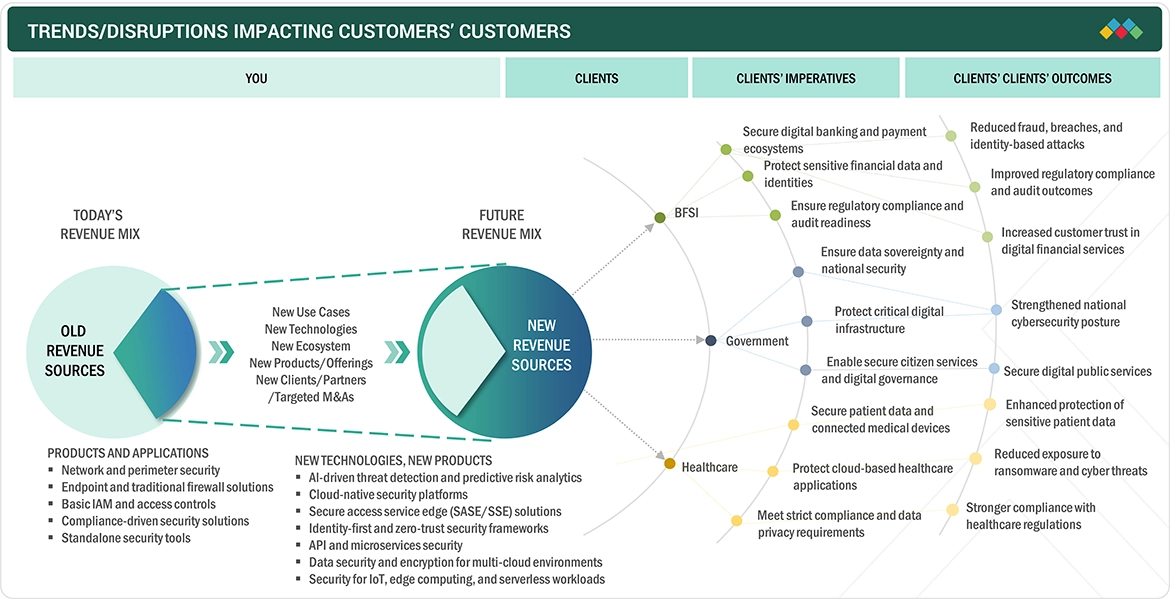
The cloud security industry is evolving from the conventional perimeter security model to a new security ecosystem that incorporates platforms and AI-enabled models tailored to the needs of the dynamic cloud environment. This figure shows that the revenue mix in the cloud security industry is evolving due to an increase in demand for CNAPP, CASB, and zero trust models. It also shows that specific needs within the BFSI, government, and healthcare sectors are driving security investments and resulting in desired outcomes.
Source: Secondary Research, Interviews with Experts, MarketsandMarkets Analysis
MARKET DYNAMICS

Drivers
Impact
Level
-
Increasing adoption of multi-cloud and hybrid cloud environments

-
Growth of DevSecOps and cloud-native development practices


RESTRAINTS
Impact
Level
-
Complexity in managing multi-cloud security environments

-
High implementation and operational costs


OPPORTUNITIES
Impact
Level
-
Adoption of Al-driven and automated cloud security solutions

-
Expansion of cloud computing and digital transformation initiatives


CHALLENGES
Impact
Level
-
Shortage of skilled cloud security professionals

-
Limited visibility and control across distributed cloud environments

Source: Secondary Research, Interviews with Experts, MarketsandMarkets Analysis
Multi-cloud and hybrid environments have become popular to prevent vendor lock-in and improve security and resiliency, driving high demand for security platforms that integrate multiple functions. According to Microsoft, in February 2025, it is important to achieve cross-cloud visibility with security tools such as Defender and Sentinel. Palo Alto Networks reported in October 2024 that its clients have begun consolidating security across AWS, Azure, and Google Cloud.
Managing security in a multi-cloud environment poses several challenges such as fragmentation of visibility, lack of policy consistency, and increased operational burden. According to AWS, in January 2025, users tend to leverage more than one native or third-party solution, creating further complexity in integration. Cisco also emphasized, in June 2024, that security professionals face difficulties owing to siloed information, resulting in delays in threat response and mitigation.
The use of AI technology in security helps detect threats more quickly, prioritize risks and make remediation easier. CrowdStrike mentions that, in March 2025, AI-driven threat detection for cloud threats was greatly reduced by its Falcon platform. The upgrades to Microsoft’s Security Copilot in April 2025 demonstrate the role of generative AI in investigations and the automation of incident response tasks.
The rapid development of cloud technology is creating a shortage of security professionals who can provide cloud-native security, DevSecOps, and AI solutions. For instance, Fortinet, in its 2024 cybersecurity skills gap report, noted a challenge in recruiting cloud security professionals. Similarly, in November 2024, ISC2 revealed that the teams were working under heavier workloads due to the skills shortage and were, therefore, resorting to automation.
CLOUD SECURITY MARKET: COMMERCIAL USE CASES ACROSS INDUSTRIES
| COMPANY | USE CASE DESCRIPTION | BENEFITS |
|---|---|---|
|
|
Capital One adopted AWS native security services, including IAM, GuardDuty, and CloudTrail, to monitor threats, manage access, and ensure compliance across cloud environments. | Secure and seamless remote access | Reduced dependency on traditional VPNs | Improved data protection and compliance | Enhanced user experience and productivity |
|
|
Heineken implemented Microsoft Defender for Cloud and Azure Security Center to provide unified security management and threat protection. | Real-time threat detection and response | Improved workload visibility | Reduced security risks in dynamic environments | Scalable protection aligned with business growth |
|
|
BMW deployed Palo Alto Networks Prisma Cloud and zero-trust solutions to secure workloads, enforce access policies, and monitor cloud environments. | Implementation of zero-trust architecture | Secure access across distributed users and systems | Enhanced workload and data protection | Reduced attack surface |
|
|
Shopify implemented CrowdStrike Falcon Cloud Security to monitor workloads, detect threats, and respond to incidents in real time. | Centralized visibility and control across environments | Improved security posture management |Faster detection of vulnerabilities and threats | Streamlined compliance reporting |
|
|
Siemens adopted Zscaler’s SASE platform to provide secure access, enforce policies, and protect data across cloud applications. | Enhanced visibility across cloud workloads | Improved threat detection and incident response | Strengthened compliance and governance | Reduced risk of data breaches and unauthorized access |





Logos and trademarks shown above are the property of their respective owners. Their use here is for informational and illustrative purposes only.
MARKET ECOSYSTEM
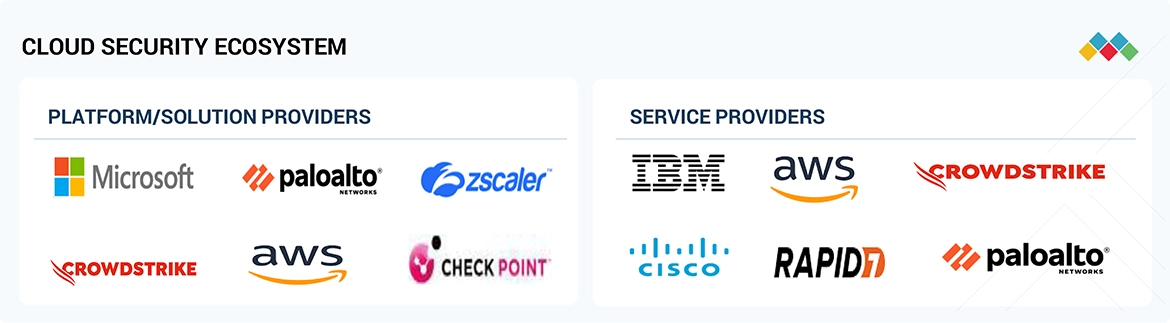
The cloud security ecosystem comprises platform/solution providers and service providers that collaborate to ensure holistic protection in the cloud environment. The solution providers concentrate on building next-generation security solutions such as CNAPP, SSE, and threat management solutions utilizing AI technology, whereas the service providers offer consultancy, integration, and managed security services in addition to the solutions.
Logos and trademarks shown above are the property of their respective owners. Their use here is for informational and illustrative purposes only.
MARKET SEGMENTS
Source: Secondary Research, Interviews with Experts, MarketsandMarkets Analysis
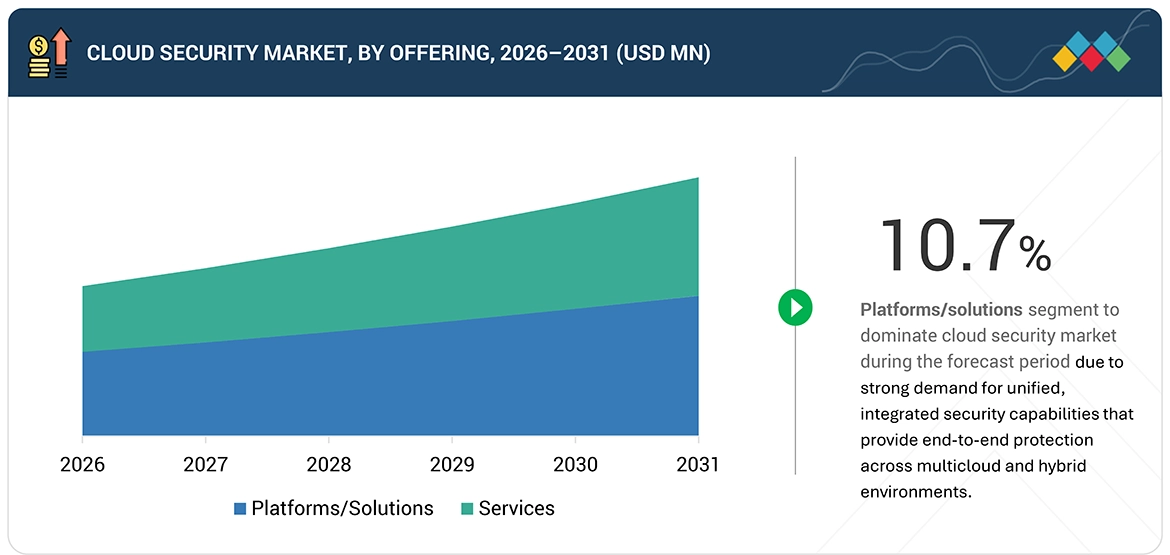
The platforms/solutions segment holds a leading position because companies prefer integrated solutions over separate tools. According to Zscaler, by 2025, companies were expected to adopt a zero-trust architecture and move away from the traditional VPN-based approach. In 2024, Microsoft reported that the adoption of the Defender for Cloud tool was increasing due to its native and AI-based threat detection capabilities.
CNAPP adoption is growing as companies look for end-to-end protection from code development through runtime execution on a single platform. As stated by SentinelOne, in January 2026, major vendors such as Microsoft, Palo Alto Networks, and Wiz are enhancing CNAPP features with agentless visibility and automated compliance. In 2025, Wiz highlighted that clients have shown preference for a single platform that minimizes complexity and prioritizes risks in multi-cloud infrastructures.
The private cloud deployment mode is important in regulated industries that require greater control over critical information. In March 2026, Cisco indicated that companies still run their operations using hybrid clouds, which have both public and private clouds, thus the need to enforce policies uniformly. According to AWS, in 2025, customers started incorporating private cloud controls with public cloud services.
Large organizations are early adopters because of their complex IT infrastructure and heightened risk exposure. Palo Alto Networks claims that by October 2025, enterprise businesses had integrated several security applications into single applications such as Prisma Cloud. In 2024, Zscaler stated that its large-scale customers are fueling its success with an emphasis on secure access and zero-trust solutions.
BFSI emerges as the largest adopter due to the high sensitivity of financial information and stringent regulations. Zscaler reported that by June 2025 financial organizations were expected to leverage AI technologies for threat detection and secure access to counter identity-based attacks. According to Microsoft, in 2024, banks are moving towards cloud-native cybersecurity tools to ensure compliance and safeguard digital payments ecosystems.
REGION
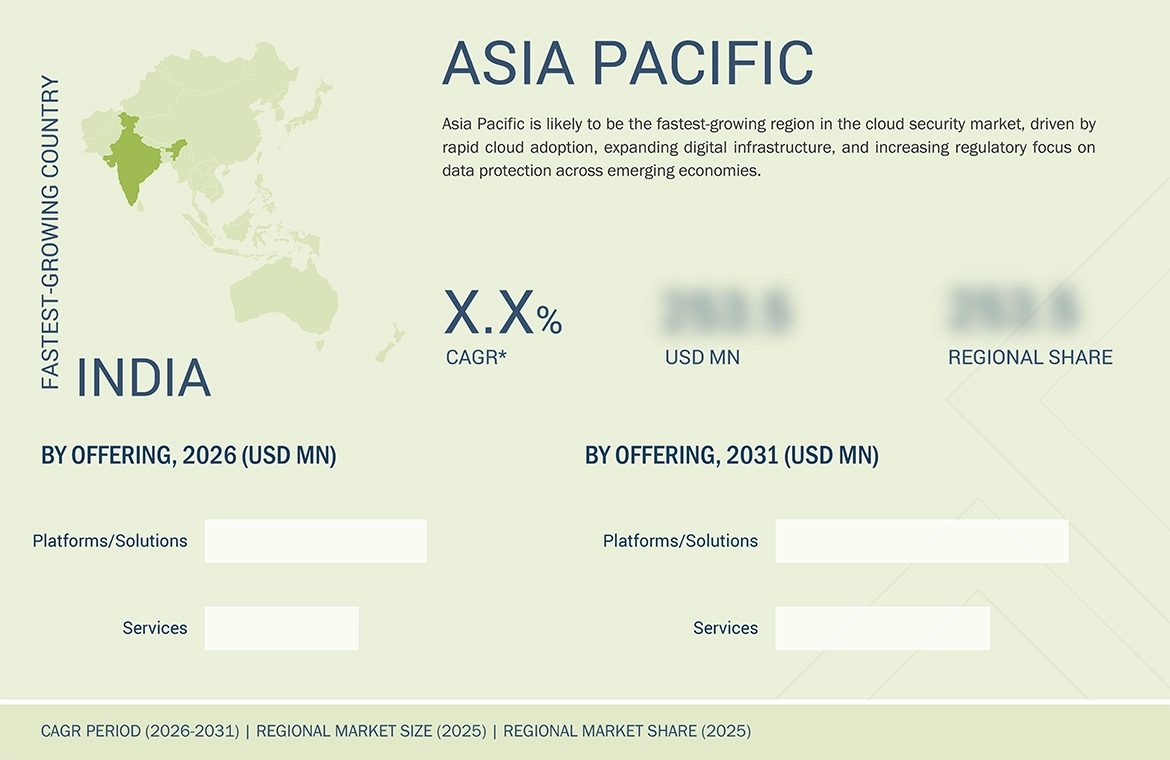
Asia Pacific to be fastest-growing region in global cloud security market during forecast period.
Asia Pacific is likely to be the fastest-growing region in the cloud security market owing to the widespread adoption of cloud computing, digitalization, and cybersecurity regulations in nations such as India, China, and Southeast Asia. According to Amazon Web Services, demand for cloud security services was expected to increase by October 2025 due to the expansion of regional data centers and enterprises migrating to the cloud. In 2024, Microsoft reported that companies in the Asia Pacific region are rapidly adopting security solutions based on artificial intelligence.
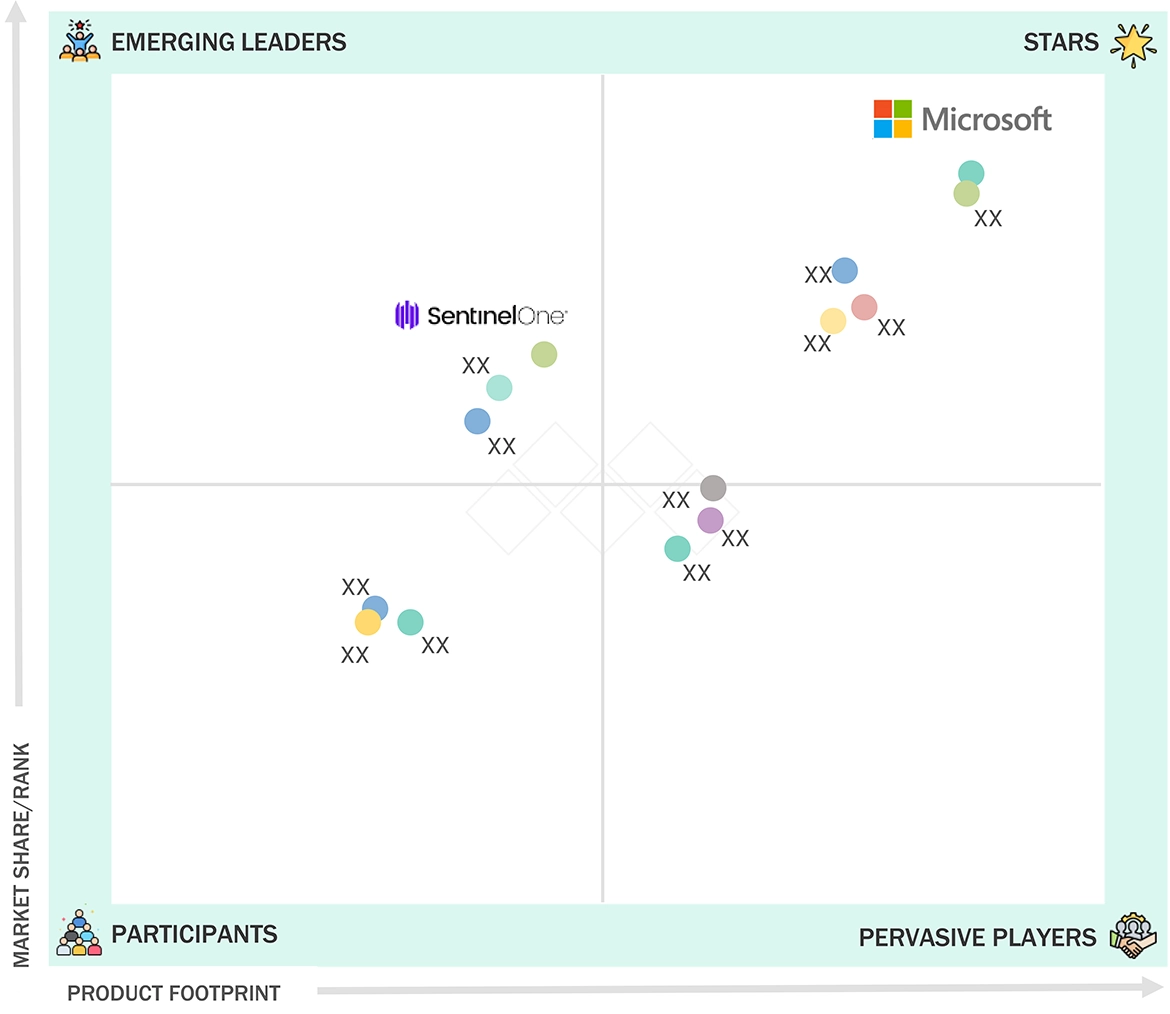
CLOUD SECURITY MARKET: COMPANY EVALUATION MATRIX
Microsoft (Star Player) is a leader in the cloud security market, with its integrated, AI-driven platform spanning Defender, Sentinel, and Entra, providing unified protection across multi-cloud environments. SentinelOne (Emerging Player) is gaining traction with its AI-powered singularity platform, enabling real-time threat detection and autonomous response for cloud workloads.
Source: Secondary Research, Interviews with Experts, MarketsandMarkets Analysis
KEY MARKET PLAYERS
- Microsoft (US)
- AWS (US)
- Palo Alto Networks (US)
- Wiz (US)
- Zscaler (US)
- Fortinet (US)
- Akamai Technologies (US)
- Cloudflare (US)
- IBM (US)
- CrowdStrike (US)
- SentinelOne (US)
- Check Point (Israel)
- Trend Micro (Japan)
- Cisco (US)
- Netskope (US)
MARKET SCOPE
| REPORT METRIC | DETAILS |
|---|---|
| Market Size in 2025 (Value) | USD 30.60 Billion |
| Market Forecast in 2026 (Value) | USD 34.37 Billion |
| Market Forecast in 2031 (Value) | USD 59.34 Billion |
| Growth Rate | CAGR of 11.5% from 2026-2031 |
| Years Considered | 2020-2031 |
| Base Year | 2025 |
| Forecast Period | 2026-2031 |
| Units Considered | Value (USD Billion) |
| Report Coverage | Revenue forecast, company ranking, competitive landscape, growth factors, and trends |
| Segments Covered |
|
| Regions Covered | North America, Europe, Asia Pacific, Middle East & Africa, Latin America |
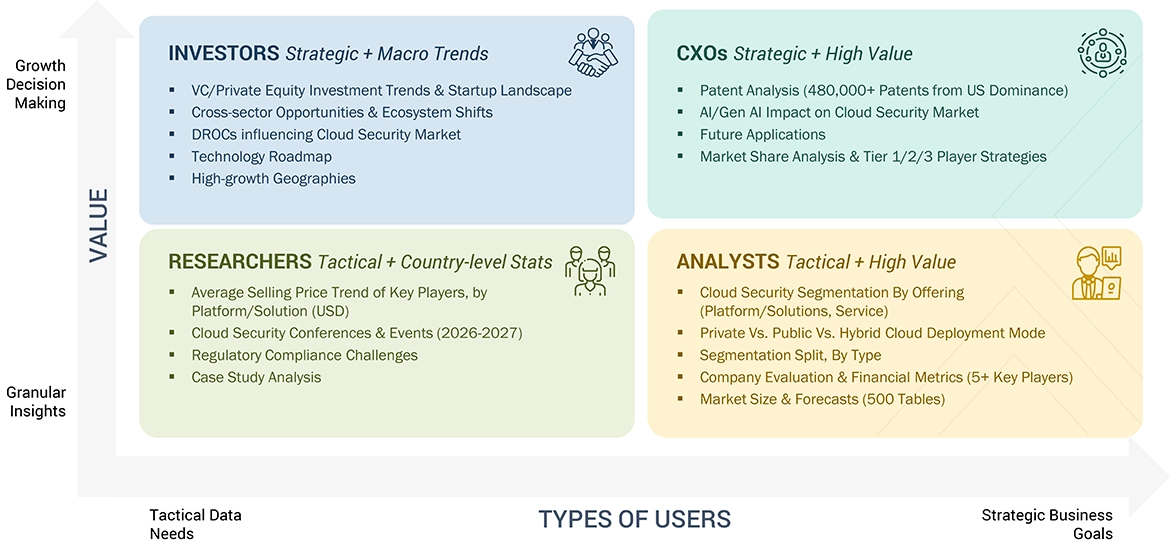
WHAT IS IN IT FOR YOU: CLOUD SECURITY MARKET REPORT CONTENT GUIDE
DELIVERED CUSTOMIZATIONS
We have successfully delivered the following deep-dive customizations:
| CLIENT REQUEST | CUSTOMIZATION DELIVERED | VALUE ADDS |
|---|---|---|
| Leading Solution Provider (US) | Product Analysis: Cloud Security Platform comparison providing an in-depth evaluation of leading vendors’ offerings, including CNAPP, SSE, workload protection, identity security, and threat detection capabilities. The analysis covers AI-driven threat intelligence, runtime protection, multi-cloud and hybrid deployment support, API integrations, scalability, compliance frameworks, and automation capabilities across cloud environments | Stronger understanding of competitive positioning in the cloud security market, with insights into platform capabilities across cloud workloads, identity, and data protection use cases, AI-driven threat detection performance, deployment flexibility, and ecosystem integration, supporting strategic investments, vendor selection, and long-term cloud security transformation strategies |
| Leading Service Provider (EU) | Company Information: Detailed profiling and evaluation of additional cloud security vendors and service providers (up to 5), covering CNAPP platforms, zero-trust solutions, managed security services, cloud risk management, compliance (GDPR and regional regulations), global presence, and strategic partnerships across sectors such as BFSI, government, healthcare, and IT. | Comprehensive perspective of the evolving cloud security landscape, highlighting increasing adoption of zero-trust architectures, growing demand for unified CNAPP platforms, rising importance of AI-driven security operations, and vendor differentiation through automation, real-time visibility, and scalable multi-cloud security solutions |
RECENT DEVELOPMENTS
- April 2026 : Palo Alto Networks expanded its platform by integrating CyberArk capabilities, strengthening privileged access management and identity security across cloud environments to address identity-based attack vectors.
- March 2026 : Microsoft expanded Security Copilot capabilities to support cloud security operations, enabling automated threat investigation, response recommendations, and integration with security analytics tools.
- March 2026 : Palo Alto Networks partnered with NVIDIA to deliver AI-powered security for cloud and AI workloads, integrating real-time threat detection and protection into AI infrastructure environments.
- March 2026 : Cisco completed the acquisition of Splunk to strengthen its cloud security analytics and monitoring capabilities, integrating SIEM, SOAR, and data analytics into its Security Cloud platform for enhanced threat detection and response.
- January 2026 : Zscaler collaborated with CrowdStrike to integrate endpoint security and cloud-delivered zero-trust capabilities, enabling unified threat detection and response across cloud and endpoint environments.
Table of Contents
 Exclusive indicates content/data unique to MarketsandMarkets and not available with any competitors.
TITLE
PAGE NO
1
INTRODUCTION
15
2
EXECUTIVE SUMMARY
3
PREMIUM INSIGHTS
4
MARKET OVERVIEW
(IDENTIFY GROWTH OPPORTUNITIES AND STRATEGIC GAPS IN THE CLOUD SECURITY MARKET)
4.1
INTRODUCTION
4.2
MARKET DYNAMICS
4.2.1
DRIVERS
4.2.2
RESTRAINTS
4.2.3
OPPORTUNITIES
4.2.4
CHALLENGES
4.3
UNMET NEEDS AND WHITE SPACES
4.4
INTERCONNECTED MARKETS AND CROSS-SECTOR OPPORTUNITIES
4.5
STRATEGIC MOVES BY TIER 1/2/3 PLAYERS
5
INDUSTRY TRENDS
(NAVIGATE INDUSTRY SHIFTS WITH STRATEGIC INSIGHTS FROM COMPETITIVE FORCES AND EVOLVING CLOUD SECURITY TRENDS.)
5.1
PORTER’S FIVE FORCES ANALYSIS
5.2
MACROECONOMIC OUTLOOK
5.2.1
INTRODUCTION
5.2.2
GDP TRENDS AND FORECAST
5.2.3
TRENDS IN GLOBAL ICT INDUSTRY MARKET
5.2.4
TRENDS IN CYBERSECURITY MARKET
5.3
VALUE CHAIN ANALYSIS
5.4
ECOSYSTEM ANALYSIS
5.5
PRICING ANALYSIS
5.5.1
AVERAGE SELLING PRICE OF OFFERINGS, BY KEY PLAYER (2026)
5.5.2
INDICATIVE PRICING ANALYSIS OF CLOUD SECURITY PLATFORMS, BY VENDOR (2026)
5.6
KEY CONFERENCES AND EVENTS, 2026–2027
5.7
TRENDS/DISRUPTIONS IMPACTING CUSTOMER BUSINESS
5.8
INVESTMENT AND FUNDING SCENARIO
5.9
CASE STUDY ANALYSIS
5.9.1
CASE STUDY
5.9.2
CASE STUDY
5.9.3
CASE STUDY
5.9.4
CASE STUDY
5.9.5
CASE STUDY
5.10
IMPACT OF 2025 US TARIFF: CLOUD SECURITY MARKET
5.10.1
INTRODUCTION
5.10.2
KEY TARIFF RATES
5.10.3
PRICE IMPACT ANALYSIS
5.10.4
IMPACT ON COUNTRIES/REGIONS
5.10.4.1
US
5.10.4.2
EUROPE
5.10.4.3
ASIA PACIFIC
5.10.5
IMPACT ON END-USE INDUSTRIES
6
TECHNOLOGICAL ADVANCEMENTS, AI-DRIVEN IMPACT, PATENTS, INNOVATIONS, AND FUTURE APPLICATIONS
(HARNESS INNOVATIONS TO REVOLUTIONIZE SOLUTIONS AMID EVOLVING THREAT LANDSCAPES.)
6.1
KEY TECHNOLOGIES/EMERGING TECHNOLOGIES
6.2
COMPLEMENTARY TECHNOLOGIES
6.3
ADJACENT TECHNOLOGIES
6.4
TECHNOLOGY ROADMAP
6.5
PATENT ANALYSIS
6.6
FUTURE APPLICATIONS
6.7
IMPACT OF AI ON CLOUD SECURITY MARKET
6.7.1
TOP USE CASES AND MARKET POTENTIAL
6.7.2
BEST PRACTICES FOLLOWED BY MANUFACTURERS/OEMS IN CLOUD SECURITY MARKET
6.7.3
CASE STUDIES RELATED TO AI IMPLEMENTATION IN CLOUD SECURITY MARKET
6.7.4
INTERCONNECTED ECOSYSTEM AND IMPACT ON MARKET PLAYERS
6.7.5
CLIENTS’ READINESS TO ADOPT AI-INTEGRATED CLOUD SECURITY PLATFORMS/SOLUTIONS
7
REGULATORY LANDSCAPE
(NAVIGATE COMPLEX GLOBAL REGULATIONS WITH A COMPREHENSIVE GUIDE TO REGIONAL COMPLIANCE AND INDUSTRY STANDARDS.)
7.1
REGIONAL REGULATIONS AND COMPLIANCE
7.1.1
REGULATORY BODIES, GOVERNMENT AGENCIES, AND OTHER ORGANIZATIONS
7.1.2
INDUSTRY STANDARDS
8
CUSTOMER LANDSCAPE AND BUYING BEHAVIOR
(UNCOVER HOW STAKEHOLDER DYNAMICS SHAPE PURCHASING DECISIONS AND REVEAL CRITICAL UNMET INDUSTRY NEEDS)
8.1
DECISION-MAKING PROCESS
8.2
KEY STAKEHOLDERS INVOLVED IN BUYING PROCESS AND THEIR EVALUATION CRITERIA
8.2.1
KEY STAKEHOLDERS IN BUYING PROCESS
8.2.2
BUYING CRITERIA
8.3
ADOPTION BARRIERS AND INTERNAL CHALLENGES
8.4
UNMET NEEDS OF VARIOUS VERTICALS
9
CLOUD SECURITY MARKET, BY OFFERING
(MARKET SIZE & FORECAST TO 2031 – IN VALUE, USD MILLION)
(OFFERING-WISE DEMAND POTENTIAL AND GROWTH PATHWAYS SHAPING CLOUD SECURITY ADOPTION ACROSS INDUSTRIES)
9.1
INTRODUCTION
9.1.1
OFFERING: CLOUD SECURITY MARKET DRIVERS
9.2
PLATFORMS/SOLUTIONS
9.3
SERVICES
9.3.1
PROFESSIONAL SERVICES
9.3.1.1
CONSULTING & ADVISORY
9.3.1.2
INTEGRATION & DEPLOYMENT
9.3.1.3
TRAINING & EDUCATION
9.3.1.4
SUPPORT & MAINTENANCE
9.3.2
MANAGED SERVICES
10
CLOUD SECURITY MARKET, BY TYPE (MARKET SIZE & FORECAST TO 2031 – IN VALUE, USD MILLION)
(TYPE-WISE DEMAND POTENTIAL AND GROWTH PATHWAYS SHAPING CLOUD SECURITY ADOPTION ACROSS INDUSTRIES)
10.1
INTRODUCTION
10.1.1
TYPE: CLOUD SECURITY MARKET DRIVERS
10.2
CLOUD-NATIVE SECURITY PLATFORMS (CNAPP)
10.2.1
CLOUD SECURITY POSTURE MANAGEMENT (CSPM)
10.2.2
CLOUD WORKLOAD PROTECTION PLATFORM (CWPP)
10.2.3
CLOUD INFRASTRUCTURE ENTITLEMENT MANAGEMENT (CIEM)
10.2.4
CLOUD DETECTION & RESPONSE (CDR)
10.2.5
KUBERNETES SECURITY POSTURE MANAGEMENT (KSPM)
10.2.6
INFRASTRUCTURE AS CODE (IAC) SECURITY
10.2.7
OTHERS (DSPM, API SECURITY INTEGRATION, SAST, SCA, ATTACK PATH ANALYSIS)
10.3
CLOUD ACCESS SECURITY BROKER (CASB)
10.4
ANALYTICS & MONITORING
11
CLOUD SECURITY MARKET, BY DEPLOYMENT MODE
(MARKET SIZE & FORECAST TO 2031 – IN VALUE, USD MILLION)
(DEPLOYMENT MODE-WISE DEMAND POTENTIAL AND GROWTH PATHWAYS SHAPING CLOUD SECURITY ADOPTION IN DIVERSE INDUSTRIES)
11.1
INTRODUCTION
11.1.1
DEPLOYMENT MODE: CLOUD SECURITY MARKET DRIVERS
11.2
PUBLIC CLOUD
11.3
PRIVATE CLOUD
11.4
HYBRID CLOUD
12
CLOUD SECURITY MARKET, BY ORGANIZATION SIZE
(MARKET SIZE & FORECAST TO 2031 – IN VALUE, USD MILLION)
(ORGANIZATION SIZE-WISE DEMAND POTENTIAL AND GROWTH PATHWAYS SHAPING CLOUD SECURITY ADOPTION IN DIVERSE INDUSTRIES)
12.1
INTRODUCTION
12.1.1
ORGANIZATION SIZE: CLOUD SECURITY MARKET DRIVERS
12.2
LARGE ENTERPRISES
12.3
SMALL AND MEDIUM-SIZED ENTERPRISES (SMES)
13
CLOUD SECURITY MARKET, BY VERTICAL
(MARKET SIZE & FORECAST TO 2031 – IN VALUE, USD MILLION)
(VERTICAL-SPECIFIC ADOPTION DRIVERS, DEMAND, DYNAMICS, AND MARKET POTENTIAL ACROSS EACH VERTICAL)
13.1
INTRODUCTION
13.1.1
VERTICAL: CLOUD SECURITY MARKET DRIVERS
13.2
BANKING, FINANCIAL SERVICES AND INSURANCE (BFSI)
13.3
HEALTHCARE & LIFE SCIENCES
13.4
IT & TELECOMMUNICATIONS
13.5
GOVERNMENT & DEFENSE
13.6
RETAIL & E-COMMERCE
13.7
MANUFACTURING
13.8
ENERGY & UTILITIES
13.9
MEDIA & ENTERTAINMENT
13.10
TRANSPORTATION & LOGISTICS
13.11
TRAVEL & HOSPITALITY
13.12
OTHER VERTICALS
14
CLOUD SECURITY MARKET, BY REGION
(MARKET SIZE & FORECAST TO 2032 – IN VALUE, USD MILLION)
14.1
INTRODUCTION
14.2
NORTH AMERICA
14.2.1
NORTH AMERICA: CLOUD SECURITY MARKET DRIVERS
14.2.2
UNITED STATES (US)
14.2.3
CANADA
14.3
EUROPE
14.3.1
EUROPE: CLOUD SECURITY MARKET DRIVERS
14.3.2
UNITED KINGDOM (UK)
14.3.3
GERMANY
14.3.4
FRANCE
14.3.5
ITALY
14.3.6
REST OF EUROPE
14.4
ASIA PACIFIC
14.4.1
ASIA PACIFIC: CLOUD SECURITY MARKET DRIVERS
14.4.2
CHINA
14.4.3
JAPAN
14.4.4
INDIA
14.4.5
AUSTRALIA
14.4.6
REST OF ASIA PACIFIC
14.5
MIDDLE EAST & AFRICA (MEA)
14.5.1
MIDDLE EAST & AFRICA: CLOUD SECURITY MARKET DRIVERS
14.5.1.1
GCC
14.5.1.1.1
SAUDI ARABIA
14.5.1.1.2
UAE
14.5.1.1.3
REST OF GCC
14.5.1.2
SOUTH AFRICA
14.5.1.3
REST OF MEA
14.6
LATIN AMERICA (LATAM)
14.6.1
LATIN AMERICA: CLOUD SECURITY MARKET DRIVERS
14.6.2
BRAZIL
14.6.3
MEXICO
14.6.4
REST OF LATAM
15
COMPETITIVE LANDSCAPE
(STRATEGIC ASSESSMENT OF LEADING PLAYERS, MARKET SHARE, REVENUE ANALYSIS, COMPANY POSITIONING, AND COMPETITIVE BENCHMARKING INFLUENCING MARKET POTENTIAL)
15.1
OVERVIEW
15.2
KEY PLAYER COMPETITIVE STRATEGIES/RIGHT TO WIN, 2024-2026
15.3
REVENUE ANALYSIS, 2021-2025
15.4
MARKET SHARE ANALYSIS,
15.5
BRAND COMPARISON,
15.6
COMPANY VALUATION AND FINANCIAL METRICS,
15.7
COMPANY EVALUATION MATRIX: KEY PLAYERS,
15.7.1
STARS
15.7.2
EMERGING LEADERS
15.7.3
PERVASIVE PLAYERS
15.7.4
PARTICIPANTS
15.7.5
COMPANY FOOTPRINT: KEY PLAYERS,
15.7.5.1
COMPANY FOOTPRINT
15.7.5.2
REGION FOOTPRINT
15.7.5.3
OFFERING FOOTPRINT
15.7.5.4
TYPE FOOTPRINT
15.7.5.5
VERTICAL FOOTPRINT
15.8
COMPANY EVALUATION MATRIX: STARTUPS/SMES,
15.8.1
PROGRESSIVE COMPANIES
15.8.2
RESPONSIVE COMPANIES
15.8.3
DYNAMIC COMPANIES
15.8.4
STARTING BLOCKS
15.8.5
COMPETITIVE BENCHMARKING: STARTUPS/SMES,
15.8.5.1
DETAILED LIST OF KEY STARTUPS/SMES
15.8.5.2
COMPETITIVE BENCHMARKING OF KEY STARTUPS/SMES
15.9
COMPETITIVE SCENARIO
15.9.1
PRODUCT LAUNCHES
15.9.2
DEALS
15.9.3
EXPANSIONS
16
COMPANY PROFILES
(IN-DEPTH REVIEW OF COMPANIES, PRODUCTS, SERVICES, RECENT INITIATIVES, AND POSITIONING STRATEGIES IN THE CLOUD SECURITY MARKET LANDSCAPE)
16.1
KEY PLAYERS
16.1.1
MICROSOFT
16.1.2
PALO ALTO NETWORKS
16.1.3
WIZ (GOOGLE)
16.1.4
AWS
16.1.5
ZSCALER
16.1.6
FORTINET
16.1.7
AKAMAI
16.1.8
CLOUDFLARE
16.1.9
IBM
16.1.10
CROWDSTRIKE
16.1.11
SENTINELONE
16.1.12
CHECK POINT
16.1.13
TREND MICRO
16.1.14
CISCO
16.2
NETSKOPEOTHER KEY PLAYERS
16.2.1
ORCA SECURITY
16.2.2
SYSDIG
16.2.3
QUALYS
16.2.4
TENABLE
16.2.5
RAPID7
16.2.6
MENLO SECURITY
16.2.7
AQUA SECURITY
16.2.8
SECPOD
16.2.9
PLEXICUS
16.2.10
UPWIND SECURITY
17
RESEARCH METHODOLOGY
17.1
RESEARCH DATA
17.1.1
SECONDARY DATA
17.1.1.1
KEY DATA FROM SECONDARY SOURCES
17.1.1.2
LIST OF KEY SECONDARY SOURCES
17.1.2
PRIMARY DATA
17.1.2.1
KEY DATA FROM PRIMARY SOURCES
17.1.2.2
KEY PRIMARY PARTICIPANTS
17.1.2.3
BREAKDOWN OF PRIMARY INTERVIEWS
17.1.2.4
KEY INDUSTRY INSIGHTS
17.2
MARKET SIZE ESTIMATION
17.2.1
BOTTOM-UP APPROACH
17.2.2
TOP-DOWN APPROACH
17.2.3
MARKET SIZE CALCULATION FOR BASE YEAR
17.3
MARKET FORECAST APPROACH
17.3.1
SUPPLY SIDE
17.3.2
DEMAND SIDE
17.4
DATA TRIANGULATION
17.5
FACTOR ANALYSIS
17.6
RESEARCH ASSUMPTIONS
17.7
RESEARCH LIMITATIONS
17.8
RISK ASSESSMENT
18
APPENDIX
18.1
DISCUSSION GUIDE
18.2
KNOWLEDGE STORE: MARKETSANDMARKETS’ SUBSCRIPTION PORTAL
18.3
CUSTOMIZATION OPTIONS
18.4
RELATED REPORTS
18.5
AUTHOR DETAILS
Methodology
Secondary research was conducted to collect information useful for this technical, market-oriented, and commercial study of the cloud security market. The next step involved validating these findings, assumptions, and sizing with industry experts across the value chain using primary research. Different approaches, including top-down and bottom-up methods, were employed to estimate the total market size. After that, the market breakup and data triangulation procedures were used to estimate the market size of the segments and subsegments of the cloud security market.
Secondary Research
During the secondary research process, various secondary sources were consulted to identify and collect information relevant to the study. The secondary sources included annual reports, press releases, investor presentations of cloud security vendors, forums, certified publications, and whitepapers. The secondary research was mainly used to obtain key information about the industry’s supply chain, the total pool of key players, market classification and segmentation according to industry trends to the bottom-most level, regional markets, and key developments from both market- and technology-oriented perspectives, all of which were further validated by primary sources.
Primary Research
In the primary research process, various primary sources from both the supply and demand sides were interviewed to obtain qualitative and quantitative information for this report. The primary sources from the supply side included industry experts such as chief executive officers (CEOs), vice presidents (VPs), marketing directors, technology and innovation directors, and other key executives from major companies and organizations operating in the cloud security market.
In the market engineering process, top-down and bottom-up approaches were extensively used, along with several data triangulation methods, to estimate and forecast the overall market segments and subsegments listed in this report. Extensive qualitative and quantitative analyses were performed on the complete market engineering process to present key information/insights throughout the report.
After the complete market engineering process (including calculations for market statistics, market breakups, market size estimates, market forecasts, and data triangulation), extensive primary research was conducted to gather information and verify & validate the derived critical numbers. The primary research was also conducted to identify the segmentation types, industry trends, competitive landscape of cloud security market players, and key market dynamics, such as drivers, restraints, opportunities, challenges, and key strategies.
Following is the breakup of the primary study:

Note: Tier 1 companies receive revenues higher than USD 10 billion; Tier 2 companies' revenues range between USD 1 and 10 billion; and Tier 3 companies' revenues range between USD 500 million and USD 1 billion. Other designations include sales, marketing, and product managers.
To know about the assumptions considered for the study, download the pdf brochure
Market Size Estimation
Top-down and bottom-up approaches were employed to estimate and validate the size of the cloud security market and of various dependent subsegments within it. The research methodology used to estimate the market size includes the following: critical players in the market were identified through secondary research, and their market shares in the respective regions were determined through both primary and secondary research. This procedure involved analyzing the annual and financial reports of the top market players and conducting extensive interviews with key industry leaders, including CEOs, VPs, directors, and marketing executives, to gather valuable insights.
All percentage splits and breakdowns were determined using secondary sources and verified through primary sources. All parameters that affect the market covered in this study were accounted for, examined in detail, verified through primary research, and analyzed to obtain final quantitative and qualitative data. This data was consolidated with detailed inputs and analysis from MarketsandMarkets.
Cloud Security Market : Top-Down and Bottom-Up Approach

Data Triangulation
The market was divided into several segments and subsegments after determining the overall market size using the market size estimation processes explained above. Data triangulation and market breakup procedures were employed, where applicable, to complete the overall market engineering process and arrive at the exact statistics for each market segment and subsegment. The data was triangulated by studying various factors and trends from both the demand and supply sides.
Market Definition
According to MarketsandMarkets, “The cloud security market refers to the segment of the cybersecurity industry that includes platforms/solutions and services designed to secure cloud-based infrastructure and data across public, private, and hybrid environments. As organizations increasingly adopt cloud computing to support digital transformation, the need to protect distributed and dynamic cloud environments from evolving cyber threats has become a critical priority.
The market primarily includes security solutions such as Cloud-Native Application Protection Platforms (CNAPP) and Cloud Access Security Broker (CASB). Cloud security encompasses a broad set of capabilities for securing cloud workloads, managing access to applications and resources, protecting sensitive data, and enabling continuous monitoring and threat detection. These capabilities are designed to address cloud-specific risks, including configuration vulnerabilities, unauthorized access, data exposure, and application-layer threats, arising from the shared responsibility model and the highly dynamic nature of cloud environments. Security is increasingly embedded across the cloud lifecycle, from development and deployment to runtime operations.
In addition to technology solutions, the market includes services that support the design, implementation, and ongoing management of cloud security environments. Organizations are leveraging external expertise to integrate security into cloud architectures, ensure regulatory compliance and maintain continuous visibility and control across multi-cloud environments. These services play a key role in addressing skill gaps and operational complexities associated with cloud security.
Key Stakeholders
- Chief technology and data officers
- Cloud security professionals
- Business analysts
- Information technology (IT) professionals
- Government agencies
- Investors and venture capitalists
- Small and medium-sized enterprises (SMEs) and large enterprises
- Third-party service providers
- Consultants/consultancies/advisory firms
- Managed and professional service providers
- The study categorizes the cloud security market by offering, type, organization size, deployment mode, vertical, and region.
Report Objectives
- To describe and forecast the cloud security market by offering, type, deployment mode, organization size, vertical, and region, as well as analyze the various macroeconomic and microeconomic factors that affect market growth
- To forecast the market size of five major regions: North America, Europe, Asia Pacific, the Middle East & Africa, and Latin America
- To analyze the subsegments of the market concerning individual growth trends, prospects, and contributions to the overall market
- To provide detailed information related to the primary factors (drivers, restraints, opportunities, and challenges) influencing the growth of the cloud security market.
- To analyze opportunities in the market for stakeholders by identifying high-growth segments of the cloud security market
- To profile the key players of the cloud security market and comprehensively analyze their market size and core competencies
- To analyze competitive developments, such as product launches, mergers and acquisitions, partnerships, agreements, and collaborations in the global cloud security market
Available customizations:
With the given market data, MarketsandMarkets offers customizations based on company-specific needs. The following customization options are available for the report:
Reginal Analysis
- Further breakdown of the Asia Pacific market, by country, contributes to the regional market size.
- Further breakdown of the North American market, by country, contributes to the regional market size.
- Further breakdown of the Latin American market, by country, contributes to the regional market size.
- Further breakdown of the Middle Eastern & African market by country contributes to the regional market size.
- Further breakdown of the European market by country contributes to the regional market size.
Company Information
- Detailed analysis and profiling of additional market players (up to 5)
⚡ Growth Signals
Personalize This Research
- Triangulate with your Own Data
- Get Data as per your Format and Definition
- Gain a Deeper Dive on a Specific Application, Geography, Customer or Competitor
- Any level of Personalization
Let Us Help You
- What are the Known and Unknown Adjacencies Impacting the Cloud Security Market
- What will your New Revenue Sources be?
- Who will be your Top Customer; what will make them switch?
- Defend your Market Share or Win Competitors
- Get a Scorecard for Target Partners

Leading IT Company in US
The research and discussions with the MarketsandMarkets team were insightful and influential towards driving our team's strategic direction. After engaging with the analyst team, we were able to have focused use cases, a targeted market segment, and strategic partners to consider as part of our GTM. The insights shared by MarketsandMarkets captured some useful information that we could leverage to develop our point of view for the next steps. The market reports were a great start for the project, but the analyst hours made a rough diamond turn into a polished gem of a project

Still Researching the
Cloud Security Ecosystem?
See the competitors, opportunity evaluation, and growth signals shaping it - Instantly!
Generate 15+ consulting-grade strategic intelligence outputs - from competitor analysis to board-ready strategy decks, tailored to your Cloud Security growth question.
