







- DESCRIPTION
- TABLE OF CONTENTS
- METHODOLOGY
- DOWNLOAD PDF
Low-speed Vehicle Market by Vehicle Type (Golf Cart, Commercial Turf Utility, Industrial Utility, Personal), Power Output (<5, 5-8, 9-15, >15 kW), Motor Type & Configuration, Battery, Propulsion, Category, Application, Voltage - Global Forecast to 2035

USD 19.17 BN
MARKET SIZE, 2035

CAGR 5.5%
(2026-2035)

350
REPORT PAGES

300
MARKET TABLES
OVERVIEW
Source: Secondary Research, Interviews with Experts, MarketsandMarkets Analysis
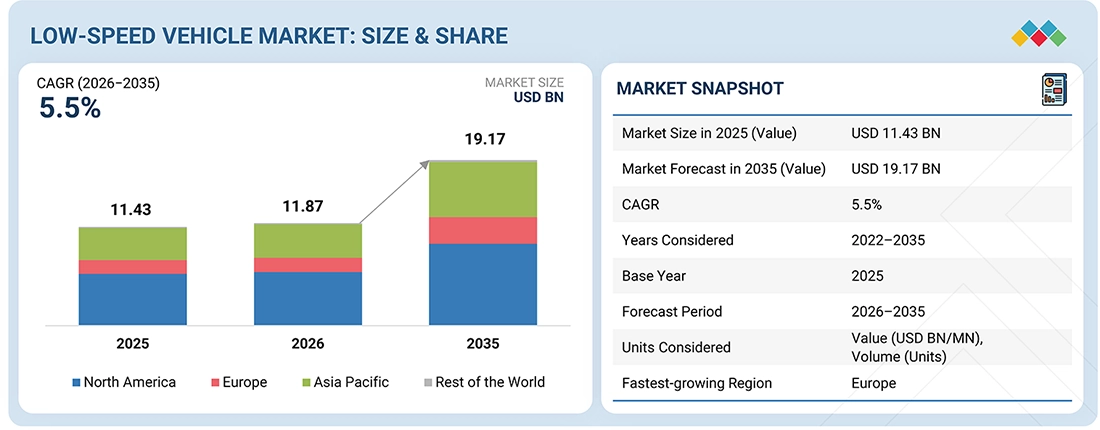
The low-speed vehicle market is expected to reach USD 19.17 billion by 2035, from USD 11.87 billion in 2026, with a CAGR of 5.5%. Growth is driven by stricter emission regulations and rising demand for cost-efficient short-distance mobility solutions across urban and semi-urban environments. Increasing electrification and government support for low-speed electric vehicles are further accelerating adoption across commercial and personal use cases. North America leads the market, supported by strong demand from golf courses, where vehicles are widely used for course operations and player mobility, alongside adoption in gated communities and campuses, followed by Asia Pacific, with rising adoption in countries such as China, Japan, Thailand, and India, driven by urban congestion and demand for affordable electric mobility. Europe is the fastest-growing region due to tightening emissions norms and expanding quadricycle frameworks, which are enabling broader use of low-speed vehicles across urban transport and shared mobility applications.
KEY TAKEAWAYS
-
BY VEHICLE TYPE
Commercial turf utility vehicles are expected to dominate the market during the forecast period.
-
BY
The electric segment is expected to lead the market during the forecast period.
-
PROPULSION
-
BY APPLICATION
Airports are expected to record the highest CAGR of 7.7% during the forecast period.
-
BY POWER OUTPUT
The >15 kW segment is expected to grow at the fastest rate during the forecast period.
-
BY VOLTAGE
The <60 V segment is estimated to dominate the market, with a 70% share in 2026.
-
COMPETITIVE LANDSCAPE
Key players such as Textron Inc. (US), Yamaha Motor Co., Ltd. (Japan), Deere & Company (US), The Toro Company (US), and Kubota Corporation (Japan) are focusing on expanding low-speed electric vehicle portfolios, improving battery efficiency, and strengthening offerings across golf, turf, and utility applications.
Low-speed vehicles are growing due to rising demand for short-distance, low-cost mobility across tourism, golf courses, campuses, and industrial facilities, supported by electrification, low operating costs, and favorable regulations for low-speed environments.
TRENDS & DISRUPTIONS IMPACTING CUSTOMERS' CUSTOMERS
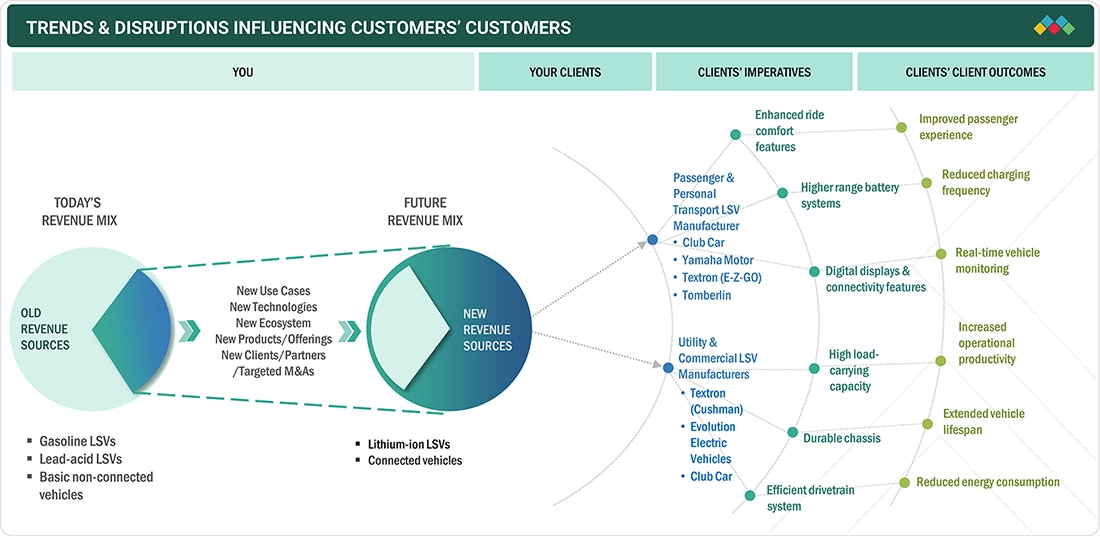
The low-speed vehicle market is transitioning from a traditionally simple, cost-driven model toward more efficient, feature-rich offerings. Earlier, revenue was largely driven by lead-acid battery-based vehicles with basic, standalone operation and minimal electronic integration. However, the market is gradually shifting toward lithium-ion-powered low-speed vehicles with improved diagnostics and basic connectivity features. This transition reflects a growing focus on reducing maintenance, improving vehicle performance, and enhancing operational visibility for fleet-based users, while maintaining the segment's cost sensitivity.
Source: Secondary Research, Interviews with Experts, MarketsandMarkets Analysis
MARKET DYNAMICS

Drivers
Impact
Level
-
Increasing adoption of low-speed vehicles in controlled environments

-
Shift toward electric and lightweight platforms for short-range mobility


RESTRAINTS
Impact
Level
-
Higher cost of low-speed vehicles compared to conventional utility vehicles

-
Restricted road access due to speed limits and regulatory changes across regions


OPPORTUNITIES
Impact
Level
-
Growing use of low-speed vehicles in large-scale residential developments and private low-speed zones

-
Integration of autonomous and connected technologies in low-speed vehicles


CHALLENGES
Impact
Level
-
Substantial cost of batteries

-
Competitive pressure from Chinese manufacturers

Source: Secondary Research, Interviews with Experts, MarketsandMarkets Analysis
Low-speed vehicles have evolved from basic electric golf carts to specialized platforms for short-distance mobility. Modern designs incorporate lithium-ion batteries, lightweight materials, and compact drivetrains to reduce operating costs and comply with stricter urban regulations. Advances in battery technology extend longevity, reduce maintenance, and improve performance in stop-and-go conditions, making these vehicles ideal for campuses, resorts, and industrial settings. Dedicated components tailored to specific use cases further enhance functionality. For example, Tropos Motors’ ABLE platform is a versatile electric vehicle designed for a range of commercial applications.
Low-speed vehicles operate under strict regulatory limits, such as the 25 mph cap in the US (FMVSS 500) and quadricycle regulations in Europe, which restrict speed, power, and use. While these frameworks enable simpler, cost-effective designs, they also confine low-speed vehicles to limited operating environments, such as campuses, gated areas, and designated low-speed zones. This creates scalability challenges, as low-speed vehicles cannot be widely used in mixed traffic, resulting in limited route coverage, operational inefficiencies, and dependence on local regulations, which limit their expansion as a mainstream mobility solution.
Low-speed vehicles have been used in gated communities and villages with privately managed internal roads and low speed limits. Over time, newer residential developments, especially in North America and parts of Europe, have begun integrating mobility planning into their design, including narrower roads, dedicated cart paths, and charging access for electric vehicles. This has shifted low-speed vehicles from an optional convenience to a planned mode of transport within these communities. Developers are increasingly aligning infrastructure, such as parking layouts, charging points, and access routes, to support short-distance electric mobility within the development itself.
Low-speed electric vehicles in China have evolved differently from those in regulated markets like the US and Europe, with manufacturers focusing on low-cost, basic vehicles with simpler designs and minimal safety features. This enables significantly lower pricing, allowing Chinese OEMs to target price-sensitive domestic and export markets. As a result, established low-speed vehicle manufacturers face challenges in cost-driven segments, where strict regulatory compliance increases production costs, making it difficult to compete with lower-priced alternatives despite differences in quality, certification, and aftersales support.
LOW SPEED VEHICLE MARKET SIZE, SHARE & ANALYSIS: COMMERCIAL USE CASES ACROSS INDUSTRIES
| COMPANY | USE CASE DESCRIPTION | BENEFITS |
|---|---|---|
|
|
Deploys electric low-speed vehicles such as E-Z-GO and Cushman across golf courses, resorts, and industrial facilities, with focus on lithium-ion platforms and connected fleet management systems. | Lowers operating and maintenance costs, improves fleet uptime through remote diagnostics, and enables quiet zero-emission operations in regulated environments. |
|
|
Supplies electric golf cars and utility low-speed vehicles in golf, hospitality, and large private facilities, with emphasis on energy-efficient drivetrains and durable battery systems. | Delivers reliable daily operations, reduces energy consumption, extends vehicle lifecycle, and improves user experience in leisure and commercial settings. |
|
|
Integrates Gator utility low-speed vehicles into golf course maintenance, turf care, and municipal operations, aligned with its broader precision turf and equipment ecosystem. | Enhances workforce productivity, reduces fuel and servicing needs, and enables efficient transport of equipment and personnel across large operational areas. |
|
|
Offers Workman electric utility vehicles across golf courses, sports venues, and commercial landscapes, often used alongside Toro turf equipment systems. | Supports low noise operations, improves task efficiency, and helps customers meet sustainability goals in commercial environments. |




Logos and trademarks shown above are the property of their respective owners. Their use here is for informational and illustrative purposes only.
MARKET ECOSYSTEM
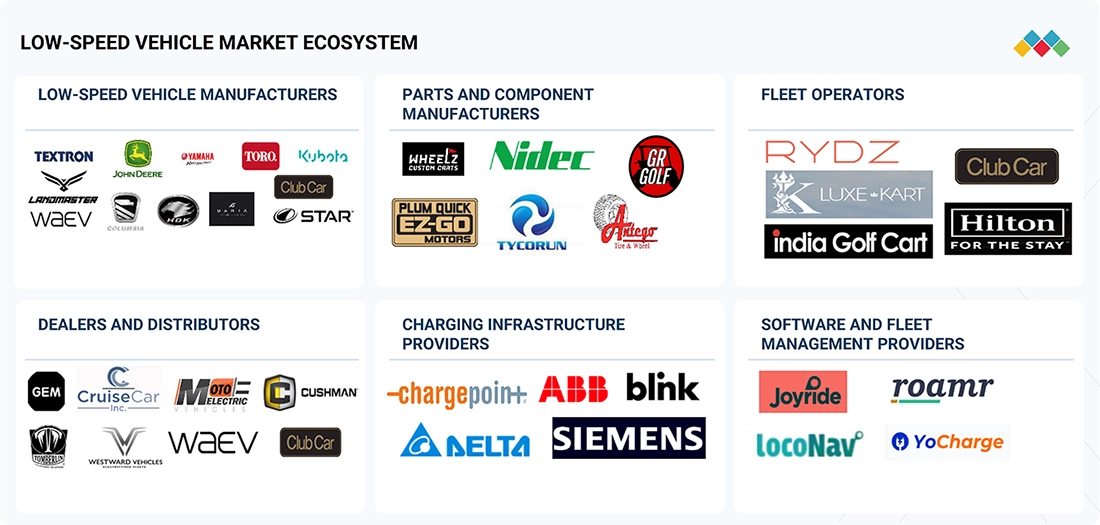
The ecosystem analysis highlights various players in the low-speed vehicle market, including low-speed vehicle manufacturers, dealers, distributors, and part & component manufacturers, each contributing to the development and delivery of innovative solutions. The leading players in the low-speed vehicle market are Textron Inc., Yamaha Motor Co., Ltd., Deere & Company, The Toro Company, and Kubota Corporation, among others.
Logos and trademarks shown above are the property of their respective owners. Their use here is for informational and illustrative purposes only.
MARKET SEGMENTS
Source: Secondary Research, Interviews with Experts, MarketsandMarkets Analysis
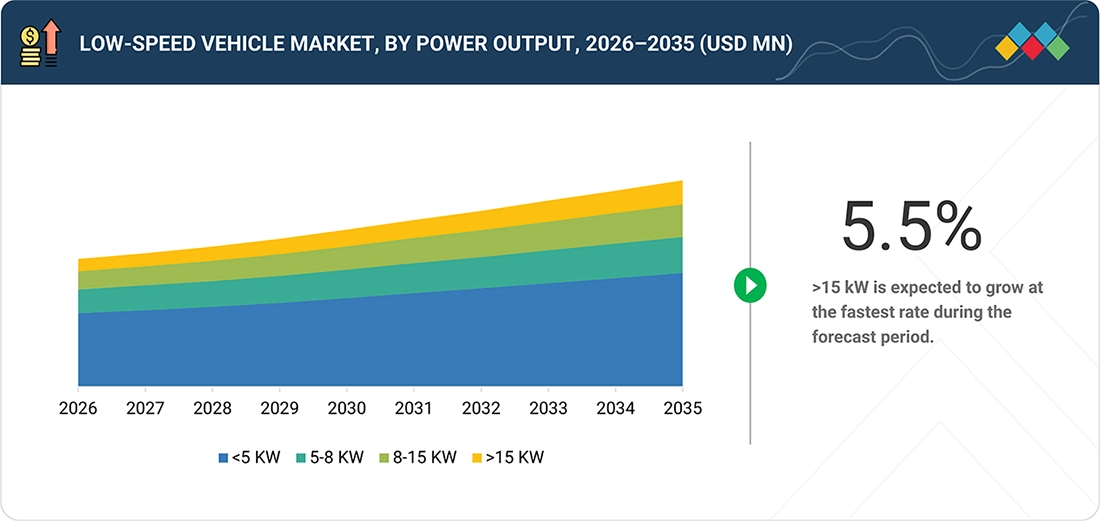
The >15 kW segment is expected to lead the low-speed vehicle market, driven by demand for higher payload capacity and multi-passenger applications in commercial settings. These vehicles are well suited for towing, hill climbing, and continuous duty cycles, supported by improvements in motor efficiency and battery systems. OEMs such as Deere & Company (Gator series) offer models in this range, enabling better productivity and versatility across utility-intensive applications.
The 61–100V segment is expected to register the fastest growth during the forecast period. This voltage range strikes an optimal balance between power delivery and energy efficiency, making it suitable for applications such as multi-passenger transport, light cargo movement, and continuous-duty cycles across campuses, resorts, and municipal fleets. There is increasing standardization of higher-voltage architectures to enable better torque output, faster charging, and improved thermal management compared to traditional lower-voltage systems. Additionally, operators are adopting these systems to reduce energy losses and extend the operating range per charge, thereby supporting fleet productivity and lowering the total cost of ownership.
REGION
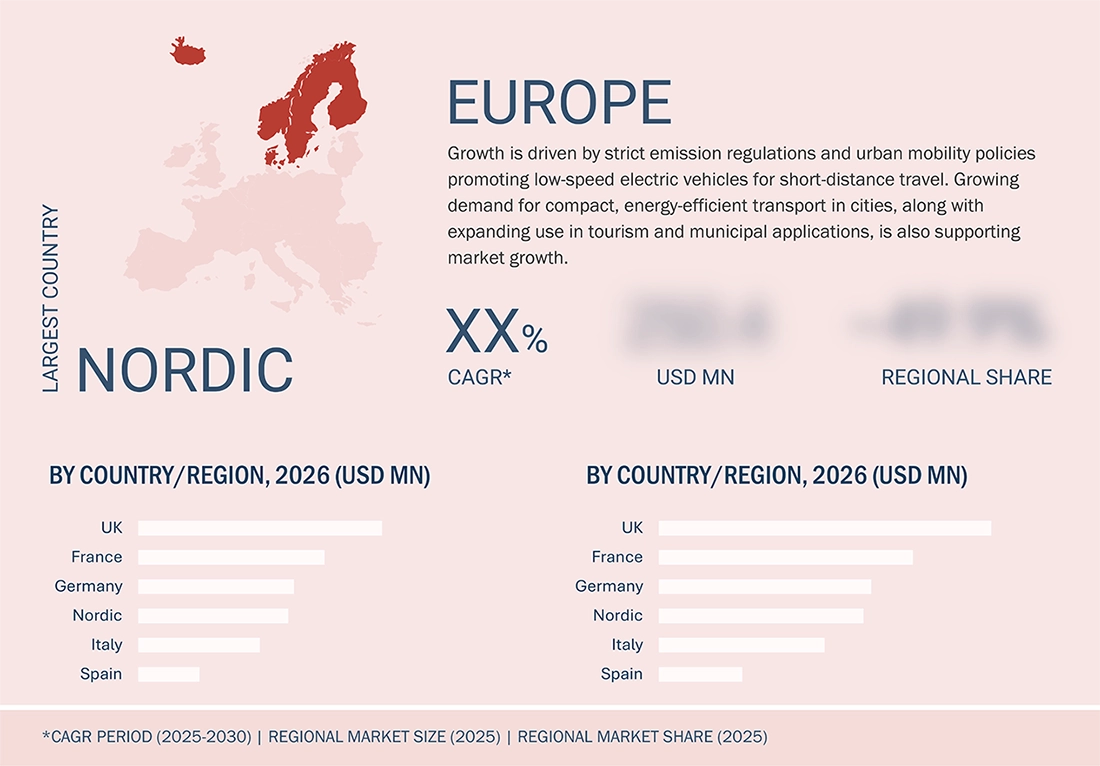
Europe is expected to be the fastest-growing region in the global low-speed vehicle market during the forecast period.
In Europe, the low-speed vehicle market is increasingly shaped by application-specific demand, with golf carts holding the largest share. This trend is driven by the growing number of golf courses, tournaments, and tourism-linked recreational activities, particularly in the UK, Spain, and France. Golf carts are followed by turf utility vehicles and industrial low-speed vehicles, which are widely used for maintenance, facility operations, and logistics across resorts, airports, and commercial sites. Regulatory support under the L6e and L7e classifications continues to enable adoption through simplified homologation and access benefits in urban areas. Additionally, low-emission zones and urban access regulations are supporting the use of compact electric vehicles for short-distance mobility. Overall, demand is increasingly driven by end-use applications and operational needs, with golf carts leading, followed by utility and industrial vehicles.
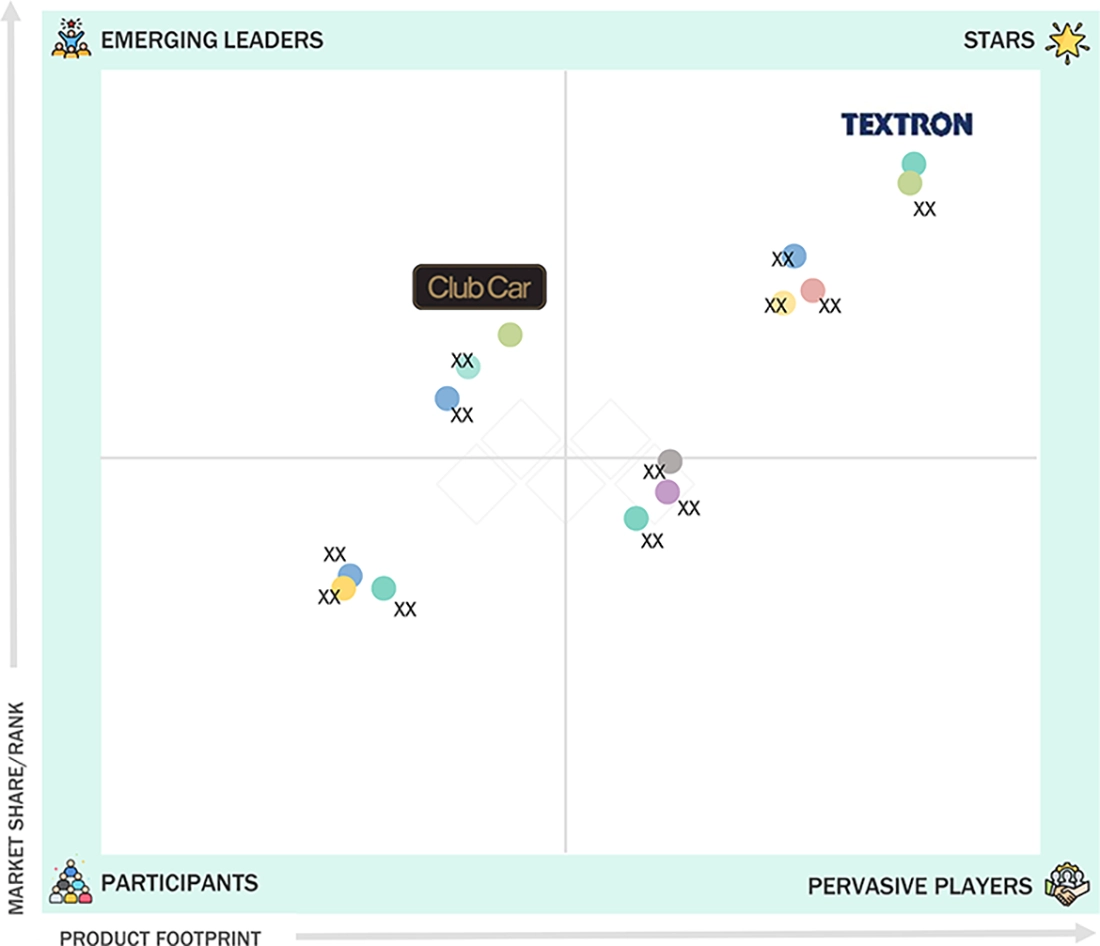
LOW SPEED VEHICLE MARKET SIZE, SHARE & ANALYSIS: COMPANY EVALUATION MATRIX
In the low-speed vehicle market, Textron (Star) leads with a strong global portfolio, a large dealer network, and ongoing product launches focused on off-road vehicles. Club Car (Emerging Leader) is rapidly scaling by expanding its vehicle lineup and integrating more powerful engines, increased cargo capacity, and precision agriculture connectivity features.
Source: Secondary Research, Interviews with Experts, MarketsandMarkets Analysis
KEY MARKET PLAYERS
- • Textron Inc.
- • Yamaha Motor Co., Ltd.
- • Deere and Company
- • The Toro Company
- • Kubota Corporation
- • Club Car
- • Columbia Vehicle Group Inc
- • American Landmaster
- • Suzhou Eagle Electric Vehicle Manufacturing
MARKET SCOPE
| REPORT METRIC | DETAILS |
|---|---|
| Market Size in 2025 (Value) | 11.43 BN |
| Market Size in 2035 (Value) | 19.17 BN |
| Growth Rate | CAGR of 5.5% from 2026 to 2035 |
| Actual Data | 2022–2035 |
| Base Year | 2025 |
| Forecast Period | 2026–2035 |
| Units Considered | Value (USD BN/MN), Volume (Units) |
| Report Coverage | Revenue forecast, company ranking, competitive landscape, growth factors, and trends |
| Segments Covered |
|
| Regional Scope | Asia Pacific, Europe, North America, Rest of the World |
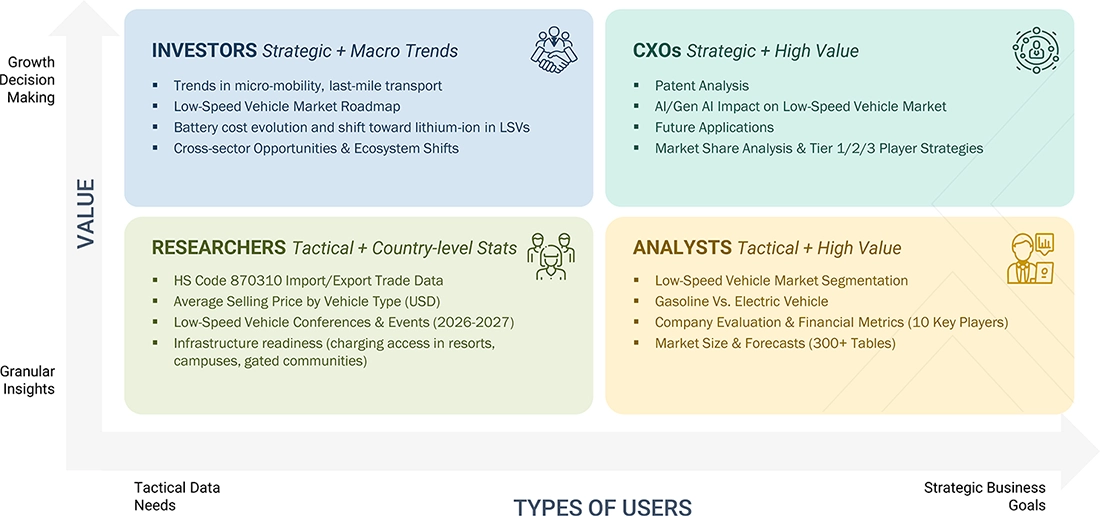
WHAT IS IN IT FOR YOU: LOW SPEED VEHICLE MARKET SIZE, SHARE & ANALYSIS REPORT CONTENT GUIDE
DELIVERED CUSTOMIZATIONS
We have successfully delivered the following deep-dive customizations:
| CLIENT REQUEST | CUSTOMIZATION DELIVERED | VALUE ADDS |
|---|---|---|
| OEMs and fleet operators want clarity on how evolving L6/L7 regulations (speed limits, safety norms, homologation) are impacting product design and market entry across regions. | Comparative mapping of regulatory updates across key markets (India quadricycle norms, EU L6e/L7e framework continuity, Japan kei-class adjacency), covering speed caps, weight limits, and safety requirements. Assessment of impact on vehicle design, powertrain sizing, and certification timelines. | Enables faster homologation and export planning by identifying compliant configurations; helps OEMs align lightweight design and speed calibration strategies with regulatory limits while maintaining usability. |
| Manufacturers are evaluating the shift from lead-acid to lithium-ion batteries in low-speed vehicles and its impact on cost, lifecycle, and operational efficiency. | Analysis of OEM product portfolios showing increased lithium-ion adoption in low-speed vehicles, comparing cycle life, charging time, weight, and maintenance vs. lead-acid across applications like resorts, campuses, and industrial fleets. | Provides clear battery selection strategy—lithium-ion for high-utilization fleets needing low downtime; lead-acid for cost-sensitive, low-usage scenarios—optimizing total cost of ownership. |
| Fleet buyers (resorts, airports, gated communities) want to understand demand patterns across application segments to optimize procurement and fleet mix. | Segmentation of low-speed vehicle demand into recreational, commercial utility, and personal mobility, with recent trends showing rising electric low-speed vehicle adoption in hospitality and airport operations due to low noise and emission benefits. | Identifies high-growth demand pockets such as tourism fleets and airport mobility, enabling better fleet allocation and higher utilization in controlled environments. |
| Distributors and OEMs seek insights on pricing and feature expectations across regions to position low-speed vehicle models competitively. | Benchmarking of low-speed vehicle configurations (range, seating, payload, telematics, modularity) across regions using OEM catalogs and official product data; assessment of feature integration trends like connected fleet management. | Supports product positioning by highlighting where premium features (IoT, lithium-ion) drive differentiation vs. cost-focused models, aligning offerings with regional demand and regulations. |
RECENT DEVELOPMENTS
- February 2026 : Club Car and Crownwood Club have entered a partnership to supply Club Car’s fleet of premium golf vehicles. The partnership was recently featured by Golf Business News, highlighting Crownwood’s decision to equip its course with Club Car Tempo golf carts as part of its high-end member experience.
- January 2026 : Textron launched next-generation in-vehicle digital solutions named “Pace Technology Onyx”. This device had an ultra-wide HD display, high-precision GPS tracking, and advanced geofencing capabilities to enhance golf course fleet management and the user experience.
- January 2026 : The Toro company announced the Workman LTX Utility Vehicle, the next generation of the light-duty Workman Series to replace the GTX Series. It is available in two powertrain options and offers a gasoline or electric model.
- October 2025 : Deere & Company announced the expansion of its Gator utility vehicle lineup with the introduction of the all-electric Gator GX and GX Crew. These vehicles are offered for light-duty jobs to manage the properties of residential and rural property owners, farmers, and rural lifestyle enthusiasts, or for leisurely drives
- January 2025 : Yamaha Golf-Car Company announced a strategic agreement with Pilotcar Otomotiv to become the exclusive distributor for Pilotcar-branded low-speed vehicles in North America. Yamaha will conduct exclusive wholesale operations for Pilotcar-branded low-speed vehicles and offer two 2025 Pilotcar models, the PC2 and PC4 in various configurations
Table of Contents
 Exclusive indicates content/data unique to MarketsandMarkets and not available with any competitors.
TITLE
PAGE NO
1
INTRODUCTION
15
2
EXECUTIVE SUMMARY
3
PREMIUM INSIGHTS
4
MARKET OVERVIEW
4.1
INTRODUCTION
4.2
MARKET DYNAMICS
4.2.1
DRIVERS
4.2.2
RESTRAINTS
4.2.3
OPPORTUNITIES
4.2.4
CHALLENGES
4.3
UNMET NEEDS AND WHITE SPACES
4.4
INTERCONNECTED MARKETS AND CROSS-SECTOR OPPORTUNITIES
4.5
STRATEGIC MOVES BY TIER-1/2/3 PLAYERS
5
INDUSTRY TRENDS
5.1
MACROECONOMIC OUTLOOK
5.1.1
GDP TRENDS AND FORECAST
5.1.2
TRENDS IN GLOBAL RECREATIONAL VEHICLE INDUSTRY
5.2
SUPPLY CHAIN ANALYSIS
5.3
ECOSYSTEM ANALYSIS
5.4
PRICING ANALYSIS
5.4.1
AVERAGE SELLING PRICE TREND, BY VEHICLE TYPE, 2021–2025
5.4.2
AVERAGE SELLING PRICE TREND, BY REGION, 2021–2025
5.4.3
AVERAGE SELLING PRICE, BY KEY PLAYER,
5.5
TRADE ANALYSIS
5.5.1
IMPORT SCENARIO (HS CODE 870310)
5.5.2
EXPORT SCENARIO (HS CODE 870310)
5.6
KEY CONFERENCES AND EVENTS, 2026–2027
5.7
TRENDS/DISRUPTIONS IMPACTING CUSTOMER BUSINESS
5.8
INVESTMENT AND FUNDING SCENARIO
5.9
FUNDING BY USE CASE
5.10
CASE STUDY ANALYSIS
5.11
OEM ANALYSIS
5.11.1
SEATING CAPACITY VS. VOLTAGE
5.11.2
GASOLINE VS. ELECTRIC
5.11.3
AC MOTOR VS. DC MOTOR
5.11.4
LEAD-ACID VS. LI-ION
5.12
IMPACT OF EU-FTA TRADE DEAL ON RECREATIONAL VEHICLE INDUSTRY
5.13
IMPACT OF ISRAEL-IRAN WAR ON RECREATIONAL VEHICLE INDUSTRY
6
TECHNOLOGICAL ADVANCEMENTS, AI-DRIVEN IMPACT, PATENTS, INNOVATIONS, AND FUTURE APPLICATIONS
6.1
KEY TECHNOLOGIES
6.2
EMERGING TECHNOLOGIES
6.3
TECHNOLOGY/PRODUCT ROADMAP
6.4
PATENT ANALYSIS
6.5
FUTURE APPLICATIONS
6.6
IMPACT OF AI/GEN AI
6.7
TOTAL COST OF OWNERSHIP
6.7.1
ELECTRIC VS. GASOLINE LOW-SPEED VEHICLES
6.7.2
COST-BENEFIT ANALYSIS
7
REGULATORY LANDSCAPE
7.1
REGULATORY BODIES, GOVERNMENT AGENCIES, AND OTHER ORGANIZATIONS
7.2
REGULATIONS RELATED TO LOW-SPEED VEHICLES
7.2.1
US
7.2.2
CANADA
7.2.3
EUROPE/ASIA
7.3
REGULATIONS RELATED TO EL7 VEHICLES
7.3.1
US
7.3.2
CANADA
7.3.3
EUROPE/ASIA
7.4
EUROPE L6 / L7 QUADRICYCLE RULES
7.5
LICENSING AND ROAD-USE RESTRICTIONS
7.6
SAFETY COMPLIANCE REQUIREMENTS
8
CUSTOMER LANDSCAPE AND BUYER BEHAVIOR
8.1
DECISION-MAKING PROCESS
8.2
KEY STAKEHOLDERS IN BUYING PROCESS AND THEIR EVALUATION CRITERIA
8.3
ADOPTION BARRIERS AND INTERNAL CHALLENGES
8.4
UNMET NEEDS FROM END-USE INDUSTRIES
8.5
MARKET PROFITABILITY
9
LOW-SPEED VEHICLE MARKET, BY VEHICLE TYPE
9.1
INTRODUCTION
9.2
GOLF CARTS
9.3
COMMERCIAL TURF UTILITY VEHICLES
9.4
INDUSTRIAL UTILITY VEHICLES
9.5
PERSONAL MOBILITY VEHICLES
9.6
PRIMARY INSIGHTS
10
LOW-SPEED VEHICLE MARKET, BY POWER OUTPUT
10.1
INTRODUCTION
10.2
≤5 KW
10.3
5–8 KW
10.4
9–15 KW
10.5
>15 KW
10.6
PRIMARY INSIGHTS
11
LOW-SPEED VEHICLE MARKET, BY BATTERY TYPE
11.1
INTRODUCTION
11.2
LITHIUM-ION
11.3
LEAD-ACID
11.4
PRIMARY INSIGHTS
12
LOW-SPEED VEHICLE MARKET, BY APPLICATION
12.1
INTRODUCTION
12.2
GOLF COURSES
12.3
HOTELS & RESORTS
12.4
AIRPORTS
12.5
INDUSTRIAL FACILITIES
12.6
OTHER APPLICATIONS
12.7
PRIMARY INSIGHTS
13
LOW-SPEED VEHICLE MARKET, BY PROPULSION
13.1
INTRODUCTION
13.2
ELECTRIC
13.3
GASOLINE
13.4
DIESEL
13.5
PRIMARY INSIGHTS
14
LOW-SPEED VEHICLE MARKET, BY CATEGORY
14.1
INTRODUCTION
14.2
L7
14.2.1
ELECTRIC L7 VEHICLES
14.2.1.1
ASIA PACIFIC
11.2.2.1.1
CHINA
11.2.2.1.2
JAPAN
11.2.2.1.3
INDIA
11.2.2.1.4
SOUTH KOREA
14.2.1.2
EUROPE
14.2.1.3
NORTH AMERICA
14.3
L6
14.4
PRIMARY INSIGHTS
15
LOW-SPEED VEHICLE MARKET, BY VOLTAGE
15.1
INTRODUCTION
15.2
<60V
15.3
61–100V
15.4
>100V
15.5
PRIMARY INSIGHTS
16
LOW-SPEED VEHICLE MARKET, BY MOTOR CONFIGURATION
16.1
INTRODUCTION
16.2
HUB-MOUNTED
16.3
MID-MOUNTED
16.4
PRIMARY INSIGHTS
17
LOW-SPEED VEHICLE MARKET, BY MOTOR TYPE
17.1
INTRODUCTION
17.2
AC MOTORS
17.3
DC MOTORS
17.4
PRIMARY INSIGHTS
18
LOW-SPEED VEHICLE MARKET, BY REGION
18.1
INTRODUCTION
18.2
ASIA PACIFIC
18.2.1
CHINA
18.2.2
INDIA
18.2.3
JAPAN
18.2.4
SOUTH KOREA
18.2.5
THAILAND
18.2.6
INDONESIA
18.2.7
VIETNAM
18.2.8
PHILIPPINES
18.3
NORTH AMERICA
18.3.1
US
18.3.2
MEXICO
18.3.3
CANADA
18.4
EUROPE
18.4.1
UK
18.4.2
FRANCE
18.4.3
GERMANY
18.4.4
NORDIC
18.4.5
ITALY
18.4.6
SPAIN
18.5
REST OF THE WORLD
18.5.1
SOUTH AFRICA
18.5.2
BRAZIL
18.5.3
IRAN
19
COMPETITIVE LANDSCAPE
19.1
OVERVIEW
19.2
KEY PLAYER STRATEGIES/RIGHT TO WIN
19.3
REVENUE ANALYSIS, 2022–2025
19.4
MARKET SHARE ANALYSIS,
19.5
COMPANY VALUATION AND FINANCIAL METRICS
19.6
BRAND COMPARISON
19.7
COMPANY EVALUATION MATRIX: LOW-SPEED VEHICLE SUPPLIERS,
19.7.1
STARS
19.7.2
EMERGING LEADERS
19.7.3
PERVASIVE PLAYERS
19.7.4
PARTICIPANTS
19.7.5
COMPANY FOOTPRINT
19.8
COMPANY EVALUATION MATRIX: GOLF CART MANUFACTURERS,
19.8.1
STARS
19.8.2
EMERGING LEADERS
19.8.3
PERVASIVE PLAYERS
19.8.4
PARTICIPANTS
19.8.5
COMPANY FOOTPRINT
19.9
COMPETITIVE SCENARIO
19.9.1
PRODUCT LAUNCHES
19.9.2
DEALS
19.9.3
EXPANSION
19.9.4
OTHERS
19.10
ELECTRIC L7 VEHICLES: RECENT LAUNCHES AND UPCOMING MODELS
19.10.1
ELECTRIC L7 VEHICLES: PRODUCT LAUNCHES
19.10.2
ELECTRIC L7 VEHICLES: UPCOMING MODELS
20
COMPANY PROFILES
20.1
KEY PLAYERS
20.1.1
TEXTRON INC.
20.1.1.1
BUSINESS OVERVIEW
20.1.1.2
PRODUCTS/SOLUTIONS/SERVICES OFFERED
20.1.1.3
RECENT DEVELOPMENTS
20.1.1.3.1
PRODUCT LAUNCHES
20.1.1.3.2
DEALS
20.1.1.3.3
EXPANSIONS
20.1.1.3.4
OTHER DEVELOPMENTS
20.1.1.4
MNM VIEW
20.1.1.4.1
KEY STRENGTHS/RIGHT TO WIN
20.1.1.4.2
STRATEGIC CHOICES
20.1.1.4.3
WEAKNESSES/COMPETITIVE THREATS
20.1.2
DEERE & COMPANY
20.1.3
YAMAHA MOTOR CO., LTD.
20.1.4
THE TORO COMPANY
20.1.5
KUBOTA CORPORATION
20.1.6
CLUB CAR
20.1.7
COLUMBIA VEHICLE GROUP INC.
20.1.8
WAEV INC.
20.1.9
SUZHOU EAGLE ELECTRIC VEHICLE MANUFACTURING CO., LTD.
20.2
OTHER PLAYERS
20.2.1
AGT ELECTRIC CARS
20.2.2
BINTELLI ELECTRIC VEHICLES
20.2.3
MARSHELL GREEN POWER
20.2.4
ICON ELECTRIC VEHICLES
20.2.5
STAR EV CORPORATION, USA
20.2.6
HDK ELECTRIC VEHICLE
20.2.7
TROPOS MOTORS, INC.
20.2.8
PILOTCAR
20.2.9
MOTO ELECTRIC VEHICLES
20.2.10
AGC INC.
20.2.11
CITECAR ELECTRIC VEHICLES
20.2.12
CRUISE CAR INC.
20.2.13
LIGIER GROUP
20.2.14
SPEEDWAYS ELECTRIC
20.2.15
DINIS
20.2.16
AUTOPOWER
20.2.17
CUSHMAN VEHICLES
20.2.18
TOMBERLIN
20.2.19
DONGGUAN EXCAR ELECTRIC VEHICLE CO., LTD.
20.2.20
HAWK CARTS
20.2.21
AETRIC ELECTRIC VEHICLES
20.2.22
EV TITAN
20.2.23
ENVY ELECTRIC NEIGHBOURHOOD VEHICLE
20.2.24
VARLEY ELECTRIC VEHICLES
20.2.25
MAINI MATERIALS MOVEMENT PVT LTD.
20.2.26
EVOLUTION ELECTRIC VEHICLES
21
RESEARCH METHODOLOGY
21.1
RESEARCH DATA
21.1.1
SECONDARY DATA
21.1.1.1
SECONDARY SOURCES
21.1.1.2
KEY DATA FROM SECONDARY SOURCES
21.1.2
PRIMARY DATA
21.1.2.1
KEY DATA FROM PRIMARY SOURCES
21.1.2.2
BREAKDOWN OF PRIMARY INTERVIEWS
21.1.3
SAMPLING TECHNIQUES AND DATA COLLECTION METHODS
21.2
MARKET SIZE ESTIMATION
21.2.1
BOTTOM-UP APPROACH
21.2.2
TOP-DOWN APPROACH
21.3
DATA TRIANGULATION
21.4
FACTOR ANALYSIS
21.5
RESEARCH ASSUMPTIONS
21.6
RESEARCH LIMITATIONS AND RISK ASSESSMENT
22
APPENDIX
22.1
DISCUSSION GUIDE
22.2
KNOWLEDGESTORE: MARKETSANDMARKETS’ SUBSCRIPTION PORTAL
22.3
CUSTOMIZATION OPTIONS
22.3.1
LOW-SPEED VEHICLE MARKET, BY PROPULSION, AT COUNTRY LEVEL
22.3.1.1
GASOLINE
22.3.1.2
DIESEL
22.3.1.3
ELECTRIC
22.3.2
LOW-SPEED VEHICLE MARKET, BY POWER OUTPUT, AT COUNTRY LEVEL
22.3.2.1
≤5 KW
22.3.2.2
6–15 KW
22.3.2.3
>15 KW
22.3.3
LOW-SPEED VEHICLE MARKET, BY SEATING CAPACITY
22.3.3.1
SMALL (2–4 SEATER)
22.3.3.2
MEDIUM (6–8 SEATER)
22.3.3.3
LARGE (ABOVE 8 SEATER)
22.4
RELATED REPORTS
22.5
AUTHOR DETAILS
Methodology
The research study involves extensive use of secondary sources such as company annual reports/presentations, industry association publications, low-speed vehicle magazine articles, directories, technical handbooks, World Economic Outlook, trade websites, technical articles, and databases to identify and collect information on the low-speed vehicle market. Primary sources, including experts from related industries, low-speed vehicle OEMs, and suppliers, have been interviewed to obtain and verify critical information, as well as to assess growth prospects and market estimates.
Secondary Research
In the secondary research process, various secondary sources were used to identify and collect information on the low-speed vehicle market for this study. Secondary sources included annual reports, press releases, and investor presentations of companies; whitepapers, certified publications, and articles from recognized authors; directories; databases; and articles from recognized associations and government publishing sources. Low-speed vehicle sales and end-use industry demand are derived through secondary sources such as the International Light Transportation Vehicle Association, Inc., the National Mobility Equipment Dealers Association (NMEDA), the National Motorists Association, Neighborhood Electric Vehicle Association (NEVA), European Association of Motorcycle Manufacturers (ACEM), Light Electric Vehicle Association Europe, etc.
Primary Research
Extensive primary research was conducted after understanding the low-speed vehicle market scenario through secondary research. Several primary interviews were conducted with market experts from both supply and demand sides to obtain qualitative and quantitative information on the market. Primary sources from the supply side included industry experts, such as CXOs, vice presidents, and directors from business development, marketing, and product development/innovation teams, as well as related executives from various companies. Various system integrators, industry associations, independent consultants/industry veterans, and key opinion leaders were also interviewed.
Primary interviews have been conducted with market experts from the demand side (end-use industries) and the supply side (low-speed vehicle providers) across four regions: North America, Europe, Asia Pacific, and the Rest of the World. Approximately 80% of the primary interviews were conducted with low-speed vehicle manufacturers, and 20% with low-speed vehicle component providers. Primary data has been collected through questionnaires, emails, and telephonic interviews.
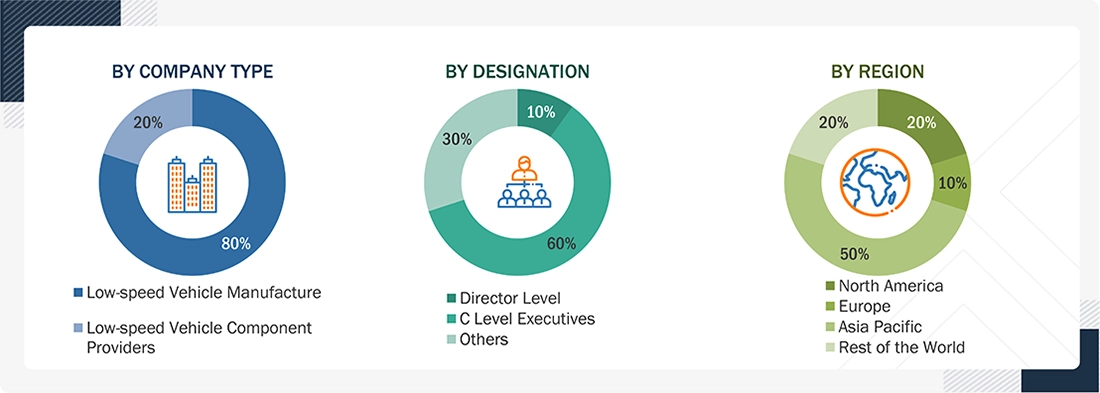
Note: Other designations include sales, marketing, and product managers.
Company tiers are based on the value chain; the revenue of the company is not considered.
To know about the assumptions considered for the study, download the pdf brochure
Market Size Estimation
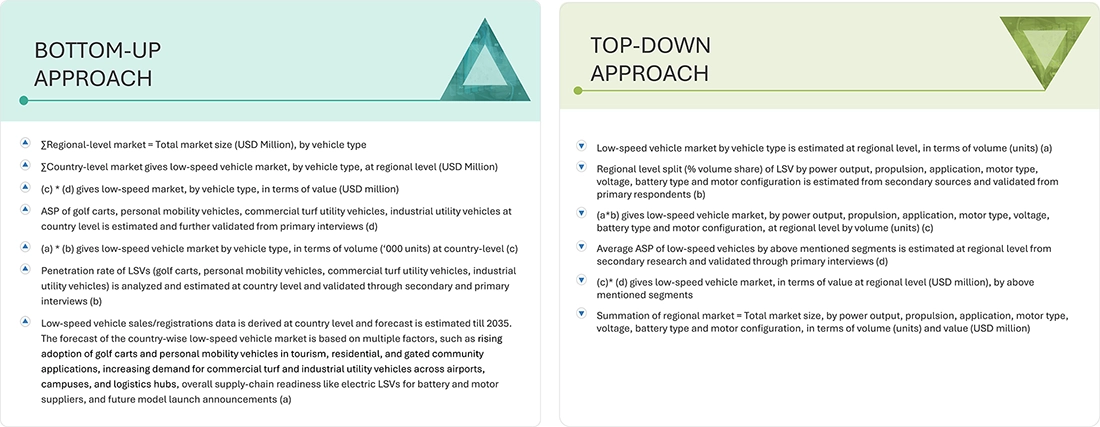
A bottom-up and top-down approach was used to estimate and validate the total size of the low-speed vehicle market. This method was also widely used to estimate the sizes of various subsegments in the market. The research methodology used to estimate the market size includes the following:
Data Triangulation
After arriving at the overall market size using the market size estimation processes as explained above, the market was split into several segments and subsegments. All parameters that affect the markets covered in this research study have been accounted for, viewed in extensive detail, and analyzed to obtain the final quantitative and qualitative data. All percentage shares, splits, and breakdowns have been determined using secondary sources and verified by primary sources. The data was triangulated by studying various factors and trends from both the demand and supply sides.
Market Definition
Low-speed vehicles, according to the US Department of Energy, are 4-wheeled motor vehicles capable of reaching speeds of more than 20 miles per hour (mph) but not more than 25 mph. These vehicles may not operate on a highway with a posted speed limit exceeding 35 mph. A city or county may adopt ordinances that allow the operation of low-speed vehicles on city streets or county roads with posted speed limits greater than 35 mph. Low-speed vehicles must comply with specific standards in Title 49 of the US Code of Federal Regulations, section 571.500.
Key Stakeholders
- Low-speed Vehicle Manufacturers
- Low-speed Vehicle Component Manufacturers
- Low-speed Vehicle Battery Providers
- Low-speed Vehicle Service Providers
- Low-speed Vehicle Dealers and Distributors
- Industrial and End Use Organizations/Associations
- Regulatory Authorities
Report Objectives
- To define, describe, and forecast the size of the low-speed vehicle market in terms of value (USD million) and volume (units) between 2026 and 2035 based on the following segments:
- By Application (Golf Courses, Hotels & Resorts, Airports, Industrial Facilities, and Other Applications)
- By Vehicle Type (Golf Carts, Commercial Turf Utility Vehicles, Industrial Utility Vehicles, and Personal Mobility Vehicles)
- By Propulsion (Electric, Gasoline, and Diesel)
- By Power Output (<5 kW, 5–8 kW, 9–15 kW, and >15 kW)
- By Battery Type (Lithium-ion and Lead-acid)
- By Category (L6 and L7)
- By Voltage (<60V, 61–100V, and >100 V)
- By Motor Configuration (Hub-mounted and Mid-mounted)
- By Motor Type (AC Motors and DC Motors)
- By Region (Asia Pacific, Europe, North America, and Rest of the World)
- To identify and analyze key drivers, restraints, opportunities, and challenges influencing the market.
- To strategically profile key players and comprehensively analyze their respective market share and core competencies.
- To analyze recent developments, including product launches, partnerships, collaborations, acquisitions, and expansions, among others, undertaken by key players in the market.
- To study the following concerning the market
- Supply Chain Analysis
- Ecosystem Analysis
- Technology Analysis
- Trade Analysis
- Case Study Analysis
- Patent Analysis
- Regulatory Landscape
- Average Selling Price Analysis
- Impact of AI/Gen AI
- Trend and Disruption Impact
- Key Stakeholders and Buying Criteria
- Key Conferences and Events
- Sustainability initiatives
- To understand competitive dynamics and assess companies using an evaluation matrix.
- To analyze the opportunities offered by various segments of the market to its stakeholders.
Available customizations:
With the given market data, MarketsandMarkets offers customizations in accordance with the company’s specific needs.
- low-speed vehicle market, By max speed
- low-speed vehicle market, BY seating capacity
Company Information:
- Profiling of additional market players (up to five)

What the Low-speed Vehicle Report Didn't Show You?
Explore the strategic intelligence behind the Low-speed Vehicle Market
- 🏆 Competitors
- 🎯 Opportunities
- 📈 Growth Signals
Generate 15+ consulting-grade insights instantly
Powered by 17 years of MarketsandMarkets intelligence