






- DESCRIPTION
- TABLE OF CONTENTS
- METHODOLOGY
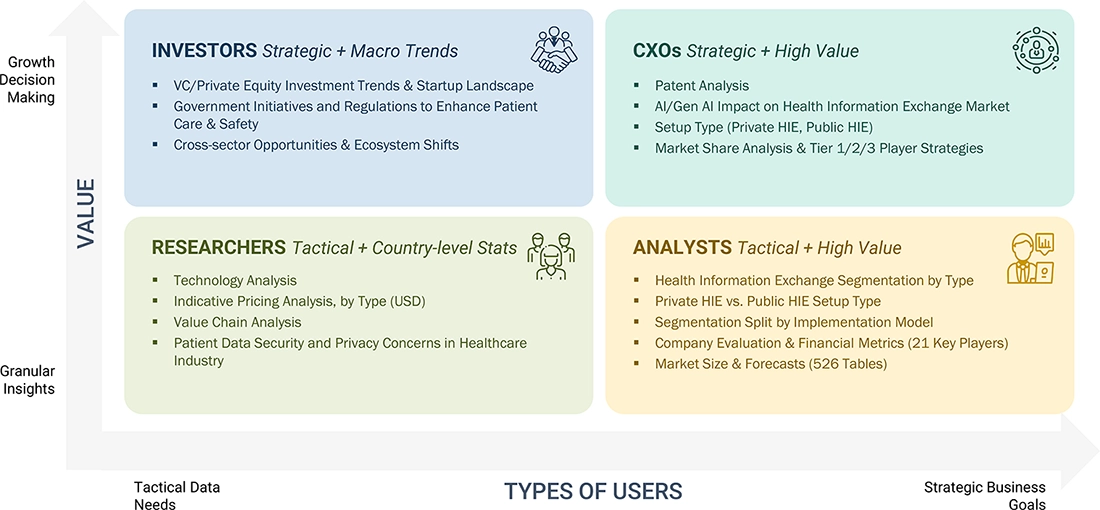
- DOWNLOAD PDF
Healthcare Information Exchange (HIE) Market by Type (Direct, Query), Mode (Centralized, Decentralized), Setup (Private, Public), Solution (Portal, Platform), Application (Workflow, Interfacing), End User (Hospital, ASC) - Global Forecast to 2031

USD 3.40 BN
MARKET SIZE, 2031

CAGR 10.3%
(2026-2031)

414
REPORT PAGES

526
MARKET TABLES
OVERVIEW
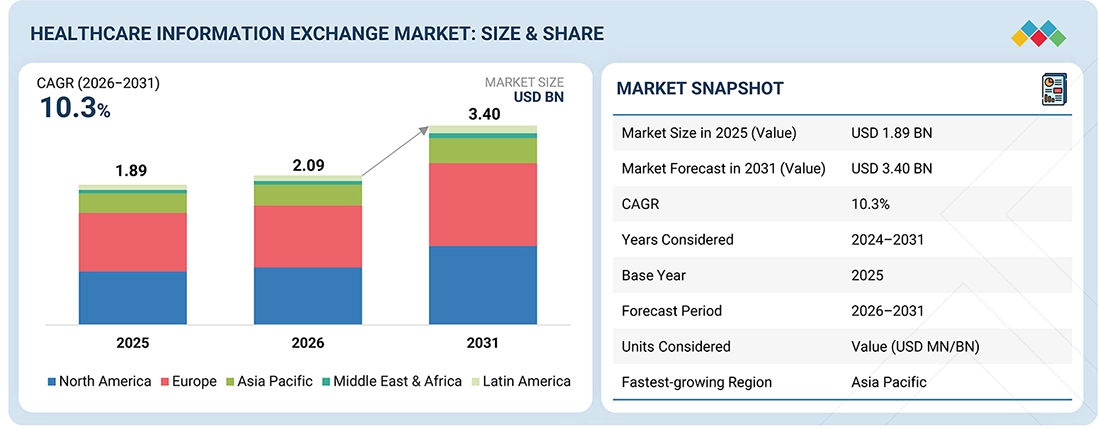
Source: Secondary Research, Interviews with Experts, MarketsandMarkets Analysis
The healthcare information exchange market is projected to reach USD 3.40 billion by 2031 from USD 2.09 billion in 2026, at a CAGR 10.3% from 2026 to 2031. The growth of the market is mainly driven by an increasing focus on population health management, value-based care models, and regulatory mandates for electronic health records (EHRs). Moreover, the increasing digitization of healthcare systems worldwide and the growing emphasis on interoperability and care coordination within the healthcare industry have propelled the adoption of HIE solutions.
KEY TAKEAWAYS
-
BY REGION
By region, the North American healthcare information exchange market accounted for 53.0% in 2025.
-
BY TYPE
By type, the query-based exchange market is expected to register the highest CAGR during the forecast period.
-
BY SETUP TYPE
By setup type, the public HIE segment is projected to grow at the fastest rate of 10.7% from 2026 to 2031.
-
BY IMPLEMENTATION MODEL
By implementation model, the hybrid model segment is expected to dominate the market.
-
BY SOLUTION
By solution, the portal-centric HIE solutions segment held the largest share of 57.3% in 2025.
-
BY COMPONENT
By component, the clinical data repository segment is expected to grow at the highest CAGR.
-
BY APPLICATION
By application, the internal interfacing segment is expected to grow at the fastest CAGR.
-
BY END USER
By end user, the healthcare providers segment is expected to dominate the market during the forecast period.
-
COMPETITIVE LANDSCAPE - KEY PLAYERS
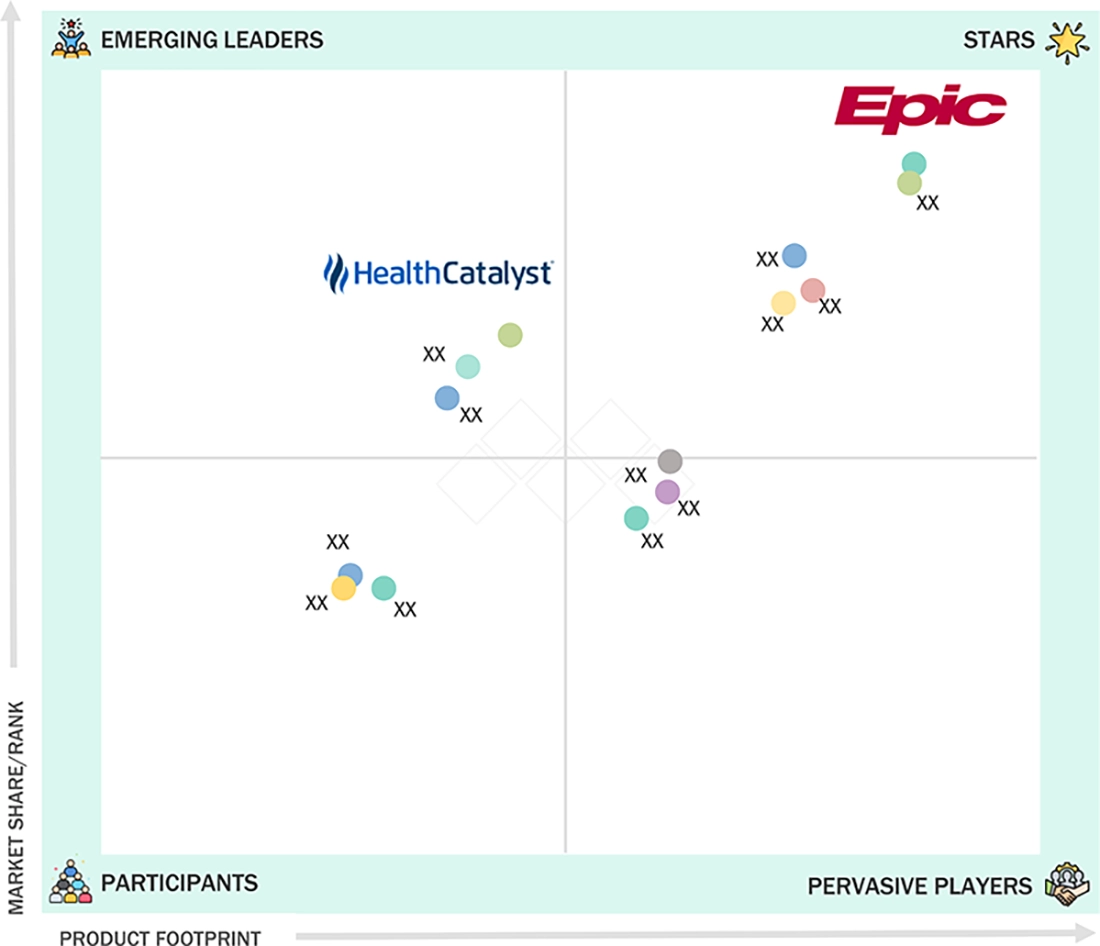
Epic Systems Corporation, Oracle, and Veradigm LLC were identified as the star players in the global healthcare information exchange market, given their strong market share and product footprint.
-
COMPETITIVE LANDSCAPE - STARTUPS
SISGAIN and Aderson Inc. have distinguished themselves among startups and SMEs by securing strong footholds in specialized niche areas, underscoring their potential as emerging market leaders.
The healthcare information exchange (HIE) market continues to expand steadily amid growing emphasis on health system organizations’ ability to ensure the sharing of information through secure communication. Market growth is driven by the ongoing modernization of electronic medical records (EMRs), requirements for higher interoperability standards, and the transition to value-based care delivery models. The proliferation of collaborations involving hospitals, insurers, and other stakeholders as well as investments in FHIR API solutions, cloud computing technology, real-time data analysis capabilities, and patient-focused data management platforms are contributing to rapid development within this space. In parallel with this process, innovations related to data normalization, consent management, and cross-border data transfer initiatives significantly influence the industry landscape.
TRENDS & DISRUPTIONS IMPACTING CUSTOMERS' CUSTOMERS
The healthcare sector is experiencing rapid changes, leading to a greater demand for seamless data flow, interoperable solutions, and the digital delivery of services. This transformation is heavily influenced by the shift towards value-based care and population health management. Technologies such as cloud computing, FHIR standards, and artificial intelligence are becoming increasingly common because they enhance the efficiency of care delivery. These trends have a significant impact on healthcare facilities, creating a pressing need for next-generation healthcare information exchange (HIE) platforms. These platforms must ensure interoperability and actively engage patients in their own care.
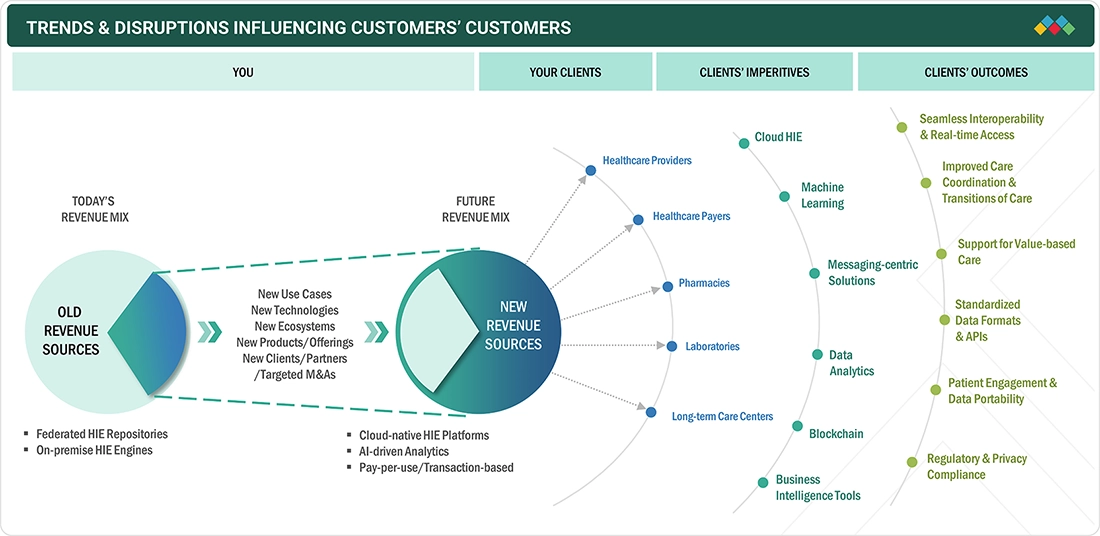
Source: Secondary Research, Interviews with Experts, MarketsandMarkets Analysis
MARKET DYNAMICS

Drivers
Impact
Level
-
Government initiatives and regulations to enhance patient care & safety

-
Rising investments from government & private institutes


RESTRAINTS
Impact
Level
-
Lack of true interoperability solutions

-
Need for significant investments in infrastructure development and high cost of deployment


OPPORTUNITIES
Impact
Level
-
Improving healthcare infrastructure in emerging markets

-
Advancements in software technology for real-time data exchange


CHALLENGES
Impact
Level
-
Increasing complexity due to lack of consistent data

-
Patient data security and privacy concerns in healthcare industry

Source: Secondary Research, Interviews with Experts, MarketsandMarkets Analysis
Government initiatives aimed at enhancing patient care and safety have significantly increased the demand for health information exchange (HIE) software solutions. This demand is driven by the need for seamless data sharing and interoperability among healthcare providers. Health authorities have mandated the rapid implementation of HIE solutions to enable healthcare organizations to share real-time data on infection rates, hospital bed capacity, and vaccination status. Furthermore, the widespread adoption of electronic health information exchange has the potential to improve healthcare quality and reduce costs. Through the HITECH Act, the federal government allocated USD 2.4 billion to states in the US to improve and advance specific aspects of electronic health information exchange. These government-led initiatives, combined with the adoption of value-based care models, have further fueled the demand for HIE software solutions.
Despite increasing pressure for the integration of digital health, the health information exchange (HIE) sector faces numerous barriers that hinder its success. One major issue is the non-interoperability of various systems. The use of different information standards, the presence of fragmented legacy infrastructures, and the inability to ensure compatibility across multiple platforms have made information sharing quite difficult. As a result, healthcare institutions, laboratories, pharmacies, and even governmental public health organizations struggle to share patient data efficiently.
The development of healthcare infrastructure in developing countries has been identified as a significant factor driving the growing demand for health information exchange (HIE) platforms. As governments and healthcare organizations increase their investments in digital health platforms, the need for HIE solutions also rises. For example, India is advancing its digital health initiatives through the Ayushman Bharat Digital Mission, which aims to promote the interoperability of health records and facilitate data exchanges—key components of HIE platforms. Additionally, Saudi Arabia is working to enhance its healthcare infrastructure through the Vision 2030 initiative.
The healthcare information exchange industry is becoming increasingly complex due to inconsistencies in patient information. Records may be inconsistent, incomplete, and lack standardization. This can lead to compatibility issues stemming from different electronic health records and multiple data sources. As a result, inefficiencies and delays in delivering health services to patients may occur. Such inconsistencies can lead to duplicate tests, failures in care coordination, and inaccuracies in a patient's medical record.
HEALTHCARE INFORMATION EXCHANGE MARKET: GROWTH, SIZE, SHARE, AND TRENDS: COMMERCIAL USE CASES ACROSS INDUSTRIES
| COMPANY | USE CASE DESCRIPTION | BENEFITS |
|---|---|---|
|
|
Epic enables cross-network patient data exchange between hospitals, clinics, labs, and payers through Care Everywhere using FHIR, HL7, and national networks. | Reduces duplicate tests, improves care coordination, provides faster access to complete patient history, and supports value-based care. |
|
|
Oracle supports large HIE deployments integrating EHRs, labs, imaging, and claims systems using HealtheIntent and cloud-based interoperability tools. | Population-level insights, unified patient records, improved public-health reporting, and scalable multi-state HIE operations. |
|
|
InterSystems enables real-time data exchange across hospitals, labs, and care networks through interoperable HIE platforms. | Faster data access, seamless interoperability, improved care coordination, and reduced data silos. |
|
|
Veradigm aggregates multi-source clinical, financial, and population data to support interoperability plus analytics-driven care improvement. | Advanced insights, population health dashboards, cost reductions, and reduced data silos across provider networks. |
|
|
Meditech provides integrated EHR systems that support secure sharing of patient records across healthcare facilities. | Streamlined workflows, accurate and unified patient data, improved clinical efficiency, and better decision-making. |





Logos and trademarks shown above are the property of their respective owners. Their use here is for informational and illustrative purposes only.
MARKET ECOSYSTEM
The health information exchange (HIE) market is experiencing significant disruption due to the transition to cloud-based and API-driven interoperability platforms. Key players in this shift include Epic Systems, Oracle Health, InterSystems, and Medical Information Technology, Inc. Major cloud providers, such as Amazon Web Services, Google Cloud, and Microsoft Azure, are fostering innovation in this field. Additionally, startups like SISGAIN, CleverDev Software, and OSP Labs are introducing flexible solutions to enhance the landscape. These trends, combined with an increasing focus on patient-centric data and security, are contributing to the development of a more connected and real-time healthcare ecosystem.
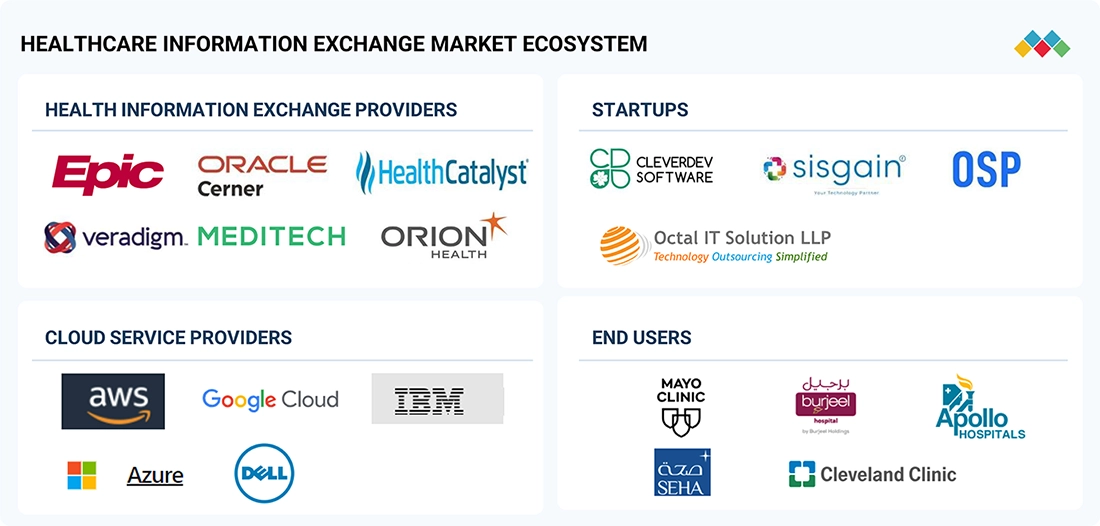
Logos and trademarks shown above are the property of their respective owners. Their use here is for informational and illustrative purposes only.
MARKET SEGMENTS
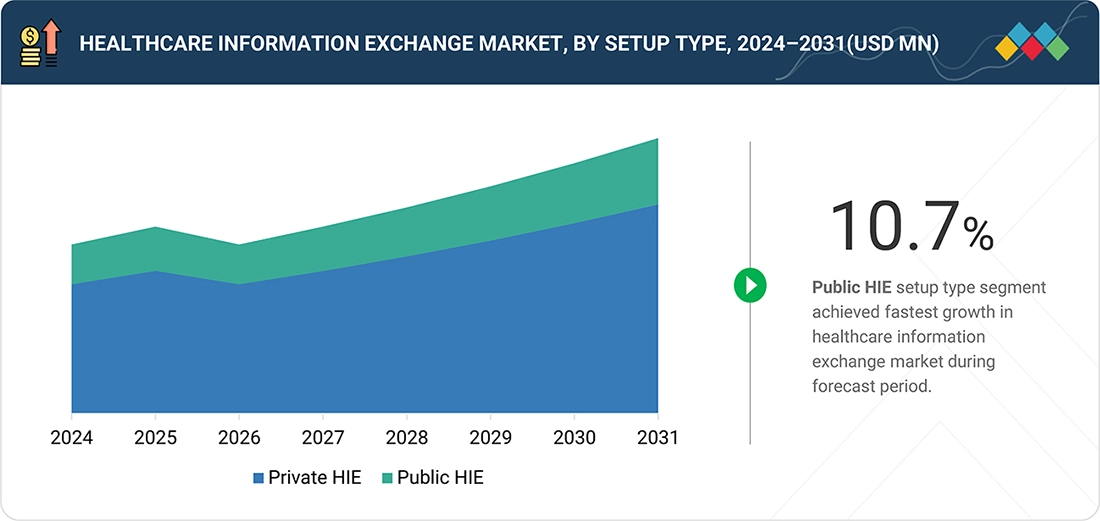
Source: Secondary Research, Interviews with Experts, MarketsandMarkets Analysis
Based on type, the health information exchange market is segmented into directed exchange, query-based exchange, and consumer-mediated exchange. The directed exchange segment accounted for the largest share of the global health information exchange market in 2025. A significant portion of this segment can be attributed to its benefits, including the prevention of duplicate information collection from patients, reduction of medication errors, and avoidance of duplicate testing. For example, the Trusted Exchange Framework and Common Agreement in the US promotes a standardized national exchange of information across healthcare networks, further enhancing directed exchanges.
Based on setup type, the health information exchange market is segmented into public HIE and private HIE. In 2025, the private HIE segment accounted for the largest market share. The large share of this segment can primarily be attributed to the growing preference among healthcare providers for enhanced data security, control, and tailored interoperability solutions within closed networks. Private HIEs enable organizations to manage patient data more efficiently while ensuring compliance with regulatory requirements. For instance, Epic Systems facilitates private health information exchange through its Care Everywhere platform, allowing secure and seamless data sharing across connected hospitals and clinics, further strengthening the adoption of private HIE models.
In 2025, hybrid models accounted for the largest market share as they provide the advantages of both private and public models of exchanges. These models provide scalability, flexibility, and security in exchanging healthcare information. For example, InterSystems provides its HealthShare solution for integrated health information exchange in hospitals, regional health networks, and nationwide health care networks, indicating the importance of hybrid models.
In 2025, the portal-centric HIE solutions segment held the largest share of the market, due to its capability of offering centralized access to patient information via web-based interfaces, thereby improving collaboration and patient engagement. This allows for the secure exchange of health information among stakeholders through a centralized web-based interface. For example, the Oracle Cerner portal solution, which is integrated with its HIE platforms, allows for efficient sharing of clinical information.
In 2025, the clinical data repository segment accounted for the largest share of the market. This was attributed to the ability of such systems to collect, store, and manage vast amounts of patient data in order to have an extensive database for making important decisions on patients. Examples of such applications include HealthShare Unified Care Record, provided by InterSystems, which gathers patient data from different systems and places it in a central repository.
Based on application, the web portal development segment held the largest share of the market, driven by the increasing demand for user-friendly interfaces that enable seamless access to health information for both providers and patients. These portals enhance patient engagement, streamline workflows, and support real-time data access across healthcare systems. For instance, Allscripts Healthcare Solutions offers web-based patient portals integrated with its HIE solutions, facilitating secure access to medical records and strengthening the adoption of web portal development services.
In 2025, healthcare providers emerged as the leading segment owing to the rising demand for faster and effective data exchanges, coordination of care, and better patient outcomes among hospitals and clinics. Providers have the most common user base of HIE systems that help them obtain complete information about patients and improve their processes. For example, the Mayo Clinic is known to utilize the services of HIE systems efficiently.
REGION
Asia Pacific to be fastest-growing region in global healthcare information exchange market during forecast period
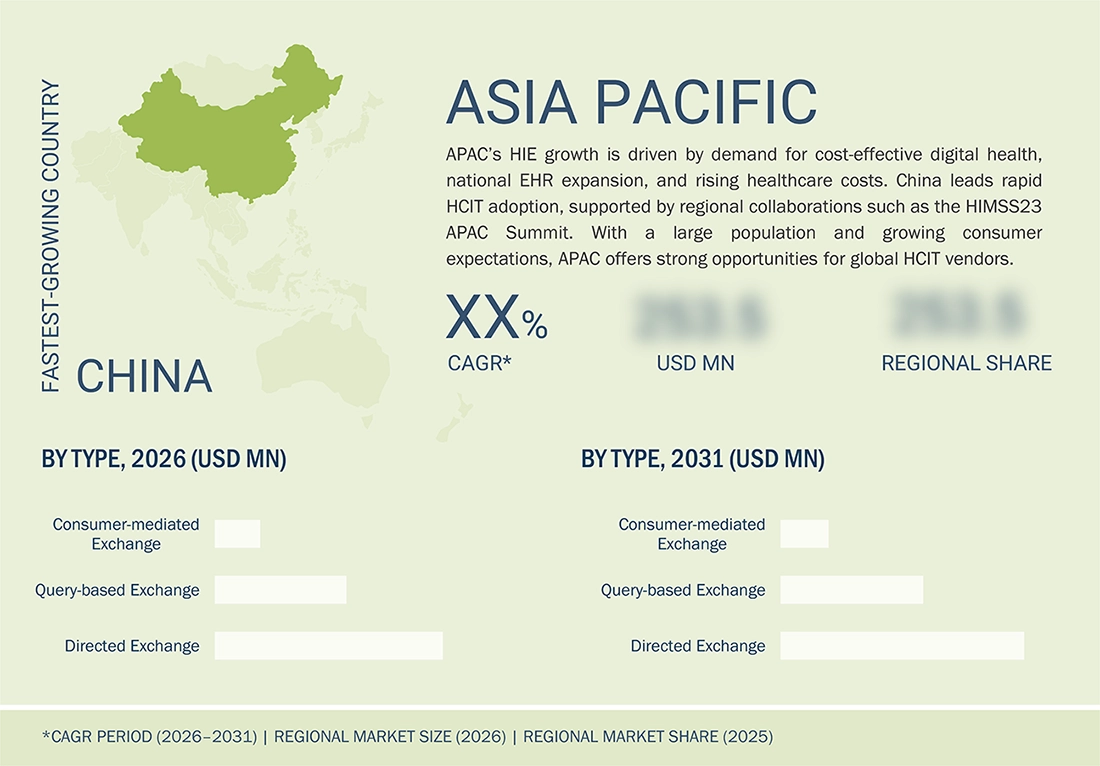
The Asia Pacific healthcare information exchange market is expected to grow at the highest CAGR during the forecast period, due to fast uptake of digital health applications, increase in nationwide EHR implementations, and active participation of governments in transforming their health IT framework. Nations, including China, Japan, India, Singapore, and Australia, are increasing investments in the development of interoperable health IT infrastructures to achieve effective coordination of care delivery and lower healthcare expenses. In July 2025, Australia announced its national HIE roadmap as part of the Health Connect Australia initiative, aimed at boosting interoperability and allowing for smooth exchange of patient health data through cloud-based digital health technologies. Furthermore, rising healthcare consumerism, investments made by the private HCIT sector, and setting up of cross-border health data exchange in the region will also drive Asia Pacific HIE market expansion.
HEALTHCARE INFORMATION EXCHANGE MARKET: GROWTH, SIZE, SHARE, AND TRENDS: COMPANY EVALUATION MATRIX
In the healthcare information exchange market matrix, Epic Systems (Star) leads with a dominant market share and a broad, deeply integrated product ecosystem, driven by its robust EHR platform. Health Catalyst (Emerging Leader) is rapidly gaining recognition with its strong analytics-driven data platform, population health solutions, and modular interoperability offerings tailored for health systems seeking data harmonization and outcomes improvement.
Source: Secondary Research, Interviews with Experts, MarketsandMarkets Analysis
KEY MARKET PLAYERS
- Epic Systems Corporation (US)
- Oracle (US)
- InterSystems Corporation (US)
- Veradigm LLC (US)
- Medical Information Technology, Inc. (US)
- Health Catalyst (US)
- Kellton (India)
- eClinicalWorks (US)
- NXGN Management LLC (US)
- Orion Health (New Zealand)
- Chetu Inc. (US)
- Telstra Health (Australia)
- CGI Inc. (Canada)
- Meditab (US)
- Dreamsoft4u (US)
- NCrypted Technologies (India)
- Glorium Technologies (US)
- Daffodil Software (India)
- Siemens Healthineers AG (Germany)
- Deloitte (UK)
- Excelicare (UK)
MARKET SCOPE
| REPORT METRIC | DETAILS |
|---|---|
| Market Size in 2025 (Value) | USD 1.89 Billion |
| Market Forecast in 2031 (Value) | USD 3.40 Billion |
| CAGR | 10.3% |
| Years Considered | 2024–2031 |
| Base Year | 2025 |
| Forecast Period | 2026–2031 |
| Units Considered | USD Million/Billion |
| Report Coverage | Revenue Forecast, Company Ranking, Competitive Landscape, Growth Factors, and Trends |
| Segments Covered |
|
| Regions Covered | North America, Asia Pacific, Europe, the Middle East & Africa, Latin America |
WHAT IS IN IT FOR YOU: HEALTHCARE INFORMATION EXCHANGE MARKET: GROWTH, SIZE, SHARE, AND TRENDS REPORT CONTENT GUIDE
DELIVERED CUSTOMIZATIONS
We have successfully delivered the following deep-dive customizations:
| CLIENT REQUEST | CUSTOMIZATION DELIVERED | VALUE ADDS |
|---|---|---|
| Competitive Landscape Mapping |
|
Enables benchmarking of HIE vendor capabilities, identifies gaps in interoperability, supports vendor comparison for procurement, and informs strategic partnerships, integration planning, and M&A decisions |
| Market Entry & Growth Strategy |
|
Reduces go-to-market risk, accelerates adoption through evidence-backed localization strategies, supports expansion into high-growth regions (e.g., APAC), and aligns growth initiatives with national digital-health priorities |
RECENT DEVELOPMENTS
- February 2025 : MEDITECH partnered with leading technology companies, including Google Cloud, Microsoft, Commure, DrFirst, Health Gorilla, and Suki, to showcase interoperability at HIMSS25.
- February 2024 : Telstra Health partnered with Smile Digital Health to bring an FHIR-based health data platform to Australia and New Zealand, enabling secure, real-time health information exchange across care settings.
- January 2024 : Veradigm partnered with MedAllies as its Qualified Health Information Network (QHIN) under TEFCA to enable nationwide health data exchange.
- COLUMN 'A' SHOULD BE IN TEXT FORMAT AND NOT DATE FORMAT :
Table of Contents
 Exclusive indicates content/data unique to MarketsandMarkets and not available with any competitors.
TITLE
PAGE NO
1
INTRODUCTION
15
2
EXECUTIVE SUMMARY
3
PREMIUM INSIGHTS
4
MARKET OVERVIEW
4.1
INTRODUCTION
4.2
MARKET DYNAMICS
4.2.1
DRIVERS
4.2.1.1
RISING ADOPTION OF EHR/EMR SOLUTIONS
4.2.1.2
GROWING FOCUS ON PATIENT-CENTRIC CARE DELIVERY
4.2.1.3
NEED TO CURTAIL ESCALATING HEALTHCARE COSTS
4.2.1.4
GOVERNMENT INITIATIVES AND REGULATIONS TO ENHANCE PATIENT CARE & SAFETY
4.2.1.5
RISING INVESTMENTS FROM GOVERNMENT & PRIVATE INSTITUTES
4.2.2
RESTRAINTS
4.2.2.1
NEED FOR SIGNIFICANT INVESTMENTS IN INFRASTRUCTURE DEVELOPMENT AND HIGH COST OF DEPLOYMENT
4.2.2.2
LACK OF TRUE INTEROPERABILITY SOLUTIONS
4.2.2.3
USE OF OUTDATED LEGACY SYSTEMS
4.2.3
OPPORTUNITIES
4.2.3.1
IMPROVING HEALTHCARE INFRASTRUCTURE IN EMERGING MARKETS
4.2.3.2
ADVANCEMENTS IN SOFTWARE TECHNOLOGY FOR REAL-TIME DATA EXCHANGE
4.2.4
CHALLENGES
4.2.4.1
PATIENT DATA SECURITY AND PRIVACY CONCEMS IN HEALTHCARE INDUSTRY
4.2.4.2
INCREASING COMPLEXITY DUE TO LACK OF CONSISTENT DATA
4.2.4.3
SHORTAGE OF SKILLED HEALTHCARE IT PROFESSIONALS
4.3
UNMET NEEDS & WHITE SPACES
4.4
INTERCONNECTED MARKETS & CROSS-SECTOR OPPORTUNITIES
4.5
STRATEGIC MOVES BY TIER-1/2/3 PLAYERS
5
INDUSTRY TRENDS
5.1
PORTER'S FIVE FORCES ANALYSIS
5.2
MACROECONOMIC INDICATORS
5.2.1
INTRODUCTION
5.2.2
GDP TRENDS & FORECAST
5.2.3
TRENDS IN GLOBAL HEALTHCARE IT INDUSTRY
5.3
VALUE CHAIN ANALYSIS
5.4
ECOSYSTEM ANALYSIS
5.5
PRICING ANALYSIS
5.5.1
INDICATIVE PRICE FOR HEALTHCARE INFORMATION EXCHANGE SOLUTIONS, BY TYPE (2025)
5.5.2
INDICATIVE PRICE FOR HEALTHCARE INFORMATION EXCHANGE SOLUTIONS, BY REGION (2025)
5.6
KEY CONFERENCES & EVENTS, 2026–2027
5.7
TRENDS/DISRUPTIONS IMPACTING CUSTOMERS’ BUSINESSES
5.8
INVESTMENT & FUNDING SCENARIO
5.9
CASE STUDY ANALYSIS
5.10
IMPACT OF 2025 US TARIFFS ON HEALTHCARE INFORMATION EXCHANGE MARKET
5.10.1
INTRODUCTION
5.10.2
KEY TARIFF RATES
5.10.3
PRICE IMPACT ANALYSIS
5.10.4
IMPACT ON COUNTRIES/REGIONS
5.10.4.1
US
5.10.4.2
EUROPE
5.10.4.3
ASIA PACIFIC
5.10.5
IMPACT ON END-USE INDUSTRIES
6
TECHNOLOGICAL ADVANCEMENTS, AI-DRIVEN IMPACT, PATENTS, INNOVATIONS, AND FUTURE APPLICATIONS
6.1
KEY EMERGING TECHNOLOGIES
6.1.1
ARTIFICIAL INTELLIGENCE & MACHINE LEARNING
6.1.2
BLOCKCHAIN
6.2
COMPLEMENTARY TECHNOLOGIES
6.2.1
INTERNET OF THINGS
6.2.2
DATA ANALYTICS & BUSINESS INTELLIGENCE TOOLS
6.3
ADJACENT TECHNOLOGIES
6.3.1
CLOUD COMPUTING
6.4
TECHNOLOGY/PRODUCT ROADMAP
6.5
PATENT ANALYSIS
6.6
FUTURE APPLICATIONS
6.7
IMPACT OF AI/GEN AI ON HEALTHCARE INFORMATION EXCHANGE MARKET
6.7.1
TOP USE CASES & MARKET POTENTIAL
6.7.2
BEST PRACTICES FOLLOWED BY MANUFACTURERS/OEMS IN HEALTHCARE INFORMATION EXCHANGE MARKET
6.7.3
CASE STUDIES OF AI IMPLEMENTATION IN HEALTHCARE INFORMATION EXCHANGE MARKET
6.7.4
6.6.4 INTERCONNECTED ECOSYSTEMS & IMPACT ON MARKET PLAYERS
6.7.5
6.6.5 CLIENTS’ READINESS TO ADOPT AI-INTEGRATED HIE SOLUTIONS
7
REGULATORY LANDSCAPE
7.1
REGIONAL REGULATIONS & COMPLIANCE
7.1.1
REGULATORY BODIES, GOVERNMENT AGENCIES, AND OTHER ORGANIZATIONS
7.1.2
INDUSTRY STANDARDS
8
CUSTOMER LANDSCAPE & BUYER BEHAVIOR
8.1
INTRODUCTION
8.2
DECISION-MAKING PROCESS
8.3
KEY STAKEHOLDERS INVOLVED IN BUYING PROCESS & THEIR EVALUATION CRITERIA
8.3.1
KEY STAKEHOLDERS IN BUYING PROCESS
8.3.2
BUYING CRITERIA
8.4
ADOPTION BARRIERS & INTERNAL CHALLENGES
8.5
UNMET NEEDS FROM VARIOUS END-USE INDUSTRIES
8.6
MARKET PROFITABILITY
9
HEALTHCARE INFORMATION EXCHANGE MARKET, BY TYPE (MARKET SIZE & FORECAST TO 2031)
9.1
INTRODUCTION
9.2
DIRECTED EXCHANGE
9.3
QUERY-BASED EXCHANGE
9.4
CONSUMER-MEDIATED EXCHANGE
10
HEALTHCARE INFORMATION EXCHANGE MARKET, BY SETUP TYPE (MARKET SIZE & FORECAST TO 2031)
10.1
INTRODUCTION
10.2
PRIVATE HIE
10.3
PUBLIC HIE
11
HEALTHCARE INFORMATION EXCHANGE MARKET, BY IMPLEMENTATION MODEL (MARKET SIZE & FORECAST TO 2031)
11.1
INTRODUCTION
11.2
HYBRID MODEL
11.3
CENTRALIZED MODEL
11.4
DECENTRALIZED/FEDERATED MODEL
12
HEALTHCARE INFORMATION EXCHANGE MARKET, BY SOLUTION (MARKET SIZE & FORECAST TO 2031)
12.1
INTRODUCTION
12.2
PORTAL-CENTRIC HIE SOLUTIONS
12.3
MESSAGING-CENTRIC HIE SOLUTIONS
12.4
PLATFORM-CENTRIC HIE SOLUTIONS
13
HEALTHCARE INFORMATION EXCHANGE MARKET, BY COMPONENT (MARKET SIZE & FORECAST TO 2031)
13.1
INTRODUCTION
13.2
CLINICAL DATA REPOSITORY
13.3
ENTERPRISE MASTER PERSON INDEX
13.4
RECORD LOCATOR SERVICE
13.5
HEALTHCARE PROVIDER DIRECTORY
14
HEALTHCARE INFORMATION EXCHANGE MARKET, BY APPLICATION (MARKET SIZE & FORECAST TO 2031)
14.1
INTRODUCTION
14.2
WEB PORTAL DEVELOPMENT
14.3
WORKFLOW MANAGEMENT
14.4
SECURE MESSAGING
14.5
INTERNAL INTERFACING
14.6
TRANSACTION MONITORING
15
HEALTHCARE INFORMATION EXCHANGE MARKET, BY END USER (MARKET SIZE & FORECAST TO 2031)
15.1
INTRODUCTION
15.2
HEALTHCARE PROVIDERS
15.2.1
HOSPITALS & CLINICS
15.2.2
LONG-TERM CARE CENTERS
15.2.3
OTHER HEALTHCARE PROVIDERS
15.3
HEALTHCARE PAYERS
15.4
PHARMACIES
15.5
LABORATORIES
15.6
OTHER END USERS
16
HEALTHCARE INFORMATION EXCHANGE MARKET, BY REGION (MARKET SIZE & FORECAST TO 2031)
16.1
INTRODUCTION
16.2
NORTH AMERICA
16.2.1
US
16.2.2
CANADA
16.3
EUROPE
16.3.1
GERMANY
16.3.2
FRANCE
16.3.3
UK
16.3.4
ITALY
16.3.5
SPAIN
16.3.6
REST OF EUROPE
16.4
ASIA PACIFIC
16.4.1
CHINA
16.4.2
JAPAN
16.4.3
INDIA
16.4.4
AUSTRALIA
16.4.5
SOUTH KOREA
16.4.6
REST OF ASIA PACIFIC
16.5
LATIN AMERICA
16.5.1
BRAZIL
16.5.2
MEXICO
16.5.3
REST OF LATIN AMERICA
16.6
MIDDLE EAST & AFRICA
16.6.1
GCC COUNTRIES
16.6.1.1
SAUDI ARABIA
16.6.1.2
UAE
16.6.1.3
REST OF GCC COUNTRIES
16.6.2
SOUTH AFRICA
16.6.3
REST OF MIDDLE EAST & AFRICA
17
COMPETITIVE LANDSCAPE
17.1
OVERVIEW
17.2
KEY PLAYER STRATEGIES/RIGHT TO WIN (JANUARY 2022–FEBRUARY 2026)
17.2.1
COMPETITIVE STRATEGIES
17.2.2
OPERATIONAL STRATEGIES (WORKFORCE UPSKILLING, LEADERSHIP DEVELOPMENT, GLOBAL COLLABORATIONS, AND ORGANIZATIONAL AGILITY)
17.3
REVENUE ANALYSIS (2021–2025)
17.4
MARKET SHARE ANALYSIS (2025)
17.5
BRAND COMPARISON
17.6
COMPANY EVALUATION MATRIX: KEY PLAYERS,
17.6.1
STARS
17.6.2
EMERGING LEADERS
17.6.3
PERVASIVE PLAYERS
17.6.4
PARTICIPANTS
17.6.5
COMPANY FOOTPRINT: KEY PLAYERS,
17.6.5.1
COMPANY FOOTPRINT
17.6.5.2
REGION FOOTPRINT
17.6.5.3
COMPONENT FOOTPRINT
17.6.5.4
SOLUTION FOOTPRINT
17.6.5.5
END-USER FOOTPRINT
17.7
COMPANY EVAULATION MATRIX: STARTUPS/SMES,
17.7.1
PROGRESSIVE COMPANIES
17.7.2
DYNAMIC COMPANIES
17.7.3
RESPONSIVE COMPANIES
17.7.4
STARTING BLOCKS
17.7.5
COMPETITIVE BENCHMARKING: STARTUPS/SMES,
17.7.5.1
DETAILED LIST OF KEY STARTUPS/SMES
17.7.5.2
COMPETITIVE BENCHMARKING OF KEY STARTUPS/SMES
17.8
COMPANY VALUATION & FINANCIAL METRICS
17.9
COMPETITIVE SCENARIO
17.9.1
PRODUCT LAUNCHES & UPGRADES
17.9.2
DEALS
17.9.3
EXPANSIONS
17.9.4
OTHER DEVELOPMENTS
18
COMPANY PROFILES
18.1
KEY PLAYERS
18.1.1
EPIC SYSTEMS CORPORATION
18.1.2
ORACLE
18.1.3
INTERSYSTEMS CORPORATION
18.1.4
VERADIGM LLC
18.1.5
MEDICAL INFORMATION TECHNOLOGY, INC.
18.1.6
HEALTH CATALYST
18.1.7
KELLTON
18.1.8
NXGN MANAGEMENT, LLC
18.1.9
ORION HEALTH GROUP OF COMPANIES
18.1.10
CHETU INC.
18.1.11
TELSTRA HEALTH
18.1.12
CGI INC.
18.1.13
MEDITAB
18.1.14
DREAMSOFT4U
18.1.15
NCRYPTED TECHNOLOGIES
18.1.16
GLORIUM TECHNOLOGIES
18.1.17
DAFFODIL SOFTWARE
18.1.18
SIEMENS HEALTHINEERS AG
18.1.19
DELOITTE
18.1.20
ECLINICALWORKS
18.1.21
EXCELICARE
18.2
OTHER PLAYERS
1.1.1
OCTAL IT SOLUTION
1.1.2
ANDERSEN INC.
1.1.3
SISGAIN
1.1.4
CLEVERDEV SOFTWARE
1.1.5
OSP LABS
19
RESEARCH METHODOLOGY
19.1
RESEARCH DATA
19.1.1
SECONDARY DATA
19.1.1.1
KEY DATA FROM SECONDARY SOURCES
19.1.1.2
LIST OF KEY SECONDARY SOURCES
19.1.2
PRIMARY DATA
19.1.2.1
KEY DATA FROM PRIMARY SOURCES
19.1.2.2
KEY PRIMARY PARTICIPANTS
19.1.2.3
BREAKDOWN OF PRIMARY INTERVIEWS
19.1.2.4
KEY INDUSTRY INSIGHTS
19.2
MARKET SIZE ESTIMATION
19.2.1
BOTTOM-UP APPROACH
19.2.2
TOP-DOWN APPROACH
19.2.3
BASE NUMBER CALCULATION
19.3
MARKET FORECAST APPROACH
19.3.1
SUPPLY SIDE
19.3.2
DEMAND SIDE
19.4
DATA TRIANGULATION
19.5
FACTOR ANALYSIS
19.6
RESEARCH ASSUMPTIONS
19.7
RESEARCH LIMITATIONS
19.8
RISK ASSESSMENT
20
APPENDIX
20.1
DISCUSSION GUIDE
20.2
KNOWLEDGESTORE: MARKETSANDMARKETS' SUBSCRIPTION PORTAL
20.3
CUSTOMIZATION OPTIONS
20.4
RELATED REPORTS
20.5
AUTHOR DETAILS
Methodology
The study involved five major activities to estimate the current size of the healthcare information exchange market. Exhaustive secondary research was conducted to gather information on the market and its subsegments. The next step was to validate these findings, assumptions, and sizing estimates with industry experts across the value chain through primary research. Both top-down and bottom-up approaches were employed to estimate the complete market size. The following market breakdown and data triangulation procedures were used to estimate the market size of the segments and subsegments.
Secondary Research
In the secondary research process, various secondary sources such as annual reports, press releases & investor presentations of companies, white papers, certified publications, articles by recognized authors, gold-standard & silver-standard websites, regulatory bodies, and databases (such as D&B Hoovers, Bloomberg Business, and Factiva) were referred to in order to identify and collect information for the study of the healthcare information exchange market. It was also used to obtain important information on the top players, market classification, segmentation by industry trends, bottom-most-level geographic markets, and key developments related to the market. A database of the key industry leaders was also prepared using secondary research.
Primary Research
Extensive primary research was conducted after acquiring a basic understanding of the global healthcare information exchange market through secondary research. Several primary interviews were conducted with market experts from both the demand side (hospital directors, hospital vice presidents, department heads, and critical care specialists ) and supply side (such as C-level and D-level executives, technology experts, product managers, and marketing & sales managers, among others) across five major regions—North America, Europe, the Asia Pacific, Latin America, and the Middle East & Africa. This primary data was collected through questionnaires, e-mails, online surveys, personal interviews, and telephoic interviews.
BREAKDOWN OF PRIMARY PARTICIPANTS:
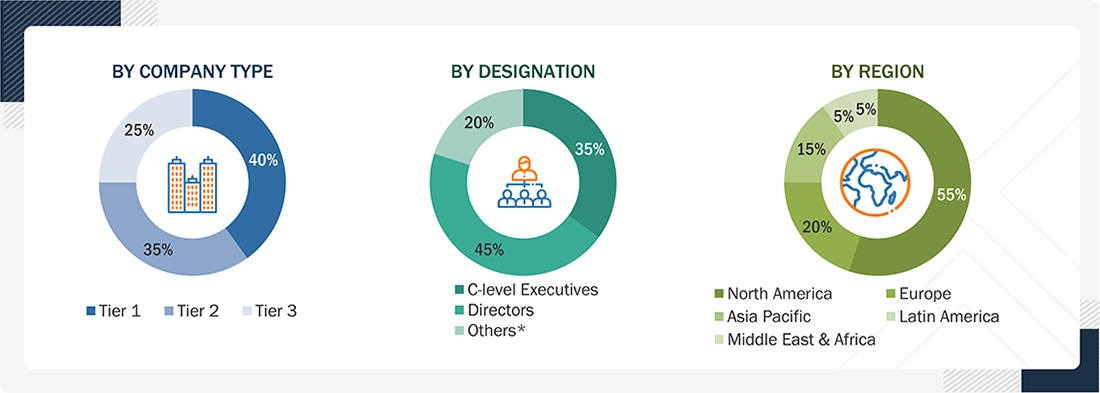
*Others include sales, marketing, and product managers.
Note: Tiers of companies are defined based on their total revenues in 2025. Tier 1 = >USD 1 billion, Tier 2 = USD 500 million to USD 1 billion, and Tier 3 = <USD 500 million.
To know about the assumptions considered for the study, download the pdf brochure
Market Size Estimation
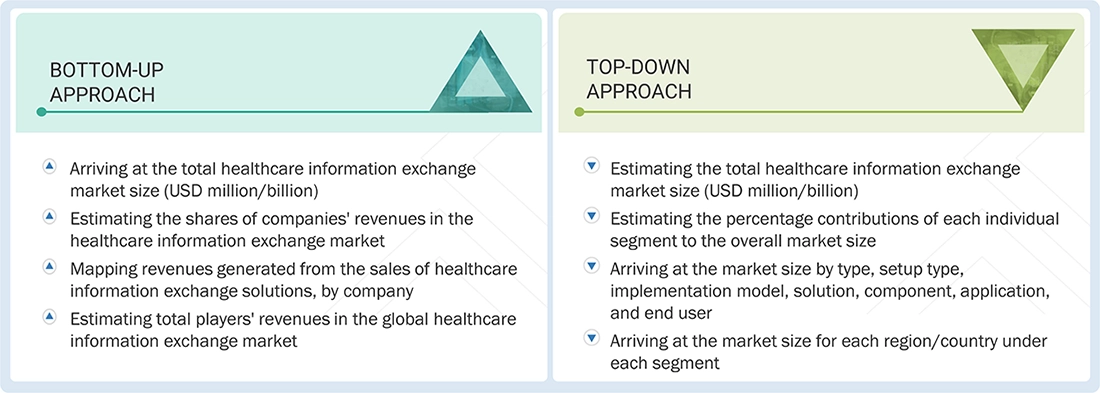
Both top-down and bottom-up approaches were used to estimate and validate the total size of the healthcare information exchange market. These methods were also widely used to estimate the sizes of various subsegments in the market. The research methodology used to estimate the market size includes the following:
- The key players in the industry and markets have been identified through extensive secondary research.
- The industry’s supply chain and market size, in terms of value, have been determined through primary and secondary research processes.
- All percentage shares, splits, and breakdowns have been determined using secondary sources and verified through primary sources.
Healthcare Information Exchange (HIE) Market : Top-Down and Bottom-Up Approach
Data Triangulation
After arriving at the overall market size, the market was segmented and subsegmented using market sizing processes. To complete the overall market engineering process and obtain the exact statistics for each market segment and sub-segment, data triangulation and market breakdown procedures were employed, as applicable. The data was triangulated by examining various factors and trends on both the demand and supply sides of the health information exchange market.
Market Definition
Healthcare information exchange (HIE) is a technology network used to electronically mobilize healthcare information across or within organizations. HIE provides the capability to electronically move clinical information among different healthcare information systems. The goal of HIE is to facilitate access to and retrieval of clinical data between healthcare providers and payers to provide safer, more timely, efficient, effective, and equitable patient-centered care, which may also be useful to public health authorities in analyzing population health. Efficient HIE networks help reduce data duplication and improve information sharing, leading to better patient experiences and care.
Key Stakeholders
- Healthcare institutions/providers (hospitals, medical groups, physicians’ practices, diagnostic centers, pharmacies, ambulatory centers, and outpatient clinics)
- Healthcare insurance companies/payers
- Healthcare IT service providers
- EHR vendors
- Health information exchange (HIE) organizations
- Healthcare data aggregators
- Venture capitalists
- Government agencies
- Healthcare startups, consultants, and regulators
- Academic medical institutes
Report Objectives
- To define, describe, and forecast the global healthcare information exchange market based on type, setup type, implementation model, solution, component, application, end user, and region
- To provide detailed information regarding the major factors (such as drivers, restraints, opportunities, and challenges) influencing the market growth
- To strategically analyze micromarkets with respect to individual growth trends, prospects, and contributions to the overall health information exchange market
- To analyze opportunities in the market for stakeholders and provide details of the competitive landscape for market leaders
- To strategically analyze the market structure, profile the key players of the healthcare information exchange market, and comprehensively analyze their core competencies
- To forecast the size of the market segments with respect to five regions: North America, Europe, Asia Pacific, Latin America, and the Middle East & Africa
- To track and analyze competitive developments such as product launches & enhancements, investments, partnerships, collaborations, acquisitions, expansions, agreements, sales contracts, and alliances in the healthcare information exchange market during the forecast period
Available customizations:
With the given market data, MarketsandMarkets offers customizations as per the company’s specific needs. The following customization options are available for the report:
Product Analysis
- Product matrix, which gives a detailed comparison of the product portfolios of each company.
Regional Analysis
-
Further breakdown of the Latin American healthcare information exchange market into specific countries
-
Further breakdown of the Middle East & Africa healthcare information exchange market into specific countries
-
Further breakdown of the Rest of Europe healthcare information exchange market into specific countries
⚡ Growth Signals
Personalize This Research
- Triangulate with your Own Data
- Get Data as per your Format and Definition
- Gain a Deeper Dive on a Specific Application, Geography, Customer or Competitor
- Any level of Personalization
Let Us Help You
- What are the Known and Unknown Adjacencies Impacting the Healthcare Information Exchange (HIE) Market
- What will your New Revenue Sources be?
- Who will be your Top Customer; what will make them switch?
- Defend your Market Share or Win Competitors
- Get a Scorecard for Target Partners


JAYANT RAJPUROHIT
Director of Market Insights, Data and Analytics
SFI Health,
Leading Pharmaceutical Company

We at SFI Health approached MarketsandMarkets for an Opportunity Assessment on "Incidence and Prevalence of Focus Indications" as we wanted to know the most attractive HCPs like Physician, Functional MD, Naturopath and Pharmacist. The project was critical for us to ensure our focus on the right target which would enable sustainable growth and profitability for SFI Health. The business insights provided exceeded our expectations and we were extremely impressed. The team at MarketsandMarkets is highly professional and detail oriented and very well understood our business needs. MarketsandMarkets offers a unique combination of expertise and dedicated engagement model. We identified 2 new products to be launched in coming months, based on the research findings provided by MarketsandMarkets. We are happy with the services and would strongly recommend MarketsandMarkets to my peers in the industry.

BEATRIZ DE LA CALLE
Head of Commercial Analytics
Qualicaps,
Leading Pharmaceutical Company

We partnered with MarketsandMarkets for an assessment study on hard empty capsules. The team was extremely professional in understanding our business requirements and we received timely responses to all our queries. The market intelligence and the recommendations has met our business requirements. We were extremely impressed to see the final study results; it really exceeded our expectations. The market intelligence offered by MarketsandMarkets, and clarity on next steps will help us achieve our business objective for the Year 2021. We are happy with the services and would strongly recommend MarketsandMarkets to my peers in the industry.

Bob Williams,
Senior Director Business Development & Innovation
Bracco Diagnostics Inc.,
Italian Multinational in life sciences sector and a World Leader in imaging diagnostics
We were pleased with targeted insights that MarketsandMarkets identified from a custom study on the 'Radiation Dose Management Solutions Market'. Your team identified and characterized the market participants as well as underlying trends accurately. This study was useful to Bracco in formulating business strategies for our dose monitoring product lines and we thank MarketsandMarkets for the job well done.
Cody Coonradt,
Market Development and Strategy Manager
3M Health Information Systems,
Leader in Health care Coding, Payment & Analytics Solutions.
The value for our organization comes from three things: depth of research, specificity of segments and being easy to work with. As important as the first two are, the third can't be underestimated. MarketsandMarkets, maybe more than any other research vendor, wants to know what is top of mind for our team and what big questions we are grappling to answer.
Their customer first approach and high value engagement model, have given us great analysis and excellent value for money

Still Researching the
Healthcare Information Exchange (HIE) Ecosystem?
See the competitors, opportunities, and growth signals shaping it - instantly.
Generate 15+ consulting-grade strategic insights tailored to your growth question.
