







- DESCRIPTION
- TABLE OF CONTENTS
- METHODOLOGY
- DOWNLOAD PDF
North America Feed Additives Market by Type (Amino Acids, Probiotics, Vitamins, Acidifiers, Enzymes, Flavors & Sweeteners, Mycotoxin Detoxifiers, Minerals, and Antioxidants), Livestock, Form, Source, Function, and Country - Forecast to 2030

USD 14.75 BN
MARKET SIZE, 2030

CAGR 4.8%
(2025-2030)

150
REPORT PAGES

150
MARKET TABLES
OVERVIEW
Source: Secondary Research, Interviews with Experts, MarketsandMarkets Analysis
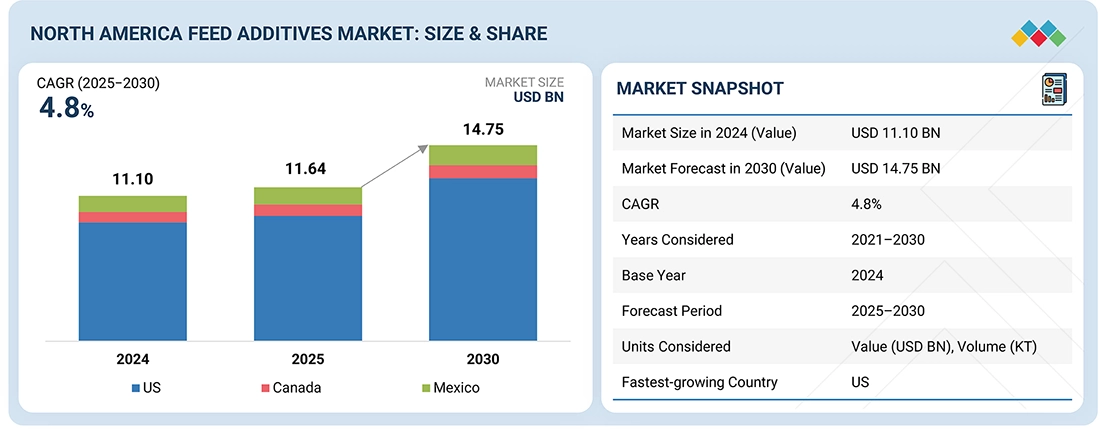
The North America feed additives market is projected to reach USD 14.75 billion by 2030 from an estimated USD 11.64 billion in 2025, at a CAGR of 4.8% from 2025 to 2030. The increasing focus on preventive health and wellness in animal nutrition/production mainly drives the market growth, along with the rising trend for plant-based and clean-label supplement ingredients. Furthermore, the expanded scope for performance enhancement in modern animal farming practices (such as aquaculture) and the sports nutrition-inspired formulation followed by lifestyle-driven fitness trends among pet owners will further support market growth.
KEY TAKEAWAYS
-
BY COUNTRY
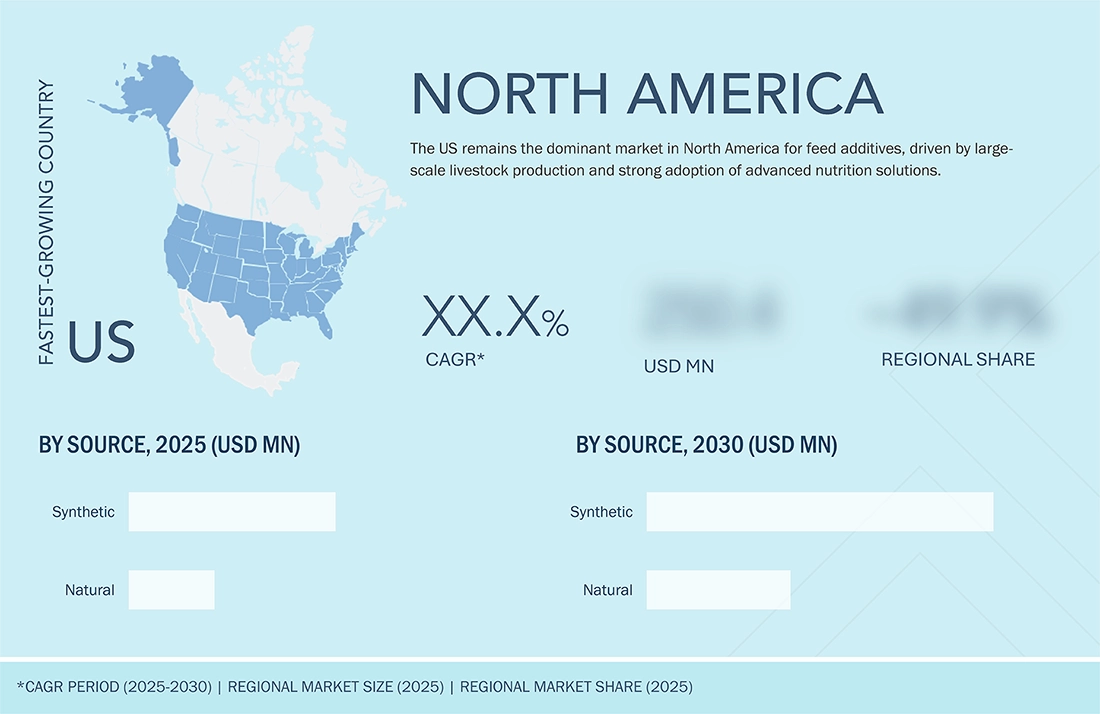
The US is estimated to account for 81.4% of the North America feed additives market in 2025.
-
BY SOURCE
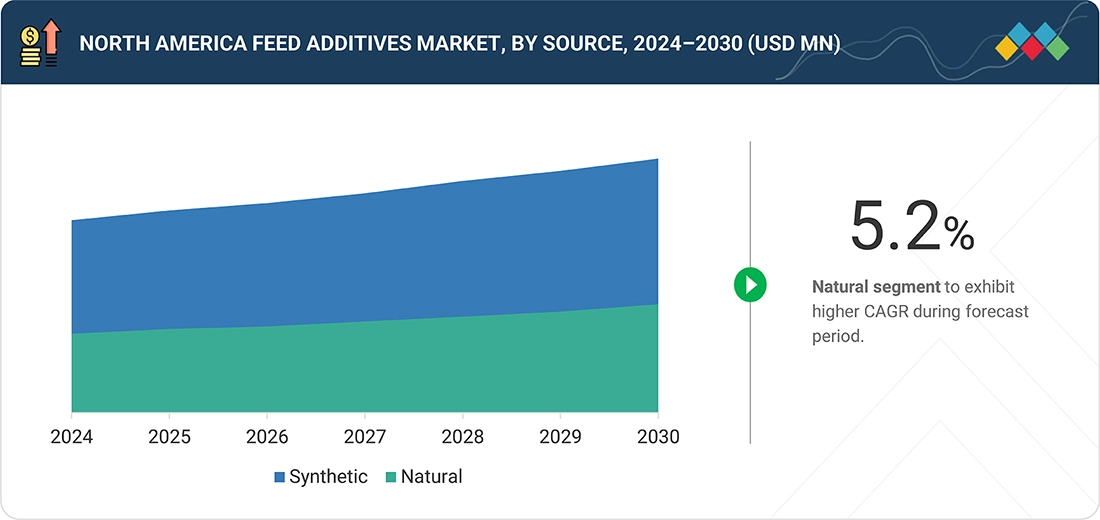
By source, the natural segment is expected to register a higher CAGR of 5.2%.
-
BY TYPE
By type, the preservatives segment is projected to grow at the highest rate from 2025 to 2030.
-
BY LIVESTOCK
By livestock, the poultry segment is estimated to lead the market.
-
BY FORM
By form, the dry segment is estimated to hold a significant market share.
-
COMPETITIVE LANDSCAPE - KEY PLAYERS
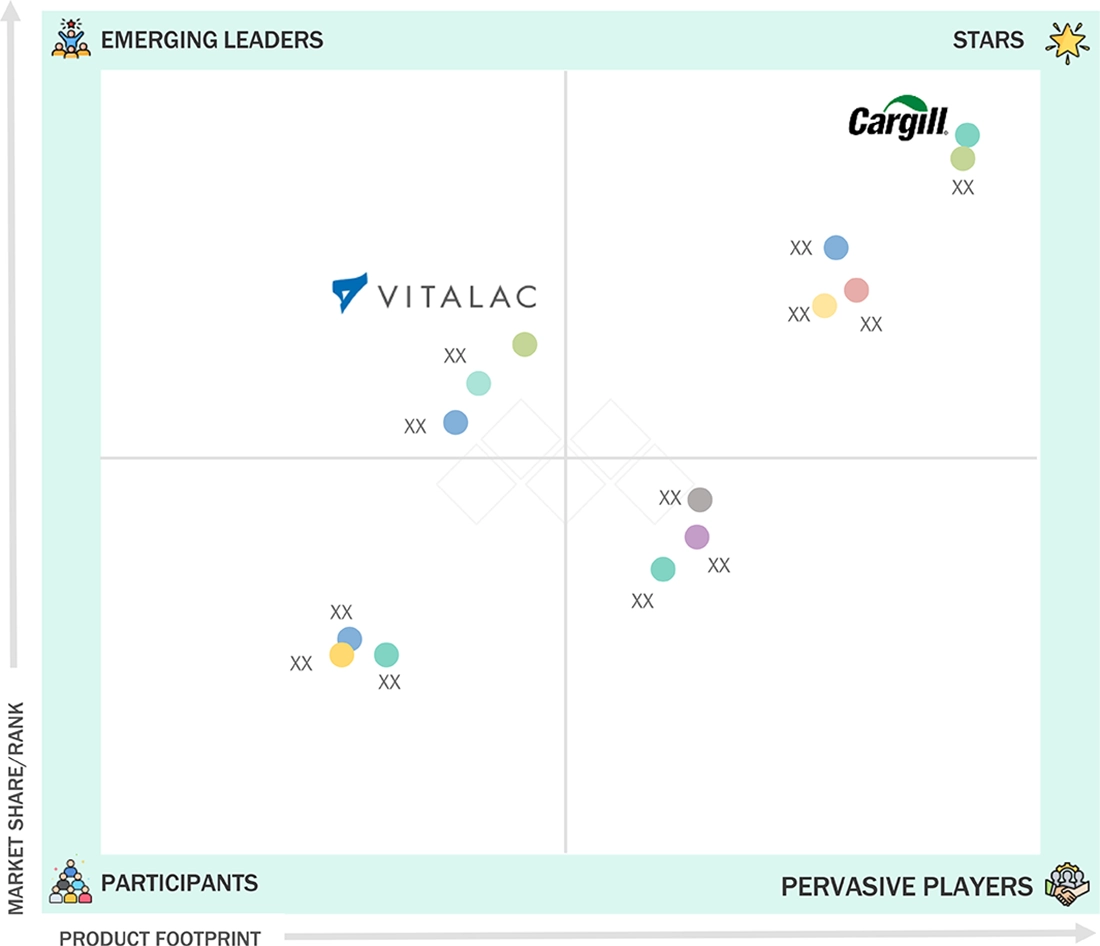
Cargill, ADM, International Flavors & Fragrances, Evonik Industries AG, and BASF SE were identified as some of the star players in the North America feed additives market, given their strong market share and product footprint.
-
COMPETITIVE LANDSCAPE - STARTUPS
VITALAC, Tex Biosciences, and Centafarm SRL, among others, have distinguished themselves among startups and SMEs by securing strong footholds in specialized niche areas, underscoring their potential as emerging market leaders.
The North America feed additives market is projected to grow steadily, supported by advancements in animal nutrition technologies and the rising focus on livestock health, productivity, and disease prevention. Increasing demand for high-quality protein, stricter food safety standards, and the shift toward sustainable and efficient feed solutions are further accelerating market expansion across the region.
TRENDS & DISRUPTIONS IMPACTING CUSTOMERS' CUSTOMERS
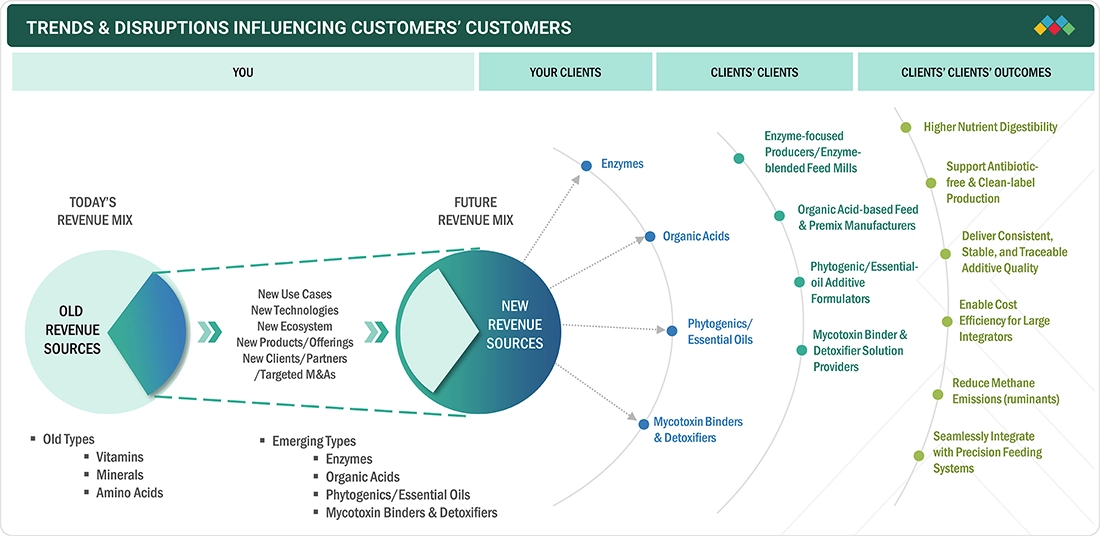
The impact on the client's business is mainly driven by the evolving consumer trends and market disruptions in the North America feed additives market. There is an expected shift in the revenue mix from the traditional feed additives to emerging offerings such as enzymes, organic acids, phytogenics, essential oils, and others. As a result, changes in go-to-market and distribution strategies are expected to significantly affect the market dynamics in the North American region.
Source: Secondary Research, Interviews with Experts, MarketsandMarkets Analysis
MARKET DYNAMICS

Drivers
Impact
Level
-
High commercialization & large industrial livestock operations

-
Shift to antibiotic-free/clean-label solutions


RESTRAINTS
Impact
Level
-
Volatility in commodity (corn/soy) prices

-
Conservative adoption by smaller family farms


OPPORTUNITIES
Impact
Level
-
Growth in value-added additives (digestibility, mycotoxin binders, acidifiers)

-
On-farm precision dosing and premix services


CHALLENGES
Impact
Level
-
Price competition from commodity premixes

-
Regulatory uncertainty for novel biotics and enzymes

Source: Secondary Research, Interviews with Experts, MarketsandMarkets Analysis
The rise of intensive, commercial-scale livestock farming in North America boosts the demand for efficient feed additives. Producers increasingly rely on additives to improve feed conversion, animal health, and overall production efficiency.
Frequent fluctuations in corn and soybean prices increase feed production costs, directly impacting additive affordability. This volatility pressures margins for both feed manufacturers and livestock producers.
Demand is rising for advanced, performance-enhancing additives that improve gut health, nutrient absorption, and toxin management. These value-added solutions offer strong opportunities as producers shift toward higher-efficiency nutrition inputs.
Low-cost commodity premixes create pricing pressure for premium additive formulators. This competition makes it harder for high-value or specialized additive products to capture market share.
NORTH AMERICA FEED ADDITIVES MARKET: COMMERCIAL USE CASES ACROSS INDUSTRIES
| COMPANY | USE CASE DESCRIPTION | BENEFITS |
|---|---|---|
|
|
Integration of amino acids, vitamins, enzymes, and organic acids into compound feed and premix formulations for poultry, swine, ruminants, and aquaculture. | Improves feed efficiency, nutrient utilization, and animal performance while supporting consistent productivity in large-scale livestock systems. |
|
|
Deployment of customized feed additive premixes and functional nutrition solutions tailored to species- and lifecycle-specific requirements. | Enhances production efficiency, supports precision feeding, and strengthens sustainability outcomes in commercial livestock operations. |
|
|
Deployment of bioscience-based feed additives, including enzymes, probiotics, and functional nutrition solutions, to improve gut health, immunity, and feed efficiency in livestock. | Enhances animal wellness and operational efficiency while supporting sustainable and performance-driven feed formulations. |


Logos and trademarks shown above are the property of their respective owners. Their use here is for informational and illustrative purposes only.
MARKET ECOSYSTEM
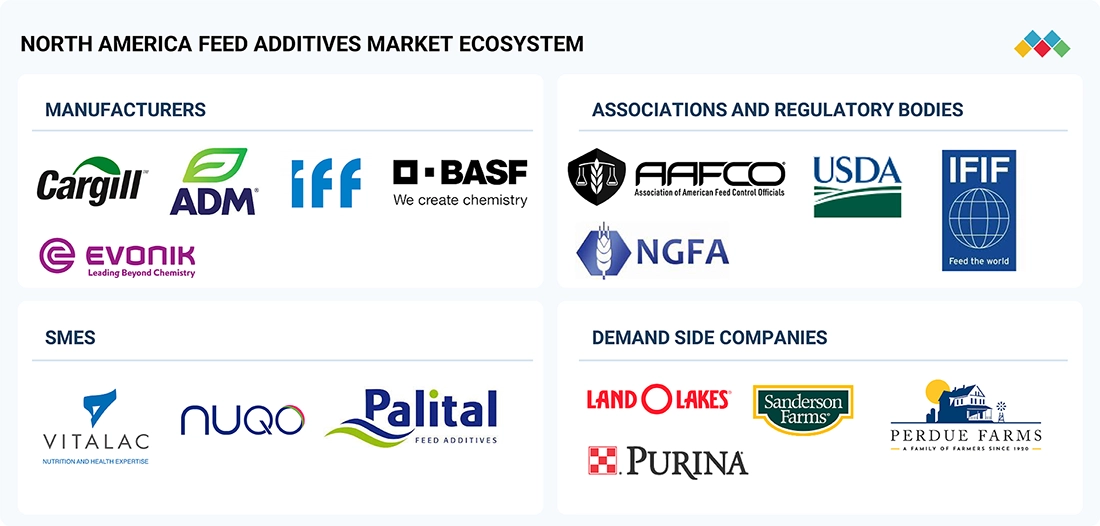
The feed additives ecosystem in North America is categorized into manufacturers, regulatory bodies, and end-use companies. The North America feed additives market is a dynamic and rapidly expanding ecosystem characterized by diverse stakeholders and innovative products. Established companies and agile startups are central to this market, developing feed additive products in the region.
Logos and trademarks shown above are the property of their respective owners. Their use here is for informational and illustrative purposes only.
MARKET SEGMENTS
Source: Secondary Research, Interviews with Experts, MarketsandMarkets Analysis
The natural-based feed additives segment is expected to grow at a higher rate than the synthetic segment, supported by the rising shift toward clean-label, sustainable, and antibiotic-free livestock nutrition.
The preservatives segment is projected to witness the fastest growth, driven by the increasing need to enhance feed stability and prevent spoilage across intensive livestock operations.
The poultry segment is estimated to dominate the market, as poultry producers increasingly rely on additives to improve feed efficiency, immunity, and overall flock performance.
The dry segment is estimated to hold a significant market share, owing to its convenience in handling, longer shelf life, and widespread use in commercial feed manufacturing.
REGION
US to dominate North America feed additives market during forecast period
The US is estimated to account for the largest share of the North America feed additives market in 2025, driven by large-scale commercial livestock production, advanced feed manufacturing infrastructure, and high adoption of performance-enhancing additives.
NORTH AMERICA FEED ADDITIVES MARKET: COMPANY EVALUATION MATRIX
In the North America feed additives market landscape, Cargill and ADM (Stars) lead with a strong market presence supported by their extensive production capabilities, broad feed additive portfolios, and well-established distribution networks across livestock sectors. Their scale, innovation in nutrition solutions, and deep integration with large commercial farming operations reinforce their dominant position. Emerging players such as NUQO Feed Additives (Emerging Leaders) are gaining visibility through specialized solutions like botanicals and functional additives, strengthening their position with targeted, high-value offerings tailored to evolving animal health and performance needs.
Source: Secondary Research, Interviews with Experts, MarketsandMarkets Analysis
KEY MARKET PLAYERS
- Cargill, Incorporated (US)
- ADM (US)
- International Flavors & Fragrances Inc. (US)
- Evonik Industries AG (Germany)
- BASF SE (Germany)
- dsm-firmenich (Switzerland)
- Ajinomoto Co., Inc. (Japan)
- Novonesis Group (Denmark)
- Adisseo (France)
- Jubilant Ingrevia Limited (India)
- Nutreco (Netherlands)
- Kemin Industries, Inc. (US)
- Lallemand Inc. (Canada)
- BRF Global (Brazil)
- Bentoli (US)
- Alltech (US)
- Neospark Drugs and Chemicals Private Limited (India)
- Volac International Ltd. (England)
- Global Nutrition International (France)
- Novus International, Inc. (US)
MARKET SCOPE
| REPORT METRIC | DETAILS |
|---|---|
| Market Size in 2024 (Value) | USD 11.10 Billion |
| Market Forecast in 2030 (Value) | USD 14.75 Billion |
| Growth Rate | CAGR of 4.8% from 2025 to 2030 |
| Years Considered | 2021–2030 |
| Base Year | 2024 |
| Forecast Period | 2025–2030 |
| Units Considered | Value (USD Billion), Volume (KT) |
| Report Coverage | Revenue Forecast, Company Ranking, Competitive Landscape, Growth Factors, and Trends |
| Segments Covered |
|
| Countries Covered | US, Canada, Mexico |
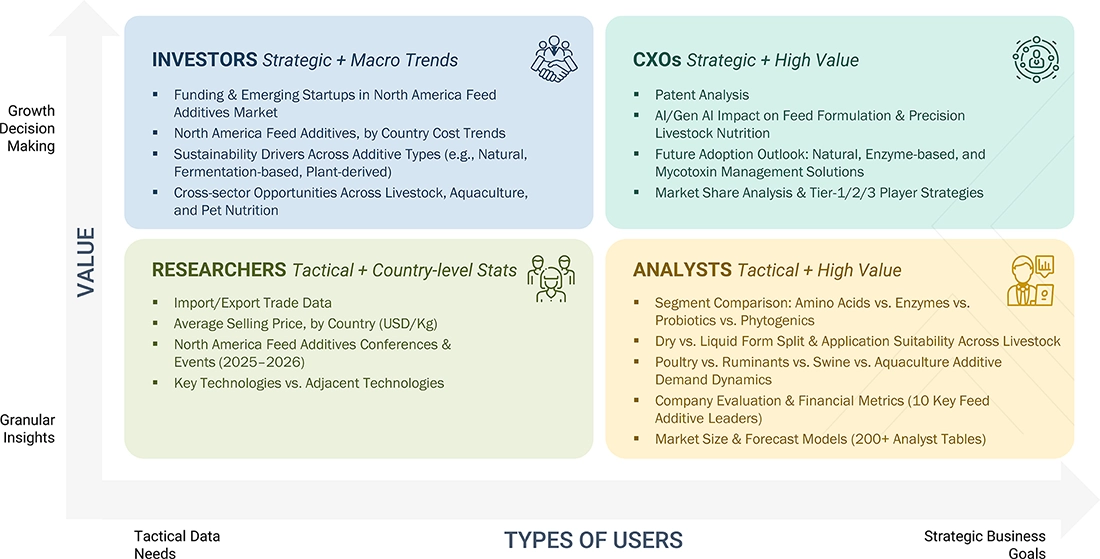
WHAT IS IN IT FOR YOU: NORTH AMERICA FEED ADDITIVES MARKET REPORT CONTENT GUIDE
DELIVERED CUSTOMIZATIONS
We have successfully delivered the following deep-dive customizations:
| CLIENT REQUEST | CUSTOMIZATION DELIVERED | VALUE ADDS |
|---|---|---|
| US-based Feed Additive Manufacturers | Detailed feed additives analysis by source (natural vs. synthetic), additive types (amino acids, enzymes, probiotics, preservatives, etc.), competitive landscape, and key manufacturer profiling (financial performance, production capacity, product portfolio mapping). Customer landscape assessment by livestock category (poultry, ruminants, swine, aquaculture) and distribution channels. Market share benchmarking, pricing analysis, and regulatory environment review for feed additives in the US and Canada. | Identified & profiled 20+ feed additive manufacturers operating in North America, including integrators, mills, and specialty additive suppliers. Tracked adoption trends in high-growth additive categories (enzymes, probiotics, phytogenics, mycotoxin binders). Highlighted emerging livestock clusters and demand pockets driven by sustainability mandates, antibiotic reduction policies, and precision nutrition initiatives. |
| Feed Additives, Type & Application Segment Assessment | Segmentation of feed additive demand across major livestock groups (poultry, ruminants, swine, aquaculture, and others). Benchmarking adoption across additive types such as amino acids, enzymes, mycotoxin detoxifiers, phytogenics, and probiotics. Switching barrier analysis for feed mills and integrators (cost sensitivity, proven efficacy, regulatory compliance, and formulation compatibility). | Delivered revenue share & growth outlook for key additive categories across different livestock species. Identified substitution risks & opportunities in cost-sensitive segments (e.g., synthetic vs. natural additives, antibiotics vs. probiotics). Mapped regulatory frameworks across North America, highlighting compliance pathways and ingredient approval requirements. |
RECENT DEVELOPMENTS
-
September 2025: ADM and Alltech announced the signing of a definitive agreement to form a North American animal feed joint venture, marking a culmination of their collective decades of experience and unique strengths for the betterment of their clientele.
Contributions from Alltech would include Hubbard Feeds based in the U.S. and Canada-based Masterfeeds, and 17 feed mills based in the U.S. and 15 based in Canada, while ADM would contribute 11 feed mills based in the U.S. The joint venture would be controlled by Alltech and would have an equal board representation from each of the contributing firms.
- January 2025: Axitan & QualiTech entered into a strategic partnership to develop and market Endolysin enzyme products for poultry, swine & ruminant segments. This product is expected to replace antibiotics in animal feed. The products will be distributed in North America, and it is expected to resolve pathogenic issues in the swine & ruminant segments.
- June 2024: Kemin Industries introduced FORMYL, a new feed acidifier for swine in the US. This product combines encapsulated calcium formate and citric acid to enhance gut health, combat pathogens, and improve digestion. Designed to reduce gastrointestinal pH and the incidence of diarrhea, FORMYL offers a non-antibiotic solution that ensures effective delivery and safer handling, aligning with Kemin’s focus on innovative, sustainable animal nutrition solutions.
- June 2024: Novus International, Inc. (US) & BioResource International, Inc. (US) enhanced its feed additives portfolio with the acquisition of BioResource International, Inc. (BRI), integrating BRI’s fermentation expertise with NOVUS’ CIBENZA Enzyme Feed Additive. This expansion helps improve feed formulations, enhancing animal nutrition and performance while addressing sustainability challenges in the global feed additives market.
- April 2024: Alltech introduced Bioplex Aqua Boost, enhancing its Bioplex minerals line. This innovative, highly bioavailable chelated mineral pack is designed for improved water solubility and addresses the trace mineral needs of fish and shrimp.
Table of Contents
 Exclusive indicates content/data unique to MarketsandMarkets and not available with any competitors.
TITLE
PAGE NO
1
INTRODUCTION
15
2
EXECUTIVE SUMMARY
3
PREMIUM INSIGHTS
4
MARKET OVERVIEW
4.1
INTRODUCTION
4.2
MARKET DYNAMICS
4.2.1
DRIVERS
4.2.1.1
HIGH COMMERCIALIZATION & LARGE INDUSTRIAL LIVESTOCK OPERATIONS
4.2.1.2
SHIFT TO ANTIBIOTIC-FREE/CLEAN LABEL SOLUTIONS
4.2.1.3
PRECISION NUTRITION & FORMULATION TECH
4.2.2
RESTRAINTS
4.2.2.1
VOLATILITY IN COMMODITY (CORN/SOY) PRICES
4.2.2.2
CONSERVATIVE ADOPTION BY SMALLER FAMILY FARMS
4.2.2.3
SUPPLY-CHAIN & MANUFACTURING CONSOLIDATION
4.2.3
OPPORTUNITIES
4.2.3.1
GROWTH IN VALUE-ADDED ADDITIVES (DIGESTIBILITY, MYCOTOXIN BINDERS, ACIDIFIERS)
4.2.3.2
ON-FARM PRECISION DOSING AND PREMIX SERVICES
4.2.3.3
FORMULATIONS FOR ALTERNATIVE PROTEINS
4.2.4
CHALLENGES
4.2.4.1
PRICE COMPETITION FROM COMMODITY PREMIXES
4.2.4.2
REGULATORY UNCERTAINTY FOR NOVEL BIOTICS AND ENZYMES
4.2.4.3
CONSOLIDATION AMONG INTEGRATORS
4.3
UNMET NEEDS AND WHITE SPACES
4.4
INTERCONNECTED MARKETS AND CROSS-SECTOR OPPORTUNITIES
4.5
STRATEGIC MOVES BY TIER-1/2/3 PLAYERS
5
INDUSTRY TRENDS
5.1
PORTER’S FIVE FORCES ANALYSIS
5.1.1
INTENSITY OF COMPETITIVE RIVALRY
5.1.2
THREAT OF NEW ENTRANTS
5.1.3
THREAT OF SUBSTITUTES
5.1.4
BARGAINING POWER OF SUPPLIERS
5.1.5
BARGAINING POWER OF BUYERS
5.2
MACROECONOMICS INDICATORS
5.2.1
RISING DEMAND FOR COMPOUND FEED
5.2.2
LIVESTOCK & POULTRY PRODUCTION VOLUMES
5.2.3
FEED RAW-MATERIAL PRICES (CORN & SOYBEAN MEAL)
5.3
VALUE CHAIN ANALYSIS
5.3.1
RESEARCH AND PRODUCT DEVELOPMENT
5.3.2
RAW MATERIAL SOURCING
5.3.3
PROCESSING AND MANUFACTURING OPERATIONS
5.3.4
DISTRIBUTION AND LOGISTICS
5.3.5
END-USER SEGMENTS AND CONSUMPTION PATTERNS
4.3.6
VALUE ADDED ACROSS VALUE CHAIN
5.4
ECOSYSTEM ANALYSIS
5.4.1
DEMAND SIDE
5.4.2
SUPPLY SIDE
5.5
PRICING ANALYSIS
5.5.1
AVERAGE SELLING PRICE TREND OF TYPE, BY KEY PLAYERS (2024)
5.5.2
AVERAGE SELLING PRICE TREND, BY COUNTRY (2021-2024)
5.6
TRADE ANALYSIS
5.6.1
EXPORT SCENARIO (HS CODE 230990) – MAJOR EXPORTING COUNTRIES & REGIONS
5.6.2
IMPORT SCENARIO (HS CODE 230990) – MAJOR IMPORTING COUNTRIES & REGIONS
5.7
KEY CONFERENCES AND EVENTS IN 2025–2026
5.8
TRENDS/DISRUPTIONS IMPACTING CUSTOMER BUSINESS
5.9
INVESTMENT AND FUNDING SCENARIO
5.10
CASE STUDY ANALYSIS
5.11
IMPACT OF 2025 US TARIFF – NORTH AMERICA FEED ADDITIVES MARKET
5.11.1
INTRODUCTION
5.11.2
KEY TARIFF RATES
5.11.3
PRICE IMPACT ANALYSIS
5.11.4
IMPACT ON COUNTRIES
5.11.4.1
US
5.11.4.2
CANADA
5.11.4.3
MEXICO
5.11.5
IMPACT ON END-USE INDUSTRIES
6
STRATEGIC DISRUPTION THROUGH TECHNOLOGY, PATENTS, DIGITAL, AND AI ADOPTIONS
6.1
KEY TECHNOLOGIES
6.1.1
PRECISION ENZYME FORMULATIONS
6.1.2
NEXT-GENERATION PROBIOTICS & SPORE-FORMING STRAINS
6.1.3
ENCAPSULATION & CONTROLLED-RELEASE SYSTEMS
6.2
COMPLEMENTARY TECHNOLOGIES
6.2.1
PRECISION LIVESTOCK NUTRITION & RATION FORMULATION SOFTWARE
6.2.2
FEED MILL PROCESS OPTIMIZATION SYSTEMS
6.3
ADJACENT TECHNOLOGIES
6.3.1
DATA-DRIVEN LIVESTOCK PERFORMANCE MONITORING PLATFORMS
6.3.2
ANIMAL HEALTH DIAGNOSTICS (RAPID MICROBIOME & PATHOGEN TESTS)
6.4
TECHNOLOGY/PRODUCT ROADMAP
6.5
PATENT ANALYSIS
6.5.1
LIST OF MAJOR PATENTS PERTAINING TO MARKET
6.6
IMPACT OF GEN AI ON NORTH AMERICA FEED ADDITIVES MARKET
6.6.1
TOP USE CASES AND MARKET POTENTIAL
6.6.2
BEST PRACTICE FOLLOWED BY MANUFACTURERS
6.6.3
CASE STUDY RELATED TO AI IMPLEMENTATION IN NORTH AMERICA FEED ADDITIVES MARKET
6.6.4
INTERCONNECTED ECOSYSTEM AND IMPACT ON MARKET PLAYERS
6.6.5
CLIENT READINESS TO ADOPT AI-INTEGRATED FEED ADDITIVES
6.7
SUCCESS STORIES AND REAL-WORLD APPLICATIONS
7
REGULATORY AND SUSTAINABILITY LANDSCAPE
7.1
REGIONAL REGULATIONS AND COMPLIANCE
7.1.1
REGULATORY BODIES, GOVERNMENT AGENCIES, AND OTHER ORGANIZATIONS
7.1.2
INDUSTRY STANDARDS
7.2
SUSTAINABILITY INITIATIVES
7.3
IMPACT OF REGULATORY POLICIES ON SUSTAINABILITY INITIATIVES
8
CUSTOMER LANDSCAPE AND BUYER BEHAVIOR
8.1
DECISION-MAKING PROCESS
8.2
BUYER STAKEHOLDERS AND BUYING EVALUATION CRITERIA
8.3
ADOPTION BARRIERS & INTERNAL CHALLENGES
8.4
UNMET NEEDS FROM VARIOUS END-USE INDUSTRIES
8.5
MARKET PROFITABILITY
9
NORTH AMERICA FEED ADDITIVES MARKET, BY TYPE
(COMPARATIVE ASSESSMENT OF KEY FEED ADDITIVE TYPES, THEIR MARKET POTENTIAL, AND DEMAND PATTERNS BY VARIOUS SUPPLIER COMPANIES)
9.1
INTRODUCTION
9.2
AMINO ACIDS
9.2.1
LYSINE
9.2.2
METHIONINE
9.2.3
THREONINE
9.2.4
TRYPTOPHAN
9.2.5
OTHER AMINO ACIDS
9.3
PHOSPHATES
9.3.1
MONOCALCIUM PHOSPHATE
9.3.2
DICALCIUM PHOSPHATE
9.3.3
MONO-DICALCIUM PHOSPHATE
9.3.4
DEFLUORINATED PHOSPHATE
9.3.5
TRICALCIUM PHOSPHATE
9.3.6
OTHER PHOSPHATES
9.4
VITAMINS
9.4.1
FAT-SOLUBLE VITAMINS
9.4.2
WATER-SOLUBLE VITAMINS
9.5
ACIDIFIERS
9.5.1
PROPIONIC ACID
9.5.2
FORMIC ACID
9.5.3
CITRIC ACID
9.5.4
LACTIC ACID
9.5.5
SORBIC ACID
9.5.6
MALIC ACID
9.5.7
BENZOIC ACID
9.5.8
OTHER ACIDIFIERS
9.6
CAROTENOIDS
9.6.1
ASTAXANTHIN
9.6.2
CANTHAXANTHIN
9.6.3
LUTEIN
9.6.4
BETA CAROTENE
9.6.5
OTHER CAROTENOIDS
9.7
ENZYMES
9.7.1
PHYTASE
9.7.2
CARBOHYDRASE
9.7.3
PROTEASE
9.7.4
OTHER ENZYMES
9.9
MYCOTOXIN DETOXIFIERS
9.9.1
BINDERS
9.9.2
MODIFIERS
9.9
FLAVORS & SWEETENERS
9.9.1
FEED FLAVORS
9.9.2
FEED SWEETENERS
9.10
ANTIBIOTICS
9.10.1
TETRACYCLINE
9.10.2
PENICILLIN
9.10.3
OTHER ANTIBIOTICS
9.11
MINERALS
9.11.1
POTASSIUM
9.11.2
CALCIUM
9.11.3
PHOSPHORUS
9.11.4
MAGNESIUM
9.11.5
SODIUM
9.11.6
IRON
9.11.7
ZINC
9.11.8
COPPER
9.11.9
MANGANESE
9.11.10
OTHER MINERALS
9.12
ANTIOXIDANTS
9.12.1
SYNTHETIC
9.12.2
NATURAL
9.13
NON-PROTEIN NITROGEN
9.13.1
UREA
9.13.2
AMMONIA
9.13.3
OTHER NON-PROTEIN NITROGEN
9.14
PHYTOGENIC
9.14.1
ESSENTIAL OILS
9.14.2
FLAVONOIDS
9.14.3
SAPONINS
9.14.4
OLEORESINS
9.14.5
OTHER PHYTOGENICS
9.15
PRESERVATIVES
9.15.1
MOLD INHIBITORS
9.15.2
ANTICAKING AGENTS
9.16
PROBIOTICS
9.16.1
LACTOBACILLI
9.16.2
BIFIDOBACTERIA
9.16.3
STREPTOCOCCUS THERMOPHILUS
9.16.4
YEAST & FUNGI
10
NORTH AMERICA FEED ADDITIVES MARKET, BY LIVESTOCK
(COMPARATIVE ASSESSMENT OF LIVESTOCK, THEIR MARKET POTENTIAL, AND DEMAND IN FEED ADDITIVES SEGMENT)
10.1
INTRODUCTION
10.2
POULTRY
10.2.1
BROILERS
10.2.2
LAYERS
10.2.3
BREEDERS
10.3
RUMINANTS
10.3.1
CALF
10.3.2
DAIRY
10.3.3
BEEF
10.3.4
OTHER RUMINANTS
10.4
SWINE
10.4.1
STARTER
10.4.2
GROWER
10.4.3
SOW
10.5
AQUATIC ANIMALS
10.5.1
FISH
10.5.2
CRUSTACEANS
10.5.3
MOLLUSKS
10.5.4
OTHER AQUATIC ANIMALS
10.6
OTHER LIVESTOCK (EQUINE & PETS)
11
NORTH AMERICA FEED ADDITIVES MARKET, BY SOURCE
(DEMAND FOR FEED ADDITIVES BY SOURCES AND GROWTH PATHWAY SHAPING MARKET)
11.1
INTRODUCTION
11.2
NATURAL
11.3
SYNTHETIC
12
NORTH AMERICA FEED ADDITIVES MARKET, BY FORM
(FORM-WISE DEMAND POTENTIAL AND GROWTH PATHWAYS SHAPING FEED ADDITIVES ADOPTION)
12.1
INTRODUCTION
12.2
DRY
12.3
LIQUID
13
NORTH AMERICA FEED ADDITIVES MARKET, BY FUNCTION
13.1
INTRODUCTION
13.2
GUT HEALTH
13.3
PALATABILITY ENHANCERS
13.4
GROWTH BOOSTERS
13.5
IMMUNE SYSTEM SUPPORT
13.6
OTHER FUNCTIONS
14
NORTH AMERICA FEED ADDITIVES MARKET, BY COUNTRY
(ASSESSING MARKET POTENTIAL AND GROWTH PATTERNS ACROSS KEY COUNTRIES)
14.1
US
14.2
CANADA
14.3
MEXICO
15
COMPETITIVE LANDSCAPE
(STRATEGIC ASSESSMENT OF LEADING PLAYERS, MARKET SHARE, REVENUE ANALYSIS, COMPANY POSITIONING, AND COMPETITIVE BENCHMARKS INFLUENCING MARKET POTENTIAL)
15.1
OVERVIEW
15.2
KEY PLAYERS STRATEGIES/RIGHT TO WIN, 2022–2025
15.3
REVENUE ANALYSIS, 2022–2024
15.4
MARKET SHARE ANALYSIS,
15.5
PRODUCT COMPARISON
15.6
COMPANY VALUATION AND FINANCIAL METRICS
15.7
COMPANY EVALUATION MATRIX: KEY PLAYERS,
15.7.1
STARS
15.7.2
EMERGING LEADERS
15.7.3
PERVASIVE PLAYERS
15.7.4
PARTICIPANTS
15.7.5
COMPANY FOOTPRINT: KEY PLAYERS,
15.7.5.1
COMPANY FOOTPRINT
15.7.5.2
TYPE FOOTPRINT
15.7.5.3
LIVESTOCK FOOTPRINT
15.7.5.4
FORM FOOTPRINT
15.8
COMPANY EVALUATION MATRIX: STARTUPS/SMES,
15.8.1
PROGRESSIVE COMPANIES
15.8.2
RESPONSIVE COMPANIES
15.8.3
DYNAMIC COMPANIES
15.8.4
STARTING BLOCKS
15.8.5
COMPETITIVE BENCHMARKING: STARTUPS/SMES,
15.8.5.1
DETAILED LIST OF KEY STARTUPS/SMES
15.8.5.2
COMPETITIVE BENCHMARKING OF KEY STARTUPS/SMES
15.9
COMPETITIVE SCENARIO
15.9.1
NEW PRODUCT LAUNCHES
15.9.2
DEALS
15.9.3
EXPANSIONS
15.9.4
OTHERS
16
COMPANY PROFILES
(IN-DEPTH REVIEW OF COMPANIES, PRODUCTS, RECENT INITIATIVES, AND POSITIONING STRATEGIES IN THE NORTH AMERICA FEED ADDITIVES MARKET LANDSCAPE)
16.1
KEY PLAYERS
16.1.1
CARGILL, INCORPORATED
16.1.2
ADM
16.1.3
IFF
16.1.4
BASF SE
16.1.5
DSM-FIRMENICH
16.1.6
NUTRECO
16.1.7
KEMIN INDUSTRIES, INC.
16.1.8
ALLTECH
16.1.9
LALLEMAND INC.
16.1.10
NOVUS INTERNATIONAL, INC.
16.2
STARTUPS/SMES
16.2.1
BENTOLI
16.2.2
ADISSEO
16.2.3
LAND O'LAKES INC. (PURINA MILLS)
16.2.4
BRF GLOBAL
16.2.5
GLOBAL NUTRITION INTERNATIONAL
16.2.6
VOLAC INTERNATIONAL LTD.
16.2.7
VITALAC
16.2.8
NUQO FEED ADDITIVES
16.2.9
PHYTOBIOTICS FUTTERZUSATZSTOFFE GMBH
16.2.10
NOREL S.A.
17
RESEARCH METHODOLOGY
17.1
RESEARCH DATA
17.1.1
SECONDARY DATA
17.1.1.1
KEY DATA FROM SECONDARY SOURCES
17.1.2
PRIMARY DATA
17.1.2.1
KEY DATA FROM PRIMARY SOURCES
17.1.2.2
KEY INDUSTRY INSIGHTS
17.1.2.3
BREAKDOWN OF PRIMARIES
17.2
MARKET SIZE ESTIMATION
17.2.1
BOTTOM-UP APPROACH
17.2.1.1
APPROACH FOR CAPTURING MARKET SHARE BY BOTTOM-UP ANALYSIS
17.2.2
TOP-DOWN APPROACH
17.2.2.2
APPROACH FOR CAPTURING MARKET SHARE BY TOP-UP ANALYSIS
17.3
MARKET BREAKDOWN AND DATA TRIANGULATION
17.4
RESEARCH ASSUMPTIONS
17.5
RISK ASSESSMENT
17.6
RESEARCH LIMITATIONS
18
ADJACENT & RELATED MARKETS
19
APPENDIX
19.1
DISCUSSION GUIDE
19.2
KNOWLEDGE STORE: MARKETSANDMARKETS’ SUBSCRIPTION PORTAL
19.3
CUSTOMIZATION OPTIONS
19.4
RELATED REPORTS
19.5
AUTHOR DETAILS
Methodology
The study involved two major approaches in estimating the current size of the North America Feed Additives Market. Exhaustive secondary research was done to collect information on the market, peer, and parent markets. The next step was to validate these findings, assumptions, and sizing with industry experts across the value chain through primary research. Both top-down and bottom-up approaches were employed to estimate the complete market size. After that, market breakdown and data triangulation were used to estimate the market size of segments and subsegments.
Secondary Research
This research study involved the extensive use of secondary sources—directories and databases such as Bloomberg Businessweek and Factiva—to identify and collect information useful for a technical, market-oriented, and commercial study of the market.
In the secondary research process, various sources such as annual reports, press releases & investor presentations of companies, white papers, food journals, certified publications, articles from recognized authors, directories, and databases were referred to identify and collect information.
Secondary research was mainly used to obtain key information about the industry’s supply chain, the total pool of key players, and market classification and segmentation as per the industry trends to the bottom-most level, regional markets, and key developments from both market- and technology-oriented perspectives.
Primary Research
Extensive primary research was conducted after obtaining information regarding the North America Feed Additives Market scenario through secondary research. Primary data was collected through questionnaires, emails, and telephonic interviews. The primary sources from the supply side included various industry experts, such as Chief X Officers (CXOs), Vice Presidents (VPs), Directors from business development, marketing, research, and development teams, and related key executives from distributors and key opinion leaders. Primary interviews were conducted to gather insights such as market statistics, data on revenue collected from the products and services, market breakdowns, market size estimations, market forecasting, and data triangulation. Primary research also helped in understanding the various trends related to feed additives by livestock, type, form, source, functions, and regions. Stakeholders from the demand side, such as livestock growers who are using feed additives, were interviewed to understand the buyer’s perspective on the suppliers, products, and their current usage of feed additives and the outlook of their business, which will affect the overall market.
|
COMPANY NAME |
DESIGNATION |
|
Cargill, Incorporated (US) |
General Manager |
|
ADM (US) |
Sales Manager |
|
dsm-firmenich (Switzerland) |
Manager |
|
International Flavors & Fragrances Inc (US) |
Head of processing department |
|
BASF SE (Germany) |
Marketing Manager |
|
Ajinomoto Co. Inc (Japan) |
Sales Executive |
Market Size Estimation
Both the top-down and bottom-up approaches were used to estimate and validate the total size of the North America Feed Additives Market. These approaches were also used extensively to determine the size of various subsegments in the market. The research methodology used to estimate the market size includes the following details:
- The key players in the industry and the overall markets were identified through extensive secondary research.
- All shares, splits, and breakdowns were determined using secondary sources and verified through primary sources.
- All possible parameters that affect the market covered in this research study were accounted for, viewed in extensive detail, verified through primary research, and analyzed to obtain final quantitative and qualitative data.
Feed Additives Market : Top-Down and Bottom-Up Approach
Data Triangulation
After arriving at the overall market size from the estimation process explained above, the total market was split into several segments and subsegments. The data triangulation and market breakdown procedures were employed, wherever applicable, to estimate the overall North America Feed Additives Market and arrive at the exact statistics for all segments and subsegments. The data was triangulated by studying various factors and trends from the demand and supply sides. The market size was also validated using both the top-down and bottom-up approaches.
Market Definition
According to the European Food Safety Authority, “Feed additives are products used in animal nutrition to achieve an effect on the feed itself, on the animals, on food products obtained from the animals consuming the feed additive, or on the environment. For instance, feed additives are used to enhance flavor of feed, to meet the need for certain nutrients, or to increase the performance of animals in good health. They are used in feed for food-producing animals and in pet food.”
According to the European Commission, “Feed additives are defined as products used in animal nutrition for the purpose of improving the quality of feed and the quality of food from animal origin, or to improve the animals’ performance and health, e.g., providing enhanced digestibility of the feed materials. Feed additives may not be put on the market unless authorization has been given, following a scientific evaluation demonstrating that the additive has no harmful effects on human and animal health and the environment.”
Stakeholders
- Feed manufacturers
- Dairy, poultry farms, and livestock farms
- Feed importers and exporters
- Intermediary suppliers such as traders and distributors of feed additives such as amino acids, phosphates, enzymes, vitamins, acidifiers, carotenoids, mycotoxin detoxifiers, flavors & sweeteners, antibiotics, minerals, antioxidants, nonprotein nitrogen, phytogenics, preservatives, and probiotics
- Government and research organizations
-
Associations and industry bodies:
- Food and Agriculture Organization (FAO)
- United States Department of Agriculture (USDA)
- European Food Safety Authority (EFSA)
- European Association of Specialty Feed Ingredients and their Mixtures (FEFANA)
- International Feed Industry Federation (IFIF)
- Organization for Economic Co-operation and Development (OECD)
- Animal Feed Manufacturers Association (AFMA)
- The Irish Grain and Feed Association (IGFA)
- National Grain and Feed Association (NGFA)
- The Compound Feed Manufacturers Association (CLFMA)
- Brazilian Poultry Association and the Brazilian Chicken Producers and Exporters Association (UBABEF)
- Japan Feed Manufacturers Association (JAFMA)
- Animal Nutrition Association of Canada (ANAC)
Report Objectives
- To determine and project the size of the North America Feed Additives Market with respect to the livestock, type, source, form, functions (qualitative), and regions in terms of value over five years, ranging from 2024 to 2029.
- To identify the attractive opportunities in the market by determining the largest and fastest-growing segments across regions.
- To provide detailed information about the key factors influencing market growth (drivers, restraints, opportunities, and challenges)
- To analyze the opportunities in the market for stakeholders and provide details of the competitive landscape for market leaders.
- To analyze the micro-markets with respect to individual growth trends, prospects, and their contribution to the total market.
- To identify and profile the key players in the North America Feed Additives Market.
- To understand the competitive landscape and identify the major growth strategies adopted by players across the key regions.
This research report categorizes the North America Feed Additives Market based on livestock, type, form, source, functions (qualitative) and region.
Available Customizations
With the given market data, MarketsandMarkets offers customizations according to company-specific scientific needs.
The following customization options are available for the report:
Product Analysis
- Product Matrix, which gives a detailed comparison of the product portfolio of each company.
Company Information
- Detailed analyses and profiling of additional market players (up to five)
⚡ Growth Signals
Personalize This Research
- Triangulate with your Own Data
- Get Data as per your Format and Definition
- Gain a Deeper Dive on a Specific Application, Geography, Customer or Competitor
- Any level of Personalization
Let Us Help You
- What are the Known and Unknown Adjacencies Impacting the North America Feed Additives Market
- What will your New Revenue Sources be?
- Who will be your Top Customer; what will make them switch?
- Defend your Market Share or Win Competitors
- Get a Scorecard for Target Partners


Business Innovation Director
US Based Leading Agribusiness,
Food and Ingredients Manufacturer
I highly appreciate the team's efficiency for a well-conducted study that helped us clarify some blind spots in the area of proteins. Although compiling information for B2B ingredients is very difficult, the MnM team pulled out the task successfully. The quality of research, level of insights, and the responsiveness of the team were commendable!
What the North America Feed Additives Report Didn't Show You?
Explore the strategic intelligence behind the North America Feed Additives Market
- 🏆 Competitors
- 🎯 Opportunities
- 📈 Growth Signals
Generate 15+ consulting-grade insights instantly
Powered by 17 years of MarketsandMarkets intelligence
