








- DESCRIPTION
- TABLE OF CONTENTS
- METHODOLOGY
- DOWNLOAD PDF
Automotive Lead-Acid Battery Market by Product (SLI Batteries, Micro Hybrid, Auxiliary), Type (Flooded, VRLA), Customer, End Use (Passenger Cars, Light & Heavy Commercial Vehicles, Two Wheelers, Three Wheelers), and Region - Global Forecast to 2033

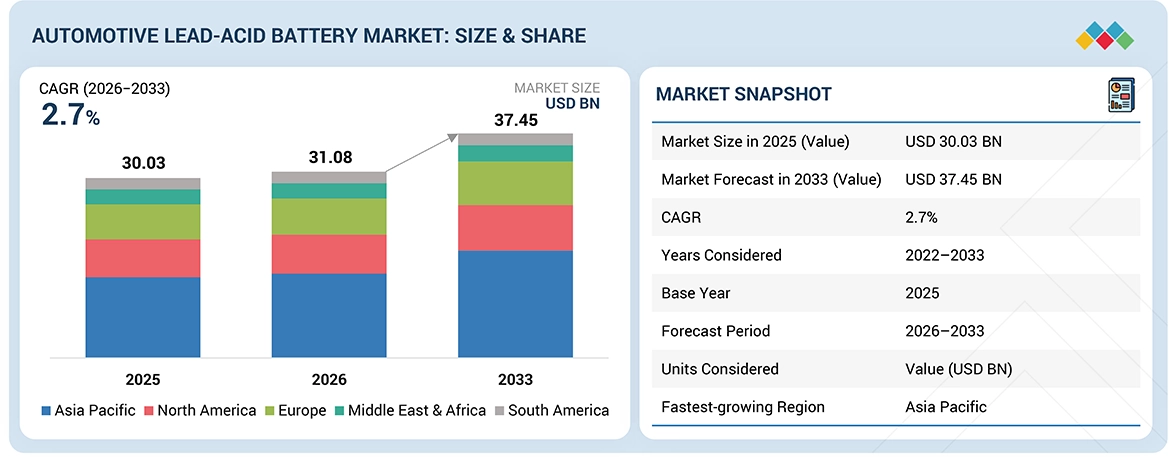
USD 37.45 BN
MARKET SIZE, 2033

CAGR 2.7%

250
REPORT PAGES

212
MARKET TABLES
OVERVIEW
Source: Secondary Research, Interviews with Experts, MarketsandMarkets Analysis
The automotive lead-acid battery market is projected to grow from USD 31.08 billion in 2026 to USD 37.45 billion by 2033, at a CAGR of 2.7% during the forecast period. The market growth is attributed to the world vehicle fleet's requirement for battery replacements in passenger cars, commercial vehicles, and two- and three-wheelers. The automotive industry maintains its preference for lead-acid batteries because these batteries provide cost-effective performance together with their established SLI application supply chains. The aftermarket segment remains a key contributor, as batteries require periodic replacement due to their limited lifecycle. The existing recycling systems, together with the lead-acid battery materials, which can be recycled, create an environmentally friendly system that supports their ongoing use.
KEY TAKEAWAYS
-
BY REGION
The Asia Pacific region is expected to register the highest CAGR of 3.5% during forecast period.
-
BY TYPE
By type, the VRLA batteries segment is projected to experience the highest CAGR of 4.2% during the forecast period.
-
BY PRODUCT
By product, the auxiliary batteries segment is projected to register the highest CAGR of 11.4% during the forecast period.
-
BY CUSTOMER
By customer, the aftermarket segment is projected to register the highest CAGR of 3.2% during the forecast period.
-
BY END USE
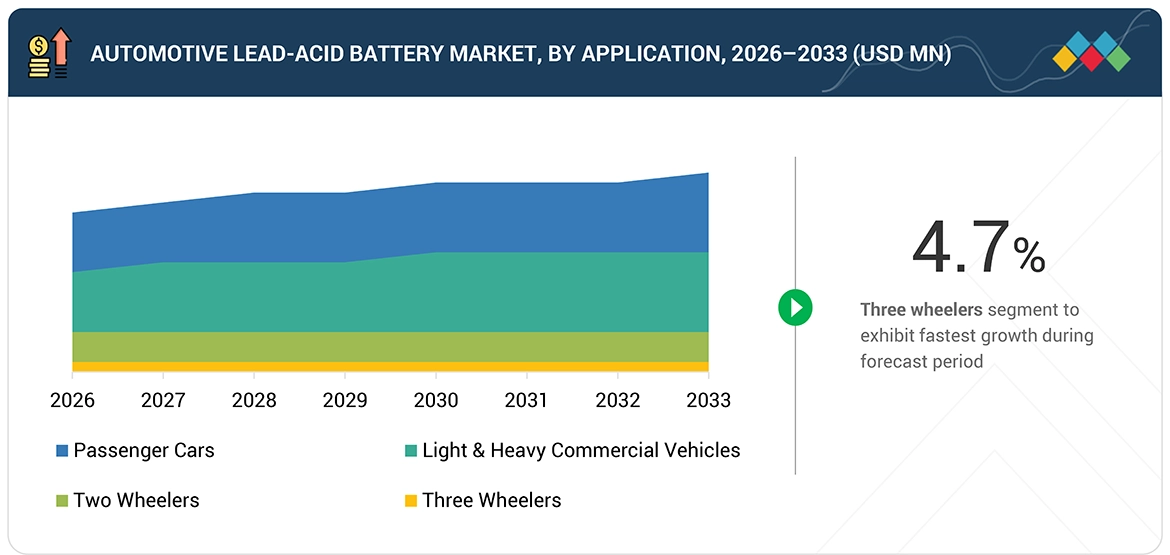
By end use, three-wheelers segment is projected to register the highest CAGR of 4.7% during the forecast period
-
Competitive Landscape - Key Players
Clarios, GS Yuasa International Ltd., EnerSys, East Penn Manufacturing Company, and Exide Industries Ltd. were identified as some of the leading players in the automotive lead-acid battery market, given their strong market share and product footprint.
-
Competitive Landscape - Startups
Power Sonic Corporation and Koyosonic Power Co., Ltd., among others, have become leading startups or SMEs by identifying niche gaps early and delivering solutions that precisely match unmet customer needs. Their agility, faster decision-making, and ability to innovate continuously allow them to outperform larger, less flexible competitors.
The market is consistently expanding due to the demand for reliable and affordable energy storage solutions across various types of vehicles, including passenger cars, commercial vehicles, and two- and three-wheelers. This growth is further supported by the widespread availability and low cost of lead-acid batteries, which makes them a popular choice in the aftermarket segment. Manufacturers must create advanced battery solutions because customers require high-performance and durable battery products, which leads them to develop different types of batteries, including AGM and EFB, while their operations expand for technological progress in major regions, including Asia Pacific, North America, and Europe.
TRENDS & DISRUPTIONS IMPACTING CUSTOMERS' CUSTOMERS
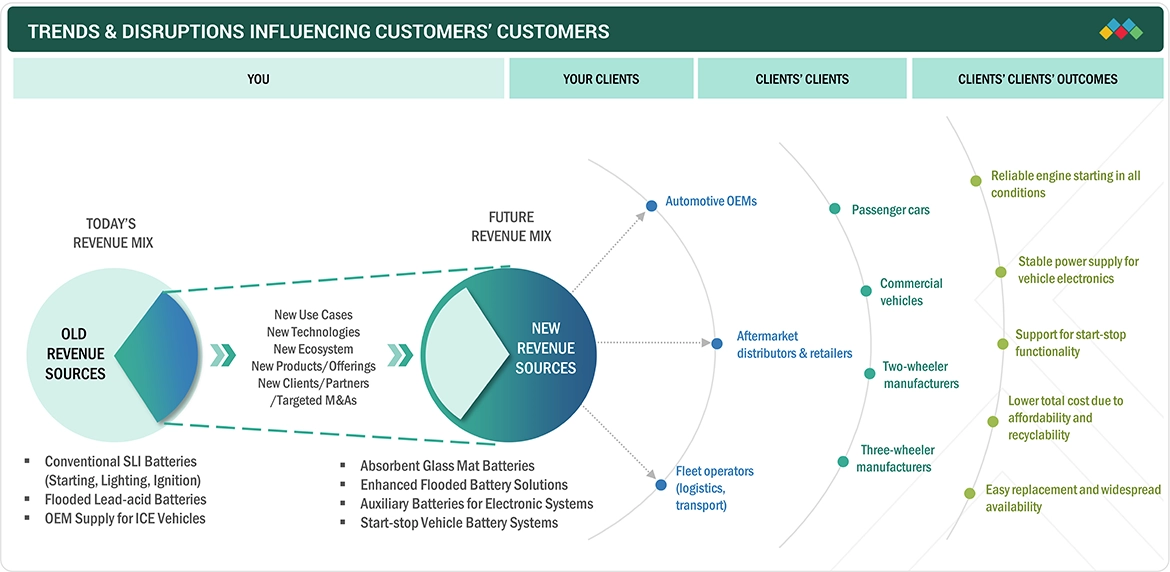
The automotive lead-acid battery market is experiencing continuous expansion because the automotive sector requires both affordable and dependable energy storage systems that can function in diverse vehicle types. End-use segments such as passenger cars, commercial vehicles, and two & three wheelers increasingly adopt lead-acid batteries for their starting, lighting, and ignition applications because these batteries deliver reliable performance and have established supply chains. The batteries provide reliable power output, which works with standard vehicle systems and maintains efficient performance under different weather conditions. The rising number of vehicles on the road, combined with the demand for continuous and low-cost battery options, drives the use of advanced lead-acid technologies like AGM and EFB, which results in stable market expansion throughout various areas.
Source: Secondary Research, Interviews with Experts, MarketsandMarkets Analysis
MARKET DYNAMICS

Drivers
Impact
Level
-
High demand for cost-effective and reliable batteries in automotive industry

-
Easy recyclability compared with lithium-ion batteries


RESTRAINTS
Impact
Level
-
Growing adoption of lithium-ion batteries


OPPORTUNITIES
Impact
Level
-
Technological advancements to enhance durability of lead-acid batteries


CHALLENGES
Impact
Level
-
Limited capacity of lead-acid batteries

Source: Secondary Research, Interviews with Experts, MarketsandMarkets Analysis
The automotive industry continues to demand lead-acid batteries owing to their cost-effectiveness and dependability. The technology exists as a fully developed system that manufacturers have operated for more than a hundred years and now provides products to multiple markets. The system delivers high cranking power, which enables vehicle systems to operate under all weather conditions. Their lower initial expense makes these batteries the most suitable option for customers who value budget-friendly solutions. Lead-acid batteries maintain a strong position in both OEM and aftermarket markets, leading to ongoing demand for these products. The combination of low costs and dependable performance with existing infrastructure systems drives their continued use in the automotive industry.
The lead-acid battery market for automobiles faces significant growth challenges as more consumers transition to lithium-ion batteries. Advanced electric vehicle technologies demand lithium-ion batteries due to their superior energy density, extended cycle life, and improved power-to-weight ratio. The automotive industry will decrease its use of traditional lead-acid batteries as it transitions toward electric vehicles. The continuous development, together with the decreasing expenses of lithium-ion technology, makes it a stronger competitor. Automakers are increasingly using lithium-ion batteries for primary and secondary functions. The automotive industry is shifting towards new technologies, which reduces the growth potential of lead-acid batteries.
Ongoing technological advancements present significant opportunities for improving the performance and lifespan of lead-acid batteries. Advanced battery management systems offer comprehensive real-time monitoring capabilities that track essential system parameters. This enhances operational efficiency and lowers the risk of unexpected breakdowns. The research highlights three key advancements: improved battery plate design, enhanced electrolyte composition, and superior charging techniques, all aimed at boosting battery performance and longevity. Manufacturers are also focusing on developing maintenance-free and sealed battery systems that reduce operational complexity and maintenance costs. Technological advancements in lead-acid battery systems have increased their usage in modern vehicles that utilize start-stop technology. The automotive industry will see increased market competition between lead-acid batteries and other types of batteries because of these advancements.
The energy density of lead-acid batteries poses a significant challenge that limits their use in applications requiring advanced battery technologies. Their lower energy storage capacity makes them less suitable for high-energy and long-duration applications, especially in modern electric vehicles. Deep discharge cycles cause these batteries to degrade faster, which reduces their total lifespan. The sustained power output requirements of certain applications are affected by this limitation. The bulkier design and increased weight of lead-acid batteries prevent their use in vehicle designs that prioritize space efficiency. The automotive industry requires manufacturers to solve performance issues that continue to emerge as vehicle technology develops.
AUTOMOTIVE LEAD ACID BATTERY MARKET: COMMERCIAL USE CASES ACROSS INDUSTRIES
| COMPANY | USE CASE DESCRIPTION | BENEFITS |
|---|---|---|
|
|
The company produces various automotive lead-acid batteries that function with both AGM and EFB technologies to deliver power for passenger cars and commercial vehicles while serving OEM installation and aftermarket replacement requirements throughout international markets | The company delivers high-performance battery solutions with strong cranking power, extended lifecycle, and enhanced charge acceptance, enabling reliable vehicle operation and improved fuel efficiency in start-stop systems. |
|
|
The company creates high-performance lead-acid batteries that suit automotive applications that include standard vehicles and start-stop systems for their products, which serve passenger cars, motorcycles, and commercial vehicles through their durability and performance capabilities. | The batteries offer high reliability, long service life, and stable performance under varying operating conditions, supporting efficient engine starting and reduced maintenance requirements. |
|
|
The company supplies lead-acid battery solutions to the automotive and commercial vehicle markets. The company provides specialized batteries for heavy-duty vehicles and fleet operations to meet their power needs. | The products ensure dependable power delivery, high durability, and resistance to deep cycling, supporting demanding operational environments and reducing downtime for commercial vehicle operators. |
|
|
The company produces a complete range of lead-acid batteries which serve automotive needs through their application in passenger vehicles and commercial fleets and aftermarket distribution channels while maintaining high standards of manufacturing quality and recycling systems. | The batteries provide consistent performance, high reliability, and sustainable lifecycle advantages through efficient recycling systems, ensuring cost-effective and environmentally responsible solutions. |
|
|
The company produces a complete range of lead-acid batteries, which serve automotive needs through their application in passenger vehicles, commercial fleets, and aftermarket distribution channels while maintaining high standards of manufacturing quality and recycling systems. | The products deliver reliable starting power, affordability, and a wide service network support, ensuring easy availability, low maintenance, and dependable performance across diverse vehicle segments. |
Logos and trademarks shown above are the property of their respective owners. Their use here is for informational and illustrative purposes only.
MARKET ECOSYSTEM
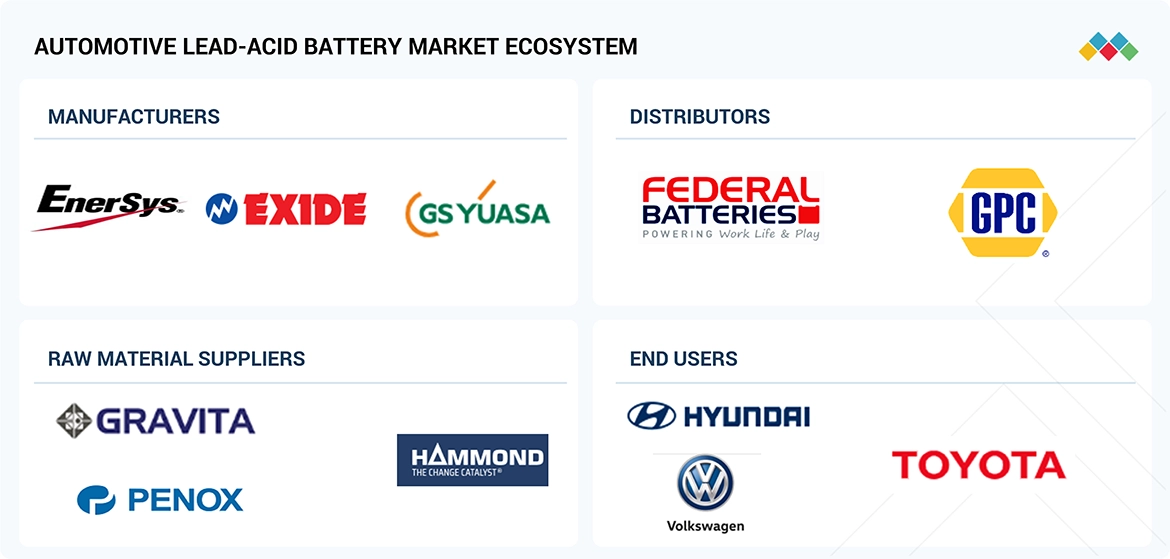
The automotive lead-acid battery market ecosystem consists of raw material suppliers (e.g., Gravita India Ltd., PENOX Group), producers (e.g., Exide Industries Ltd., GS Yuasa International Ltd.), distributors (e.g., Federal Batteries, Genuine Parts Company), and end users (e.g., Toyota Motor Corporation, Volkswagen Group). Automotive lead-acid batteries are used in applications such as passenger cars and light & heavy commercial vehicles.
Logos and trademarks shown above are the property of their respective owners. Their use here is for informational and illustrative purposes only.
MARKET SEGMENTS
Source: Secondary Research, Interviews with Experts, MarketsandMarkets Analysis
The automotive lead-acid battery market, by product, is segmented into SLI (starting, lighting, and ignition) batteries, auxiliary batteries, and micro-hybrid batteries. The market is primarily controlled by SLI batteries because they serve as the standard starting and electrical power solution for most traditional internal combustion engine vehicles. Their affordability, reliability, and established presence across both OEM and aftermarket channels support their strong demand. Micro-hybrid batteries are experiencing growth because more people choose to implement start-stop systems, which help them achieve better fuel efficiency and lower emissions. The batteries enable contemporary vehicles to achieve improved cycling capabilities and better energy recovery systems.
The market is divided into two segments according to battery type: flooded batteries and valve-regulated lead-acid (VRLA) batteries. Flooded batteries maintain a major market share because they provide economical pricing and demonstrate dependable performance for standard vehicle uses. Modern vehicles use both flooded batteries and VRLA batteries because they power start-stop systems in these vehicles. The advanced battery technologies deliver superior charge acceptance and extended lifespan and require no maintenance throughout their entire lifespan. The transition to advanced battery systems with superior performance capabilities is slowly changing the market competition.
The automotive lead-acid battery market is divided into two customer-based segments: OEM and aftermarket. The aftermarket segment dominates the market because vehicles in operation require battery replacement after their batteries reach end-of-life. The OEM market maintains its demand through ongoing vehicle manufacturing and the incorporation of lead-acid batteries into newly developed cars. The primary source of revenue for the business comes from replacement sales because there exists a substantial number of vehicles for which drivers need to replace their lead-acid batteries. The aftermarket expansion receives additional support through robust distribution networks and effective service channels.
Based on end use, the market is divided into four segments: passenger cars, light and heavy commercial vehicles, two-wheelers, and three-wheelers. The passenger cars segment holds the biggest market share because of its high vehicle volume and common use of lead-acid batteries in SLI applications. The commercial vehicles sector makes up a major portion of the market because it needs high-capacity batteries to support its lengthy operational periods and demanding work activities. Two-wheelers and three-wheelers contribute notably in emerging economies, driven by affordability and high replacement frequency. Lead-acid batteries maintain consistent demand because they serve various vehicle types in different applications.
REGION
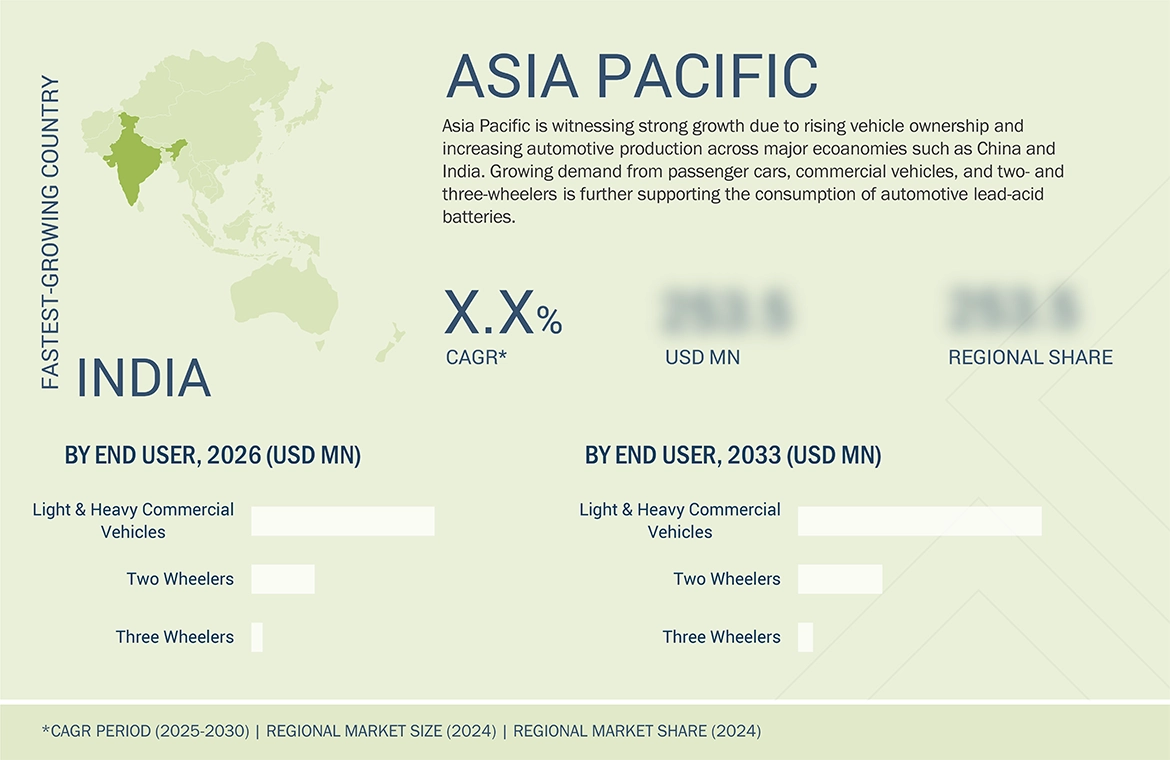
Asia Pacific to be fastest-growing region in automotive lead-acid battery market during forecast period
The automotive lead-acid battery market will experience the fastest growth in the Asia Pacific region due to rising vehicle ownership, expanding automotive production, and increasing demand from countries such as China, India, Japan, and South Korea. The region needs more dependable and budget-friendly battery solutions because its passenger car, commercial vehicle, and two-wheel and three-wheel vehicle markets continue to grow. The market expansion receives additional strength from increasing replacement demand, which is supported by the large existing vehicle base. The demand for SLI batteries remains strong, primarily because the automotive industry continues to rely on internal combustion engine vehicles, especially in developing markets. This market benefits from robust manufacturing capabilities, access to raw materials, and an established recycling infrastructure. Additionally, rapid urbanization, economic development, and increasing transportation needs are contributing to the growing demand for automotive lead-acid batteries in the Asia Pacific region.
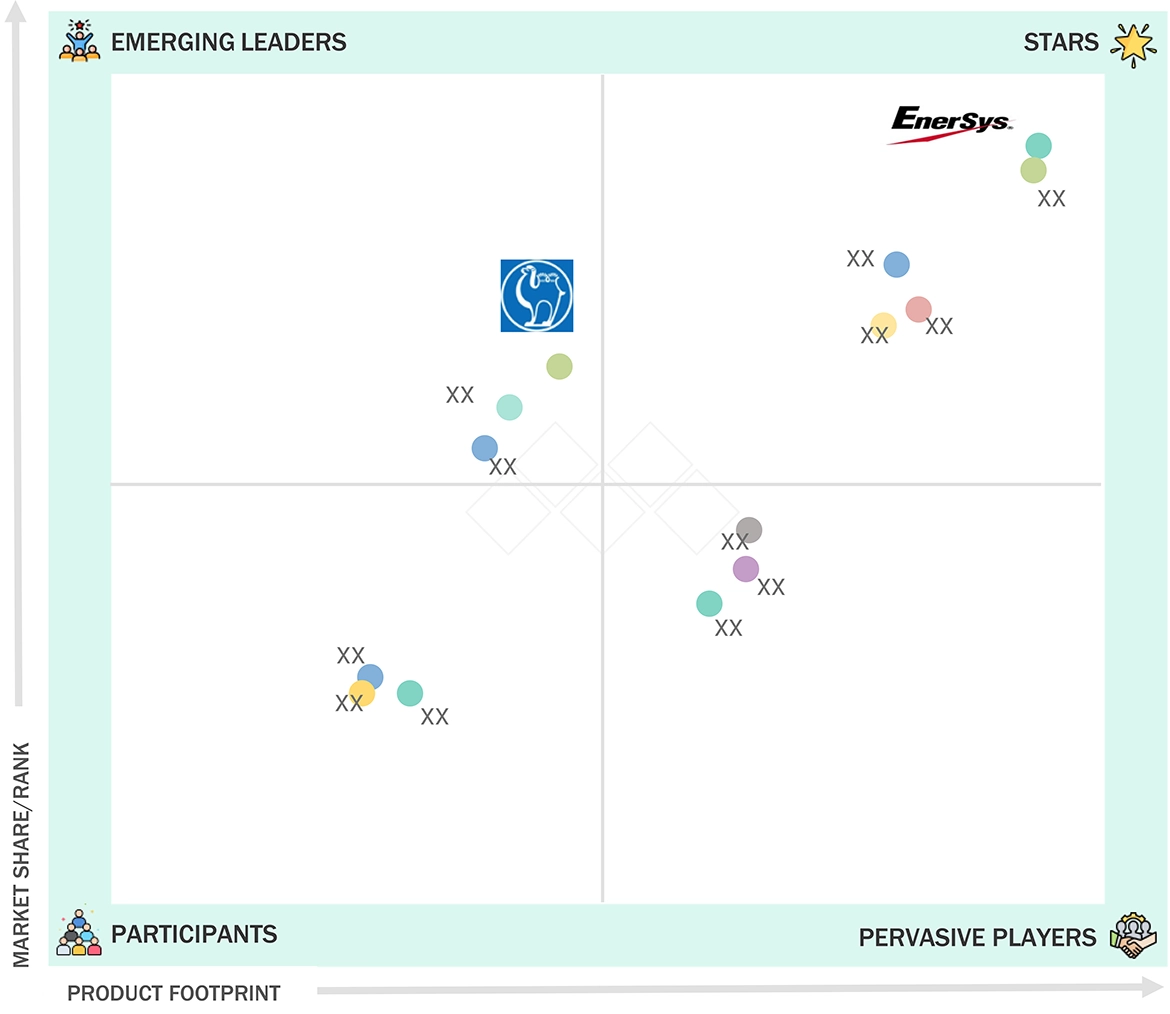
AUTOMOTIVE LEAD ACID BATTERY MARKET: COMPANY EVALUATION MATRIX
Clarios (Star) maintains its dominant position in the automotive lead-acid battery market through its extensive global footprint, strong OEM partnerships, and comprehensive portfolio of advanced battery solutions, which include AGM and enhanced flooded battery technologies for modern vehicles. Camel Group Co., Ltd (Emerging Player) is gaining traction with its expanding production capacity and increasing presence in supplying automotive lead-acid batteries especially across Asia. Clarios sustains its market leadership through its scale and technological capabilities together with its strong presence in both OEM and aftermarket segments while Camel Group Co. Ltd strengthens its market position by capitalizing on growing regional demand and expanding its product offerings in the automotive battery segment.
Source: Secondary Research, Interviews with Experts, MarketsandMarkets Analysis
KEY MARKET PLAYERS
- Clarios (US)
- EnerSys (US)
- GS Yuasa International Ltd. (Japan)
- East Penn Manufacturing Company (US)
- Exide Industries Ltd. (India)
- Camel Group Co., Ltd. (China)
- The Furukawa Battery Co., Ltd. (Japan)
- C&D Technologies, Inc. (US)
- Robert Bosch LLC (US)
- Amara Raja Energy & Mobility Limited (India)
- FIAMM Energy Technology S.p.A. (Italy)
- Crown Battery (US)
- Century Batteries Indonesia (Indonesia)
- Stryten Energy (US)
- Reem Batteries (Oman)
- Tianneng Rechargeable Battery Manufacturers (China)
- CSB Energy Technology Co., Ltd. (Taiwan)
- Moura Accumulators SA (Brazil)
MARKET SCOPE
| REPORT METRIC | DETAILS |
|---|---|
| Market Size in 2025 (Value) | USD 30.03 BN |
| Market Forecast in 2033 (Value) | USD 37.45 BN |
| Growth Rate | CAGR of 2.7% from 2026 to 2033 |
| Years Considered | 2022–2033 |
| Base Year | 2025 |
| Forecast Period | 2026–2033 |
| Units Considered | Value (USD Billion) and Volume (MWh) |
| Report Coverage | Revenue forecast, competitive landscape, growth factors, and trends |
| Segments Covered | By Product: SLI Batteries, Micro Hybrid Batteries, Auxiliary Batteries |
| Regions Covered | North America, Europe, Asia Pacific, Middle East & Africa, South America |
WHAT IS IN IT FOR YOU: AUTOMOTIVE LEAD ACID BATTERY MARKET REPORT CONTENT GUIDE
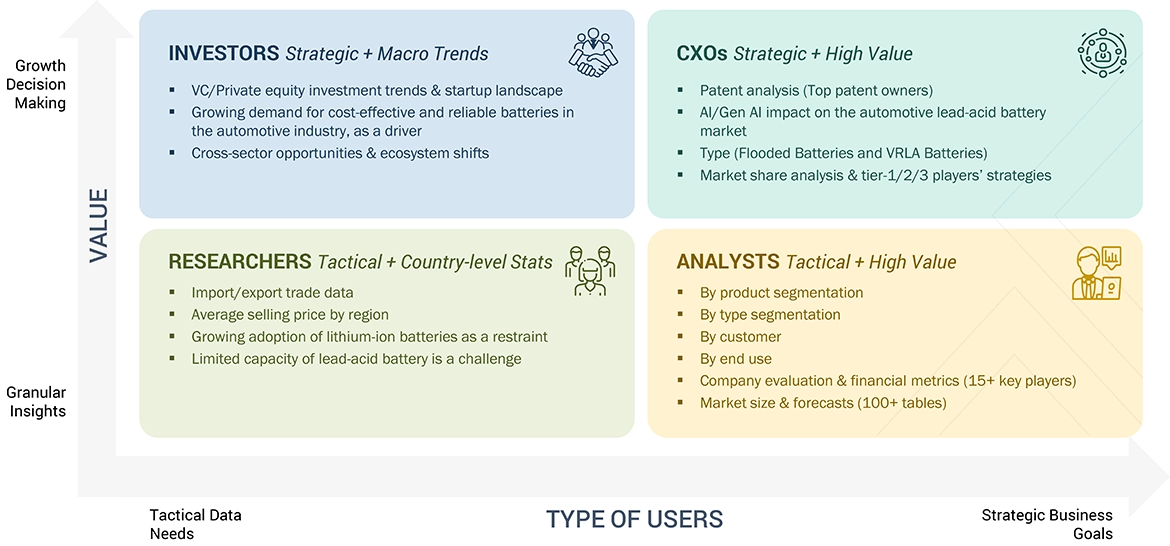
DELIVERED CUSTOMIZATIONS
We have successfully delivered the following deep-dive customizations:
| CLIENT REQUEST | CUSTOMIZATION DELIVERED | VALUE ADDS |
|---|---|---|
| Region-specific market insights | The demand trends for Asia Pacific, North America, and Europe were analyzed in detail, highlighting growth driven by increasing vehicle ownership, rising automotive production, and strong replacement demand. The study identified key demand drivers such as the growing existing vehicle base, expansion of commercial fleets, and increasing adoption of start-stop systems across major regions | Helps clients identify high-growth regions, optimize market entry strategies, and align production and distribution capabilities with regional demand patterns |
| Competitor benchmarking | The study evaluated major automotive lead-acid battery manufacturers by comparing their product portfolios, including conventional and advanced batteries such as Absorbent Glass Mat and Enhanced Flooded Battery technologies, along with their production capacities and distribution networks. It also assessed their market presence across OEM and aftermarket segments | Enables better competitive positioning, identification of market leaders, and understanding of differentiation strategies for business expansion. |
| Application-specific insights | The study provided detailed insights into key applications, including starting, lighting, and ignition functions, as well as start-stop vehicle systems across passenger cars, commercial vehicles, and two- and three-wheelers. It analyzed battery performance requirements, usage patterns, and demand variations across different vehicle categories. | Supports targeted product development, application-specific marketing strategies, and alignment with end-user requirements across vehicle segments |
| Custom material & product specification support | The research assessed various battery types, including flooded, absorbent glass mat (AGM), and enhanced flooded battery, based on performance parameters such as charge acceptance, cycle life, durability, and maintenance requirements. It also evaluated suitability across different vehicle and climatic conditions. | Improves product performance, supports optimal battery selection, and enhances alignment with specific automotive application requirements. |
| Technical feasibility & supply chain insights | Provided insights into raw material sourcing, including lead availability, recycling infrastructure, and manufacturing processes, along with supply chain considerations such as distribution networks and aftermarket channels. The study also covered regional production capabilities and logistics factors. | Enhances operational efficiency, reduces procurement risks, and ensures consistent product availability across global and regional markets. |
RECENT DEVELOPMENTS
- March 2025 : Clarios announced a USD 6 billion investment strategy to expand its manufacturing footprint across the US. This includes building new facilities and upgrading existing plants to strengthen the supply of automotive starter batteries and improve domestic production capacity.
- April 2023 : The acquisition of IBCS by EnerSys is a strategic move to expand its motive power services and strengthen its presence in the UK market. This addition will enhance EnerSys's range of battery-related services, including installation, maintenance, repair, and replacement.
- August 2023 : Clarios acquired Paragon GmbH & Co. KGaA’s power business, which specializes in batteries and battery management systems for the automotive industry. This acquisition enhances Clarios' engineering capabilities and supports its low-voltage and lithium-ion projects, significantly expanding the team dedicated to developing new low-voltage architectures.
Table of Contents
 Exclusive indicates content/data unique to MarketsandMarkets and not available with any competitors.
TITLE
PAGE NO
1
INTRODUCTION
15
2
EXECUTIVE SUMMARY
3
PREMIUM INSIGHTS
4
MARKET OVERVIEW
4.1
INTRODUCTION
4.2
MARKET DYNAMICS
4.2.1
DRIVERS
4.2.2
RESTRAINTS
4.2.3
OPPORTUNITIES
4.2.4
CHALLENGES
4.3
UNMET NEEDS AND WHITE SPACES
4.4
INTERCONNECTED MARKETS AND CROSS-SECTOR OPPORTUNITIES
4.5
STRATEGIC MOVES BY TIER-1/2/3 PLAYERS
5
INDUSTRY TRENDS
5.1
PORTER’S FIVE FORCES ANALYSIS
5.1.1
BARGAINING POWER OF SUPPLIERS
5.1.2
THREAT OF NEW ENTRANTS
5.1.3
THREAT OF SUBSTITUTES
5.1.4
BARGAINING POWER OF BUYERS
5.1.5
INTENSITY OF COMPETITIVE RIVALRY
5.2
MACROECONOMIC OUTLOOK
5.2.1
INTRODUCTION
5.2.2
GDP TRENDS AND FORECAST
5.2.3
TRENDS IN GLOBAL AUTOMOTIVE LEAD-ACID BATTERY INDUSTRY
5.3
VALUE CHAIN ANALYSIS
5.4
ECOSYSTEM ANALYSIS
5.5
PRICING ANALYSIS
5.5.1
AVERAGE SELLING PRICE TREND, BY REGION (2022–2025)
5.5.2
AVERAGE SELLING PRICE OF AUTOMOTIVE LEAD-ACID BATTERY, BY KEY PLAYER (2025)
5.6
TRADE ANALYSIS, 2021–2024
5.6.1
IMPORT SCENARIO
5.6.2
EXPORT SCENARIO
5.7
KEY CONFERENCES AND EVENTS IN 2026–2027
5.8
TRENDS/DISRUPTIONS IMPACTING CUSTOMER BUSINESS
5.9
INVESTMENT AND FUNDING SCENARIO
5.10
CASE STUDY ANALYSIS
5.11
IMPACT OF 2025 US TARIFF - AUTOMOTIVE LEAD-ACID BATTERY MARKET
5.11.1
INTRODUCTION
5.11.2
KEY TARIFF RATES
5.11.3
PRICE IMPACT ANALYSIS
5.11.4
IMPACT ON COUNTRIES/REGIONS
5.11.4.1
US
5.11.4.2
EUROPE
5.11.4.3
ASIA PACIFIC
5.11.5
IMPACT ON APPLICATIONS
6
TECHNOLOGICAL ADVANCEMENTS, AI-DRIVEN IMPACT, PATENTS, INNOVATIONS, AND FUTURE APPLICATIONS
6.1
KEY TECHNOLOGIES
6.2
COMPLEMENTARY TECHNOLOGIES
6.3
TECHNOLOGY/PRODUCT ROADMAP
6.4
PATENT ANALYSIS
6.5
FUTURE APPLICATIONS
6.6
IMPACT OF GEN AI/AI ON AUTOMOTIVE LEAD-ACID BATTERY MARKET
7
REGULATORY LANDSCAPE AND SUSTAINABILITY INITIATIVES
7.1
REGIONAL REGULATIONS AND COMPLIANCE
7.1.1
REGULATORY BODIES, GOVERNMENT AGENCIES, AND OTHER ORGANIZATIONS
7.1.2
INDUSTRY STANDARDS
7.2
SUSTAINABILITY INITIATIVES
7.3
IMPACT OF REGULATORY POLICIES ON SUSTAINABILITY INITIATIVES
8
CUSTOMER LANDSCAPE AND BUYER BEHAVIOR
8.1
INTRODUCTION
8.2
DECISION-MAKING PROCESS
8.3
KEY STAKEHOLDERS INVOLVED IN BUYING PROCESS AND THEIR EVALUATION CRITERIA
8.3.1
KEY STAKEHOLDERS IN BUYING PROCESS
8.3.2
BUYING CRITERIA
8.4
ADOPTION BARRIERS AND INTERNAL CHALLENGES
8.5
UNMET NEEDS OF VARIOUS END-USE INDUSTRIES
8.6
MARKET PROFITABILITY
9
AUTOMOTIVE LEAD-ACID BATTERY MARKET, BY TYPE
9.1
INTRODUCTION
9.2
FLOODED BATTERIES
9.3
VALVE-REGULATED LEAD-ACID
10
AUTOMOTIVE LEAD-ACID BATTERY MARKET, BY PRODUCT
10.1
INTRODUCTION
10.2
STARTING, LIGHTING, AND IGNITION BATTERIES
10.3
MICRO HYBRID BATTERIES
10.4
AUXILIARY BATTERIES
11
AUTOMOTIVE LEAD-ACID BATTERY MARKET, BY CUSTOMER
11.1
INTRODUCTION
11.2
OEM
11.3
AFTERMARKET
12
AUTOMOTIVE LEAD-ACID BATTERY MARKET, BY END USE
12.1
INTRODUCTION
12.2
PASSENGER CARS
12.3
LIGHT & HEAVY COMMERCIAL VEHICLES
12.4
TWO-WHEELERS
12.5
THREE-WHEELERS
13
AUTOMOTIVE LEAD-ACID BATTERY MARKET, BY REGION
13.1
INTRODUCTION
13.2
NORTH AMERICA
13.2.1
US
13.2.2
CANADA
13.2.3
MEXICO
13.3
EUROPE
13.3.1
UK
13.3.2
FRANCE
13.3.3
GERMANY
13.3.4
ITALY
13.3.5
REST OF EUROPE
13.4
ASIA PACIFIC
13.4.1
CHINA
13.4.2
INDIA
13.4.3
SOUTH KOREA
13.4.4
JAPAN
13.4.5
REST OF ASIA PACIFIC
13.5
MIDDLE EAST & AFRICA
13.5.1
GCC COUNTRIES
13.5.1.1
SAUDI ARABIA
13.5.1.2
UAE
13.5.1.3
REST OF GCC COUNTRIES
13.5.2
SOUTH AFRICA
13.5.3
REST OF MIDDLE EAST & AFRICA
13.6
SOUTH AMERICA
13.6.1
BRAZIL
13.6.2
CHILE
13.6.3
REST OF SOUTH AMERICA
14
COMPETITIVE LANDSCAPE
14.1
OVERVIEW
14.2
KEY PLAYER COMPETITIVE STRATEGIES/RIGHT TO WIN, JANUARY 2021–FEBRUARY
14.3
REVENUE ANALYSIS, 2021–2025
14.4
MARKET SHARE ANALYSIS,
14.5
BRAND COMPARISON
14.6
COMPANY EVALUATION MATRIX: KEY PLAYERS,
14.6.1
STARS
14.6.2
EMERGING LEADERS
14.6.3
PERVASIVE PLAYERS
14.6.4
PARTICIPANTS
14.6.5
COMPANY FOOTPRINT: KEY PLAYERS,
14.6.5.1
COMPANY FOOTPRINT
14.6.5.2
REGION FOOTPRINT
14.6.5.3
TYPE FOOTPRINT
14.6.5.4
END USE FOOTPRINT
14.7
COMPANY EVALUATION MATRIX: STARTUPS/SMES,
14.7.1
PROGRESSIVE COMPANIES
14.7.2
RESPONSIVE COMPANIES
14.7.3
DYNAMIC COMPANIES
14.7.4
STARTING BLOCKS
14.7.5
COMPETITIVE BENCHMARKING: STARTUPS/SMES,
14.7.5.1
DETAILED LIST OF KEY STARTUPS/SMES
14.7.5.2
COMPETITIVE BENCHMARKING OF KEY STARTUPS/SMES
14.8
COMPANY VALUATION AND FINANCIAL METRICS
14.9
COMPETITIVE SCENARIO
14.9.1
PRODUCT LAUNCHES
14.9.2
DEALS
14.9.3
EXPANSIONS
15
COMPANY PROFILES
15.1
KEY PLAYERS
15.1.1
ENERSYS
15.1.1.1
BUSINESS OVERVIEW
15.1.1.2
PRODUCTS/SOLUTIONS/SERVICES OFFERED
15.1.1.3
RECENT DEVELOPMENTS
15.1.1.4
MNM VIEW
15.1.1.4.1
KEY STRENGTHS
15.1.1.4.2
STRATEGIC CHOICES
15.1.1.4.3
WEAKNESSES AND COMPETITIVE THREATS
15.1.2
CLARIOS
15.1.3
EAST PENN MANUFACTURING COMPANY
15.1.4
GS YUASA INTERNATIONAL LTD.
15.1.5
EXIDE INDUSTRIES LTD.
15.1.6
C&D TECHNOLOGIES, INC.
15.1.7
CAMEL GROUP CO., LTD.
15.1.8
TIANNENG RECHARGEABLE BATTERY MANUFACTURERS
15.1.9
REEM BATTERIES
15.1.10
CENTURY BATTERIES INDONESIA
15.1.11
LEOCH INTERNATIONAL TECHNOLOGY LIMITED INC
15.1.12
ROBERT BOSCH LLC
15.1.13
STRYTEN ENERGY
15.1.14
EXIDE TECHNOLOGIES
15.1.15
AMARA RAJA ENERGY & MOBILITY LIMITED.
15.1.16
THE FURUKAWA BATTERY CO., LTD.
15.1.17
CROWN BATTERY
15.1.18
FIAMM ENERGY TECHNOLOGY S.P.A.
15.1.19
CSB ENERGY TECHNOLOGY CO., LTD.
15.1.20
MOURA ACCUMULATORS SA
15.2
OTHER PLAYERS
15.2.1
MEBCO
15.2.2
KOYOSONIC POWER CO., LTD.
15.2.3
RITAR INTERNATIONAL GROUP LIMITED
15.2.4
JYC BATTERY MANUFACTURER CO., LTD.
15.2.5
POWER SONIC CORPORATION
15.2.6
XINFU TECHNOLOGY (CHINA) CO., LIMITED
16
RESEARCH METHODOLOGY
16.1
RESEARCH DATA
16.1.1
SECONDARY DATA
16.1.1.1
KEY DATA FROM SECONDARY SOURCES
16.1.1.2
LIST OF KEY SECONDARY SOURCES
16.1.2
PRIMARY DATA
16.1.2.1
KEY DATA FROM PRIMARY SOURCES
16.1.2.2
KEY PRIMARY PARTICIPANTS
16.1.2.3
BREAKDOWN OF PRIMARY INTERVIEWS
16.1.2.4
KEY INDUSTRY INSIGHTS
16.2
MARKET SIZE ESTIMATION
16.2.1
BOTTOM-UP APPROACH
16.2.2
TOP-DOWN APPROACH
16.2.3
MARKET SIZE CALCULATION FOR BASE YEAR
16.3
MARKET FORECAST APPROACH
16.3.1
SUPPLY SIDE
16.3.2
DEMAND SIDE
16.4
DATA TRIANGULATION
16.5
FACTOR ANALYSIS
16.6
RESEARCH ASSUMPTIONS AND LIMITATIONS
16.7
RISK ASSESSMENT
17
APPENDIX
17.1
DISCUSSION GUIDE
17.2
KNOWLEDGESTORE: MARKETSANDMARKETS’ SUBSCRIPTION PORTAL
17.3
CUSTOMIZATION OPTIONS
17.4
RELATED REPORTS
17.5
AUTHOR DETAILS
Methodology
The research methodology used to estimate the size of the automotive lead-acid battery market consisted of four major activities. Extensive secondary research was conducted to obtain detailed information on the market, peer markets, and parent markets. These findings, assumptions, and metrics were verified through primary interviews with experts from both the demand and supply sides of the automotive lead-acid battery value chain. Both top-down and bottom-up approaches were used to estimate the total market size. The market sizes for various segments and subsegments were finalized using complete market segmentation and data triangulation.
Secondary Research
The research methodology for estimating and forecasting the automotive lead-acid battery market begins with gathering data on key vendors' revenues through secondary research. The secondary research process involves consulting a range of secondary sources, including Hoover's, Bloomberg Businessweek, Factiva, the World Bank, and industry-specific journals. These secondary sources encompass annual reports, press releases, investor presentations, white papers, certified publications, articles from recognized authors, regulatory notifications, trade directories, and databases. Also, vendor offerings are considered to inform market segmentation.
Primary Research
The automotive lead-acid battery market comprises several stakeholders throughout the supply chain, including raw material suppliers, processors, end-product manufacturers, and regulatory organizations. The development of various industries, including type and end use, characterizes the demand side of this market. Technological advancements and a wide range of diverse applications characterize the supply side. Various primary sources from both the supply and demand sides of the market were interviewed to obtain qualitative and quantitative information. The following is the breakdown of the primary respondents:
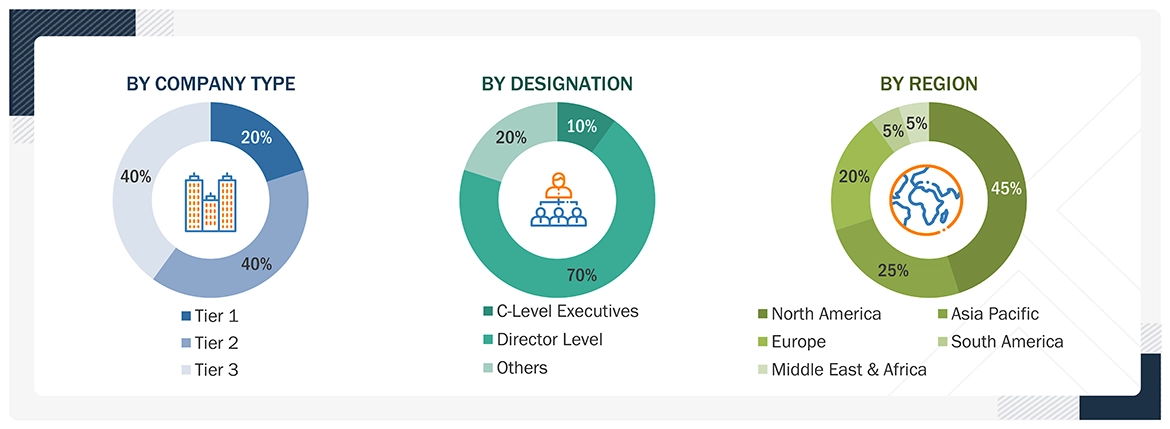
To know about the assumptions considered for the study, download the pdf brochure
Market Size Estimation
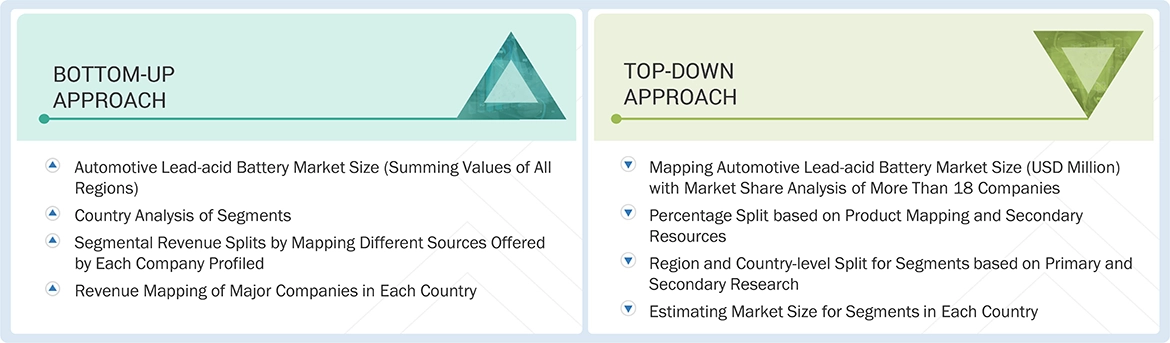
The top-down and bottom-up approaches were used to estimate and validate the total size of the automotive lead-acid battery market. These approaches were also widely used to calculate the sizes of various dependent market subsegments. The research methodology used to estimate the market size included the following.
The following segments provide details about the overall market size estimation process employed in this study:
- Extensive primary and secondary research was conducted to identify the key players.
- The value chain and market size in terms of value of the automotive lead-acid battery market were determined through primary and secondary research.
- All percentage shares, splits, and breakdowns were collected through secondary sources and verified through primary sources.
- All possible parameters that affect the market were covered in this research study and are viewed in extensive detail, verified through primary research, and analyzed to obtain the final quantitative and qualitative data.
- The study of reports, reviews, and newsletters of top market players, along with extensive interviews for opinions from key leaders, such as CEOs, directors, and marketing executives, is included in this research.
Data Triangulation
After estimating the overall market size using the above estimation process, the market was split into various segments and subsegments. Data triangulation and market segmentation techniques, along with the market engineering process, were employed to obtain precise market analysis data for each segment and its subsegments.
Research Methodology: The research methodology used to estimate and forecast the global market size began by aggregating data and information from various levels, including country-level data.
Market Definition
An automotive lead-acid battery is a rechargeable battery that utilizes lead electrodes and an electrolyte solution of sulfuric acid and water to store and release electrical energy. It is one of the oldest and most common rechargeable batteries, widely used in various applications, including automobile, marine, and uninterruptible power supply (UPS) systems. It is the most common type of battery used in the automotive industry due to its reliability, low cost, and ability to provide high starting currents. However, lead-acid batteries have certain limitations. They are relatively heavy and have a lower energy-to-weight ratio than other battery types. They also require regular maintenance, including checking the electrolyte level, cleaning terminals, and ensuring proper charging to maximize lifespan. Lead-acid batteries contain toxic materials, including lead and sulfuric acid, which require proper handling and recycling.
Key Stakeholders
- Automotive lead-acid battery manufacturers
- Research institutions, standards organizations, regulatory agencies, and other national authorities
- Traders, distributors, suppliers, and end users of automotive lead-acid batteries
- Contract manufacturing organizations (CMOs)
- NGOs, governments, investment banks, venture capitalists, and private equity firms
Report Objectives
- To define, describe, and forecast the size of the automotive lead-acid battery market, in terms of value, based on type, product, customer and region
- To provide detailed information regarding the key factors, such as drivers, restraints, opportunities, and industry-specific challenges, influencing the growth of the market
- To strategically analyze micromarkets with respect to individual growth trends, prospects, and their contribution to the total market
- To analyze opportunities in the market for stakeholders and provide a competitive landscape of the market leaders
- To project the size of the market and its submarkets, in terms of value and volume, with respect to five regions (along with their respective key countries), namely, North America, Asia Pacific, Europe, South America, and the Middle East & Africa
- To provide ecosystem analysis, case study analysis, value chain, patent analysis, technology analysis, pricing analysis, Porter's five forces analysis, key stakeholders and buying criteria, investment and funding scenario, trade analysis, impact of AI/Gen AI and 2025 US tariff, key conferences and events, regulatory bodies, government agencies, and regulations about the market under study
- To strategically profile the key players and comprehensively analyze their core competencies
- To analyze competitive developments such as mergers & acquisitions, product launches, and research & development in the market
- To provide the macroeconomic outlook for all regions considered under the study
Available customizations:
Based on the given market data, MarketsandMarkets offers customizations tailored to client-specific needs.
The following customization options are available for the report:
-
Additional country-level analysis of the automotive lead-acid battery market
Profiling of additional market players (up to 5)
Product Analysis
- Product matrix, which provides a detailed comparison of each company's product portfolio.
⚡ Growth Signals
Personalize This Research
- Triangulate with your Own Data
- Get Data as per your Format and Definition
- Gain a Deeper Dive on a Specific Application, Geography, Customer or Competitor
- Any level of Personalization
Let Us Help You
- What are the Known and Unknown Adjacencies Impacting the Automotive Lead-Acid Battery Market
- What will your New Revenue Sources be?
- Who will be your Top Customer; what will make them switch?
- Defend your Market Share or Win Competitors
- Get a Scorecard for Target Partners

We at Nissan Chemicals Corporation have been clients of MarketsandMarkets for more than a year now. We recently consulted MarketsandMarkets for a study, the team at MarketsandMarkets was extremely professional and organized. The business insights were very detailed and aligned well with our expectations that really helped us formulate the Business Plans and device new strategies for development themes. MarketsandMarkets offers a unique combination of expertise and dedicated engagement model. Their research findings have helped us in designing our Pricing Strategy which will make it easier for us to predict the future sales and profits for the next ten years. We look forward to working with MarketsandMarkets in the future.
VP of Strategy & New Business Development
Leading Specialty Chemical Company
The MarketsandMarkets Engagement Model, composed of both the Knowledge Store and advisory custom research, has greatly helped us in understanding our markets and making strategic decisions. The Knowledge Store is a fast way to allow everyone in our organization to understand more about most any market they are interested in. The ability to then get custom research done and get answers to specific strategic questions and market insight has been spectacular. The Markets and Markets team feel more like colleagues than vendors and their services have helped us change our culture where statements of things like growth opportunities and competitive position are always backed by industry research.

Rich Gibson,
Director, Corporate Strategy
Milliken & Company,
Leading Industrial Manufacturer of specialty chemical, floor covering, performance and protective textile materials, and healthcare
MarketsandMarkets is a trusted resource that helps us to better understand markets that are near-adjacencies-whether its technology, value chain or geography. Their Knowledge Store platform provides a dashboard of markets and their characteristics which is easy to use and saves us time.
Adam Shaw,
Market Development and Strategy Manager
AdvanSix Inc. USA,
An American Leader in Chemicals
The Knowledge Store from MarketsandMarkets is a valuable tool which has helped my team acquire greater insight in to the end markets that our business serves. This has enabled us to help our company build stronger strategies throughout our planning process.
TOSHIO KINOSHITA
Senior Chif Consultion Research & Consulting Division
Mitsubishi Chemical Research Corporation,
Leading Manufacturer of Chemical Products

We recently engaged with MarketsandMarkets for a study, the team not only clearly understood our business objectives but was also extremely professional in the way they handled the entire project. The study was efficiently conducted in a phase-wise manner, and the engagement model furnished us with high-quality business insights that far exceeded our expectations at each phase. We were especially happy that MarketsandMarkets could provide us with both, an English as well as a Japanese version of the study. A special thanks to the Analyst Team and Client Services Team, whose fluency in Japanese enhanced our comfort level, as we could converse with them in our preferred language.
Independent entrepreneurs
Arrow Precision
We approached MarketsandMarkets for study on Proppants Market, and their work exceeded our expectations. The study conducted was comprehensive and enabled us to view the market through the various dimensions. In addition, the team was extraordinarily responsive throughout the process and resolved our queries on time. I strongly recommend MarketsandMarkets and will certainly consider them for additional market assessments we will need in the future.
Global engineering company, Japan
Deputy Manager,
Strategic Planning Office
The high-quality insights shared by the MarketsandMarkets team helped us understand the pharmaceutical plant designers in a specific geography. It also captured the risks that we may likely face in communicating with our potential partners. The study would enable us identify partners, which would impact our future growth.

Still Researching the
Automotive Lead-Acid Battery Ecosystem?
See the competitors, opportunities, and growth signals shaping it - instantly.
Generate 15+ consulting-grade strategic insights tailored to your growth question.
Explore Automotive Lead-Acid Battery Intelligence
Powered by 17 years of MarketsandMarkets intelligence
