







- DESCRIPTION
- TABLE OF CONTENTS
- METHODOLOGY
- DOWNLOAD PDF
Dual-Axis Gyro-Stabilized Platforms Market by Gyro (RLG, FOG, MEMS), Deployment (Airborne, Land, Marine, Ground Infrastructure), Payload (EO/IR, Radar & Antenna, Laser, Acoustic, Weapon, Scientific), System, Application, and Region - Global Forecast to 2030

USD 2.99 BN
MARKET SIZE, 2030

CAGR 8.6%
(2025-2030)

300
REPORT PAGES

250
MARKET TABLES
OVERVIEW
Source: Secondary Research, Interviews with Experts, MarketsandMarkets Analysis
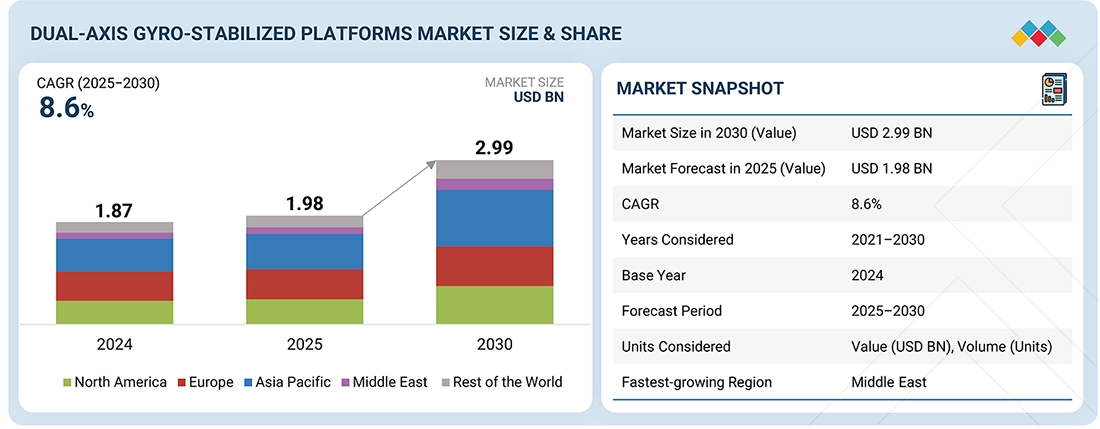
The Dual-Axis Gyro-Stabilized Platforms Market is expected to grow from USD 1.98 billion in 2025 to USD 2.99 billion by 2030, at a compound annual growth rate (CAGR) of 8.6% during the forecast period. Rising demand for high-precision stabilization in defense, surveillance, and commercial imaging is pushing the use of dual-axis gyro-stabilized platforms across the world. More deployment of unmanned aerial vehicles (UAVs) and maritime and land-based surveillance systems is increasing the need for stable motion and clear images.
Market Size & Forecast
• 2025 Market Size (Value): USD 1.98 BN
• 2030 Market Forecast (Value): USD 2.99 BN
• CAGR: 8.6% from 2025 to 2030
• Asia Pacific: Account Share of 32.6%
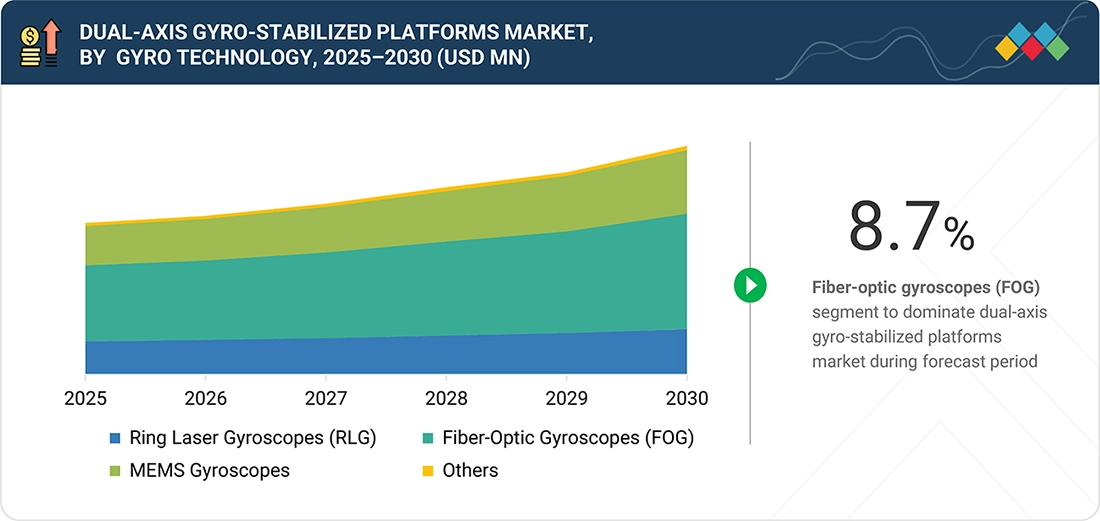
• MEMS Gyroscopes Segment: Highest CAGR of 10.1%
KEY TAKEAWAYS
-
By Region
The Asia Pacific region led the dual-axis gyro-stabilized platforms market, with a share of 32.6% in 2025.
-
By Gyro Technology
The MEMS gyroscopes segment is expected to grow at the highest CAGR of 10.1% from 2025 to 2030.
-
By System Component
The embedded software & stabilization algorithms segment is projected to grow at the highest CAGR of 10.9% from 2025 to 2030.
-
By Application
The mapping & surveying segment is projected to grow at the fastest rate during the forecast period.
-
Competitive Landscape
KONGSBERG, ASELSAN A.S., Israel Aerospace Industries, L3Harris Technologies, Inc., and KVH Industries, Inc. are recognized as key players in the global dual-axis gyro-stabilized platforms market. These companies hold strong positions due to their established product portfolios and wide operational presence. Their solutions are deployed across multiple regions and mission profiles. Consistent investment in product development supports their market standing.
-
Competitive Landscape
Edge Autonomy and Trakka are considered startups among others and have distinguished themselves in the dual-axis gyro-stabilized platforms market due to strong product innovation and technological advancement.
The Dual-Axis Gyro-Stabilized Platforms Industry is driven by a mix of long-term demand factors. The steady rise in surveillance needs and imaging use is putting pressure on current stabilization systems and how they perform. Governments and commercial users are now focusing more on better stabilization tech, improved sensors, and simple system integration to get more accuracy and reliability.
TRENDS & DISRUPTIONS IMPACTING CUSTOMERS' CUSTOMERS
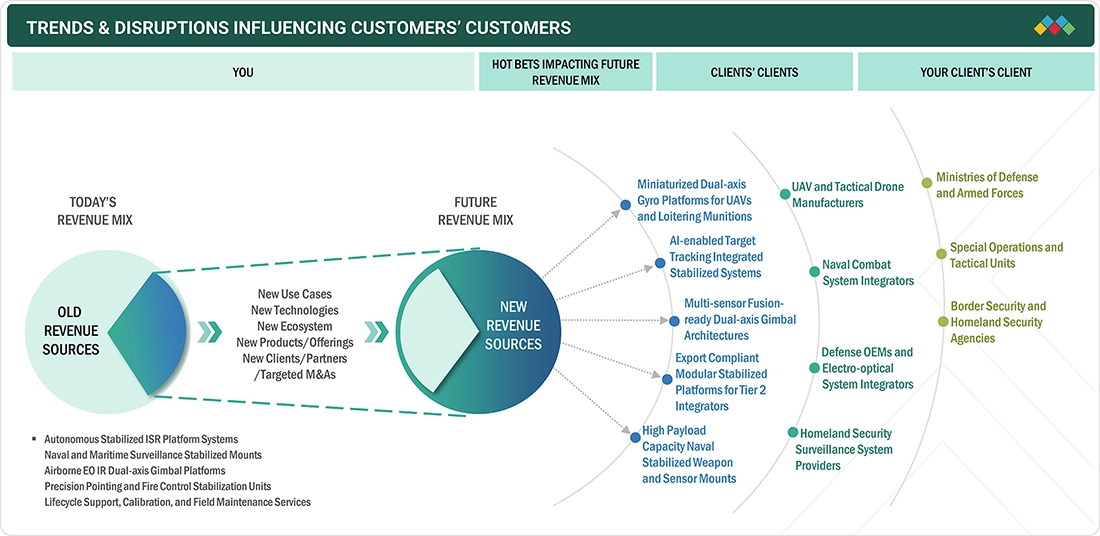
The dual-axis gyro-stabilized platforms market is changing fast as the demand for accurate stabilization grows across defense, surveillance, and unmanned systems. Companies are using better gyro technologies, sensor fusion, and AI-based tracking to improve accuracy and real-time performance. At the same time, more focus is being put on compact and software-based systems that are easier to use and help improve efficiency and long term reliability.
Source: Secondary Research, Interviews with Experts, MarketsandMarkets Analysis
MARKET DYNAMICS

Drivers
Impact
Level
-
Rising Defense Modernization & Military Spending

-
Increasing Deployment of UAVs and UGVs with Integrated Gyro-stabilized Payloads


RESTRAINTS
Impact
Level
-
High Manufacturing & Integration Costs

-
Export Controls & Regulatory Barriers


OPPORTUNITIES
Impact
Level
-
Integration with AI-based Object Tracking and Targeting

-
Miniaturization for Small UAV and Commercial Drone Platforms


CHALLENGES
Impact
Level
-
Performance Requirements in Harsh Operating Environments

-
Complexity of Systems & Skilled Workforce Requirements

Source: Secondary Research, Interviews with Experts, MarketsandMarkets Analysis
Governments worldwide are increasing investments in defense modernization to enhance surveillance, targeting accuracy, and operational efficiency. These initiatives focus on integrating advanced electro-optical systems, stabilized payloads, and next-generation sensor technologies across land, naval, and airborne platforms. Such developments are consistently driving demand for dual-axis gyro-stabilized platforms.
Dual-axis gyro-stabilized platforms require significant upfront investment in precision components, advanced sensors, and system integration. The development and deployment process is complex, involving rigorous testing, calibration, and compliance with defense standards. This high cost and long integration cycle can limit adoption, particularly for smaller players and cost-sensitive markets.
The increasing adoption of AI and autonomous systems is creating new opportunities for advanced stabilization platforms. AI-enabled tracking and targeting enhance real-time decision-making, accuracy, and operational effectiveness across defense and surveillance applications. Companies offering intelligent, software-driven stabilization solutions can gain a competitive advantage in this evolving landscape.
Dual-axis gyro-stabilized platforms are required to operate reliably in extreme conditions, including high vibrations, temperature variations, and dynamic motion environments. Maintaining precision and stability under such conditions is technically challenging and requires advanced engineering capabilities. Ensuring consistent performance and durability remains a critical challenge for manufacturers.
DUAL AXIS GYRO STABILIZED PLATFORMS MARKET: COMMERCIAL USE CASES ACROSS INDUSTRIES
| COMPANY | USE CASE DESCRIPTION | BENEFITS |
|---|---|---|
|
|
Stabilized remote weapon stations and electro-optical surveillance systems for commercial maritime security and offshore asset protection | Enhances situational awareness, ensures stable imaging in dynamic marine conditions, improves threat detection, and supports safe offshore operations |
|
|
Gyro-stabilized electro-optical payloads for border surveillance, critical infrastructure monitoring, and commercial security applications | Improves real-time monitoring accuracy, supports continuous surveillance, enhances perimeter security, and enables efficient threat identification |
|
|
Stabilized EO/IR payloads and surveillance systems for aerial mapping, environmental monitoring, and commercial ISR applications | Enables high-precision data collection, ensures stable imaging from airborne platforms, improves mapping accuracy, and supports wide-area monitoring |
|
|
Advanced stabilized imaging and sensor systems for airborne surveillance, public safety, and disaster response operations | Enhances image clarity and tracking accuracy, supports real-time decision-making, improves mission efficiency, and enables reliable performance in dynamic environments |
|
|
Fiber-optic gyro-based stabilization systems and antenna platforms for maritime communication and navigation in commercial shipping | Ensures stable connectivity, improves navigation accuracy, maintains signal reliability in rough sea conditions, and enhances operational efficiency for vessels |





Logos and trademarks shown above are the property of their respective owners. Their use here is for informational and illustrative purposes only.
MARKET ECOSYSTEM
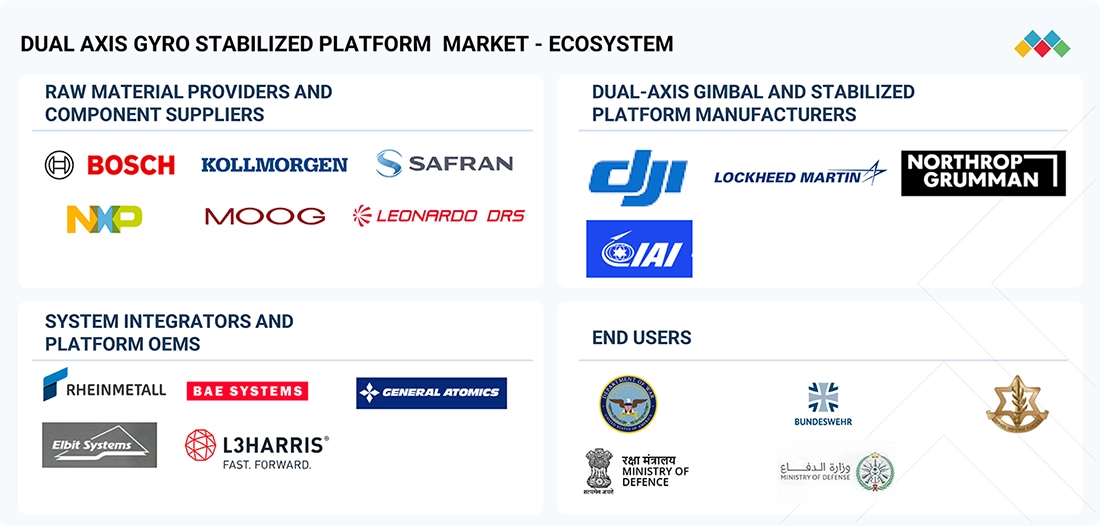
The dual-axis gyro stabilized platforms market has platform manufacturers, sensor providers, gyroscope developers and software companies. These players provide stabilized payloads and motion control systems for air, land and naval use. Defense forces, security teams, and commercial users generate demand. The ecosystem is slowly becoming more connected with AI-based stabilization, sensor fusion, and modular systems. Investments in defense upgrades and unmanned systems are increasing. This is bringing new developments across the value chain.
Logos and trademarks shown above are the property of their respective owners. Their use here is for informational and illustrative purposes only.
MARKET SEGMENTS
Source: Secondary Research, Interviews with Experts, MarketsandMarkets Analysis
Fiber-optic gyroscopes (FOG) dominate the market due to their high accuracy, reliability, and resistance to electromagnetic interference in demanding defense environments. These systems provide precise stabilization and navigation performance, making them ideal for airborne, naval, and ground platforms. Increasing adoption in mission-critical applications is further driving demand for FOG-based stabilization systems.
The motion control hardware segment leads the market as it forms the core of stabilization systems, enabling precise movement, tracking, and orientation control. The growing demand for high-performance targeting and imaging systems is increasing reliance on advanced actuators, motors, and control units. Continuous improvements in control precision and responsiveness are further supporting segmental growth.
EO/IR imaging payloads dominate due to their critical role in surveillance, reconnaissance, and targeting operations across defense and security applications. These payloads require stable and high-quality imaging, driving the adoption of dual-axis stabilization systems. Increasing deployment in unmanned and airborne platforms is further accelerating demand.
The airborne segment leads the market as aircraft and unmanned aerial systems require high-precision stabilization for surveillance, targeting, and imaging missions. The rising use of UAVs in defense and commercial applications is significantly increasing demand for stabilized platforms. These systems enable reliable performance in dynamic flight conditions, supporting mission effectiveness.
The intelligence, surveillance, and reconnaissance (ISR) segment dominates due to the growing demand for real-time situational awareness and threat detection. Stabilized platforms play a critical role in ensuring accurate tracking and imaging in dynamic operational environments. Increasing defense investments and security concerns are further driving adoption in ISR applications.
REGION
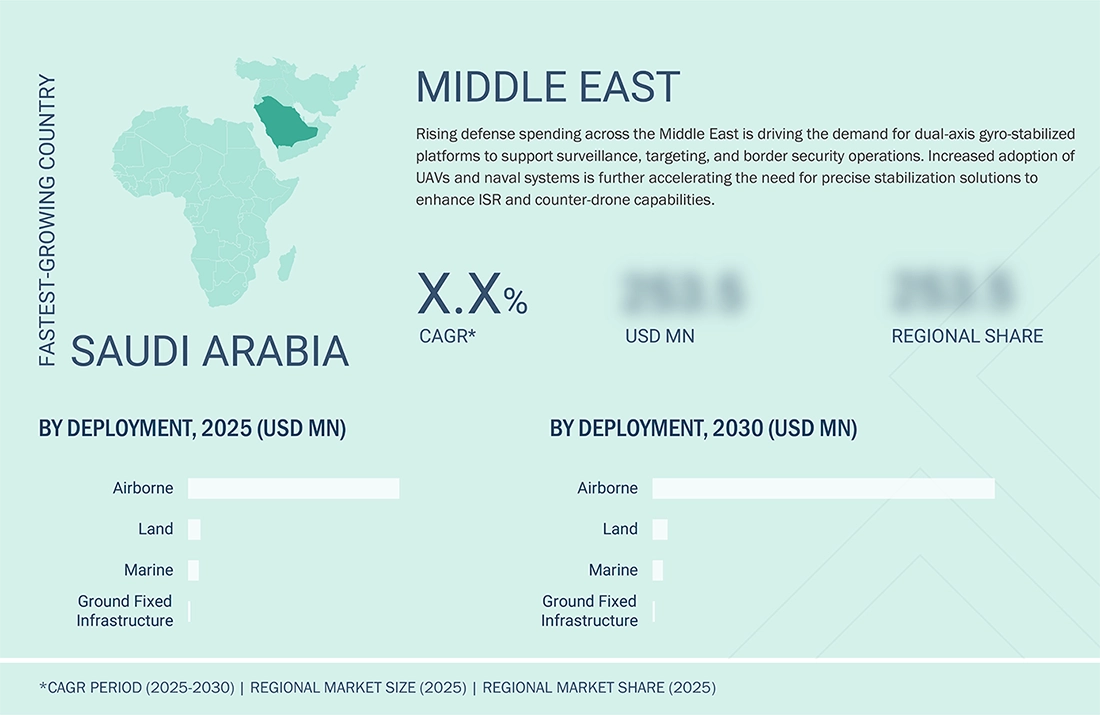
Middle East to be fastest-growing region in global dual-axis gyro-stabilized platforms market during forecast period
The Middle East region is witnessing a growing demand in the dual-axis gyro-stabilized platforms market. This is mainly due to the rising defense spending and stronger focus on border security and surveillance. Governments in the region are investing in advanced electro-optical systems. There is also an increasing use of unmanned platforms and maritime security solutions.Military modernization programs are also taking place across several countries in the region. Procurement of advanced defense technologies is increasing. This is pushing the adoption of stabilized platforms across the region.
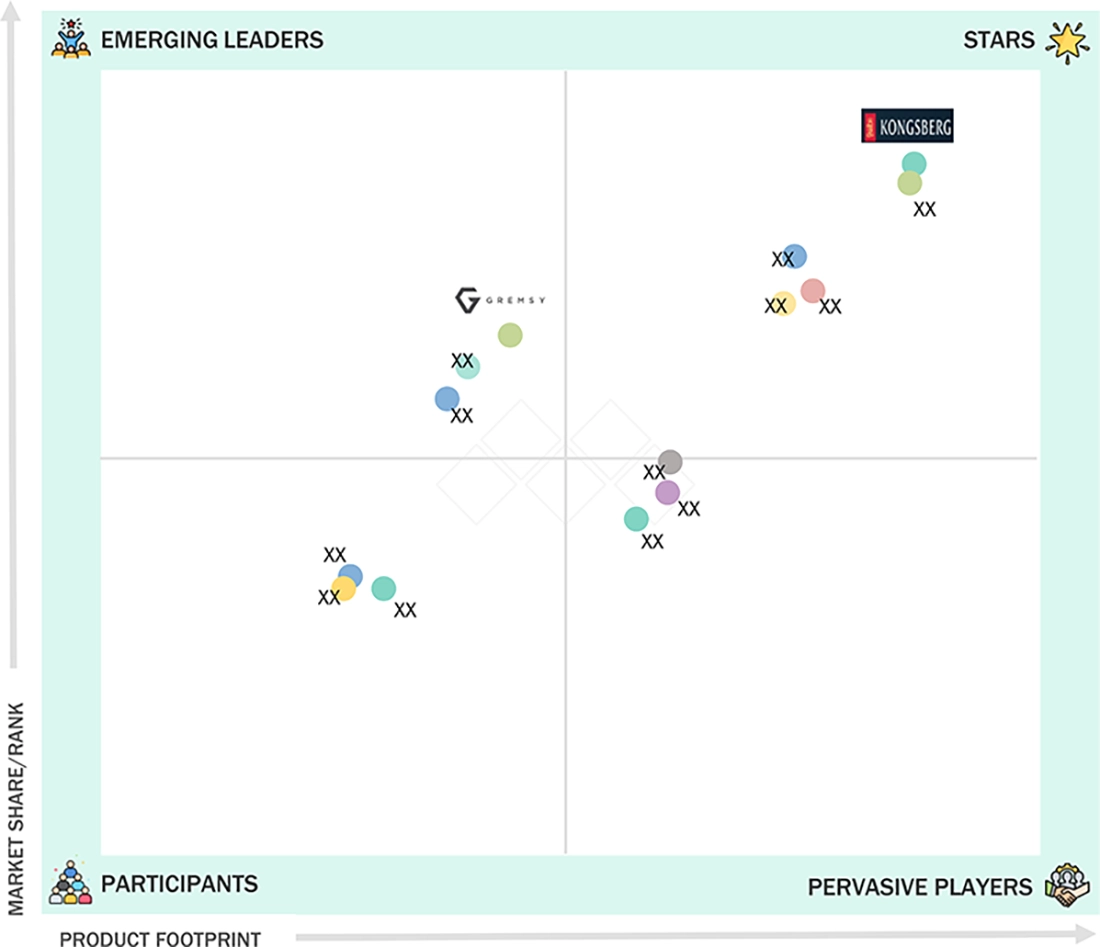
DUAL AXIS GYRO STABILIZED PLATFORMS MARKET: COMPANY EVALUATION MATRIX
KONGSBERG is a leading player in the dual-axis gyro-stabilized platforms market with strong capabilities in remote weapon systems and electro-optical surveillance used across land and naval platforms. Its role in defense modernization and focus on advanced sensor integration helps it maintain a strong market position.Gremsy is an emerging company offering lightweight and cost effective gyro-stabilized gimbal systems for UAVs and commercial drones, supporting growing use in surveillance, inspection, and imaging.
Source: Secondary Research, Interviews with Experts, MarketsandMarkets Analysis
KEY MARKET PLAYERS
List of Top Dual-Axis Gyro-Stabilized Platforms Market Companies
- KONGSBERG
- ASELSAN A.S.
- Israel Aerospace Industries
- L3Harris Technologies, Inc.
- KVH Industries, Inc.
- Lockheed Martin Corporation
- Elbit Systems Ltd.
- Safran S.A.
- Leonardo S.p.A.
- Rafael Advanced Defense Systems Ltd.
- Teledyne FLIR LLC
- HENSOLDT AG
- Moog Inc.
- GYRO-STABILIZED SYSTEMS
- CACI International Inc
- Kratos
- General Dynamics Corporation
- BAE Systems
- Hanwha Group
- Honeywell International Inc.
- Exail SAS
- TRILLIUM
- Controp
- NEXTVISION STABILIZED SYSTEMS LTD
- Gremsy
- AeroVironment, Inc.
MARKET SCOPE
| REPORT METRIC | DETAILS |
|---|---|
| Market Size in 2025 (Value) | USD 1.98 Billion |
| Market Forecast in 2030 (Value) | USD 2.99 Billion |
| Growth Rate | 8.6% |
| Years Considered | 2021-2030 |
| Base Year | 2024 |
| Forecast Period | 2025-2030 |
| Units Considered | Value (USD Million/Billion) |
| Report Coverage | Revenue forecast, company ranking, competitive landscape, growth factors, and trends |
| Segments Covered |
|
| Regions Covered | North America, Europe, Asia Pacific, Middle East, Rest of the World |
WHAT IS IN IT FOR YOU: DUAL AXIS GYRO STABILIZED PLATFORMS MARKET REPORT CONTENT GUIDE
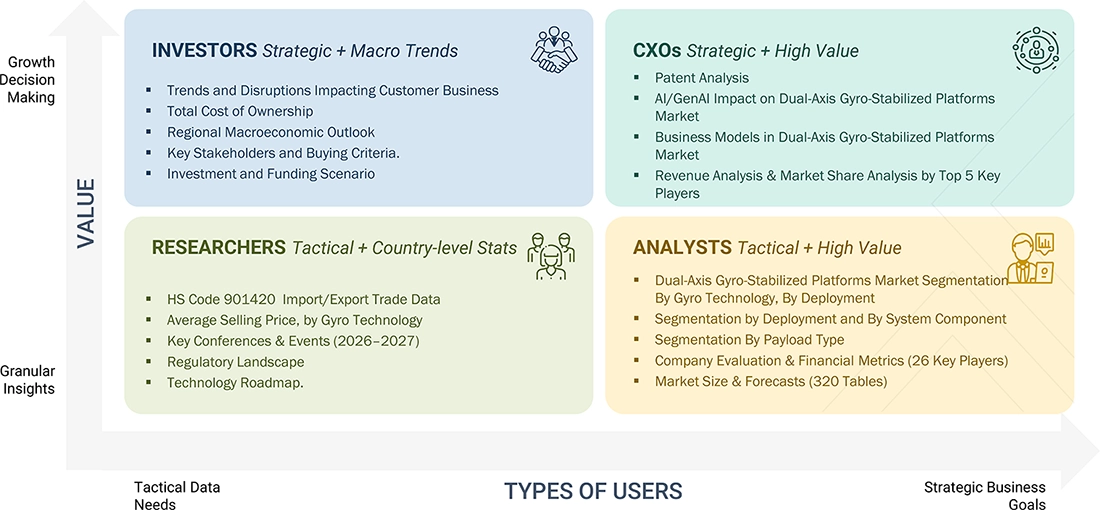
DELIVERED CUSTOMIZATIONS
We have successfully delivered the following deep-dive customizations:
| CLIENT REQUEST | CUSTOMIZATION DELIVERED | VALUE ADDS |
|---|---|---|
| Leading Manufacturer | Additional segment breakdown for countries | Additional country-level market sizing tables for segments/subsegments covered at the regional/global level to gain an understanding of market potential by each country |
| Emerging Leader | Additional company profiles | Competitive information on targeted players to gain granular insights into direct competition |
| Regional Market Leader | Additional country market estimates | Additional country-level deep dive for a more targeted understanding of the total addressable market |
RECENT DEVELOPMENTS
- September 2025 : Moog displayed the next-generation Flexible Mission Platform (FMP) at LandEuro 2025 in a standalone turret for air defense. The mission-agnostic system enables rapid integration of diverse payloads, including weapons, on combat vehicles to counter drone and loitering munition threats. Gyro-stabilization ensures precise operation across platforms. Its modular architecture enhances adaptability for urgent military needs.
- July 2025 : ASELSAN debuted advanced tactical solutions at IDEF 2025, including systems with gyro-stabilization for precision strike and air defense. Key offerings like GÖKTAN ground-based system feature stabilized smart munitions for 360-degree engagement in all weather. These platforms integrate multi-target capabilities and platform flexibility. The developments bolster electronic warfare and counter-UAV operations
- June 2025 : Lockheed Martin launched a new dual-axis gyro-stabilized platform specifically for ground vehicles. The system targets reconnaissance and surveillance missions, providing stable imaging and sensor performance in mobile operations. It incorporates advanced stabilization to maintain accuracy during vehicle motion. This product strengthens ground-based ISR capabilities in contested environments.
- December 2024 : Safran detailed developments on the PASEO XLR at Euronaval 2024, a high-performance 2-axis gyro-stabilized optronic system for naval and airborne applications. It offers very high line-of-sight point accuracy with reduced sensor head dimensions and weight, full azimuth coverage, and wide elevation range. The system integrates a 3rd-generation HD mid-wave infrared sensor for enhanced detection. This upgrade supports extended-range surveillance in maritime environments. ?
- September 2024 : HENSOLDT unveiled the ARGOS-15, a new-generation 15-inch airborne multispectral EO/IR gimbal for ISR and targeting. It features advanced modular design, AI-powered object detection, classification, and tracking with an integrated GPU for real-time processing. Four-axis gyro-stabilization with high-precision IMU achieves sub-5 μrad accuracy for superior image clarity up to 50,000 feet on manned/unmanned platforms. Production deliveries began mid-2025, positioning it as a benchmark for airborne surveillance.
Table of Contents
 Exclusive indicates content/data unique to MarketsandMarkets and not available with any competitors.
TITLE
PAGE NO
1
INTRODUCTION
15
2
EXECUTIVE SUMMARY
3
PREMIUM INSIGHTS
4
MARKET OVERVIEW
4.1
INTRODUCTION
4.2
MARKET DYNAMICS
4.2.1
DRIVERS
4.2.2
RESTRAINTS
4.2.3
OPPORTUNITIES
4.2.4
CHALLENGES
4.3
UNMET NEEDS AND WHITE SPACES
4.4
INTERCONNECTED MARKETS AND CROSS-SECTOR OPPORTUNITIES
4.5
STRATEGIC MOVES BY TIER 1/2/3 PLAYERS
5
INDUSTRY TRENDS
5.1
MACROECONOMIC OUTLOOK
5.1.1
INTRODUCTION
5.1.2
GDP TRENDS AND FORECAST
5.1.3
TRENDS IN GLOBAL MOTION CONTROL & STABILIZATION SYSTEMS INDUSTRY
5.1.4
TRENDS IN GLOBAL DUAL-AXIS GYRO-STABILIZED PLATFORMS INDUSTRY
5.2
VALUE CHAIN ANALYSIS
5.3
ECOSYSTEM ANALYSIS
5.4
INVESTMENT & FUNDING SCENARIO
5.5
PRICING ANALYSIS
5.5.1
AVERAGE PRICING ANALYSIS OF DUAL-AXIS GYRO-STABILIZED PLATFORMS, BY DEPLOYMENT, 2021-2025
5.5.2
AVERAGE PRICING ANALYSIS, BY REGION, 2021-2025
5.6
TRADE ANALYSIS
5.6.1
IMPORT SCENARIO
5.6.2
EXPORT SCENARIO
5.7
KEY CONFERENCES AND EVENTS, 2025-2026
5.8
TRENDS/DISRUPTIONS IMPACTING CUSTOMER BUSINESS
5.9
CASE STUDY ANALYSIS
5.10
IMPACT OF 2025 US TARIFFS ON DUAL AXIS GYRO-STABILIZED PLATFORMS MARKET
5.10.1
INTRODUCTION
5.10.2
KEY TARIFF RATES
5.10.3
PRICE IMPACT ANALYSIS
5.10.4
IMPACT ON COUNTRIES/REGIONS
5.10.4.1
US
5.10.4.2
EUROPE
5.10.4.3
ASIA PACIFIC
5.10.5
IMPACT ON DIFFERENT APPLICATIONS
6
TECHNOLOGICAL ADVANCEMENTS, AI-DRIVEN IMPACT, PATENTS, INNOVATIONS, AND FUTURE APPLICATIONS
6.1
KEY EMERGING TECHNOLOGIES
6.2
COMPLEMENTARY TECHNOLOGIES
6.3
ADJACENT TECHNOLOGIES
6.4
TECHNOLOGY/PRODUCT ROADMAP
6.5
PATENT ANALYSIS
6.6
FUTURE APPLICATIONS
6.7
IMPACT OF AI/GENERATIVE AI ON DUAL-AXIS GYRO-STABILIZED PLATFORMS MARKET
6.7.1
TOP USE CASES AND MARKET POTENTIAL
6.7.2
CASE STUDIES OF AI IMPLEMENTATION IN DUAL-AXIS GYRO-STABILIZED PLATFORMS MARKET
6.7.3
INTERCONNECTED ADJACENT ECOSYSTEM AND IMPACT ON MARKET PLAYERS
6.7.4
CLIENTS’ READINESS TO ADOPT GENERATIVE AI IN DUAL-AXIS GYRO-STABILIZED PLATFORMS MARKET
7
SUSTAINABILITY AND REGULATORY LANDSCAPE
7.1
REGIONAL REGULATIONS AND COMPLIANCE
7.1.1
REGULATORY BODIES, GOVERNMENT AGENCIES, AND OTHER ORGANIZATIONS
7.1.2
INDUSTRY STANDARDS
7.2
SUSTAINABILITY INITIATIVES
7.2.1
CARBON IMPACT AND ECO-APPLICATIONS OF DUAL-AXIS GYRO-STABILIZED PLATFORMS
7.3
SUSTAINABILITY IMPACT AND REGULATORY POLICY INITIATIVES
7.4
CERTIFICATIONS, LABELING, AND ECO-STANDARDS
8
CUSTOMER LANDSCAPE & BUYER BEHAVIOR
8.1
DECISION-MAKING PROCESS
8.2
BUYER STAKEHOLDERS AND BUYING EVALUATION CRITERIA
8.3
ADOPTION BARRIERS & INTERNAL CHALLENGES
8.4
UNMET NEEDS FROM VARIOUS END USERS
9
DUAL-AXIS GYRO-STABILIZED PLATFORMS MARKET, BY GYRO TECHNOLOGY (MARKET SIZE & FORECAST TO 2030 - USD MILLION)
9.1
INTRODUCTION
9.2
RING LASER GYROSCOPES (RLG)
9.3
FIBER-OPTIC GYROSCOPES (FOG)
9.4
MEMS GYROSCOPES
9.5
OTHERS (MECHANICAL & QUANTUM GYROS)
10
DUAL-AXIS GYRO-STABILIZED PLATFORMS MARKET, BY SYSTEM COMPONENT (MARKET SIZE & FORECAST TO 2030 - USD MILLION)
10.1
INTRODUCTION
10.2
STRUCTURAL ASSEMBLY
10.3
MOTION CONTROL HARDWARE
10.4
INERTIAL & POSITION SENSING
10.5
CONTROL ELECTRONICS
10.6
EMBEDDED SOFTWARE & STABILIZATION ALGORITHMS
10.7
POWER & INTERFACE MODULES
11
DUAL AXIS GYRO-STABILIZED PLATFORMS MARKET, BY PAYLOAD TYPE (MARKET SIZE & FORECAST TO 2030-USD MILLION)
11.1
INTRODUCTION
11.2
EO/IR IMAGING PAYLOAD
11.3
RADAR & ANTENNA STABILIZATION PAYLOAD
11.4
LASER-BASED PAYLOAD
11.5
ACOUSTIC PAYLOADS
11.6
WEAPON / EFFECTOR PAYLOAD
11.7
SCIENTIFIC & ENVIRONMENTAL SENSOR PAYLOAD
12
DUAL AXIS GYRO-STABILIZED PLATFORMS MARKET, BY DEPLOYMENT (MARKET SIZE & FORECAST TO 2030-USD MILLION)
12.1
INTRODUCTION
12.2
AIRBORNE
12.2.1
MANNED AIRCRAFT
12.2.1.1
FIXED WING
12.2.1.2
ROTARY WING
12.2.2
UNMANNED AERIAL VEHICLE (UAV)
12.3
LAND
12.3.1
ARMORED/TACTICAL VEHICLE
12.3.2
UNMANNED GROUND VEHICLE
12.4
MARINE
12.4.1
NAVAL SHIP
12.4.2
UNMANNED MARINE VEHICLE
12.4.3
SMALL BOAT
12.5
GROUND FIXED INFRASTRUCTURE
12.5.1
RAIL
12.5.2
BORDER TOWER
12.5.3
INDUSTRIAL PLATFORM
12.5.4
FIXED MAST
13
DUAL AXIS GYRO-STABILIZED PLATFORMS MARKET, BY APPLICATION (MARKET SIZE & FORECAST TO 2030-USD MILLION)
13.1
INTRODUCTION
13.2
COMMUNICATION STABILIZATION
13.3
NAVIGATION & GUIDANCE
13.4
AERIAL & CINEMATIC IMAGING
13.5
TARGETING & FIRE CONTROL
13.6
INTELLIGENCE, SURVEILLANCE, AND RECONNAISSANCE (ISR)
13.7
MONITORING & INSPECTION
13.8
MAPPING & SURVEYING
13.9
ATMOSPHERIC RESEARCH
14
DUAL AXIS GYRO-STABILIZED PLATFORMS MARKET, BY REGION (MARKET SIZE & FORECAST TO 2030-USD MILLION)
14.1
INTRODUCTION
14.2
NORTH AMERICA
14.2.1
US
14.2.2
CANADA
14.3
EUROPE
14.3.1
UK
14.3.2
GERMANY
14.3.3
FRANCE
14.3.4
ITALY
14.3.5
SPAIN
14.3.6
REST OF EUROPE
14.4
ASIA PACIFIC
14.4.1
CHINA
14.4.2
INDIA
14.4.3
JAPAN
14.4.4
AUSTRALIA
14.4.5
SOUTH KOREA
14.4.6
REST OF ASIA PACIFIC
14.5
MIDDLE EAST
14.5.1
GCC
14.5.1.1
UAE
14.5.1.2
SAUDI ARABIA
14.5.2
REST OF MIDDLE EAST
14.5.2.1
QATAR
14.5.2.2
TURKEY
14.6
REST OF THE WORLD
14.6.1
LATIN AMERICA
14.6.2
AFRICA
15
COMPETITIVE LANDSCAPE
15.1
INTRODUCTION
15.2
KEY PLAYER COMPETITIVE STRATEGIES/RIGHT TO WIN
15.3
REVENUE ANALYSIS
15.4
MARKET SHARE ANALYSIS
15.5
PRODUCT COMPARISON
15.6
COMPANY EVALUATION MATRIX: KEY PLAYERS,
15.6.1
STARS
15.6.2
EMERGING LEADERS
15.6.3
PERVASIVE PLAYERS
15.6.4
PARTICIPANTS
15.6.5
COMPANY FOOTPRINT, KEY PLAYERS,
15.6.5.1
COMPANY FOOTPRINT
15.6.5.2
REGION FOOTPRINT
15.6.5.3
GYRO TECHNOLOGY FOOTPRINT
15.6.5.4
SYSTEM COMPONENT FOOTPRINT
15.7
COMPANY EVALUATION MATRIX: STARTUPS/SMES,
15.7.1
PROGRESSIVE COMPANIES
15.7.2
RESPONSIVE COMPANIES
15.7.3
DYNAMIC COMPANIES
15.7.4
STARTING BLOCKS
15.7.5
COMPETITIVE BENCHMARKING: STARTUPS/SMES,
15.7.5.1
LIST OF KEY STARTUPS/SMES
15.7.5.2
COMPETITIVE BENCHMARKING OF KEY STARTUPS/SMES
15.8
COMPETITIVE SCENARIO
15.8.1
PRODUCT LAUNCHES
15.8.2
DEALS
15.8.3
OTHER DEVELOPMENTS
16
COMPANY PROFILES
16.1
KEY PLAYERS
16.1.1
LOCKHEED MARTIN CORPORATION
16.1.2
L3HARRIS TECHNOLOGIES, INC.
16.1.3
ELBIT SYSTEMS LTD.
16.1.4
SAFRAN ELECTRONICS & DEFENSE
16.1.5
LEONARDO S.P.A.
16.1.6
ASELSAN A.S.
16.1.7
RAFAEL ADVANCED DEFENSE SYSTEMS LTD.
16.1.8
ISRAEL AEROSPACE INDUSTRIES LTD.
16.1.9
KONGSBERG DEFENCE & AEROSPACE
16.1.10
TELEDYNE FLIR LLC
16.1.11
HENSOLDT AG
16.1.12
MOOG INC.
16.1.13
GYRO STABILIZED SYSTEMS
16.1.14
LITEYE SYSTEMS, INC.
16.1.15
CACI
16.1.16
KRATOS DEFENSE & SECURITY SOLUTIONS, INC.
16.1.17
GENERAL DYNAMICS CORPORATION
16.1.18
BAE SYSTEMS PLC
16.1.19
HANWHA SYSTEMS CO., LTD.
16.1.20
HONEYWELL INTERNATIONAL INC.
16.1.21
KVH INDUSTRIES, INC.
16.1.22
EXAIL SAS
16.1.23
TRILLIUM ENGINEERING
16.1.24
CONTROP PRECISION TECHNOLOGIES LTD.
16.1.25
NEXTVISION STABILIZED SYSTEMS LTD.
16.1.26
UAV VISION PTY LTD
16.1.27
GREMSY
16.1.28
AEROVIRONMENT, INC.
16.2
OTHER PLAYERS
16.2.1
EDGE AUTONOMY
16.2.2
TRAKKA
16.2.3
UAVOS INC.
16.2.4
FREEFLY SYSTEMS
16.2.5
UA VISION
16.2.6
BLITZ TECHNOLOGY INC.
17
RESEARCH METHODOLOGY
17.1
RESEARCH DATA
17.1.1
SECONDARY DATA
17.1.1.1
KEY DATA FROM SECONDARY SOURCES
17.1.2
PRIMARY DATA
17.1.2.1
KEY DATA FROM PRIMARY SOURCES
17.1.2.2
KEY PRIMARY PARTICIPANTS
17.1.2.3
BREAKDOWN OF PRIMARIES
17.1.2.4
KEY INDUSTRY INSIGHTS
17.2
MARKET SIZE ESTIMATION
17.2.1
BOTTOM-UP APPROACH
17.2.2
TOP-DOWN APPROACH
17.2.3
BASE NUMBER CALCULATION
17.3
MARKET FORECAST APPROACH
17.3.1
SUPPLY SIDE
17.3.2
DEMAND SIDE
17.4
RESEARCH ASSUMPTIONS
17.5
RESEARCH LIMITATIONS AND RISK ASSESSMENT
18
APPENDIX
18.1
DISCUSSION GUIDE
18.2
KNOWLEDGESTORE: MARKETSANDMARKETS’ SUBSCRIPTION PORTAL
18.3
CUSTOMIZATION OPTIONS
18.4
RELATED REPORTS
18.5
AUTHOR DETAILS
Methodology
The study followed four main steps to estimate the size of the dual-axis gyro-stabilized platforms market. Secondary research was conducted to gather data on stabilized platforms, electro-optical systems, gyro technologies, motion control hardware, and platform integration across airborne, land, and naval applications. These findings were confirmed through primary interviews with defense organizations, system integrators, platform manufacturers, and industry experts. The research team reviewed defense spending data, government budgets, procurement plans, and ongoing military modernization initiatives to evaluate market demand. Market estimates were then divided by gyro technology, system component, payload type, deployment, and application. Data triangulation was used to verify the final figures for each segment and sub-segment.
Secondary Research
Secondary research was conducted to establish the foundation for this study. Data was gathered from defense ministries, procurement agencies, and military modernization programs across regions. Company information was reviewed from annual reports, product documentation, press releases, and investor disclosures of dual-axis gyro-stabilized platform providers. The study also examined white papers, defense journals, and published research on electro-optical systems, gyro technologies, stabilization systems, and sensor integration. Additional insights were obtained from the aerospace & defense industry platforms and associations to analyze market trends and regional adoption.
Primary Research
Primary research was conducted after key insights from secondary analysis were identified. The study team engaged with executives, engineers, system integrators, and suppliers involved in the dual-axis gyro-stabilized platforms ecosystem. Discussions included manufacturers of electro-optical systems, defense platform providers, sensor developers, and industry experts across major regions. Interviews were conducted via calls and written correspondence to confirm market size estimates and user requirements. These inputs helped refine perspectives on competition, deployment strategies, and technological advancements. Feedback was also used to adjust assumptions and enhance data accuracy.
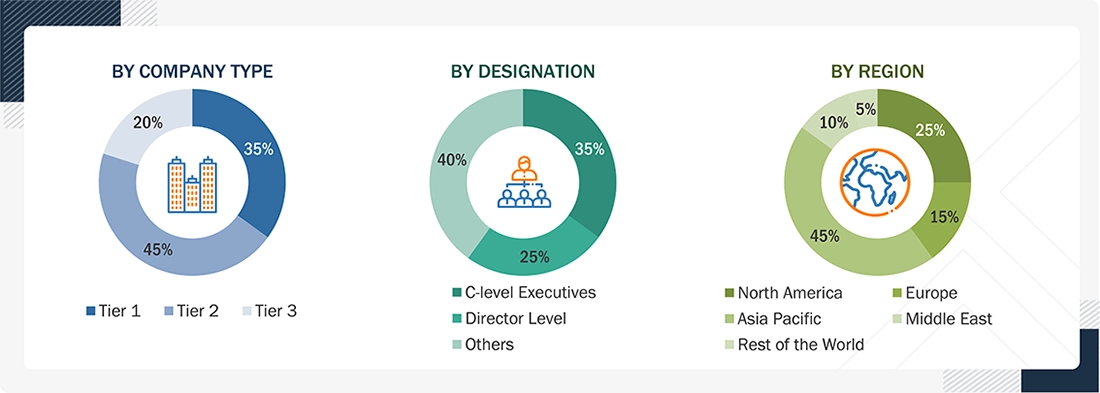
To know about the assumptions considered for the study, download the pdf brochure
Market Size Estimation
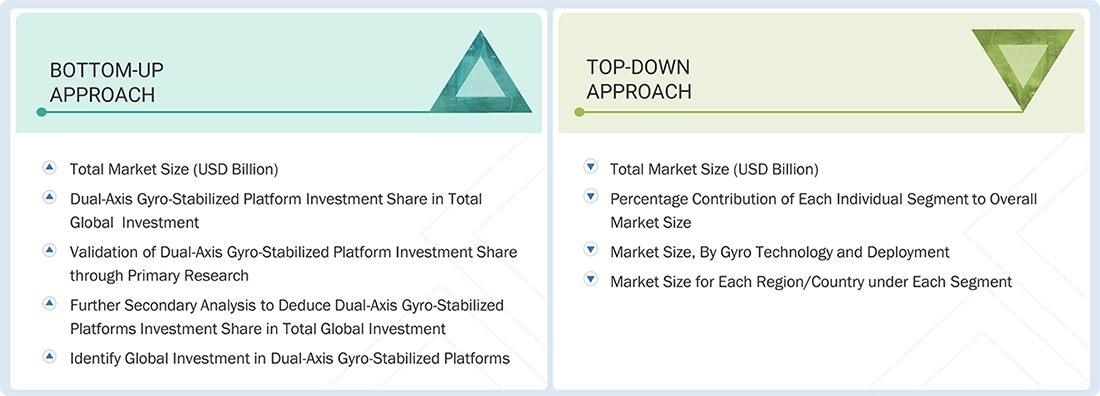
The top-down and bottom-up methods were used to estimate and validate the size of the dual-axis gyro-stabilized platforms market. The research process involved several steps to ensure accuracy.
- Key companies active in the dual-axis gyro-stabilized platforms market were identified through secondary research. Their market share was evaluated using a combination of primary inputs and published data. This included reviewing annual reports, financial disclosures, certification updates, and public filings from various organizations. Interviews were also conducted with industry participants such as company executives, program managers, operators, infrastructure providers, and aviation experts. These inputs were used to validate assumptions and refine market size estimates across regions.
- All percentage shares, segment splits, and market breakdowns were first developed using secondary information. These values were then verified through primary discussions with industry participants.
- The analysis assessed key factors influencing the dual-axis gyro-stabilized platforms market, including defense procurement frameworks, program timelines, technological advancements, platform integration capabilities, and investment trends. Each factor was evaluated through primary research and used to derive both quantitative and qualitative market estimates for this report.
Dual Axis Gyro Stabilized Platforms Market : Top-Down and Bottom-Up Approach
Data Triangulation
After determining the overall market size, the total market was divided into multiple segments and subsegments. The data triangulation and market breakdown procedures described below were carried out, where applicable, to complete the overall market analysis and determine the estimated market figures for the segments and subsegments. The data was triangulated by examining various factors and trends from both demand and supply sides. Additionally, the market size was validated using the top-down and bottom-up approaches.
Market Definition
The dual-axis gyro-stabilized platforms market encompasses all stabilized mounting systems, gimbal assemblies, control electronics, embedded software, and related services designed to maintain precise orientation and line-of-sight stability of payloads across two rotational axes (typically pitch and roll) despite platform motion or vibration. These systems are used to stabilize payloads such as electro-optical/infrared (EO/IR) sensors, radars, cameras, antennas, communication systems, and weapon systems mounted on moving platforms, including airborne, naval, land-based, and unmanned systems.
Key Stakeholders
- Defense ministries and armed forces responsible for surveillance, targeting, and platform stabilization requirements
- Homeland security and border protection agencies overseeing monitoring and reconnaissance operations
- Dual-axis gyro-stabilized platform manufacturers and original equipment manufacturers (OEMs)
- Electro-optical and infrared sensor system providers supporting surveillance and targeting capabilities
- Gyroscope and inertial navigation system providers (MEMS, fiber-optic, and ring laser gyroscopes)
- Motion control hardware providers (actuators, motors, controllers, and stabilization units)
- System integrators and defense platform manufacturers (land vehicles, naval vessels, airborne systems)
- Unmanned systems manufacturers (unmanned aerial systems, unmanned ground vehicles, and unmanned maritime platforms)
- Communication and data link solution providers supporting real-time data transmission
- Research organizations and government agencies involved in defense technology development and testing
- Maintenance, repair, and lifecycle service providers for stabilized platform systems
Report Objectives
- To define, describe, and forecast the size of the dual-axis gyro-stabilized platforms market, by gyro technology, system component, payload type, application, and deployment in terms of value
- To describe and forecast the market size of various segments across five key regions—North America, Europe, the Asia Pacific, the Middle East, and the Rest of the World, in terms of value
- To provide detailed information regarding drivers, restraints, opportunities, and challenges influencing the growth of the market
- To analyze the value chain and ecosystem, along with the average selling price of components
- To strategically analyze the regulatory landscape, standards, patents, import and export scenarios, trade data, the 2025 US tariffs, and case studies pertaining to the market under study
- To strategically analyze micromarkets1 with regard to individual growth trends, prospects, and contributions to the overall market
- To analyze opportunities in the market for stakeholders by identifying high-growth segments
- To provide details of the competitive landscape for market leaders
- To provide details of the macroeconomic outlook for regions
- To analyze strategies such asacquisitions, product launches, contracts, and partnerships adopted by players in the market
- To profile key players in the market and comprehensively analyze their market ranking based on their revenue, market share, and core competencies2
Available customizations:
MarketsandMarkets offers the following customizations for this market report:
- Additional country-level analysis of the dual-axis gyro-stabilized platforms market
- Profiling of other market players (up to 5)
Product Analysis
- Product matrix, which provides a detailed comparison of the product portfolio of each company in the dual-axis gyro-stabilized platforms market
⚡ Growth Signals
Personalize This Research
- Triangulate with your Own Data
- Get Data as per your Format and Definition
- Gain a Deeper Dive on a Specific Application, Geography, Customer or Competitor
- Any level of Personalization
Let Us Help You
- What are the Known and Unknown Adjacencies Impacting the Dual-Axis Gyro-Stabilized Platforms Market
- What will your New Revenue Sources be?
- Who will be your Top Customer; what will make them switch?
- Defend your Market Share or Win Competitors
- Get a Scorecard for Target Partners

Leading technology innovator in Aerospace and Defense
MarketsandMarkets has been crucial to our research findings and so far, they are the best source we've been able to locate. I'm sure nobody has the predictions nailed, but they seem to know it better than most.
Still Researching the Dual-Axis Gyro-Stabilized Platforms Ecosystem?
Before you go, explore the intelligence strategy teams use to analyze this market.
- Dual-Axis Gyro-Stabilized Platforms Competitor Landscape
- Dual-Axis Gyro-Stabilized Platforms Technology Shifts
- Dual-Axis Gyro-Stabilized Platforms supply consulting-grade strategic intelligence outputs tailored to your Dual-Axis Gyro-Stabilized Platforms growth question.
Generate 15+ consulting-grade strategic intelligence outputs tailored to your Dual-Axis Gyro-Stabilized Platforms growth question.
